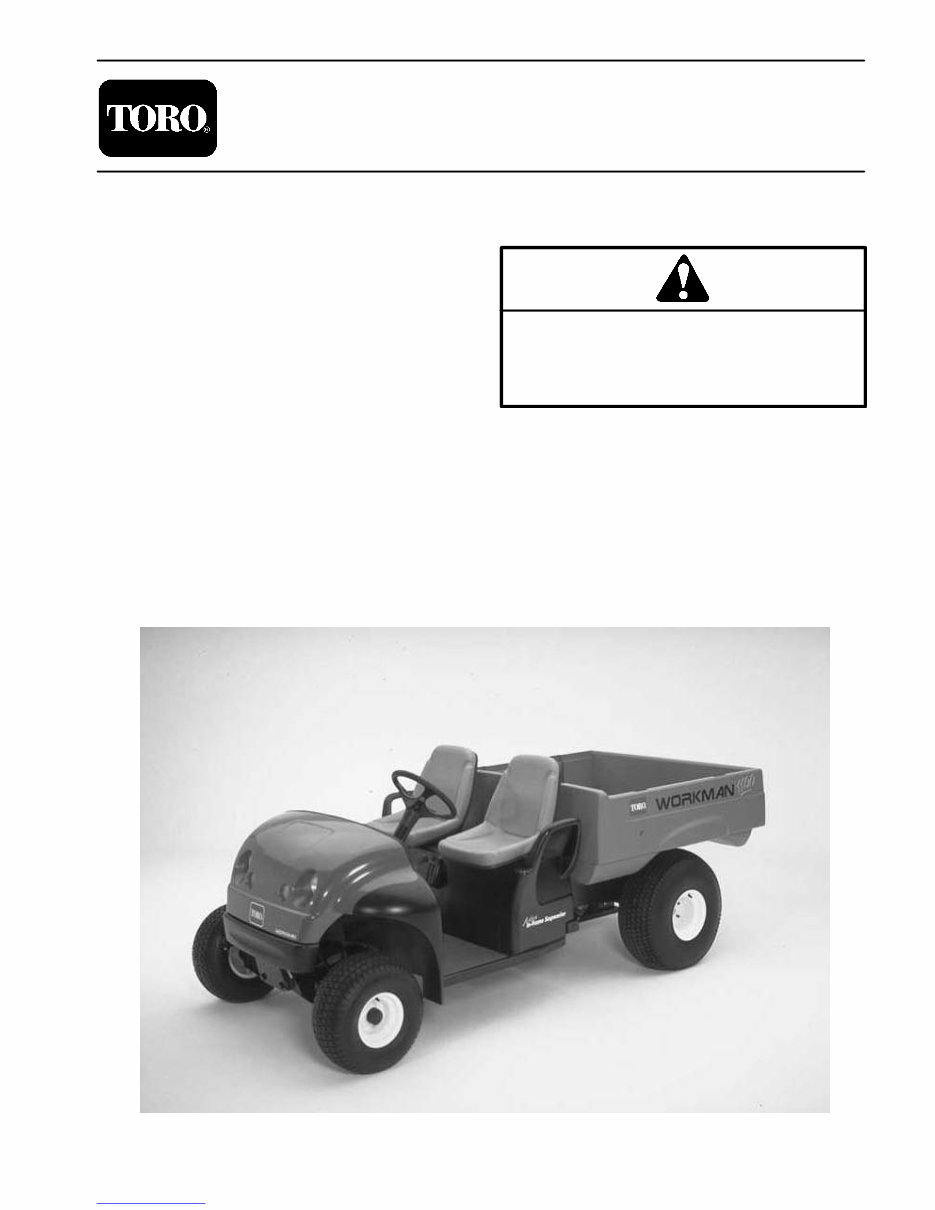
Part No. 02110SL (Rev. D) Service Manual Workman R 1100/1110/2100/2110 Preface The purpose of this publication is to provide the service technician with information for troubleshooting, testing, and repair of major systems and components on the Workman 1100, 1110, 2100, and 2110. REFER TO THE OPERATORS MANUAL FOR OPER- ATING, MAINTENANCE, AND ADJUSTMENT IN- STRUCTIONS. Space is provided in Chapter 2 of this book to insert the Operators Manuals and Parts Cata- logs for your machine. Replacement Operators Manu- als are available on the Internet at www.toro.com or by sending complete Model and Serial Number to: The Toro Company Attn. Technical Publications 8111 Lyndale Avenue South Bloomington, MN 554201196 The Toro Company reserves the right to change product specifications or this publication without notice. This safety symbol means DANGER, WARNING, or CAUTION, PERSONAL SAFETY INSTRUC- TION. When you see this symbol, carefully read the instructions that follow. Failure to obey the instructions may result in personal injury. Note: A Note will give general information about the correct operation, maintenance, service, testing, or re- pair of the machine. IMPORTANT: The IMPORTANT notice will give im- portant instructions which must be followed to pre- vent damage to systems or components on the machine. E The Toro Company 2002, 2004, 2005, 2006, 2007 Downloaded from www.Manualslib.com manuals search engine
Workman 1100/1110/2100/2110 This page is intentionally blank. Downloaded from www.Manualslib.com manuals search engine
Workman 1100/2100/2110 Page 1 – 2 Safety Safety Instructions The Workman 1100/2100/2110 was tested and certified by TORO for compliance with the B71.4–1984 specifica- tions of the American National Standards Institute. Al- though hazard control and accident prevention partially are dependent upon the design and configuration of the machine, these factors are also dependent upon the awareness, concern, and proper training of the person- nel involved in the operation, transport, maintenance, and storage of the machine. Improper use or mainte- nance of the machine can result in injury or death. Read and understand the contents of the Operator’s Manual before starting and operating the machine. Be- come familiar with all controls and know how to stop it quickly. A replacement manual is available on the Inter- net at www.toro.com or by sending complete Model and Serial Number to: The Toro Company Attn. Technical Publications 8111 Lyndale Avenue South Minneapolis, Minnesota 55420–1196 The safety alert symbol means CAUTION, WARNING or DANGER — “personal safety instruction”. Read and understand the instruction because it has to do with safety. Failure to comply with the instruc- tion may result in personal injury. WARNING To reduce the potential for injury or death, comply with the following safety instructions. Supervisors, operators, and service persons should be familiar with the following standards and publications (The material may be obtained from the addresses shown): • Flammable and Combustible Liquids Code: ANSI/NFPA 30 • National Fire Protection Association: ANSI/NFPA #505; Powered Industrial Trucks ADDRESS: National Fire Prevention Association Barrymarch Park Quincy, Massachusetts 02269 U.S.A. • ANSI/ASME B56.8; Personal Burden Carriers ADDRESS: American National Standards Institute, Inc. 1430 Broadway New York, New York 10018 U.S.A. • ANSI/UL 558; Internal Combustion Engine Powered Industrial Trucks ADDRESS: American National Standards Institute, Inc. 1430 Broadway New York, New York 10018 U.S.A. OR Underwriters Laboratories 333 Pfingsten Road Northbrook, Illinois 60062 U.S.A. WARNING The Workman is an off–highway vehicle only. It is not designed, equipped, or manufactured for use on public streets, roads or highways. Supervisor’s Responsibilities 1. Make sure operators are thoroughly trained and fa- miliar with the Operator’s Manual and all labels on the vehicle. 2. Be sure to establish your own special procedures and work rules for unusual operating conditions (e.g. slopes too steep for vehicle operation). Before Operating 1. Operate machine only after reading and understand- ing the contents of this manual. 2. Never allow children to operate the vehicle. Never allow adults to operate it without proper instructions. Only trained and authorized persons should operate this vehicle. Make sure all operators are physically and men- tally capable of operating the vehicle. Anyone who oper- ates the vehicle should have a motor vehicle license. Downloaded from www.Manualslib.com manuals search engine
Workman 1100/2100/2110 Page 1 – 3 Safety 3. This vehicle is designed to carry the operator and one passenger in the seat provided by the manufactur- er. Never carry more than one passenger on the vehicle. 4. Never operate vehicle when under the influence of drugs or alcohol. 5. Become familiar with the controls and know how to stop the engine quickly. 6. Keep all shields, safety devices, and decals in place. Repair or replace any shield, safety device, or decal if it is malfunctioning, illegible, or damaged before operat- ing the machine. 7. Always wear substantial shoes. Do not operate ma- chine while wearing sandals, tennis shoes or sneakers. Do not wear loose fitting clothing or jewelry which could get caught in moving parts and cause personal injury. 8. Wearing safety glasses, safety shoes, long pants and a helmet is advisable, and may be required by some local safety and insurance regulations. 9. Keep everyone, especially children and pets, away from the areas of operation. 10.Before operating the vehicle, always check vehicle and any attachments for damage. If something is wrong, stop using the vehicle. Make sure problem is cor- rected before the vehicle or attachment is operated again. 11. Since gasoline is highly flammable, handle it careful- ly. A. Use an approved gasoline container. B. Do not remove cap from the fuel tank when the engine is hot or running. C. Do not smoke while handling gasoline. D. Fill fuel tank outdoors to about one inch below the top of tank (bottom of filler neck). Do not overfill. E. Wipe up any spilled gasoline. While Operating WARNING POTENTIAL HAZARD • Engine exhaust contains carbon monoxide, which is odorless, colorless, poisonous, and deadly. WHAT CAN HAPPEN • Carbon monoxide can cause death. It is known by the State of California to cause birth defects. HOW TO AVOID THE HAZARD • Do not run engine indoors or in an en– closed area. 1. Operator and passenger should remain seated whenever the vehicle is in motion. Operator should keep both hands on the steering wheel. Whenever possible, the passenger should use the hand holds provided. Keep arms and legs within the vehicle body at all times. Never carry passengers in the box or on any attach- ments. Remember your passenger may not be expect- ing you to brake or turn. 2. Never overload your vehicle. The name plate (lo- cated under the dash and on the center column) shows load limits for the vehicle. The load rating is for level sur- faces only. Never overload attachments or exceed the vehicle maximum gross vehicle weight (GVW). 3. Operating the vehicle demands attention. Failure to operate the vehicle safely may result in an accident, tip over of vehicle, and/or serious injury or death. Drive carefully. To prevent tipping or loss of control: A. Use extreme caution, reduce speed, and main- tain a safe distance around sand traps, ditches, creeks, ramps, unfamiliar areas, or any areas that have abrupt changes in ground conditions or eleva- tion. WARNING Operating the vehicle on a hill may cause tipping or rolling of the vehicle, or the engine may stall and you could lose headway on a hill. This could result in personal injury. • Do not exceed slopes greater than 12 degrees. • If the engine stalls or you lose headway on a hill, never attempt to turn the vehicle around. • Never drive across a steep hill; always drive straight up or down or go around the hill. • Avoid turning on a hill. • Do not accelerate quickly or slam on the brakes. • Reduce your load and the speed of the vehicle. • Avoid stopping on hills, especially with a load. B. Use caution when operating vehicle on a slope. Normally travel straight up and down slopes. Reduce speed when making sharp turns or when turning on hillsides. Avoid turning on hillsides whenever pos- sible. If the engine stalls or you begin to lose head- way while climbing a hill, gradually apply the brakes and slowly back straight down the hill. Safety Downloaded from www.Manualslib.com manuals search engine
Workman 1100/2100/2110 Page 1 – 4 Safety C. Watch for holes or other hidden hazards. D. Use extra caution when operating the vehicle on wet surfaces, at higher speeds, or with a full load. Stopping distance will increase with a full load. Slow down before starting up or down a hill. E. When loading the box, distribute load evenly. Use extra caution if the load exceeds the dimensions of the box. Operate vehicle with extra caution when handling loads that cannot be centered. Keep loads balanced and secure to prevent them from shifting. F. Avoid sudden stops and starts. Do not go from re- verse to forward, or forward to reverse, without first coming to a complete stop. G. Do not attempt sharp turns, abrupt maneuvers, or other unsafe driving actions that may cause a loss of vehicle control. WARNING The weight of the box may be heavy and could crush hands or other body parts. • Keep hands and other body parts clear when lowering the box. • Do not dump materials on bystanders. H. When dumping, do not let anyone stand behind the vehicle. Do not dump the load on anyone’s feet. Release tailgate latches from the side of the box, not from behind the box. I. Only operate/drive vehicle when the cargo box is down and latched. J. Before backing up, look to the rear of the vehicle. Make sure no one is behind it. Back up slowly. K. Watch out for traffic when near or crossing roads. Always yield the right of way to pedestrians and other vehicles. This vehicle is not designed for use on streets or highways. Always signal your turns or stop early enough so other persons know what you plan to do. Obey all traffic rules and regulations. L. Never operate vehicle in or near an area where there is dust or fumes in the air which are explosive. The electrical and exhaust systems of the vehicle can produce sparks capable of igniting explosive materials. M. Always watch out for and avoid low overhangs such as tree limbs, door jambs, over head walkways, etc. Make sure there is enough room over head to easily clear the vehicle and your head. N. If ever unsure about safe operation, stop vehicle and ask your supervisor. WARNING Sudden changes in terrain may cause abrupt steering wheel movement, possibly resulting in hand and arm injuries. • Reduce your speed and the load when operating on rough terrain and near curbs. • Grip the steering wheel loosely around the perimeter. Keep your hands clear of the steering wheel spokes. O. When operating the vehicle over rough terrain or near curbs, reduce your speed and grip the outside of the steering wheel. Keep your hands and fingers away from the steering wheel spokes. 4. Do not touch engine or muffler while the engine is running or soon after it has stopped. These components may be hot enough to cause burns. 5. If the machine ever vibrates abnormally, stop imme- diately. Wait for all motion to stop. Inspect vehicle for damage. Repair all damage before commencing opera- tion. 6. Before getting off the seat: A. Stop movement of the machine. B. Set parking brake. C. Turn ignition key to OFF. D. Remove key from ignition switch. CAUTION If vehicle is parked on an incline, chock wheels after getting off of the vehicle. Downloaded from www.Manualslib.com manuals search engine
Workman 1100/2100/2110 Page 1 – 5 Safety Maintenance and Service 1. Only qualified and authorized personnel should maintain, repair, adjust, or inspect the vehicle. 2. Before servicing or making adjustments to the ma- chine, stop engine, set parking brake, and remove key from the ignition switch to prevent someone from acci- dentally starting the engine. 3. Make sure entire machine is in good condition. Keep all nuts, bolts, and screws properly tightened. 4. Reduce potential fire hazards. Keep engine area free of excessive grease, grass, leaves, and accumula- tion of dirt. 5. Never use an open flame to check level or leakage of fuel or battery electrolyte. 6. If the engine must be running to perform a mainte- nance adjustment, keep hands, feet, clothing, and any parts of the body away from the engine and any moving parts. Keep everyone away. 7. Do not use open pans of fuel or flammable cleaning fluids for cleaning parts. 8. Do not adjust ground speed governor. To assure safety and accuracy, have an Authorized Toro Distribu- tor check the ground speed. 9. If major repairs are needed or assistance is required, contact an Authorized Toro Distributor. 10.Make sure of optimum performance and safety. Al- ways use genuine Toro replacement parts and accesso- ries. Replacement parts and accessories made by other manufacturers could cause damage and be dangerous. Altering this vehicle in any manner may affect its opera- tion, performance, and/or durability. Alterations may re- sult in injury or death. Such use could void the product warranty of The Toro Company. Sound Pressure Level This unit has an equivalent continuous A–weighted sound pressure at the operator’s ear of 80 dB(A), which is based on measurements of identical machines per SAE J1174-MAR 85 procedures. Vibration Level This unit does not exceed a vibration level of 2.5 m/s 2 at the hands, which is based on measurements of identical machines per ISO 5349 procedures. This unit does not exceed a vibration level of 0.5 m/s 2 at the posterior, which is based on measurements of iden- tical machines per ISO 2631 procedures. Safety Downloaded from www.Manualslib.com manuals search engine
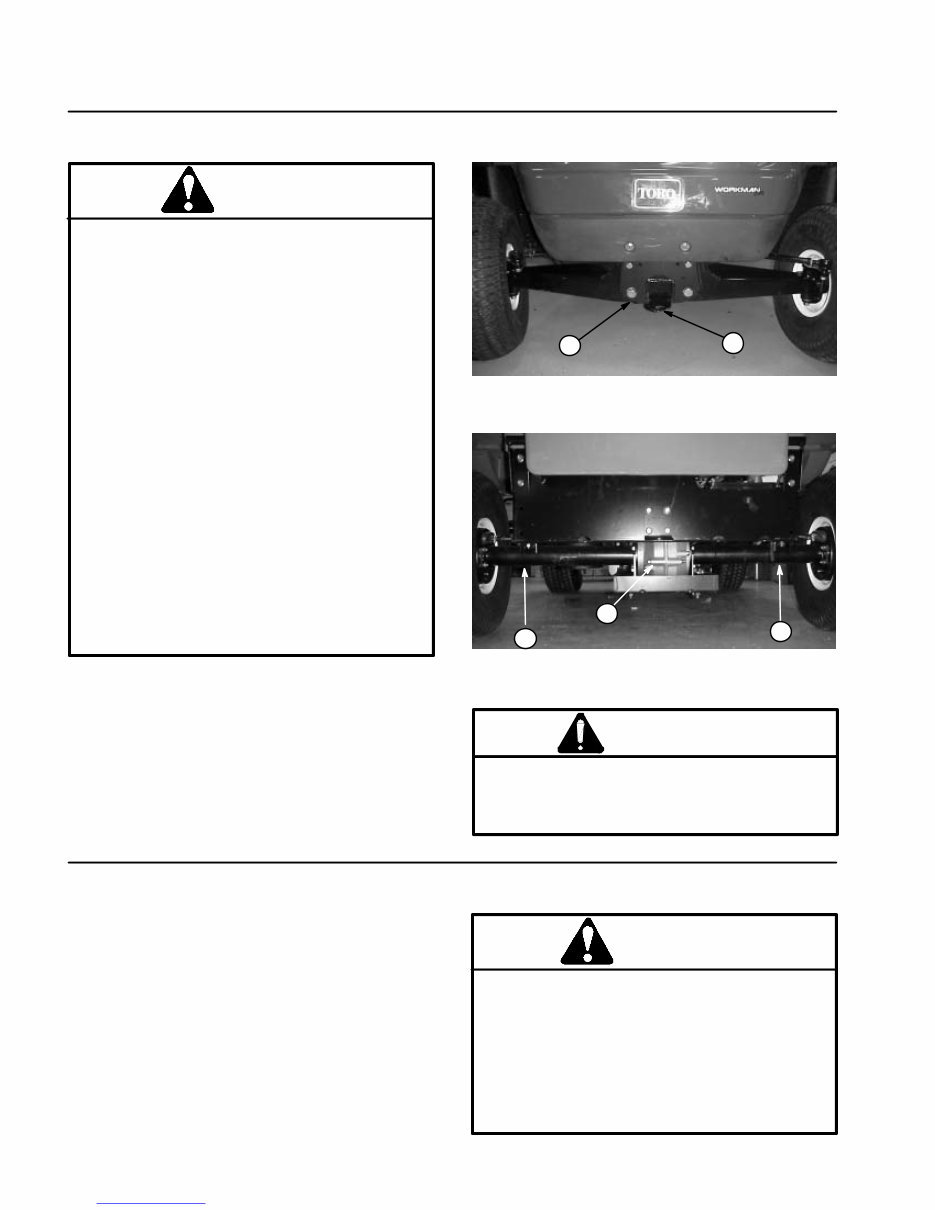
Workman 1100/2100/2110 Page 1 – 6 Safety Jacking and Other Instructions Jack Vehicle DANGER POTENTIAL HAZARD • A vehicle that is not properly supported may become unstable. WHAT CAN HAPPEN • The vehicle may move or fall. Personal injury or damage to the machine may result. HOW TO AVOID THE HAZARD • Make sure vehicle is parked on a solid level surface, such as a concrete floor. • Make sure engine is off and key is removed from the ignition switch before getting off the vehicle. • Before raising the vehicle, remove any attachments that may interfere with the safe and proper raising of the vehicle. • Always chock or block wheels to prevent the vehicle from rolling. • Do not start vehicle while it is on jack stands or blocks without transaxle locked in neutral. • Make sure proper hoists, solid wooden blocks, and jack stands are used to raise and support the vehicle. Locations 1. Jack front of the vehicle on the front of the frame and behind the towing tongue (Fig. 1). 2. Jack rear of the vehicle under each rear axle tube. Do not jack vehicle below the transaxle case (Fig. 2). 1. Front frame 2. Towing tongue Figure 1 1 2 1. Axle tube 2. Transaxle case Figure 2 2 1 1 WARNING Whenever the engine is run for testing that re- quires the rear wheels to spin, rear wheels should be at least 1 inch (25 mm) off the ground with the axle supported on jack stands. Transport Vehicle When moving the vehicle long distances, use a trailer or flatbed truck. Make sure vehicle is secured to the trailer properly. 1. Secure front of the vehicle to trailer at the towing tongue (Fig. 1). 2. Secure rear of the vehicle to the trailer at each rear axle tube (Fig. 2). WARNING POTENTIAL HAZARD • Seats may become loose and fall off the vehicle and trailer when transporting. WHAT CAN HAPPEN • Seats falling off the trailer may hit another vehicle or become a road hazard. HOW TO AVOID THE HAZARD • Remove or secure seats with cord or strap. Downloaded from www.Manualslib.com manuals search engine
You're Reading a Preview
What's Included?
Lifetime Access
Fast Download Speeds
Online & Offline Access
Access PDF Contents & Bookmarks
Full Search Facility
Print one or all pages of your manual
$31.99
Toro Workman 1100 1110 2100 2110 Series Service Repair Workshop Manual
The Toro Workman 1100 1110 2100 2110 Series Service Repair Manual is a comprehensive resource designed to provide all the necessary information for repairing and maintaining your vehicle. Whether you are a professional mechanic or a DIY enthusiast, this manual offers easy-to-read text sections, high-quality diagrams, and clear instructions to assist you in the repair process.
Models Covered:
Toro Workman 1100
Toro Workman 1110
Toro Workman 2100
Toro Workman 2110
Service Repair Manual Covers:
Safety
Product Records and Maintenance
Briggs and Stratton Gasoline Engine
Kohler Gasoline Engine
Drive Train
Electrical System
Chassis, Wheels, and Brakes
Electrical Diagrams
The manual is available in PDF format, compatible with all versions of Windows and Mac. It is written in English and requires Adobe Reader for access. This comprehensive manual is an essential tool for anyone looking to effectively and efficiently repair and maintain their Toro Workman 1100 1110 2100 2110 Series vehicle. With the ability to print any page, it provides a cost-effective and informative solution for your repair needs.
Reviews
Q&A
Recently Viewed
5,521,897Happy Clients
2,594,462eManuals
1,120,453Trusted Sellers
15Years in Business
Price:
Actual Price:
Toro Workman 1100 1110 2100 2110 Series Service Repair Workshop Manual









 Lifetime Access




