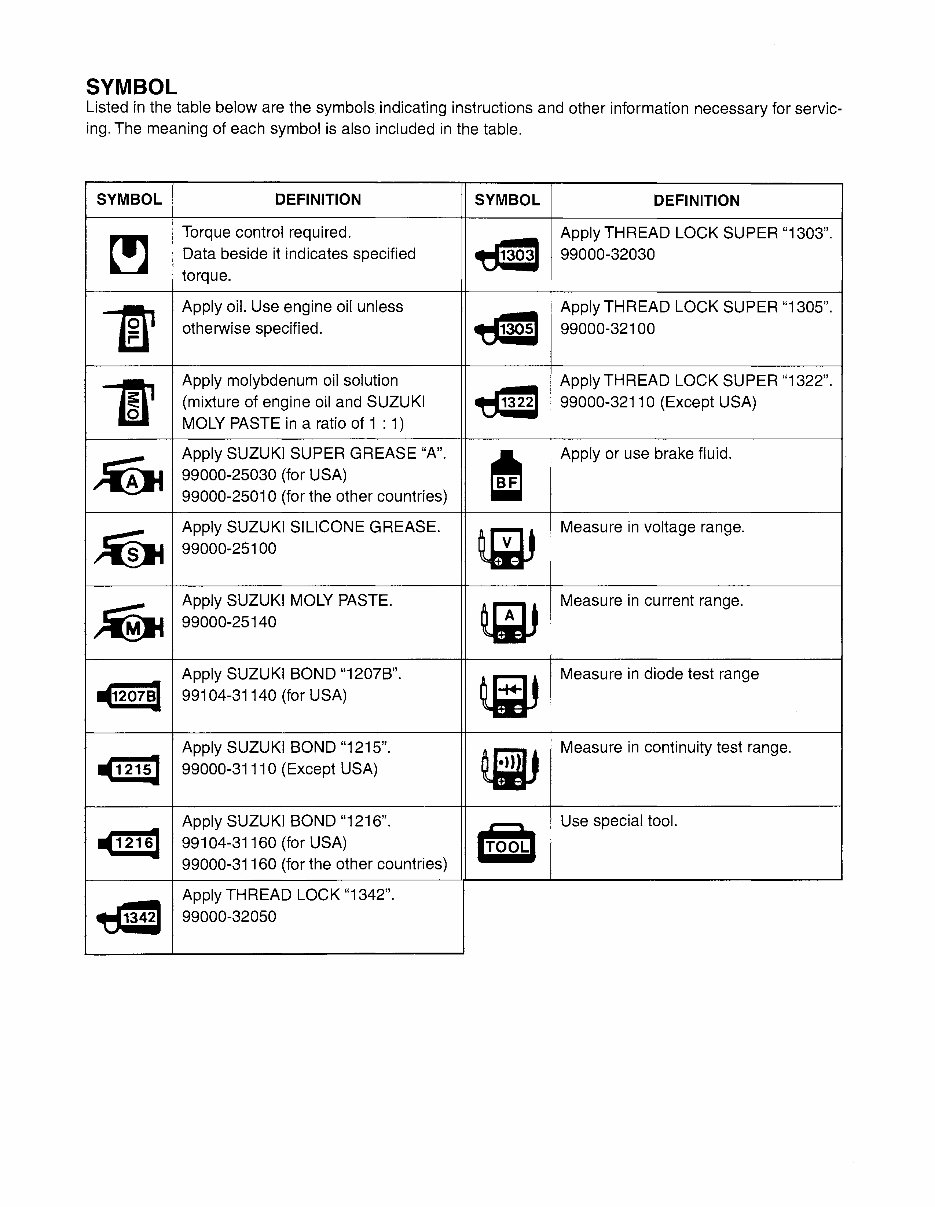
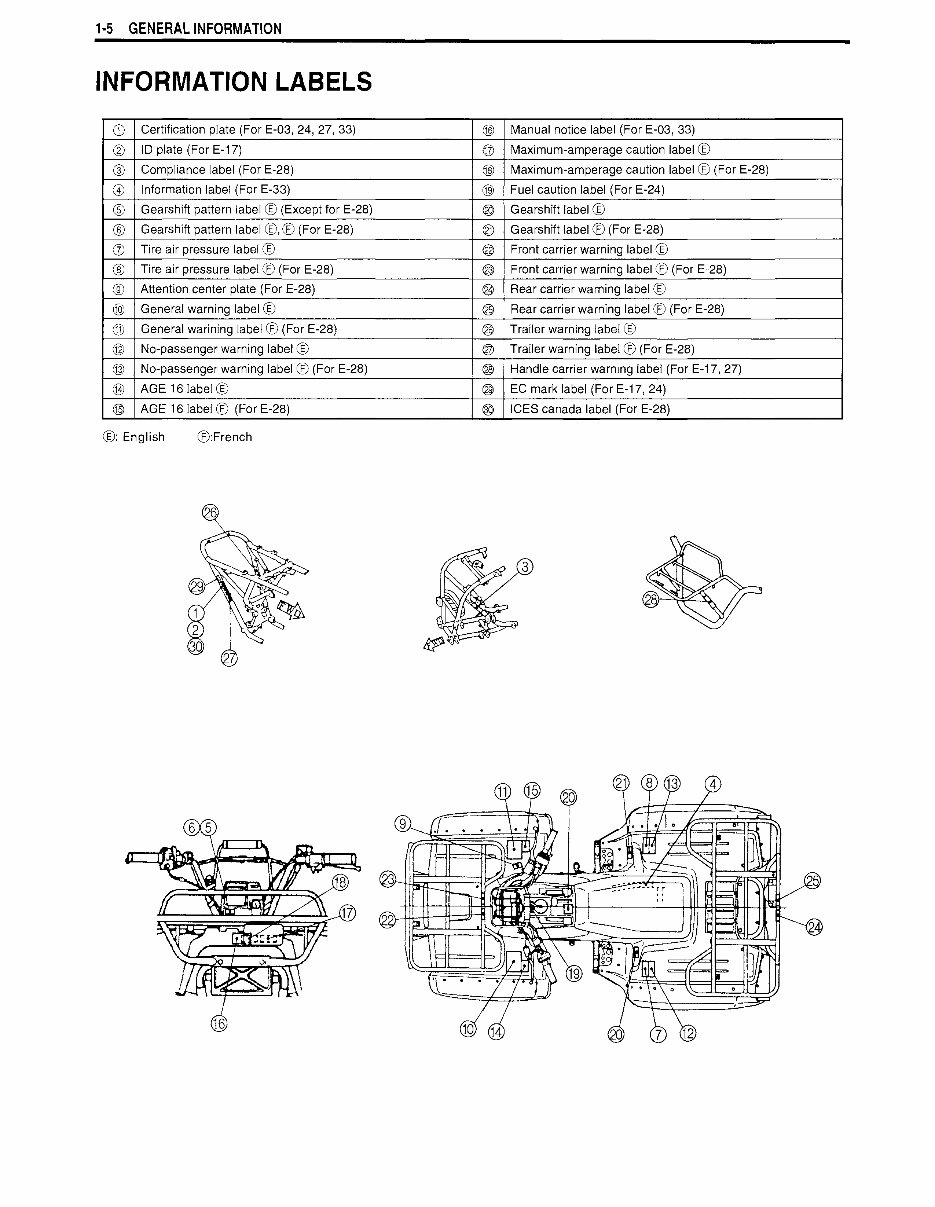
SYMBOL Listed in the table below are the symbols indicating instructions and other information necessary for servic- ing. The meaning of each symbol is also included in the table. SYMBOL DEFINITION SYMBOL DEFINITION ~ Torque control required. • Apply THREAD LOCK SUPER "1303". Data beside it indicates specified 99000-32030 torque. 1T Apply oil. Use engine oil unless • Apply THREAD LOCK SUPER "1305". otherwise specified. 99000-321 00 m· Apply molybdenum oil solution • Apply THREAD LOCK SUPER "1322". (mixture of engine oil and SUZUKI 99000-32110 (Except USA) MOLY PASTE in a ratio of 1 : 1) ~ Apply SUZUKI SUPER GREASE "A". ~ Apply or use brake fluid. 99000-25030 (for USA) 99000-25010 (for the other countries) ~ Apply SUZUKI SILICONE GREASE. ~ Measure in voltage range. 99000-251 00 ~ Apply SUZUKI MOLY PASTE. ~ Measure in current range. 99000-25140 -41207BJ Apply SUZUKI BOND "1207B". ~ Measure in diode test range 99104-31140 (for USA) ~ Apply SUZUKI BOND "1215". ijjJ Measure in continuity test range. 99000-31110 (Except USA) -41216] Apply SUZUKI BOND "1216". i4ooli Use special tool. 99104-31160 (for USA) 99000-31160 (for the other countries) m! Apply THREAD LOCK "1342". 99000-32050
GENERAL INFORMATION CONTENTS WARNING/CAUTION/NOTE .....................•.......................................... GENERAL PRECAUTIONS ................................................................. SUZUKI LT-F300XILT-F300FX ('99-MODEL) ...................................... SERIAL NUMBER LOCATION ••.....•...................•................................ FUEL AND OIL RECOMMENDATION ..................•.............................. FUEL ............................................................................................... . ENGINE OIL ..................•..•..............•............................................... DIFFERENTIAL GEAR OIL .................•........................................... BRAKE FLUID ............•.•...........................•...................................... BREAK-IN PROCEDURES ..........................•...................................... INFORMATION LABELS ................•..••.......•.....................•................... SPECIFICATIONS ..............................................•.•............................... COUNTRY AND AREA CODES .......................................................... 1- 1 1- 1 1- 3 1- 3 1- 3 1- 3 1- 4 1- 4 1- 4 1- 4 1- 5 1- 6 1- 8
1·1 GENERAL INFORMATION WARNING/CAUTION/NOTE Please read this manual and follow its instructions carefully. To emphasize special information, the symbol and the words WARNING, CAUTION and NOTE have special meanings. Pay special attention to themes- sages highlighted by these signal words. A WARNING Indicates a potential hazard that could result in death or injury. I A CAUTION I Indicates a potential hazard that could result in vehicle damage. NOTE: Indicates special information to make maintenance easier or instructions clearer. Please note, however, that the warnings and cautions contained in this manual cannot possibly cover all potential hazards relating to the servicing, or lack of servicing, of the vehicle. In addition to the WARNINGS and CAUTIONS stated, you must use good judgement and basic mechanical safety principles. If you are unsure about how to perform a particular service operation, ask a more experienced mechanic for advice. GENERAL PRECAUTIONS A WARNING * Proper service and repair procedures are important for the safety of the service mechanic and the safety and reliability of the vehicle. * When two or more persons work together, pay attention to the safety of each other. * When it is necessary to run the engine indoors, make sure that exhaust gas is forced out- doors. * When working with toxic or flammable materials, make sure that the area you work in is well ventilated and that you follow all of the manufacturer's instructions. * Never use gasoline as a cleaning solvent. * To avoid getting burned, do not touch the engine, engine oil, and exhaust system until they have cooled. * After servicing the fuel, oil, exhaust or brake systems, check all of the lines and fittings related to the system for leaks.
GENERAL INFORMATION 1·2 I A CAUTION I * If parts replacement is necessary, replace the parts with Suzuki Genuine Parts or their equivalent. * When removing parts that are to be reused, keep them arranged in an orderly manner so that they may be reinstalled in the proper order. * Be sure to use special tools when instructed. * Make sure that all parts used in reassembly are clean. Lubricate them when specified. * Use the specified lubricant, bond, or sealant. * When removing the battery, disconnect the negative cable first and then the positive cable. * When reconnecting the battery, connect the positive cable first and then the negative cable, and cover the positive terminal with the terminal cover. * When performing service to electrical parts, disconnect the battery negative cable unless the service procedure requires the battery power. * When tightening cylinder head and crankcase bolts and nuts, tighten the larger sizes first. Always tighten the bolts and nuts from the inside working out, diagonally and to the speci- fied tightening torque. * Whenever you remove oil seals, gaskets, packing, 0-rings, self-locking nuts, locking wash- ers, cotter pins, circlips, and certain other parts as specified, be sure to replace them with new ones. Also, before installing these new parts, be sure to remove any left over material from the mating surfaces. * Never reuse a circlip. When installing a new circlip, take care not to expand the end gap larger than required to slip the circlip over the shaft. After installing a circlip, always ensure that it is completely seated in its groove and securely fitted. * Use a torque wrench to tighten fasteners to the specified torque. Wipe off grease and oil if a thread is smeared with them. * After reassembling, check parts for tightness and proper operation. * To protect the environment, do not unlawfully dispose of used motor oil and all other fluids, batteries and tires. * To protect the earth's natural resources, properly dispose of used vehicles and parts.
1·3 GENERAL INFORMATION SUZU Kl L T-F300X/LT-F300FX ('99-MODEL) RIGHT SIDE LEFT SIDE * Difference between photographs and the actual vehicles depends on the markets. SERIAL NUMBER LOCATION The frame serial number or V.I.N. (Vehicle Identification Number) CD is stamped on the left side of the frame. The engine serial number ® is located on the right side of the crankcase. These numbers are required especially for registering the machine and ordering spare parts. FUEL AND OIL RECOMMENDATION FUEL (For USA) 1. Use only unleaded gasoline of at least 87 pump octane ( R ~ M ) method or 91 octane or higher rated by the research method. 2. Suzuki recommends that customers use alcohol free, unleaded gasoline whenever possible. 3. Use of blended gasoline containing MTBE (Methyl Tertiary Butyl Ether) is permitted. 4. Use of blended gasoline/alcohol fuel is permitted, provided that the fuel contains not more than 10% ethanol. Gasoline/alcohol fuel may contain up to 5% methanol if appropriate cosolvents and corrosion inhibitors are present in it. 5. If the performance of the vehicle is unsatisfactory while using blended gasoline/alcohol fuel, you should switch to alcohol-free unleaded gasoline. 6. Failure to follow these guideline could possibly void applicable warranty coverage. Check with your fuel sup- plier to make sure that the fuel you intend to use meets the requirements listed above.
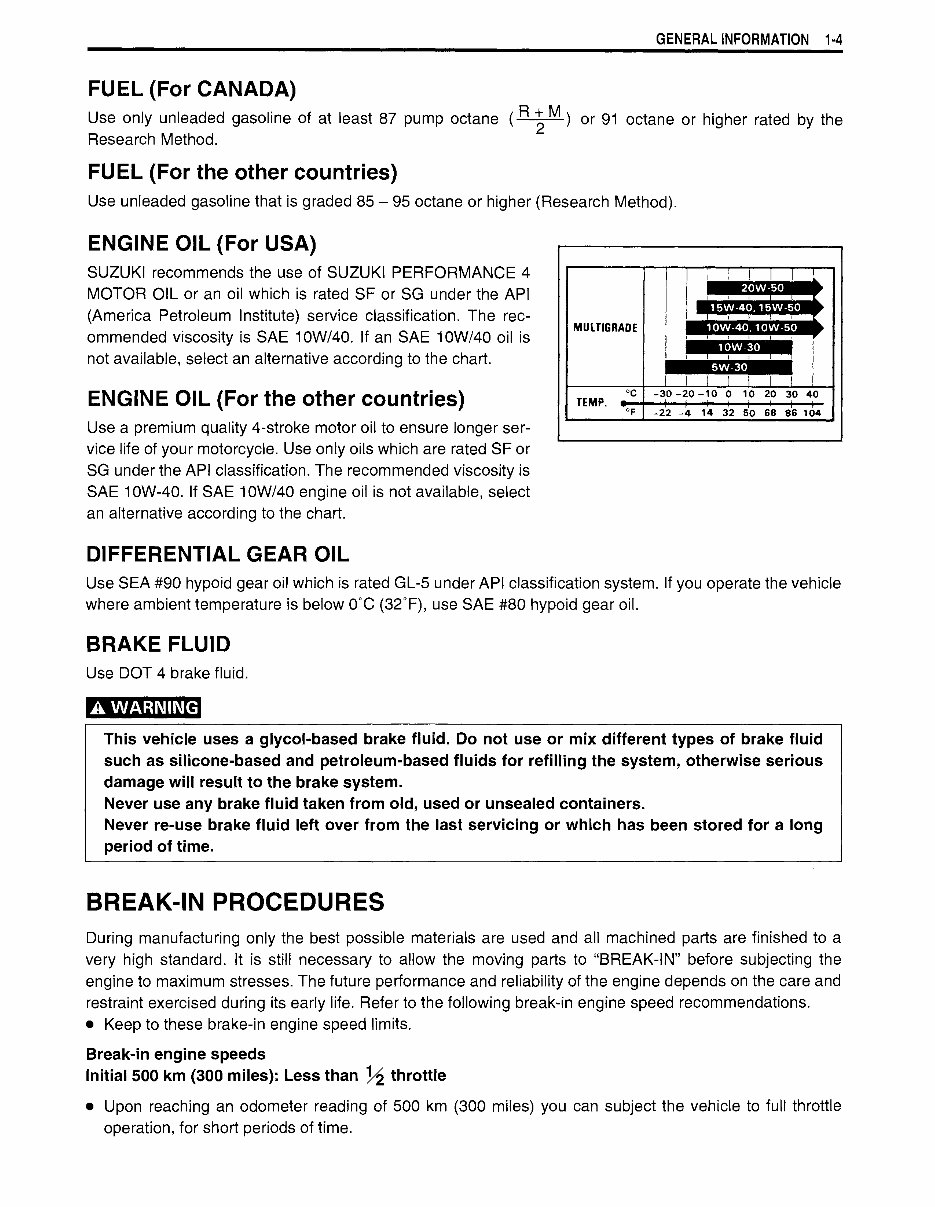
GENERAL INFORMATION 1·4 FUEL (For CANADA) Use only unleaded gasoline of at least 87 pump octane ( R ~ M ) or 91 octane or higher rated by the Research Method. FUEL (For the other countries) Use unleaded gasoline that is graded 85- 95 octane or higher (Research Method). ENGINE OIL (For USA) SUZUKI recommends the use of SUZUKI PERFORMANCE 4 MOTOR OIL or an oil which is rated SF or SG under the API (America Petroleum Institute) service classification. The rec- ommended viscosity is SAE 1 OW/40. If an SAE 1 OW/40 oil is not available, select an alternative according to the chart. ENGINE OIL (For the other countries) Use a premium quality 4-stroke motor oil to ensure longer ser- vice life of your motorcycle. Use only oils which are rated SF or SG under the API classification. The recommended viscosity is SAE 1 OW-40. If SAE 1 OW/40 engine oil is not available, select an alternative according to the chart. DIFFERENTIAL GEAR OIL MULTIGRADE 'C TEMP. 'F I I I I I L • ·- I I I .. • I I -ltl•••Jr!!l • • ' ' I I • • I I I • I I I I I I -30 -20 -10 0 10 20 30 40 -22 -4 14 32 50 68 86 104 Use SEA #90 hypoid gear oil which is rated GL-5 under API classification system. If you operate the vehicle where ambient temperature is below O'C (32'F), use SAE #80 hypoid gear oil. BRAKE FLUID Use DOT 4 brake fluid. A WARNING This vehicle uses a glycol-based brake fluid. Do not use or mix different types of brake fluid such as silicone-based and petroleum-based fluids for refilling the system, otherwise serious damage will result to the brake system. Never use any brake fluid taken from old, used or unsealed containers. Never re-use brake fluid left over from the last servicing or which has been stored for a long period of time. BREAK-IN PROCEDURES During manufacturing only the best possible materials are used and all machined parts are finished to a very high standard. It is still necessary to allow the moving parts to "BREAK-IN" before subjecting the engine to maximum stresses. The future performance and reliability of the engine depends on the care and restraint exercised during its early life. Refer to the following break-in engine speed recommendations. • Keep to these brake-in engine speed limits. Break-in engine speeds Initial 500 km (300 miles): Less than J-2 throttle • Upon reaching an odometer reading of 500 km (300 miles) you can subject the vehicle to full throttle operation, for short periods of time.
The Suzuki King Quad 300 1999 2000 2001 2002 Workshop Repair Service Manual is a comprehensive guide covering the repair and overhaul of Suzuki King Quad 300 vehicles. It is designed for both professional mechanics and DIY enthusiasts, assuming familiarity with general automobile practices.
This manual includes detailed instructions on tune-ups, maintenance, removal and installation procedures, assemblies and disassemblies, fuel system, ignition, lubrication system, exhaust, electrical system, body, and more. It also covers extensive repairs involving engine and transmission disassembly, providing the most reliable information to help maintain and repair the vehicle.
It contains specifications and procedures available in an authorized Suzuki dealer service department, offering diagnostic and repair procedures for routine maintenance and servicing. By owning and referring to this manual, the Suzuki King Quad 300 owner can be better informed and perform repairs like a professional automotive technician.
For those looking to save time and money, the manual enables quicker do-it-yourself maintenance and repairs, avoiding the expense of a dealer. Safety equipment and precautions are emphasized, along with the use of recommended special tools and torque wrench for proper adjustments and repairs.
The manual is delivered electronically via email in English language and is printable. It is available in .OVA file format for software manuals and contains essential information for maintaining and repairing Suzuki King Quad 300 vehicles.
General Information
Maintenance
Lubrication
Heating
Ventilation
Air Conditioning
Suspension
Front Suspension
Rear Suspension
Wheel
Tire System
Differential
Driveline
Drive Shaft
Transfer Case
Brakes
Engine
Engine Mechanical
Engine Cooling
Engine Fuel
Engine Electrical
Ignition System
Starting
Charging System
Emissions
Engine Exhaust
Engine Lubrication
Engine Speed Control System
Clutch
Cooling
Electronic Control Modules
Engine Systems
Heated Systems
Horn
Ignition Control
Instrument Cluster
Lamps
Power Systems
Restraints
Speed Control
Transmission
Exhaust System
Body Structure
Seats
Security and Locks
Air Bag System
Exterior Trim
Interior Trim
Frame
Bumpers
Fuel System
Steering
Transmission and Transfer Case
Tires
Wheels
Body
Heating
Air Conditioning
Emissions Control
Engine Removal
Engine Installation
Final Drive
Electrical System
Air cleaner element renewal
Air cleaner temperature control check
Auxiliary drivebelt check
Battery electrolyte level check
Battery terminal check
Brake hydraulic fluid renewal
Brake hydraulic system seal and hose renewal
Brake pipe and hose check
Choke adjustment check
Contact breaker point renewal and distributor lubrication
Crankcase ventilation system check
Emission control filter element renewal
Engine coolant renewal
Engine idle speed check
Engine oil and filter renewal
Engine valve clearance check - OHV engines
Exhaust system check
Fluid leak check
Fluid level checks
Front and rear brake pad/shoe check
Front wheel alignment check
Gearbox oil level check
Handbrake check
Hinge and lock check and lubrication
HT lead, distributor cap
ignition circuit check
Ignition timing
contact breaker gap (dwell angle) check
Intensive maintenance
Mixture adjustment check
Road test
Roadwheel security check
Seat belt check
Spark plug check
Spark plug renewal
Steering and suspension security check
Throttle damper operation check
Timing belt renewal
Tyre checks
Underbody inspection
Wiper blade check
Recently Viewed
5,521,897Happy Clients
2,594,462eManuals
1,120,453Trusted Sellers
15Years in Business
Price:
Actual Price:
1999-2002 Suzuki King Quad 300 Service & Repair Manual



 Lifetime Access