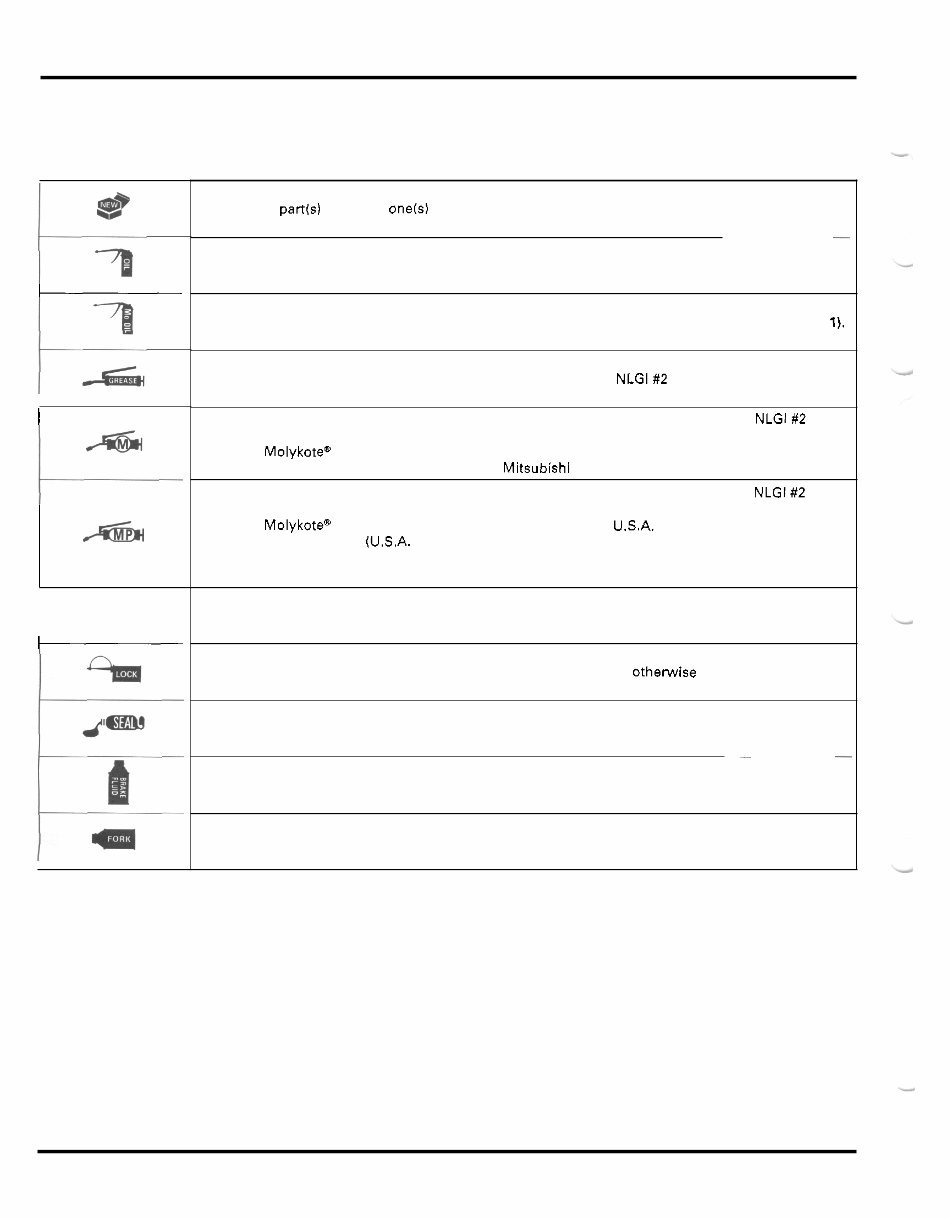
SYMBOLS The symbols used throughout this manual show specific service procedures. If supplementary information is required per- taining to these symbols. it would be explained specifically in the text without the use of the symbols. I I I - - Replace the part(s) with new one(s1 before assembly. Use recommended engine oil, unless otherwise specified. Use molybdenum oil solution (mixture of the engine oil and molybdenum grease in a ratio of 1 : 1). Use multi-purpose grease (Lithium based multi-purpose grease NLGl#2 or equivalent) Use molybdenum disulfide grease (containing more than 3% molybdenum disulfide, NLGl#2 or equivalent). Example: Molykote" BR-2 plus manufactured by Dow Corning, U.S.A. Use molybdenum disulfide paste (containing more than 40% molybdenum disulfide, NLGl#2 or equivalent). Example: Molykotea G-n paste, manufactured by Dow Corning, USA. Multi-purpose M-2 manufactured by Mitsubishi Oil, Japan Honda Moly 60 (U.S.A. only) Rocol ASP manufactured by Rocol Limited, U.K. Rocol Paste manufactured by Sumico Lubricant, Japan Use silicone grease. Apply a locking agent. Use a middle strength locking agent unless othelwise specified. Apply sealant. ~ Use DOT 4 brake fluid. Use the recommended brake fluid unless otherwise specified. Use Fork or Suspension Fluid.
1. GENERAL INFORMATION GENERAL SAFETY 1-1 LUBRICATION & SEAL POINTS 1-16 SERVICE RULES 1-2 CABLE & HARNESS ROUTING 1-18 MODEL IDENTIFICATION 1-3 EMISSION CONTROL SYSTEMS 1-23 SPECIFICATIONS 1-4 EMISSION CONTROL INFORMATION TORQUE VALUES 1-11 TOOLS 1-14 LABEL 1-24 I GENERAL SAFETY CARBON MONOXIDE If the engine must be running to do some work, make sure the area is well ventilated. Never run the engine in an enclosed area. - USED ENGINE OIL The exhaust contains poisonous carbon monoxide gas that may cause loss of consciousness and may lead t o death. Run the engine in an open area or with an exhaust evac- uation system in an enclosed area. GASOLINE Work in a well ventilated area. Keep cigarettes, flames or sparks away from the work area or where gasoline is stored. Gasoline is extremely flammable and is explosive under certain conditions. KEEP OUT OF REACH OF CHILDREN. HOT COMPONENTS Engine and exhaust system park become very hot and remain hot for some time after the engine is run. Wear insulated gloves or wait until the engine and exhaust system have cooled before handling these parts. Used engine oil may cause skin cancer if repeatedly left in contact with the skin for prolonged periods. Although this is unlikely unless you handle used oil on a daily basis, it is still advisable to thoroughly wash your hands with soap and water as soon as possible after handling used oil. KEEP OUT OF REACH OF CHILDREN. BRAKE DUST Never use an air hose or dry brush to clean brake assemblies. Use an OSHA-approved vacuum cleaner or alternate method approved by OSHA, designed to mini- mize the hazard caused by air borne asbestos fibers. Inhaled asbestos fibers have been found t o cause respi- ratorv disease and cancer. BRAKE FLUID CAUTION: Spilling fluid on painted, plastic or rubber parts will damage them. Place a clean shop towel over these parts whenever the system is serviced. KEEP OUT OF REACH OF CHILDREN. 1 - 1
GENERAL INFORMATION BAlTERY HYDROGEN GAS 81 ELECTROLYTE The battery gives of explosive gases; keep sparks, flames and cigarettes away. Provide adequate venti - lation when charging or using the battery in an enclosed space. The battery contains sulfuric acid (electrolytel. Contact with skin or eyes may cause severe burns. Wearprotective clothing and a face shield. - If electrolyte gets on your skin, flush with water. - If electrolyte gets in your eyes, flush with water for at least 15 minutes and call a physician, imme- diately. Electrolyte is poisonous. -If swallowed, drink large quantities of wafer or milk and follow with milk of magnesia or vegetable oil and call a physician. KEEP OUT OF REACH OF CHILDREN. SERVICE RULES 1. Use genuine HONDA or HONDA-recommended parts and lubricants or their equivalents. Parts that don't meet HONDAs 2. Use the special tools designed for this product to avoid damage and incorrect assembly. 3. Use only metric tools when servicing the motorcycle. Metric bolts, nuts and screws are not interchangeable with English 4. Install new gaskets, O-rings, cotter pins, and lock plates when reassembling. 5. When tightening bolts or nuts, begin with the larger diameter or inner bolt first. Then tighten to the specified torque diago- 6. Clean parts in cleaning solvent upon disassembly. Lubricate any sliding surfaces before reassembly. 7. After reassembly, check all parts for proper installation and operation. 8. Route all electrical wires as show on pages 1-18 through 1-22, Cable &Harness routing. design specifications may cause damage to the motorcycle. fasteners. nally in incremental steps unless a particular sequence is specified. - 1 - 2
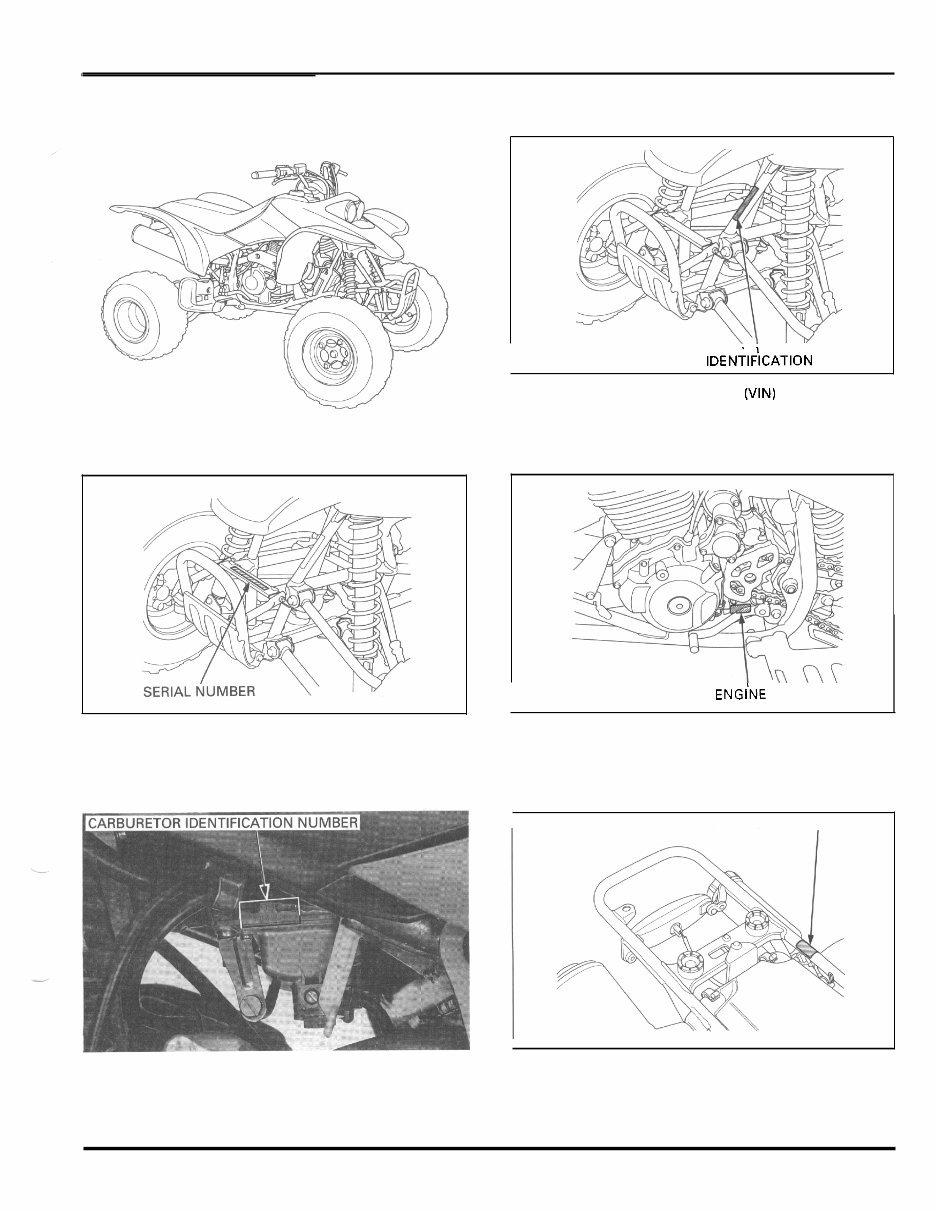
GENERAL INFORMATION MODEL IDENTIFICATION I VEHICLE IDENTIF'ICATION NUMBER left side frame down tube. FRAME I I The frame serial number is stamped on the front side of the frame. The Vehicle Identification Number (VIN) is located on the The engine serial number is stamped on the lower left of ENGiNE SERIALNUMBER I the crankcase. I COLOR LABEL The carburetor identification number is stamped on the left side of the carburetor body. The color label is attached on the frame crossmember under the seat. When ordering color - coded parts, always specify the designated color code. 1-3
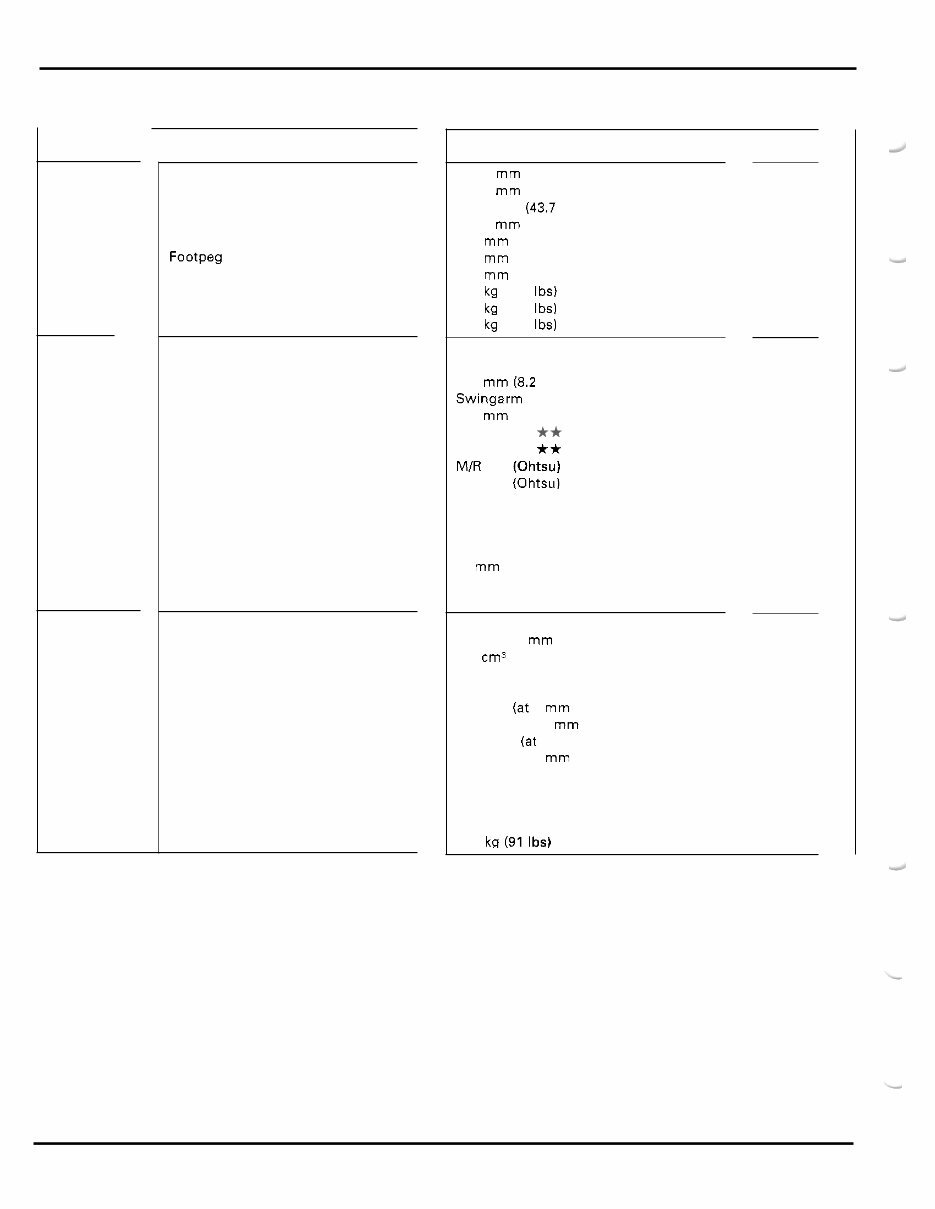
GENERAL INFORMATION SPECIFICATIONS - GENERAL DIMENSIONS FRAME ENGINE ITEM Overall length Overall width Overall height Wheelbase Seat height Footpeg height Ground clearance Dry weight Curb weight Maximum weight capacity Frame type Front suspension Front wheel travel Rear suspension Rear axle travel Front tire size Rear tire size Front tire brand Rear tire brand Front brake Rear brake Caster angle Camber angle Trail length Fuel tank capacity Fuel tank reserve capacity Cylinder arrangement Bore and stroke Displacement Compression ratio Valve train Intake valve opens closes Exhaust valve opens closes Lubrication system Oil pump type Cooling system Air filtration Engine dry weight SPECIFICATIONS 1,835 mm (72.2 in) 1,150 mm (45.3 in) 1,110 rnm (43.7 in) 1,230 mm (48.4 in) 810 mm (31.9 in) 353 mm (13.9 in) 110 mm (4.3 in) 170 kg (375 Ibs) 178 kg (392 Ibs) 110 kg (243 Ibs) Double cradle Double wish-bone 209 mm (8.2 in) Swingarm 230 mm (9.1 in) AT22 x 7-10 ** AT20 x 10-9 ** M/R 101 (Ohtsu) M/R 501 (Ohtsu) Hydraulic disc x 2 Hydraulic disc 6.5" -0.8" 28 mm (1.1 in) 10 liters (2.6 US gal, 2.2 Imp gal) 1.6 liters (0.42 US gal, 3.52 Imp gal) Single cylinder, 15" inclined from vertical 85.0 x 70.0 mm (3.35 x 2.76 in) 397 cm3 (24.2 cu-in) 9.1 : 1 Silent multi -link chain driven SOHC with rocker arms 5" BTDC (at 1 mm lift) 40" ABDC (at 1 mm lift) 40" BBDC (at 1 mrn lift) 5" ATDC (at 1 mm lift) Forced pressure (dry sump) Trochoid Air cooled Oiled urethane foam 41.5 kn (91 Ibs) 1-4
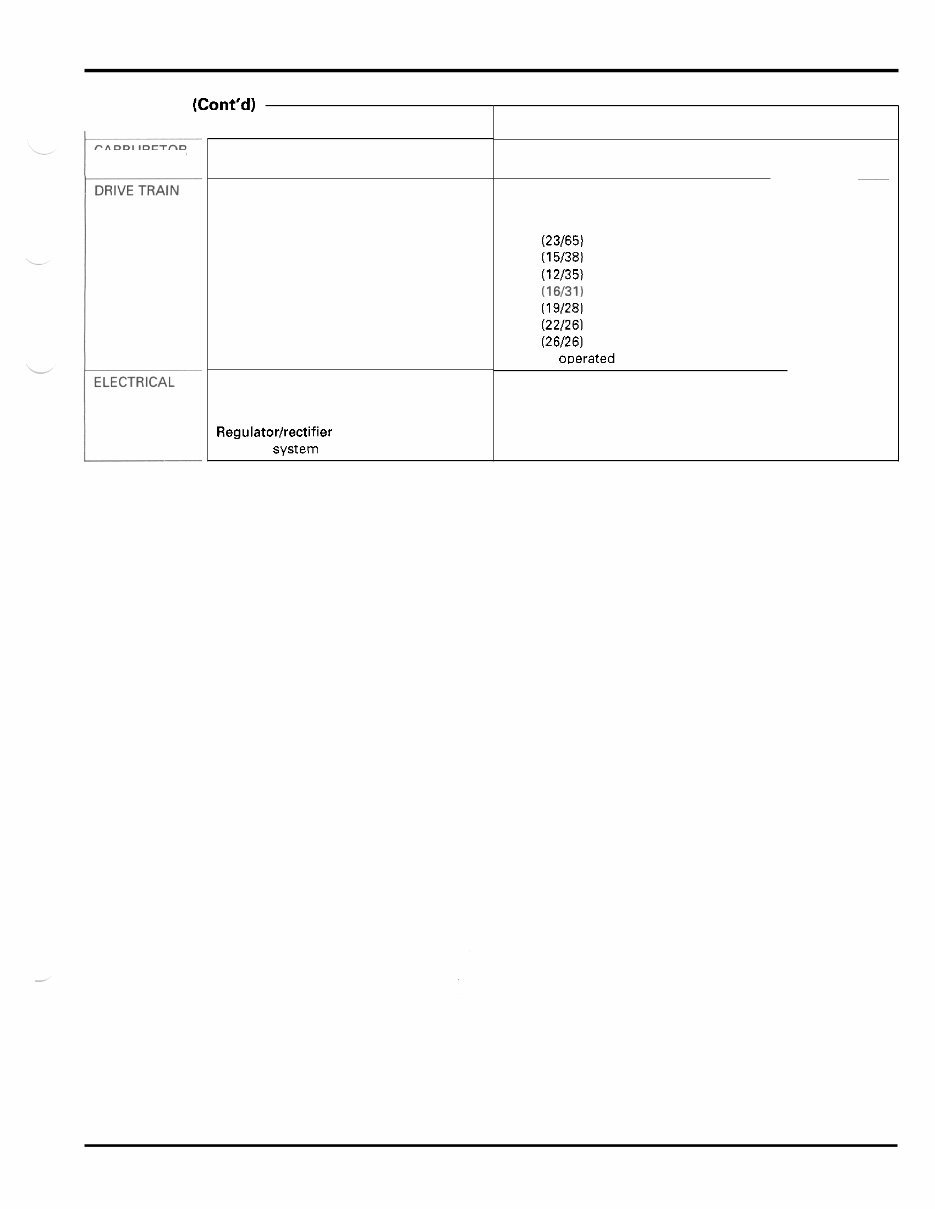
GENERAL INFORMATION GENERAL (Cont'd) r CARBURETOR ITEM Carburetor type Throttle bore Clutch system Clutch operation system Transmission Primary reduction Final reduction Gear ratio 1st 2nd 3rd 4th 5th Gearshift pattern Ignition system Starting system Charging system Regulatortrectifier Lighting system SPECIFICATIONS Piston valve 38 mm (1.5 in) Multi -plate, wet Cable operating Constant mesh, 5-speeds 2.826 (23/65) 2.533 (15/38) 2.916 (12/35) 1.937 (16/31) 1.473 (19/28) 1.181 (22/26) 1.000 (26/26) Left foot oDerated return svstern. 1 - N - 2 - 3 - 4 - 5 ICM (Capacitive Discharge Ignition) Electric starter motor Single phase output alternator Single phase full wave rectification Battery 1- 5
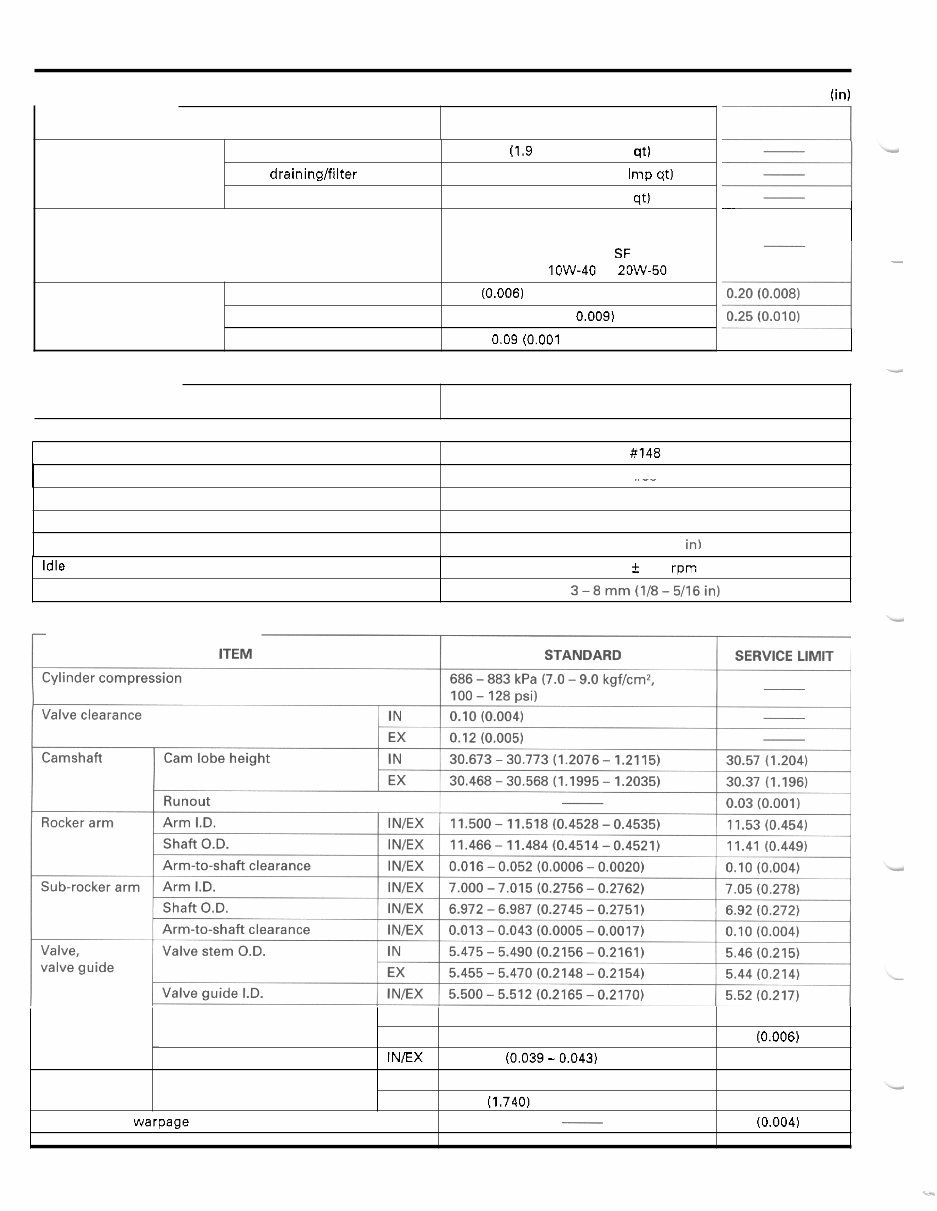
GENERAL INFORMATION ITEM STANDARD Engine oil capacity After draining After draininglfilter change After disassembly Recommended engine oil Oil pump Tip clearance Body clearance Side clearance Unit: mm (in) SERVICE LIMIT 1.8 liters (1.9 US qt, 1.6 Imp qt) 1.85 liters (1.95 US qt, 1.63 Imp qt) 2.2 liters (2.3 US qt, 1.9 Imp qt) Honda GN4 or HP4 4-stroke oil or equivalent motor oil API service classification SF or SG Viscosity: SAE 1OW-40 or 2OW-50 0.15 (0.006) 0.15 - 0.22 (0.006 - 0.009) 0.02 - 0.09 (0.001 - 0.004) I ITEM - SPECIFICATIONS 0.12 10.005) Main jet #148 Jet needle clip position Pilot screw opening Float level 3rd groove from top See page 5-13 18.5 mm 10.73 in) Idle speed 1,400 f 100 rpm Throttle lever free play 3-8mm(1/8-5/16in) Valve spring Stem-to-guide clearance IN 0.010 - 0.037 (0.0004 - 0.0015) 0.12 10.005) - EX 0.030 - 0.057 (0.0012 - 0.0022) 0.14 (0.006) Valve seat width INEX 1.0- 1.1 (0.039-0.043) 2.0 (0.08) Free length Inner 37.19 (1.464) 36.3 11.43) Outer 44.20 (1.740) 43.1 (1.70) Cylinder head warpage - 0.10 (0.004)
You're Reading a Preview
What's Included?
Lifetime Access
Fast Download Speeds
Online & Offline Access
Access PDF Contents & Bookmarks
Full Search Facility
Print one or all pages of your manual
$27.99$36.99
TRX400EX TRX 400EX FOURTRAX Service Manual 1999-02
The TRX400EX Fourtrax Service Manual 1999-02 is a comprehensive guide for maintaining and repairing the TRX 400EX Fourtrax model from 1999 to 2002. This manual contains detailed instructions, diagrams, and illustrations to assist both professional mechanics and DIY enthusiasts in performing various tasks such as engine overhaul, electrical system troubleshooting, brake maintenance, and more.
Whether you are looking to troubleshoot a specific issue or conduct routine maintenance, this manual provides valuable insights and step-by-step procedures to ensure the proper care and upkeep of the TRX 400EX Fourtrax. With its clear and concise information, this manual serves as an indispensable resource for anyone seeking to maintain or repair this particular model.
Reviews
Q&A
Recently Viewed
5,521,897Happy Clients
2,594,462eManuals
1,120,453Trusted Sellers
15Years in Business
Price:
Actual Price:
TRX400EX TRX 400EX FOURTRAX Service Manual 1999-02




 Lifetime Access