


2005-2010 Triumph Sprint ST 1050 Bike Service & Repair Manual
What's Included?
 Lifetime Access
Fast Download Speeds
Online & Offline Access
Access PDF Contents & Bookmarks
Full Search Facility
Print one or all pages of your manual

iumph 1050 Sprint,
Speed iple & Tiger
Service and Repair Manual
Models covered
Sprint ST. 1050cc. 2005 to 2011
Sprint GT. 1050cc. 2011-on
Speed Triple. 1050cc. 2005-on
Speed iple R. 1050cc. 2012-on
figer. 1050cc. 2007 to 2011
Tiger SE. 1050cc. 2010-on
Tiger Spo. 1050cc. 2013-on
ABS and Special Edition versions included
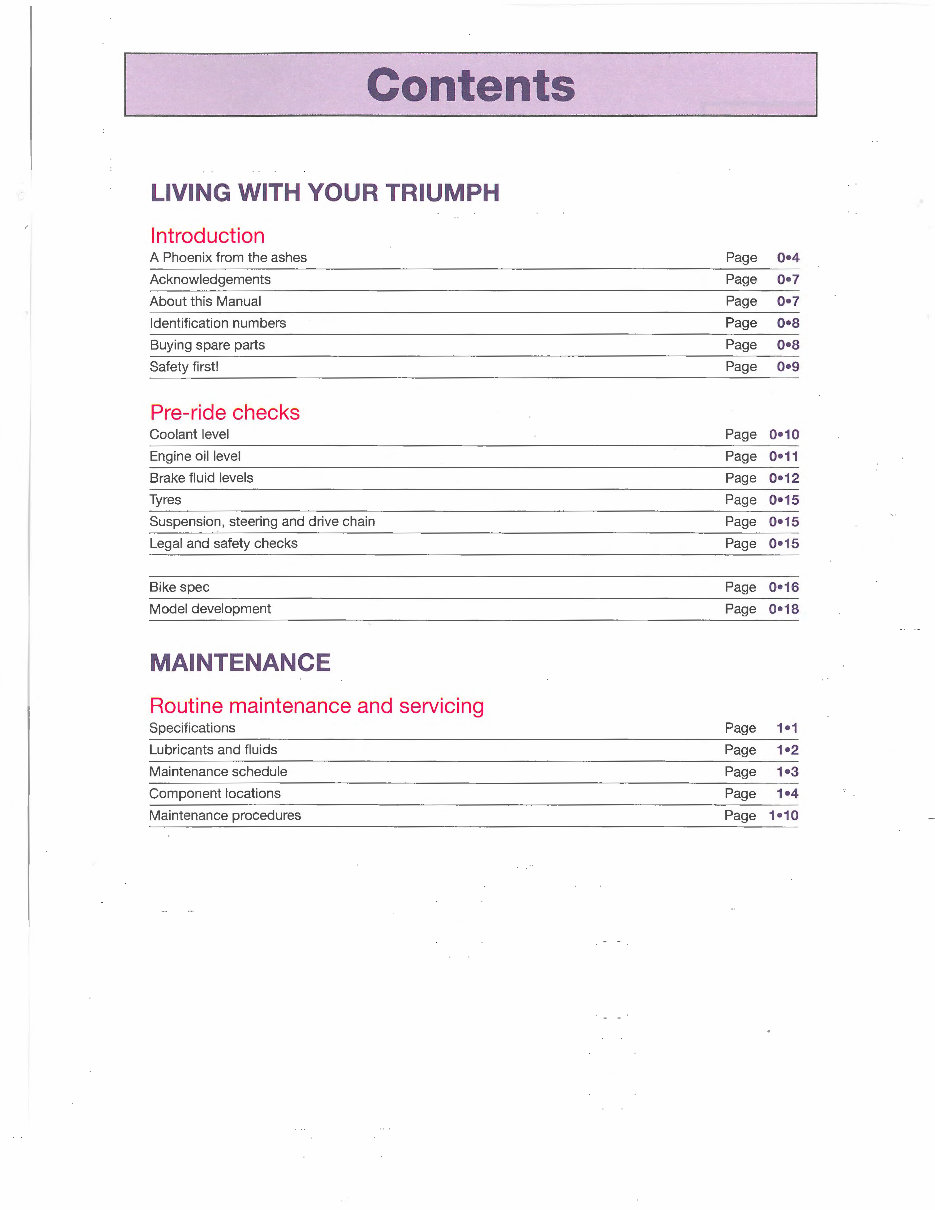
Contents
LIVING WITH YOUR TRIUMPH
Introduction
A Phoenix from the ashes Page 0•4
Acknowledgements Page 0•7
About this Manual Page 0•7
Identification numbers Page 0•8
Buying spare parts Page 0•8
Safety first! Page 0•9
Pre-ride checks
Coolant level Page 0•10
Engine oil level Page 0•11
Brake fluid levels Page 0•12
Tyres Page 0•15
Suspension, steering and drive chain Page 0•15
Legal and safety checks Page 0•15
Bike spec Page 0•16
Model development Page 0•18
MAINTENANCE
Routine maintenance and servicing
Specifications Page 1 •1
Lubricants and fluids Page 1•2
Maintenance schedule Page 1•3
Component locations Page 1•4
Maintenance procedures Page 1•10
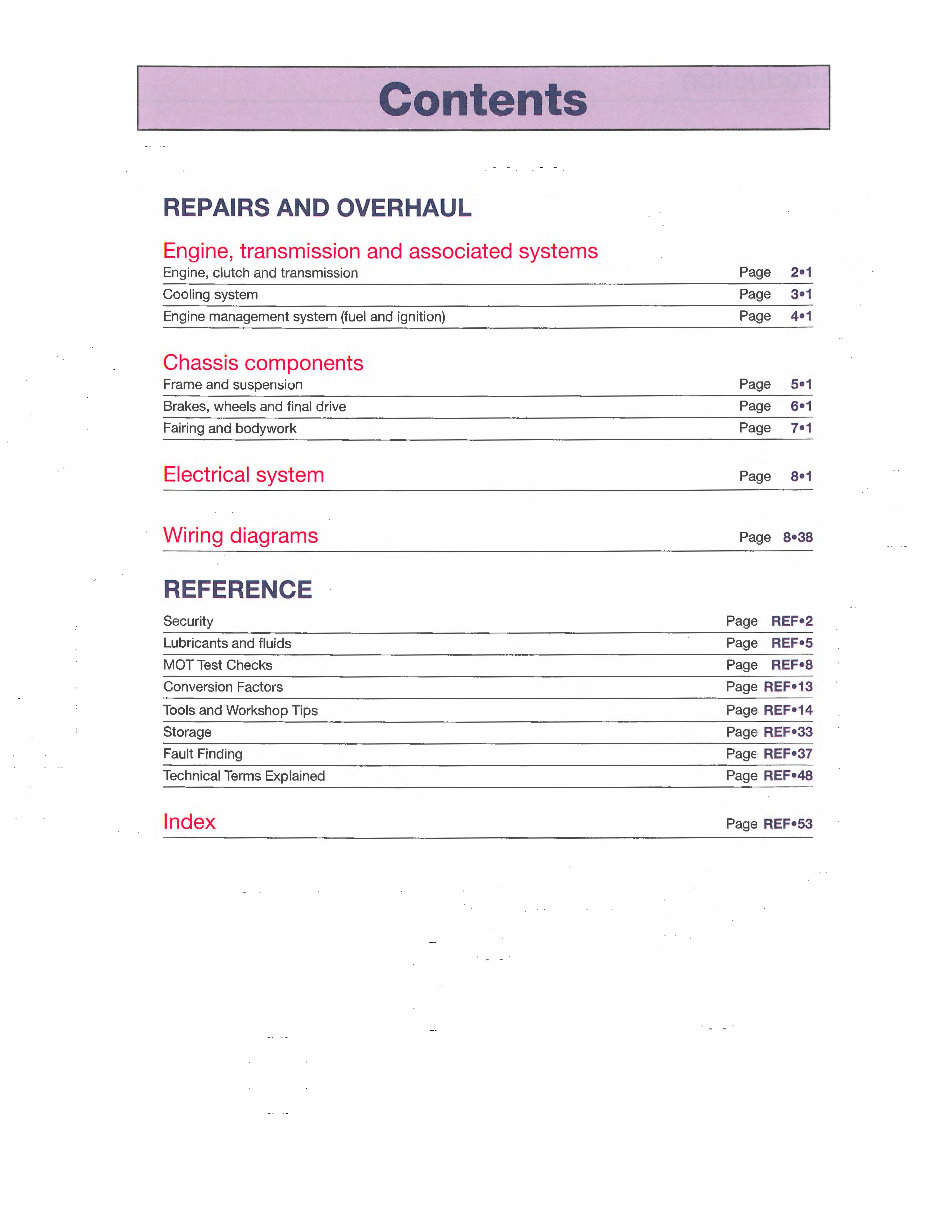
Contents
REPAIRS AND OVERHAUL
Engine, transmission and associated systems
Engine, clutch and transmission
Page 2•1
Cooling system
Page 3•1
Engine management system (fuel and ignition)
Page 4•1
Chassis components
Frame and suspension
Page 5•1
Brakes, wheels and final drive
Page 6•1
Fairing and bodywork
Page 7•1
Electrical system
Page 8•1
Wiring diagrams
Page 8•38
REFERENCE
Security Page REF•2
Lubricants and fluids Page REF•5
MOT Test Checks
Page REF•8
Conversion Factors Page REF•13
Tools and Workshop Tips Page REF•14
Storage Page REF•33
Fault Finding Page REF•37
Technical Terms Explained
Page REF•48
Index
Page REF•53
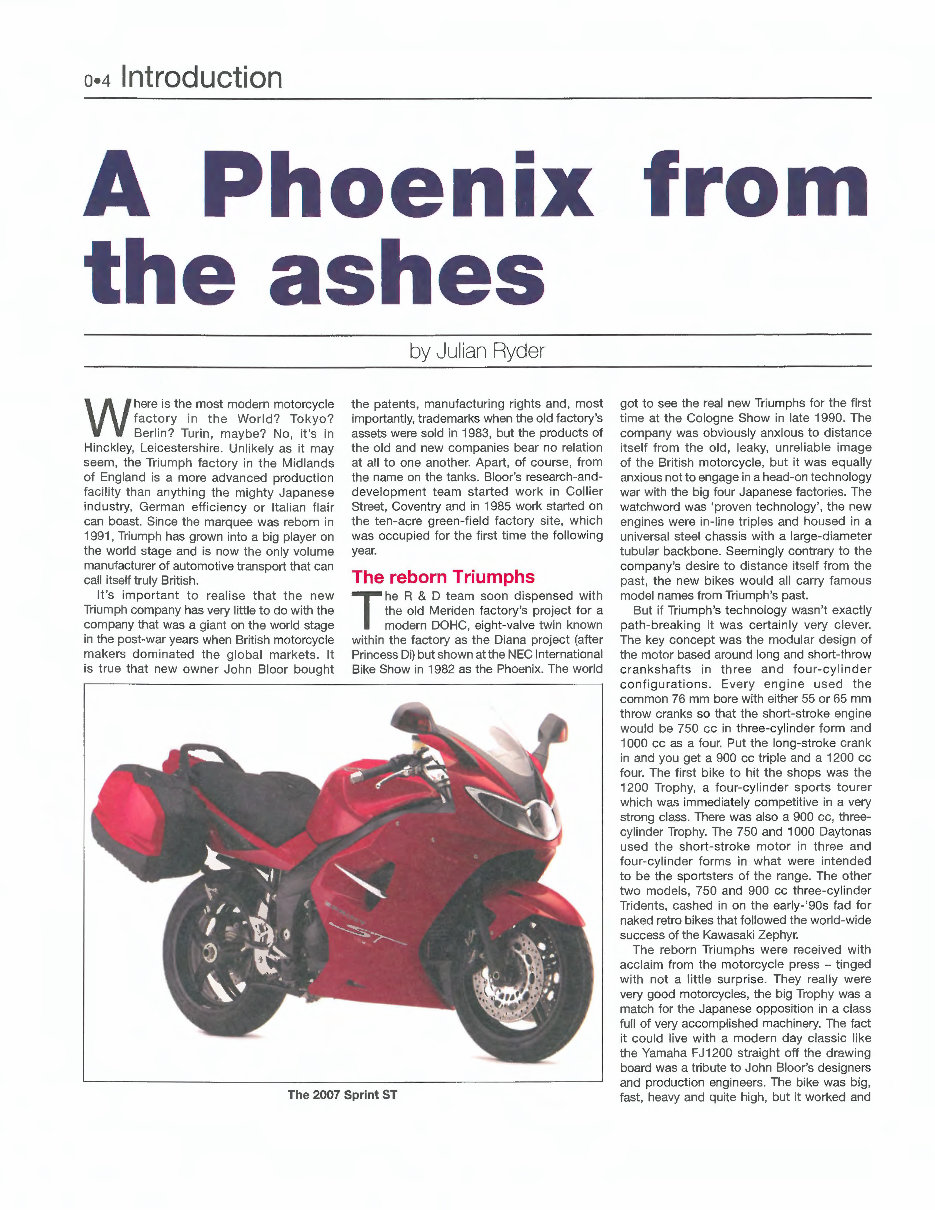
o•4 Introduction
A Phoenix from
the ashes
W
here is the most modern motorcycle
factory in the World? Tokyo?
Berlin? Turin, maybe? No, it's in
Hinckley, Leicestershire. Unlikely as it may
seem, the Triumph factory in the Midlands
of England is a more advanced production
facility than anything the mighty Japanese
industry, German efficiency or Italian flair
can boast. Since the marquee was reborn in
1991 , Triumph has grown into a big player on
the world stage and is now the only volume
manufacturer of automotive transport that can
call itself truly British.
It's important to realise that the new
Triumph company has very little to do with the
company that was a giant on the world stage
in the post-war years when British motorcycle
makers dominated the global markets. It
is true that new owner John Bloor bought
by Julian Ryder
the patents, manufacturing rights and, most
importantly, trademarks when the old factory's
assets were sold in 1983, but the products of
the old and new companies bear no relation
at all to one another. Apart, of course, from
the name on the tanks. Bloor's research-and-
development team started work in Collier
Street, Coventry and in 1985 work started on
the ten-acre green-field factory site, which
was occupied for the first time the following
year.
The reborn Triumphs
T
he R & D team soon dispensed with
the old Meriden factory's project for a
modern DOHC, eight-valve twin known
within the factory as the Diana project (after
Princess Di) but shown at the NEC International
Bike Show in 1982 as the Phoenix. The world
The 2007 Sprint ST
got to see the real new Triumphs for the first
time at the Cologne Show in late 1990. The
company was obviously anxious to distance
itself from the old, leaky, unreliable image
of the British motorcycle, but it was equally
anxious not to engage in a head-on technology
war with the big four Japanese factories. The
watchword was 'proven technology', the new
engines were in-line triples and housed in a
universal steel chassis with a large-diameter
tubular backbone. Seemingly contrary to the
company's desire to distance itself from the
past, the new bikes would all carry famous
model names from Triumph's past.
But if Triumph's technology wasn't exactly
path-breaking it was certainly very clever.
The key concept was the modular design of
the motor based around long and short-throw
crankshafts in three and four - cylinder
configurations . Every engine used the
common 76 mm bore with either 55 or 65 mm
throw cranks so that the short-stroke engine
would be 750 cc in three-cylinder form and
1000 cc as a four. Put the long-stroke crank
in and you get a 900 cc triple and a 1200 cc
four. The first bike to hit the shops was the
1200 Trophy, a four-cylinder sports tourer
which was immediately competitive in a very
strong class. There was also a 900 cc, three-
cylinder Trophy. The 750 and 1000 Daytonas
used the short-stroke motor in three and
four-cylinder forms in what were intended
to be the sportsters of the range. The other
two models, 750 and 900 cc three-cylinder
Tridents, cashed in on the early-'90s fad for
naked retro bikes that followed the world-wide
success of the Kawasaki Zephyr.
The reborn Triumphs were received with
acclaim from the motorcycle press - tinged
with not a little surprise. They really were
very good motorcycles, the big Trophy was a
match for the Japanese opposition in a class
full of very accomplished machinery. The fact
it could live with a modern day classic like
the Yamaha FJ1200 straight off the drawing
board was a tribute to John Bloor's designers
and production engineers. The bike was big,
fast, heavy and quite high, but it worked and
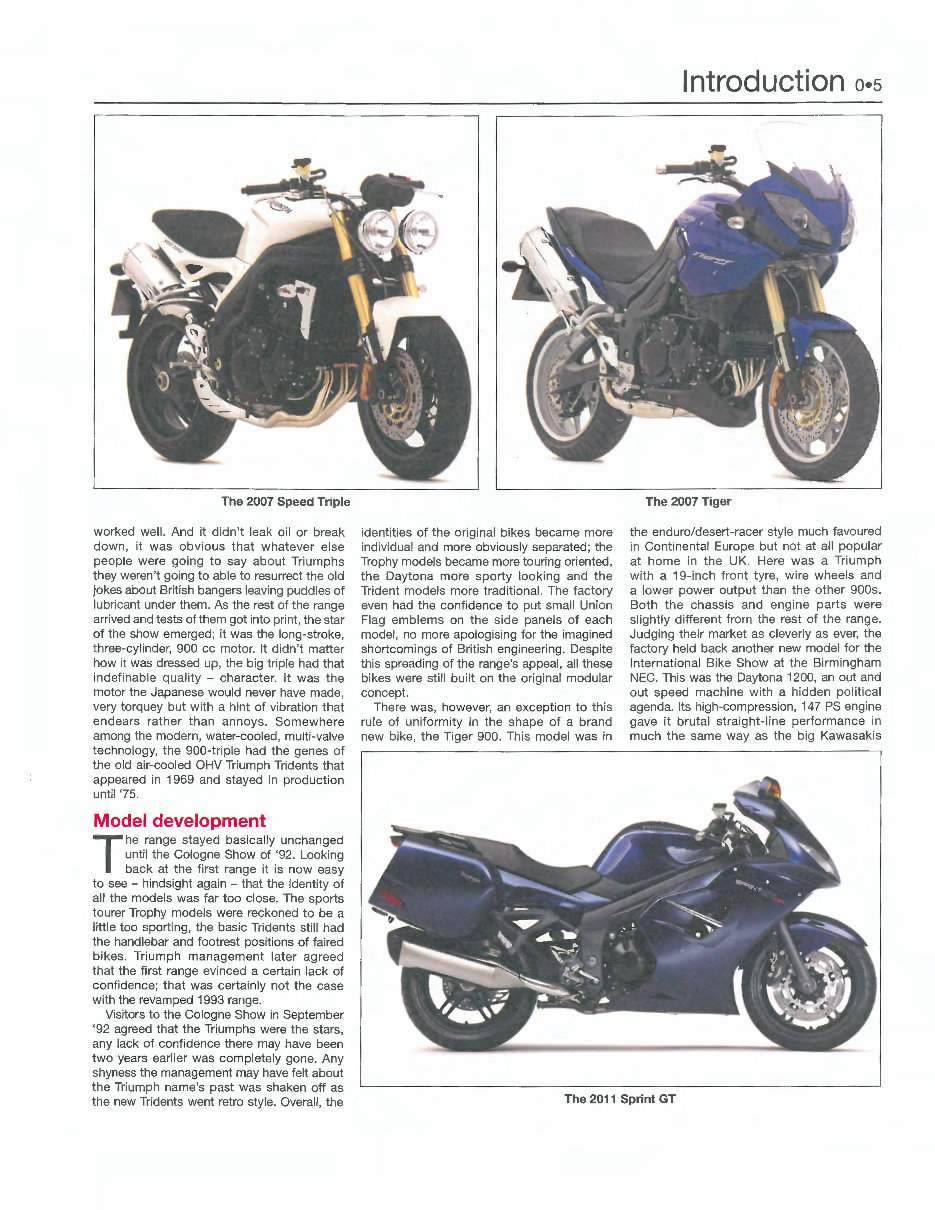
The 2007 Speed Triple
worked well. And it didn't leak oil or break
down, it was obvious that whatever else
people were going to say about Triumphs
they weren't going to able to resurrect the old
jokes about British bangers leaving puddles of
lubricant under them. As the rest of the range
arrived and tests of them got into print, the star
of the show emerged; it was the long-stroke,
three-cylinder, 900 cc motor. It didn't matter
how it was dressed up, the big triple had that
indefinable quality - character. It was the
motor tne Japanese would never have made,
very torquey but with a hint of vibration that
endears rather than annoys. Somewhere
among the modern, water-cooled, multi-valve
technology, the 900-triple had the genes of
the old air-cooled OHV Triumph Tridents that
appeared in 1969 and stayed in production
until '75.
Model development
T
he range stayed basically unchanged
until the Cologne Show of '92. Looking
back at the first range it is now easy
to see - hindsight again - that the identity of
all the models was far too close. The sports
tourer Trophy models were reckoned to be a
little too sporting, the basic Tridents still had
the handlebar and footrest positions of faired
bikes. Triumph management later agreed
that the first range evinced a certain lack of
confidence; that was certainly not the case
with the revamped 1993 range.
Visitors to the Cologne Show in September
'92 agreed that the Triumphs were the stars,
any lack of confidence there may have been
two years earlier was completely gone. Any
shyness the management may have felt about
the Triumph name's past was shaken off as
the new Tridents went retro style. Overall, the
identities of the original bikes became more
individual and more obviously separated; the
Trophy models became more touring oriented,
the Daytona more sporty looking and the
Trident models more traditional. The factory
even had the confidence to put small Union
Flag emblems on the side panels of each
model, no more apologising for the imagined
shortcomings of British engineering. Despite
this spreading of the range's appeal, all these
bikes were still built on the original modular
concept.
There was, however, an exception to this
rule of uniformity in the shape of a brand
new bike, the Tiger 900. This model was in
Introduction o•5
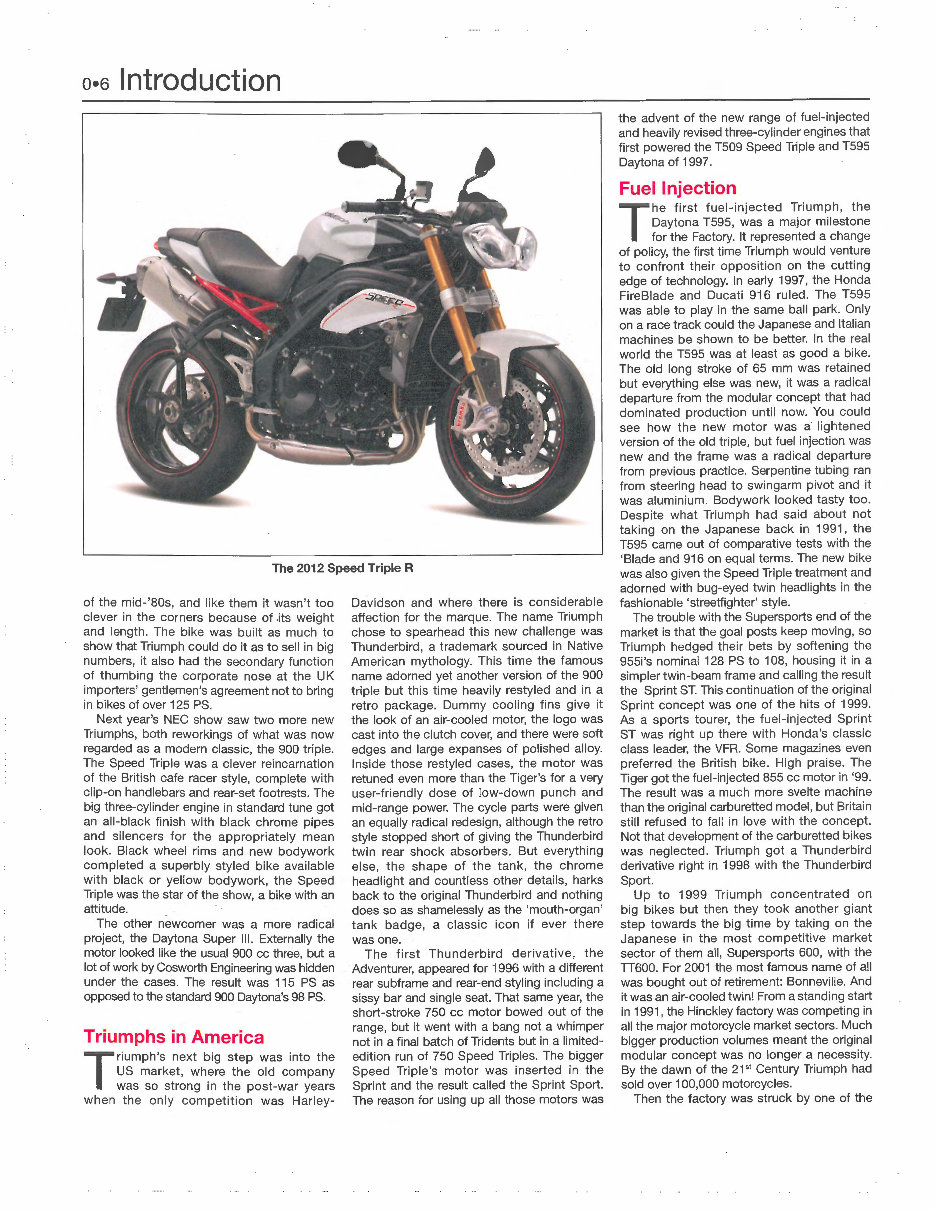
The 2007 Tiger
the endure/desert-racer style much favoured
in Continental Europe but not at all popular
at home in the UK. Here was a Triumph
with a 19-inch front tyre, wire wheels and
a lower power output than the other 900s.
Both the chassis and engine parts were
slightly different from the rest of the range.
Judging their market as cleverly as ever, the
factory held back another new model for the
International Bike Show at the Birmingham
NEC. This was the Daytona 1200, an out and
out speed machine with a hidden political
agenda. Its high-compression, 147 PS engine
gave it brutal straight-line performance in
much the same way as the big Kawasakis
The 2011 Sprint GT
o•6 Introduction
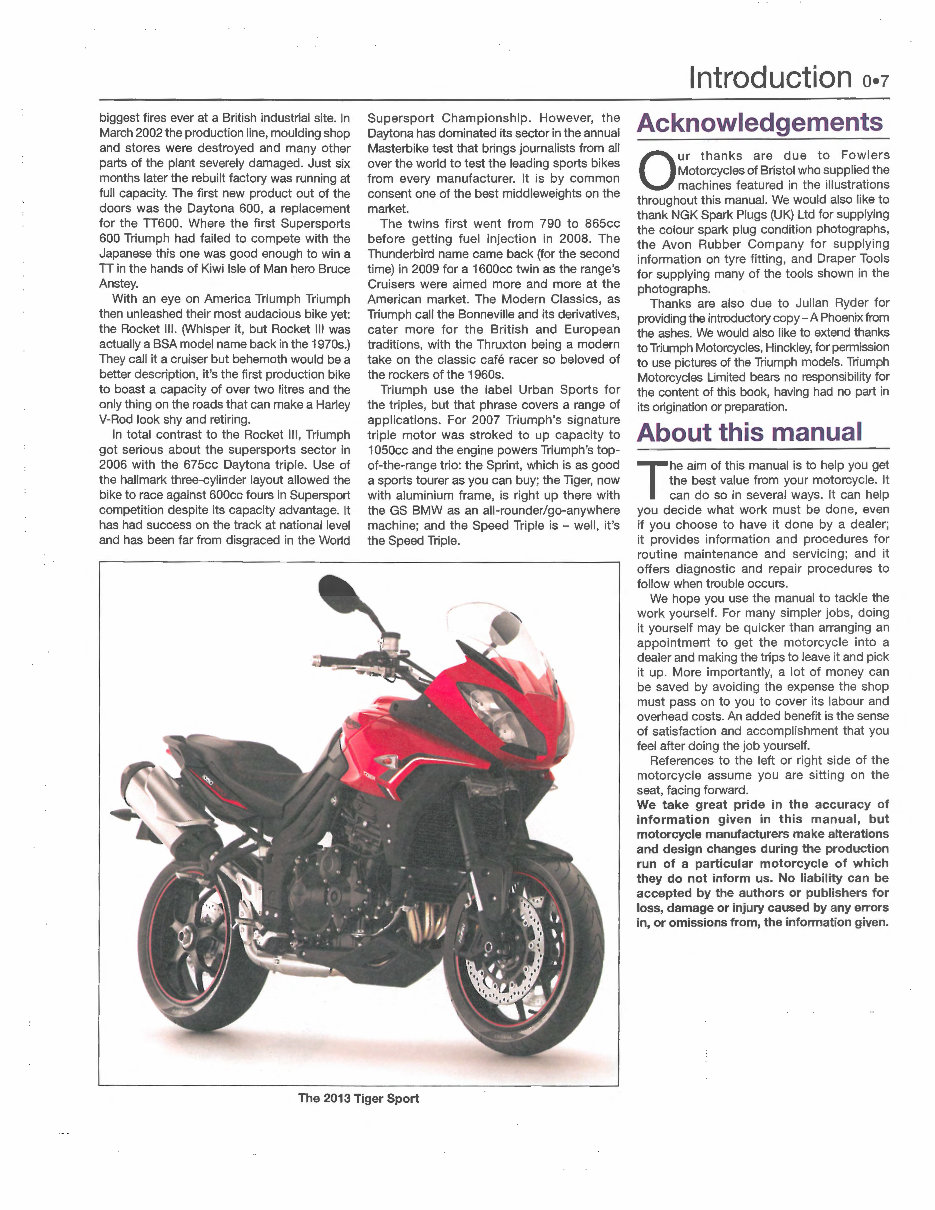
The 2012 Speed Triple R
of the mid-'80s, and like them it wasn't too
clever in the corners because of .its weight
and length. The bike was built as much to
show that Triumph could do it as to sell in big
numbers, it also had the secondary function
of thumbing the corporate nose at the UK
importers' gentlemen's agreement not to bring
in bikes of over 125 PS.
Next year's NEC show saw two more new
Triumphs, both reworkings of what was now
regarded as a modern classic, the 900 triple.
The Speed Triple was a clever reincarnation
of the British cafe racer style, complete with
clip-on handlebars and rear-set footrests. The
big three-cylinder engine in standard tune got
an all-black finish with black chrome pipes
and silencers for the appropriately mean
look . Black wheel rims and new bodywork
completed a superbly styled bike available
with black or yellow bodywork , the Speed
Triple was the star of the show, a bike with an
attitude.
The other newcomer was a more radical
project, the Daytona Super Ill. Externally the
motor looked like the usual 900 cc three, but a
lot of work by Cosworth Engineering was hidden
under the cases. The result was 115 PS as
opposed to the standard 900 Daytona's 98 PS.
Triumphs in America
T
riumph's next big step was into the
US market , where the old company
was so strong in the post-war years
when the only competition was Harley-
Davidson and where there is considerable
affection for the marque. The name Triumph
chose to spearhead this new challenge was
Thunderbird, a trademark sourced in Native
American mythology. This time the famous
name adorned yet another version of the 900
triple but this time heavily restyled and in a
retro package . Dummy cooling fins give it
the look of an air-cooled motor, the logo was
cast into the clutch cover, and there were soft
edges and large expanses of polished alloy.
Inside those restyled cases, the motor was
retuned even more than the Tiger's for a very
user-friendly dose of low-down punch and
mid-range power. The cycle parts were given
an equally radical redesign, although the retro
style stopped short of giving the Thunderbird
twin rear shock absorbers. But everything
else, the shape of the tank, the chrome
headlight and countless other details, harks
back to the original Thunderbird and nothing
does so as shamelessly as the 'mouth-organ'
tank badge, a classic icon if ever there
was one.
The first Thunderbird derivative, the
Adventurer, appeared for 1996 with a different
rear subframe and rear-end styling including a
sissy bar and single seat. That same year, the
short-stroke 750 cc motor bowed out of the
range, but it went with a bang not a whimper
not in a final batch of Tridents but in a limited-
edition run of 750 Speed Triples. The bigger
Speed Triple's motor was inserted in the
Sprint and the result called the Sprint Sport.
The reason for using up all those motors was
the advent of the new range of fuel-injected
and heavily revised three-cylinder engines that
first powered the T509 Speed Triple and T595
Daytona of 1997.
Fuel Injection
T
he first fuel-injected Triumph , the
Daytona T595, was a major milestone
for the Factory. It represented a change
of policy, the first time Triumph would venture
to confront their opposition on the cutt ing
edge of technology. In early 1997, the Honda
FireBlade and Ducati 916 ruled. The T595
was able to play in the same ball park. Only
on a race track could the Japanese and Italian
machines be shown to be better. In the real
world the T595 was at least as good a bike.
The old long stroke of 65 mm was retained
but everything else was new, it was a radical
departure from the modular concept that had
dominated production until now. You could
see how the new motor was a lightened
version of the old triple, but fuel injection was
new and the frame was a radical departure
from previous practice. Serpentine tubing ran
from steering head to swingarm pivot and it
was aluminium. Bodywork looked tasty too .
Despite what Triumph had said about not
taking on the Japanese back in 1991, the
T595 came out of comparative tests with the
'Blade and 916 on equal terms. The new bike
was also given the Speed Triple treatment and
adorned with bug-eyed twin headlights in the
fashionable 'streetfighter' style.
The trouble with the Supersports end of the
market is that the goal posts keep moving, so
Triumph hedged their bets by softening the
955i's nominal 128 PS to 108, housing it in a
simpler twin-beam frame and calling the result
the Sprint ST. This continuation of the ori ginal
Sprint concept was one of the hits of 1999.
As a sports tourer, the fuel-injected Sprint
ST was right up there with Honda's classic
class leader, the VFR. Some magazines even
preferred the British bike. High praise. The
Tiger got the fuel-injected 855 cc motor in '99.
The result was a much more svelte machine
than the original carburetted model, but Britain
still refused to fall in love with the concept.
Not that development of the carburetted bikes
was neglected. Tr iumph got a Thunderbird
derivative right in 1998 with the Thunderbird
Sport.
Up to 1999 Triumph concentrated on
big bikes but then they took another giant
step towards the big time by taking on the
Japanese in the most competitive market
sector of them all, Supersports 600, with the
TT600. For 2001 the most famous name of all
was bought out of retirement: Bonneville. And
it was an air-cooled twin! From a standing start
in 1991 , the Hinckley factory was competing in
all the major motorcycle market sectors. Much
bigger production volumes meant the original
modular concept was no longer a necessity.
By the dawn of the 21 '' Century Triumph had
sold over 100,000 motorcycles.
Then the factory was struck by one of the
biggest fires ever at a British industrial site. In
March 2002 the production line, moulding shop
and stores were destroyed and many other
parts of the plant severely damaged. Just six
months later the rebuilt factory was running at
full capacity. The first new product out of the
doors was the Daytona 600, a replacement
for the TI600. Where the first Supersports
600 Triumph had failed to compete with the
Japanese this one was good enough to win a
TI in the hands of Kiwi Isle of Man hero Bruce
Anstey.
With an eye on America Triumph Triumph
then unleashed their most audacious bike yet:
the Rocket Ill. {Whisper it, but Rocket Ill was
actually a BSA model name back in the 1970s.)
They call it a cruiser but behemoth would be a
better description, it's the first production bike
to boast a capacity of over two litres and the
only thing on the roads that can make a Harley
V-Rod look shy and retiring.
In total contrast to the Rocket Ill, Triumph
got serious about the supersports sector in
2006 with the 675cc Daytona triple. Use of
the hallmark three-cylinder layout allowed the
bike to race against 600cc fours in Supersport
competition despite its capacity advantage. It
has had success on the track at national level
and has been far from disgraced in the World
Supersport Championship . However, the
Daytona has dominated its sector in the annual
Masterbike test that brings journalists from all
over the world to test the leading sports bikes
from every manufacturer. It is by common
consent one of the best middleweights on the
market.
The twins first went from 790 to 865cc
before getting fuel injection in 2008. The
Thunderbird name came back (for the second
time) in 2009 for a 1600cc twin as the range's
Cruisers were aimed more and more at the
American market. The Modern Classics, as
Triumph call the Bonneville and its derivatives,
cater more for the British and European
traditions, with the Thruxton being a modern
take on the classic cafe racer so beloved of
the rockers of the 1960s.
Triumph use the label Urban Sports for
the triples, but that phrase covers a range of
applications. For 2007 Triumph's signature
triple motor was stroked to up capacity to
1050cc and the engine powers Triumph's top-
of-the-range trio: the Sprint, which is as good
a sports tourer as you can buy; the Tiger, now
with aluminium frame, is right up there with
the GS BMW as an all-rounder/go-anywhere
machine; and the Speed Triple is - well, it's
the Speed Triple.
The 2013 Tiger Sport
Introduction o•?
Acknowledgements
O
ur thanks are due to Fowlers
Motorcycles of Bristol who supplied the
machines featured in the illustrations
throughout this manual. We would also like to
thank NGK Spark Plugs (UK) Ltd for supplying
the colour spark plug condition photographs,
the Avon Rubber Company for supplying
information on tyre fitting, and Draper Tools
for supplying many of the tools shown in the
photographs.
Thanks are also due to Julian Ryder for
providing the introductory copy-A Phoenix from
the ashes. We would also like to extend thanks
to Triumph Motorcycles, Hinckley, for permission
to use pictures of the Triumph models. Triumph
Motorcycles Limited bears no responsibility for
the content of this book, having had no part in
its origination or preparation.
About this manual
T
he aim of this manual is to help you get
the best value from your motorcycle. It
can do so in several ways. It can help
you decide what work must be done, even
if you choose to have it done by a dealer;
it provides information and procedures for
routine maintenance and servicing; and it
offers diagnostic and repair procedures to
follow when trouble occurs.
We hope you use the manual to tackle the
work yourself. For many simpler jobs , doing
it yourself may be quicker than arranging an
appointment to get the motorcycle into a
dealer and making the trips to leave it and pick
it up. More importantly, a lot of money can
be saved by avoiding the expense the shop
must pass on to you to cover its labour and
overhead costs. An added benefit is the sense
of satisfaction and accomplishment that you
feel after doing the job yourself.
References to the left or right side of the
motorcycle assume you are sitting on the
seat, facing forward.
We take great pride in the accuracy of
information given in this manual, but
motorcycle manufacturers make alterations
and design changes during the production
run of a particular motorcycle of which
they do not inform us. No liability can be
accepted by the authors or publishers for
loss, damage or injury caused by any errors
in, or omissions from, the information given.
o·a Identification numbers
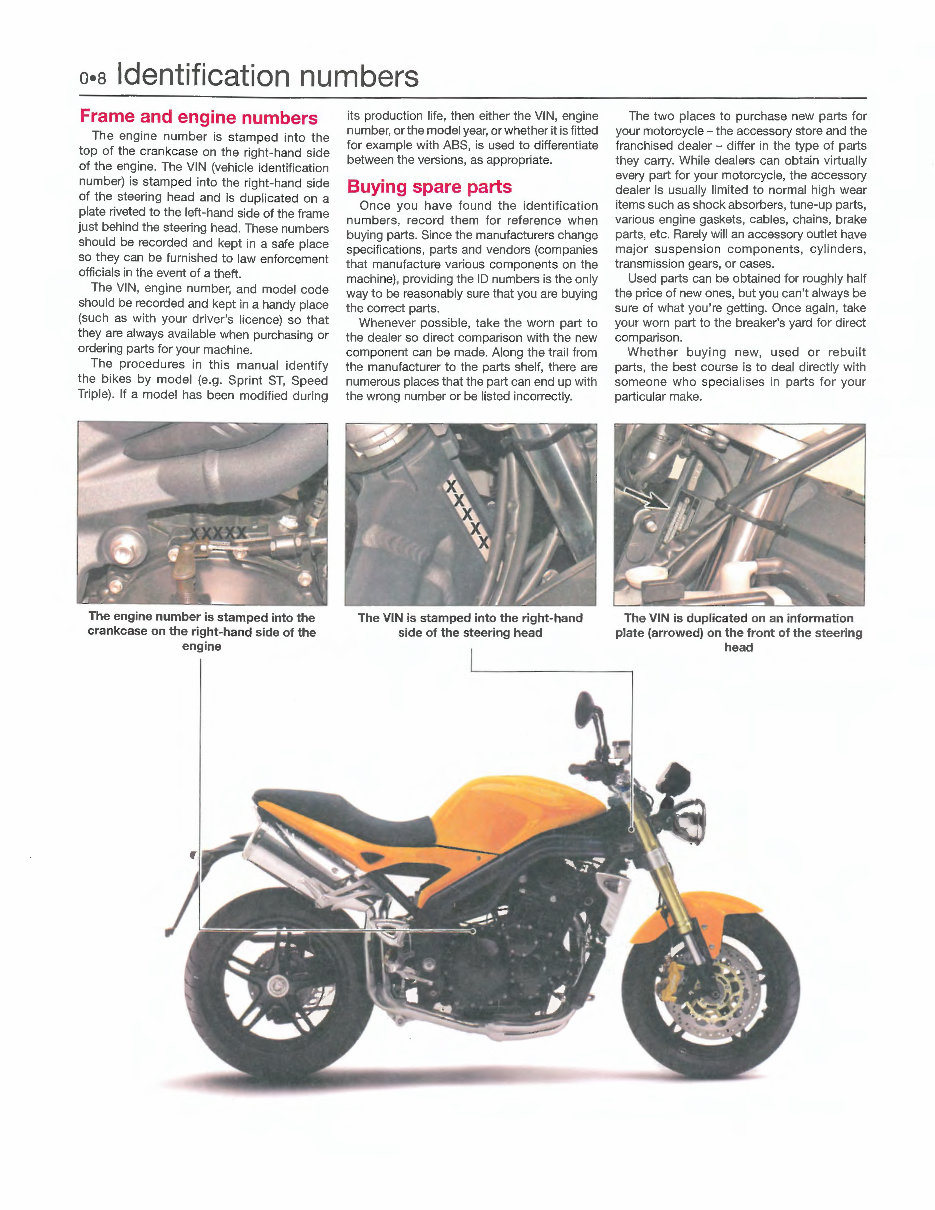
Frame and engine numbers
The engine number is stamped into the
top of the crankcase on the right-hand side
of the engine. The VIN (vehicle identification
number) is stamped into the right-hand side
of the steering head and is duplicated on a
plate riveted to the left-hand side of the frame
just behind the steering head. These numbers
should be recorded and kept in a safe place
so they can be furnished to law enforcement
officials in the event of a theft.
The VIN, engine number, and model code
should be recorded and kept in a handy place
(such as with your driver's licence) so that
they are always available when purchasing or
ordering parts for your machine.
The procedures in this manual identify
the bikes by model (e.g. Sprint ST, Speed
Triple). If a model has been modified during
The engine number is stamped into the
crankcase on the right-hand side of the
engine
its production life, then either the VIN, engine
number, or the model year, or whether it is fitted
for example with ABS, is used to differentiate
between the versions, as appropriate.
Buying spare parts
Once you have found the identification
numbers, record them for reference when
buying parts. Since the manufacturers change
specifications, parts and vendors (companies
that manufacture various components on the
machine), providing the ID numbers is the only
way to be reasonably sure that you are buying
the correct parts.
Whenever possible, take the worn part to
the dealer so direct comparison with the new
component can be made. Along the trail from
the manufacturer to the parts shelf, there are
numerous places that the part can end up with
the wrong number or be listed incorrectly.
The VIN is stamped into the right-hand
side of the steering head
The two places to purchase new parts for
your motorcycle - the accessory store and the
franchised dealer - differ in the type of parts
they carry. While dealers can obtain virtually
every part for your motorcycle, the accessory
dealer is usually limited to normal high wear
items such as shock absorbers, tune-up parts,
various engine gaskets, cables, chains, brake
parts, etc. Rarely will an accessory outlet have
major suspension components , cylinders ,
transmission gears, or cases.
Used parts can be obtained for roughly half
the price of new ones, but you can't always be
sure of what you're getting. Once again, take
your worn part to the breaker's yard for direct
comparison.
Whether buying new, used or rebuilt
parts, the best course is to deal directly with
someone who specialises in parts for your
particular make.
The VIN is duplicated on an information
plate (arrowed) on the front of the steering
head
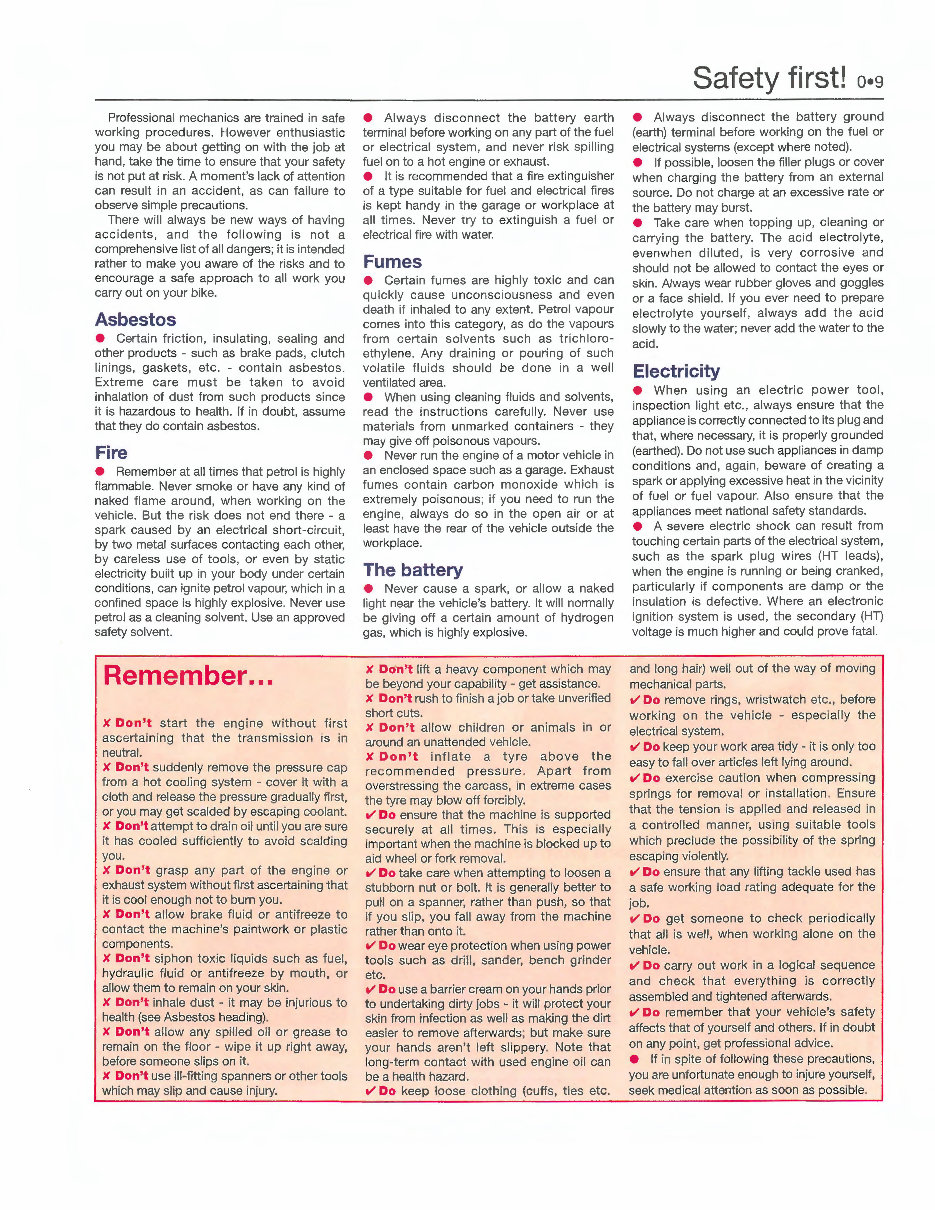
Professional mechanics are trained in safe
working procedures. However enthusiastic
you may be about getting on with the job at
hand, take the time to ensure that your safety
is not put at risk. A moment's lack of attention
can result in an accident, as can failure to
observe simple precautions.
There will always be new ways of having
accidents, and the following is not a
comprehensive list of all dangers; it is intended
rather to make you aware of the risks and to
encourage a safe approach to all work you
carry out on your bike.
Asbestos
• Certain friction, insulating, sealing and
other products - such as brake pads, clutch
linings, gaskets, etc . - contain asbestos .
Extreme care must be taken to avoid
inhalation of dust from such products since
it is hazardous to health. If in doubt, assume
that they do contain asbestos.
Fire
• Remember at all times that petrol is highly
flammable. Never smoke or have any kind of
naked flame around, when working on the
vehicle. But the risk does not end there - a
spark caused by an electrical short-circuit,
by two metal surfaces contacting each other,
by careless use of tools, or even by static
electricity built up in your body under certain
conditions, can ignite petrol vapour, which in a
confined space is highly explosive. Never use
petrol as a cleaning solvent. Use an approved
safety solvent.
Remember ...
>< Don't start the engine without first
ascertaining that the transm ission 1s in
neutral.
>< Don't suddenly remove the pressure cap
from a hot cooling system - cover It with a
cloth and release the pressure gradually first,
or you may get scalded by escaping coolant.
>< Don't attempt to drain oil until you are sure
,t has cooled sufficiently to avoid scalding
you.
>< Don't grasp any part of the engine or
exhaust system without first ascertaining that
it 1s cool enough not to burn you .
>< Don't allow brake fluid or antifreeze to
contact the machine's paintwork or plastic
components.
>< Don't siphon toxic liquids such as fuel,
hydraulic fluid or antifreeze by mouth, or
allow them to remain on your skin.
>< Don't inhale dust - it may be injurious to
health (see Asbestos heading).
>< Don't allow any spilled 011 or grease to
remain on the floor - wipe it up right away,
before someone slips on it.
>< Don't use ill-fitting spanners or other tools
which may slip and cause injury.
• Always disconnect the battery earth
terminal before working on any part of the fuel
or electrical system, and never risk spilling
fuel on to a hot engine or exhaust.
• It is recommended that a fire extinguisher
of a type suitable for fuel and electrical fi res
is kept handy in the garage or workplace at
all times. Never try to extinguish a fuel or
electrical fire with water.
Fumes
• Certain fumes are highly toxic and can
qui ckly cause unconsciousness and even
death if inhaled to any extent. Petrol vapour
comes into this category, as do the vapours
from certain solvents such as trichloro-
ethylene. Any draining or pouring of such
volatile fluids should be done in a well
ventilated area.
• When using cleaning fluids and solvents,
read the instructions carefully. Never use
materials from unmarked containers - they
may give off poisonous vapours.
• Never run the engine of a motor vehicle in
an enclosed space such as a garage. Exhaust
furnes contain carbon monox i de which is
extremely poisonous; if you need to run the
engine, always do so in the open air or at
least have the rear of the vehicle outside the
workplace.
The battery
• Never cause a spark, or allow a naked
light near the vehicle's battery. It will normally
be giving off a certain amount of hydrogen
gas, which is highly explosive.
>< Don't lift a heavy component which may
be beyond your capability - get assistance.
>< Don't rush to fin ish a job or take unverified
short cuts.
>< Don't allow children or animals ,n or
around an unattended vehicle.
>< Don't inflate a tyre above the
re c ommended pressure . Apart from
overstressing the carcass, 111 extreme cases
the tyre may blow off forcibly.
v' Do ensure that the machine is supported
securely at all times. This 1s especially
important when the machine ts blocked up to
aid wheel or fork removal.
v' Do take care when attempting to loosen a
stubborn nut or bolt. It 1s generally better to
pull on a spanner, rather than push, so that
if you slip, you fall away from the machine
rather than onto it.
v' Do wear eye protection when using power
tools such as drill, sander, bench grinder
etc.
v' Do use a barrier cream on your hands prior
to undertaking dirty jobs - it will protect your
skin from infection as well as making the dirt
easter to remove afterwards; but make sure
your hands aren't left slippery. Note that
long-term contact with used engine oil can
be a health hazard.
v' Do keep loose clothing (cuffs, ties etc .
Safety first! o•9
• Always disconnect the battery ground
(earth) terminal before working on the fuel or
electrical systems (except where noted).
• If possible, loosen the filler plugs or cover
when charging the battery from an external
source. Do not charge at an excessive rate or
the battery may burst.
• Take care when topping up, cleaning or
carrying the battery. The acid electrolyte,
evenwhen diluted , is very corrosive and
should not be allowed to contact the eyes or
skin. Always wear rubber gloves and goggles
or a face shield. If you ever need to prepare
electrolyte yourself, always add the acid
slowly to the water; never add the water to the
acid.
Electricity
• When using an electric power tool,
inspection light etc., always ensure that the
appliance is correctly connected to its plug and
that, where necessary, it is properly grounded
(earthed). Do not use such appliances in damp
conditions and, again, beware of creating a
spark or applying excessive heat in the vicinity
of fuel or fuel vapour. Also ensure that the
appliances meet national safety standards.
• A severe electric shock can result from
touching certain parts of the electrical system,
such as the spark plug wires (HT leads),
when the engine is running or being cranked,
particularly if components are damp or the
insulation is defective. Where an electronic
ignition system is used, the secondary (HT)
voltage is much higher and could prove fatal.
and long hair) well out of the way of moving
mechanical parts.
v' Do remove rings, wristwatch etc., before
working on the vehicle - especially the
electrical system.
ti Do keep your work area tidy - it is only too
easy to fall over articles left lying around.
v' Do exercise caution when compressing
springs for removal or installation. Ensure
that the tension ts applied and released ,n
a controlled manner, using suitable tools
which preclude the possibility of the spring
escaping violently.
v' Do ensure that any lifting tackle used has
a safe working load rating adequate for the
job.
ti Do get someone to check periodically
that all is well, when working alone on the
vehicle.
v' Do carry out work in a logical sequence
and check that everything ts correctly
assembled and tightened afterwards.
v' Do remember that your vehicle's safety
affects that of yourself and others. If in doubt
on any point, get professional advice.
• If in spite of following these precautions,
you are unfortunate enough to injure yourself,
seek medical attention as soon as possible.
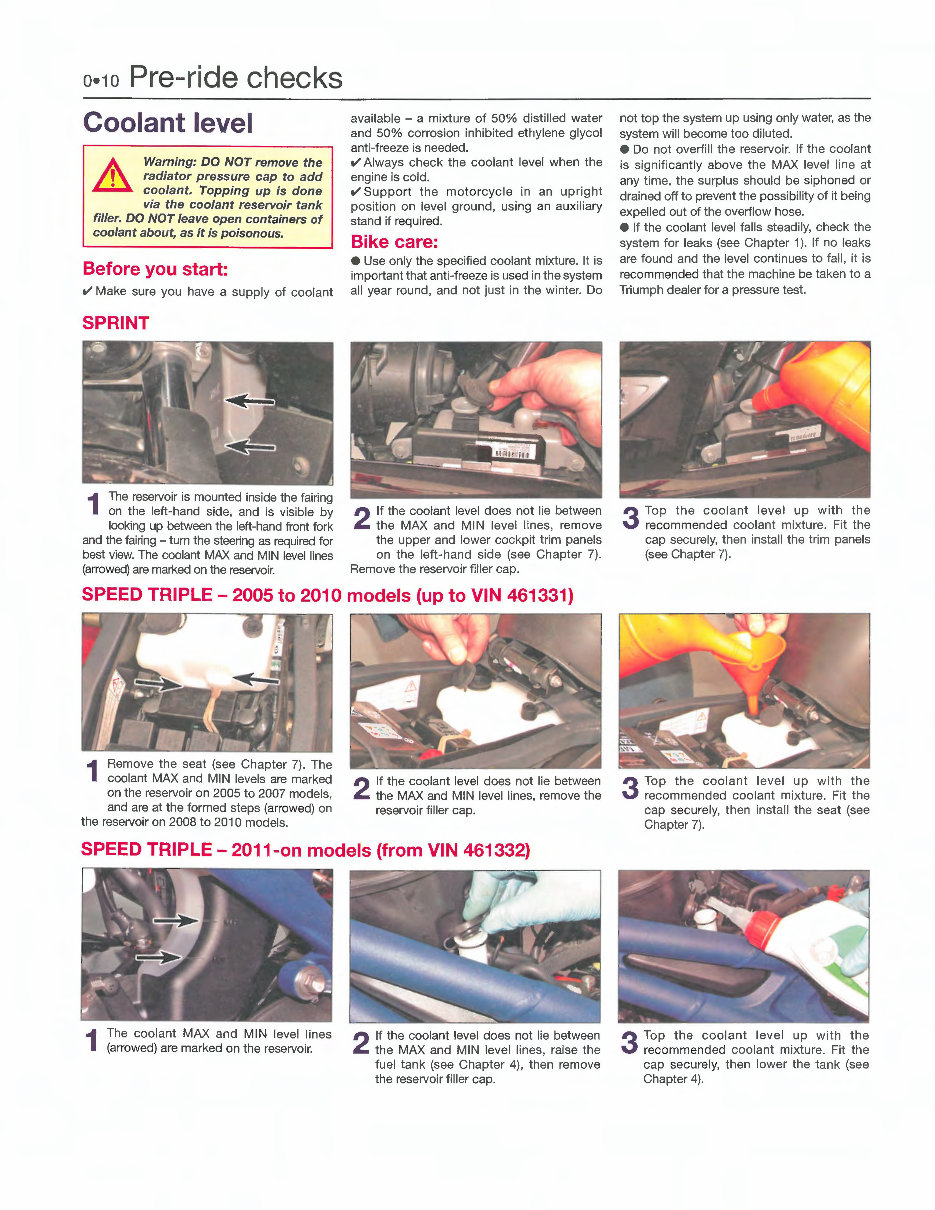
0·10 Pre-ride checks
Coolant level
Warning: DO NOT remove the
radiator pressure cap to add
coolant. Topping up is done
via the coolant reservoir tank
filler. DO NOT leave open containers of
coolant about, as it is poisonous.
Before you start:
v' Make sure you have a supply of coolant
SPRINT
1
The reservoir is mounted inside the fairing
on the left-hand side, and is visible by
looking up between the left-hand front fork
and the fairing - turn the steering as required for
best view. The coolant MAX and MIN level lines
(arrowed) are marked on the reservoir.
available - a mixture of 50% distilled water
and 50% corrosion inhibited ethylene glycol
anti-freeze is needed.
v' Always check the coolant level when the
engine is cold.
v' Support the motorcycle in an upright
position on level ground, using an auxiliary
stand if required.
Bike care:
• Use only the specified coolant mixture. It is
important that anti-freeze is used in the system
all year round, and not just in the winter. Do
2
If the coolant level does not lie between
the MAX and MIN level lines, remove
the upper and lower cockpit trim panels
on the left-hand side (see Chapter 7) .
Remove the reservoir filler cap.
SPEED TRIPLE - 2005 to 2010 models (up to VIN 461331)
1
Remove the seat (see Chapter 7) . The
coolant MAX and MIN levels are marked
on the reservoir on 2005 to 2007 models,
and are at the formed steps (arrowed) on
the reservoir on 2008 to 2010 models.
2
If the coolant level does not lie between
the MAX and MIN level lines, remove the
reservoir filler cap.
SPEED TRIPLE - 2011-on models (from VIN 461332)
1
The coolant MAX and MIN level lines
(arrowed) are marked on the reservoir.
2
If the coolant level does not lie between
the MAX and MIN level lines, raise the
fuel tank (see Chapter 4), then remove
the reservoir filler cap.
not top the system up using only water, as the
system will become too diluted.
• Do not overfill the reservoir. If the coolant
is significantly above the MAX level line at
any time, the surplus should be siphoned or
drained off to prevent the possibility of it being
expelled out of the overflow hose.
• If the coolant level falls steadily, check the
system for leaks (see Chapter 1) . If no leaks
are found and the level continues to fall, it is
recommended that the machine be taken to a
Triumph dealer for a pressure test.
3
Top the coo l ant level up with the
recommended coolant mixture. Fit the
cap securely, then install the trim panels
(see Chapter 7) .
3
Top the coolant level up with the
recommended coolant mixture. Fi t the
cap securely, then install the seat (see
Chapter 7) .
3
Top the coolant leve l up with the
recommended coolant mixture. Fit the
cap securely, then lower the tank (s ee
Chapter 4).
You're Reading a Preview
What's Included?
Lifetime Access
Fast Download Speeds
Online & Offline Access
Access PDF Contents & Bookmarks
Full Search Facility
Print one or all pages of your manual
$37.99
$49.99
Viewed 91 Times Today


Secure transaction
What's Included?
Lifetime Access
Fast Download Speeds
Online & Offline Access
Access PDF Contents & Bookmarks
Full Search Facility
Print one or all pages of your manual
$37.99
$49.99
This is a comprehensive service repair manual for the TRIUMPH SPRINT ST 1050 2005-2010 bike, featuring detailed information on the 1050 cc 3-cylinder, 12-valve, DOHC engine. It is useful for both professional mechanics and DIY enthusiasts and includes the following content:
- General Information
- Routine Maintenance
- Cylinder Head
- Clutch
- Balancer
- Crankshaft
- Transmission
- Lubrication
- Engine Removal/Installation
- Fuel System
- Engine Management
- Cooling System
- Rear Suspension
- Front Suspension
- Brakes
- Wheel and Tires
- Frame/Bodywork
- Electrical System
This manual features detailed exploded views, step-by-step written procedures with pictures and diagrams, and is fully printable. It is the same manual that technicians use to fix vehicles, making it ideal for repairs, maintenance, and servicing.


