1999-2005 Peugeot Vivacity 50cc 100cc Service & Repair Manual
What's Included?
Lifetime Access
Fast Download Speeds
Online & Offline Access
Access PDF Contents & Bookmarks
Full Search Facility
Print one or all pages of your manual
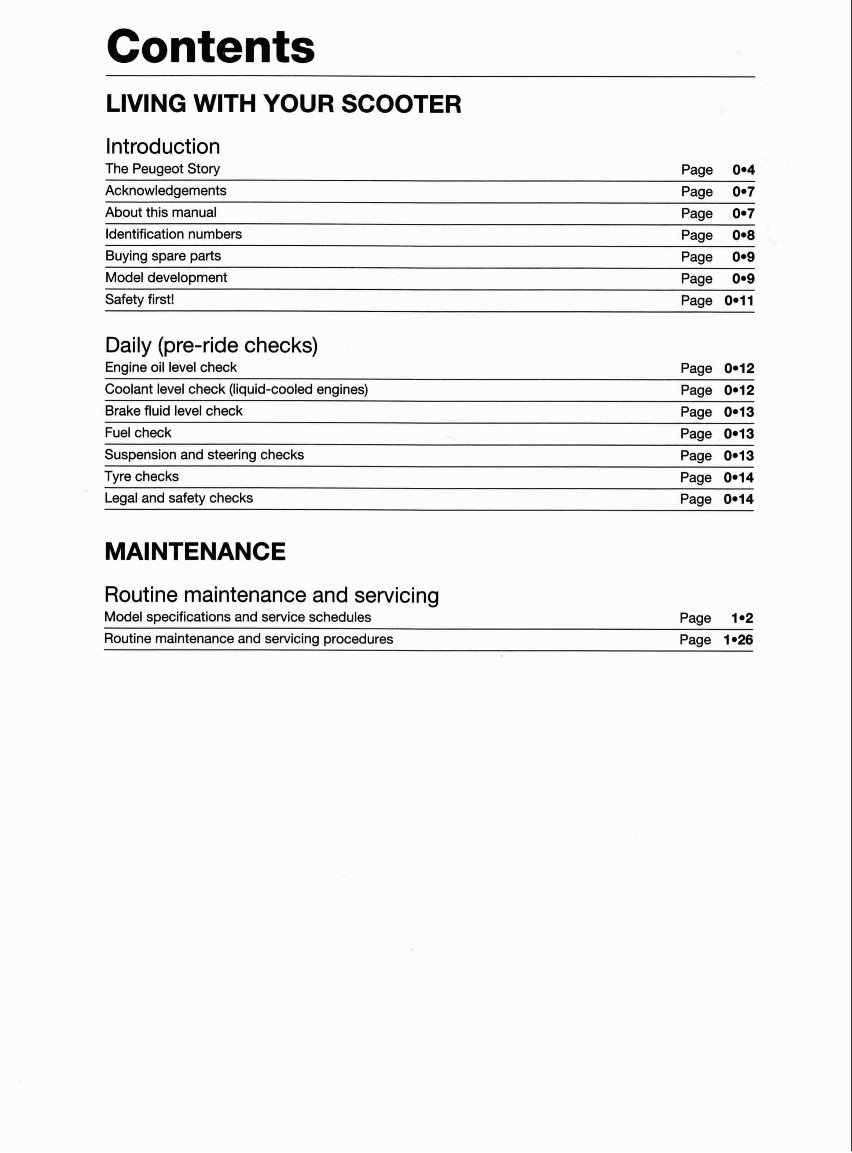
Contents LIVING WITH YOUR SCOOTER Introduction The Peuaeot Storv Paae 0 . 4 Acknowledgements Page 0.7 About this manual Page 0.7 Identification numbers Pane 0.8 Buying spare parts Page 0.9 Model development Page 0.9 Safety first! Page 0.11 Daily (pre-ride checks) Engine oil level check Page 0.12 Coolant level check (liquid-cooled engines) Page 0.12 Brake fluid level check Page 0.13 Fuel check Paae 0.13 Suspension and steering checks Page 0.13 Tyre checks Page 0.14 Legal and safety checks Pane 0.14 MAINTENANCE Routine maintenance and servicing Model specifications and service schedules Page 1.2 Routine maintenance and servicing procedures Page 1.26
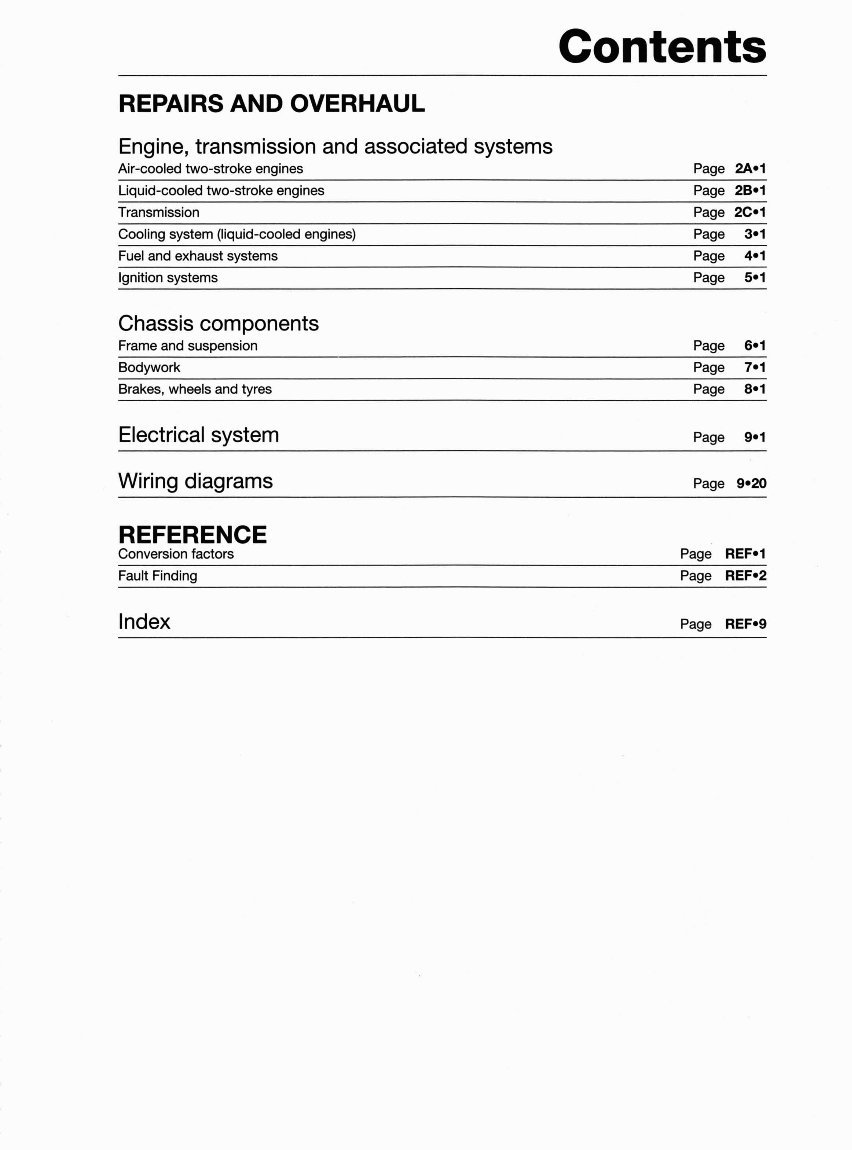
Contents REPAIRS AND OVERHAUL Engine, transmission and associated systems Air-cooled two-stroke engines Page 2A.1 Liauid-cooledtwo-stroke enaines Paae 28.1 Transmission Page 2C.1 Cooling system (liquid-cooled engines) Page 3.1 Fuel and exhaust systems Page 4.1 Ignition svstems Pane 5.1 Chassis components Frame and suspension Page 6.1 Bodywork Page 7.1 Brakes, wheels and tvres Pane 8.1 Electrical system Page 9.1 Wiring diagrams Page 9.20 REFERENCE Conversion factors Page REF4 Fault Finding Page REF02 Index Page REF~Q
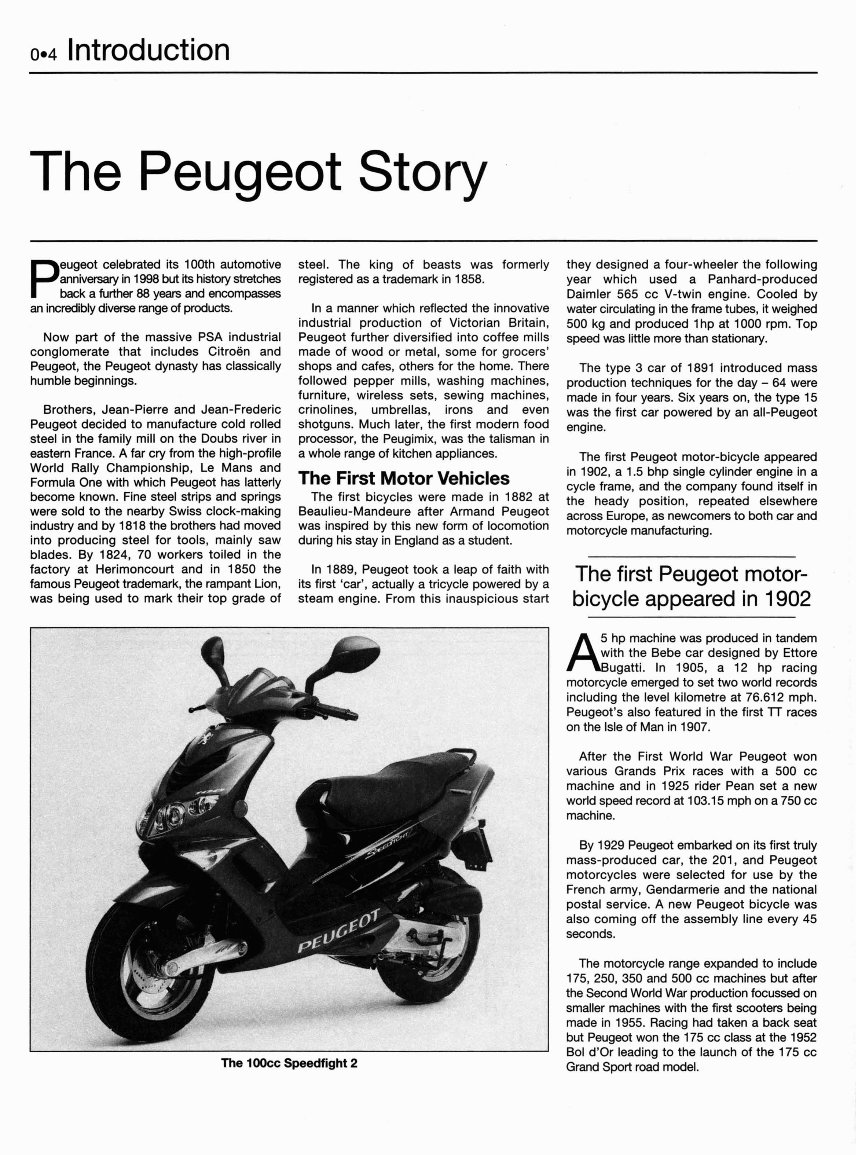
0.4 Introduction The Peugeot Story D eugeot celebrated its 100th automotive anniversarv in 1998 but its histow stretches 1 back a furiher 88 years and en&mpasses an incredibly diverse range of products. Now part of the massive PSA industrial conglomerate that includes Citrogn and Peugeot, the Peugeot dynasty has classically humble beginnings. Brothers, Jean-Pierre and Jean-Frederic Peugeot decided to manufacture cold rolled steel in the family mill on the Doubs river in eastern France. A far cry from the high-profile World Rally Championship, Le Mans and Formula One with which Peugeot has latterly become known. Fine steel strips and springs were sold to the nearby Swiss clock-making industry and by 181 8 the brothers had moved into producing steel for tools, mainly saw blades. By 1824, 70 workers toiled in the factory at Herimoncourt and in 1850 the famous Peugeot trademark, the rampant Lion, was being used to mark their top grade of steel. The king of beasts was formerly registered as a trademark in 1858. In a manner which reflected the innovative industrial production of Victorian Britain, Peugeot further diversified into coffee mills made of wood or metal, some for grocers' shops and cafes, others for the home. There followed pepper mills, washing machines, furniture, wireless sets, sewing machines, crinolines, umbrellas, irons and even shotguns. Much later, the first modern food processor, the Peugimix, was the talisman in a whole range of kitchen appliances. The First Motor Vehicles The first bicycles were made in 1882 at Beaulieu-Mandeure after Armand Peugeot was inspired by this new form of locomotion during his stay in England as a student. In 1889, Peugeot took a leap of faith with its first 'car', actually a tricycle powered by a steam engine. From this inauspicious start The lOOcc Speedfight 2 they designed a four-wheeler the following year which used a Panhard-produced Daimler 565 cc V-twin engine. Cooled by water circulating in the frame tubes, it weighed 500 kg and produced 1 hp at 1000 rpm. Top speed was little more than stationary. The type 3 car of 1891 introduced mass production techniques for the day - 64 were made in four years. Six years on, the type 15 was the first car powered by an all-Peugeot engine. The first Peugeot motor-bicycle appeared in 1902, a 1.5 bhp single cylinder engine in a cycle frame, and the company found itself in the heady position, repeated elsewhere across Europe, as newcomers to both car and motorcyclemanufacturing. The first Peugeot motor- bicycle appeared in 1902 5 hp machine was produced in tandem with the Bebe car designed by Ettore A ugatti. In 1905, a 12 hp racing motorcycle emerged to set two world records including the level kilometre at 76.612 mph. Peugeot's also featured in the first lT races on the Isle of Man in 1907. After the First World War Peugeot won various Grands Prix races with a 500 cc machine and in 1925 rider Pean set a new world speed record at 103.15 mph on a 750 cc machine. By 1929 Peugeot embarked on its first truly mass-produced car, the 201, and Peugeot motorcycles were selected for use by the French army, Gendarmerie and the national postal service. A new Peugeot bicycle was also coming off the assembly line every 45 seconds. The motorcycle range expanded to include 175,250,350 and 500 cc machines but after the Second World War production focussed on smaller machines with the first scooters being made in 1955. Racing had taken a back seat but Peugeot won the 175 cc class at the 1952 Bol d'Or leading to the launch of the 175 cc Grand Sport road model.
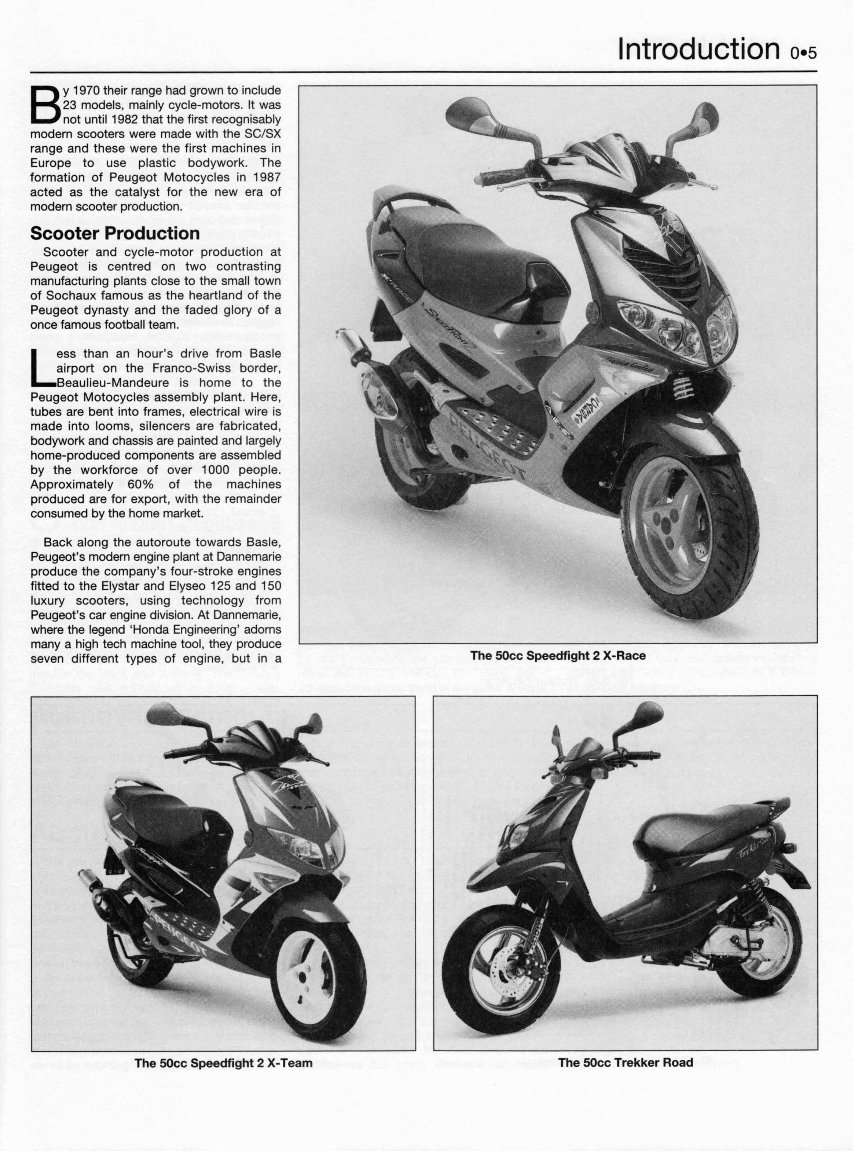
Introduction 0.5 B y 1970 their range had grown to include 23 models, mainly cycle-motors. It was not until 1982 that the first recognisably modern scooters were made with the SC/SX range and these were the first machines in Europe to use plastic bodywork. The formation of Peugeot Motocycles in 1987 acted as the catalyst for the new era of modern scooter production. Scooter Production Scooter and cycle-motor production at Peugeot is centred on two contrasting manufacturing plants close to the small town of Sochaux famous as the heartland of the Peugeot dynasty and the faded glory of a once famous football team. L ess than an hour's drive from Basle airport on the Franco-Swiss border, Beaulieu-Mandeure is home to the Peugeot Motocycles assembly plant. Here, tubes are bent into frames, electrical wire is made into looms, silencers are fabricated, bodywork and chassis are painted and largely home-produced components are assembled by the workforce of over 1000 people. Approximately 60% of the machines produced are for export, with the remainder consumed by the home market. Back along the autoroute towards Basle, Peugeot's modern engine plant at Dannemarie produce the company's four-stroke engines fitted to the Elystar and Elyseo 125 and 150 luxury scooters, using technology from Peugeot's car engine division. At Dannemarie, where the legend 'Honda Engineering' adorns many a high tech machine tool, they produce seven different types of engine, but in a The Wcc Speedfight 2 X-Race The Wcc Speedfight 2 X-Team The 50cc Trekker Road
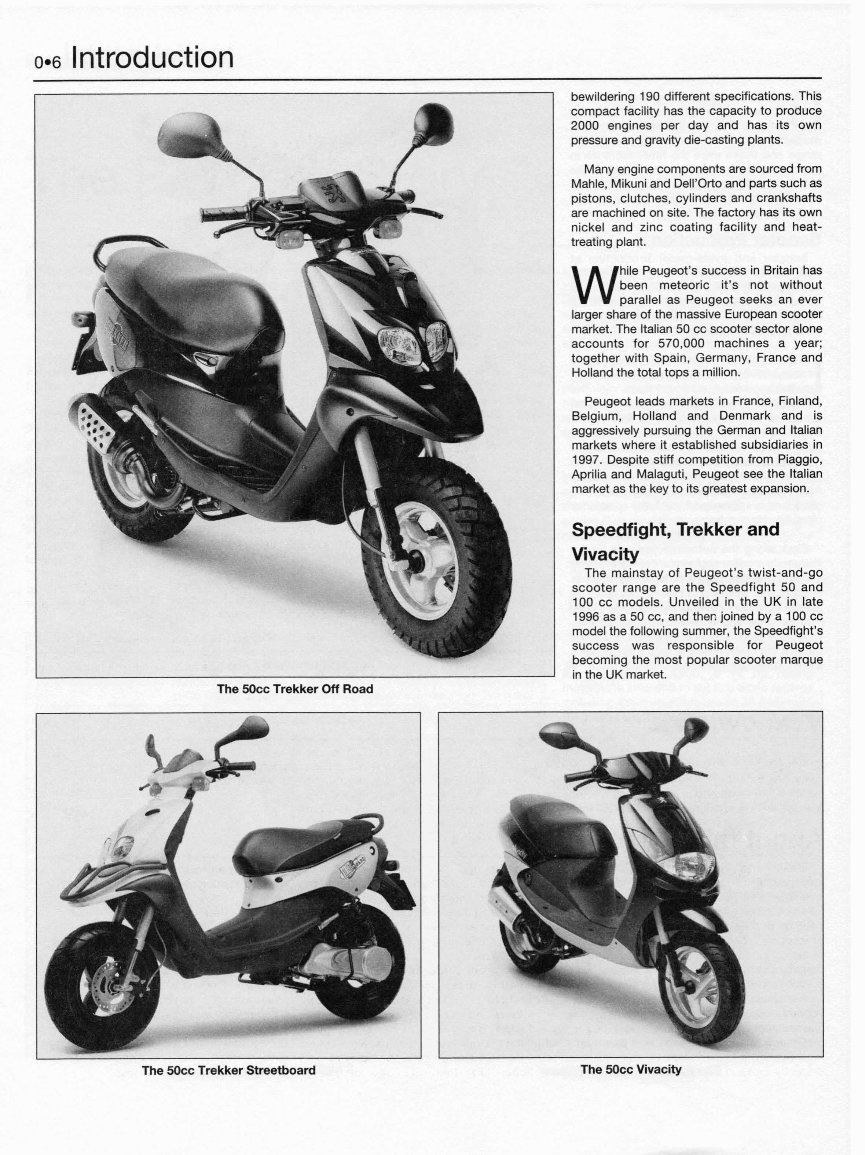
0.6 Introduction bewildering 190 different specifications. This compact facility has the capacity to produce 2000 engines per day and has its own pressure and gravity die-casting plants. Many engine components are sourced from Mahle, Mikuni and Dell'Orto and parts such as pistons, clutches, cylinders and crankshafts are machined on site. The factory has its own nickel and zinc coating facility and heat- treating plant. w hile Peugeot's success in Britain has been meteoric it's not without parallel as Peugeot seeks an ever larger share of the massive European scooter market. The Italian 50 cc scooter sector alone accounts for 570,000 machines a year; together with Spain, Germany, France and Holland the total tops a million. Peugeot leads markets in France, Finland, Belgium, Holland and Denmark and is aggressively pursuing the German and Italian markets where it established subsidiaries in 1997. Despite stiff competition from Piaggio, Aprilia and Malaguti, Peugeot see the Italian market as the key to its greatest expansion. Speedfight, Trekker and Vivacity The mainstay of Peugeot's twist-and-go scooter range are the Speedfight 50 and 100 cc models. Unveiled in the UK in late 1996 as a 50 cc, and then joined by a 100 cc model the following summer, the Speedfight's success was responsible for Peugeot becoming the most popular scooter marque in the UK market. The 50cc Trekker Off Road - The 50cc Trekker Streetboard The 50cc Vivacity
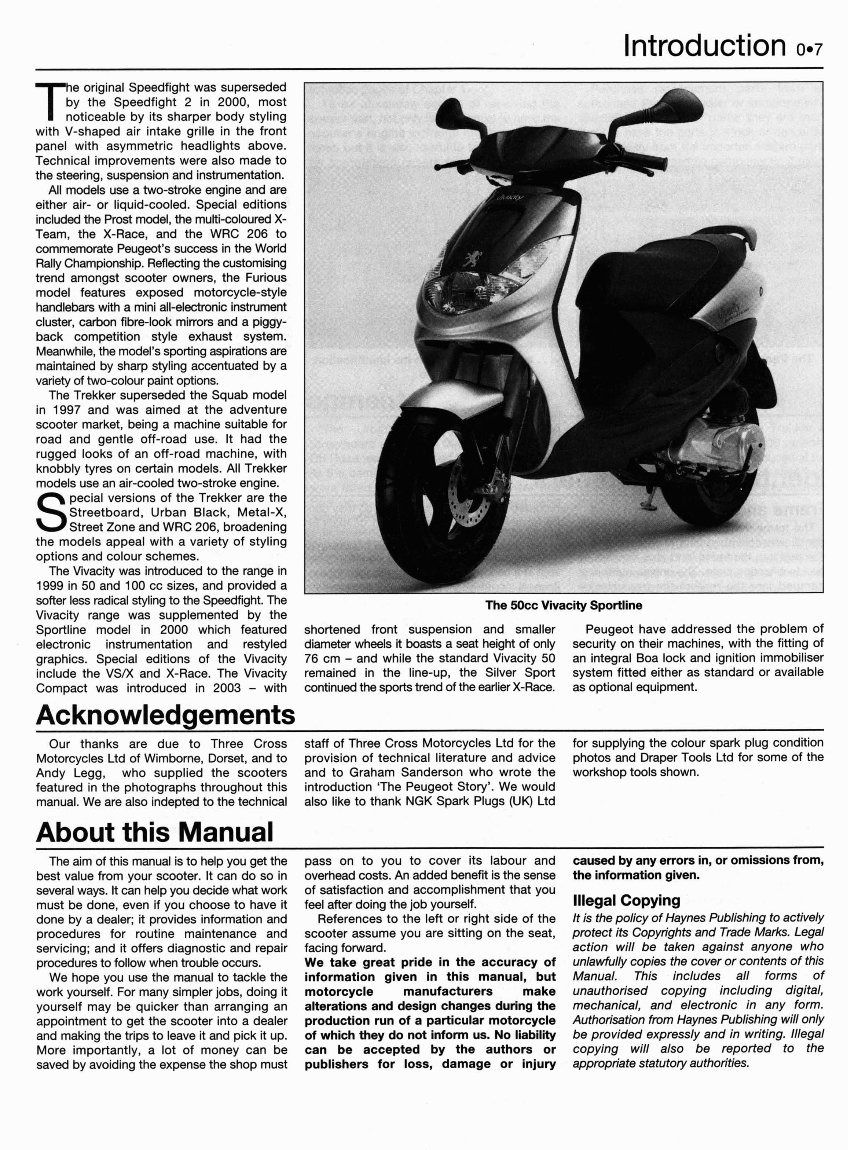
Introduction 0.7 T he original Speedfight was superseded by the Speedfight 2 in 2000, most noticeable by its sharper body styling with V-shaped air intake grille in the front panel with asymmetric headlights above. Technical improvements were also made to the steering, suspension and instrumentation. All models use a two-stroke engine and are either air- or liquid-cooled. Special editions included the Prost model, the multi-coloured X- Team, the X-Race, and the WRC 206 to commemorate Peugeot's success in the World Rally Championship. Reflectingthe customising trend amongst scooter owners, the Furious model features exposed motorcycle-style handlebars with a mini all-electronic instrument cluster, carbon fibre-look mirrors and a piggy- back competition style exhaust system. Meanwhile,the model's sporting aspirations are maintained by sharp styling accentuated by a variety of twotolour paint options. The Trekker superseded the Squab model in 1997 and was aimed at the adventure scooter market, being a machine suitable for road and gentle off-road use. It had the rugged looks of an off-road machine, with knobbly tyres on certain models. All Trekker models use an air-cooled two-stroke engine. S pecial versions of the Trekker are the Streetboard, Urban Black, Metal-X, Street Zone and WRC 206, broadening the models appeal with a variety of styling options and colour schemes. The Vivacity was introduced to the range in 1999 in 50 and 100 cc sizes, and provided a softer less radical styling to the Speedfight. The Vivacity range was supplemented by the Sportline model in 2000 which featured electronic instrumentation and restyled graphics. Special editions of the Vivacity include the VS/X and X-Race. The Vivacity Compact was introduced in 2003 - with The 50cc Vivacity Sportline shortened front suspension and smaller Peugeot have addressed the problem of diameter wheels it boasts a seat height of only security on their machines, with the fitting of 76 cm - and while the standard Vivacity 50 an integral Boa lock and ignition immobiliser remained in the line-up, the Silver Sport system fitted either as standard or available continued the sports trend of the earlier X-Race. as optional equipment. Acknowledgements Our thanks are due to Three Cross staff of Three Cross Motorcycles Ltd for the for supplying the colour spark plug condition Motorcycles Ltd of Wimborne, Dorset, and to provision of technical literature and advice photos and Draper Tools Ltd for some of the Andy Legg, who supplied the scooters and to Graham Sanderson who wrote the workshop tools shown. featured in the photographs throughout this introduction 'The Peugeot Story'. We would manual. We are also indepted to the technical also like to thank NGK Spark Plugs (UK) Ltd About this Manual The aim of this manual is to help you get the best value from your scooter. It can do so in several ways. It can help you decide what work must be done, even if you choose to have it done by a dealer; it provides information and procedures for routine maintenance and servicing; and it offers diagnostic and repair procedures to follow when trouble occurs. We hope you use the manual to tackle the work yourself. For many simpler jobs, doing it yourself may be quicker than arranging an appointment to get the scooter into a dealer and making the trips to leave it and pick it up. More importantly, a lot of money can be saved by avoiding the expense the shop must pass on to you to cover its labour and overhead costs. An added benefit is the sense of satisfaction and accomplishment that you feel after doing the job yourself. References to the left or right side of the scooter assume you are sitting on the seat, facing forward. We take great pride in the accuracy of information given in this manual, but motorcycle manufacturers make alterations and design changes during the production run of a particular motorcycle of which they do not inform us. No liability can be accepted by the authors or publishers for loss, damage or injury caused by any errors in, or omissions from, the information given. Illegal Copying It is the policy of Haynes Publishing to actively protect its Copyrights and Trade Marks. Legal action will be taken against anyone who unlawfully copies the cover or contents of this Manual. This includes all forms of unauthorised copying including digital, mechanical, and electronic in any form. Authorisation from Haynes Publishing will only be provided expressly and in writing. lllegal copying will also be reported to the appropriate statutory authorities.
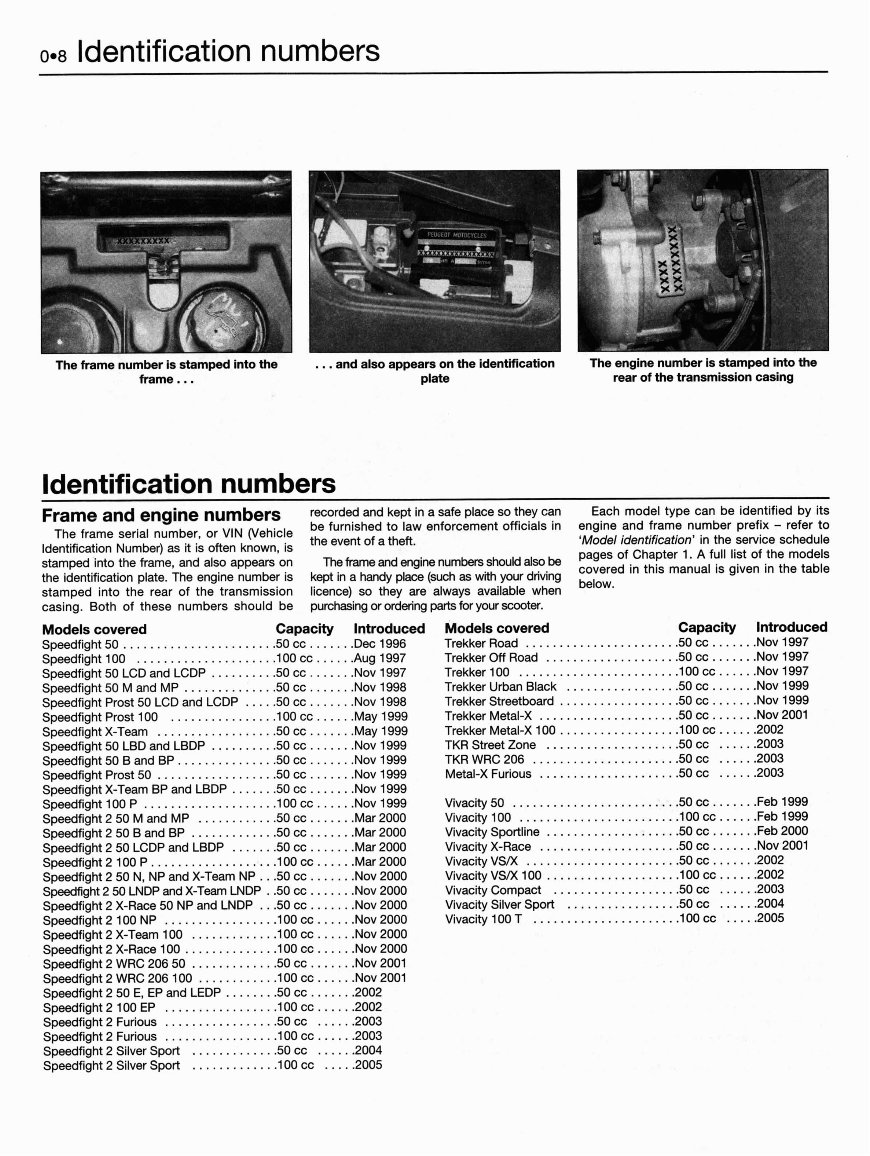
0.8 ldentification numbers .. The frame number is stamped into the ... and also appears on the identification The engine number is stamped into the frame ... plate rear of the transmission casing ldentification numbers Frame and engine numbers recorded and kept in a safe place so they can Each model type can be identified by its be furnished to law enforcement officials in engine and frame number prefix . refer to The frame serial number. or VIN (Vehicle the event of a 'Model identification' in the service schedule Identification Number) as it is often known. is pages of Chapter 1 . A full list of the models stamped into the frame. and also appears on The frame and engine numbers shouM also be covered in this manual is given in the table the identification plate . The engine number is kept in a handy place (such as with your driving below . stam~ed into the rear of the transmission licence) so they are always available when ~asin'~ . Both of these numbers should be or ordering partsfor your scooter . Models covered Capacity Introduced Models covered Capacity Introduced ....... Speedfight 50 ....................... 50 cc ....... Dec 1996 TrekkerRoad ....................... 50cc Nov1997 Speedfight 100 ..................... 100 cc ...... Aug 1997 Trekker Off Road .................... 50 cc ....... Nov 1997 ........................ Speedfight 50 LCD and LCDP .......... 50 cc ....... Nov 1997 Trekker 100 100 cc ...... Nov 1997 Speedfight 50 M and MP .............. 50 cc ....... Nov 1998 Trekker Urban Black ................. 50 cc ....... Nov 1999 .................. ....... Speedfight Prost 50 LCD and LCDP ..... 50 cc ....... Nov 1998 Trekker Streetboard 50 cc Nov 1999 Speedfight Prost 100 ................ 100 cc ..... .May 1999 Trekker Metal-X ..................... 50 cc ....... Nov 2001 .................. ...... .................. ...... Speedfight X-Team 50 cc .May 1999 Trekker Metal-X 100 100 cc 2002 .................... ...... Speedfight 50 LBD and LBDP .......... 50 cc ....... Nov 1999 TKR Street Zone 50 cc 2003 Speedfight 50 B and BP ............... 50 cc ....... Nov 1999 TKRWRC206 ...................... 50cc ...... 2003 ..................... ...... Speedfight Prost 50 .................. 50 cc ....... Nov 1999 Metal-X Furious 50 cc 2003 Speedfight X-Team BP and LBDP ....... 50 cc ....... Nov 1999 ......................... Speedfight 100 P .................... 100 cc ...... Nov 1999 Vivacity 50 50 cc ....... Feb 1999 ...... Speedfight 2 50 M and MP ............ 50 cc ...... .Mar 2000 Vivacity 100 ........................ 100 cc Feb 1999 Speedfight 2 50 B and BP ............. 50 cc ...... .Mar 2000 Vivacity Sportline .................... 50 cc ....... Feb 2000 Speedfight 2 50 LCDP and LBDP ....... 50 cc ...... .Mar 2000 Vivacity X-Race ..................... 50 cc ....... Nov 2001 ....................... ................... ..... ....... Speedfight 2 100 P 100 cc .Mar 2000 Vivacity VS/X 50 cc 2002 .................... ....... ...... Speedfight 2 50 N, NP and X-Team NP ... 50 cc Nov 2000 Vivacity VS/X 100 100 cc 2002 ................... .. ....... ...... Speedfight 2 50 LNDP and X-Team LNDP 50 cc Nov 2000 Vivacity Compact 50 cc 2003 ....... ................. ...... Speedfight 2 X-Race 50 NP and LNDP ... 50 cc Nov 2000 Vivacity Silver Sport 50 cc 2004 ...................... ................. ...... ..... Speedfight 2 100 NP 100 cc Nov 2000 Vivacity 100 T 100 cc 2005 Speedfight 2 X-Team 100 ............. 100 cc ...... Nov 2000 Speedfight 2 X-Race 100 .............. 100 cc ...... Nov 2000 Speedfight 2 WRC 206 50 ............. 50 cc ....... Nov 2001 Speedfight 2 WRC 206 100 ............ 100 cc ...... Nov 2001 Speedfight 2 50 E, EP and LEDP ........ 50 cc ....... 2002 ................. Speedfight 2 100 EP 100 cc ...... 2002 ................. Speedfight 2 Furious 50 cc ...... 2003 ................. Speedfight 2 Furious 100 cc ...... 2003 Speedfight 2 Silver Sport ............. 50 cc ...... 2004 Speedfight 2 Silver Sport ............. 100 cc ..... 2005
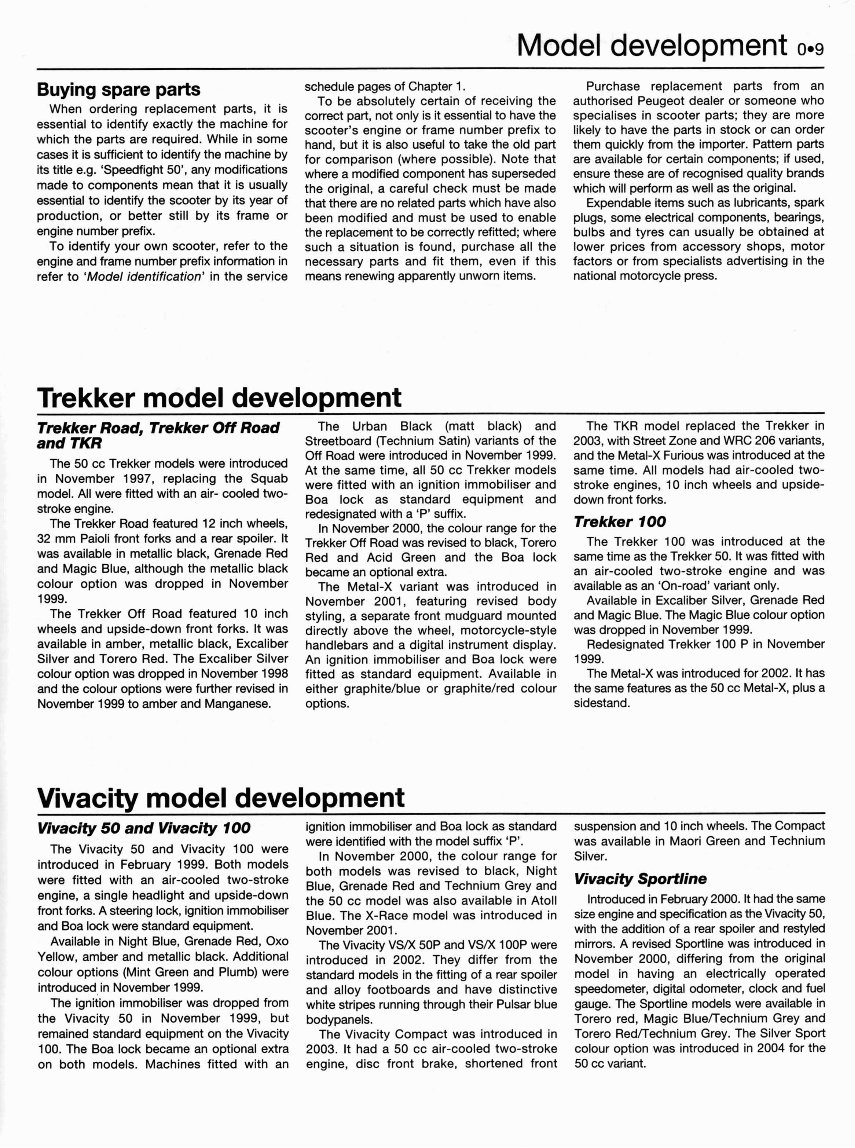
Model development 0.9 Buying spare parts When ordering replacement parts, it is essential to identify exactly the machine for which the parts are required. While in some cases it is sufficient to identify the machine by its title e.g. 'Speedfight 50', any modifications made to components mean that it is usually essential to identify the scooter by its year of production, or better still by its frame or engine number prefix. To identify your own scooter, refer to the engine and frame number prefix information in refer to 'Model identification' in the service schedule pages of Chapter 1. To be absolutely certain of receiving the correct part, not only is it essential to have the scooter's engine or frame number prefix to hand, but it is also useful to take the old part for comparison (where possible). Note that where a modified component has superseded the original, a careful check must be made that there are no related parts which have also been modified and must be used to enable the replacement to be correctly refitted; where such a situation is found, purchase all the necessary parts and fit them, even if this means renewing apparently unworn items. Trekker model development Purchase replacement parts from an authorised Peugeot dealer or someone who specialises in scooter parts; they are more likely to have the parts in stock or can order them quickly from the importer. Pattern parts are available for certain components; if used, ensure these are of recognised quality brands which will perform as well as the original. Expendable items such as lubricants, spark plugs, some electrical components, bearings, bulbs and tyres can usually be obtained at lower prices from accessory shops, motor factors or from specialists advertising in the national motorcycle press. - Trekker Road, Trekker Off Road The Urban Black (matt black) and and TKR Streetboard (lechnium Satin) variants of the - - - - - - - - - The 50 cc Trekker models were introduced in November 1997, replacing the Squab model. All were fitted with an air- cooled two- stroke engine. The Trekker Road featured 12 inch wheels, 32 mm Paioli front forks and a rear spoiler. It was available in metallic black, Grenade Red and Magic Blue, although the metallic black colour option was dropped in November 1999. The Trekker Off Road featured 10 inch wheels and upside-down front forks. It was available in amber, metallic black, Excaliber Silver and Torero Red. The Excaliber Silver colour option was dropped in November 1998 and the colour options were further revised in November 1999 to amber and Manganese. Off Road were introduced in November 1999. At the same time, all 50 cc Trekker models were fitted with an ignition immobiliser and Boa lock as standard equipment and redesignatedwith a 'P' suffix. In November 2000, the colour range for the Trekker Off Road was revised to black, Torero Red and Acid Green and the Boa lock became an optional extra. The Metal-X variant was introduced in November 2001, featuring revised body styling, a separate front mudguard mounted directly above the wheel, motorcycle-style handlebars and a digital instrument display. An ignition immobiliser and Boa lock were fitted as standard equipment. Available in either graphite/blue or graphitehed colour options. The TKR model replaced the Trekker in 2003, with Street Zone and WRC 206 variants, and the Metal-X Furious was introduced at the same time. All models had air-cooled two- stroke engines, 10 inch wheels and upside- down front forks. Trekker 100 The Trekker 100 was introduced at the same time as the Trekker 50. It was fitted with an air-cooled two-stroke engine and was available as an 'On-road' variant only. Available in Excaliber Silver, Grenade Red and Magic Blue. The Magic Blue colour option was dropped in November 1999. Redesignated Trekker 100 P in November 1999. The Metal-X was introducedfor 2002. It has the same features as the 50 cc Metal-X, plus a sidestand. Vivacity model development Vivacity 50 and Vivacity 100 ignition immobiliser and Boa lock as standard suspension and 10 inch wheels. The Compact were identified with the model suffix 'P'. was available in Maori Green and Technium The Vivacity 50 and Vivacity loo were In November 2000, the colour range for Silver. introduced in February 1999. Both models both models was revised to black, Night were fitted with an air-cooled two-stroke Blue, Grenade Red and Technium Grey and Vivacity Sportline a single headlight and upside-d0wn the 50 cc model was also available in Atoll Introduced in February2000. It had the same front forks. A steering lock, bnition immObiliser Blue. The X-Race model was introduced in size engine and specification as the Vivacity 50, and Boa lock were standard equipment. November 2001. with the addition of a rear spoiler and restyled Available in Night Blue, Grenade Red, 0x0 he Vivacity VS/X 50P and VS/X l o o p were mirrors. A revised Sportline was introduced in Yellow, amber and metallic black. Additional introduced in 2002. They differ from the November 2000, differing from the original CO~OU~ options (Mint Green and Plumb) were standard models in the fitting of a rear spoiler model in having an electrically operated introduced in November 1999. and alloy footboards and have distinctive speedometer, digital odometer, clock and fuel The ignition immobiliser was dropped from white stripes running through their Pulsar blue gauge. The Sportline models were available in the Vivacity 50 in November 1999, but bodypanels. Torero red, Magic BlueAechnium Grey and remained standard equipment on the Vivacity The Vivacity Compact was introduced in Torero RedAechnium Grey. The Silver Sport 100. The Boa lock became an optional extra 2003. It had a 50 cc air-cooled two-stroke colour option was introduced in 2004 for the on both models. Machines fitted with an engine, disc front brake, shortened front 50 cc variant.
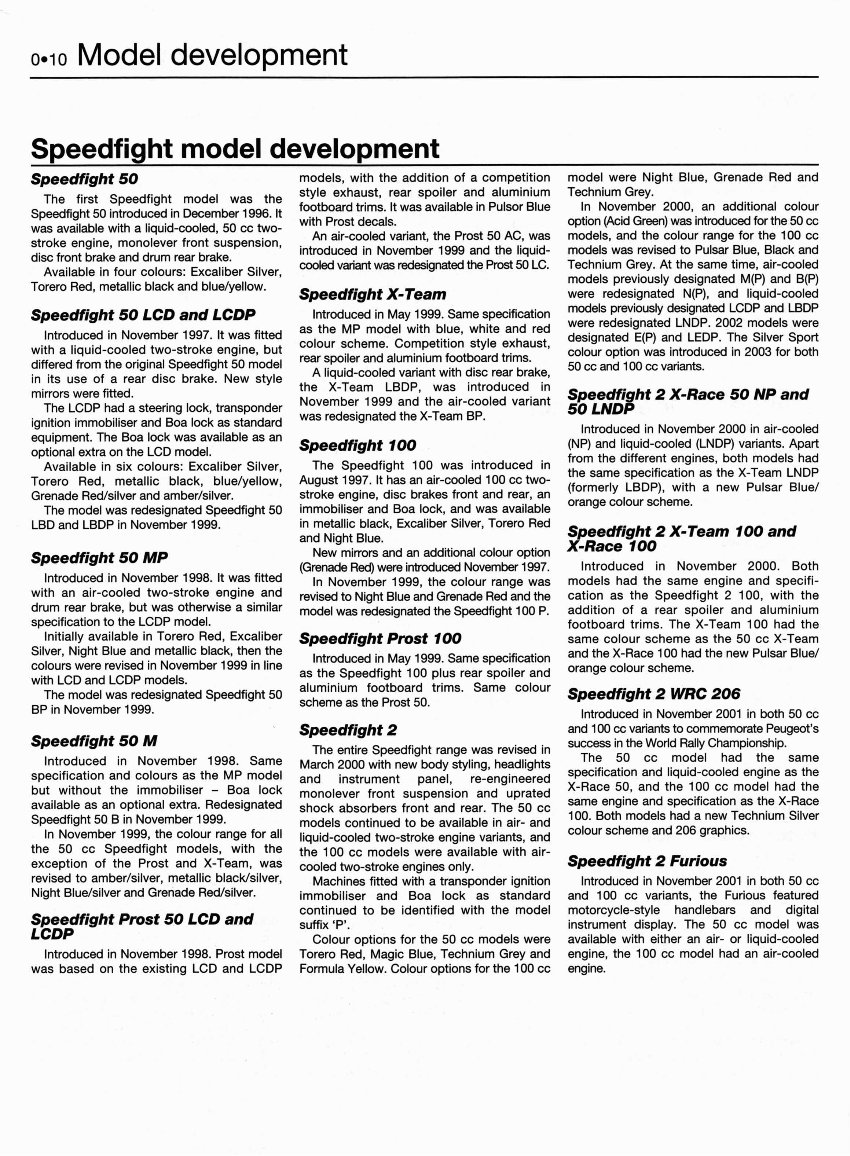
0.10 Model development Speedfight model development Speedfight 50 The first Speedfight model was the Speedfight 50 introduced in December 1996. It was available with a liquid-cooled, 50 cc two- stroke engine, monolever front suspension, disc front brake and drum rear brake. Available in four colours: Excaliber Silver, Torero Red, metallic black and blue/yellow. Speedfight 50 LCD and LCDP lntroduced in November 1997. It was fltted with a liquid-cooled two-stroke engine, but differed from the original Speedfight 50 model in its use of a rear disc brake. New style mirrors were fitted. The LCDP had a steering lock, transponder ignition immobiliser and Boa lock as standard equipment. The Boa lock was available as an optional extra on the LCD model. Available in six colours: Excaliber Silver, Torero Red, metallic black, blue/yellow, Grenade Red/silver and amber/silver. The model was redesignatedSpeedfight 50 LBD and LBDP in November 1999. Speedfight 50 MP lntroduced in November 1998. It was fitted with an air-cooled two-stroke engine and drum rear brake, but was otherwise a similar specification to the LCDP model. Initially available in Torero Red, Excaliber Silver, Night Blue and metallic black, then the colours were revised in November 1999 in line with LCD and LCDP models. The model was redesignatedSpeedfight 50 BP in November 1999. models, with the addition of a competition style exhaust, rear spoiler and aluminium footboard trims. It was available in Pulsor Blue with Prost decals. An air-cooled variant, the Prost 50 AC, was introduced in November 1999 and the liquid- cooledvariant was redesignated the Prost 50 LC. Speedfight X-Team lntroduced in May 1999. Same specification as the MP model with blue, white and red colour scheme. Competition style exhaust, rear spoiler and aluminium footboard trims. A liquid-cooledvariant with disc rear brake, the X-Team LBDP, was introduced in November 1999 and the air-cooled variant was redesignatedthe X-Team BP. Speedfight 100 The Speedfight 100 was introduced in August 1997. It has an air-cooled 100 cc two- stroke engine, disc brakes front and rear, an immobiliser and Boa lock, and was available in metallic black, Excaliber Silver, Torero Red and Night Blue. New mirrors and an additional colour option (Grenade Red)were introduced November 1997. In November 1999, the colour range was revised to Night Blue and Grenade Red and the model was redesignatedthe Speedfight 100 P. Speedfight Prost 100 lntroduced in May 1999. Same specification as the Speedfight 100 plus rear spoiler and aluminium footboard trims. Same colour scheme as the Prost 50. model were Night Blue, Grenade Red and Technium Grey. In November 2000, an additional colour option (Acid Green) was introducedfor the 50 cc models, and the colour range for the 100 cc models was revised to Pulsar Blue, Black and Technium Grey. At the same time, air-cooled models previously designated M(P) and B(P) were redesignated N(P), and liquid-cooled models previously designated LCDP and LBDP were redesignated LNDP. 2002 models were designated E(P) and LEDP. The Silver Sport colour option was introduced in 2003 for both 50 cc and 100 cc variants. Speedfight 2 X-Race 50 NP and 50 LNDP lntroduced in November 2000 in air-cooled (NP) and liquid-cooled (LNDP) variants. Apart from the different engines, both models had the same specification as the X-Team LNDP (formerly LBDP), with a new Pulsar Blue/ orange colour scheme. Speedfight 2 X-Team 100 and X-Race 100 lntroduced in November 2000. Both models had the same engine and specifi- cation as the Speedfight 2 100, with the addition of a rear spoiler and aluminium footboard trims. The X-Team 100 had the same colour scheme as the 50 cc X-Team and the X-Race 100 had the new Pulsar Blue/ orange colour scheme. Speedfight 2 WRC 206 lntroduced in November 2001 in both 50 cc Speedfight 50 M lntroduced in November 1998. Same specification and colours as the MP model but without the immobiliser - Boa lock available as an optional extra. Redesignated Speedfight 50 B in November 1999. In November 1999, the colour range for all the 50 cc Speedfight models, with the exception of the Prost and X-Team, was revised to amber/silver, metallic black/silver, Night Blue/silver and Grenade Red/silver. Speedfight Prost 50 LCD and LCDP lntroduced in November 1998. Prost model was based on the existing LCD and LCDP Speedfight 2 The entire Speedfight range was revised in March 2000 with new body styling, headlights and instrument panel, re-engineered monolever front suspension and uprated shock absorbers front and rear. The 50 cc models continued to be available in air- and liquid-cooled two-stroke engine variants, and the 100 cc models were available with air- cooled two-stroke engines only. Machines fitted with a transponder ignition immobiliser and Boa lock as standard continued to be identified with the model suffix 'P'. Colour options for the 50 cc models were Torero Red, Magic Blue, Technium Grey and Formula Yellow. Colour options for the 100 cc and 100 cc variants to commemorate Peugeot's success in the World Rally Championship. The 50 cc model had the same specification and liquid-cooled engine as the X-Race 50, and the 100 cc model had the same engine and specification as the X-Race 100. Both models had a new Technium Silver colour scheme and 206 graphics. Speedfight 2 Furious lntroduced in November 2001 in both 50 cc and 100 cc variants, the Furious featured motorcycle-style handlebars and digital instrument display. The 50 cc model was available with either an air- or liquid-cooled engine, the 100 cc model had an air-cooled engine.
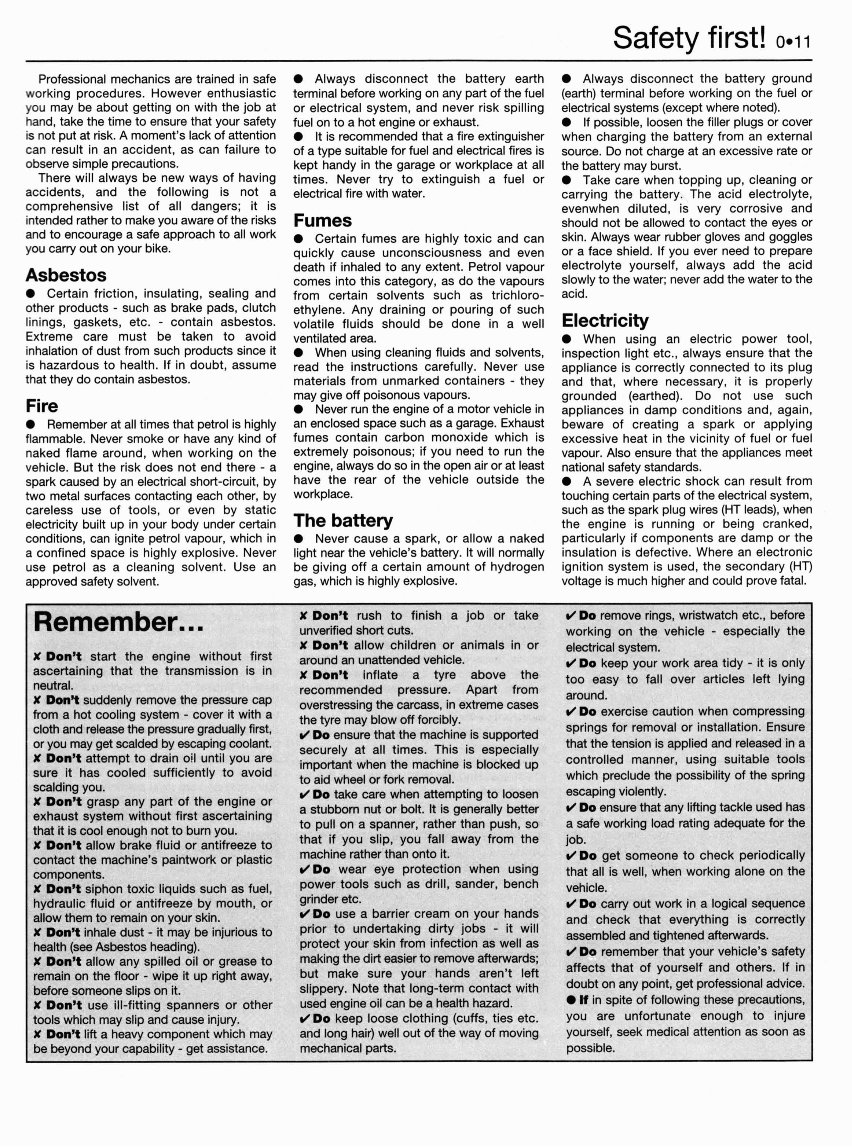
Safety first! 0 . 1 I Professional mechanics are trained in safe working procedures. However enthusiastic you may be about getting on with the job at hand, take the time to ensure that your safety is not put at risk. A moment's lack of attention can result in an accident, as can failure to observe simple precautions. There will always be new ways of having accidents, and the following is not a comprehensive list of all dangers; it is intended rather to make you aware of the risks and to encourage a safe approach to all work you carry out on your bike. Always disconnect the battery earth terminal before working on any part of the fuel or electrical system, and never risk spilling fuel on to a hot engine or exhaust. It is recommended that a fire extinguisher of a type suitable for fuel and electrical fires is kept handy in the garage or workplace at all times. Never try to extinguish a fuel or electrical fire with water. Always disconnect the battery ground (earth) terminal before working on the fuel or electrical systems (except where noted). If possible, loosen the filler plugs or cover when charging the battery from an external source. Do not charge at an excessive rate or the battery may burst. Take care when topping up, cleaning or carrying the battery. The acid electrolyte, evenwhen diluted, is very corrosive and should not be allowed to contact the eyes or skin. Always wear rubber gloves and goggles or a face shield. If you ever need to prepare electrolyte yourself, always add the acid slowly to the water; never add the water to the acid. Fumes Certain fumes are highly toxic and can quickly cause unconsciousness and even death if inhaled to any extent. Petrol vapour comes into this category, as do the vapours from certain solvents such as trichloro- ethylene. Any draining or pouring of such volatile fluids should be done in a well ventilated area. When using cleaning fluids and solvents, read the instructions carefully. Never use materials from unmarked containers - they may give off poisonous vapours. Never run the engine of a motor vehicle in an enclosed space such as a garage. Exhaust fumes contain carbon monoxide which is extremely poisonous; if you need to run the engine, always do so in the open air or at least have the rear of the vehicle outside the workplace. Asbestos Certain friction, insulating, sealing and other products - such as brake pads, clutch linings, gaskets, etc. - contain asbestos. Extreme care must be taken to avoid inhalation of dust from such products since it is hazardous to health. If in doubt, assume that they do contain asbestos. Electricity When using an electric power tool, inspection light etc., always ensure that the appliance is correctly connected to its plug and that, where necessary, it is properly grounded (earthed). Do not use such appliances in damp conditions and, again, beware of creating a spark or applying excessive heat in the vicinity of fuel or fuel vapour. Also ensure that the appliances meet national safety standards. A severe electric shock can result from touching certain parts of the electrical system, such as the spark plug wires (HT leads), when the engine is running or being cranked, particularly if components are damp or the insulation is defective. Where an electronic ignition system is used, the secondary (HT) voltage is much higher and could prove fatal. Fire Remember at all times that petrol is highly flammable. Never smoke or have any kind of naked flame around, when working on the vehicle. But the risk does not end there - a spark caused by an electrical short-circuit, by two metal surfaces contacting each other, by careless use of tools, or even by static electricity built up in your body under certain conditions, can ignite petrol vapour, which in a confined space is highly explosive. Never use petrol as a cleaning solvent. Use an approved safety solvent. The battery Never cause a spark, or allow a naked light near the vehicle's battery. It will normally be giving off a certain amount of hydrogen gas, which is highly explosive. RI X Don't rush to rings, wrist , before unverified short cuts he vehicle ally the X Don't allow chilaren or anlrnals In I X Don't start the engine without first I unattended vehicle. ascertaining that the transmission is in inflate neutral. !nded prt X Don- suddenly remove the pressvr~ can overstressing the carcass, In extreme cast from a hot cooling system - cover it the tyre may blow off forcibly. 10 exercise caution \n lresslng cloth and release the pressure gradua b' Do ensure that the machine ngs for removal or ir Ensure or you may get scalded by escaping c securely at all times. This i: the tension is appliec sed in a X Don't attempt to drain oil until y important when the machine is blocked L trolled manner, using suitable tools sure to aid wheel or fork removal. scalc X Dc (/Do take care when attempti exhaust sysrem wltnour rlrsr ascer a stubborn nut or bolt. It is gel that I to pull on a spanner, rather than push, ! ife working load rating adequate for the x Dc that if you slip, you fall awi cont, machine rather than onto it. odically comC -. . b'Do wear eye protection wnen uslr all w=lt, , v.vrking alone on the X Don't siphon toxic liquids such as fuel, Power hydraulic fluid or antifreeze by mouth, or grinder et allow them to remain on your skin. /Do ust X Don% inhale dust - it may be injurious to prior undertaking dirty jc smbled and tightened afterwards health (see Asbestos head protect your skin from infectic making the dirt easier to removl ler that yo1 X Don't allow any spillec but make sure your hands ~f yourself remain on the floor - wipe before someone slips on il slippery. Note that long-term contact wi ~oint, get p X Don't use ill-fitting spanners or other used engi f in spite of following these precautions, tools which may slip and cause injury. /Do kec X Don't lift a heavy component which may and long be beyond your capability - get assistance. mechanic . finish a j ob or tal .- 10 remove king on tl . . watch etc. - especii wor !m. lur work ar fall over or elec b'D Ie too arot :trical syste : is only ft lying around ar X Don't recomme above tt 4part fro 10 keep yo easy to ~nd. 'ea tray - 11 articles le .PC. . , . A , . , with a Ily first, ioolant. 'rill Ira ,hen comp stall at ion. 1 and relea is supportt s especial .. . . ?d spri that ly ,.A,. -- -.- avoid it has cc jing you. mn't grasp . . iciently to :h precludc aping violel B the possi ntly. hat any lifti~ . . ibility of thc ng tackle u 3 spring ng to loost ierally bett I any part ... . of the en( .. . lo ensure tl . . sed has - .. tainino 50 a sz ie job. b'u 19 that it is cool er an't allow act the ma oonnnts. lough not t brake fluic chine's pa o burn you j or antifrf intwork or ay from tt !eze to plastic 10 get son nll :. ... nll leone to c ... ha.. ,.,A, 01s such s C. s a barrier . .. is drill, sa nder, benc :h vehl b'D js and 'ill "eel icle. 10 carry ou check tl ~t work in E lat everyt i logical se hing is c' !quence orrectly your hanc ~bs - it w cream on .. . . In as well i e afterward aren't If a**? 1s Is; b'u !ft affe s safety rs. If in advice. ling). j oil or g n I it up right 10 rememt: ~cts that o bt on any f ur vehicle': and othe~ rofessional !ase to : away, ne oil can I ?p loose cl hair) well o a1 parts. be a health lothing (cu ut of the w, hazard. ffs, ties et ay of movir are unfc rself, seek sible. ~rtunatet medical at ?nough to tention as 1 I injure soon as
Get your vehicle repair done today with our comprehensive service and repair manual. Whether you're a professional mechanic or a DIY enthusiast, our manual covers every service and repair job, providing you with the best resources to save on repair costs and maintain your vehicle.
Our manual includes step-by-step instructions, highly detailed exploded pictures, and diagrams to efficiently complete the required job. It covers the entire vehicle from front to back, offering the same quality used by professional mechanics.
Access an abundance of information instantly
Easy-to-use manual
Print what you need, when you need it
The only service repair workshop manual you'll ever need
Compatible with PC & MAC
Instant delivery means no shipping costs or waiting for a CD or paper manual. Upon payment completion through our secure processor, you'll receive the manual today via instant download. We accept Paypal and all major credit/debit cards.
Click on the button above to get started on your vehicle repair today.
All rights reserved. Designated trademarks and brands are the property of their respective owners.
Recently Viewed
5,521,897Happy Clients
2,594,462eManuals
1,120,453Trusted Sellers
15Years in Business
Price:
Actual Price:
1999-2005 Peugeot Vivacity 50cc 100cc Service & Repair Manual



 Lifetime Access