


2012-2013 Kawasaki KX450F Service & Repair Manual
What's Included?
 Lifetime Access
Fast Download Speeds
Online & Offline Access
Access PDF Contents & Bookmarks
Full Search Facility
Print one or all pages of your manual
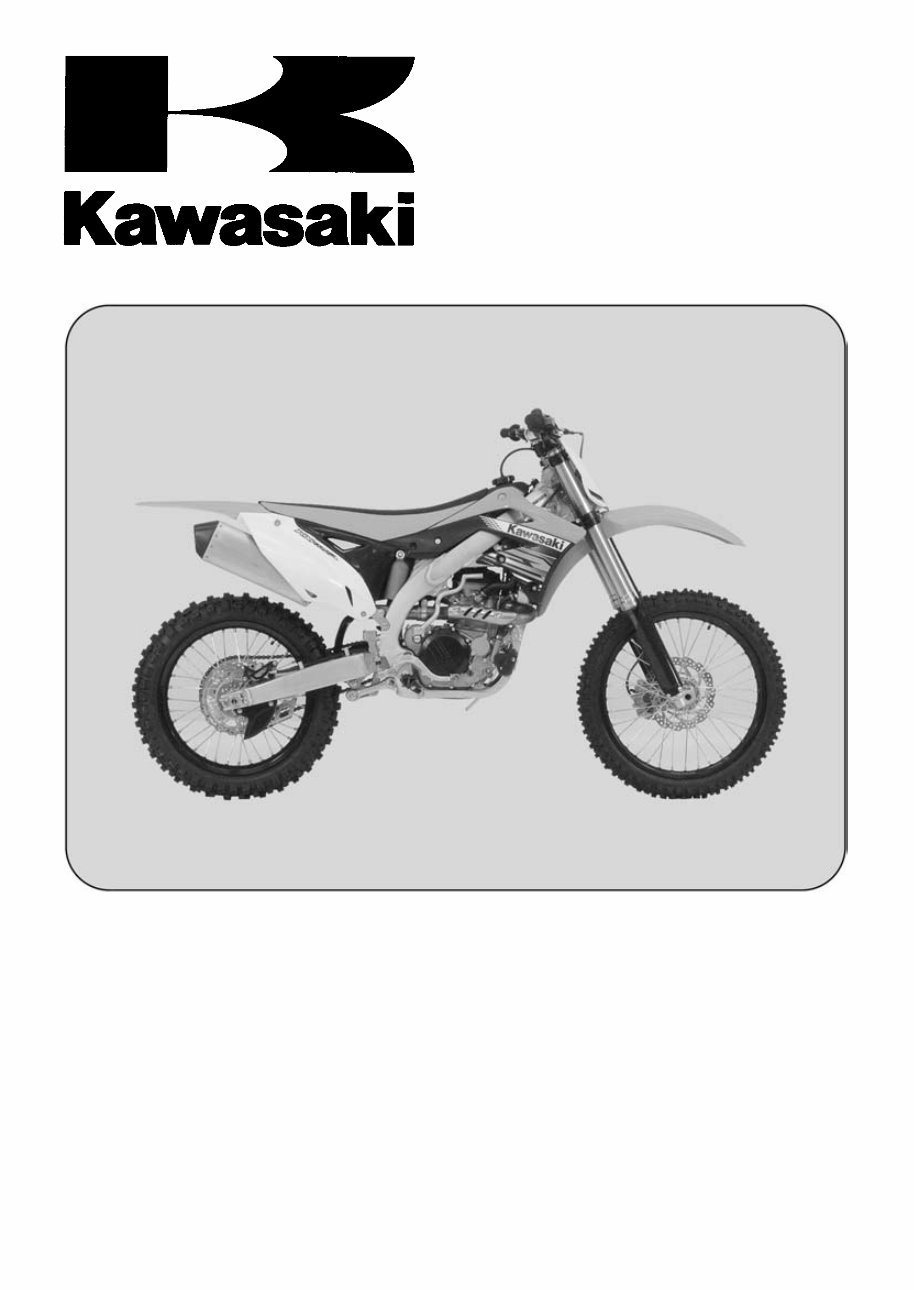
KX450F
Motorcycle
Service Manual

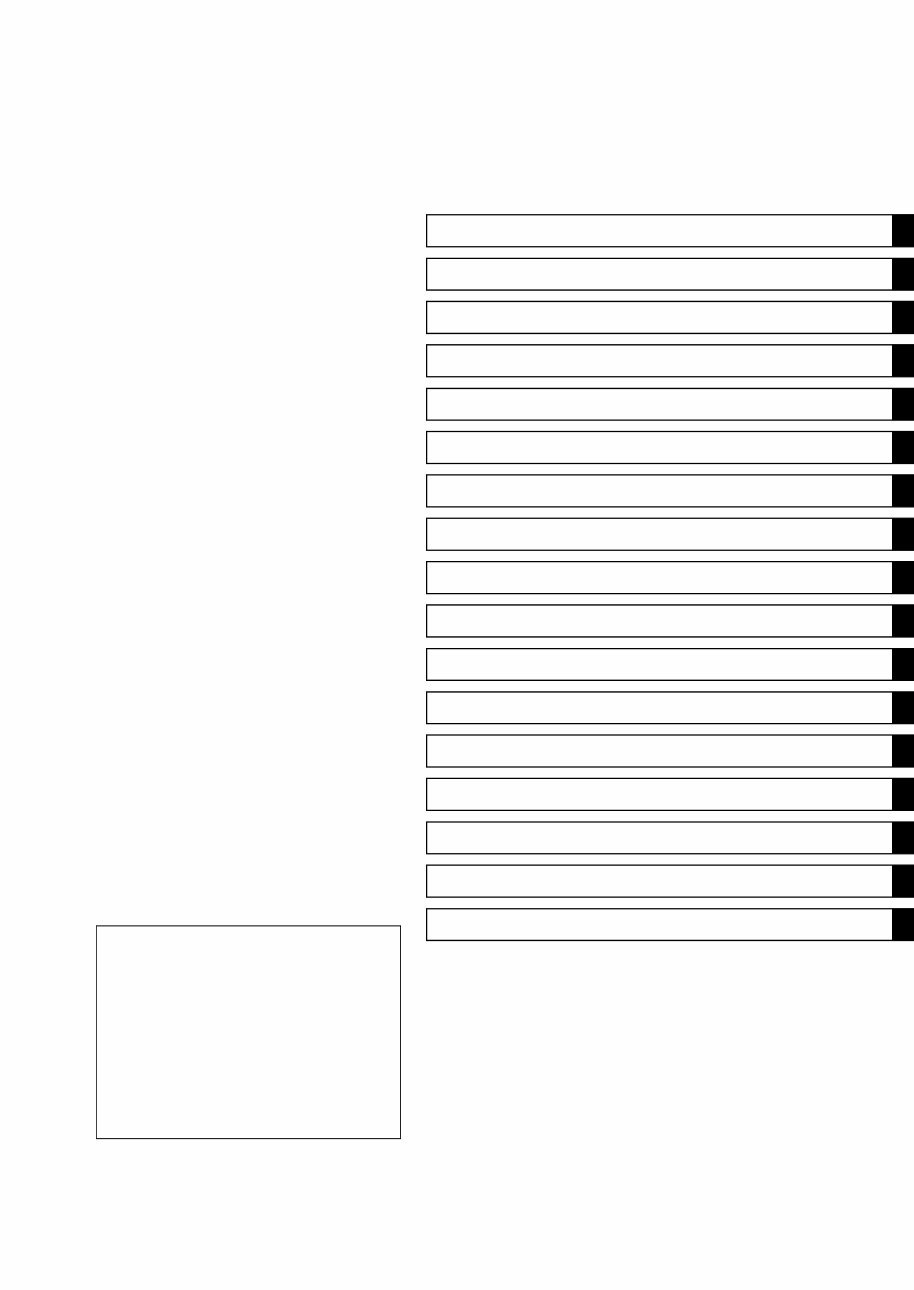
This quick reference guide will assist
you in locating a desired topic or pro-
cedure.
•Bend the pages back to match the
black tab of the desired chapter num-
ber with the black tab on the edge at
each table of contents page.
•Refer to the sectional table of contents
for the exact pages to locate the spe-
cific topic required.
Quick Reference Guide
General Information 1
Periodic Maintenance 2
Fuel System (DFI) 3
Cooling System 4
Engine Top End 5
Clutch 6
Engine Lubrication System 7
Engine Removal/Installation 8
Crankshaft/Transmission 9
Wheels/Tires 10
Final Drive 11
Brakes 12
Suspension 13
Steering 14
Frame 15
Electrical System 16
Appendix 17


KX450F
Motorcycle
Service Manual
All rights reserved. No parts of this publication may be reproduced, stored in a retrieval system, or
transmitted in any form or by any means, electronic mechanical photocopying, recording or otherwise,
without the prior written permission of Quality Assurance Division/Motorcycle & Engine Company/Kawasaki
Heavy Industries, Ltd., Japan.
No liability can be accepted for any inaccuracies or omissions in this publication, although every possible
care has been taken to make it as complete and accurate as possible.
The right is reserved to make changes at any time without prior notice and without incurring an obligation
to make such changes to products manufactured previously. See your Motorcycle dealer for the latest
information on product improvements incorporated after this publication.
All information contained in this publication is based on the latest product information available at the time
of publication. Illustrations and photographs in this publication are intended for reference use only and may
not depict actual model component parts.
© 2011 Kawasaki Heavy Industries, Ltd. Second Edition (0) : Apr. 18, 2012

LIST OF ABBREVIATIONS
A ampere(s) in. inch(s)
ABDC after bottom dead center KDS Kawasaki Diagnostic System
AC alternating current km/h kilometers per hour
Ah ampere hour L liter(s)
ATDC after top dead center lb pound(s)
BBDC before bottom dead center LED Light Emitting Diode
BDC bottom dead center m meter(s)
BTDC before top dead center min minute(s)
°C degree(s) Celsius mph miles per hour
cmHg centimeters of mercury N newton(s)
CPU Central Processing Unit oz ounce(s)
cu in cubic inch(s) Pa pascal(s)
DC direct current PS horsepower
DFI Digital Fuel Injection psi pound(s) per square inch
ECU Electronic Control Unit qt quart(s)
F farad(s) r revolution
°F degree(s) Fahrenheit rpm revolution(s) perminute
ft foot, feet s second(s)
g gram(s) TDC top dead center
gal gallon(s) V volt(s)
h hour(s) W watt(s)
HP horsepower(s) Ω ohm(s)
COUNTRY AND AREA CODES
AU Australia EUR Europe
BR Brazil US United States
CA Canada
Foreword
This manual is designed primarily for use by
trained mechanics in a properly equipped shop.
However, it contains enough detail and basic in-
formation to make it useful to the owner who de-
sires to perform his own basic maintenance and
repair work. A basic knowledge of mechanics,
the proper use of tools, and workshop proce-
dures must be understood in order to carry out
maintenance and repair satisfactorily. When-
ever the owner has insufficient experience or
doubts his ability to do the work, all adjust-
ments, maintenance, and repair should be car-
ried out only by qualified mechanics.
In order to perform the work efficiently and
to avoid costly mistakes, read the text, thor-
oughly familiarize yourself with the procedures
before starting work, and then do the work care-
fully in a clean area. Whenever special tools or
equipment are specified, do not use makeshift
tools or equipment. Precision measurements
can only be made if the proper instruments are
used, and the use of substitute tools may ad-
versely affect safe operation.
To get the longest life out of your vehicle:
•
Follow the Periodic Maintenance Chart in the
Service Manual.
•
Be alert for problems and non-scheduled
maintenance.
•
Use proper tools and genuine Kawasaki Mo-
torcycle parts. Special tools, gauges, and
testers that are necessary when servicing
Kawasaki motorcycles are introduced by the
Service Manual. Genuine parts provided as
spare parts are listed in the Parts Catalog.
•
Follow the procedures in this manual care-
fully. Don’t take shortcuts.
•
Remember to keep complete records of main-
tenance and repair with dates and any new
parts installed.
How to Use This Manual
In this manual, the product is divided into
its major systems and these systems make up
the manual’s chapters. The Quick Reference
Guide shows you all of the product’s system
and assists in locating their chapters. Each
chapter in turn has its own comprehensive Ta-
ble of Contents.
For example, if you want stick coil information,
use the Quick Reference Guide to locate the
Electrical System chapter. Then, use the Table
of Contents on the first page of the chapter to
find the Stick Coil section.
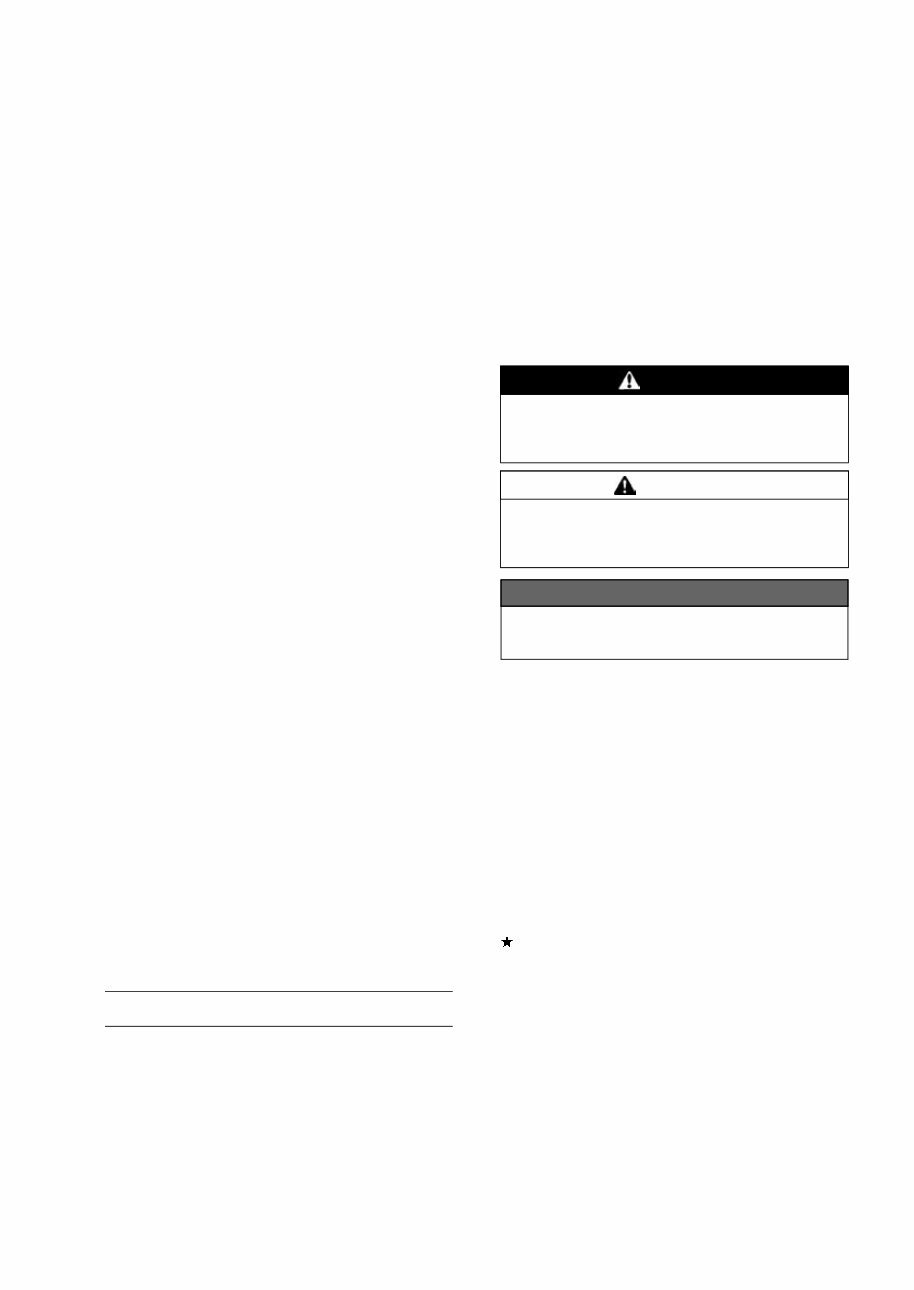
Whenever you see symbols, heed their in-
structions! Always follow safe operating and
maintenance practices.
DANGER
DANGER indicates a hazardous situa-
tion which, if not avoided, will result in
death or serious injury.
WARNING
WARNING indicates a hazardous situa-
tion which, if not avoided, could result
in death or serious injury.
NOTICE
NOTICE is used to address practices not
related to personal injury.
This manual contains four more symbols
which will help you distinguish different types
of information.
NOTE
○ This note symbol indicates points of par-
ticular interest for more efficient and con-
venient operation.
•
Indicates a procedural step or work to be
done.
○ Indicates a procedural sub-step or how to do
the work of the procedural step it follows. It
also precedes the text of a NOTE.
Indicates a conditional step or what action to
take based on the results of the test or inspec-
tion in the procedural step or sub-step it fol-
lows.
In most chapters an exploded view illustration
of the system components follows the Table of
Contents. In these illustrations you will find the
instructions indicating which parts require spec-
ified tightening torque, oil, grease or a locking
agent during assembly.


GENERAL INFORMATION 1-1
1
General Information
Table of Contents
Before Servicing ..................................................................................................................... 1-2
Model Identification................................................................................................................. 1-7
General Specifications............................................................................................................ 1-8
Technical Information - DFI Setting Data Selection ................................................................ 1-11
Technical Information - Launch Control Mode ........................................................................ 1-13
Technical Information - PSF (Pneumatic Spring Fork) Front Fork (KX450FD) ....................... 1-15
Unit Conversion Table ............................................................................................................ 1-20
1-2 GENERAL INFORMATION
Before Servicing
Before starting to perform an inspection service or carry out a disassembly and reassembly opera-
tion on a motorcycle, read the precautions given below. To facilitate actual operations, notes, illustra-
tions, photographs, cautions, and detailed descriptions have been included in each chapter wherever
necessary. This section explains the items that require particular attention during the removal and
reinstallation or disassembly and reassembly of general parts.
Especially note the following:
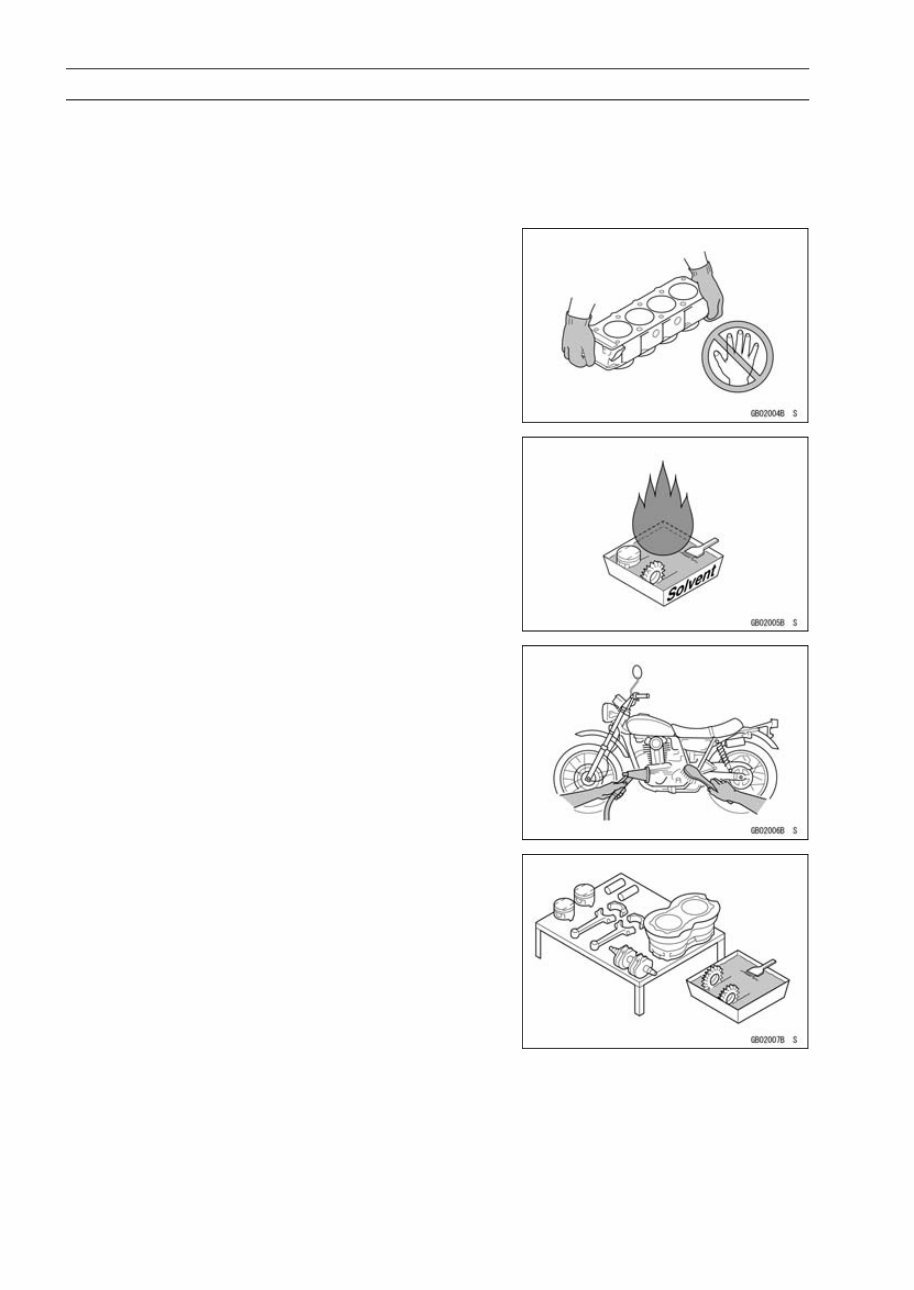
Edges of Parts
Lift large or heavy parts wearing gloves to prevent injury
from possible sharp edges on the parts.
Solvent
Use a high flash-point solvent when cleaning parts. High
flash-point solvent should be used according to directions
of the solvent manufacturer.
Cleaning Vehicle before Disassembly
Clean the vehicle thoroughly before disassembly. Dirt or
other foreign materials entering into sealed areas during ve-
hicle disassembly can cause excessive wear and decrease
performance of the vehicle.
Arrangement and Cleaning of Removed Parts
Disassembled parts are easy to confuse. Arrange the
parts according to the order the parts were disassembled
and clean the parts in order prior to assembly.
You're Reading a Preview
What's Included?
Lifetime Access
Fast Download Speeds
Online & Offline Access
Access PDF Contents & Bookmarks
Full Search Facility
Print one or all pages of your manual
$39.99
Viewed 94 Times Today


Secure transaction
What's Included?
Lifetime Access
Fast Download Speeds
Online & Offline Access
Access PDF Contents & Bookmarks
Full Search Facility
Print one or all pages of your manual
$39.99
Get access to the comprehensive Kawasaki KX450F 2012 - 2013 Workshop Service Manual. This manual, written by the manufacturers, provides detailed information for vehicle repair, making it valuable for both professional mechanics and DIY enthusiasts.
- General Information
- Periodic Maintenance
- Fuel System
- Cooling System
- Engine Top End
- Clutch
- Engine Lubrication System
- Engine Removal/Installation
- Crankshaft/Transmission
- Wheels/Tires
- Final Drive
- Brakes
- Suspension
- Steering
- Frame
- Electrical System
- Appendix
This manual comes in PDF format and is compatible with all versions of Windows & Mac. It is available in English and consists of 492 pages, providing the most accurate and complete information for vehicle repair and maintenance.


