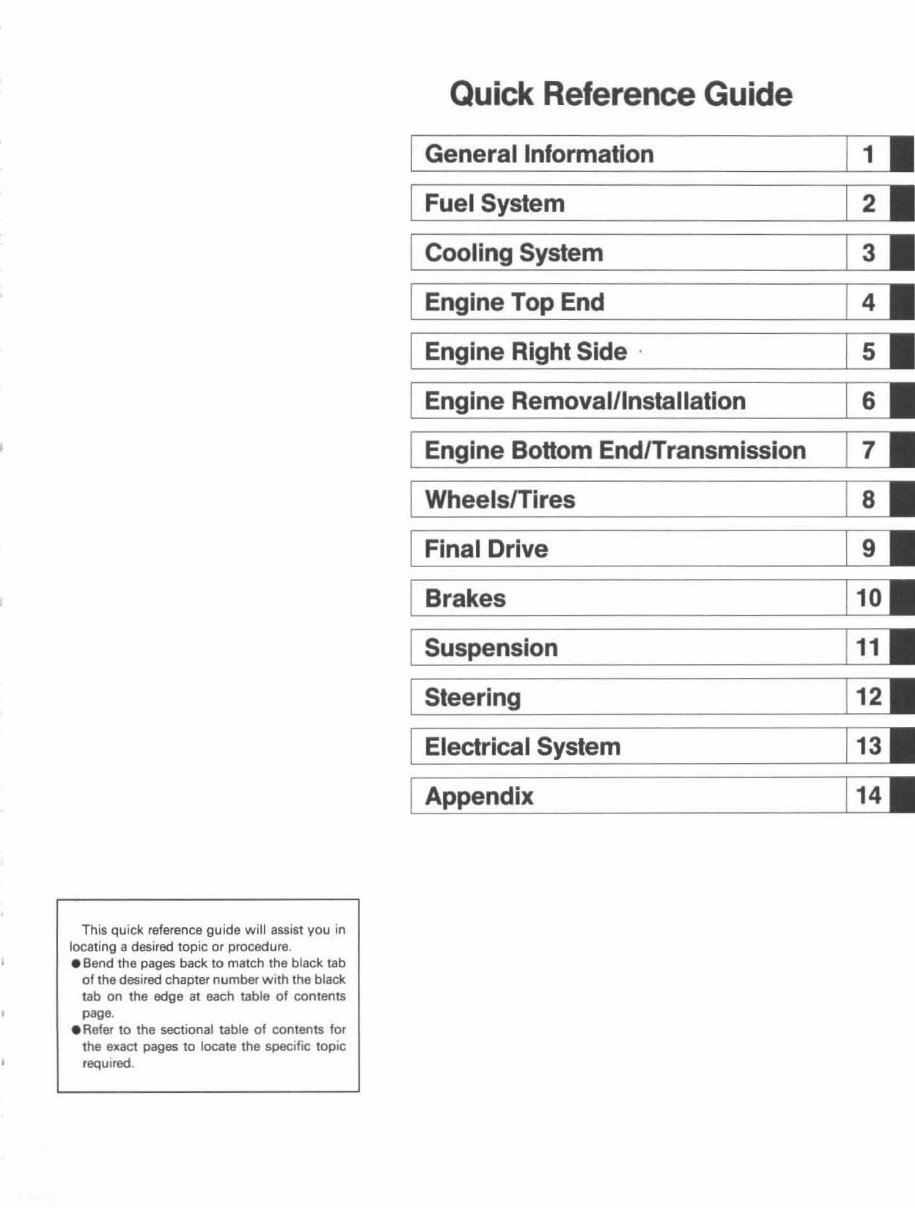
This quick reference guide will assist you in locating a desired topic or procedure. • Bend the pages back to match the black tab of the desired chapter number with the black tab on the edge at each table of contents page. • Refer to the sectional table of contents for the exact pages to locate the specific topic requ ired . Quick Reference Guide General Information Fuel System Cooling System Engine Top End Engine Right Side Engine Removal/Installation Engine Bottom End/Transmission WheelslTires Final Drive Brakes Suspension Steering Electrical System Appendix 1 • 2 • 3 • 4 • 5 • 6 • 7 • 8 • 9 • 101 111 1 12 • 1 1 31 1 141
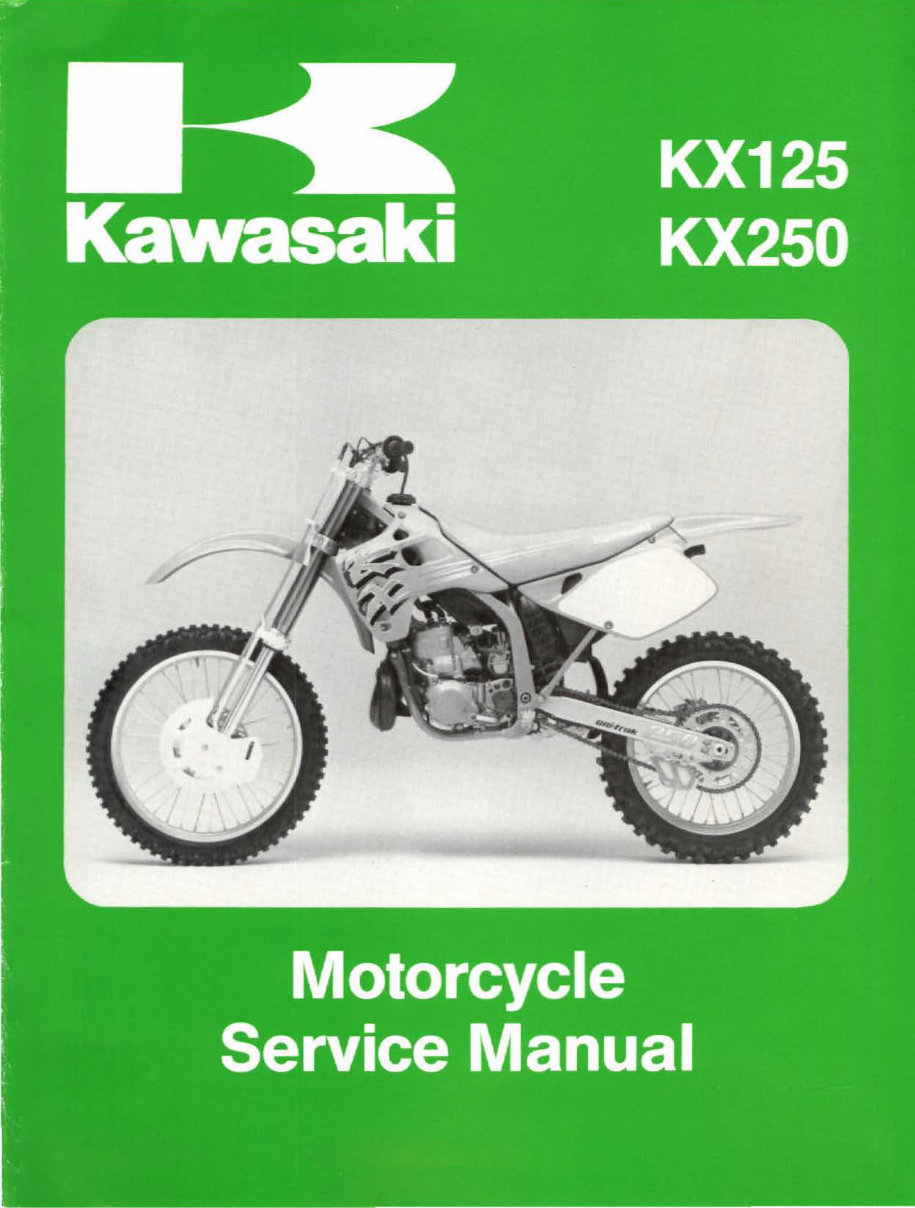
Kawasaki KX125 KX250 Motorcycle Service Manual
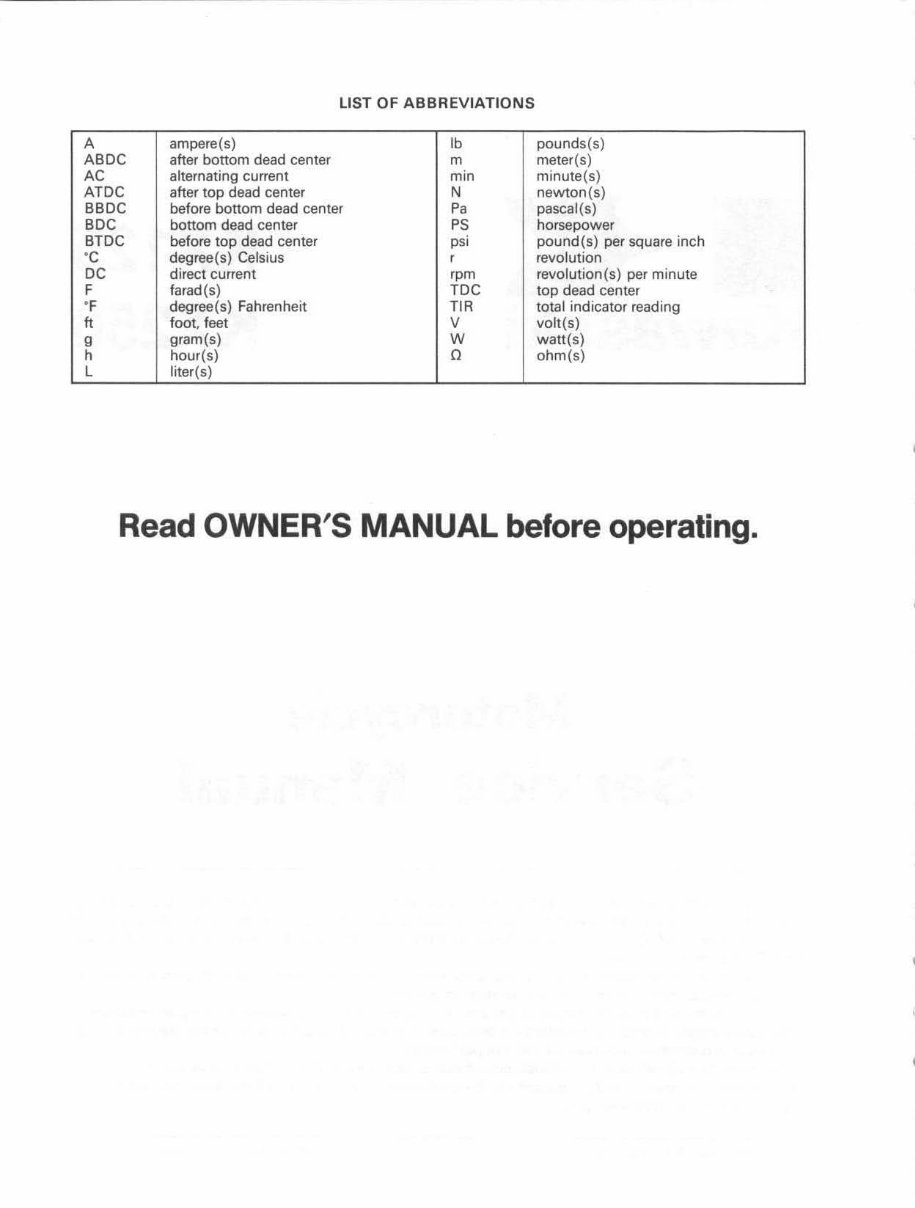
LI ST OF AB BR EV IATIONS A ampere(s) Ib pounds(s) ABOC aher bottom dead center m meter(s) AC alternating current min minute(s) ATDC after top dead center N newton(s) BBOC before bottom dead center Pa pascal(s) BOC bottom dead center PS horsepower BTDC before top dead center psi pound(s) per SQuare inch "C degree(s) Celsius , revo lution DC direct current 'pm revolution(s) per minute F farad(s) TOC top dead center "F degree(s) Fahrenheit TIR tota l indicator reading ft foot, feet V volt(s) 9 gram(s) W watt(s) h hour(s) n ohm(s) L liter(s) Read OWNER'S MANUAL before operating.
Foreword This manual is designed primarily for use by trained mechanics in a properly equipped shop. However, it contains enough detail and basic information to make it useful to the owner who desires to perform his own basic maintenance and repair work. A basic knowledge of mechanics, the proper use of tools, and workshop procedures must be understood in order to carry out maintenance and repair satisfactorily. Whenever the owner has insufficient experience or doubts his ability to do the work, all adjustments, maintenance. and repair should be carried out only by Qualified mechanics. In order to perform the work efficiently and to avoid costly mistakes, read the text, thoroughly familiarize yourself with the procedures before starting work. and then do the work carefully in a clean area , Whenever special tools or equipment are specified. do not use makeshih tools or equipment. Precision measurements can only be made if the proper instruments are used. and the use of substi - tute tools may adversely affect safe operation. We recommend that all repairs and scheduled maintenance be performed in accordance with this service manual. To get the longest life out of your Motorcycle: • Follow the Periodic Maintenance Chart in the Service Manual. • Be alert for problems and non-scheduled mainte- nance . • Use proper tools and genuine Kawasaki Motorcy- cle parts. Special tools. gauges. and testers that are necessary when seNicing Kawasaki Motorcy- cles are introduced by the Special Tool Manual. Genuine pans provided as spare pans are listed in the parts Catalog. • Follow the procedures in this manual carefully. Don't take shortcuts. • Remember to keep complete records of mainte- nance and repair with dates and any new parts installed . H ow to Use this Manua l In preparing this manual. we divided the product into its major systems. These systems became the manual's chapters. All information for a particular system from adjustment through disassembly and inspection is located in a single chapter. The Ouick Reference Guide shows you all of the product's system and assists in locating their chapters. Each chapter in turn has its own compre- hensive Table of Contents. The Periodic Maintenance Chart is located in the General Information chapter. The chart gives a time schedule for required maintenance operations. If you want spark plug information. for example, go to the Periodic Maintenance Chart first. The chart tells you how frequently to clean and gap the plug. Next, use the Ouick Reference Guide to locate the Electrical System chapter. Then, use the Table of Contents on the first page of the chapter to find the Spark Plug section. Whenever you see these WARNING and CAUTION symbols, heed their instructions! Always follow safe operating and maintenance practices. AWARNING This warning symbol identifies special instr u ction, or procedures which. jf not correctly followed. could r&luh in Pfjrll(tnal injury. or loss of life . CAUTION This caution symbol identifies specia l instr u ctions or procedures which, If not strict ly observed. cou ld r 8ltllt in dsmage to or destruction of equipmen t. This manual contains fOur more symbols (in addition to WARNING and CAUTION) which will help you distinguish different types of information.
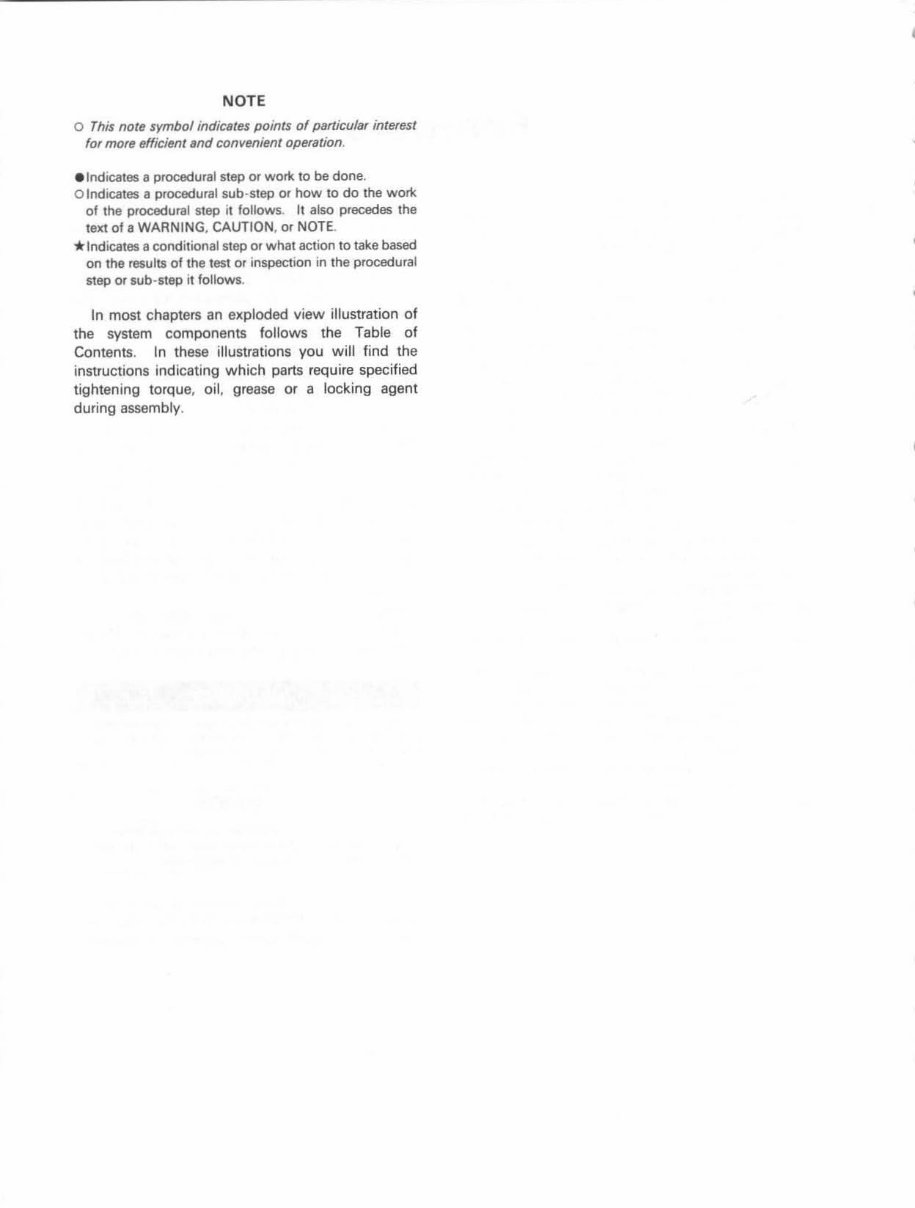
NOTE o This note symbol indicates points of particular interest fOf mor" efficient and convenient operation. • Indicates a procedural step or work to be done. 01 ndicates a procsdural sub-step or how to do the work of the procedural step it follows. It also precedes the text of 8 WARNING, CAUTION, or NOTE. * Indicates a conditional step or what action to take based on the results of the test or inspection in the procedural step or sub-step i1 follows. In most chapters an exploded view illustration of the system components foHows the Table of Contents. In these illustrations you will find the instructions indicating which parts require specified tightening torque, oil. grease or a locking agent during assembly.
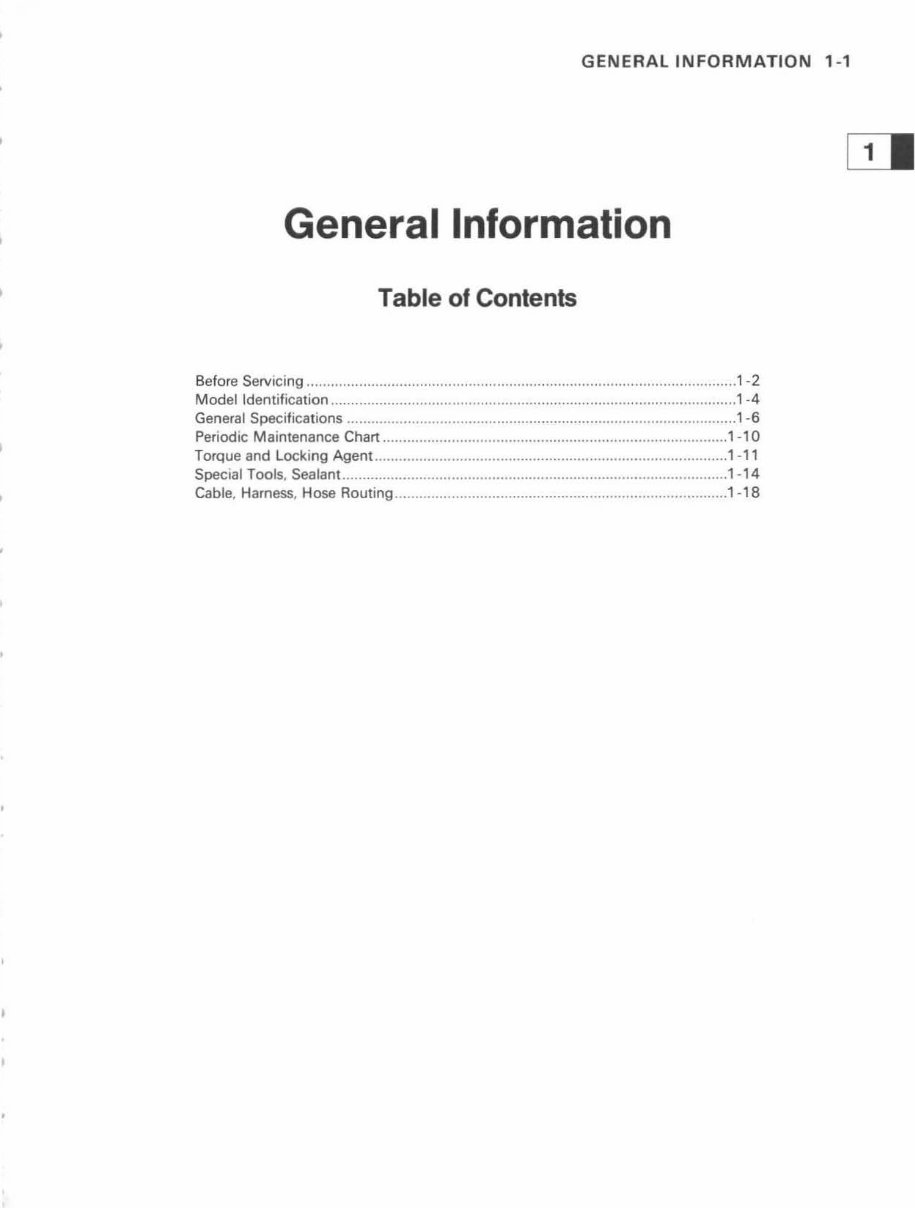
GENERAL INFORMATION 1-1 General Information Table of Contents Before Servicing ................ ............ ............................. ............ ....................... ... 1-2 Model Identification ........... .................................................................................. 1-4 General Specificati ons ............................................... .. ............................................ .. . 1-6 Periodic Maintenance Chart ..................................................................................... 1-10 Torque and locking Agent ................................................................................... ...., -, 1 Special Tools . Sealant ............................................................................................... 1-14 Cable . Harness. Hose Routing .................................................................................. 1- 18
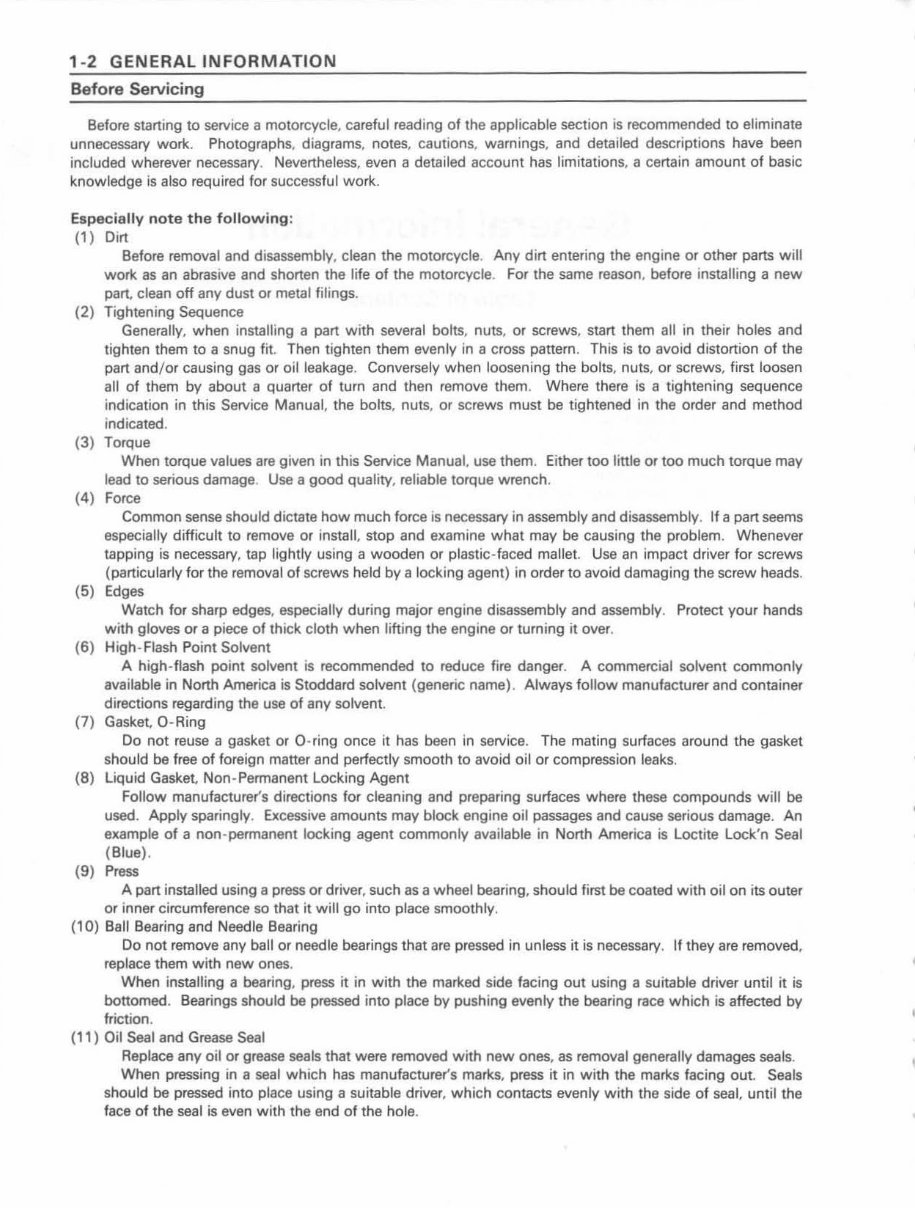
1-2 GENERAL INFORMATION Before Servicing Before starting to service a motorcycle, careful reading of the applicable section is recommended to eliminate unnecessary work. Photographs, diagrams. notes, cautions, warnings, and detailed descriptions have been included wherever necessary. Nevertheless, even a detailed account has limitations, a certain amount of basic knowledge is also required for successful wo rk. Especially note the following: (1) Di~ Before removal and disassembly. clean the motorcycle. Any dirt entering the engine or other parts will work as an abrasive and shorten the life of the motorcyc le. For the same reason, before installing a new part, clean off any dust or metal filings. (2) Tightening Sequence Generally. when installing a part with several bolts, nuts, or screws, start them all in their holes and tighten them to a snug fit. Then tighten them evenly in a cross pattern. This is to avoid distortion of the part and/ or causing gas or oil leakage. Conversely when loosening the bolts, nuts, or screws, first loosen atl of them by about a quarter of turn and then remove them. Where there is a tightening sequence indication in this SelVice Manual. the botts, nuts, or screws must be tightened in the order and method indicated. (3) Torque When torque values are given in this SelVice Manual. use them. Either too little or too much torque may lead to serious damage. Use a good quality, reliable torque wrench. (4) Force Common sense should dictate how much force is necessary in assembly and disassembly. If a part seems especially difficult to remove or install, stop and examine what may be causing the problem. Whenever tapping is necessary, tap lightly using a wooden or plastic-faced mallet. Use an impact driver for screws (particularly for the removal of screws held by a locking agent) in order to avoid damaging the screw heads. (5) Edges Watch for sharp edges, especially during major engine disassembly and assembly. Protect your hands with gloves or a piece of thick cloth when lifting the engine or turning it over. (6) High -Flash Point Solvent A high - ftash point solvent is recommended to reduce fire danger. A commercial solvent commonty available in North America is Stoddard solvent (generic name). Always follow manufacturer and container directions regarding the use of any solvent. (7) Gasket, O- Ring Do not reuse a gasket or O-ring once it has been in selVice. The mating surfaces around the gasket should be free of foreign maner and perfectly smooth to avoid oil or compression leaks. (8) Liquid Gasket. Non -Permanent Locking Agent Follow manufacturer's directions for cleaning and preparing surfaces where these compounds will be used. Apply sparingly. Excessive amounts may block engine oil passages and cause serious damage. An example of a non -permanent locking agent commonly available in North America is Loctite Lock' n Seal (Blue) . (9) Pross A part installed using a press or driver, such as a wheel bearing, should first be coated with oil on its outer or inner circum ference so that it will go into place smoothly. (10) Ball Bearing and Needle Bearing Do not remove any ball or needle bearings that are pressed in unless it is necessary. If they are removed, replace them with new ones. When installing a bearing, press it in with the marked side facing out using a suitable driver until it is bottomed. Bearings should be pressed into place by pushing evenly the bearing race which is affected by friction. (11) Oil Seal and Grease Seal Replace any oil or grease seals that were removed with new ones, as removal generally damages seals. When pressing in a seal which has manufacturer's marks, press it in with the marks facing out. Seals shou ld be pressed into place using a suitable driver, which contacts evenly with the side of seal, until the face of the seal is even with the end of the hole. •
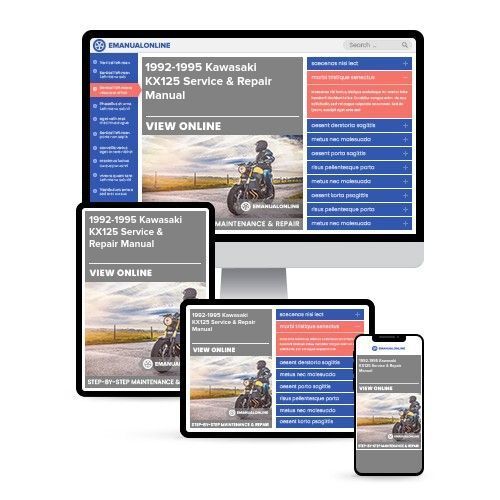
This is a comprehensive service and repair manual suitable for PC, MAC, tablets, and smartphones. It provides detailed instructions, wiring diagrams, and pictures for easy repair jobs, including routine maintenance.
The manual is available in English and is compatible with Win/MAC/Linux. It can be instantly accessed without any shipping costs, making it convenient for immediate use.
With a user-friendly layout, this manual covers all repair procedures in great detail, enabling better understanding of parts and repair processes. It includes all models for the specified years and engine types, packed with comprehensive service, repair, and maintenance information.
Upon payment via Credit/Debit/Paypal Account, the manual is instantly delivered, allowing users to save significant amounts of money by performing repairs themselves. It is designed for easy use on any PC, tablet, or laptop, making it accessible to all users.
FAQ: Why should I purchase this manual?
This manual provides an easy layout format covering all repair procedures in great detail, enabling better understanding of all parts and repair processes. With the knowledge contained within this manual, users can easily perform their own servicing, maintenance, and repairs.
FAQ: What models are covered in this manual?
All models for the specified years and all engine types are included in this manual.
FAQ: What type of information is covered?
Every manual is packed with all aspects of service, repair, and maintenance.
FAQ: How long for delivery?
Delivery on this item is instant upon payment, with no shipping involved. Users will receive the manual right away, enabling immediate repair work.
FAQ: How much money will I save?
This manual will help users save significant amounts of money, preventing overcharging by mechanics, technicians, or engineers for jobs that can be done using the information and knowledge contained in the manual.
FAQ: Is this manual hard to use?
No, it is not. The manual is in a format that is simple to use and will work on any PC/MAC computer, making it accessible to all users.



 Lifetime Access