



KAWASAKI KLX250 KLX250R KLX300R Service Repair Manual 1993- Onwards
What's Included?
 Lifetime Access
Fast Download Speeds
Online & Offline Access
Access PDF Contents & Bookmarks
Full Search Facility
Print one or all pages of your manual

Kawasaki
KLX250R
KLX250
Motorcycle
Service Manual
© Kawasaki Heavy Industries. Ltd. 1993,1994,1996 Third Edition (2): Jul. 29, 1997 (K)
LIST OF ABBREVIATIONS
A ampere(s) lb pound(s)
ABDC after bottom dead center m meter(s)
AC alternating current min minute(s)
ATDC after top dead center N newton(s)
BBDC before bottom dead center Pa pascal (s)
BDC bottom dead center PS horsepower
BTDC before top dead center psi pound(s) per square inch
°C degree(s) Celsius r revolution
DC direct current rpm revolution(s) per minute
F farad (s) TDC top dead center
°F degree(s) Fahrenheit TIR total indicator reading
ft foot, feet V volt(s)
g
gram(s) W watt(s)
h hour(s) Q ohm(s)
L liter(s)
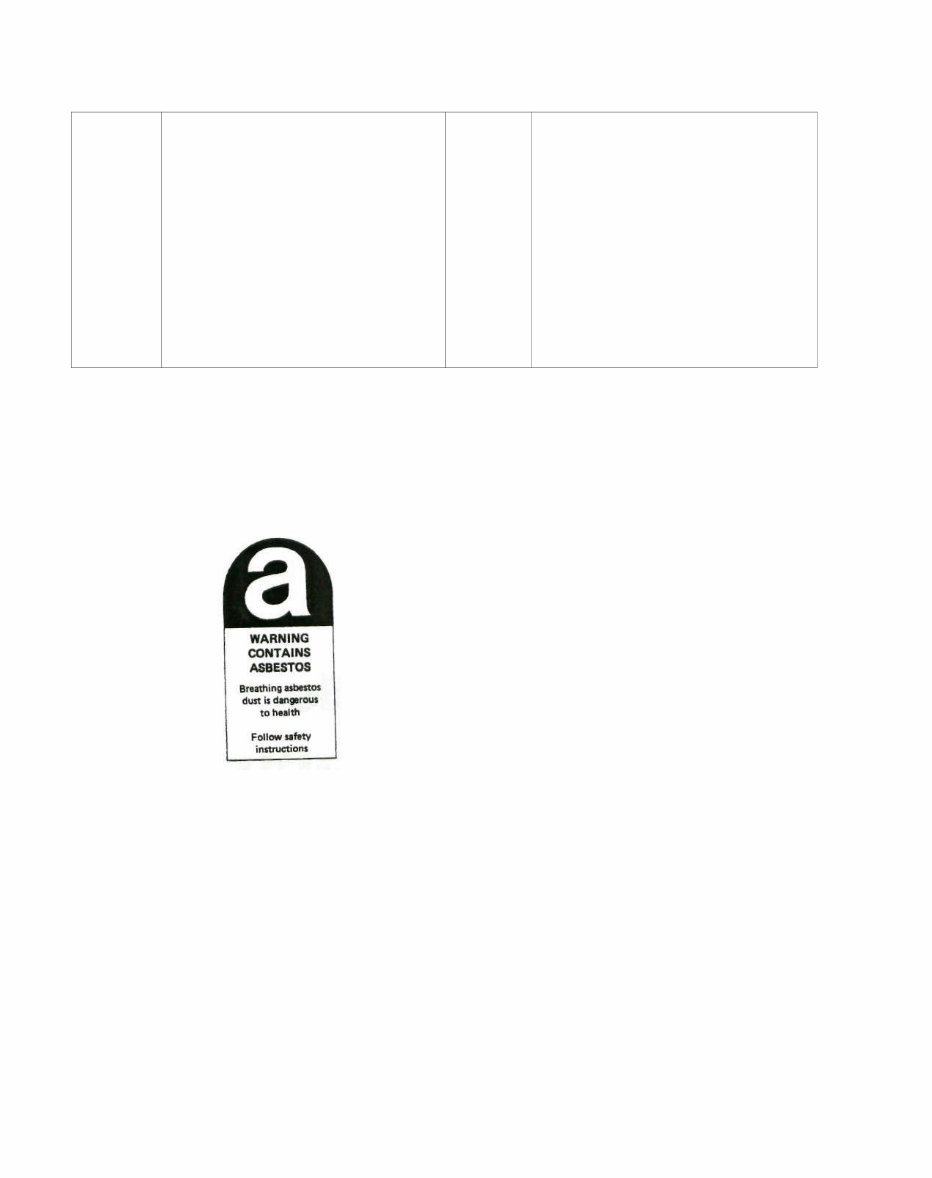
This warning may apply to any of the following
components or any assembly containing one or
more of these components:-
Brake Shoes or Pads
Clutch Friction Material
Gaskets
Insulators
SAFETY INSTRUCTIONS
• Operate if possible out of doors or in a well
ventilated place.
• Preferably use hand tools or low speed tools
equipped, if necessary, with an appropriate dust
extraction facility. If high speed tools are used,
they should always be so equipped.
• If possible, dampen before cutting or drilling.
• Dampen dust and place it in properly closed
receptacle and dispose of it safely.
Read OWNER'S MANUAL before operating.
Foreword
This manual is designed primarily for use by
trained mechanics in a properly equipped shop.
However, it contains enough detail and basic
information to make it useful to the owner who
desires to perform his own basic maintenance and
repair work. A basic knowledge of mechanics, the
proper use of tools, and workshop procedures must
be understood in order to carry out maintenance and
repair satisfactorily. Whenever the owner has
insufficient experience or doubts his ability to do the
work, all adjustments, maintenance, and repair
should be carried out only by qualified mechanics.
In order to perform the work efficiently and to
avoid costly mistakes, read the text, thoroughly
familiarize yourself with the procedures before
starting work, and then do the work carefully in a
clean area. Whenever special tools or equipment are
specified, do not use makeshift tools or equipment.
Precision measurements can only be made if the
proper instruments are used, and the use of substi-
tute tools may adversely affect safe operation.
For the duration of the warranty period,
we recommend that all repairs and scheduled
maintenance be performed in accordance with this
service manual. Any owner maintenance or repair
procedure not performed in accordance with this
manual may void the warranty.
To get the longest life out of your "JET SKI"
watercraft:
• Follow the Periodic Maintenance Chart in the
Service Manual.
• Be alert for problems and non-scheduled mainte-
nance.
• Use proper tools and genuine Kawasaki "JET SKI"
watercraft parts. Special tools, gauges, and testers
that are necessary when servicing Kawasaki "JET
SKI" watercraft are introduced by the Special Tool
Manual. Genuine part provided as spare parts are
listed in the Parts Catalog.
• Follow the procedures in this manual carefully.
Don't take shortcuts.
• Remember to keep complete records of mainte-
nance and repair with dates and any new parts
installed.
How to Use this Manual
In preparing this manual, we divided the product
into its major systems. These systems became the
manual's chapters. All information for a particular
system from adjustment through disassembly and
inspection is located in a single chapter.
The Quick Reference Guide shows you all of the
product's system and assists in locating their
chapters. Each chapter in turn has its own compre-
hensive Table of Contents.
The Periodic Maintenance Chart is located in the
General Information chapter. The chart gives a time
schedule for required maintenance operations.
If you want spark plug information, for example,
go to the Periodic Maintenance Chart first. The chart
tells you how frequently to clean and gap the plug.
Next, use the Quick Reference Guide to locate the
Electrical System chapter. Then, use the Table of
Contents on the first page of the chapter to find the
Spark Plug section.
Whenever you see these WARNING and
CAUTION symbols, heed their instructions! Always
follow safe operating and maintenance practices.
This warning symbol identifies special
instructions or procedures which, if not
correctly followed, could result in personal
injury, or loss of life.
This caution symbol identifies special
instructions or procedures which, if not
strictly observed, could result in damage to
or destruction of equipment.

This manual contains four more symbols (in
addition to WARNING and CAUTION) which will
help you distinguish different types of information.
NOTE
o This note symbol indicates points of partic-
ular interest for more efficient and convenient
operation.
• Indicates a procedural step or work to be done.
o Indicates a procedural sub-step or how to do the
work of the procedural step it follows. It also
precedes the text of a NOTE.
* Indicates a conditional step or what action to take
based on the results of the test or inspection in the
procedural step or sub-step it follows.
In most chapters an exploded view illustration of
the system components follows the Table of
Contents. In these illustrations you will find the
instructions indicating which parts require specified
tightening torque, oil, grease or a locking agent
during assembly.

EMISSION CONTROL ll\lFORMATION
To protect the environment in which we all live, Kawasaki has incorporated crankcase emission
(1) and exhaust emission (2) control systems in compliance with applicable regulations of the
United States Environmental Protection Agency and California Air Resources Board. Additionally,
Kawasaki has incorporated an evaporative emission control system (3) in compliance with
applicable regulations of the California Air Resources Board on vehicles sold in California only.
1. Crankcase Emission Control System
This system eliminates the release of crankcase vapors into the atmosphere. Instead, the
vapors are routed through an oil separator to the intake side of the engine. While the engine
is operating, the vapors are drawn into combustion chamber, where they are burned along
with the fuel and air supplied by the carburetion system.
2. Exhaust Emission Control System
This system reduces the amount of pollutants discharged into the atmosphere by the exhaust
of this motorcycle. The fuel and ignition systems of this motorcycle have been carefully
designed and constructed to ensure an efficient engine with low exhaust pollutant levels.
3. Evaporative Emission Control System
Vapors caused by fuel evaporation in the fuel system are not vented into the atmosphere.
Instead, fuel vapors are routed into the running engine to be burned, or stored in a canister
when the engine is stopped. Liquid fuel is caught by a vapor separator and returned to the
fuel tank.
The Clean Air Act, which is the Federal law covering motor vehicle pollution, contains what is
commonly referred to as the Act's "tampering provisions."
"Sec. 203(a) The following acts and the causing thereof are prohibited...
(3) (A) for any person to remove or render inoperative any device or element of design installed
on or in a motor vehicle or motor vehicle engine in compliance with regulations under
this title prior to its sale and delivery to the ultimate purchaser, or for any manufacturer
or dealer knowingly to remove or render inoperative any such device or element of
design after such sale and delivery to the ultimate purchaser.
(3)(B) for any person engaged in the business of repairing, servicing, selling, leasing, or trading
motor vehicles or motor vehicle engines, or who operates a fleet of motor vehicles
knowingly to remove or render inoperative any device or element of design installed on
or in a motor vehicle or motor vehicle engine in compliance with regulations under this
title following its sale and delivery to the ultimate purchaser..."
(Continued on next page.)

NOTE
o The phrase "remove or render inoperative any device or element of design" has been
generally interpreted as follows:
1. Tampering does not include the temporary removal or rendering inoperative of
devices or elements of design in order to perform maintenance.
2. Tampering could include:
a. Maladjustment of vehicle components such that the emission standards are
exceeded.
b. Use of replacement parts or accessories which adversely affect the performance
or durability of the motorcycle.
c. Addition of components or accessories that result in the vehicle exceeding the
standards.
d. Permanently removing, disconnecting, or rendering inoperative any component
or element of design of the emission control systems.
WE RECOMMEND THAT ALL DEALERS OBSERVE THESE PROVISIONS OF FEDERAL
LAW, THE VIOLATION OF WHICH IS PUNISHABLE BY CIVIL PENALTIES NOT
EXCEEDING $10,000 PER VIOLATION.
TAMPERING WITH NOISE CONTROL SYSTEM PROHIBITED
Federal law prohibits the following acts or the causing thereof: (1) The removal or rendering
inoperative by any person other than for purposes of maintenance, repair, or replacement, of any
device or element of design incorporated into any new vehicle for the purpose of noise control prior
to its sale or delivery to the ultimate purchaser or while it is in use, or (2) the use of the vehicle after
such device or element of design has been removed or rendered inoperative by any person.
Among those acts presumed to constitute tampering are the acts listed below:
• Replacement of the original exhaust system or muffler with a component not in compliance with
Federal regulations.
• Removal of the muffler(s) or any internal portion of the muffler(s).
• Removal of the air box or air box cover.
• Modifications to the muffler(s) or air intake system by cutting, drilling, or other means if such
modifications result in increased noise levels.
Quick Reference Guide
This quick reference guide will assist you in
locating a desired topic or procedure.
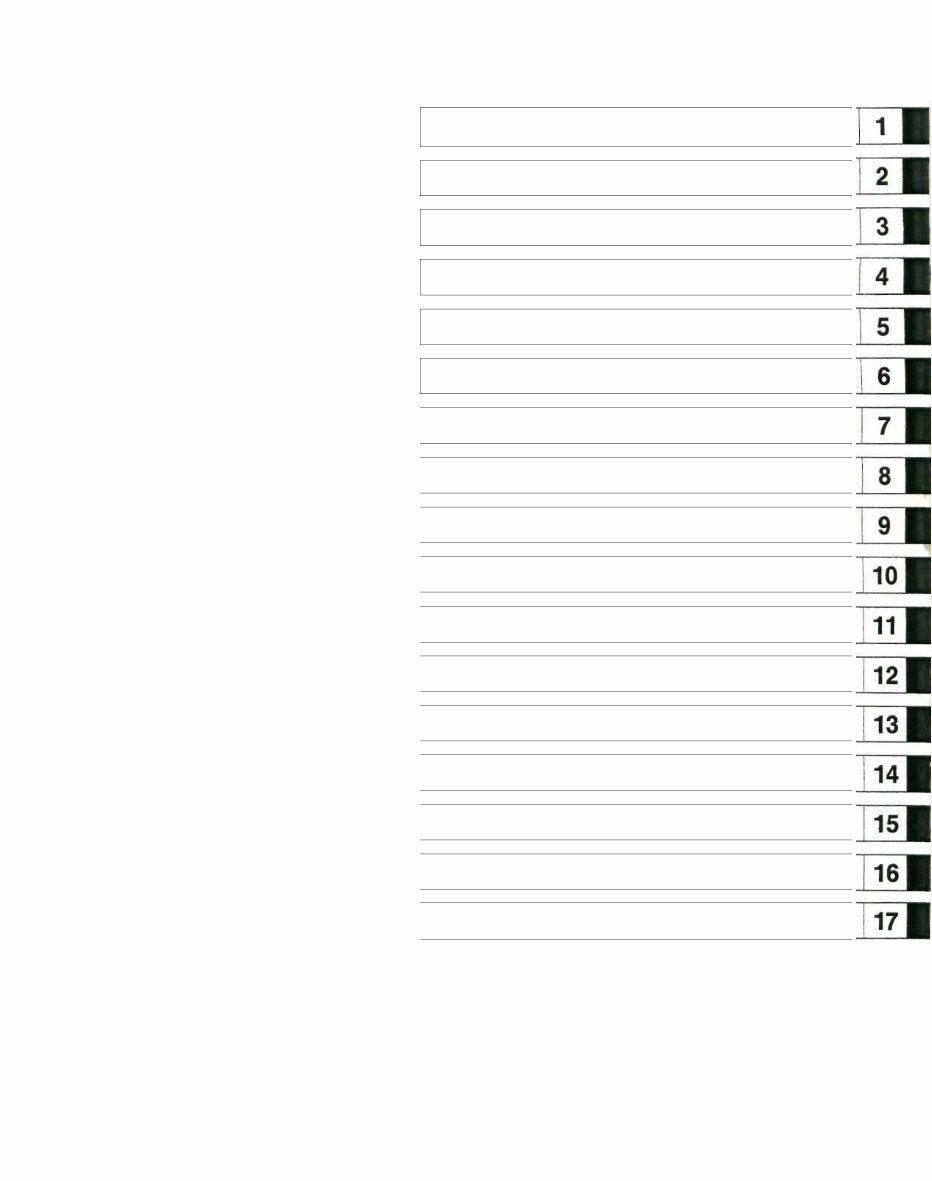
• Bend the pages back to match the black tab
of the desired chapter number with the black
tab on the edge at each table of contents
page.
• Refer to the sectional table of contents for
the exact pages to locate the specific topic
required.
General Information
Fuel System
Cooling System
Engine Top End
Engine Right Side/Left Side
Engine Lubrication System
Engine Removal/Installation
Crankshaft/Transmission
Wheels/Tires
Final Drive
Brakes
Suspension
Steering
Frame
Electrical System
Appendix
Supplement -1994 Models

GENERAL INFORMATION 1-1
General Information
Table of Contents
Before Servicing 1-1
Model Identification 1 -4
General Specifications 1 -6
Periodic Maintenance Chart - KLX250D 1-10
Periodic Maintenance Chart - KLX250E 1 -12
Torque and Locking Agent 1 -14
Special Tools and Sealant 1-17
Cable, Wire and Hose Routing 1 -23

1-2 GENERAL INFORMATION
Before Servicing
Before starting to service a motorcycle, careful reading of the applicable section is recommended to eliminate
unnecessary work. Photographs, diagrams, notes, cautions, warnings, and detailed descriptions have been
included wherever necessary. Nevertheless, even a detailed account has limitations, a certain amount of basic
knowledge is also required for successful work.
Especially note the following:
(1) Dirt
Before removal and disassembly, clean the motorcycle. Any dirt entering the engine or other parts will
work as an abrasive and shorten the life of the motorcycle. For the same reason, before installing a new
part, clean off any dust or metal filings.
(2) Battery Ground
Remove the ground (-) lead from the battery before performing any disassembly operations on the
motorcycle. This prevents:
(a) the possibility of accidentally turning the engine over while partially disassembled.
(b) sparks at electrical connections which will occur when they are disconnected.
(c) damage to electrical parts.
(3) Tightening Sequence
Generally, when installing a part with several bolts, nuts, or screws, start them all in their holes and
tighten them to a snug fit. Then tighten them evenly in a cross pattern. This is to avoid distortion of the
part and/or causing gas or oil leakage. Conversely when loosening the bolts, nuts, or screws, first loosen
all of them by about a quarter turn and then remove them. Where there is a tightening sequence indication
in this Service Manual, the bolts, nuts, or screws must be tightened in the order and method indicated.
(4) Torque
When torque values are given in this Service Manual, use them. Either too little or too much torque may
lead to serious damage. Use a good quality, reliable torque wrench.
(5) Force
Common sense should dictate how much force is necessary in assembly and disassembly. If a part seems
especially difficult to remove or install, stop and examine what may be causing the problem. Whenever
tapping is necessary, tap lightly using a wooden or plastic-faced mallet. Use an impact driver for screws
(particularly for the removal of screws held by a locking agent) in order to avoid damaging the screw heads.
(6) Edges
Watch for sharp edges, especially during major engine disassembly and assembly. Protect your hands
with gloves or a piece of thick cloth when lifting the engine or turning it over.
(7) High-Flash Point Solvent
A high-flash point solvent is recommended to reduce fire danger. A commercial solvent commonly
available in North America is Stoddard solvent (generic name). Always follow manufacturer and container
directions regarding the use of any solvent.
(8) Gasket, 0-Ring
Do not reuse a gasket or O-ring once it has been in service. The mating surfaces around the gasket
should be free of foreign matter and perfectly smooth to avoid oil or compression leaks.
(9) Liquid Gasket, Non-Permanent Locking Agent
Follow manufacturer's directions for cleaning and preparing surfaces where these compounds will be
used Apply sparingly. Excessive amounts may block engine oil passages and cause serious damage. An
example of a non-permanent locking agent commonly available in North America is Loctite Lock'n Seal
(Blue).
(10) Press .
A part installed using a press or driver, such as a wheel bearing, should first be coated with oil on its outer
or inner circumference so that it will go into place smoothly.
(11) Ball Bearing and Needle Bearing
Do not remove any ball or needle bearings that are pressed in unless it is necessary. If they are removed,
replace them with new ones.
When installing a bearing, press it in with the marked side facing out using a suitable driver until it is
bottomed. Bearings should be pressed into place by pushing evenly the bearing race which is affected by
friction.
GENERAL INFORMATION 1-3
(12) Oil Seal and Grease Seal
Replace any oil or grease seals that were removed with new ones, as removal generally damages seals.
When pressing in a seal which has manufacturer's marks, press it in with the marks facing out. Seals
should be pressed into place using a suitable driver, which contacts evenly with the side of seal, until the
face of the seal is even with the end of the hole.
(13) Seal Guide
A seal guide is required for certain oil or grease seals during installation to avoid damage to the seal lips.
Before a shaft passes through a seal, apply a little high temperature grease on the lips to reduce rubber to
metal friction.
(14) Circlip, Retaining Ring
Replace any circlips and retaining rings that were removed with new ones, as removal weakens and
deforms them. When installing circlips and retaining rings, take care to compress or expand them only
enough to install them and no more.
(15) Cotter Pin
Replace any cotter pins that were removed with new ones, as removal deforms and breaks them.
(16) Lubrication
Engine wear is generally at its maximum while the engine is warming up and before all the rubbing
surfaces have an adequate lubricative film. During assembly, oil or grease (whichever is more suitable)
should be applied to any rubbing surface which has lost its lubricative film. Old grease and dirty oil should
be cleaned off. Deteriorated grease has lost its lubricative quality and may contain abrasive foreign particles.
Don't use just any oil or grease. Some oils and greases in particular should be used only in certain
applications and may be harmful if used in an application for which they are not intended. This manual
makes reference to molybdenum disulfide grease (M0S2 ) in the assembly of certain engine and chassis
parts. Always check manufacturer recommendations before using such special lubricants.
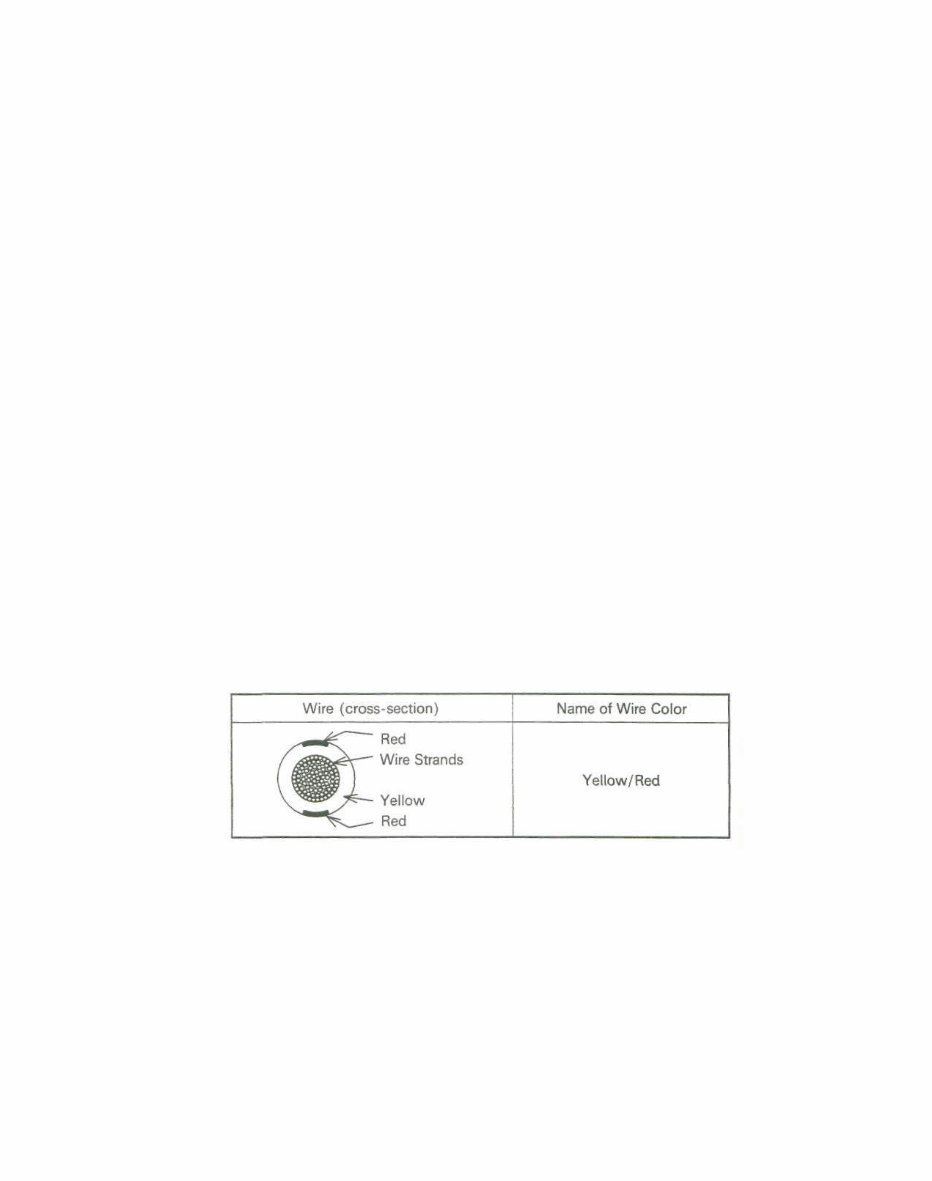
(17) Electrical Wires
All the electrical wires are either single-color or two-color and, with only a few exceptions, must be
connected to wires of the same color. On any of the two-color wires there is a greater amount of one color
and a lesser amount of a second color, so a two-color wire is identified by first the primary color and then
the secondary color. For example, a yellow wire with thin red stripes is referred to as a "yellow/red" wire;
it would be a "red/yellow" wire if the colors were reversed to make red the main color.
(18) Replacement Parts
When there is a replacement instruction, replace these parts with new ones every time they are removed.
These replacement parts will be damaged or lose their original function once removed.
(19) Inspection
When parts have been disassembled, visually inspect these parts for the following conditions or other
damage. If there is any doubt as to the condition of them, replace them with new ones.
Abrasion Crack Hardening Warp
Bent Dent Scratch Wear
Color change Deterioration Seizure
(20) Specifications
Specification terms are defined as follows:
"Standards" show dimensions or performances which brand-new parts or systems have.
"Service Limits" indicate the usable limits. If the measurement shows excessive wear or deteriorated
performance, replace the damaged parts.
You're Reading a Preview
What's Included?
Lifetime Access
Fast Download Speeds
Online & Offline Access
Access PDF Contents & Bookmarks
Full Search Facility
Print one or all pages of your manual
$31.99
Viewed 18 Times Today


Secure transaction
What's Included?
Lifetime Access
Fast Download Speeds
Online & Offline Access
Access PDF Contents & Bookmarks
Full Search Facility
Print one or all pages of your manual
$31.99
Our service repair workshop manual is a comprehensive guide supplied in an easy-to-read format, covering all repairs from A-Z and all models. It is a valuable resource for both professional mechanics and DIY enthusiasts.
- Maintenance & Servicing
- Engine & Clutch
- Transmissions
- Cooling Systems
- Fuel & Exhaust
- Ignition & Electrical
- Brakes & Brake Assembly
- Wheels & Tires
- Steering & Suspension
- Frame & Bodywork
- Wiring Diagrams
- Fault Finding Troubleshooting
Our manual also includes high-quality pictures and diagrams, providing professional quality information for immediate access. It covers all major repair topics in great detail, ensuring that you can fix it today without any waiting.
This service repair workshop manual is compatible with all operating systems, including PC and MAC. Whether you are using Windows 95, 98, 2000, Me, Xp, Vista, or Windows 7, our manual will work seamlessly for you.


