1984-2005 Kawasaki KLR250 4 Stroke Motorcycle Service & Repair Manual
What's Included?
Lifetime Access
Fast Download Speeds
Online & Offline Access
Access PDF Contents & Bookmarks
Full Search Facility
Print one or all pages of your manual
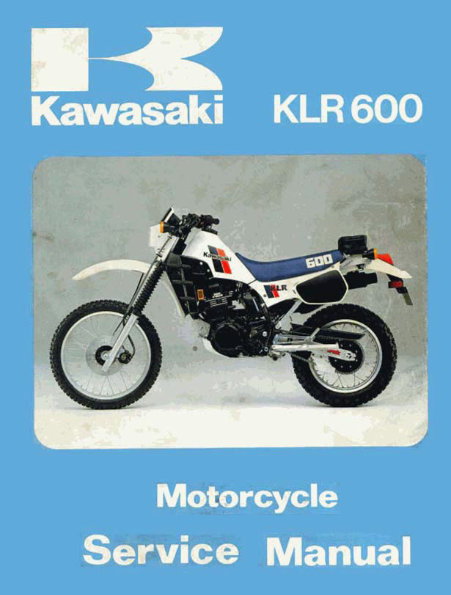
Kawasaki KLR250 service manual 1984-2005 This manual is comprised of a base manual for the Kawasaki KLR600, along with a supplement manual to make it relevant for the KLR250. Kawasaki service manuals sometimes utilize this build-on-earlier models method when two models are similar to each other. Use the links below or the bookmarks to the left to get to the manual that covers your model. Kawasaki KLR600 base manual Kawasaki KLR250 supplement manual
lb@mqde 1 Scl %-- Manual
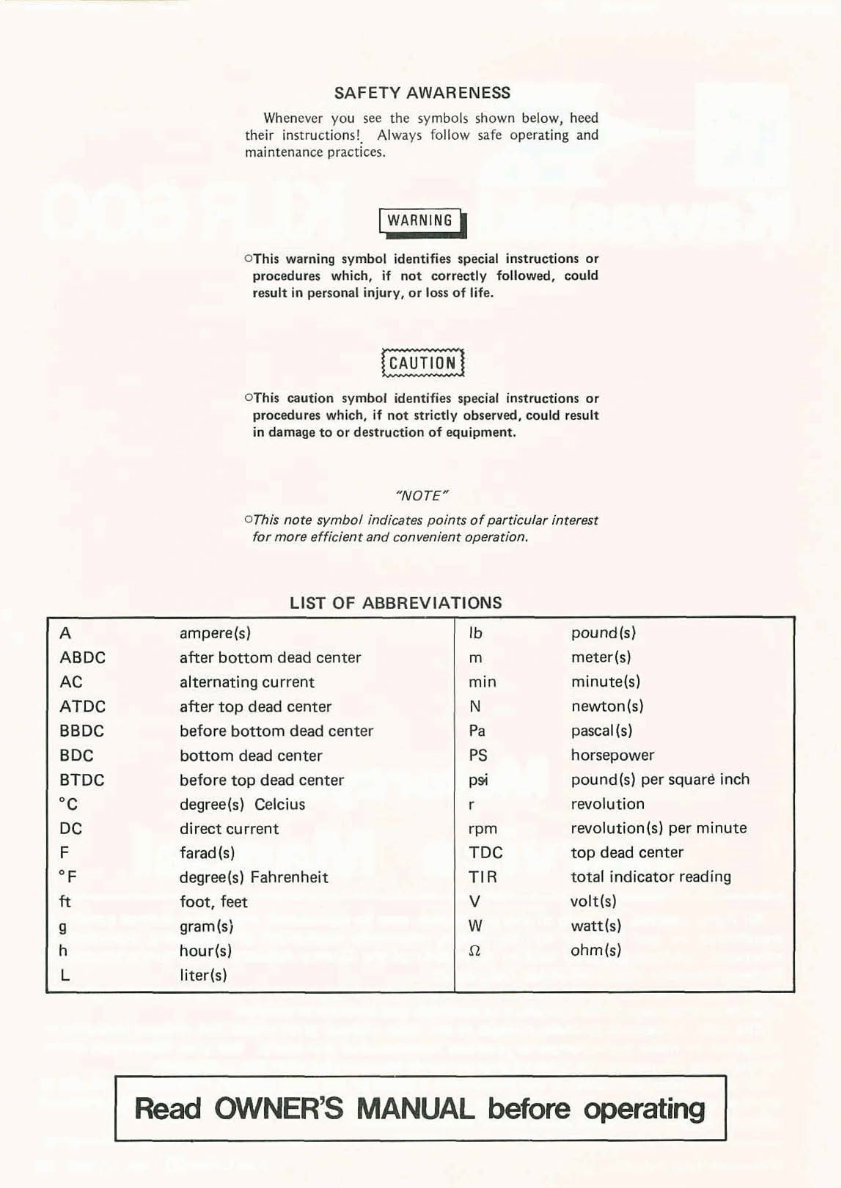
SAFETY AWARENESS Whenever you see the symbols shown beIow, heed their instructions!. Always follow safe operating and maintenance practices. OThis warning symbol identifies special instructions or procedur~ which, if not correctIy followd, could result in personal injury, or loss of life. OThis caution symbol identifies special instructions or procedures whlch, if not strictly observed, could result in damage to or destruction of equipment. "NOTE" OThis note symbol indicates points of particular interest for more efficient and convenient operation. LIST OF ABBREVIATIONS Read OWNER'S MANUAL before operating A arnpere(s) ABDC after bottom dead center AC alternating current ATDC after top dead center BRDC before bottom dead center BDC bottom dead center BTDC before top dead center "C degree(s) Celcius DC direct current F farad (s) " F degree(s) Fahrenheit ft foot, feet 9 gram (s) h hods) L IiterIs) Ib pound(s) m meter (s) mi n rninute(s) N newton Is) Pa pascal (s) PS horsepower pound(s) per squarP inch r revolution rPm revolution(s) per minute TDC top dead center TI R total indicator reading V volr(s) W watt 1s) a ohm(s)
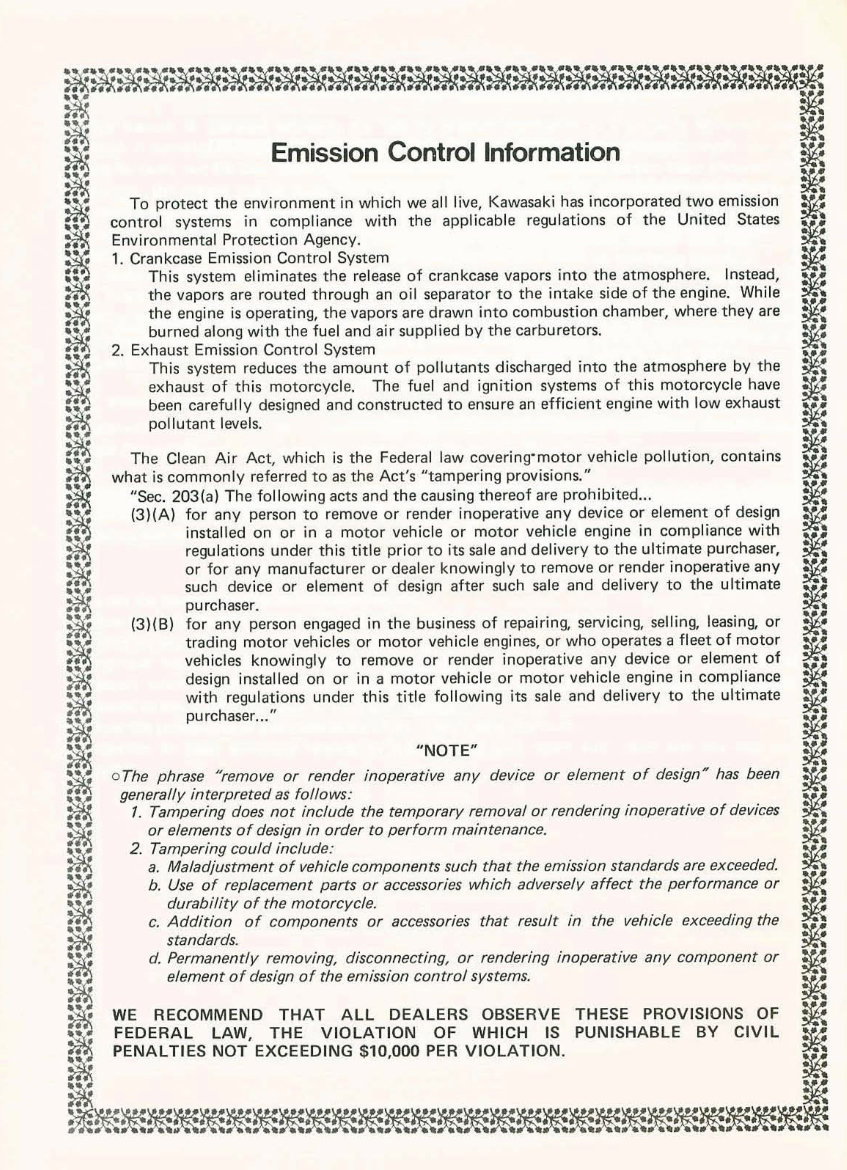
Emission Control Information To protect the environment in which we all live, Kawasaki has incorporated two emission control systems in compliance with the applicable regulations of the United States Environmental Protection Agency. 1. Crankcase Emission Control System This system eliminates the release of crankcase vapors into the atmosphere. Instead, the vapors are routed through an oil separator to the intake side of the engine. While the engine is operating, the vapors are drawn into combustion chamber, where they are burned along with the fuel and air supplied by the carburetors. 2. Exhaust Emission Control System This system reduces the amount of pollutants discharged into the atmosphere by the exhaust of this motorcycle. The fuel and ignition systems of this motorcycle have been carefully designed and constructed to ensure an efficient engine with low exhaust pollutant levels. The Clean Air Act, which is the Federal law covering-motor vehicle pollution, contains what is commonly referred to as the Act's "tampering provisions." "Sec. 203(a) The following acts and the causing thereof are prohibited ... (3)(A) for any person to remove or render inoperative any device or element of design installed on or in a motor vehicle or motor vehicle engine in compliance with regulations under this title prior to its sale and delivery to the ultimate purchaser, or for any manufacturer or dealer knowing1 y to remove or render inoperative any such device or element of design after such sale and delivery to the ultimate purchaser. (3)(8) for any person engaged in the business of repairing, servicing, selling, leasing, or trading motor vehicles or motor vehicle engines, or who operates a fleet of motor vehicles knowingly to remove or render inoperative any device or element of design installed on or in a motor vehicle or motor vehicle engine in compliance with regulations under this title following its sale and delivery to the ultimate purchaser ..." "NOTE" o The phrase "remove or render inoperative any device or element of design" has been generally interpreted as follo ws: I. Tampering does not include the temporary removal or rendering inoperative of devices or elements of design in order to perform maintenance. 2. Tampering could include: a. Maladjustment of vehicle components such that the emission standards are exceeded. b. Use of replacement parts or accessories which adverse1 y affect the performance or durability of the motorcycle. c. Addition of components or accessories that result in the vehicle exceeding the standards. d. Permanently removing, disconnectingf or rendering inoperative any component or el emen t of design of the emission control systems. WE RECOMMEND THAT ALL DEALERS OBSERVE THESE PROVISIONS OF FEDERAL LAW, THE VIOLATION OF WHICH 1s PUNISHABLE BY CIVIL PENALTIES NOT EXCEEDING $10,000 PER VIOLATION.
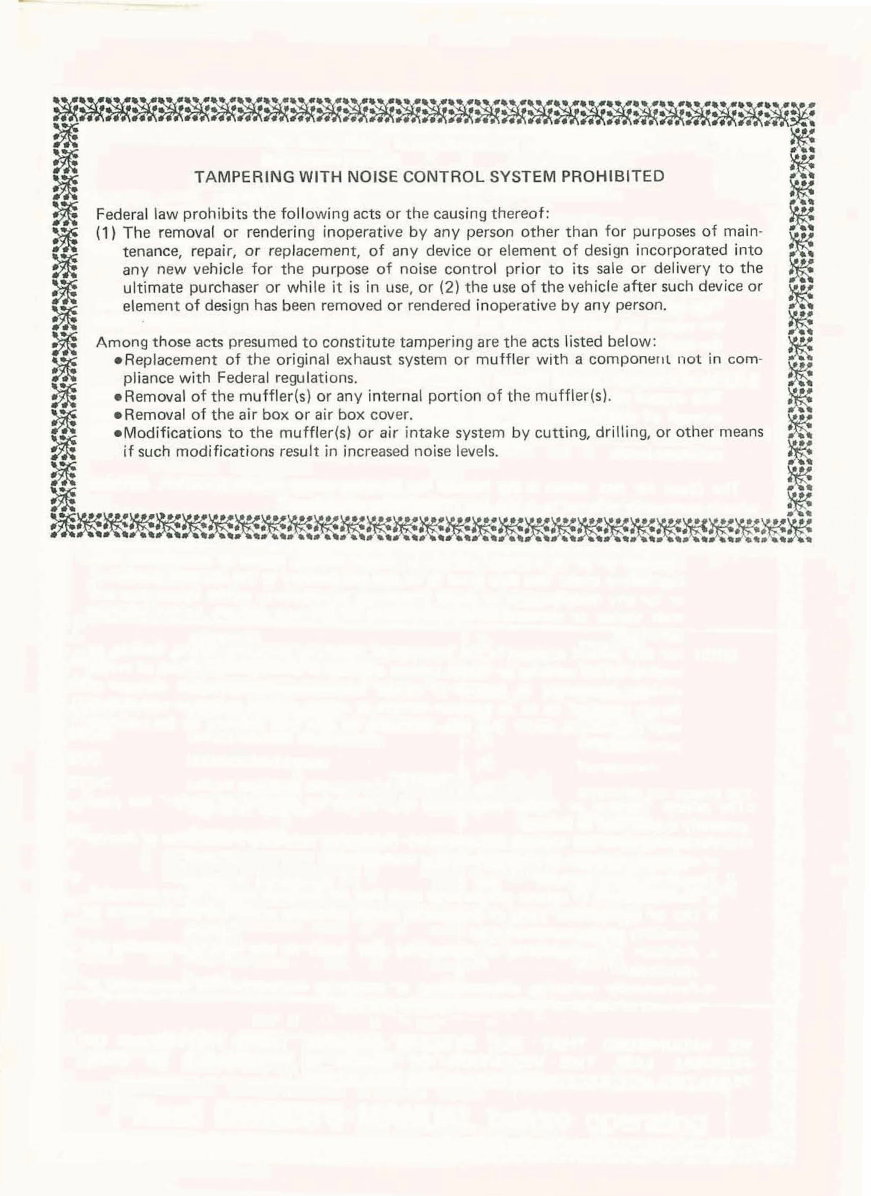
TAMPERING WITH NOISE CONTROL SYSTEM PROHIBITED Federal law prohibits the following acts or the causing thereof: (1 ) The removal or rendering inoperative by any person other than for purposes of main- tenance, repair, or replacement, of any device or element of design incorporated into any new vehicle for the purpose of noise control prior to its sale or delivery to the ultimate purchaser or while it is in use, or (2) the use of the vehicle after such device or element of design has been removed or rendered inoperative by any person. I Among those acts presumed to constitute tampering are the acts listed below: +Replacement of the original exhaust system or muffler with a componerll not in com- pliance with Federal regulations. Removal of the muffler(s) or any internal portion of the muffler(s1. *Removal of the air box or air box cover. .w .Modifications to the muffler(s) or air intake system by cutting, drilling, or other means if such modifications result in increased noise levels. I I iQ
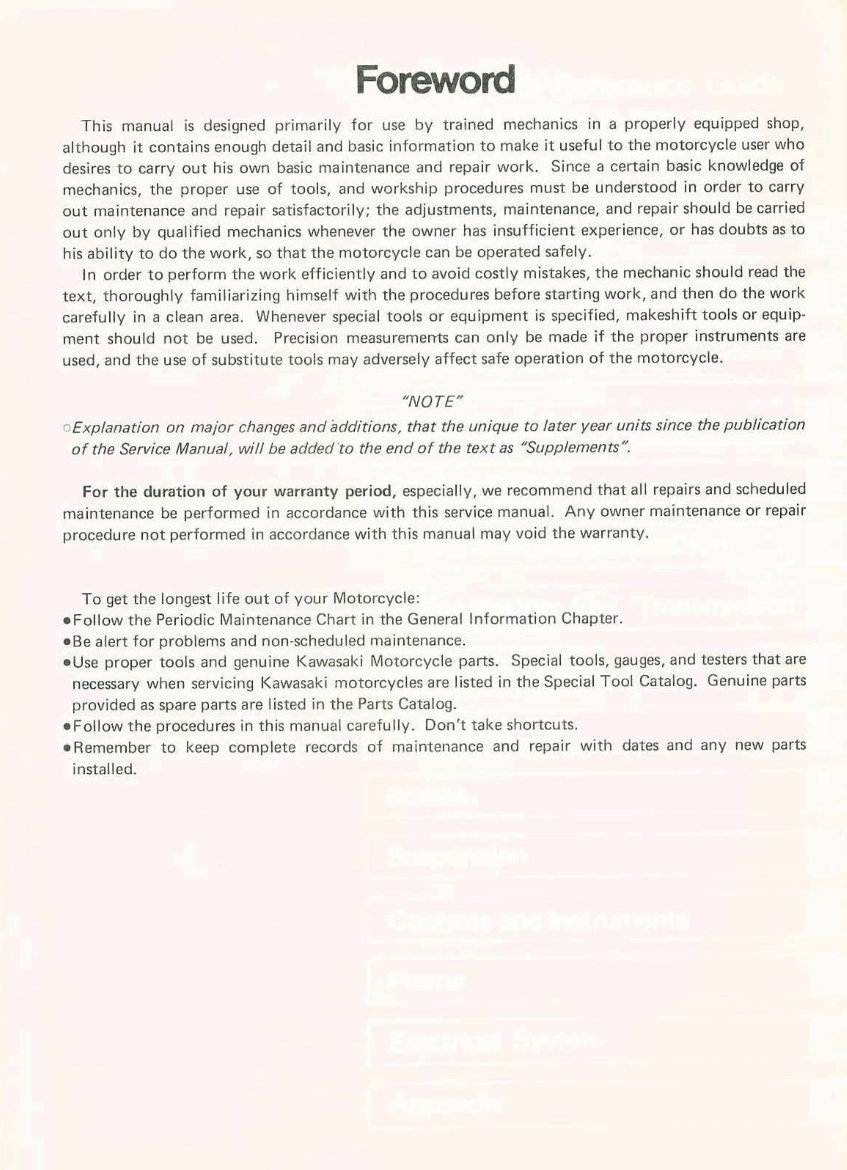
Foreword This manual is designed primarily for use by trained mechanics in a properly equipped shop, although it cantains enough detail and basic information to make it useful to the motorcycle user who desires to carry out his own basic maintenance and repair work. Since a certain basic knowledge of mechanics, the proper use of tools, and workship procedures must be understood in order to carry out maintenance and repair satisfactorily; the adjustments, maintenance, and repair should be carried out only by qualified mechanics whenever the owner has insufficient experience, or has doubts as to his ability to do the work, so that the motorcycle can be operated safely. In order to perform the work efficiently and to avoid costly mistakes, the mechanic should read the text, thoroughly familiarizing himself with The procedures before starting work, and then do the work carefully in a clean area. Whenever special tools or equipment is specified, makeshift tools or equip- ment should not: be used. Precision measuremerrts can only be made i f the proper instruments are used, and the use of substitute tools may adversely affect safe operation of the motorcycle. "NOTE" c Explana tion on major changes and additions, that the unique to later year units since the of the Service Manual, will be added 'ro the end of the text as "Supplements ". For the duration of your warranty period, especially, we recommend that all repairs and scheduled maintenance be performed in accordance with this service manual. Any owner maintenance or repair procedure not performed in accordance with this manual may void the warranty. To get the longest life out of your Motorcycle: Follow the Periodic Maintenance Chart in the General Information Chapter. .Be alert for problems and non-scheduled maintenance. .Use proper tools and genuine Kawasaki Motorcycle parts. Special tools, gauges, and testers that are necessary when servicing Kawasaki motorcycles are listed in the Special Tool Catalog. Genuine parts provided as spare parts are listed in the Parts Catalog. .Follow the procedures in this manual carefully. Don't take shortcuts. .Remember to keep comple.te records of maintenance and repair with dates and any new parts instal led.
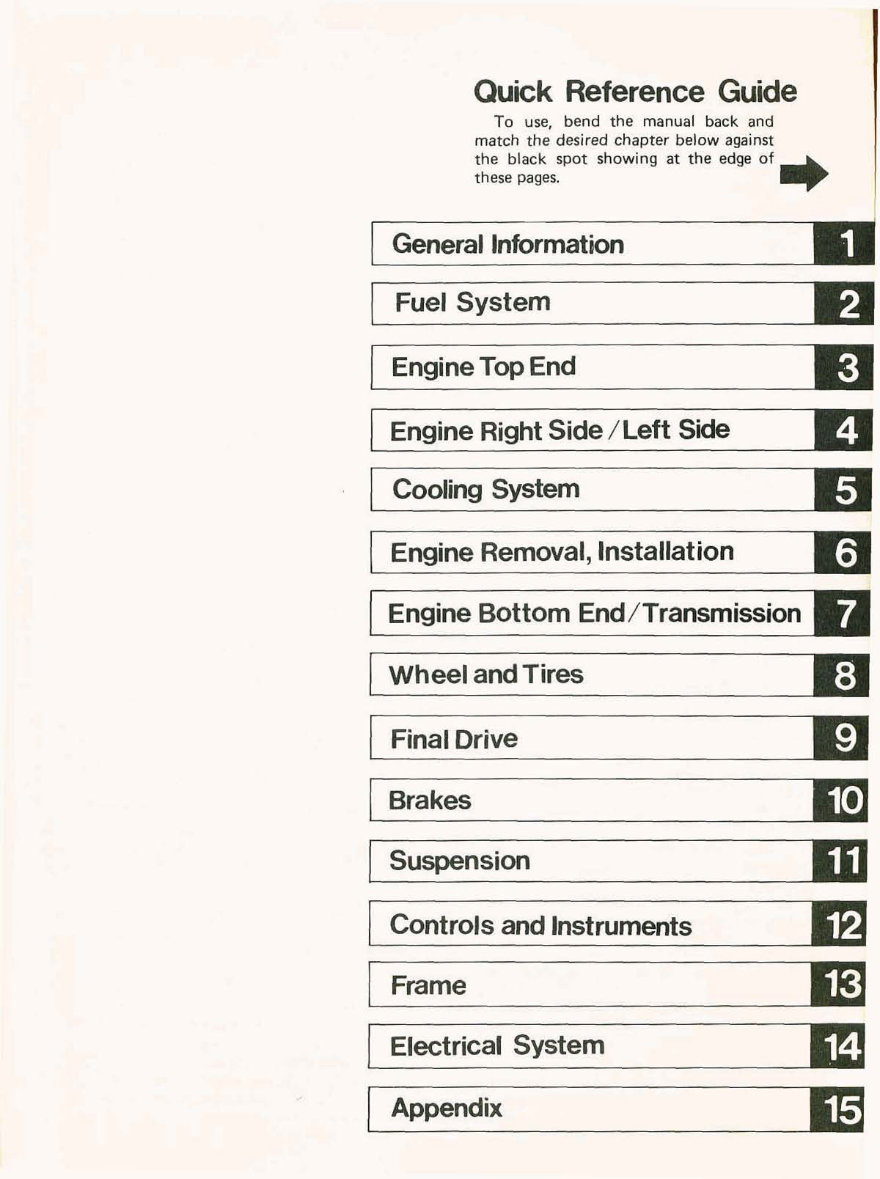
Quick Reference Guide To use, bend the manual back and match the desired chapter below against the black spot showing at the edge of these pages. General Information Fuel System I Engine Top End Cooling System I Engine Removal, Installat ion Engine Bottom End /Transmission Wheel and Tires Final Drive Brakes Suspension Controls and Instruments Frame L Electrical System Appendix
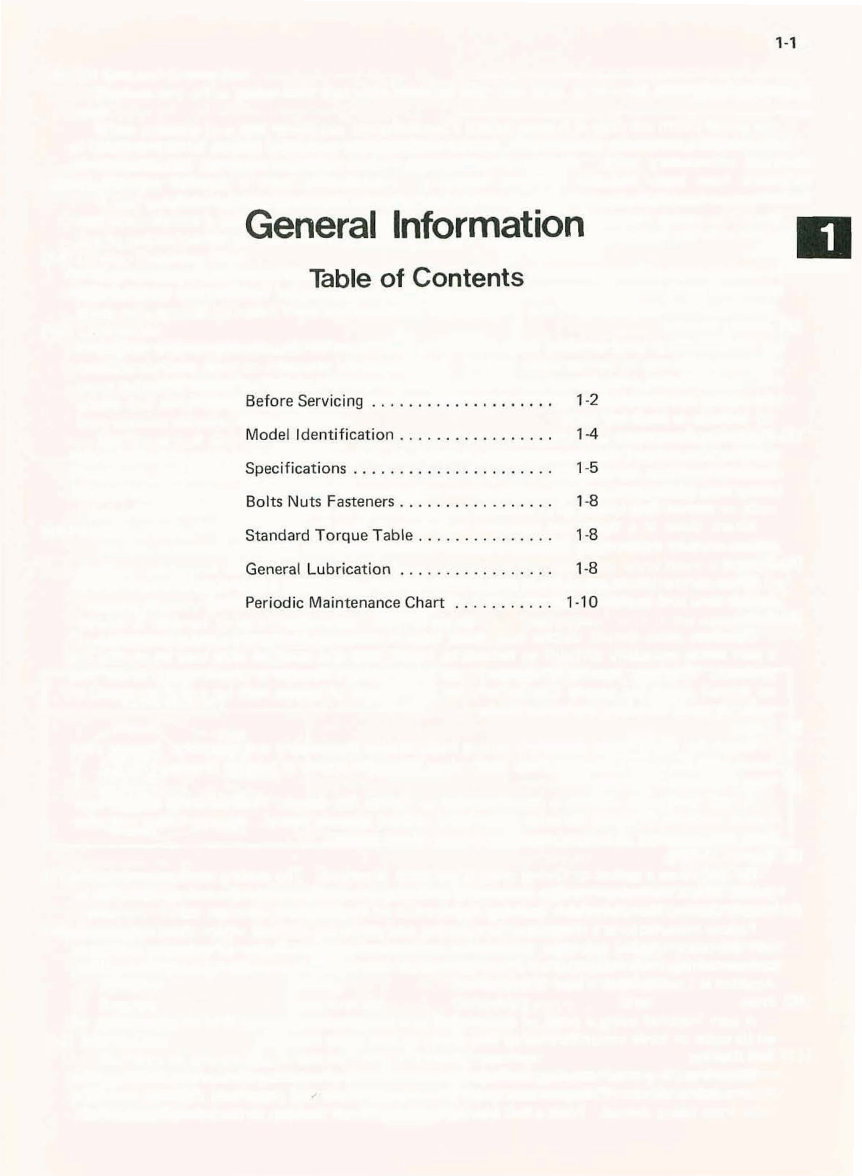
General Information Table of Contents .................... Before Servicing 1-2 ................. Model Identification 1-4 Specifications ...................... 1-5 ................. Bolts Nuts Fasteners 1-8 ............... Standard Torque Table 1-8 General Lubrication ................. 1-8 ........... Periodic Mahtenance Chart 1 -10
The Kawasaki KLR250 4 Stroke Motorcycle 1984-2005 Service & Repair Workshop Manual is a comprehensive resource for all your repair and servicing needs. Whether you are a professional mechanic or a DIY enthusiast, this manual provides detailed instructions and troubleshooting procedures to ensure the correct completion of every job.
Containing hundreds of pages with detailed photos and diagrams, this professional manual is the same type used by professional mechanics and technicians. It includes highly detailed exploded diagrams and pictures to guide you through each step.
With this manual, you have the flexibility to print out a single page or the entire manual, as per your requirement. Additionally, it can be used on multiple computers without any limitations or trial periods, and there is no need for renewal or extra fees.
Compatible with both Windows and MAC computers, this full manual is available for instant access on your computer, tablet, or smartphone. It is a valuable resource that will remain accessible for life, providing you with the support you need for years to come.
Recently Viewed
5,521,897Happy Clients
2,594,462eManuals
1,120,453Trusted Sellers
15Years in Business
Price:
Actual Price:
1984-2005 Kawasaki KLR250 4 Stroke Motorcycle Service & Repair Manual




 Lifetime Access