



2000-2003 Honda CR125R Service & Repair Manual
What's Included?
 Lifetime Access
Fast Download Speeds
Online & Offline Access
Access PDF Contents & Bookmarks
Full Search Facility
Print one or all pages of your manual
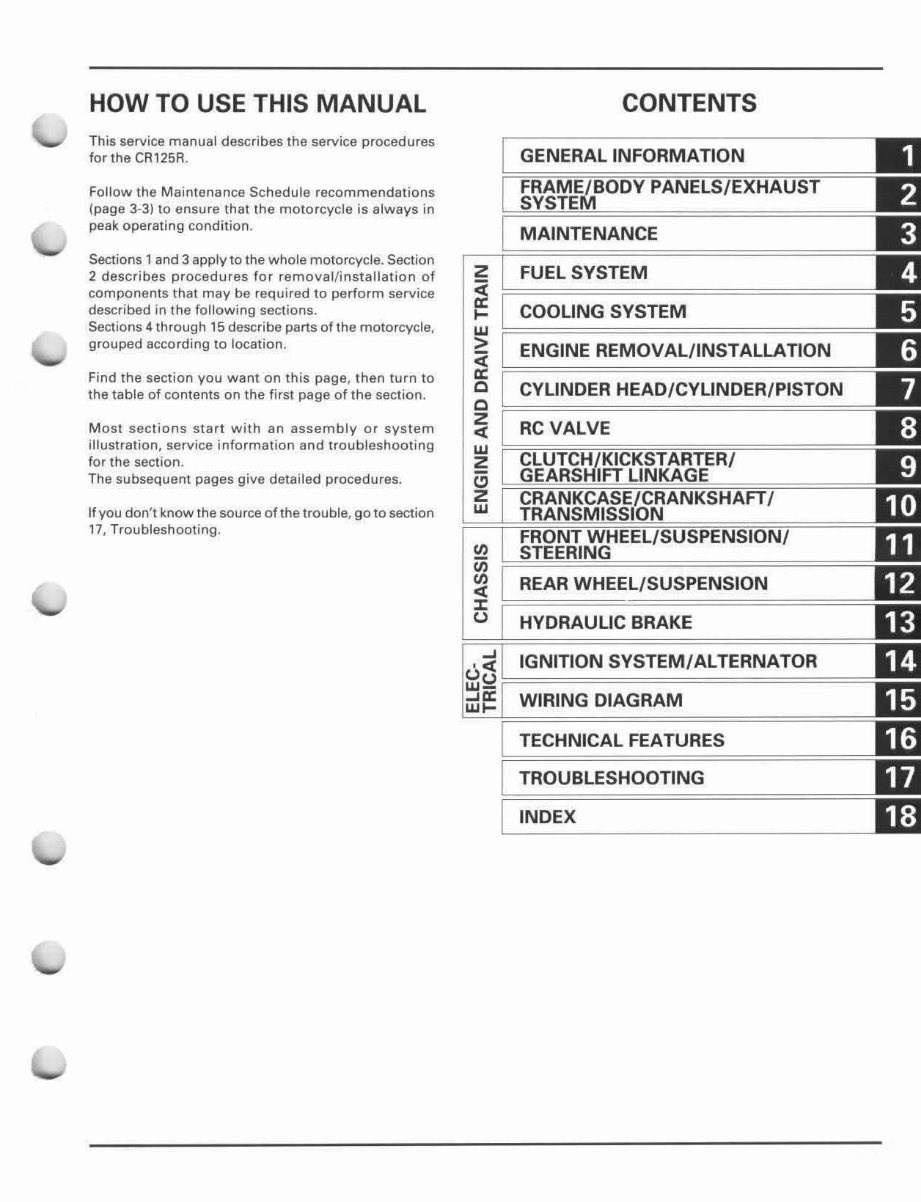
HOW TO USE THIS MANUAL
This service manual describes the service procedures
for the CR125R.
Follow the Maintenance Schedule recommendations
(page 3·3) to ensure that the motorcycle is always in
peak operating co ndition.
Sections 1 and 3 apply to the whole motorcycle. Section
2 describes procedures for removal / installation of
components that may be required to perform service
described in the following sections .
Sections 4 through 15 describe parts of the mOTorcycle,
grouped according to location.
Find the section you want on this page , then turn to
the table of contents on the first page of the section.
Most sections start with an assembly or system
illustration, service information and troubleshooting
for the section .
The subsequent pages give detailed procedures.
If you don't know the source of the trouble , go to section
17, Troubleshooting .
z
~
~
W
>
<1:
a:
c
c
z
..:
w
z
a
z
w
CONTENTS
FUEL SYSTEM
COOLING SYSTEM
ENGINE REMOVAL/INSTALLATION
CYLINDER HEAD/CYLINDER/PISTON
RC VALVE
REAR WHEEL/SUSPENSION
HYDRAULIC BRAKE
IGNITION SYSTEM/ ALTERNATOR
WIRING DIAGRAM
TECHNICAL FEATURES
TROUBLESHOOTING
INDEX
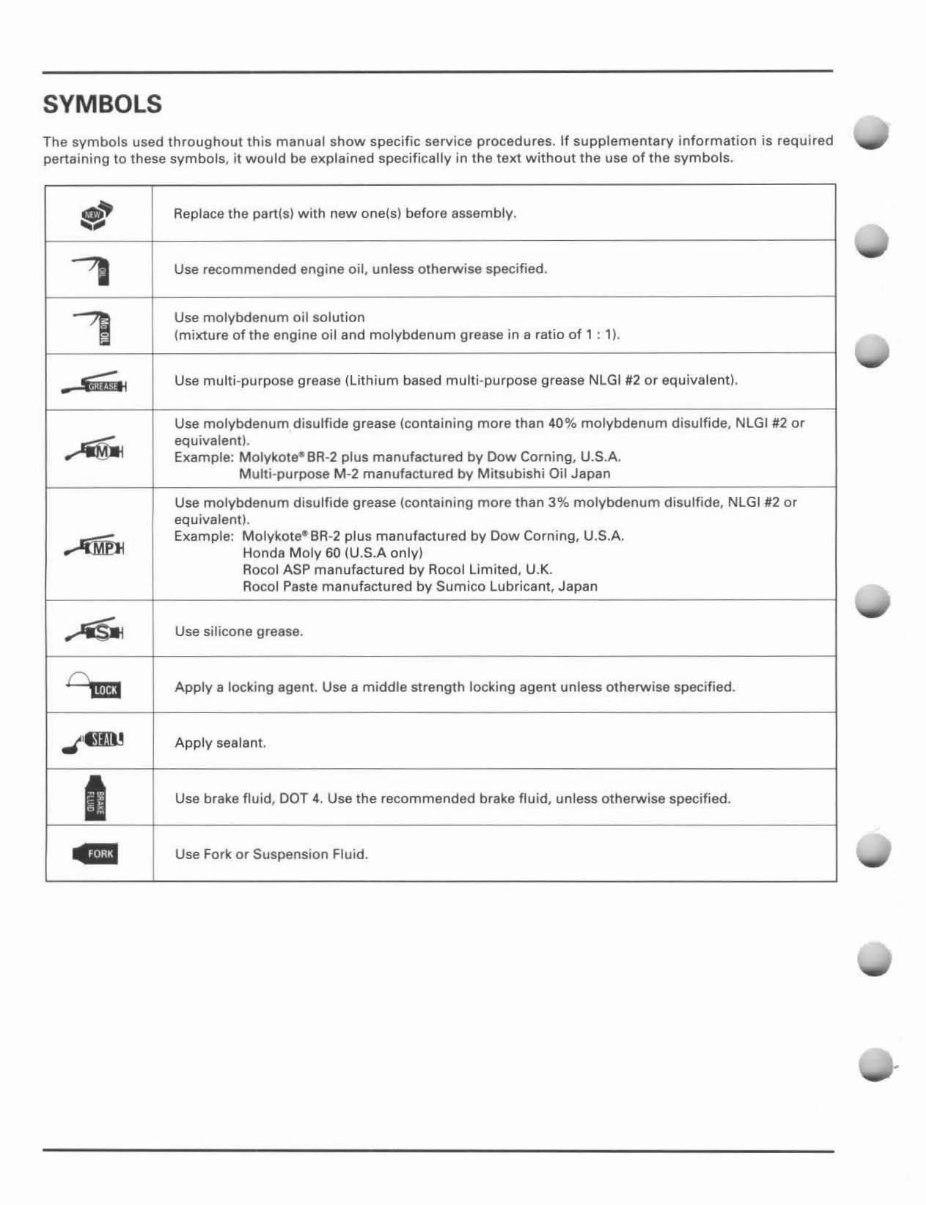
SYMBOLS
The symbols used throughout this manual show specific service procedures. If supplementary information is required
pertaini ng to these symbols, it would be explained specifically in the text without the use of the symbols .
$"
Replace the part(s) with new one(s) before assembly .
.,
Use recommended engine oil, unless otherwise specified .
.,
Use molybdenum oil solution
( mixture of the engine oil and molybdenum grease in a ratio of 1: 1) .
• .s;;;; ..
Use multi -purpose grease (Lithium based multi ' purpose grease NlGI #2 or equivalent).
Use molybdenum disulfide grease (containing more than 40 0/0 molybdenum disulfide, NLGI #2 or
~
equivalent).
Exampl e: Molykote- BR -2 plus manufactured by Dow Corning , U.S.A.
Multi -purpose M-2 manufactured by Mitsubishi Oil Japan
Use molybdenum disulfide grease (containing more than 3% molybdenum disulfide, NlGI #2 or
equivalent).
.... -'i'ID
Example: Molykote· BA -2 pl us manufactured by Dow Corning, U.S.A .
Honda Moly 60 (U.S.A only)
Aocol ASP manufactured by Rocollimited , U.K.
Aocol Paste manufactured by Sumico lubricant , Japan
~
Use silicone grease.
n
"-)'m!
Apply a locking agent. Use a middle strength locking agent unless otherwise specified.
,",' Ull!
Apply sealant.
I
Use brake fluid, DOT 4. Use the recommended brake fluid , unless otherwise specified.
GIl
Use Fork or Suspension Fluid.
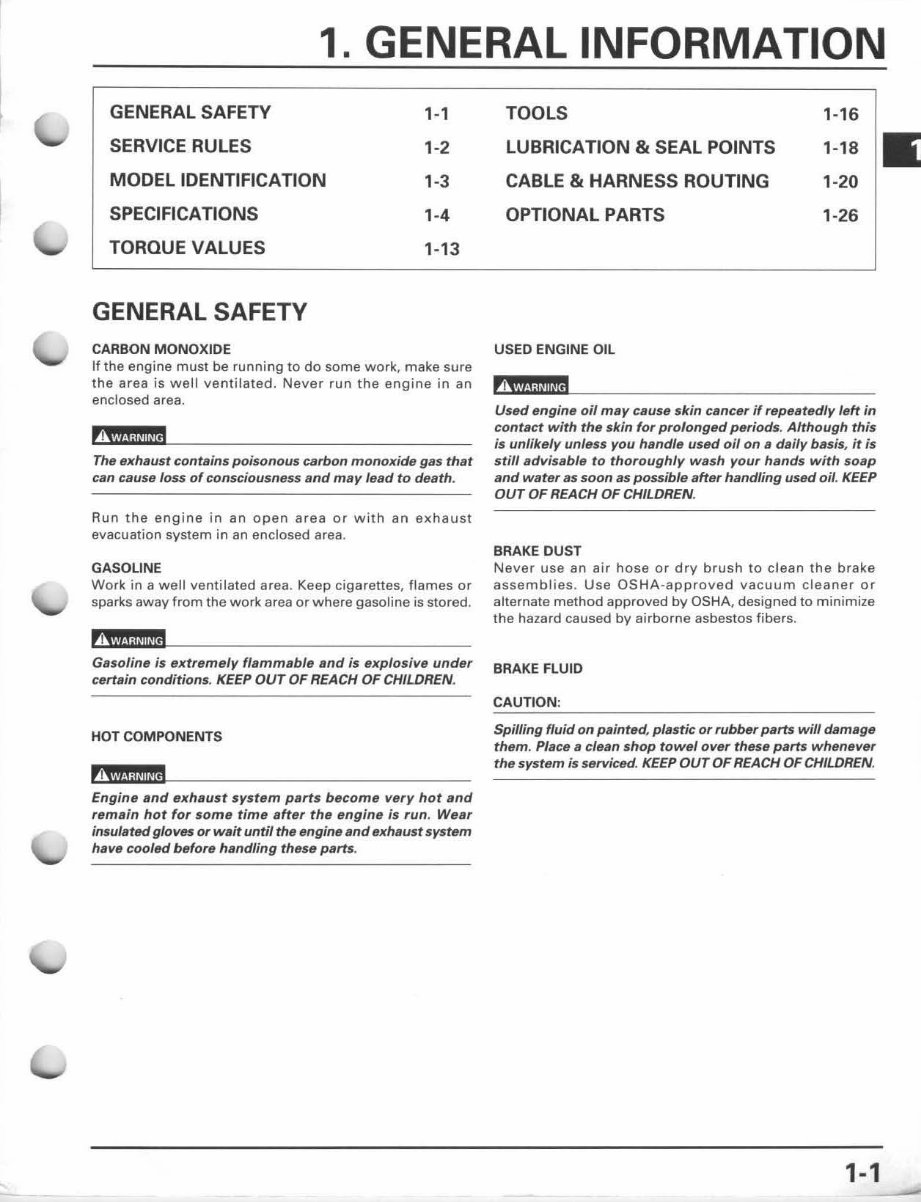
1. GENERAL INFORMATION
GENERAL SAFETY 1-1
SERVICE RULES 1-2
MODEL IDENTIFICATION 1-3
SPECIFICATIONS 1-4
TORQUE VALUES 1-13
GENERAL SAFETY
CARBON MONOXIDE
If the engine must be running to do some work , make sure
the area is well ventilated. Never run the engine in an
enclosed area.
The exhaust contains poisonous carbon monoxide gas that
can cause loss of consciousness and may lead to death.
Aun the engine in an open area or with an exhaust
evacuation system in an enclosed area.
GASOLINE
Work in a well ventilated area. Keep cigarettes , flames or
sparks away from the work area or where gasoline is stored .
Gasoline is BKtremely flammable and is Bxpfos;ve under
cfJriain conditions. KEEP OUT OF REACH OF CHILDREN.
HOT COMPONENTS
'1 Wi i;ldW4
Engine and exhaust system parts become very hot and
remain hot for some time aher the engine is run. Wear
insulated glOVBS or wait until the engine and exhaust system
have cooled belore handling these parts.
TOOLS 1-16
LUBRICATION & SEAL POINTS 1-1 8
CABLE & HARNESS ROUTING 1-20
OPTIONAL PARTS 1-26
USED ENGINE OIL
Used engine oil may cause skin cancer if repeatedly left in
contact with the skin lor prolonged periods. Although this
is unlikely unless you handle used oil on a daily basis, it is
still advisable to thoroughly wash your hands with soap
and water as soon as possible after handling used oil. KEEP
OUT OF REACH OF CHILDREN.
BRAKE DUST
Never use an air hose or dry brush to clean the brake
assemblies . Use OSHA - approved vacuum cleaner or
alternate method approved by OSHA, designed to minimize
the hazard caused by airborne asbestos fibers.
BRAKE FLUID
CAUTION:
Spilling fluid on painted , plastic or rubber parts will damage
them. Place a clean shop towel oller these parts whenever
the system ;5 serviced. KEEP OUT OF REACH OF CHILDREN.
1-1
GENERAL INFORMATION
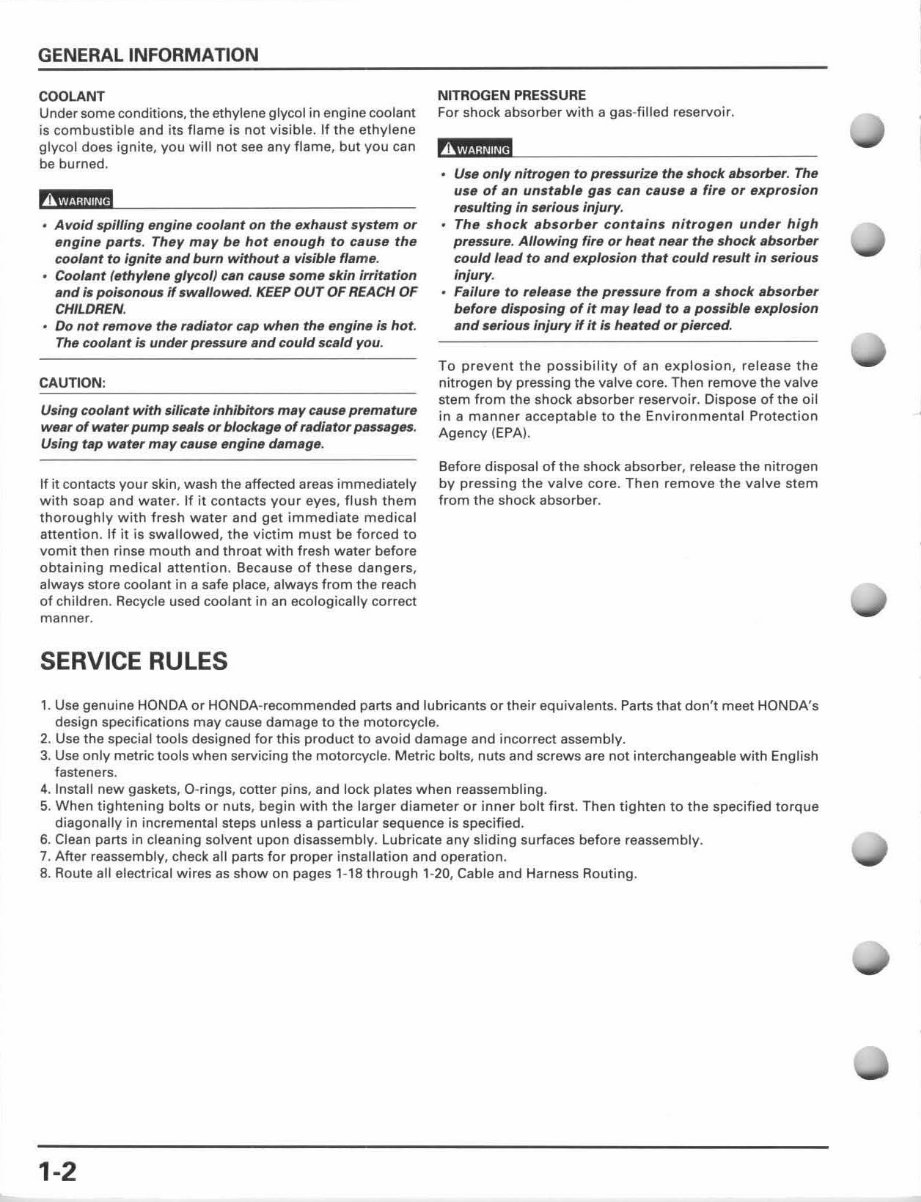
COOLANT
Under some conditions, the ethylene glycol in engine coolant
is combustible and its flame is not visible. If the ethy lene
glycol does i gn ite. you will not see any flame, but you can
be burned.
Avoid spilling engine coolant on the ex haust system or
engine parts. They may be hot enough to cause the
coo/e nt to ignite and burn without II visible flame.
Coolant (ethylene glyco l) can ca use some skin irritation
and ;s poisonous if s wallowed. KEEP OUT OF REACH OF
CHILDREN.
Do not remove the radiator cap when the engine ;s hot.
The coolant is under pressure and could scald you.
CAUTION:
Using coolant with silica te inhibitors may cause premature
wear of water pump seals or blockage of radiator passagfJS.
Usi ng tap wa ter may cause engine damage.
If it contacts you r skin, wash the affected areas immediately
with soap and water. If it contacts you r eyes, flush them
thoroughly with fresh wate r and get imme diate med ical
attention . If it is swallowed, the vi ctim must be f orced to
vomit then rinse mouth and th roat with fresh water before
obtaining me dical attention. Because of these dange r s,
always store coo lant in a safe place, always from the reach
of children . Recycle used coolant in an ecol ogically correct
manner.
SERVICE RULES
NITROGEN PRESSURE
For shock absorber with a gas-filled reservoir.
Use only nitrogen to pressurize the shock absorber. The
use of an unst able gas csn cause s fire or exprosion
resulting in serious injury.
The s hock a bsorber conta ins nitrog en under hi gh
pressure. Allowing fire or heat near the shock absorber
could lead to and explosion that could res ult in serious
injury.
Failure to release the pressure from a sh ock absorb er
before disposing of it may lead to a possible explosion
and serious injury if it is hested or pierced.
To p revent the po ssibility of an explosion, r elease the
nit rogen by pressing the valve core. Then remove the valve
stem fr om the shock absorber reservoir. Dispose of the oil
in a manne r acceptab le to the En vironmental Protection
Agency (EPA).
Before disposal of the shock absorber, release the nitrogen
by pressing the valve co re. Then remove the valve stem
from the shock absorber.
1. Use genuine HONDA or HONDA-recommended pa rt s and l ubricants or their equivalents. Parts that don't meet HONDA's
design spec ificatio ns may cause damage to t he moto rcycle.
2. Use the special too ls designed for this product to avoid damage and incorrect assembly.
3. Use only metric tools when servicing the motorcycle. Met ric bo lts, nuts and screws are not interchangeable wit h English
fasteners .
4. Install new gaskets, O-ri ngs, cotter pins, and lock plates whe n reassembling.
5. When tighten ing bolts or nuts, begin with the larger diameter or inner bolt first. Then tighten to the specified to r que
diagonal ly in incremental steps unless a particular sequence is specified.
6. Clean parts in cleaning solvent upo n disassemb ly. lub ricate any slid ing su rf aces bef ore reassembly.
7. After reassembly, check all parts for proper installation and operation.
S. Route all electrical wires as show on pages ' · 18 thr ough 1-20, Cable and Harness Routing.
1-2
GENERAL INFORMATION
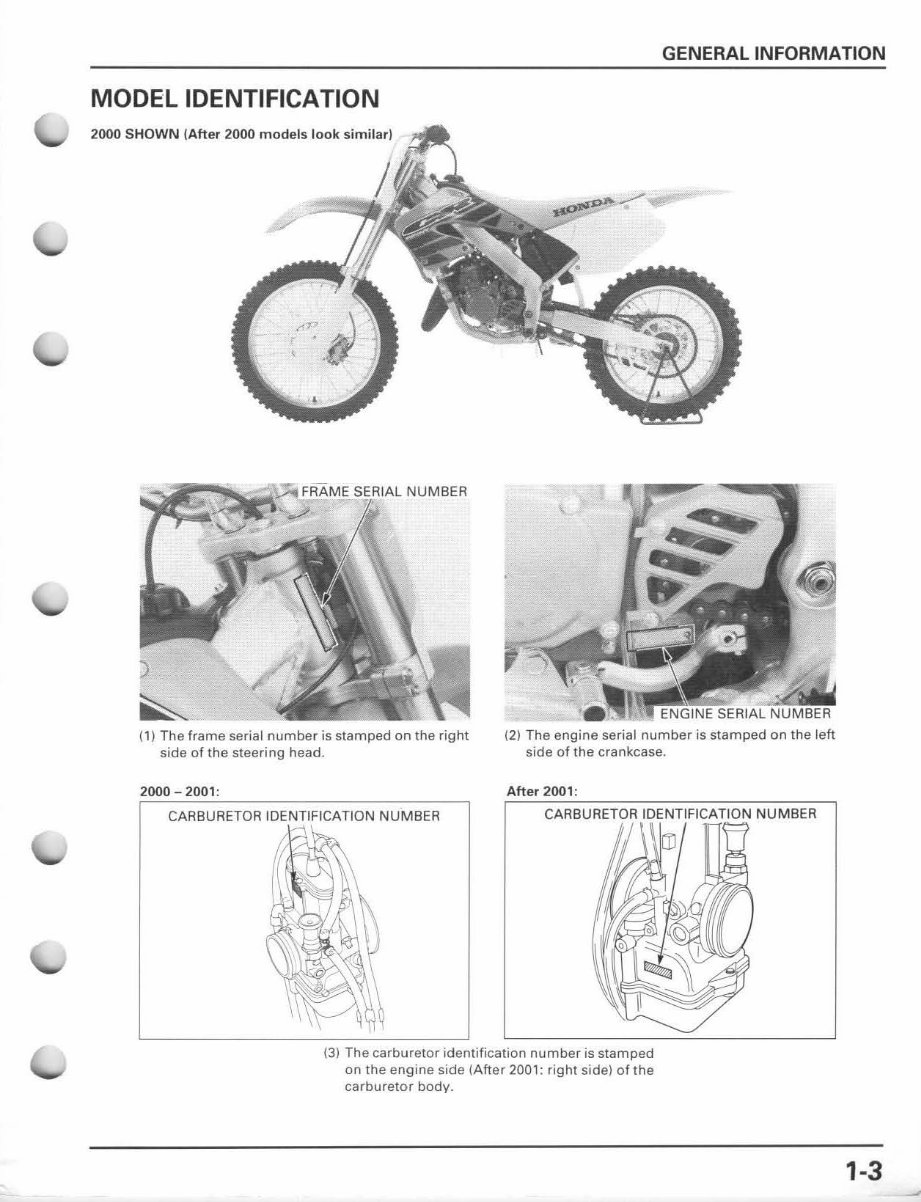
MODEL IDENTIFICATION
2000 SHOWN (After 2000 mode ls l ook simi lar)
~M."" SI~RI.", NUMBER
(1) The frame serial number is stamped on the right
side of the steering head.
200 0 - 200 1:
CARBURETOR IDENTIFICATION NUMBE R
(2) The engine serial number is stamped on t he left
side of the crankcase.
After 2001:
CARB URETOR IDENTIFICATION NUMBER
(3) The carburetor identification number is stamped
on the engine side (After 2001: right side) of the
carburetor body.
1-3
GENERAL INFORMATION
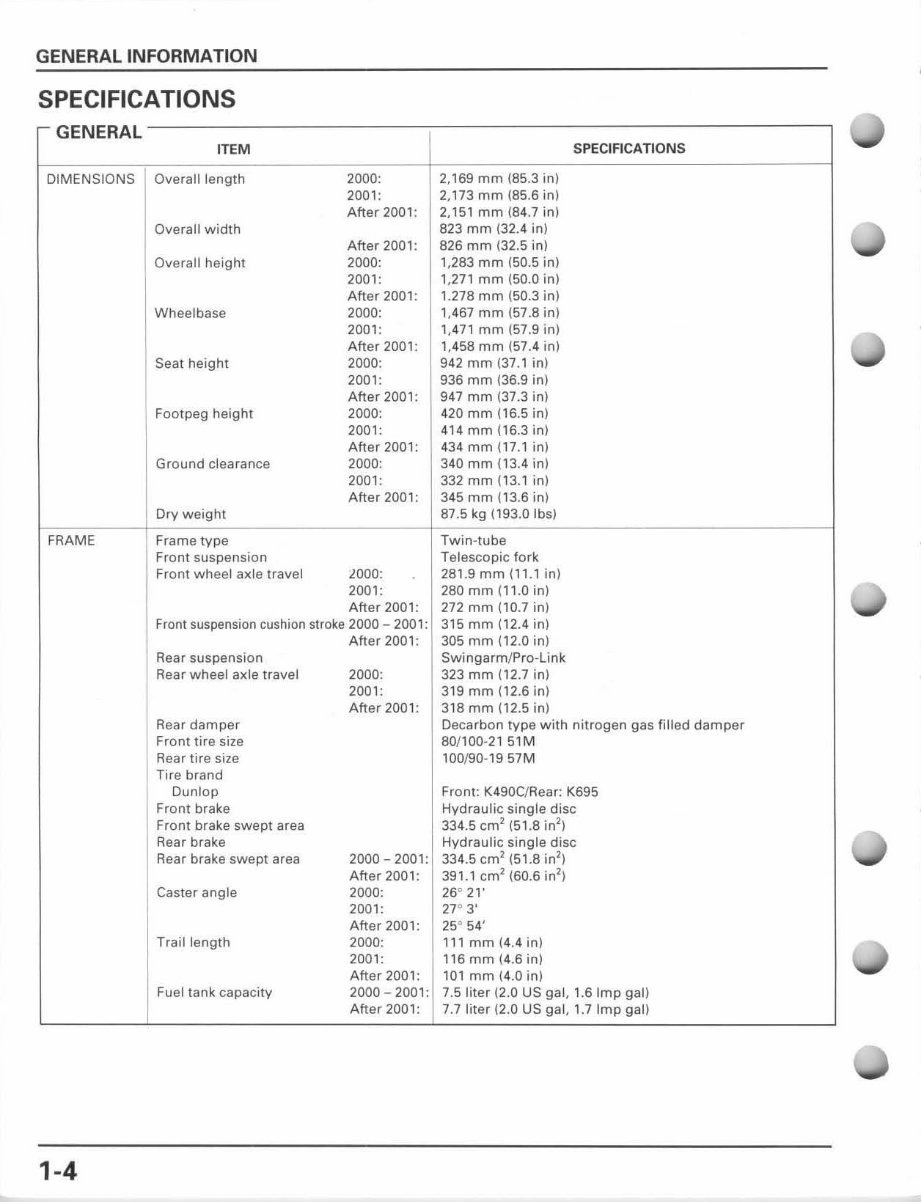
SPECIFICATIONS
r GENERAL
ITEM SPECIFICATIONS
DIMENSIONS Overall length 2000: 2,169 mm (85.3 in)
2001: 2,173 mm (85.6 in)
After 2001: 2,151 mm (84.7 in)
Overall width 823 mm (32.4 in)
Afte r 2001: 826 mm (32.5 in)
Overall height 2000: 1,283 mm (50.5 in)
2001 : 1,27 1 mm (50.0 in)
After 2001: 1.278 mm (50.3 in)
Wheelbase 2000: 1,467 mm (57.B in)
2001: 1,471 mm (S7.9 in)
After 2001: 1,458 mm (57 .4 in)
Seat heigh I 2000: 942 mm (37.1 in)
2001: 936 mm (36.9 in)
After 2001: 947 mm (37.3 in)
Foolpeg height 2000: 420 mm (16.5 in)
2001 : 414 mm (16.3 in)
After 2001: 434 mm (17.1 in)
Ground clearance 2000: 340 mm (13.4 in)
2001 : 332 mm / 13.1 in)
After 200 1: 345 mm (13.6 in)
Dry weight 87.5 kg (193.0 IbsJ
FRAME Frame type Twin-tube
Front suspension Telescopic fo rk
Front wheel axle travel 2000: 28 1. 9 mm 111.1 in)
2001: 280 mm (11.0 in)
After 2001: 272 mm (10.7 in)
Front suspension cushion stroke 2000 - 200 1: 315 mm (12.4 in)
Afte r 2001: 305 mm (12.0 in)
Rear suspension Swingarm/Pro·Link
Rear wheel axle travel 2000: 323 mm (12.7 in)
2001: 3 19 mm 1 12.6 in)
After 2001: 3 18 mm (12.5 i n)
Rear damper Decarbon type with nitrogen gas filled damper
Front tire size 80/100-2151M
Rear tire size 100/90-1957M
Tire brand
Dunlop Front: K490C/Rear: K695
Front brake Hydraulic single disc
Front brake swept area 334.5 cm
2
(51.8 in
2
)
Rear brake Hydrau l ic single disc
Rear brake swept area 2000 - 2001: 334.5 cm
2
(51.B in
2
)
After 2001: 391.1 cm
2
(60.6 in
2
)
Caster angle 2000: 26° 21'
2001 : 27
0
3'
After 2001: 25° 54'
Tra il length 2000: 111 mm (4.4 in)
2001 : 116 mm 14.6 in)
After 2001: 101 mm (4.0 in)
Fuel tank capacity 2000 - 2001: 7.5 liter (2 .0 US gal, 1.61mp gal)
After 2001: 7.7 liter (2.0 US ga l, 1.7 Imp gal)
1-4
GENERAL INFORMATION
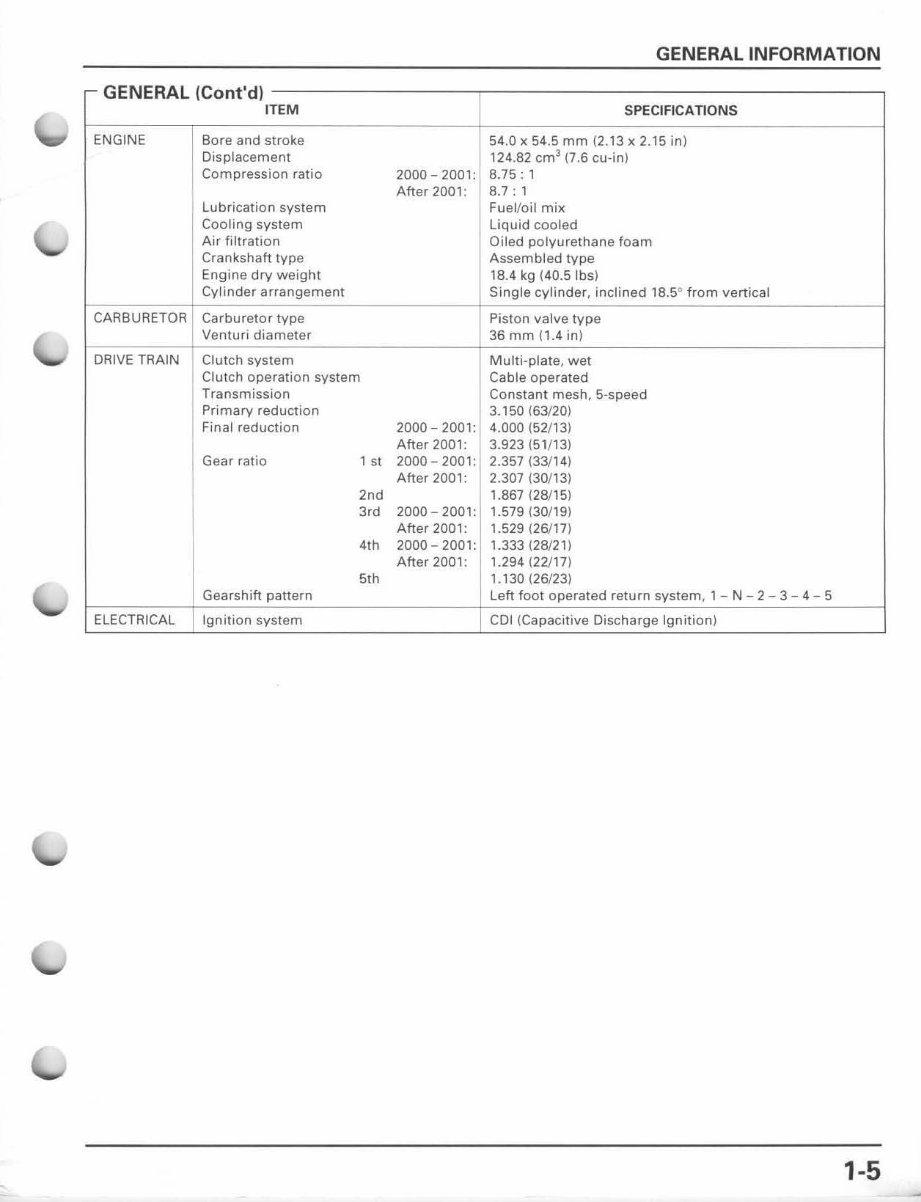
- GENERAL (Cont'dl
ITEM SPE CIFICATIONS
ENGINE Bore and stroke 54.0 x 54.5 mm (2.13 x 2.15 in)
Displacement 124.82 cm
3
(7.6 cu-in)
Compression rat io 2000 - 2001: 8.75 : 1
After 2001 : 8.7 : 1
Lubrication system Fuel/oil mix
Cooling system Liquid cooled
Air filtration Oiled polyurethane foam
Crankshaft type Assembled type
Engine dry weight 18.4 kg (40.5 Ibs)
Cylinder arrangement Single cylinder. inclined 18.5° from vertical
CARBURETOR Carburetor type Piston valve type
Venturi diameter 36 mm (1 .4 in)
DRIVE TRAIN Clutch system Multi-plate, wet
Clutch operation system Cable operated
Transmission Constant mesh, 5-speed
Primary reduction 3.150 (63/ 20)
Final reduction 2000 - 2001: 4.000 (52/13)
After 2001: 3.923 (51/13)
Gear ratio
, st
2000 - 2001: 2.357 (33/ 14)
After 2001: 2.307 (30/ 13)
20d 1.867 (28/15)
3cd 2000 - 2001: 1.579 (30; 19)
After 2001: 1.529 (26/17)
4th 2000 - 2001: 1.333 (28/21)
After 2001: 1.294 (22/17)
5,h 1.130 (26/23)
Gearshift pattern left foot operated return system, 1 - N - 2 - 3 - 4 - 5
ELECTRICAL Ignition system COl (Capacitive Discharge Ignition)
1-5
GENERAL INFORMATION
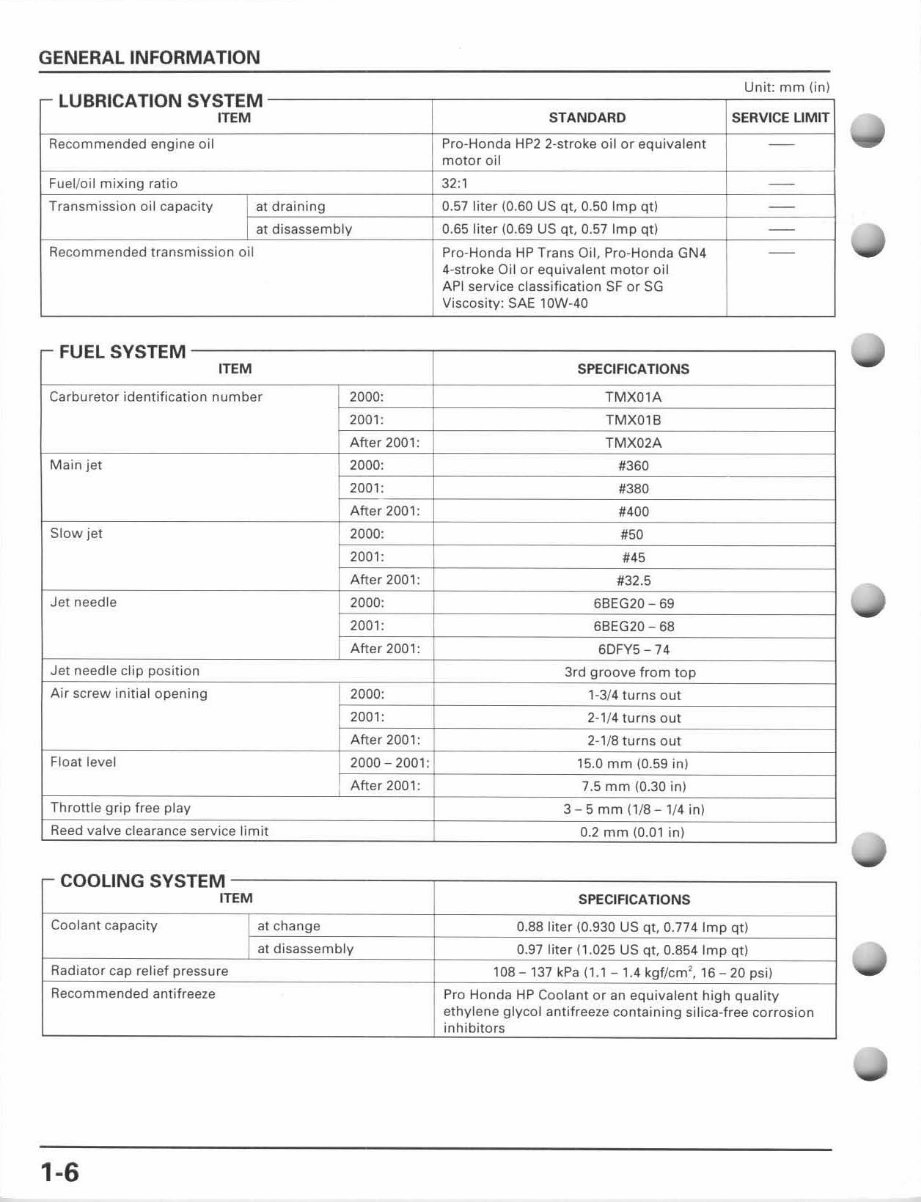
Unit: mm ( in )
r LUBRICATION SYSTEM
ITEM STANDARD SERVICE LIMIT
Re co mmended engine oil Pro~Honda HP2 2-stroke oil or equivalent
motor oil
Fuel/oil mixing ratio 32:1 --
Transm i ssion oil capaci ty al draining 0.57 liter (G.50 US qt. 0.50 Imp qt) -
at disassembly 0. 65 liter (0.69 US qt, 0.57 Imp qt) --
Recommended transmission oil Pro-Honda HP Trans Oil, Pro-Honda GN4 --
4-stroke Oi l or equivalent motor oil
API service classification SF or SG
Viscosity: SAE 10W-40
- FUEL SYSTEM
ITEM SPECIFICATIONS
Carburetor i dentifi cation number 2000: TMX01A
200 1 : TMX01S
After 2001: TMX02A
Main jet 2000: #360
2001 : #380
After 2001 : #400
Slow jet 2000: .50
2001 : #45
After 2001: #32.5
Jet needle 2000; 6BEG20 - 69
2001: 6BEG20 - 68
After 2001: BOFY5 - 74
Jet needle clip position 3rd groove fr om top
Air screw initial opening 2000: 1-3/4 turns out
2001 : 2-1/4 turns out
After 2001: 2-1/8 turns out
Flo at level 2000 - 2001 : 15.0 mm (0.59 in)
After 2001: 7.5 mm (0 .30 in)
Throttle grip free play 3 - 5 mm (1 /8 - 1/4 in)
Reed valve clearance serv ice l imit 0.2 mm (0.01 in)
r COOLING SYSTEM
ITEM SPECIFICATIONS
Coolant capacity at change 0.88 liter (0.930 US qt, 0.774 Imp qt)
at disassembly 0.97 liter 11 .025 US qt, 0.854 Imp qt)
Radiator cap relief pressure 108-137 k Pa 11.1 1.4 kgf / cm1, 16 20 psi)
Recommended antifreeze Pro Honda HP Coolant or an eq u ivalent high quality
ethylene glycol antifreeze conta i ning silica-free corrosion
inhibitors
1-6
You're Reading a Preview
What's Included?
Lifetime Access
Fast Download Speeds
Online & Offline Access
Access PDF Contents & Bookmarks
Full Search Facility
Print one or all pages of your manual
$35.99
$46.99
Viewed 98 Times Today


Secure transaction
What's Included?
Lifetime Access
Fast Download Speeds
Online & Offline Access
Access PDF Contents & Bookmarks
Full Search Facility
Print one or all pages of your manual
$35.99
$46.99
The Honda CR125R Workshop Manual for the years 2000-2003 is a comprehensive guide containing all the necessary information for repairing, maintaining, rebuilding, refurbishing, or restoring your vehicle. It is an invaluable resource for both professional technicians and DIY enthusiasts.
- Includes detailed repair procedures covering all aspects from A-Z
- Features high-quality photos, illustrations, and diagrams
- Compatible with Microsoft Windows 95, 98, 98SE, 2000, NT, ME, XP, Vista, and Windows 7, as well as all Mac computers
This Workshop Manual provides easy access to complete repair procedures, allowing users to view, print, and start working without the need for advanced computer skills. Say goodbye to cumbersome and worn-out manuals with this trusted resource.


