



The Scooter with Power and Pedal | September 1966 | 7
O you want to turn your scooter
into a little bomb, do you? Fed up
with being run into the kerb by thun-
dering lorries and chased by maniac
motorists, you are in search of more
power –and you know you can get it.
The first thing to remember is that
speed costs you money says Don Noys
of London, S.E.19., who gave us our
tips. You may have to spend £5 for
the first extra 5 m.p.h., but the next 5
m.p.h. may cost £20.
Next step is to ensure that the
machine is basically sound mechani-
cally. Proceed as for a decoke and you
will then be able to examine the big
ends, main bearings, small-end bush,
barrel, piston and cylinder head. Whilst
doing this, check the oil seal between
crank-case and gear box (this involves
further stripping down of course), for a
faulty oil seal is one of the chief causes
of loss of oil on many two-strokes.
Cycle parts like steering, tyres, sus-
pension and brakes must be checked
before you can begin to tweak the unit
for improved output. More ‘go’ always
calls for more ‘stop’ and a brake over-
haul is vital. Also check that your
insurance does not ban any tuning-up.
Piston touching risks
Stage one tuning of any orthodox
scooter involves increasing the com-
pression ratio. Sometimes this can be
done simply by removing the cylinder
head gasket, but great care must be
taken to ensure that there is no danger
of the piston clouting the head as it
operates. If it does, then the cylinder
head must be relieved around the outer
periphery to prevent this. Again, this is
a simple job, but it must be done accu-
rately.
The ratio can be even further increased
by reducing the head face itself. This is
achieved accurately by use of a surface
plate. An old mirror and fine grinding
paste is just as good provided care is
taken to keep the action level.
This is about as far as you can go
with modifying of the cylinder head
at home. Further output can be gained
by fitting a special high-compression
head, complete with central spark plug,
which ensures central burning of the
mixture and cleaner combustion, and
sporting units like these are readily
available. Do not tamper with the fin-
ning of the head or barrel, and on no
account impair the cooling system by
removing flywheel finning.
On the cylinder barrel, the ports are
of paramount importance. All must be
clean and smooth, with any casting
lips or imperfections removed. Do this
SPEED -
TUNE
YOUR
SCOOTER
First in a new
series of speed-up
articles aimed at
boosting both
speed and
acceleration
S
(Continued on p.8 )
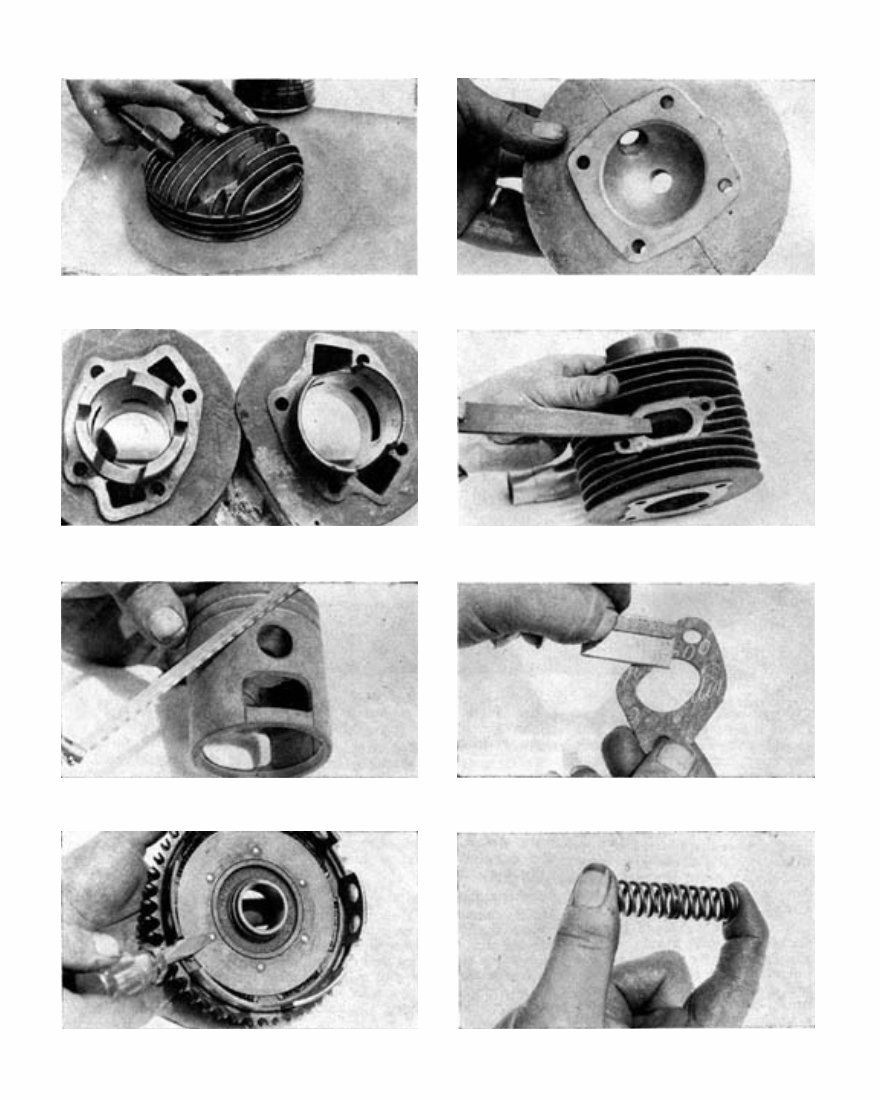
To skim down cylinder head, use an old mirror or
piece of plate glass and fine carborundum paste.
Standard and modified barrels, showing how the
transfer ports have been carefully cut out bigger.
The ‘window’ in the piston is cut out more to lessen
drag and also to advance the port timings.
Clutch housing rivets must be checked for any loose-
ness as rigid assembly is vital for speed.
Outside edge of hemisphere must be cut away well to
stop piston hitting. Note new centre plug hole.
Gas flow through the inlet and exhaust ports can be
helped by filing away smooth any rough edges.
Induction manifold gasket is cut back to stop it
squeezing and obstructing port when it’s bolted up.
Test clutch springs by putting old and new together
and squeezing to see which of them moves most.
8 | The Scooter with Power and Pedal | September 1966
carefully with fine files and emery
cloth. Opening of the ports is really
a specialist job and should not be
attempted without advice. However,
on the Lambretta for instance, it is
possible to open up the transfer ports,
making them flush to the barrel walls,
by filing away the protuding spigot.
Don’t try to open up the inlet port too
much; simply match it to the piston
and the induction manifold. In addi-
tion, make allowance for the squashing
of the new induction manifold gasket,
by cutting away the inner opening of
the gasket with a razor blade.
File it square
On the exhaust port, where this is
oval as standard, you can file all four
corners to right angles, at the same
time ensuring that this matches the
piston. On finishing, make sure that
you chamfer off all the inside edges of
the ports to prevent any trapping of
the piston rings when the engine is
operating. It goes without saying that
for all this work a selection of good
quality, sharp files, medium and fine-
toothed, are absolutely necessary. On
With this degree of tuning, the
bottom end will stand up well to the
power increase, provided it is sound
in the first place. So leave the bottom
end well alone and do not attempt
to increase crankcase compression by
filling the crankshaft webs with ducal
blocks.
Highly specialised
If you perhaps intend to go on to
second stage tuning though, scooter
tune specialists like Don Noys provide
an over-the-counter crankshaft, com-
plete with ducal blocks inserted into
the webs. This is highly specialised
and involves splitting the crankshaft
halves, and re-balancing. Cost of this
modified unit is £1.15.0. for the Lam-
bretta.
Having gained extra power, it now
has to be transmitted to the rear wheel
and the weakest link en-route is the
clutch. This must be in perfect condi-
tion, otherwise there is risk of clutch
slip or breakage. If in doubt, strip the
clutch for inspection, paying special
the piston, it is vital to make sure that
there is no excessive burning or oval-
ity, and that the ring gaps arc no wider
than about 7 thou. as a maximum.
Better if they are around 5 thou. Any-
thing more than 7 thou. and new rings
must be fitted. The piston itself must
not have more than 10 thou. clearance
between piston skirt and cylinder barrel
wall. If it is in excess of this and a
rebore becomes necessary, ensure that
the reboring specialist knows that the
machine is to be used for high speed
work. For the standard bore should
be between 4 and 7 thou tolerance
whereas if increased performance is in
mind, greater tolerance is allowed.
In other words, the barrel will be
machined out to provide a looser fit
for the standard piston. Cost of a
rebore, including new piston and rings
to match, is 65s. 0d.
Final home tuning hint on the piston;
carefully cut away the bottom sections
of the transfer port windows, and then
use a fine file, blue-back emery cloth
and then metal polish to ensure a really
smooth finish. This will lighten the
piston and reduce operating drag.
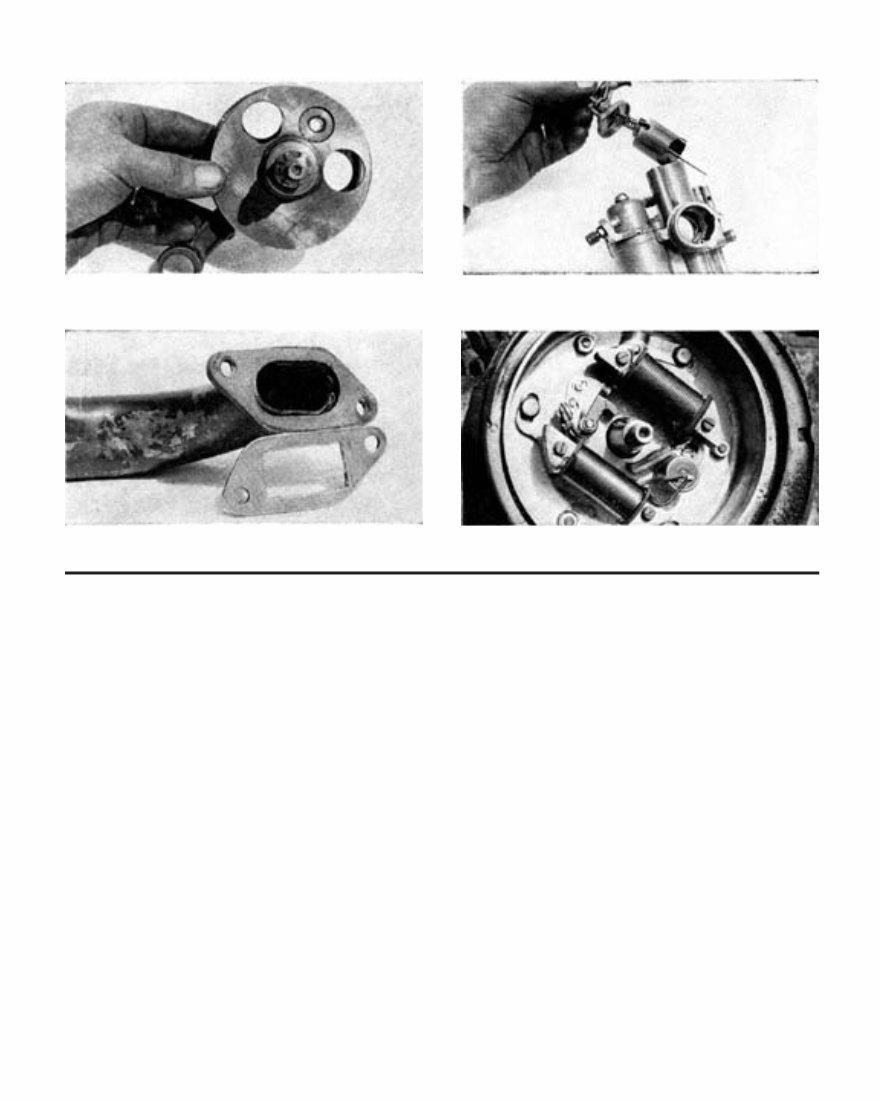
Crankshaft balance holes con be filled to bump up the
primary compression—an experts job, however.
Modified exhaust gasket is shown here with exit tube
before it is filled to mate cylinder flange.
Check carb slide and make sure needle is not bent.
The needle position can be experimentally raised.
Ignition timing advance is vital. Elongated slots in
breaker plate allow you to shift points further on.
(Continued on p.27 )
The Scooter with Power and Pedal | September 1966 | 9
done later with a close watch on the
spark plug.
Needle setting can often be raised
from the middle notch to the next
in line or maybe even two positions.
Remember to move it in the right direc-
tion (up or down according to the car-
burettor model), the object being to
raise it away from the atomiser. Make
a close check on the carb. slide too.
There must be no wear, or signs of
scoring. If there is, then renew the
slide.
Keep air cleaner
On no account attempt to dispense
with the air cleaner; it will make
the mixture weak, carburettor setting
almost impossible and cause overheat-
ing of the engine.
Ignition is the subject that has many
scooter owners foxed. But it is vital
to advance the ignition having altered
the port timings in the cylinder barrel.
Usually 1 degree of advance is suffi-
cient with Stage One tuning.
Do this by removing the flywheel
and advancing the stator plate either
forward or backward according to the
model. Most machines will have a full
description of this operation in the
hand-book. You will almost certainly
need a few special tools to do this, par-
ticularly a flywheel extractor. A stan-
dard tool costs about 10s 0d. Points
setting remains constant whatever the
degree of tuning, i.e. same as that rec-
ommended in the handbook. A harder
plug will probably be needed, too.
The silencer itself is very important
with any two-stroke machine and pro-
vided it is in good condition it is as
well to leave alone. Never, in any case,
completely remove the baffles which
will destroy the back pressure so vital
to performance.
However, if the standard unit seems
unsatisfactory—test by holding a hand
over the outlet pipe and revving the
engine; if efficient gases will pulsate
strongly enough to thrust your hand
away—try fitting one of the propri-
etory units which allows for increased
expansion of the gases.
Don’t be tempted to knock some of
the old baffles out of existing silencer,
as this will only make the machine
extra noisy—and will probably make
the engine run worse than it did before.
Remember, more power does not mean
more noise.
Speed Tune
Your Scooter
(
•
Continued from p.9 )
attention to the fixed plate rivets, the
plates themselves for wear or glazing,
and the clutch retaining springs. Hold
a new spring and one of the existing set
between your fingers and press hard. If
the old one closes its coils more than
the new it is obviously weaker and the
whole set of five must be renewed.
So much then for the basic power
and transmission units. We now come
to the all important carburettor. With
the greater power development, more
fuel will be needed. Just how much
more can only be assessed by trial
and error testing with differing main
jets and needle settings. Each machine
has different characteristics. Generally
though, it will be found that an increase
of ten sizes of main jet (from the basic
number 78 up to 90 or even beyond),
will be about right.
This check on mixture can only be
carried out on the road, and must be
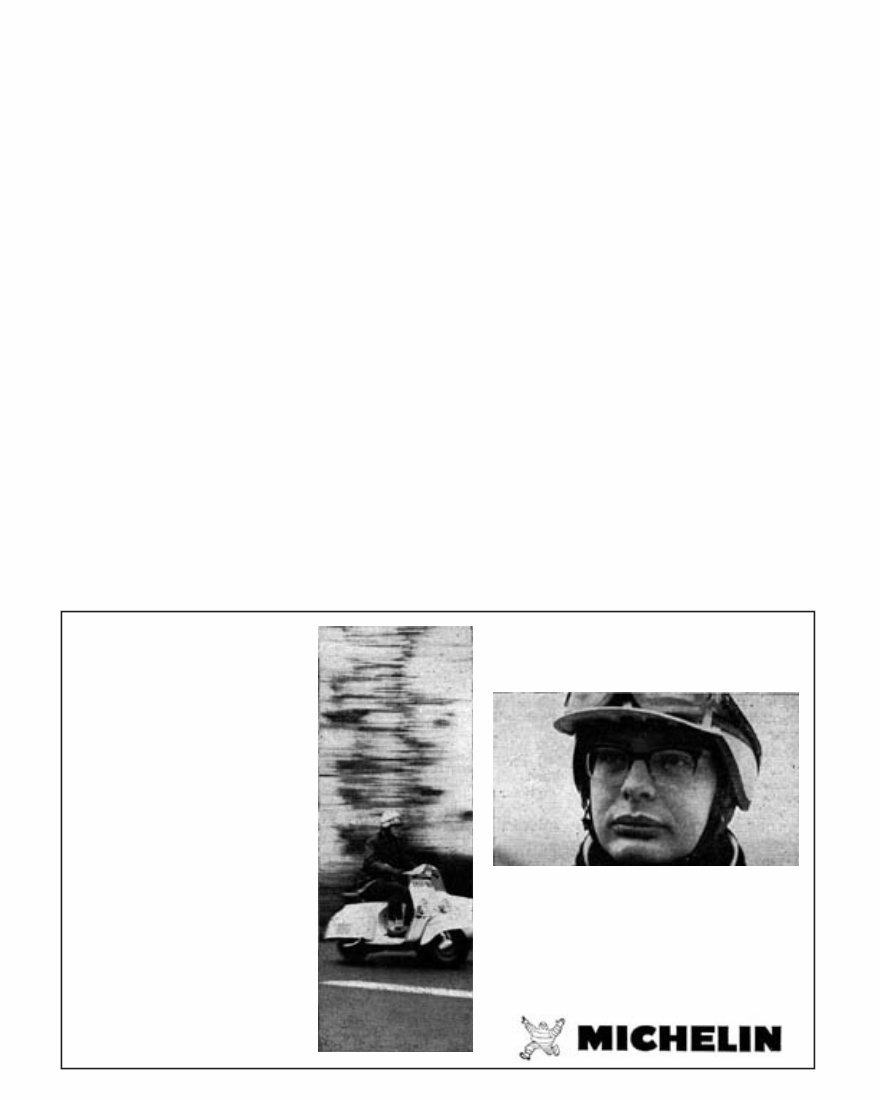
In June, Robert Currie
sets out from Cheltenham
to journey the world an a
Vespa SS–a journey which
will take him
over 25,000 land miles.
The tyres he’s chosen are
Michelin ACS
This is what he says about them: “I’ve
found Michelin tyres last longer. l get 15,000 to 20,000
miles from one set in comparison with the average 10,000
I used to get with other brands.”
About the traveller. Robert Currie is 23. He is a member
of the Cheltenham Vespa Club and since joining in 1958
has collected 25 cups and trophies including four firsts for
national rally events. In 1961 he won the Isle of Man 12-hour
trial, and in the same year scored two firsts in the Interna-
tional Rally held at Cheltenham in which nearly 4,000 British
and Continental riders competed. The route planned for his
world trip takes him through America, Canada, Mexico, New
Zealand and Australia. His return trip covers India, Iran, Paki-
stan, the Middle East and Turkey.
The Scooter with Power and Pedal | September 1966 | 27
You're Reading a Preview
What's Included?
 Lifetime Access
Fast Download Speeds
Online & Offline Access
Access PDF Contents & Bookmarks
Full Search Facility
Print one or all pages of your manual
$26.99
BAOTIAN HOW To SPEED TUNE YOUR Scooter
Viewed 46 Times Today

What's Included?
Lifetime Access
Fast Download Speeds
Online & Offline Access
Access PDF Contents & Bookmarks
Full Search Facility
Print one or all pages of your manual
$26.99

Secure transaction
What's Included?
Lifetime Access
Fast Download Speeds
Online & Offline Access
Access PDF Contents & Bookmarks
Full Search Facility
Print one or all pages of your manual
The parts manual you will receive contains all the necessary information for tuning your scooter. It is a valuable resource for both professional mechanics and DIY enthusiasts.
- Baotian
- How to speed tune your scooter


