


DISHWASHER Repair Manual MODEL
What's Included?
 Lifetime Access
Fast Download Speeds
Online & Offline Access
Access PDF Contents & Bookmarks
Full Search Facility
Print one or all pages of your manual
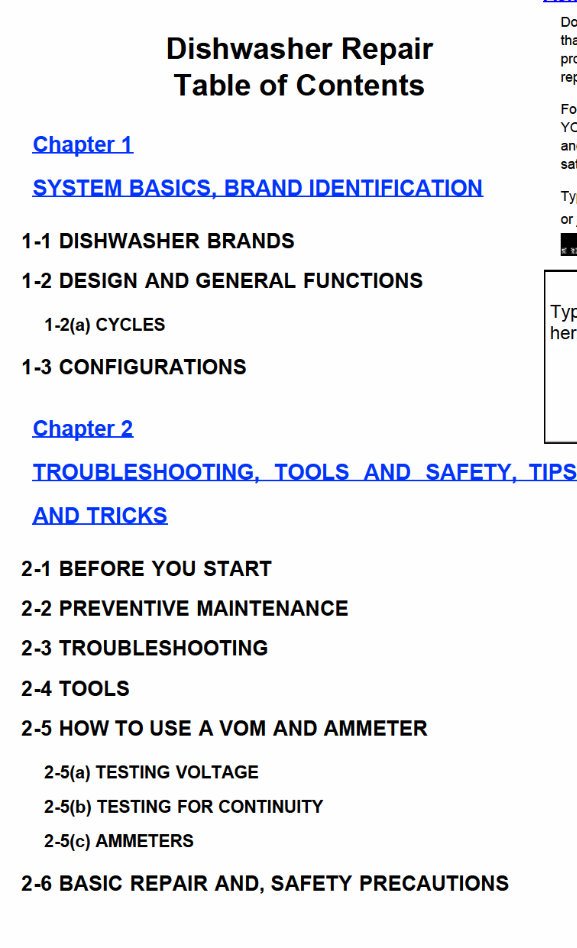
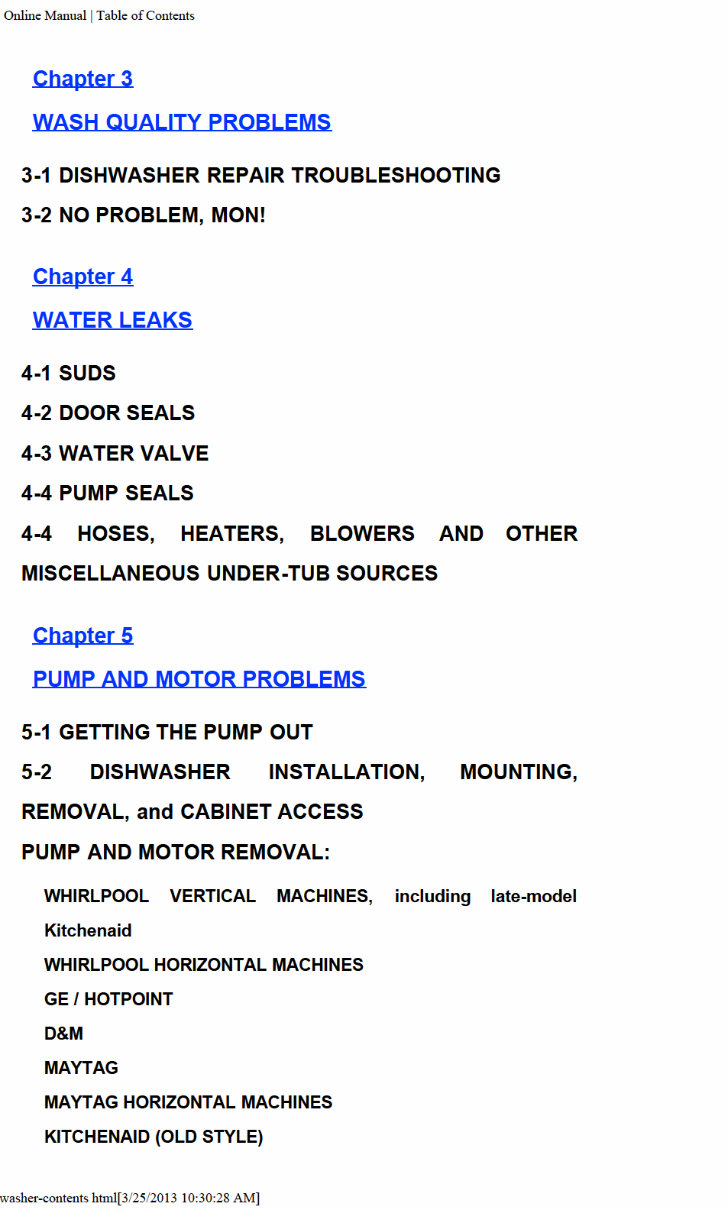
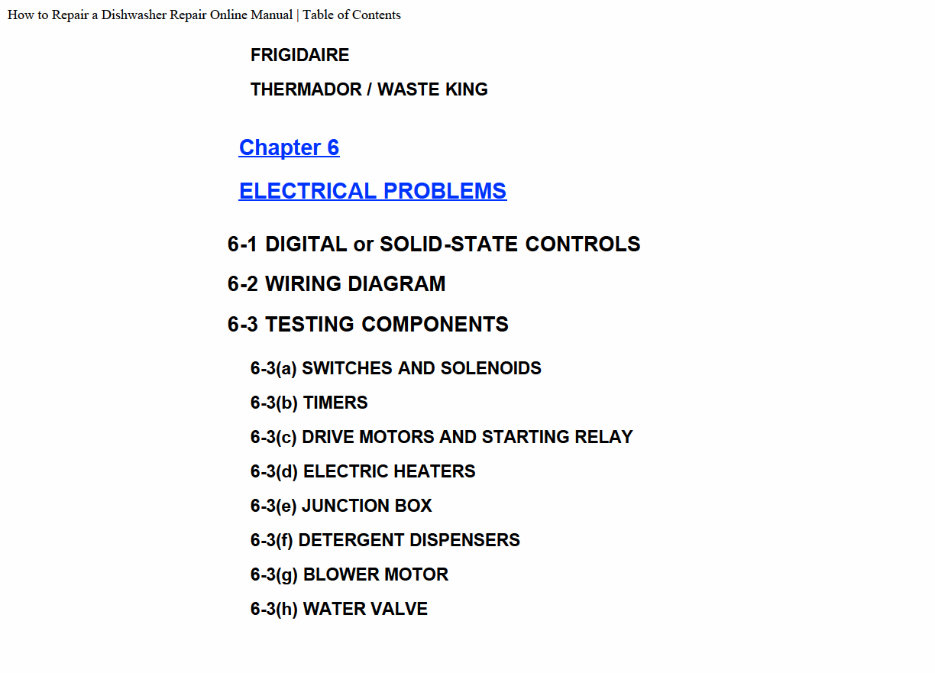

Dishwasher Sytem Basics - Chapter 1 - Dishwasher Repair Manual
http://www.appliancerepair net/dishwasher-repair-1.html[3/25/2013 10:30:46 AM]
shorter-lived than other major appliances. Why? Well, to answer that
question, let's all be little deviants for a moment, and design ourselves a
torture chamber—for an electric motor.
What is absolutely the worst enemy of electricity in a machine? Water,
right? Well, then, let's use the motor to pump water, and let's mount the
motor right underneath the water seal. That way if the seal leaks at all,
lots of hot, steamy water will run right down on top of the motor and rust
it up and short it out. While we're at it, let's run some bits of broken glass
and big chunks of food and nutshells and seeds through the pump, so we
can chew up the seals and the impeller and also to introduce some nice,
sudden deceleration shocks to the motor and pump. And of course, for
maximum heat buildup, let's mount the whole motor and pump package in
a tiny, cramped, steamy, dusty, poorly ventilated space, right beneath a
tub full of hot steamy water. Get the picture?
1-2(a) CYCLES
STARTING DRAIN CYCLE
Cold water can kill your wash quality. (see Chapter 3) So before letting any
hot water into the tub, we must make sure the tub has no cold water left
in it from the last wash. Therefore, in most designs, a new wash cycle
starts with the pump operating for a minute or so in the "drain" mode.
FILL CYCLE
An electric solenoid fill valve then opens to let hot water into the tub. The
timer controls how long the solenoid valve stays open, which controls the
water level. A flow-control washer built into the valve compensates for
variations in the water supply pressure.
Most designs use an anti-flood float switch to prevent accidental overflow
during the fill cycle.
WASH CYCLE
The pump then starts in the "wash" mode. Water is channelled to the
spray arms which spray the hot water at the dishes. In some models,
detergent is dispensed during the wash cycle. The timer controls when this
occurs. In most designs, the dispenser is opened either by a solenoid or by
a bi-metallic trigger. GE uses a cam on the timer to trip open the
dispenser.
WATER HEATING
Most designs also have a water heater in the tub to maintain proper water
temperature during the wash cycle. In some designs, the heater also dries
the dishes at the end of the wash.
RINSE CYCLE
Note that the dishwasher also operates in the "wash" mode during the
Dishwasher Sytem Basics - Chapter 1 - Dishwasher Repair Manual
http://www.appliancerepair net/dishwasher-repair-1.html[3/25/2013 10:30:46 AM]
"rinse" cycle. The only substantial difference is that no detergent is being
released during the "rinse" cycle.
2nd or 3rd DRAIN CYCLE
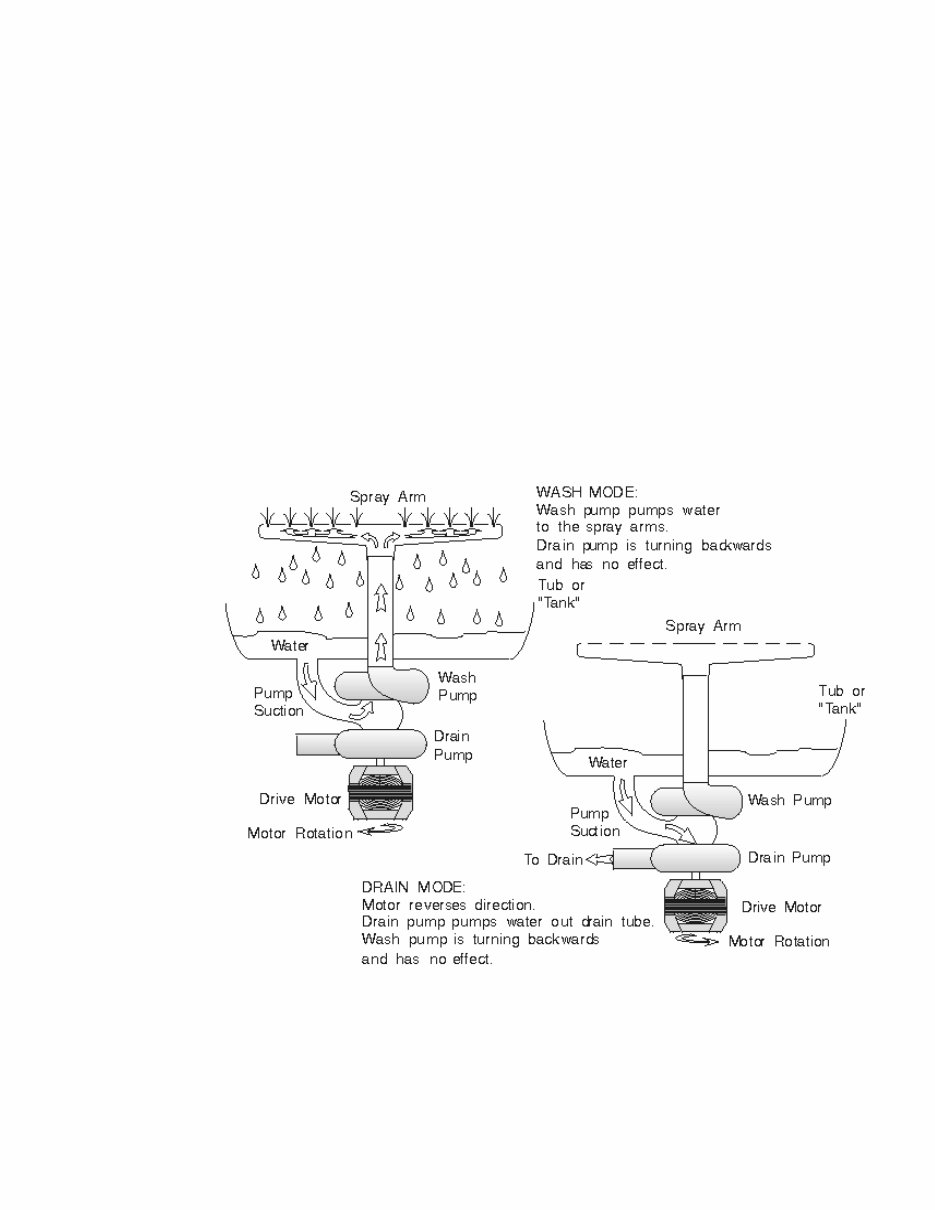
At the end of the "wash" and "rinse" cycles, the pump enters the "drain"
mode. The pump drains water from the tub in one of two ways. In some
"direct-reversing" designs, the motor reverses direction and a separate
impeller pumps the water out. (Figure 1-A)
In other designs, a solenoid-controlled valve opens to allow the pump to
discharge to the drain line. (Figure 1-B) The timer controls the direction of
the motor or the opening of the drain valve.
DRY CYCLE
Most models also have a "dry" cycle. In some machines, the heater does
this. In others, a blower fan circulates air inside the cabinet to evacuate
steam and dry the dishes somewhat.
Figure 1-A: Typical Direct-Reversing Design
Figure 1-B: Typical Single-Direction Machine
You're Reading a Preview
What's Included?
Lifetime Access
Fast Download Speeds
Online & Offline Access
Access PDF Contents & Bookmarks
Full Search Facility
Print one or all pages of your manual
£21.99
Viewed 79 Times Today


Secure transaction
What's Included?
Lifetime Access
Fast Download Speeds
Online & Offline Access
Access PDF Contents & Bookmarks
Full Search Facility
Print one or all pages of your manual
£21.99
This dishwasher repair manual model covers almost all models and repairs, making it the perfect resource for both professional mechanics and DIY enthusiasts. Why pay $75-125 to repair your dishwasher when you can do it yourself? This manual provides everything you need to fix your own dishwasher, and you can easily print out any pages that you need. It works with all Windows and Mac computers, and you can securely pay using PayPal or your credit card. If you're not satisfied, it's guaranteed or your money back.


