OPERATOR’S MANUAL Part number 47529192 3 rd edition English October 2013 LM5030 Telescopic Handler ORIGINAL INSTRUCTIONS ORIGINAL INSTRUCTIONS - according to Directive 2006/42/EC, Annex I 1.7.4.1
Contents 1 GENERAL INFORMATION Introduction ................................................................................. 1-1 Intended use of your Telehandler........................................................... 1-3 Machine identification ...................................................................... 1-5 Machine Components ...................................................................... 1-6 Telehandler identification .................................................................. 1-11 Technical documentation holder ........................................................... 1-13 CE DECLARATION OF CONFORMITY ................................................... 1-14 Electromagnetic interferance .............................................................. 1-20 Vibration ................................................................................... 1-21 Noise level ................................................................................. 1-22 Storing hazardous liquids.................................................................. 1-23 Diesel fuel ................................................................................. 1-26 Evaluate the firmness of the Ground below ............................................... 1-29 Agricultural applications ................................................................... 1-31 2 SAFETY INFORMATION Recognizing the safety rules Aspects relating to safety of the directive 2010/52/EC ...... 2-1 Machine out of service ..................................................................... 2-8 General notices ............................................................................. 2-9 Protective clothing ......................................................................... 2-13 Preventing fires and accidents ............................................................ 2-20 List of capacity diagrams .................................................................. 2-26 Work condition ............................................................................. 2-27 Recommendations for working in safety .................................................. 2-33 Safety Decals .............................................................................. 2-36 Safety devices ............................................................................. 2-44 Hand signals ............................................................................... 2-46 3 CONTROLS/INSTRUMENTS ACCESS TO OPERATOR'S PLATFORM Getting in or out of the driver's cab ..................................................... 3-1 Door opening controls .................................................................. 3-2 OPERATOR'S SEAT Seat Belts............................................................................... 3-7 FORWARD CONTROLS Pedals ................................................................................. 3-11 Multifunction control lever ............................................................. 3-13 Movement selection lever ............................................................. 3-15 Parking Brake ......................................................................... 3-16 RIGHT-HAND SIDE CONTROLS Tools controls .......................................................................... 3-18
Steering selector ...................................................................... 3-22 INSTRUMENT CLUSTER Getting to know the internal parts of the cab .......................................... 3-25 Central dashboard - Warning lights.................................................... 3-26 Status and warning icons .............................................................. 3-28 Display settings ........................................................................ 3-37 Initial dashboard instrumentation check ............................................... 3-40 SIDE CONSOLE Emergency button ..................................................................... 3-43 Starting and stopping the vehicle ...................................................... 3-44 Fast/Slow drive enabling signal ....................................................... 3-47 Diagram notebook ..................................................................... 3-48 Rear window wiper control ............................................................ 3-49 Cab Internal Ventilation ................................................................ 3-51 Switching on lights ..................................................................... 3-54 4 OPERATING INSTRUCTIONS COMMISSIONING THE UNIT Environmental conditions ............................................................... 4-1 MOVING THE UNIT Driving on roads ........................................................................ 4-2 PARKING THE UNIT Parking the machine .................................................................... 4-3 5 TRANSPORT OPERATIONS ROAD TRANSPORT Warnings for towing a trailer ............................................................ 5-1 RECOVERY TRANSPORT Lifting the machine ..................................................................... 5-2 Transporting the machine .............................................................. 5-3 Towing the machine .................................................................... 5-5 6 WORKING OPERATIONS GENERAL INFORMATION Equipment Installation .................................................................. 6-1 Hydraulic connections .................................................................. 6-8
Electrical connections ................................................................. 6-14 Removing equipment .................................................................. 6-16 Forks .................................................................................. 6-21 Safe working procedures for forks ..................................................... 6-26 Load tables ............................................................................ 6-31 Load handling ......................................................................... 6-39 7 MAINTENANCE GENERAL INFORMATION Maintenance descriptions .............................................................. 7-1 TABLE OF LUBRICANTS .............................................................. 7-6 CLEANING ............................................................................. 7-7 Table of lubricating oils ................................................................. 7-9 Opening the engine bonnet............................................................ 7-10 MAINTENANCE CHART Maintenance Chart .................................................................... 7-12 Every 10 hours Engine oil .............................................................................. 7-14 Air filter: Cleaning ..................................................................... 7-15 Every 50 hours Lubrication ............................................................................. 7-16 Transmission shafts: Lubrication ...................................................... 7-17 Every 100 hours Wheels and Tires ...................................................................... 7-19 Radiator ............................................................................... 7-25 Tire pressure: Inspection .............................................................. 7-26 Every 250 hours Engine maintenance ................................................................... 7-27 Changing the oil ....................................................................... 7-28 Intake hydraulic oil filter: Replacement ................................................ 7-29 Return hydraulic oil filter: Replacement ............................................... 7-30 Air filter replacing ...................................................................... 7-31 Air conditioning maintenance .......................................................... 7-32 Cylinder block valve maintenance ..................................................... 7-33 Every 500 hours Fuel tank ............................................................................... 7-35 Oil change: Inspection................................................................. 7-36 Epicycloidal reduction gear oil ......................................................... 7-37 Differential axle oil: Inspection and change ........................................... 7-38
Every 1000 hours Replacing liquid........................................................................ 7-39 Oil change: Inspection and change ................................................... 7-40 When changing the oil ................................................................. 7-41 AS REQUIRED Radiator maintenance ................................................................. 7-42 Hydraulic system maintenance ........................................................ 7-43 Brake maintenance .................................................................... 7-44 Tire pressure: Inspection .............................................................. 7-45 Air conditioning maintenance .......................................................... 7-46 Telescopic boom maintenance ........................................................ 7-48 Electrical System Electric system diagram ............................................................... 7-49 Starting with auxiliary Batteries ........................................................ 7-56 Battery cut-off .......................................................................... 7-58 Fuses and Relays ..................................................................... 7-59 Engine Controller ...................................................................... 7-61 Working lights ......................................................................... 7-62 STORAGE STORING THE MACHINE ........................................................ 7-67 8 TROUBLESHOOTING FAULT CODE RESOLUTION Troubleshooting .................................................................... 8-1 9 SPECIFICATIONS Torque charts ............................................................................... 9-1 Dimensions specifications .................................................................. 9-4 10 ACCESSORIES TRAILER BRAKING SYSTEM ............................................................ 10-1 Rear hydraulic inlets ....................................................................... 10-3 QUICK HITCH ............................................................................. 10-4 Plate transfer .............................................................................. 10-5 Rear trailer hooks.......................................................................... 10-6 Hydraulic sockets and electric contact on boom head ................................... 10-10 Engine fan reversal ....................................................................... 10-13 Boom suspension (Optional) ............................................................. 10-14 Warnings for using the PTO .............................................................. 10-16 Continuous oil function ................................................................... 10-18
Water heater (Optional)................................................................... 10-19 Trailer descent ............................................................................ 10-20
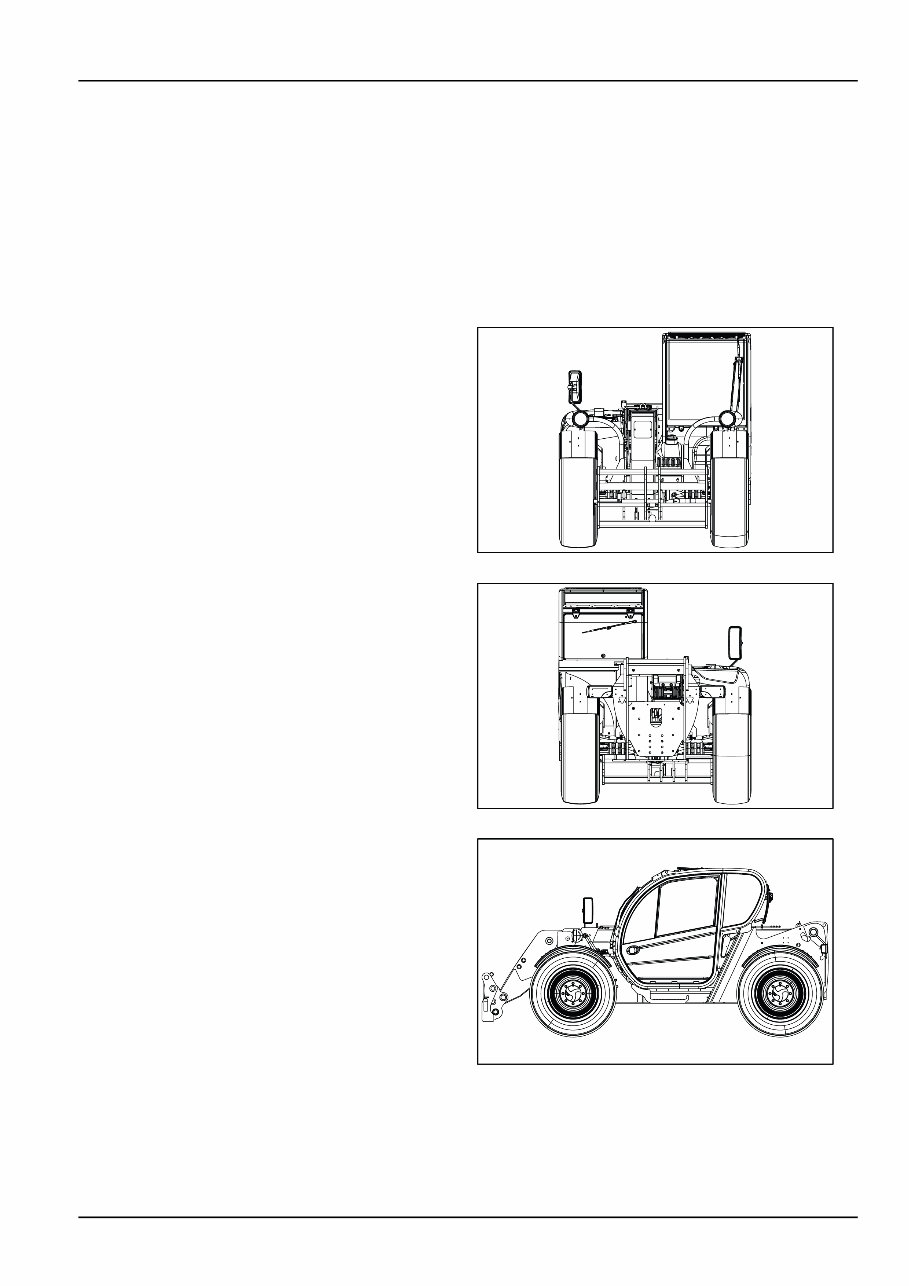
1 - GENERAL INFORMATION 1 - GENERAL INFORMATION###_1_### Introduction NOTICE: The images used to describe the components and controls refer to a vehicle complete with all the ac- cessories; these may vary according to the set-up and selected configuration. Positions and references used in the manual refer to the vehicle facing the normal drive direction. Front view LEIL13TLH0006AA 1 Rear view LEIL13TLH0007AA 2 Left side view LEIL13TLH0008AA 3 1-1
1 - GENERAL INFORMATION Right side view LEIL13TLH0009AA 4 1-2
1 - GENERAL INFORMATION Intended use of your Telehandler NOTICE: Your Telehandler is designed according to European directives related to health and safety risks; though it has been designed to minimize all the potential risks it is mandatory to carefully read, understand and observe all the decals and labels of the PPP (Plant Protection Product) and to always refer to information and prescriptions outlined in this manual to prevent all residual potential risks. In case you may need further assistance please do not hesitate to contact your dealer. The machine was designed and made according to the strictest quality standards and complies with 2006/42/EC. Your Telehandler is designed and made to pull, to carry and to power a variety of mounted or towed equipment, although within some physical limits. The working speed and performance may depend of a number of various pa- rameters, such as weather and terrain conditions. Though the machine id designed to perform in combination with a variety of equipment in most crops and conditions, there may be a number of combinations of above parameters, for which there is severe degradation of performance of the machine and/or its mounted or trailed equipment. If you notice degradation of performance, contact your dealer for assistance. He may have useful information for improve- ments, or a kit be available to enhance the performance. • Do not use the machine for another purpose than intended by the manufacturer and outlined in this manual. • Do not use the machine beyond its limits of terrain gradient and stability as outlined further in this manual. Using the machine beyond these limits may result in roll over or tip over. Observe the recommendations in this manual. • Do not use the machine on higher speeds than allowed by the load and environment. A wet surface or other low adherence conditions may increase the braking distance or result in vehicle instability. Adapt always your travelling speed according to the load of the vehicle and the characteristics of the road. • Do not use the machine near or on soft verges of canals and brooks or banks or verges that are undermined by rodents. The machine may sink sideways and roll over. • Do not use the machine on brittle bridge heads and poor bridge floors. These constructions may collapse and cause rollover of the machine. Check out always the conditions and carrying capacity of bridges and ramps prior to engage. • Do not use the machine without wearing the seat restraint system during activities where roll over or tip-over hazard exist. The ROPS cab or ROPS structure will only be fully effective when the driver remains attached to the seat. • Do not use equipment mounted on the machine which is not correctly matching and firmly fixed. Such equipment may increase the risk for-over and hit the machine when coming loose. • Do not use the machine in combination with equipment, without having consulted the specific Operator’s Manual provided with the equipment. The machine is a universal tool to carry, tow and drive a variety of equipment. This manual alone cannot provide you with all the information required for the safe operation of the combination. • Do not use the machine beyond its limits of dynamic stability. High speed, abrupt manoeuvres and fast and short cornering will increase the risk of roll over. • Be extremely cautious when working with the machine on forage silos without lateral concrete walls. Dual wheels or a wide track setting may improve the lateral stability of the machine. • Be cautious that the centre of gravity of the machine may increase when loads on the front-end loader or the three point linkage are raised. In these conditions, the machine may roll over earlier than expected. • Do not step down from the machine without shutting down the P.T.O., shifting the transmission to park or neutral and applying the park brake, unless continued P.T.O. operations is required for some equipment, such as pumps or wood chippers. The latter equipment may have an emergency stop device on the equipment itself, as human intervention is needed during operation. But other equipment, engaged and driven by the machine will have no means to stop the power transmission, other than the P.T.O. clutch of the machine. • You shall take the necessary precautions to always be aware of the possible presence of bystanders, certainly when manoeuvring in confined areas, such as the farm yard and sheds. Keep people away from the machine during work; ask bystanders to leave the field. There is not only the risk to be overrun by the machine but objects ejected by some equipment mounted on the machine, such as a rotary mower, may cause harm. Stones may be thrown further than the mowed crop. Pay the necessary attention while operating next to public roads or footpaths. Thrown objects can get projected outside the field and hit unprotected people like bikers or pedestrians. Wait to cut the edge of the field till it is clear of bystanders. • Do not allow riders on the machine do not allow people standing on the access way or step to the cab when the machine is moving. Your view to the left will be obstructed and a rider risks to fall from the machine during unfore- seen or abrupt movements. 1-3
1 - GENERAL INFORMATION • Always stay clear from implements operating area and especially do not stand between machine and trailed vehicle either three-point linkage when operating lift controls ensure no bystanders is near to these operating areas. • Your Telehandler may be equipped with a number of sensors to control safety functions. Tripping these sensors will result in a safe operation mode. Do not attempt to by pass any function on the machine. You will be exposed to serious hazard, and moreover, the behavior of the machine may become unpredictable. • A machine has only one operator station and is a one man operated vehicle. Other people on or around the machine during normal operation are not allowed. 1-4
The New Holland LM5030 Telehandlers Operator's Manual is a comprehensive guide suitable for both professional mechanics and DIY enthusiasts. It provides all the necessary information to effectively and safely operate the New Holland LM5030 Telescopic Handler.
Whether you're a seasoned professional or a novice, this manual has got you covered with detailed operating instructions, essential maintenance tips, and step-by-step procedures. It includes diagrams and illustrations to assist you in every aspect of operating and maintaining this powerful machine.
Emphasizing the importance of safety, this manual provides comprehensive safety guidelines and precautions to ensure the well-being of both operators and those working around the Telehandler.
In addition to operating and safety information, this manual also offers valuable service information covering routine maintenance procedures, troubleshooting techniques, and detailed instructions for repairs. With this manual by your side, you'll be able to handle any maintenance or service task with confidence.











 Lifetime Access