

Operating/Maintenance/Parts Manual
Manual Part Number 5799004
MASON TENDER
L-32/L-36
NANIINC, Read and observe all warnings on the unit
before operating it. Do not operate this
equipment unless all factory installed guard
and shields are properly securing in place.
ISSUED FEBRUARY 1985
PART NUMBER REVISION
SEPTEMBER 1997
For Models: Lull - L-32/L-36
Mahto - L-32/L-36
Prime-Mover - L-32/L-36

UCTS has made
ible for its products.
may exist between
riving to improve its
and the information
LULL INO IES, INC. ASSOCIATED
every effort to vi9 information as complete and accurate
However, bec e owner requirements, equipment var . '
machines. In itio due to the LULL ® policy of contin
products, occa a screpancies may exist between ma
contained here!
t to make changes and improvem
obligation. LULL® also re
at its discretion at any tim
LULL® resery
without public
manufacturing a
, LULL® ar
Highway 13, St. Pa
Copyright © 1996 L
may not be duplicate
without the expressed
STR1ES, INC., 3045
hts reserved. This document
ic•digitization, in whole or in part
are.d trademarks of LU
551-21.
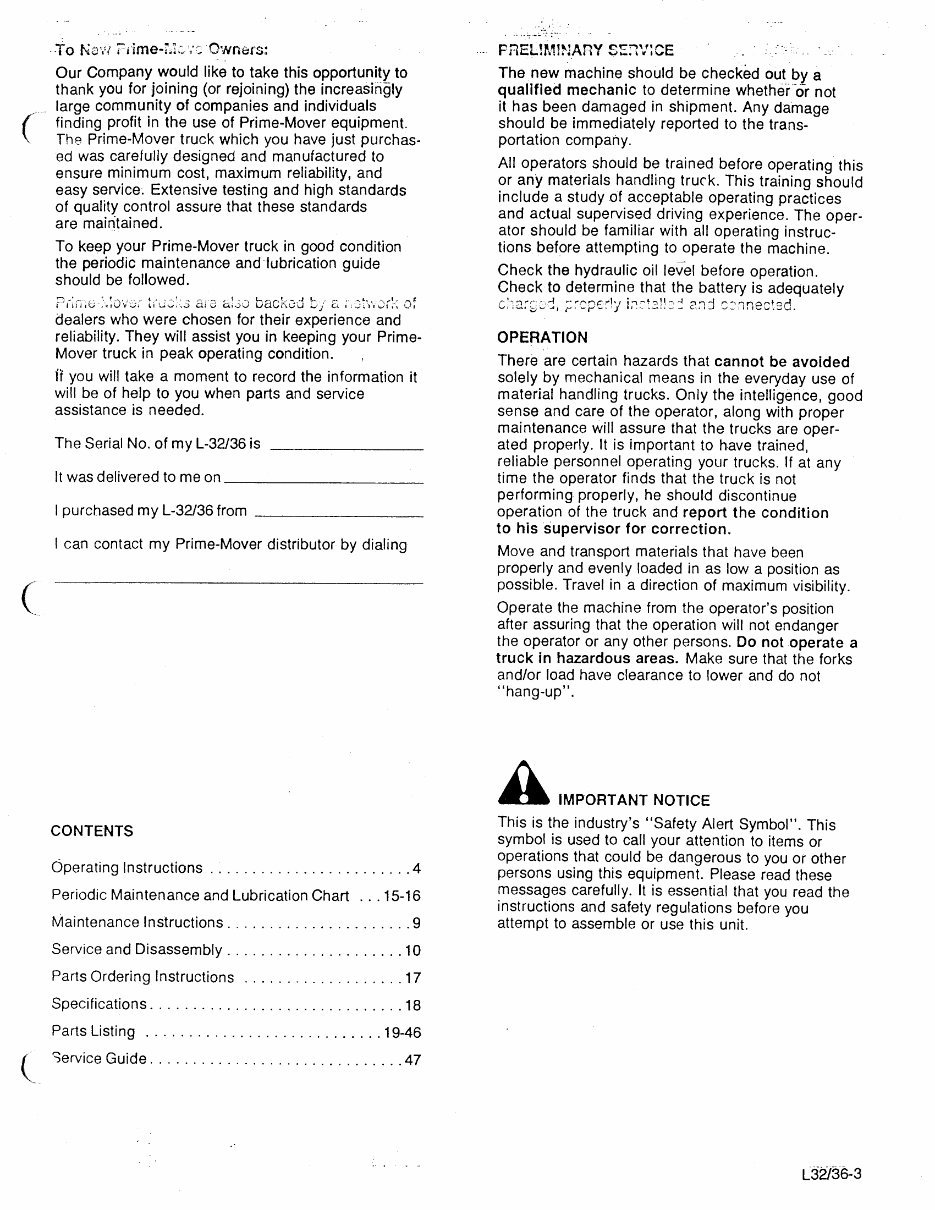
To Owniirs:
Our Company would like to take this opportunity to
thank you for joining (or rejoining) the increasingly
large community of companies and individuals
finding profit in the use of Prime-Mover equipment.
The Prime-Mover truck which you have just purchas-
ed was carefully designed and manufactured to
ensure minimum cost, maximum reliability, and
easy service. Extensive testing and high standards
of quality control assure that these standards
are maintained.
To keep your Prime-Mover truck in good condition
the periodic maintenance and lubrication guide
should be followed.
a, 3 a:•:, - ) back3d L j Ci of
dealers who were chosen for their experience and
reliability. They will assist you in keeping your Prime-
Mover truck in peak operating condition.
9 you will take a moment to record the information it
will be of help to you when parts and service
assistance is needed.
The Serial No. of my L-32/36 is
It was delivered to me on
I purchased my L-32/36 from
I can contact my Prime-Mover distributor by dialing
PFIELMINATIY SE:1V:CE
The new machine should be checked out by a
qualified mechanic to determine whether or not
it has been damaged in shipment. Any damage
should be immediately reported to the trans-
portation company.
All operators should be trained before operating this
or any materials handling truck. This training should
include a study of acceptable operating practices
and actual supervised driving experience. The oper-
ator should be familiar with all operating instruc-
tions before attempting to operate the machine.
Check the hydraulic oil level before operation.
Check to determine that the battery is adequately
~oprr!y inalL 4
OPERATION
There are certain hazards that cannot be avoided
solely by mechanical means in the everyday use of
material handling trucks. Only the intelligence, good
sense and care of the operator, along with proper
maintenance will assure that the trucks are oper-
ated properly. It is important to have trained,
reliable personnel operating your trucks. If at any
time the operator finds that the truck is not
performing properly, he should discontinue
operation of the truck and report the condition
to his supervisor for correction.
Move and transport materials that have been
properly and evenly loaded in as low a position as
possible. Travel in a direction of maximum visibility.
Operate the machine from the operator's position
after assuring that the operation will not endanger
the operator or any other persons. Do not operate a
truck in hazardous areas. Make sure that the forks
and/or load have clearance to lower and do not
"hang-up".
CONTENTS
Operating Instructions 4
Periodic Maintenance and Lubrication Chart . . . 15-16
Maintenance Instructions
9
Service and Disassembly 10
Parts Ordering Instructions 17
Specifications
18
Parts Listing
19-46
Service Guide
47
IMPORTANT NOTICE
This is the industry's "Safety Alert Symbol". This
symbol is used to call your attention to items or
operations that could be dangerous to you or other
persons using this equipment. Please read these
messages carefully. It is essential that you read the
instructions and safety regulations before you
attempt to assemble or use this unit.
L32/36-3
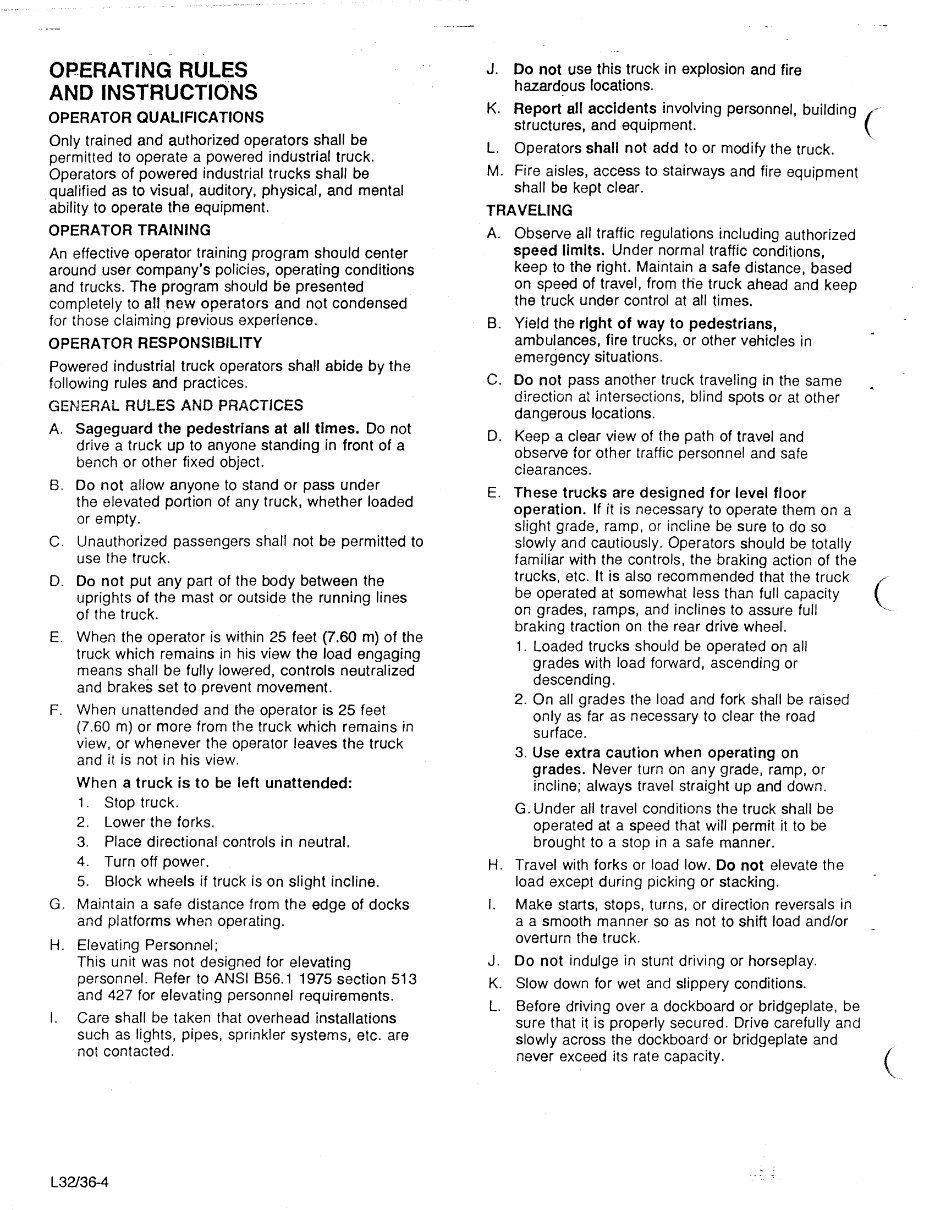
OPERATING RULES
AND INSTRUCTIONS
OPERATOR QUALIFICATIONS
Only trained and authorized operators shall be
permitted to operate a powered industrial truck.
Operators of powered industrial trucks shall be
qualified as to visual, auditory, physical, and mental
ability to operate the equipment.
OPERATOR TRAINING
An effective operator training program should center
around user company's policies, operating conditions
and trucks. The program should be presented
completely to all new operators and not condensed
for those claiming previous experience.
OPERATOR RESPONSIBILITY
Powered industrial truck operators shall abide by the
following rules and practices.
GENERAL RULES AND PRACTICES
A. Sageguard the pedestrians at all times. Do not
drive a truck up to anyone standing in front of a
bench or other fixed object.
B. Do not allow anyone to stand or pass under
the elevated portion of any truck, whether loaded
or empty.
C. Unauthorized passengers shall not be permitted to
use the truck.
D. Do not put any part of the body between the
uprights of the mast or outside the running lines
of the truck.
E. When the operator is within 25 feet (7.60 m) of the
truck which remains in his view the load engaging
means shall be fully lowered, controls neutralized
and brakes set to prevent movement.
F. When unattended and the operator is 25 feet
(7.60 m) or more from the truck which remains in
view, or whenever the operator leaves the truck
and it is not in his view.
When a truck is to be left unattended:
1. Stop truck.
2. Lower the forks.
3. Place directional controls in neutral.
4. Turn off power.
5. Block wheels if truck is on slight incline.
G. Maintain a safe distance from the edge of docks
and platforms when operating.
H. Elevating Personnel;
This unit was not designed for elevating
personnel. Refer to ANSI B56.1 1975 section 513
and 427 for elevating personnel requirements.
I. Care shall be taken that overhead installations
such as lights, pipes, sprinkler systems, etc. are
not contacted.
J. Do not use this truck in explosion and fire
hazardous locations.
K. Report all accidents involving personnel, building
structures, and equipment.
L. Operators shall not add to or modify the truck.
M. Fire aisles, access to stairways and fire equipment
shall be kept clear.
TRAVELING
A. Observe all traffic regulations including authorized
speed limits. Under normal traffic conditions,
keep to the right. Maintain a safe distance, based
on speed of travel, from the truck ahead and keep
the truck under control at all times.
B. Yield the right of way to pedestrians,
ambulances, fire trucks, or other vehicles in
emergency situations.
C. Do not pass another truck traveling in the same
direction at intersections, blind spots or at other
dangerous locations.
D. Keep a clear view of the path of travel and
observe for other traffic personnel and safe
clearances.
E. These trucks are designed for level floor
operation. If it is necessary to operate them on a
slight grade, ramp, or incline be sure to do so
slowly and cautiously. Operators should be totally
familiar with the controls, the braking action of the
trucks, etc. It is also recommended that the truck
be operated at somewhat less than full capacity
on grades, ramps, and inclines to assure full
braking traction on the rear drive wheel.
1. Loaded trucks should be operated on all
grades with load forward, ascending or
descending.
2. On all grades the load and fork shall be raised
only as far as necessary to clear the road
surface.
3. Use extra caution when operating on
grades. Never turn on any grade, ramp, or
incline; always travel straight up and down.
G. Under all travel conditions the truck shall be
operated at a speed that will permit it to be
brought to a stop in a safe manner.
H. Travel with forks or load low. Do not elevate the
load except during picking or stacking.
I. Make starts, stops, turns, or direction reversals in
a a smooth manner so as not to shift load and/or
overturn the truck.
J. Do not indulge in stunt driving or horseplay.
K. Slow down for wet and slippery conditions.
L. Before driving over a dockboard or bridgeplate, be
sure that it is properly secured. Drive carefully and
slowly across the dockboard or bridgeplate and
never exceed its rate capacity.
L32/36-4
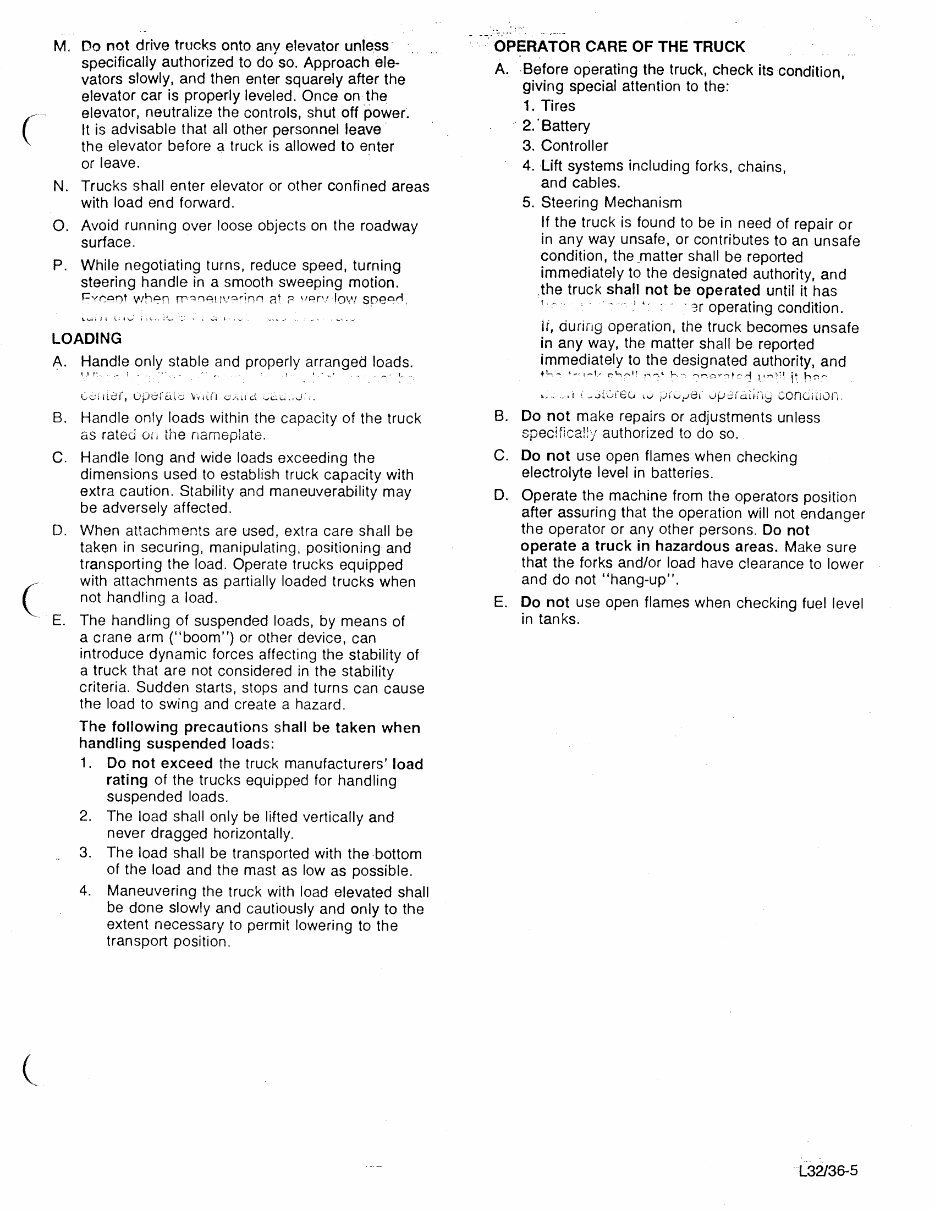
M. no not drive trucks onto any elevator unless
specifically authorized to do so. Approach ele-
vators slowly, and then enter squarely after the
elevator car is properly leveled. Once on the
elevator, neutralize the controls, shut off power.
It is advisable that all other personnel leave
the elevator before a truck is allowed to enter
or leave.
N. Trucks shall enter elevator or other confined areas
with load end forward.
0. Avoid running over loose objects on the roadway
surface.
P. While negotiating turns, reduce speed, turning
steering handle in a smooth sweeping motion.
Pyrsant when r,-, -, ncwv-, -;nr, at
p low sneari .
LOADING
A. Handle only stable and properly arranged loads.
•
—4..
B. Handle only loads within the capacity of the truck
as rated el the nameplate.
C. Handle long and wide loads exceeding the
dimensions used to establish truck capacity with
extra caution. Stability and maneuverability may
be adversely affected.
D. When attachments are used, extra care shall be
taken in securing, manipulating, positioning and
transporting the load. Operate trucks equipped
with attachments as partially loaded trucks when
not handling a load.
E. The handling of suspended loads, by means of
a crane arm ("boom") or other device, can
introduce dynamic forces affecting the stability of
a truck that are not considered in the stability
criteria. Sudden starts, stops and turns can cause
the load to swing and create a hazard.
The following precautions shall be taken when
handling suspended loads:
1. Do not exceed the truck manufacturers' load
rating of the trucks equipped for handling
suspended loads.
2. The load shall only be lifted vertically and
never dragged horizontally.
3. The load shall be transported with the bottom
of the load and the mast as low as possible.
4. Maneuvering the truck with load elevated shall
be done slowly and cautiously and only to the
extent necessary to permit lowering to the
transport position.
OPERATOR CARE OF THE TRUCK
A. Before operating the truck, check its condition,
giving special attention to the:
1. Tires
2.' Battery
3. Controller
4. Lift systems including forks, chains,
and cables.
5. Steering Mechanism
If the truck is found to be in need of repair or
in any way unsafe, or contributes to an unsafe
condition, the matter shall be reported
immediately to the designated authority, and
the truck shall not be operated until it has
?.r operating condition.
Ii, during operation, the truck becomes unsafe
in any way, the matter shall be reported
immediately to the designated authority, and
a. i 6'G
B. Do not make repairs or adjustments unless
specifically authorized to do so.
C. Do not use open flames when checking
electrolyte level in batteries.
D. Operate the machine from the operators position
after assuring that the operation will not endanger
the operator or any other persons. Do not
operate a truck in hazardous areas. Make sure
that the forks and/or load have clearance to lower
and do not "hang-up".
E. Do not use open flames when checking fuel level
in tanks.
L32/36-5
You're Reading a Preview
What's Included?
 Lifetime Access
Fast Download Speeds
Offline Viewing
Access Contents & Bookmarks
Full Search Facility
Print one or all pages of your manual
$71.99
JLG LULL Operating Maintenance Parts Manual - Loader buggy forklift Mason tender Skid
Viewed 56 Times Today

What's Included?
Lifetime Access
Fast Download Speeds
Offline Viewing
Access Contents & Bookmarks
Full Search Facility
Print one or all pages of your manual
$71.99

Secure transaction
What's Included?
Lifetime Access
Fast Download Speeds
Offline Viewing
Access Contents & Bookmarks
Full Search Facility
Print one or all pages of your manual
Description
Our collection includes 15 operating, maintenance, and parts manuals for various JLG Lull machines, such as loaders, buggies, forklifts, Mason tenders, and skid steer loaders. The manuals cover models L-32, L-36, L-812, L1300, LD40, LD50, LL40, LS75, M-20, M15B, M15BR, M25RH, Workpro 155, Workpro 150, and Workpro 250.
To view the manuals, you will need to use appropriate software. If you don't have the required software, you can download it for free from the following link: http://www.rarlab.com/
If you are unsure how to use the software, you can refer to this YouTube video for guidance: http://www.youtube.com/watch?v=vzW3EjTnOKs


