Service Manual Model 4017 3121858 Revised September 3, 2010
EFFECTIVITY PAGE 31261858 4017 i June 10, 2005 - A - Original Issue Of Manual January 6, 2006 - B - Revision Of Manual September 3, 2010 - C - Revised pages 2.8, 3.25 thru 3.27, 6.5 & 6.6
Safety Practices 1.2 4017 1.1 INTRODUCTION This service manual provides general directions for accomplishing service and repair procedures. Following the procedures in this manual will help assure safety and equipment reliability. Read, understand and follow the information in this manual, and obey all locally approved safety practices, procedures, rules, codes, regulations and laws. These instructions cannot cover all details or variations in the equipment, procedures, or processes described, nor provide directions for meeting every possible contingency during operation, maintenance, or testing. When additional information is desired consult the local JLG distributor. Many factors contribute to unsafe conditions: carelessness, fatigue, overload, inattentiveness, unfamiliarity, even drugs and alcohol, among others. For optimal safety, encourage everyone to think, and to act, safely. Appropriate service methods and proper repair procedures are essential for the safety of the individual doing the work, for the safety of the operator, and for the safe, reliable operation of the machine. All references to the right side, left side, front and rear are given from the operator’s seat looking in a forward direction. Supplementary information is available from JLG in the form of Service Bulletins, Service Campaigns, Service Training Schools, the JLG website, other literature, and through updates to the manual itself. 1.2 DISCLAIMER All information in this manual is based on the latest product information available at the time of publication. JLG reserves the right to make changes and improvements to its products, and to discontinue the manufacture of any product, at its discretion at any time without public notice or obligation. 1.3 OPERATOR & SAFETY MANUAL The mechanic must not operate the machine until the Operator & Safety Manual has been read & understood, training has been accomplished and operation of the machine has been completed under the supervision of an experienced and qualified operator. An Operator & Safety Manual is supplied with each machine and must be kept in the cab. In the event that the Operator & Safety Manual is missing, consult the local JLG distributor before proceeding. 1.4 ACCIDENT PREVENTION TAGS Place Accident Prevention Tags on the ignition key switch and the steering wheel before attempting to perform any service or maintenance. Remove key and disconnect battery leads.
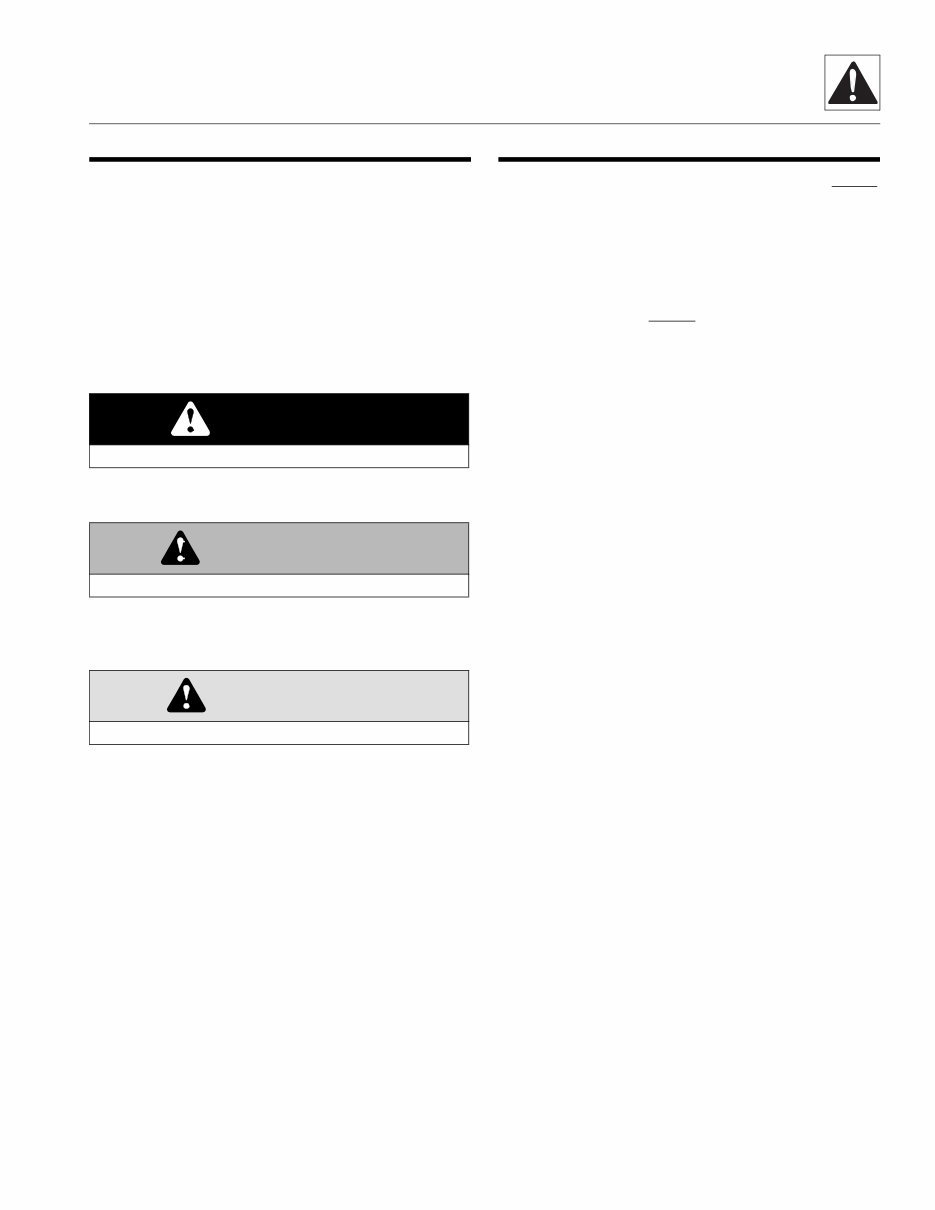
1.3 4017 Safety Practices 1.5 SAFETY INFORMATION To avoid possible death or injury, carefully read, understand and comply with all safety messages. In the event of an accident, know where to obtain medical assistance and how to use a first-aid kit and fire extinguisher/fire suppression system. Keep emergency telephone numbers (fire department, ambulance, rescue squad/paramedics, police department, etc.) nearby. If working alone, check with another person routinely to help assure personal safety. 1.5.1 Safety Alert System and Signal Words DANGER indicates an imminently hazardous situation which, if not avoided, will result in death or serious injury. WARNING indicates a potentially hazardous situation which, if not avoided, could result in death or serious injury. CAUTION indicates a potentially hazardous situation which, if not avoided, may result in minor or moderate injury. 1.6 SAFETY INSTRUCTIONS Following are general safety statements to consider before performing maintenance procedures on the telehandler. Additional statements related to specific tasks and procedures are located throughout this manual and are listed prior to any work instructions to provide safety information before the potential of a hazard occurs. For all safety messages, carefully read, understand and follow the instructions before proceeding. 1.6.1 Personal Hazards PERSONAL SAFETY GEAR: Wear all the protective clothing and personal safety gear necessary to perform the job safely. This might include heavy gloves, safety glasses or goggles, filter mask or respirator, safety shoes or a hard hat. LIFTING: NEVER lift a heavy object without the help of at least one assistant or a suitable sling and hoist. 1.6.2 Equipment Hazards LIFTING OF EQUIPMENT: Before using any lifting equipment (chains, slings, brackets, hooks, etc.), verify that it is of the proper capacity, in good working order, and is properly attached. NEVER stand or otherwise become positioned under a suspended load or under raised equipment. The load or equipment could fall or tip. DO NOT use a hoist, jack or jack stands only to support equipment. Always support equipment with the proper capacity blocks or stands properly rated for the load. HAND TOOLS: Always use the proper tool for the job; keep tools clean and in good working order, and use special service tools only as recommended. DANGER WARNING CAUTION
Safety Practices 1.4 4017 1.6.3 General Hazards SOLVENTS: Only use approved solvents that are known to be safe for use. HOUSEKEEPING: Keep the work area and operator’s cab clean, and remove all hazards (debris, oil, tools, etc.). FIRST AID: Immediately clean, dress and report all injuries (cuts, abrasions, burns, etc.), no matter how minor the injury may seem. Know the location of a First Aid Kit, and know how to use it. CLEANLINESS: Wear eye protection, and clean all components with a high-pressure or steam cleaner before attempting service. When removing hydraulic components, plug hose ends and connections to prevent excess leakage and contamination. Place a suitable catch basin beneath the machine to capture fluid run-off. Check and obey all Federal, State and/or Local regulations regarding waste storage, disposal and recycling. 1.6.4 Operational Hazards ENGINE: Stop the engine before performing any service unless specifically instructed otherwise. VENTILATION: Avoid prolonged engine operation in enclosed areas without adequate ventilation. SOFT SURFACES AND SLOPES: NEVER work on a machine that is parked on a soft surface or slope. The machine must be on a hard level surface, with the wheels blocked before performing any service. FLUID TEMPERATURE: NEVER work on a machine when the engine, cooling or hydraulic systems are hot. Hot components and fluids can cause severe burns. Allow systems to cool before proceeding. FLUID PRESSURE: Before loosening any hydraulic or diesel fuel component, hose or tube, turn the engine OFF. Wear heavy, protective gloves and eye protection. NEVER check for leaks using any part of your body; use a piece of cardboard or wood instead. If injured, seek medical attention immediately. Diesel fluid leaking under pressure can explode. Hydraulic fluid and diesel fuel leaking under pressure can penetrate the skin, cause infection, gangrene and other serious personal injury. Relieve all pressure before disconnecting any component, part, line or hose. Slowly loosen parts and allow release of residual pressure before removing any part or component. Before starting the engine or applying pressure, use components, parts, hoses and pipes that are in good condition, connected properly and are tightened to the proper torque. Capture fluid in an appropriate container and dispose of in accordance with prevailing environmental regulations. RADIATOR CAP: Always wear steam-resistant, heat protective gloves when opening the radiator cap. Cover the cap with a clean, thick cloth and turn slowly to the first stop to relieve pressure. FLUID FLAMABILTITY: DO NOT service the fuel or hydraulic systems near an open flame, sparks or smoking materials. NEVER drain or store fluids in an open container. Engine fuel and hydraulic fluid are flammable and can cause a fire and/or explosion. DO NOT mix gasoline or alcohol with diesel fuel. The mixture can cause an explosion. PRESSURE TESTING: When conducting any test, only use test equipment that is correctly calibrated and in good condition. Use the correct equipment in the proper manner, and make changes or repairs as indicated by the test procedure to achieve the desired result. LEAVING MACHINE: Lower the forks or attachment to the ground before leaving the machine. TIRES: Always keep tires inflated to the proper pressure to help prevent tipover. DO NOT over-inflate tires. NEVER use mismatched tire types, sizes or ply ratings. Always use matched sets according to machine specifications. MAJOR COMPONENTS: Never alter, remove, or substitute any items such as counterweights, tires, batteries or other items that may reduce or affect the overall weight or stability of the machine. BATTERY: DO NOT charge a frozen battery.Charging a frozen battery may cause it to explode. Allow the battery to thaw before jump-starting or connecting a battery charger.
You're Reading a Preview
What's Included?
Lifetime Access
Fast Download Speeds
Online & Offline Access
Access PDF Contents & Bookmarks
Full Search Facility
Print one or all pages of your manual
$32.99$42.99
JLG Telehandlers 3614RS, 4017RS Service Repair Workshop JLG Telehandlers 3614RS, 4017RS Service Repair Workshop Manual
This is a highly detailed factory service repair manual for the JLG Telehandlers 3614RS, 4017RS. The service manual provides detailed illustrations and step-by-step instructions, making it suitable for both do-it-yourself enthusiasts and experienced mechanics. It offers comprehensive guidance for the complete disassembly of the machine, supported by numerous photos and illustrations.
The manual covers safety practices, general information and specifications, boom, cab and covers, axles, drive shafts, wheels and tires, transmission, engine (Perkins 1104D-44T), hydraulic system, electrical system, and more.
File Format: PDF
Compatible: All Versions of Windows & Mac
Language: English
Requirements: Adobe Reader & WinZip
There's no waiting time involved. Purchase from a responsible seller and get instant access. All pages are printable, providing an inexpensive way to ensure your vehicle works properly.
Models Covered:
JLG Telehandlers 3614RS
JLG Telehandlers 4017RS
P/N: 31200940
Recently Viewed
5,521,897Happy Clients
2,594,462eManuals
1,120,453Trusted Sellers
15Years in Business
Price:
Actual Price:
JLG Telehandlers 3614RS, 4017RS Service Repair Workshop JLG Telehandlers 3614RS, 4017RS Service Repair Workshop Manual












 Lifetime Access




