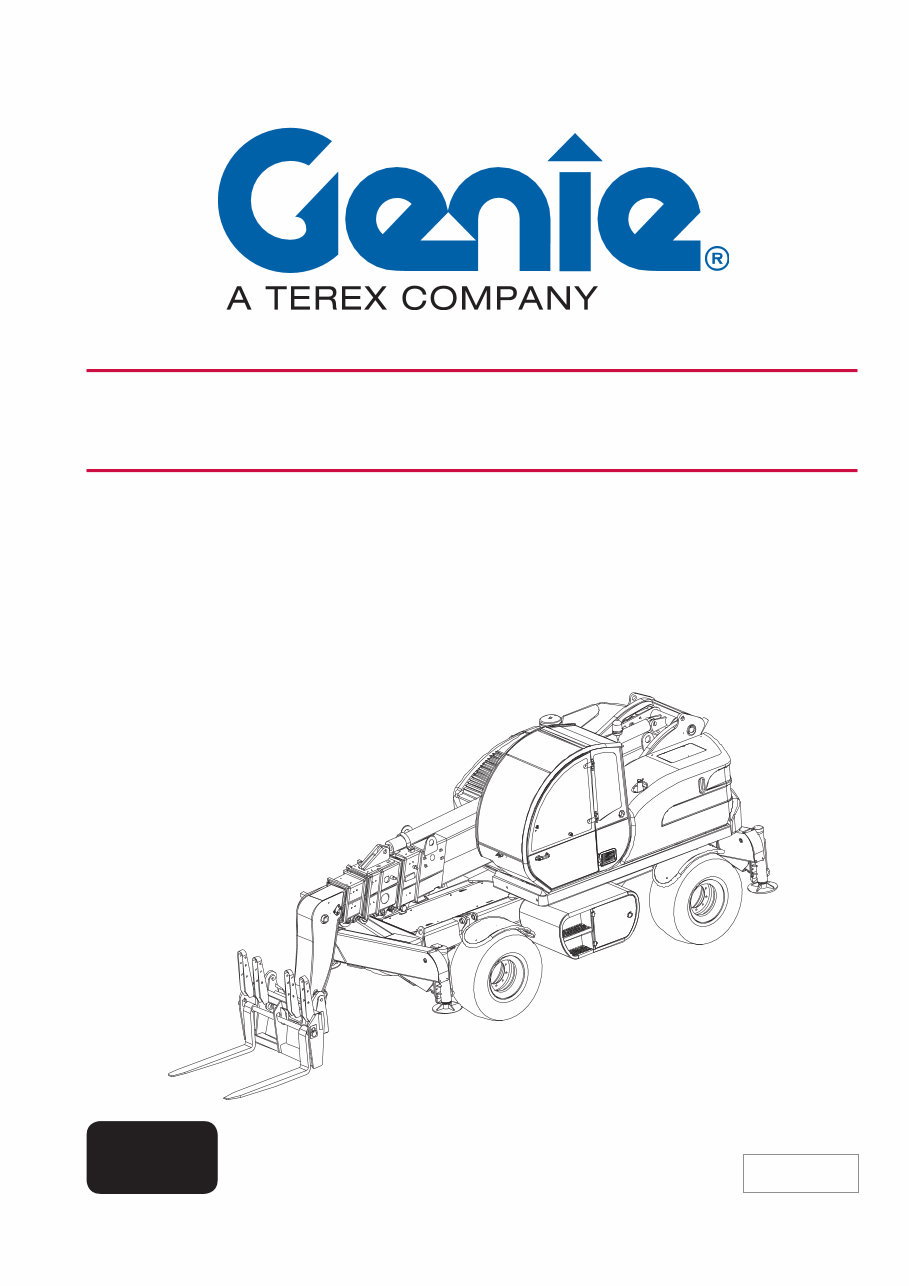
INDEX Handler with telescopic boom GTH-6025 R (da matr. 16760) SERVICE MANUAL Code 57.4403.2200 - 1 st Edition 02/2008 English Edition
Document 57.4403.2200 - 1 st Edition 02/2008 INDEX MANUAL CONTENTS INTRODUCTION Sect. 1 SAFETY RULES Sect. 2 TECHNICAL SPECIFICATIONS Sect. SCHEDULED MAINTENANCE INSPECTIONS Sect. 4 SCHEDULED MAINTENANCE PROCEDURES Sect. 5 TROUBLESHOOTING Sect. 6 SCHEMES Sect. 7 REPAIR PROCEDURES GTH-6025 R GENERAL INDEX 5
Document 57.4403.2200 - 1 st Edition 02/2008 INDEX GTH-6025 R SERIAL NUMBER IDENTIFICATION 6 Machine denomination Literature valid up to serial number GTH-6025 R 16760
Document 57.4403.2200 - 1 st Edition 02/2008 INDEX GTH-6025 R INTRODUCTION ii DESCRIPTION OF THE MACHINE OPERATION The oil-pressure system of this machine consists of two macro sections, namely turntable and undercarriage, corresponding to the machine's main parts. From an oil- pressure point of view, these two sections are connected with one another by the 13-way hydraulic rotary joint (9). The source of mechanical energy of this machine is a Cummins turbo-compressed diesel engine (1), model QSB4.5 with intercooler, which supplies 119 kW at 2300 rev/min and with a max torque of 624 Nm at 1500 rev/ min. On the flywheel side of the engine, and connected to this engine by a Technodrive coupler with elastic joint and with a 1-to-1 ratio, there is a Rexroth closed- loop pump for hydrostatic drives, model A4VG90 (2) with electroproportional adjustment valves. The max displacement of this swashplate pump is 90 cm 3 and the max calibration pressure is 430 bar. This pump is used to supply hydraulic power under form of pressure and flow rate which is then used for moving the machine. On the through-shaft of such drive pump there is a Bosch-Rexroth variable displacement piston pump with swashplate suitable for open lopp circuits, model A10VO60DFR (3), equipped with flow and pressure control valve. The displacement of this pump is 60 cm 3 . The function of this pump is to provide hydraulic power, under form of pressure and flow rate both to the steering cylinder of the machine, and to the telescopic boom and slewing turntable circuits. This "load sensing" pump is adjusted through an adequate piloting line which provides the pump a pressure signal corresponding to the max load of all the users fed by this pump. Between pump (3) and the electro-proportional main valve (8), a one-way valve (5) is placed to avoid that oil at pressure, produced by the power-driven emergency pump (48), may escape from pump (3) when this is stopped. The assembly of the two pumps involves they have a rotation velocity equal to the speed of the diesel engine. A third Casappa fixed displacement gear pump suitable for open loop circuits (4) with a displacement of 25 cm 3 , is installed on the PTO of the engine located on the distribution side. This pump feeds the servo-assisted braking system (35) and the Casappa fixed displacement hydraulic motors (20 cm 3 ) (6) and (42) which activate the heat exchanger cooling fans of diesel engine and hydraulic circuit. The circuit of pump (4) is protected by a pressure relief valve (33) calibrated to 160 bar. The suction lines of the open-loop pumps (3 and 4) and the power-driven emergency pump (48) are not protected by filters and are conveyed to a single port on the hydraulic fluid tank (32). Between this port and
Document 57.4403.2200 - 1 st Edition 02/2008 INDEX GTH-6025 R INTRODUCTION iii the suction lines of the aforesaid pumps, there is a gate valve (31) that allows to perform important maintenance interventions on the oil-pressure circuit of the machine without emptying the oil tank. This tank has a capacity of 230 litres. On the contrary, the drive pump (2) is protected by a special filter (45), placed on the discharge line of pumps (3 and 4). This filter purifies the oil from the open circuits of the machine (boom-turntable control circuit and service and parking brake feeding circuit) and allows to have an additional oil port for the drive suction line with a minimum pressure of 0.5 bar. This construction feature of the filter guarantees significant advantages in terms of absence of cavitation in the drive suction line, especially when the machine is started from cold. Valve (46). The one-way valve (34) set to 2.5 bar protects the pump housing against high pressures and guarantees a certain circulation of the drain oil to the hydrostatic motor reducing, in this way, the temperature. From port “G” of the drive pump (2) low-pressure oil is taken (25-30 bar). This oil is first conveyed to the undercarriage through port 11 of the hydraulic rotary joint (9), and then used for the two-speed shift-on-fly gearbox circuit (51) and for the differential anti-slip circuit through the solenoid valve (77) which activates the mechanism placed inside the front axle (57). Through the same low- pressure line the Pr port of the electro-proportional main valve (8) is fed. The hydraulic energy produced by the drive pump (2) and conveyed to the undercarriage through ports n.1 and n.2 of the hydraulic rotary joint (9), is converted into mechanical power by the Rexroth motor for hydrostatic transmissions, model A6VM107 (50) equipped with an electroproportional adjustment valve and with a flush valve (73) for reducing the max temperatures inside the drive circuit. Through port n. 12 of the hydraulic rotary joint, the flow coming from the drain circuit of the transmission pump (2) reaches the motor (50) and, through port n.7, this motor conveys all the drain flow to the hydraulic oil tank (9). This allows to keep the internal temperature of the circuit within acceptable operational limits. The electroproportional valves of pump (2) and motor (50) are controlled by a dedicated electronic control unit (Linde) which is connected to the remaining control devices of the machine through the digital network. The motor is flanged to a two-speed shift-on-fly gearbox, model 357 (51). Speeds are engaged by a special oil- dynamic cylinder (52) located inside the gearbox, while the selection of the first and second speed is controlled by a 4-way/2-position solenoid valve (53) of the on/off type with mechanical safety lock. The mechanical torque at the gearbox output is transmitted to the front axle (57) and the rear axle (58), both model 213 manufactured by Dana, through two
Document 57.4403.2200 - 1 st Edition 02/2008 INDEX GTH-6025 R INTRODUCTION iv Cardan shafts. The double-displacement hydraulic drive (7) of “load sensing” type (max./min. displacement of 220/60 cm 3 ) receives oil from the priority valve built in the inlet head of main valve (8) in relation to the “load sensing” signal sent by the hydraulic drive and connected to such main valve with function of pilot signal. In this way, the input flow to the hydraulic drive will be exactly the one needed for the instantaneous steering functions; any excess flow of the pump will be made available for the functions of the telescopic boom and other auxiliary functions, if needed. The steering circuit is protected against input overpressures by a pressure reducing valve (47) set to 180 bar. On the two delivery lines, there are other two reducing valves with anti-shock function set to 220 bar. The scope of these two valves is limiting possible shocks on the steering wheel due to overstress on the steering cylinders. The three pressure reducing valves are installed in the hydraulic drive (7). This model of hydraulic drive can self-adjusts the minimum displacement (60 cm 3 ) and, as a result, reduce the effort for the emergency steering in case of a too low feeding pressure (failure). The steering circuit is completed by the front steering cylinder (55), the rear steering cylinder (56) (these cylinders being integral part of the front axle (57) and the rear axle (58) respectively) and by a 4-way/3-position solenoid valve (54) for the selection of the three different steer modes: rear wheels straight, co-ordinate front/ rear steering (four-wheel steer), independent front/rear steering (crab steer). When the solenoid valve (54) is not energised, the front steering cylinder is fed by the hydraulic drive and the rear cylinder is blocked. When one magnet or the other of the solenoid valve (54) is energised, the chambers of the cylinders are connected in a different manner thus causing the desired effect on the steering mode. The connection of the steering circuit between the section integral of the turntable and the one integral of the undercarriage is done through ports n.8 and n. 9 of the hydraulic rotary joint (9). The Rexroth electro-proportional distributor (8), with 5 modular sections, receives oil from pump (63) and feeds all the movements of the telescopic boom and the turntable, and provides an oil flow to the auxiliary lines for the secondary functions such as turntable lock, outriggers and frame levelling. This main valve consists of an input head with 3-way pressure compensator used as a flow regulator for the user which works at max load (load sensing), and as a discharge valve when the pump flow is not used for the boom movements, and of 5 modules. Four of these modules control specific functions of the telescopic boom (lifting/lowering, attachment holding frame rotation, extension/retraction, attachment lock/unlock) and the fifth module controls the rotation of the turntable of the machine.
Document 57.4403.2200 - 1 st Edition 02/2008 INDEX GTH-6025 R INTRODUCTION v In the head there is a pressure relief valve set to 270 bar which, acting on the line of the “load sensing” signal, limits the maximum pressure at the inlet of the main valve through the compensator. On the main inlet head of the main valve, there is also a safety solenoid valve which, when de-excited, discharges the input pilot pressure, thus preventing the main valve from working. This solenoid valve is used as a “dead man” control and is activated by the relevant button on the joysticks in the driving cab. The pilot head delivers oil at pressure to the 5 pilot modules of the main valve. These modules operate the relevant main sliders in relation to the command signal they receive from the joysticks via the control unit. Module 1 of the main valve controls the telescopic boom lifting cylinder (12). This cylinder has one single-acting compensation valve (13) with safety function. The control module of element 2 of the main valve is the electro- proportional type with electrical feed-back and integrated electronics. The 0,5-lt. accumulator prefilled at 35 bar (14) and located on the line of the differential chamber of the lifting cylinder (12), allows for damping the boom swings when the same boom is moved down. Module 2 of the main valve controls the boom telescopes extension cylinder (15). This cylinder is equipped with a double-acting compensation valve (16) with safety function. The control module of this element of the main valve is the electro-proportional type with electrical feed- back and integrated electronics. Module 3 of the main valve controls the fork joint cylinder (17) of the telescopic boom. This cylinder is equipped with a double-acting compensation valve (18) with safety function. Paralleled to this cylinder we find the fork levelling cylinder (19) (or balancing cylinder) equipped with a special double-acting compensation valve (20). Inside this valve, the one-way valves are installed in a reverse manner with respect to the normal position to avoid the pressurisation of the cylinder when the rotation command of the attachment holding plate is operated. Again inside this valve, there are other two one-way valves set to 5 bar with anti-cavitation function (21). These valves are used to prevent the oil from escaping the closed circuit created when the operator moves the boom up and down between the fork tilting cylinder and the levelling cylinder (as the fork horizontality is guaranteed by the tightness of these cylinders), and to deliver hydraulic oil when there is a pressure drop inside the cylinder. Feeding is guaranteed by the pressure reducing valve (11). The control module of element 3 of the main valve is the electro-proportional type with electrical feed-back and integrated electronics. On the two control lines of the cylinder (17), and integral to module 3, there are two pressure relief valves (84) set to 295 bar which protect the automatic levelling system of the forks when the boom is moved up and down and in case of overload on the attachment holding plate (ex.
Document 57.4403.2200 - 1 st Edition 02/2008 INDEX GTH-6025 R INTRODUCTION vi use of the bucket). Module 4 of the main valve controls the attachment locking cylinder (23). This cylinder has a double one- way valve with hydraulic release, acting as safety valve (24). The pilot module of element n. 4 of the main valve is the electroproportional type with integrated electric and electronic feedback. On one of the two hydraulic control lines of this section of the main valve, there is a 3-way/2-position electric divider with on/off control (22). When this divider is not energised, the oil at pressure coming from the module of the main valve, is sent to the attachment locking cylinder. On the contrary, when the divider (22) is energised, the oil at pressure from element n.4 of the main valve (8), is made available for the auxiliary feeding line of the turntable lock/unlock function through a cylinder (28) equipped with a double one-way valve with hydraulic release used as safety valve. The cylinder is operated by solenoid valve (30). Afterwards, through port n. 3 of the hydraulic rotary joint (9), oil is used for the operation of the outriggers and the frame levelling. On the two feeding lines and close to the terminal part of the end trunk, there are two quick-fit connectors (25) for the connection of the hydraulic lines of any optional equipment needing a hydraulic power for their operation (e.g. hydraulic winch and jib, mixing bucket, etc.). Module n. 5 of the main valve controls the hydraulic slewing motor of the turntable (26), equipped with brake with internal mechanical block and external hydraulic release. The mechanical torque produced by this motor is transmitted to the turntable through an epicyclic reduction gear with two stages and a slewring with internal toothing. The feeding line of this motor is equipped with a double- acting compensation valve (27), used also as safety and anti-cavitation valve. The pilot module of this element of the main valve is of electroproportional type with integrated electric and electronic feedback. The main valve (8) is equipped with a pilot line of the “load sensing” type which, at its turn, receives an analog pressure signal from the hydraulic drive (7). The signal is then sent to the "load sensing" port of pump (3), thus guaranteeing the adaptation of the pump adjustment to the maximum load on the various users served by this pump under any conditions. The pressure relief valve (11) calibrated to 30 bar is placed upstream of the pressure inlet port of the main valve (8). This valve is used to deliver low-pressure oil (30 bar) to the anti-cavitation circuits of automatic fork levelling system. The block cylinder of the slewing turntable (28) is equipped with a double one-way valve (29) with hydraulic release, acting as safety valve, and is controlled by the 4-way/3-position solenoid valve of the on/off type (30). As already mentioned, the turntable lock/unlock is possible through the simultaneous energisation of
Document 57.4403.2200 - 1 st Edition 02/2008 INDEX GTH-6025 R INTRODUCTION vii module n.4 of the main valve (8), the electric divider (22) and the solenoid valve (30). The SAFIM S6 servo-assisted braking system with pedal (35) receives oil from the pump (4) and uses this oil to pressurise 3 hydraulic accumulators (36 and 37) connected to the same system. The oil at pressure contained in these accumulator is then used to operate the service brakes of the two axles (57 and 58) and to release the parking brake located inside the rear axle (58). The fill valve inside the braking system takes the flow from the feeding line so the pressure on the line of the accumulators reaches the calibration value of the cutout valve set to 150 bar. When this pressure is reached, the valve gradually releases all the flow to line B for other uses. The brake pedal located in the driving cab, which is an integral part of the braking system S6, is connected to two proportional sliders which control the two separated lines of the service brake, one for each axle. Such lines connect the part of circuit in the turntable with the one in the undercarriage through ports n. 5 and n. 6 of the hydraulic rotary joint (9). In relation to the stroke of these sliders, a gradual communication between the feeding line, connected to two accumulators (36) which, at their turn, are connected to ports R1 and R2 (the accumulators have 0.5-lt. capacity and 50 bar fill pressure), and the service brake lines is established so the flow is distributed to such lines and the discharge line increasing, in this way, the pressure (and as a result the braking force) on the lines of the service brakes. When the sliders are in the rest position, the lines of the service brakes are connected to the discharge. The pressure switch (38) set to 2-10 bar, paralleled to on of the two lines of the service brake, sends an electrical signal when this brake is engaged. The pressure switch (39) set to 70 bar and connected to port F, sends an electrical warning signal when the pressure inside the feeding circuit of the brake lines is too low to guarantee the minimum braking efficiency. The accumulator (37) with 2.5-lt. capacity and 55 bar fill pressure is connected to port R of system S6 and is used to unlock the parking brake of the rear axle (58). The connection of the part of this circuit placed in the turntable to the one of the undercarriage is done through port n. 13 of the hydraulic rotary joint (9). The command of the parking brake is controlled by a special valve with lever control (40) located in the driving cab. In relation to the position of the lever, the release line of the parking brake is connected to the pressure line (parking brake unlocked) or the discharge line (parking brake locked). The two pressure switches (41) set to 10-20 bar send an electrical warning signal when the parking brake is activated (brake locked). The oil which is not used by the SAFIM S6 servo-assisted
You're Reading a Preview
What's Included?
Lifetime Access
Fast Download Speeds
Online & Offline Access
Access PDF Contents & Bookmarks
Full Search Facility
Print one or all pages of your manual
$52.99
Genie GTH 6025R Telehandler Service Repair Workshop Manual
The Genie GTH 6025R Telehandler Service Repair Manual is a comprehensive resource for both professional mechanics and DIY enthusiasts. It contains easy-to-read text sections, high-quality diagrams, and clear instructions, making it an invaluable tool for anyone working on the Genie GTH 6025R Telehandler.
This manual covers a wide range of essential information, including safety rules, technical specifications, scheduled maintenance inspections and procedures, troubleshooting, schemes, and repair procedures.
File Format: PDF
Compatibility: All Versions of Windows & Mac
Language: English
Requirements: Adobe Reader
With this manual, you can save time and money by performing repairs and maintenance tasks yourself, with the confidence that comes from having access to the detailed guidance provided. It's an essential resource for getting the job done right and understanding your Genie GTH 6025R Telehandler inside out. Plus, all pages are printable for easy reference.
Reviews
Q&A
Recently Viewed
5,521,897Happy Clients
2,594,462eManuals
1,120,453Trusted Sellers
15Years in Business
Price:
Actual Price:
Genie GTH 6025R Telehandler Service Repair Workshop Manual












 Lifetime Access




