



Service Manual
Serial number range
From serial n.: 19388
To serial n.: 24471
GTH-5519 Perkins Tier III
GTH-5519 Deutz Tier III
From serial n.: 19006
To serial n.: 25040
Part No. 57.0009.0415
Rev A
February 2009
Service Manual February 2009
2 GTH-5519 GTH-5519-S Document 57.0009.0415
Intentionally blank page

Document 57.0009.0415 GTH-5519 GTH-5519-S iii
February 2009 Introduction
Introduction
Important
Read, understand and obey the safety rules and operating
instructions in the GTH 55-19 Operator's Manual (part
n. 57.0009.0412) before attempting any maintenance or
repair procedure.
This manual provides the machine owner and user with
detailed information on the scheduled maintenance. It also
provided qualified service technicians with infromation on
troubleshooting and repair procedures.
Basic mechanical, hydraulic and electrical skills are
required to perform most procedures. However, several
procedures require specialized skills, as well as specific
tools and equipment.
In these instances, we strongly recommend letting service
and repair the machine at an authorized TEREXLIFT
service center.
Technical Publications
No part of this publication may be reproduced, stored in a
retrieval system or transmitted in any form or by any means
without prior written permission from TEREXLIFT srl.
In pursuing a policy of constant quality improvement,
TEREXLIFT srl reserves the right to make changes at any
time and without undertaking to give prior notice; therefore,
also this publication may be subject to modifications.
Contact Us
http://www.terexlift.com
e-mail: info@terexlift.it
http://www.genielift.com
© Copyright 2007 TEREXLIFT srl - All rights reserved.
First Edition, First Printing, February 2008
For going to Table of Contents,
click on Genie symbol
iv GTH-5519 GTH-5519-S Document 57.0009.0415
Machine Identification February 2009
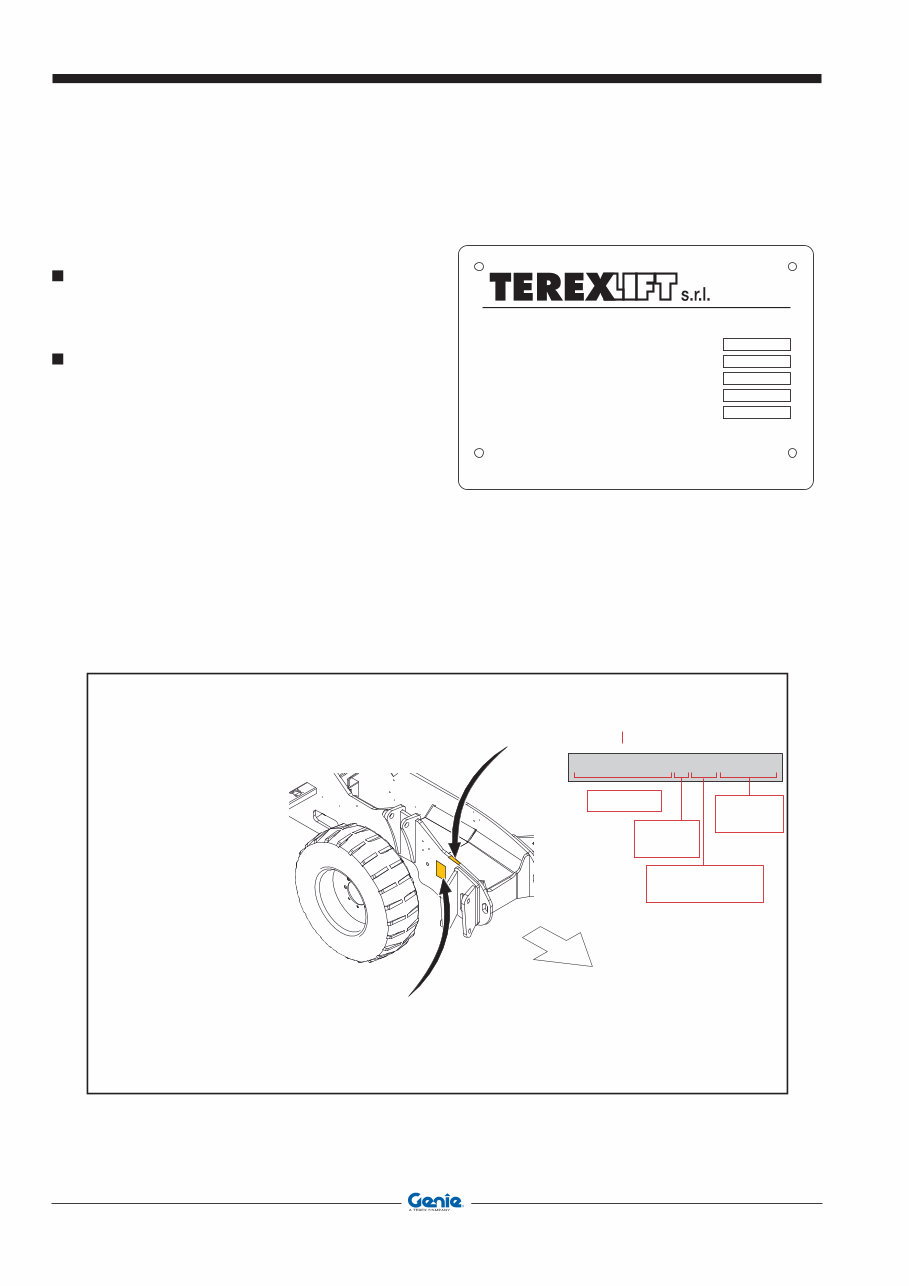
MACHINE IDENTIFICATION
CHASSIS SERIAL NUMBER
The chassis serial number is punched at the
front of the chassis on the right side.
IDENTIFICATION PLATES OF THE MAIN PARTS
The plates of the main components, not directly
manufactured by TEREXLIFT srl (for instance,
engines, pumps, etc.), are located where
originally applied by the manufacturers.
HOW TO READ
THE MACHINE
SERIAL NUMBER
Chassis serial number
(The chassis serial number is punched at the front of
the chassis on the right side)
GTH-5519 P 07 17882
MODEL
ENGINE
TYPE
YEAR OF
MANIFACTURER
SERIAL
NUMBER
Lb
Zona Industriale - 06019 - Umbertide (PG) - Italy
TRUCK CAPACITY
UNLADEN TRUCK MAXIMUN WEIGHT
SERIAL NUMBER
MADE IN ITALY
MODEL NUMBER
YEAR OF MANUFACTURE
Lb
THIS TRUCK IS COMPLIANT TO PART III OF ASME B56.6 - 2002 WHERE APPLICABLE
MACHINE DATA PLATE
Machine Identification
Machine data plate

Document 57.0009.0415 GTH-5519 GTH-5519-S v
February 2009 Description
DESCRIPTION OF THE MACHINE OPERATION
The mechanical energy source of this machine is a diesel
engine (1) which can be of two different types. A Perkins
engine, model 804D-33 Tier 3 with a power of 47.1 kW
at 2500 rev/min (63 HP) and a maximum torque of 147
lb-ft at 1600 rev/min, or a Deutz engine, model D2011
L04 Tier 3, with a power 50 kW at 2600 rev/min (68 HP)
and a maximum torque of 155 lb-ft at 1700 rev/min.
On the flywheel side of the engine, and connected to the
same by a Technodrive coupler complete with elastic joint
and with a 1-to-1 ratio, there is Bosch-Rexroth closed-
loop pump for hydrostatic drives, model A4VG56 (2) with
adjustment valve of DA type. The max displacement of
this swashplate pump is 0.0000732 yd³/rev. and the max
calibration pressure is 6235 psi. This pump is used to
supply hydraulic power under form of pressure and flow
rate which is then used for moving the machine. On the
through-shaft of such drive pump there is a Casappa
open-loop gear pump (with fixed displacement) (3) with
priority valve integrated in the housing. The displacement
of this pump is 0.0000353 yd³/rev. Its function is to provide
hydraulic power, under form of pressure and flow rate, to
the steering circuit of the machine (primary branch of the
priority valve) and to the circuit for the telescopic boom
movements (secondary branch of the priority valve).The
assembly of the two pumps involves they have a rotation
velocity equal to the speed of the diesel engine. The
suction line of the open-loop pump (3) is protected by an
immersed filter (8), placed inside the hydraulic fluid tank
(10) whose capacity is 75 litres (20 gallons). Just upstream
of the connection with the suction line, there is a gate valve
with ball valve (9) which lets you cut out the hydraulic oil
tank in order to perform maintenance interventions on the
machine's hydraulic system without having to drain oil off
the tank built in the same circuit. The filter (34), placed
in the line returning to pump (3), purifies most oil coming
from the hydraulic circuit operating the telescopic boom
before this oil returns to the tank. In addition to purify the
oil coming from the main open-loop circuit of the machine
(telescopic boom operating circuit), this filter can deliver
oil at a minimum pressure of 7,25 psi to the suction line of
the drive pump (2). This construction feature of the filter
guarantees important advantages in terms of absence
of cavitation in the transmission suction line, especially
when the machine is started from cold.
The one-way valve (11) set at 36 psi protects the pump
housing against high pressures and guarantees a
certain circulation of the drain oil to the hydrostatic motor
reducing, in this way, the temperature. From port “G” of
the drive pump (2) low-pressure oil is taken (362-345
psi) to feed the anti-cavitation circuit of the automatic
fork levelling system, the pilot circuit of the main valve of
the telescopic boom (16) and the parking brake unlock
circuit. The hydraulic energy produced by the drive pump
(2) is converted into mechanical power by a closed-loop
hydrostatic motor, model Bosch-Rexroth A6VM107 (5)
equipped with adjustment valve of DA1 type and with flush
valve (36) for reducing the max temperatures inside the
drive circuit. The max displacement of this bent-axis motor
is 0.00014 yd³/rev. The motor is directly flanged to the
front steering axle (26). The mechanical torque produced
by the drive motor is transmitted to the rear axle (27)
through a Cardan shaft.The hydraulic drive (12) of “load
sensing” type with a displacement of 0.0001635 yd³/rev.,
receives oil from the priority line of pump (3) in relation to
the “load sensing” signal sent by the hydraulic drive and
connected to such pump with function of pilot signal. In
this way, the input flow to the hydraulic drive is exactly
the one needed for the instantaneous steering functions;
any excess flow of the pump is available for operating
the different movements of the telescopic boom. The
steering circuit is protected against input overpressures
by a pressure reducing valve set at 2465 psi. On the two
delivery lines to the steering cylinders there are other two
pressure reducing valves with anti-shock function set at
3262 psi. These two valves are intended to limit possible
shocks on the steering wheel due to overstress caused
by the wheels on the steering cylinders. These pressure
reducing valves are installed in the hydrostatic drive (12)
and cannot be regulated from the outside. The steering
circuit is completed by the front steering cylinder (14),
the rear steering cylinder (15) (these cylinders being
integral part of the front axle (26) and the rear axle (27)
respectively) and by a 4-way/3-position solenoid valve
(13) for the selection of the three different steer modes
(rear wheels straight, co-ordinate front/rear steering and
independent front/rear steering).When the solenoid valve
(13) is not energised, the front steering cylinder is fed
by the hydraulic drive and the rear cylinder is blocked.
When one magnet or the other of the solenoid valve (13)
is energised, the chambers of the cylinders are connected
in a different manner thus causing the desired effect on the
steering mode. The Walvoil hydraulic 4-section main valve
(16) receives oil from the secondary line of pump (3) and
feeds all the movements of the telescopic boom. Each of
the 4 sections of the main valve controls a specific function
of the machine (lifting/lowering, attachment holding plate
rotation, boom extension/retraction, attachment locking/
unlocking). In the head there is a pressure relief valve
set at 3915 psi which reduces the max pressure at the
main valve inlet and drains the excess oil. The joystick
Description

vi GTH-5519 GTH-5519-S Document 57.0009.0415
Description February 2009
DESCRIPTION
(18) is used to reduce the pressures of the main valve
section pilot lines and to move the main sliders of the
main valve in a proportional manner with respect to their
neutral position. Slider 1 of the main valve controls the
lifting cylinder (17) of the telescopic boom. This cylinder
has one single-acting compensation valve with safety
function. Slider 2 of the main valve controls the attachment
holding frame cylinder (19) of the telescopic boom. This
cylinder is equipped with a double-acting compensation
valve serving also as a safety valve. Parallel to this
cylinder, there is the fork levelling compensation cylinder
(20) (also called balancing cylinder) which is equipped
with a special double-acting compensation valve. Inside
this valve, the one-way valves are mounted in reversed
manner with respect to the normal position to avoid the
pressurisation of the cylinder when the rotation control of
the attachment holding frame is activated. Again inside
this valve, there are other two one-way valves, set at 72
psi, serving as anti-cavitation check valves (6). These
valves deliver oil, taken from the low-pressure line of the
transmission pump (2), to the fork levelling compensation
circuit when needed. The two pressure relief valves (7)
set at 4205 psi which protect the automatic fork levelling
circuit during the boom lifting/lowering phases and in
case of overload on the attachment holding frame (for
instance, in the case of use of the bucket) are installed
in the two control lines of cylinder (19) and they are
integral to module 2. Slider 3 of the main valve controls
the extension cylinder (22) of the telescopic boom which
operates the movement of the second boom telescope
and is equipped with a single-acting compensation valve
used as well as safety valve.
Slider 4 of the main valve controls the attachment locking
cylinder (23). This cylinder has a double one-way valve
with hydraulic release and safety function. On the feeding
lines of this cylinder, there are two quick-fit connectors
(24) for the connection of the hydraulic lines to those
optional attachments necessitating hydraulic power for
their operation (ex. hydraulic winch and maintenance jib,
mixing bucket, etc.).
The special hydraulic block (21) has been designed to
group, in a single element, some valves of the low-pressure
circuit fed through port “G” of pump (2), which, in the
previous versions of the machine, were installed separately.
In particular, this block houses the selection solenoid valve
(29) operating the parking brake and the relevant valve
controlling the flow rate of the calibrated throttle with 0.02in
diameter; the selection solenoid valves (31) and (35) used
to switch the pilot lines coming from joystick (18) and
relevant to the longitudinal axis of this joystick (forward/
backward) which, depending on the operation of the two
pushbuttons installed on the control lever in the driving
place, activate one of the three sections of the main valve
(16), and namely the lift/lower movement, the attachment
holding plate rotation movement and the attachment lock/
unlock movement. The selection solenoid valve (30),
again built in block (21), activates the attachment lock/
unlock line (also used as auxiliary line for the operation of
optional attachments) without any need to move the joystick
(continuous flow). The pressure reducing valve with screw
adjustment (38), when operated together with solenoid
valve (30), allows to adjust the oil flow rate of the attachment
lock/unlock line (auxiliary line) through the adjustment of
the pilot pressure on the line of the fourth element of the
main valve (16). Finally, one of the hydraulic ports of the
block connected to the feeding line of the parking brake is
used for the connection of the safety pressure switch (28).
This pressure switch prevents the machine from moving
when the pressure of the parking brake line is too low to
guarantee the complete release of this brake.
The circuit of the service brake is operated by a SAFIM
27-20 pump (25) which takes hydraulic oil from tank (37)
to operate the service brake, located inside the front axle
(26). The brake pump can provide a maximum pressure
of 1160, thus depending on the pressure exerted on the
brake pedal placed inside the driving place.
The pressure switch (4) set at 40 - 90 psi, placed on
the pump head, sends an electrical signal when the
service brake is engaged. The oil coming from the drain
line of the main valve operating the telescopic boom
(16) is cooled down by the heat exchanger (32). This
exchanger is divided in two sectors, the former absorbs
heat from the cooling circuit of the diesel engine and
the latter absorbs heat from the hydraulic circuit of the
machine. The oil cooled down by the heat exchanger
is sent back to the special filter (34) and finally drained
into tank (10). A one-way valve (33) calibrated at 116
psi, is installed parallel to the input line of the heat
exchanger and used as safety valve. Its function is to
avoid overpressure conditions of the heat exchanger (as
is the case of a machine starting at low temperatures)
by directly draining any excess oil into the tank.
Document 57.0009.0415 GTH-5519 GTH-5519-S vii
February 2009 Description
DESCRIPTION
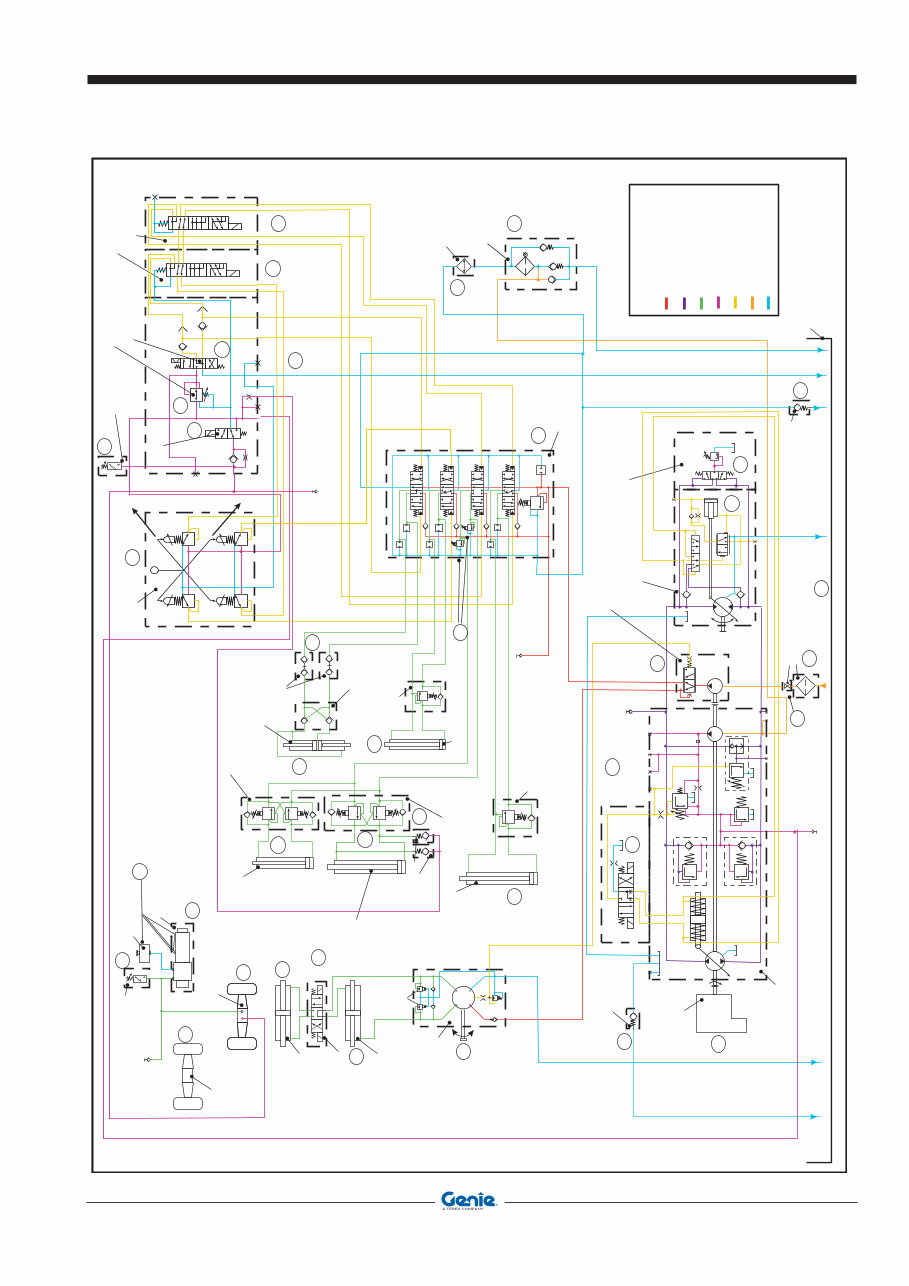
GTH 55-19 GTH 55-19-S TIER 3 hydraulic schematic
M
X1
X2
G
MH
S
A
A
M
1
X
1
X
2
T
G
T 1
P S F a F a1 F e MB
T 2 R
B
B
U
MA
F S
CF EF
L
S
L
S
L R
T P
P
1
4
2
3
T
T
P
P2 P3
F
P1
M2
F1
T1
1
2
T2
B1 C1 C2 B2
Ax2
Ax1
X
Y
A1
X
1
X
2
X
3
X
4
B 1
B 3
A3
B 2
A2
A4
B 4
T
P
C
Y
1
Y
2
Y
3
Y
4
T R
Diesel engine
Hydrostatic transmission
pump max displacement: 56 cc / rev
Hydrostatic transmission motor
max displacement: 107 cc / rev
Flushing valve
Boom functions pump
with integrated priority valve
displacement: 27 cc/rev
max flow rate 18.5 GPM
Suction screen
Heat exchanger
Anticavitation valves
cracking pressure
72 psi
Check valve
cracking pressure
36 psi
Check valve
cracking pressure
116 psi
Oil tank capacity
20 gallons
Boom functions
control lever
Boom functions
main valve
(4 sections)
HYDRAULI C C IRCUI T
COLORS LEGENDA
Functions driving lines
Low pressure and transmission
charge pressure lines
Hydrostatic transmission
high pressure lines
Load sensing and piloting lines
Open circuits high pressure lines
Suction lines
Tank lines
Steering rotating actuator
displacement: 125 cc / rev.
Front axle
Service brake
circuit reservoir
Service brake
pedal pump
max operating
pressure:
1160 psi
Forks levelling
slave cylinder
Forks tilt cylinder
Boom telescoping cylinder
Boom lift cylinder
Double overcenter safety valve
piloting ratio: 4.2 1
cracking pressure:
5075 psi
/
/
Double overcenter safety valve
piloting ratio: 4.2 1
cracking pressure:
5075 psi
/
/
Sing /
/
le overcenter safety valve
piloting ratio: 4.2 1
cracking pressure: 5075 psi
Sing / le overcenter safety valve
piloting ratio: 4.2:1
cracking pressure: 5075 psi
3915 psi
4205 psi
4205 psi
Cracking pressure
6525 psi
Cracking pressure
6525 psi
Cracking press.
362 psi
Cracking press.
6235 psi
Max relief valve
cracking
pressure:
2465 psi
Anti-shock
valves
cracking
pressure:
3262 psi
Quick coupling
hydraulic ports
Forks attachment
quick coupling cylinder
Steering mode
selector valve
4 ways / 3 positions
Front axle
steering cylinder
Rear axle
steering cylinder
TP 3
Tp 5
TP 2
TP 1
Hydraulically piloted
double check valve
piloting ratio: 4 1 /
P1
P2
T
A
P
B
Shutoff valve
Parking brake
minimum pressure
pressure switch
activating pressure:
290 psi
Parking brake
selector valve
Auxiliary continous flow
metering valve
0,02 in.
0,04in.
Auxiliary continous flow
selector valve
Forks tilt function
enabling valve
Quick connect/disconnect
attachment enabling valve
Service brake
pressure switch
activating pressure:
40-90 psi
Hydrostatic transmission
boost pressure test port
Hydrostatic transmission
high pressure test port
Boom functions hydraulic
circuit test port
Service brake
circuit test port
Ev1
Ev3
Ev5
Ev6
Ev8
Ev7
Ev4
Ev2
Return filter
with suction line
pressurized at
8 psi
Tp 4
Rear axle
27
4
37
25
26
15
13
14
12
11
1
39
2
3
9
8
10
5
36
33
16
34
32
35
31
21
30
38
29
28
18
24
23
22
19
20
17
6
7
viii GTH-5519 GTH-5519-S Document 57.0009.0415
Description February 2009
DESCRIPTION
Intentionally blank page

Document 57.0009.0415 GTH-5519 GTH-5519-S ix
February 2009 Section 1 - Safety Rules
Safety Rules
Danger
Failure to obey the instructions and safety rules in this
manual and the appropriate Operator's Manual on your
machine will result in death or serious injury.
Many of the hazards identified in the Operator's Manual
are also safety hazards when maintenace and repair
procedures are performed.
Do Not Perform Maintenace Unless:
You are trained and qualified to perform maintenace
on this machine.
You read, understand and obey:
- manufacturer's instructions and safety rules
- employer's safety rules and worksite regulations
- applicable governmental regulations
You have the appropriate tools, lifting equipment and
a suitable workshop.
x GTH-5519 GTH-5519-S Document 57.0009.0415
Section 1 - Safety Rules February 2009
SAFETY RULES
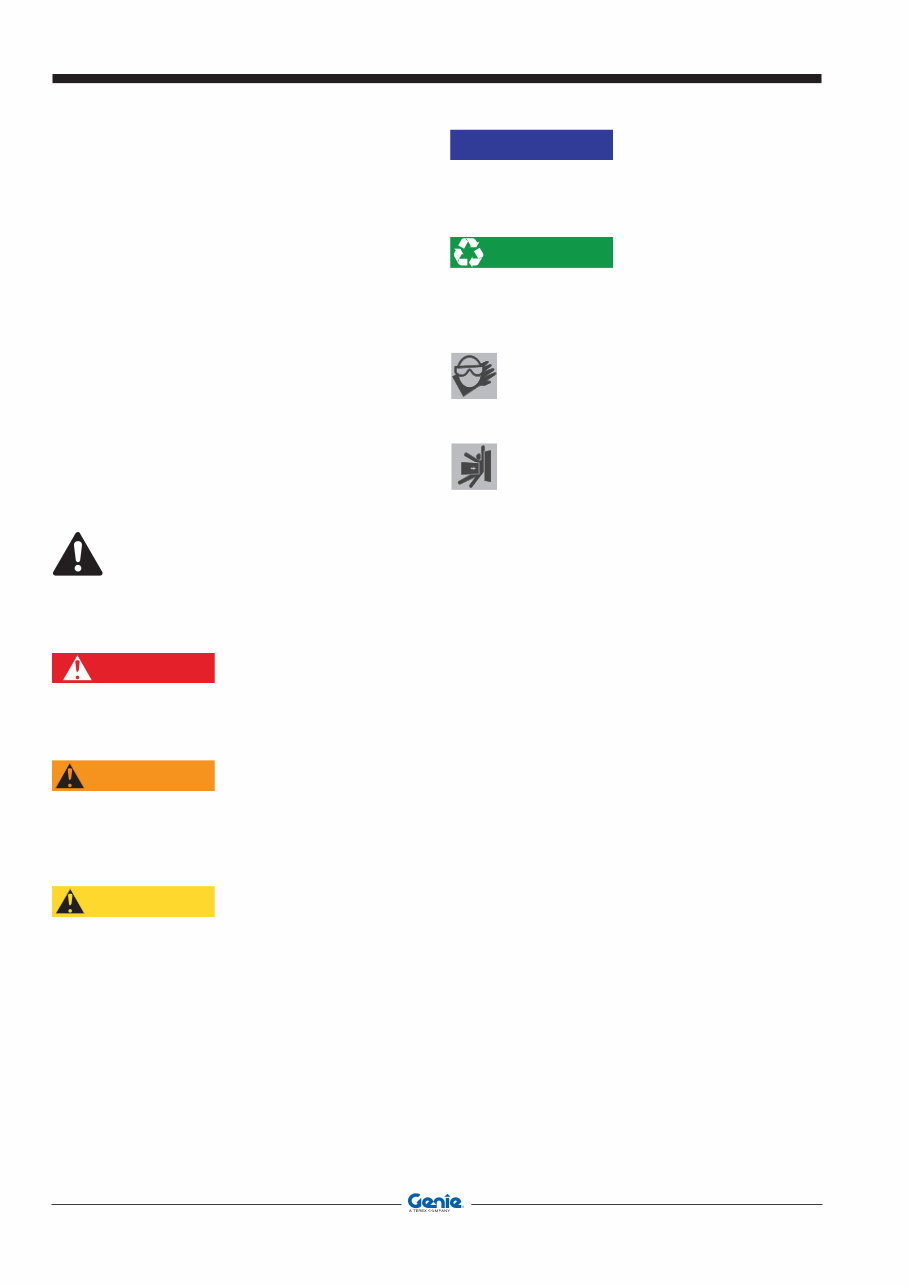
NOTICE
Draws the attention to important technical information
or practical advice that allows for a safer and more
efficient use of the machine.
PROTECT THE
ENVIRONMENT
Draws the attention to important environment-related
information.
Be sure to wear protective eye wear and
other protective clothing if the situation
warrants it.
Be aware of potential crushing hazards such
as moving parts, free swinging or unsecured
components when lifting or placing loads.
Always wear approved steel-toed shoes.
1.1 SAFETY RULES
1.1-1 Personal Safety
In this manual, any important information is preceded by
a SPECIAL SYMBOL.
All operators who work or service the machine must know
the exact meaning of these safety symbols.
There are six special (or safety) symbols in this manual,
always combined with keywords that class the situations
according to their danger degree.
The symbols are always followed by a text explaining
the situation taken into account, the attention to be paid
to such situation, the method and the behaviour to be
adopted. When necessary, it stresses prohibitions or
supplies instructions to prevent dangers.
Sometimes, it can be followed by illustrations.
We list below the special (or safety) symbols according
to the relative seriousness of the hazard situation:
Draws the attention to situations that involve your
own as well as the others’ safety and that can result
in serious or lethal injury.
DANGER
Draws the attention to situations that involve your
own as well as the others’ safety and that can result
in serious or lethal injury.
WARNING
Draws the attention either to situations that involve
your own as well as the others’ safety and that can
result in minor or moderate injury or to situations
that involve the machine efficiency.
CAUTION
Draws the attention either to situations that involve
your own as well as the others’ safety and that can
result in minor or moderate injury or to situations
that involve the machine efficiency.
You're Reading a Preview
What's Included?
 Lifetime Access
Fast Download Speeds
Online & Offline Access
Access PDF Contents & Bookmarks
Full Search Facility
Print one or all pages of your manual
$39.99
Terex Genie GTH-5519 Full Service & Repair Manual
Viewed 73 Times Today

What's Included?
Lifetime Access
Fast Download Speeds
Online & Offline Access
Access PDF Contents & Bookmarks
Full Search Facility
Print one or all pages of your manual
$39.99

Secure transaction
What's Included?
Lifetime Access
Fast Download Speeds
Online & Offline Access
Access PDF Contents & Bookmarks
Full Search Facility
Print one or all pages of your manual
Description
- Terex Genie GTH-5519 Full Service & Repair Manual
- Complete Factory Service Repair Workshop Manual
- Service Repair Workshop Manual, available for instant access on your computer, tablet, or smartphone
- This Professional Manual covers all repairs, servicing, and troubleshooting procedures
- Contains hundreds of pages with detailed photos & diagrams
- Used by professional Mechanics and Technicians
- Includes step by step instructions & highly detailed exploded diagrams & pictures
- Can print out a single page or the entire manual
- Can be used on multiple computers
- Full Manual without any limitations or trial periods
- No expiration or renewal fees
- Fully compatible with all Windows & MAC Computers
Thanks for looking at this item, please click on the Button.


