Sheet 2: General Truck and Lubrication GENERAL TRUCK AND LUBRICATION MAINTENANCE SAFE MAINTENANCE PROCEDURES Your Yale industrial truck, as manufactured, meets all the applicable mandatory requirements of ANSI B56.1 Safety Standard for Powered Industrial Trucks. All standard trucks conform to the Underwriters' Laboratories requirements for the Type Designation shown on the nameplate. The truck is also equipped with certain safety devices as standard equipment. For example, all high lift trucks are equipped with an operator's overhead guard. No additions, omissions or modifications should be made that will affect compliance to the above requirements or in any way reduce the effectiveness of the safety devices. The following instructions have been prepared for your safety and the safety of your fellow workers during maintenance operations and should be strictly followed. Carefully read and understand the maintenance procedures before attempting to repair the truck. When in doubt of any maintenance procedure, contact your local Yale industrial truck dealer. 1. Powered industrial trucks may become hazardous if maintenance is neglected. Therefore, adequate maintenance facilities, personnel and procedures should be provided. 2. The Recommended Schedules of Maintenance should be used as a guide for inspection of the truck. 3. Only qualified and authorized personnel should be permitted to maintain, repair, adjust and inspect the truck. 4. The work area should be properly ventilated. Keep shop clean and floor dry. 5. Avoid fire hazards and have fire protection equipment present. Do not use an open flame to check level of electrolyte. Do not use open pans of fuel or flammable cleaning fluids for cleaning parts. 6. Raise the lift truck only if it is on a solid level floor. Disconnect the battery. Use solid one piece blocks or other positive truck positioning devices to support the truck. Chock the wheels to prevent movement of the truck. 7. Before removing any component from the truck, such as counterweights, mast assembly, drive unit, etc., make sure that the lifting mechanism and slings are of the proper capacity and in good condition. 8. When working on the hydraulic system, be sure the truck is turned off, battery is disconnected, mast is lowered and the hydraulic pressure is relieved in hoses and tubes. 9. When necessary to work with mast in a raised position, install a safety chain to restrain moving parts. Connect moving parts to a part that does not move. 10. Brakes, steering mechanisms, control mechanisms, warning devices, guards and safety devices should be inspected regularly and maintained in a safe operating condition. 11. All parts of the lift mechanism and frame members should be carefully and regularly inspected and maintained in a safe operating condition. 12. All hydraulic systems should be regularly inspected and maintained in conformance with the maintenance schedules. Lift cylinders, valves and other similar parts should be checked to assure that "drift" has not developed to the extent that it would create a hazard. 13. Special trucks or devices designed and approved for hazardous area operation should receive special attention to ensure that maintenance preserves the original condition of the special operating features. 14. Modifications and additions which affect capacity and safe truck operation should not be performed by the customer or user without the manufacturer's prior written approval. Capacity, operation and maintenance instruction plates, tags or labels should be changed accordingly. 15. Capacity, operation and maintenance instruction plates, tags and labels should be maintained in legible condition. 16. The truck should be kept in clean condition to minimize fire hazards and facilitate detection of loose or damaged parts.
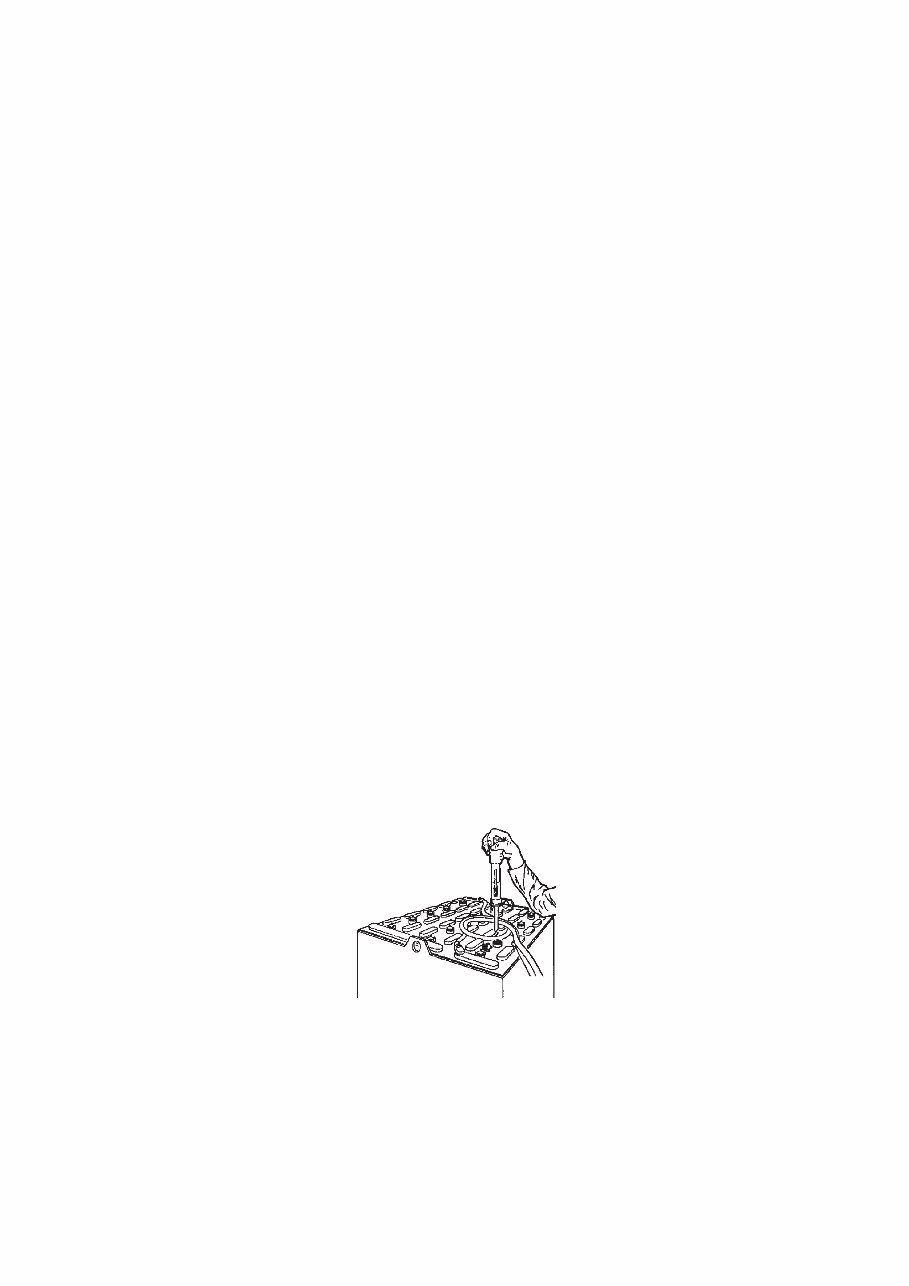
Sheet 2: General Truck and Lubrication 17. Checking the performance of the truck or attachments should be conducted in an authorized safe clearance area. 18. Always use Yale replacement parts to be sure they are interchangeable with the original parts and are of a quality equal to that provided in the original equipment. You should also be familiar with additional maintenance safety instructions contained in the following publications: 1. ANSI B56.1 -Safety Standard for Powered Industrial Trucks This booklet can be obtained from: Society of Mechanical Engineers 345 E. 47th Street New York, NY 10017 2. ANSI/NFPA 505 -Type Designations, Area of Use, Maintenance and Operation of Powered Industrial Trucks This booklet can be obtained from: National Fire Protection Assoc . Batterymarch Park Quincy, MA 02269 3. Code of Federal Regulations Title 29, Chapter XVII, Section 1910.178 (OSHA) Powered Industrial Trucks This booklet can be obtained from: Superintendent of Documents , U.S. Government Printing Office, Washington, DC BATTERY OPERATION Batteries are rated in ampere hours and are selected to perform a specific work load within an established period of time. Changing the workload or the time period could result in excessive discharging, thus shortening battery life. Limit discharging of battery so that specific gravities do not go below 1.140 to 1.100. If truck operation results in only partial discharges (50% or less) and specific gravities are 1.210 to 1.220 or more at the end of a shift, recharging may be deferred and the battery used for another shift providing the workload is not expected to increase. BATTERY INSTALLATION CAUTION : The battery must fit the battery compartment correctly. Use spacers to prevent the battery from moving horizontally in the battery compartment. Make sure that the battery voltage and weight are correct as shown on the nameplate. Remove the vent caps from each cell and determine whether the electrolyte level in all cells is at least halfway between the element protector and the bottom of the cell cover vent well. If the electrolyte is low, replace it with electrolyte of the same specific gravity as found in other cells of the battery. Replace the vent caps and give the battery a refreshing charge of three (3) to six (6) hours or continue the charge until there is no increase in specific gravity for three hydrometer readings taken at one hour intervals. The normal fully charged specific gravity is 1.280 to 1.290 at 77°F. Figure 2-1 -Checking Specific Gravity with a Hydrometer Hydrometer readings and experience will disclose the frequency of charge intervals under these circumstances. A battery should always be recharged immediately following a complete discharge. Permanent damage may result if the battery is allowed to remain in a discharged condition.
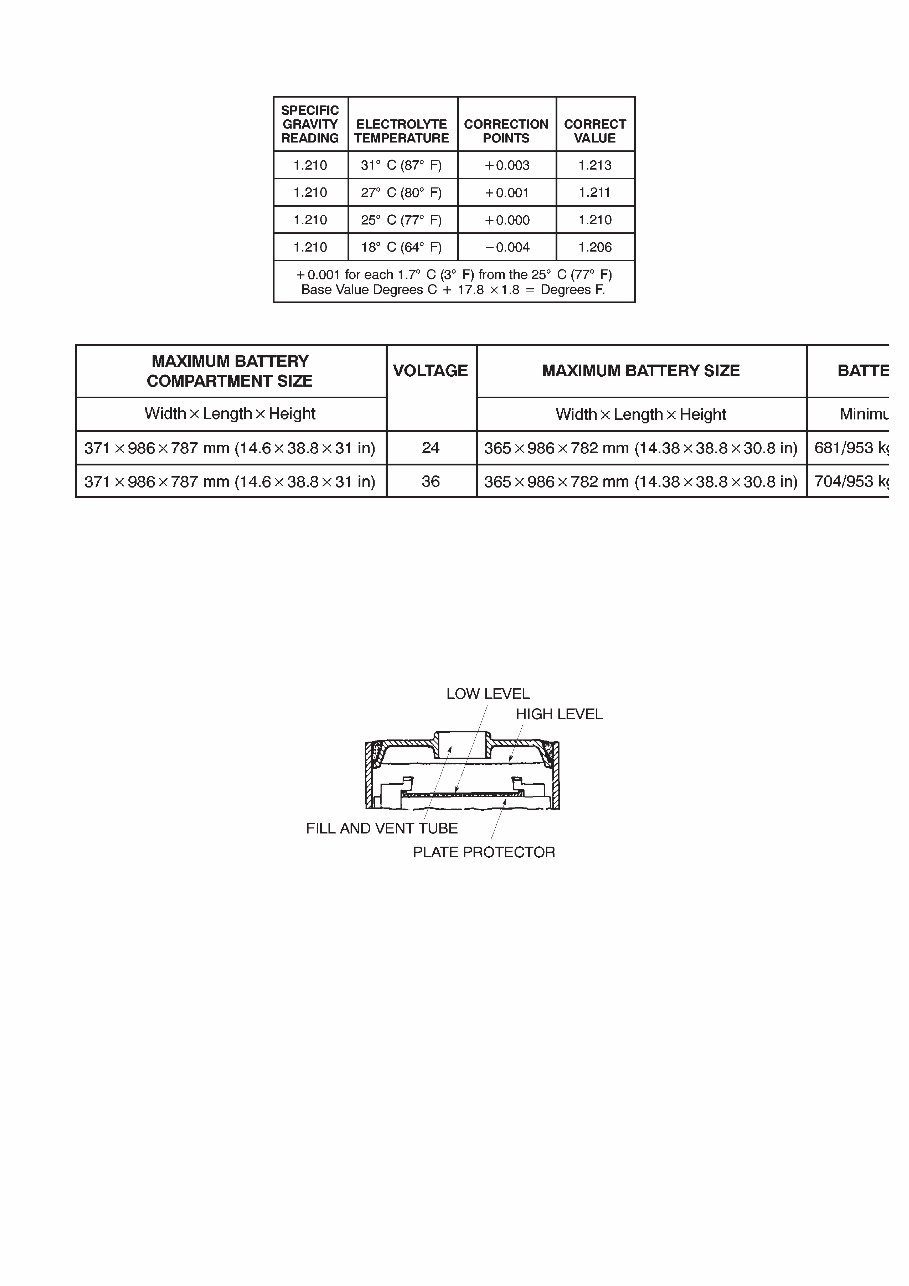
Sheet 2: General Truck and Lubrication Table 2-1 -Specific Gravity Temperature Corrections Table 2-2 -Battery Specifications WARNING : The battery must fit the battery compartment so that the battery restraint system will operate correctly. Use the spacers designed to prevent the battery from moving more than 13mm (0.5 in) in any horizontal direction. NOTE : Maximum tolerances are +0 and -13 mm (+0 and -0.5 in) for the size of the battery compartment. The battery specification chart shows the maximum size tolerances that will permit the battery to still fit into the battery compartment. CAUTION : Disposal of batteries must meet local environmental regulations. Figure 2-2 -Proper Water Level Maintain the electrolyte levels halfway between the plate protector and the bottom of the fill and vent tube but never below the plate protector or higher than the bottom of the fill and vent tube. Add only distilled or approved water. Check electrolyte level daily, prior to charging on at least one cell and weekly on all cells. WARNING : To prevent personal injury and unexpected battery movement, the battery must be level when it is moving. Before removing the battery to check the electrolyte levels, make sure the battery stand is on a level surface and is aligned and adjusted. CLEANING Examine the battery case for damage and leaking. The battery can be washed off with water if dusty. Keep vent caps in place. If electrolyte has accumulated on top, wash with a neutralizing solution of soda and water (one pound of baking or commercial soda ash to one gallon of water). Follow with a rinse using clear water. The top of the battery should be kept clean and dry. Keep vent caps in place during use and charging. Remove vent caps only to observe levels, make water additions, take temperatures or take specific gravity readings with a hydrometer. CAUTION: Keep vent plugs in the cells at all times, except when taking hydrometer readings, adjusting specific gravity and electrolyte levels, troubleshooting or reassembling a repaired cell.
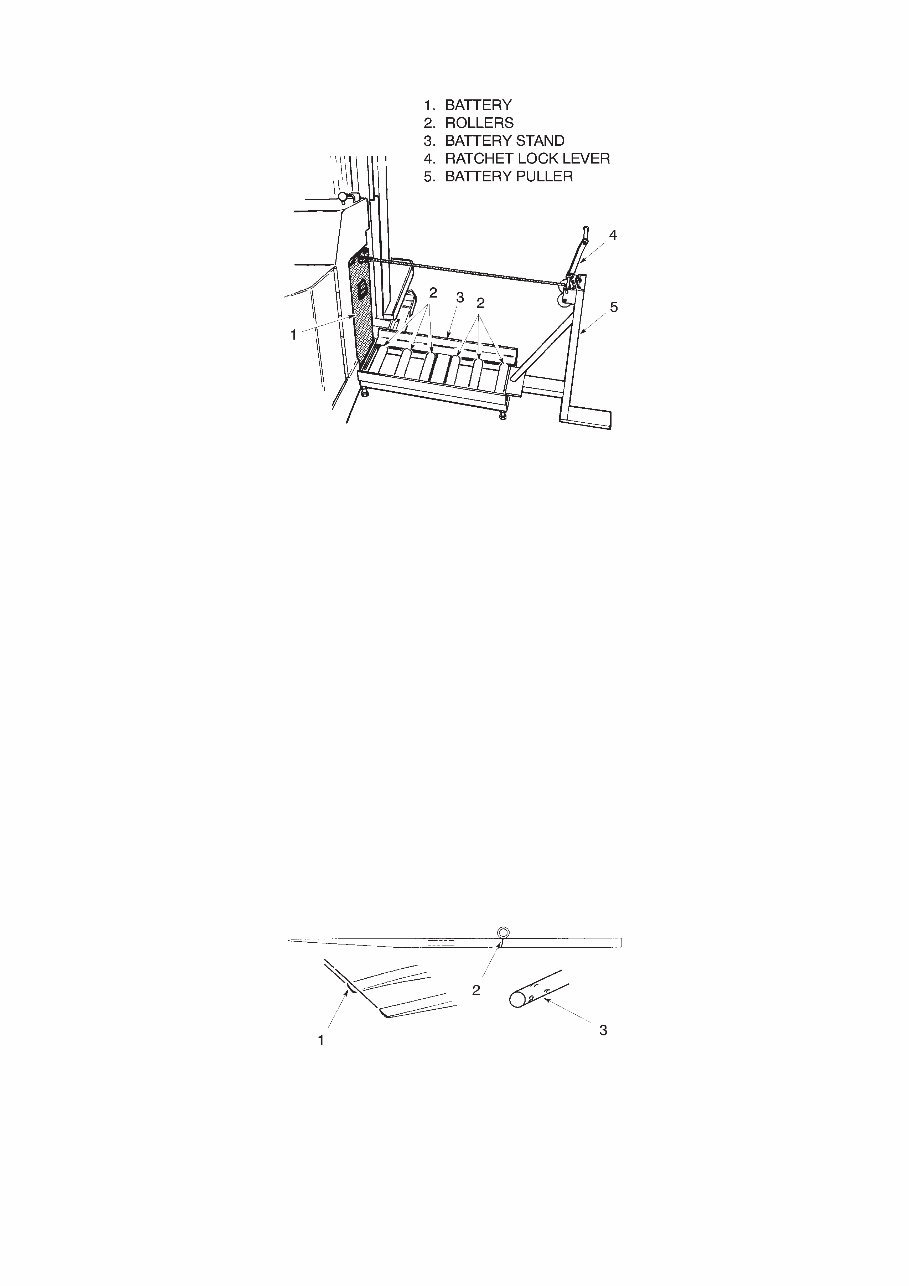
Sheet 2: General Truck and Lubrication CHARGING THE BATTERY The storage battery which powers your lift truck will normally be placed on charge after each shift. If you are responsible for connecting and disconnecting the truck to the charger, follow these instructions: 1. Be sure the charger is turned off before touching the charger cable. Attempting to disconnect the cable while the charger is operating may result in damage to the cable end and injury to you. 2. If the charger is still on when you begin your shift, report this condition to your supervisor, the battery may not have received the proper charge. 3. When you are sure the charger is off, disconnect the battery from the charger. Before connecting the battery lead to the truck receptacle, make sure the truck controls are in neutral and that the connector is firmly in place. When recharging a fully discharged battery, the starting charge rate may be 3 to 5 times higher than the finish charge rate indicated on the battery nameplate. The charge rate should taper down to the finish charge rate by the time the battery is 85% charged and may be even lower when fully charged. High "on charge" temperatures or frequent need for water additions are indications of overcharging. Consult your Yale industrial truck dealer on specific charging problems. For complete charging instructions, refer to the manual supplied with the battery charger. CHANGING THE BATTERY WARNING : To prevent personal injury and unexpected battery movement, the battery must be level when it is moving. Make sure the battery stand is on a level surface and is aligned and adjusted as described in the following procedure. 1. Make sure the key is in the OFF position. Disconnect the battery. Move the connector and cables so that they will not be damaged when the battery is moved. 2. Remove the battery restraint panel. 3. Align the battery stand with the battery so that the end of the stand is against the roller frame. Adjust the capscrew legs of the battery stand so that the tops of the rollers are the same height as the bottom of the battery. Adjust all four capscrew legs of the stand so that the rollers are level. Stand on the base of the battery puller and pull the battery onto the battery stand. 4. If the battery is lifted use a spreader bar and crane to lift the battery from the battery stand. 5. Before installing the battery, make sure the battery is cleaned and painted. 6. When a replacement battery is installed, make sure the battery fits the battery compartment. Use spacers to prevent the battery from moving more than 13 mm (0.5 in) in any horizontal direction. 7. Make sure the weight of the replacement battery is within the maximum and minimum weights shown on the nameplate. 8. The battery must be installed so that the battery connector will connect to the lift truck connector without pulling on the cables. WARNING : Batteries are heavy. Use care to avoid injury. WARNING : Make sure the capacity of the crane and the spreader bar is greater than the weight of the battery. The weight of the battery is normally shown on the battery case. The maximum battery weight is shown on the lift truck nameplate. The spreader bar must not be made of metal or it must have insulated straps. NOTE: Complete information relating to the care and maintenance of batteries can be found in the literature shipped with the battery.
Sheet 2: General Truck and Lubrication Figure 2-3 -Changing the Battery WARNING : If a different size battery is installed in the lift truck the battery spacers must be changed. See the parts manual for the correct battery spacer arrangement. WARNING : If the lift truck has been operated with a low battery, check the contactors for welded contacts before a charged battery is connected. The circuit will not reset and lift truck operation cannot be controlled if the contacts are welded. To check the contacts, see the Maintenance Manual for this truck. NOTE: Your company, industry and government safety regulations should be reviewed to help reduce accidents and damage to equipment. FORKS WARNING : Do not try to lift a fork without a lifting device. On some trucks the forks can weigh up to 180 kg (400 lb) each. WARNING : Never work under a raised carriage or forks. Lower the carriage or use chains on the mast weldments and carriage so that they cannot move. Make sure the moving parts are attached to a part that does not move. See SAFETY PROCEDURES WHEN WORKING NEAR THE MAST , Page 9-3 for specific instructions. 1. Check that the fork tips are aligned within 13 mm (0.5 in) of each other. Do not try to correct alignment of the fork tips by bending the forks. Use shims to align the fork tips. 2. Inspect forks for cracks and wear. Never repair damaged forks by heating or welding. Forks are made of special steel using special procedures. Replace damaged forks. Always replace forks in pairs. 3. Replace any damaged or broken parts that are used to keep the forks locked in position. Figure 2-4 -Checking the Forks TETHER LINE AND BELT WARNING: The tether line is specially made to lessen the shock of a fall. Do not substitute other types of rope. 1. Inspect the tether line for wear, cuts or damage. Inspect the clips for cracks and proper operation. 2. Inspect the belt for cracks, cuts or wear. The operator must fasten the belt snugly with the "D" ring in the center of
You're Reading a Preview
What's Included?
Lifetime Access
Fast Download Speeds
Offline Viewing
Access Contents & Bookmarks
Full Search Facility
Print one or all pages of your manual
$31.99
YALE (C826) OS030BD, SS030BD Lift Truck Service Repair Manual
If you are facing trouble with YALE (C826) OS030BD, SS030BD LIFT TRUCK maintenance, worry no more. We have a comprehensive service repair manual available electronically, suitable for both professional mechanics and DIY enthusiasts. This manual is rich in maintenance knowledge and practical for use at any location. It covers various aspects including operating instructions, general truck and lubrication, electrical system introduction, status, warning, and fault code troubleshooting, electrical system components, EV-100LX motor controller, motor maintenance, wiring diagrams, drive unit, brake system, and steering system with wire guidance.
The file format is compatible with all versions of Windows & Mac, and it is available in English. It requires Adobe Reader & Win for access. With this manual, your YALE (C826) OS030BD, SS030BD LIFT TRUCK will receive top-notch service. The electronic format ensures practicality and ease of use, making it a valuable resource for on-site repairs. Embracing electronic products aligns with modern trends and enhances your technical image. Whether you operate a repair shop or handle your own repairs, this service manual will assist you in overcoming maintenance challenges.
Reviews
Q&A
Recently Viewed
5,521,897Happy Clients
2,594,462eManuals
1,120,453Trusted Sellers
15Years in Business
Price:
Actual Price:
YALE (C826) OS030BD, SS030BD Lift Truck Service Repair Manual






 Lifetime Access