


総 説
GI
メンテナンス
MA
エンジン脱着
ER
クラッチ
CL
マニュアルトラン
MT
オートマチックト
AT
デファレンシャル
DF
フロントアクスル
DA
リヤアクスル
SA
ロードホイール&
RT
ブレーキシステム
BR
ステアリングシス
ST
ハイドロリックシ
HD
ローディングメカ
LM
FE
車両制御システム
VC
ボディー&フレー
BF
ボデ ィ ー電装
BE
1. TYPES AND FEATURES OF POWER
TRANSMISSION SYSTEMS . . . . . . . . CL- 2
2. MAIN DIFFERENCES BETWEEN DRY AND
WET CLUTCHES . . . . . . . . . . . . . . . . CL- 3
3. MECHANISMS AND FUNCTIONS OF
CLUTCHES . . . . . . . . . . . . . . . . . . . . . CL- 4
4. CLUTCH . . . . . . . . . . . . . . . . . . . . . . . CL- 5
(1) For Dry Clutch . . . . . . . . . . . . . . . . . CL- 5
(2) For Wet Clutch . . . . . . . . . . . . . . . . CL- 6
(3) Components . . . . . . . . . . . . . . . . . . CL- 7
5. CLUTCH UNIT . . . . . . . . . . . . . . . . . . CL- 9
(1) Component Parts Location. . . . . . . . CL- 9
(2) Disassembly . . . . . . . . . . . . . . . . . . CL- 9
(3) Inspection and Correction . . . . . . . . CL-11
(4) Assembly . . . . . . . . . . . . . . . . . . . . CL-13
6. CLUTCH COVER ASSEMBLY . . . . . . CL-16
(1) Disassembly . . . . . . . . . . . . . . . . . . CL-16
(2) Inspection and Correction . . . . . . . . CL-17
(3) Assembly . . . . . . . . . . . . . . . . . . . . CL-18
7. CLUTCH MASTER CYLINDER
(FOR DRY CLUTCH) . . . . . . . . . . . . . CL-19
(1) Disassembly . . . . . . . . . . . . . . . . . . CL-19
(2) Inspection and Correction . . . . . . . . CL-20
(3) Assembly . . . . . . . . . . . . . . . . . . . . CL-21
8. CLUTCH OPERATING
CYLINDER . . . . . . . . . . . . . . . . . . . . . CL-22
(1) Disassembly . . . . . . . . . . . . . . . . . . CL-22
(2) Inspection and Correction . . . . . . . . CL-23
(3) Assembly . . . . . . . . . . . . . . . . . . . . CL-24
9. ADJUSTMENT . . . . . . . . . . . . . . . . . . CL-25
(1) Clutch Air Bleeding . . . . . . . . . . . . . CL-25
(2) Adjustment of Clutch Pedal
(Dry Clutch) . . . . . . . . . . . . . . . . . . CL-27
(3) Adjustment of Clutch Pedal
(Wet Clutch) . . . . . . . . . . . . . . . . . . CL-28
(4) Clutch Disc Wear Limit
Inspection . . . . . . . . . . . . . . . . . . . . CL-30
CONTENTS
CLUTCH
SECTION
CL
CL-2
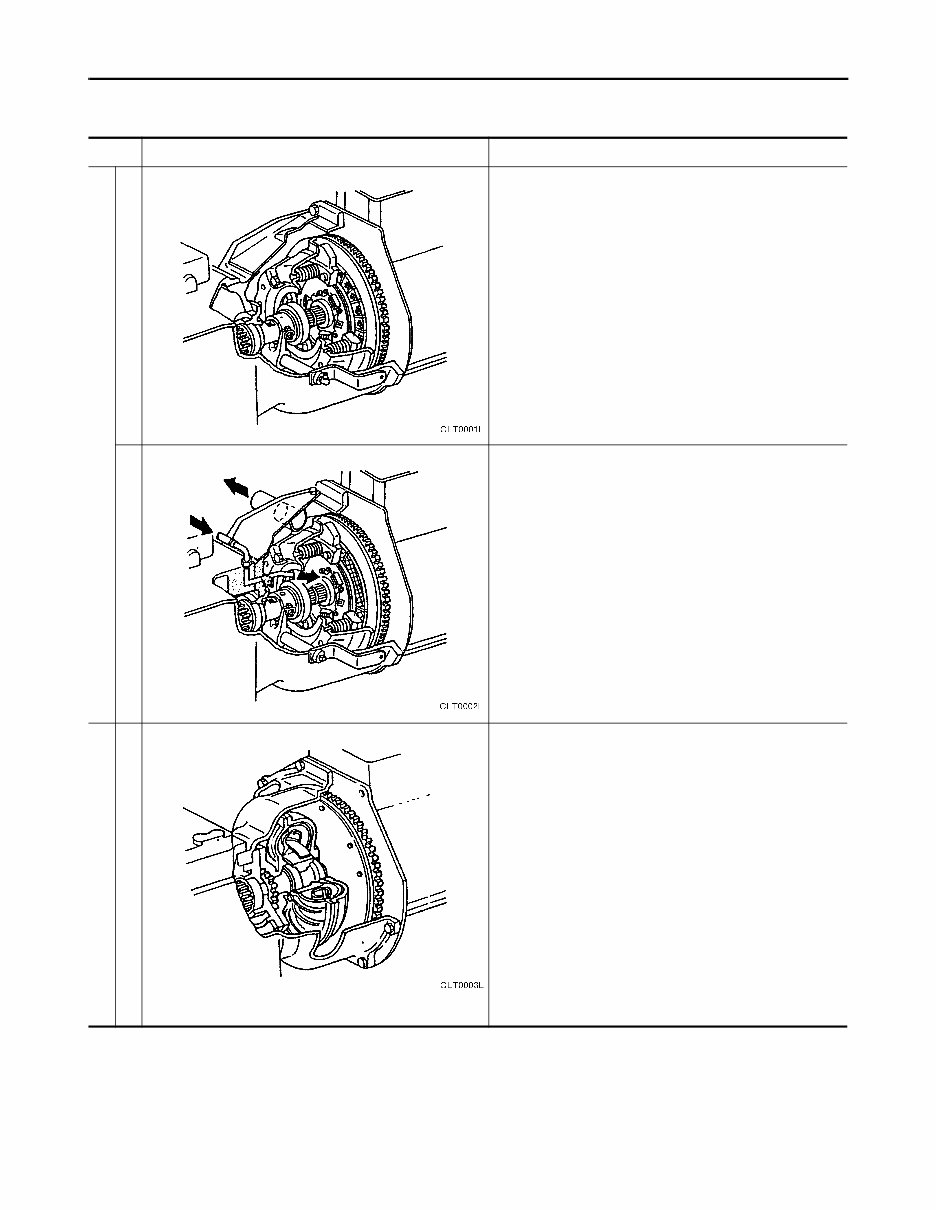
1. TYPES AND FEATURES OF POWER TRANSMISSION SYSTEMS
Type Construction Features
・This is the most popular structure. Half-clutch operation
makes it possible to perform delicate cargo handling
work. Thus, it is liked by veteran operators who dislike
torque converter vehicles. And since power
transmission loss is minimal and output can be used
effectively, fuel consumption is reduced.
・ Depending on the type of cargo handling work, the
clutch disc life may be shortened and maintenance
costs can be high under demanding half-clutch
operation. Operability is inferior to that of models with
an automatic transmission, and experience and skill
are required.
・The operation feel and fuel economy are the same as a
dry-clutch-equipped vehicle, but the clutch disc life is
much longer than that of a dry type, even with frequent
half-clutch operation.
・ In vehicles that are operated for long hours and under
harsh conditions, vehicles equipped with attachments
such as roll clamps that require frequent half-clutch
operations, and vehicles equipped with hinged forks
that require traction, this type has a longer clutch life
than that of a dry type.
・ Operation is simple, which minimizes operator fatigue
and improves work efficiency. (Efficiency is about 10%
better than that of models with manual transmission,
depending on the work.)
・ Hydraulically operated wet clutch is built into the
transmission, so the clutch life is lengthened and it
provides the same advantages as that of the
aforementioned models with wet clutch (manual
transmission).
・ Since power transmission loss occurs, fuel economy is
about 10% less per volume of work when compared to
models with manual transmission.
(On a per-hour basis, it is about 20% inferior, but the
volume of work increases about 10%. Of course, these
percentages will vary according to the nature of the
work and should be considered as general standards
only.)
CLT0001L
CLT0002L
CLT0003L
TYPES AND FEATURES OF POWER TRANSMISSION SYSTEMS
Dry clutch
(Manual transmission)
Torque converter
(Automatic transmission)
Wet clutch
CL-3
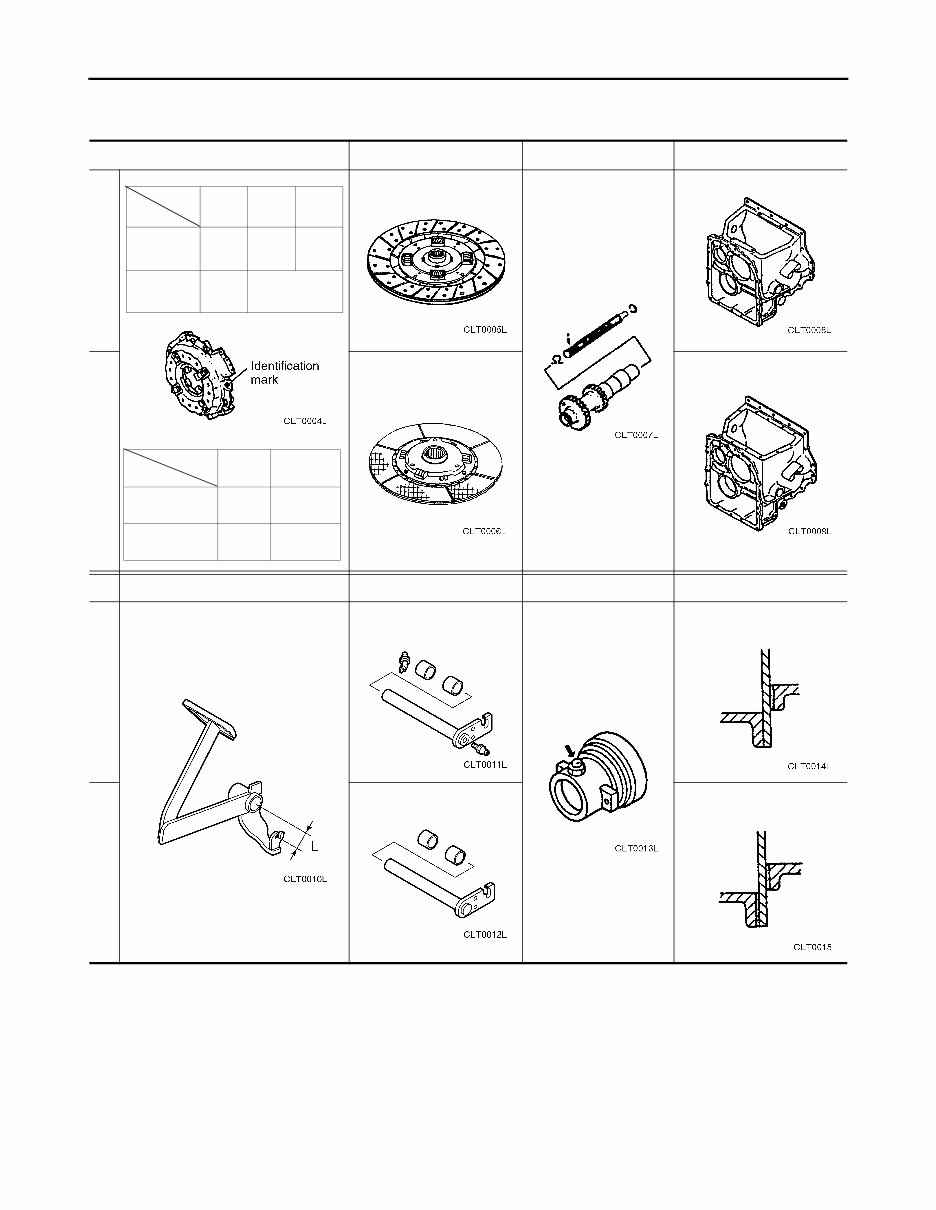
2. MAIN DIFFERENCES BETWEEN DRY AND WET CLUTCHES
Clutch cover assembly Clutch disc Input shaft Clutch housing
Clutch pedal Clutch shaft Clutch bearing E/G packing
L = 45 mm (dry)
L = 40.5 mm (wet)
Grease type
With grease nipple
Without grease nipple
No
Yes
Engine
Items
K15
K21
2.5L-4C
K25
3.3L-4C
Identification
mark
FJ10 FJ20 FK00
Spring
8
Color-
less
12
Colorless
CLT0004L
Engine
Items
2.5L-4C
K21
3.3L-4C
K25
Identification
mark
FJ50 FJ51
Spring
10
Brown
12
Brown
CLT0005L
CLT0007L
CLT0008L
CLT0006L
CLT0009L
CLT0010L
CLT0011L
CLT0013L
CLT0014L
CLT0012L
CLT0015L
MAIN DIFFERENCES BETWEEN DRY AND WET CLUTCHES
Dry
Wet
Wet Dry

CL-4
3. MECHANISMS AND FUNCTIONS OF CLUTCHES
Dry clutch
For the purpose of replacing the clutch disc, a dry clutch has an
opening on the upper housing surface. By separating the input shaft
and input gear and sliding the spline to the transmission, the clutch
disc can easily be replaced.
CAUTION
• The pressure plate size is common for all vehicle models. Only
the number of pressure springs used is different.
Wet clutch
A wet clutch is sealed with a cover because of its mechanism in
which the clutch disc is cooled by the return oil of the clutch booster.
The cooled oil is returned to the operating oil tank using the turning
force of the flywheel.
CAUTION
• HDS-3-10W oil is used for diesel engine, and this also serves
as lubricant. Do not confuse them when filling.
• The pressure plate size is common for all vehicle models. Only
the number of pressure springs used is different.
1. Clutch disc
2. Clutch cover assembly
3. Input shaft
4. Release bearing sleeve
5. Release bearing
6. Clutch shifter shaft
7. Front cover
CLT0016LÅ@WÅ@
MECHANISMS AND FUNCTIONS OF CLUTCHES

CL-5
4. CLUTCH
(1) For Dry Clutch
With a dry clutch, a pin is used to connect the direct clutch pedal and
push rod of the clutch master cylinder. Clutch operating cylinder
absorbs the positional change that occurs in the pressure plate
release lever due to clutch disc wear. If the pedal is adjusted at the
beginning, it can be used without adjustment.
1. Bracket
2. Clutch pedal
3. Reservoir tank
4. Clutch master cylinder
5. Clutch operating cylinder
6. Stopper bolt
CLT0017L
CLUTCH
You're Reading a Preview
What's Included?
 Lifetime Access
Fast Download Speeds
Offline Viewing
Access Contents & Bookmarks
Full Search Facility
Print one or all pages of your manual
$36.99
Nissan Forklift Internal Combustion L01, L02 Series Service Repair Workshop Manual (Engine 2.5 / 3.3 Diesel, Engine Gas
Viewed 87 Times Today

What's Included?
Lifetime Access
Fast Download Speeds
Offline Viewing
Access Contents & Bookmarks
Full Search Facility
Print one or all pages of your manual
$36.99

Secure transaction
What's Included?
Lifetime Access
Fast Download Speeds
Offline Viewing
Access Contents & Bookmarks
Full Search Facility
Print one or all pages of your manual
Description
This is a highly detailed factory service repair manual for the Nissan Forklift Internal Combustion L01, L02 Series. The manual provides step-by-step instructions and detailed illustrations, making it suitable for both do-it-yourself enthusiasts and experienced mechanics. It covers the complete disassembly of the machine, including the engine 2.5 / 3.3 diesel and engine gas / LPG K15 / K21 / K25. The manual includes the following:
- Introduction
- Foreword
- General Information
- Maintenance / Service
- Engine Removal
- Clutch
- Manual Transmission
- Automatic Transmission
- Differential Carrier
- Drive Axle
- Steering Axle
- Wheel and Tires
- Brake System
- Steering System
- Hydraulic System
- Loading Mechanism
- Fuel and Exhaust System
- Vehicle Control System
- Body and Frame
- Body Electric System
- Product Bulletin Vehicle
- Engine 2.5 / 3.3 Diesel Service Manual
- Engine Gas / LPG K15 / K21 / K25 Service Manual
The manual is compatible with all versions of Windows and Mac, and it requires Adobe Reader and Win. It is an inexpensive way to ensure proper functioning of your vehicle, and all pages are printable for convenience.


