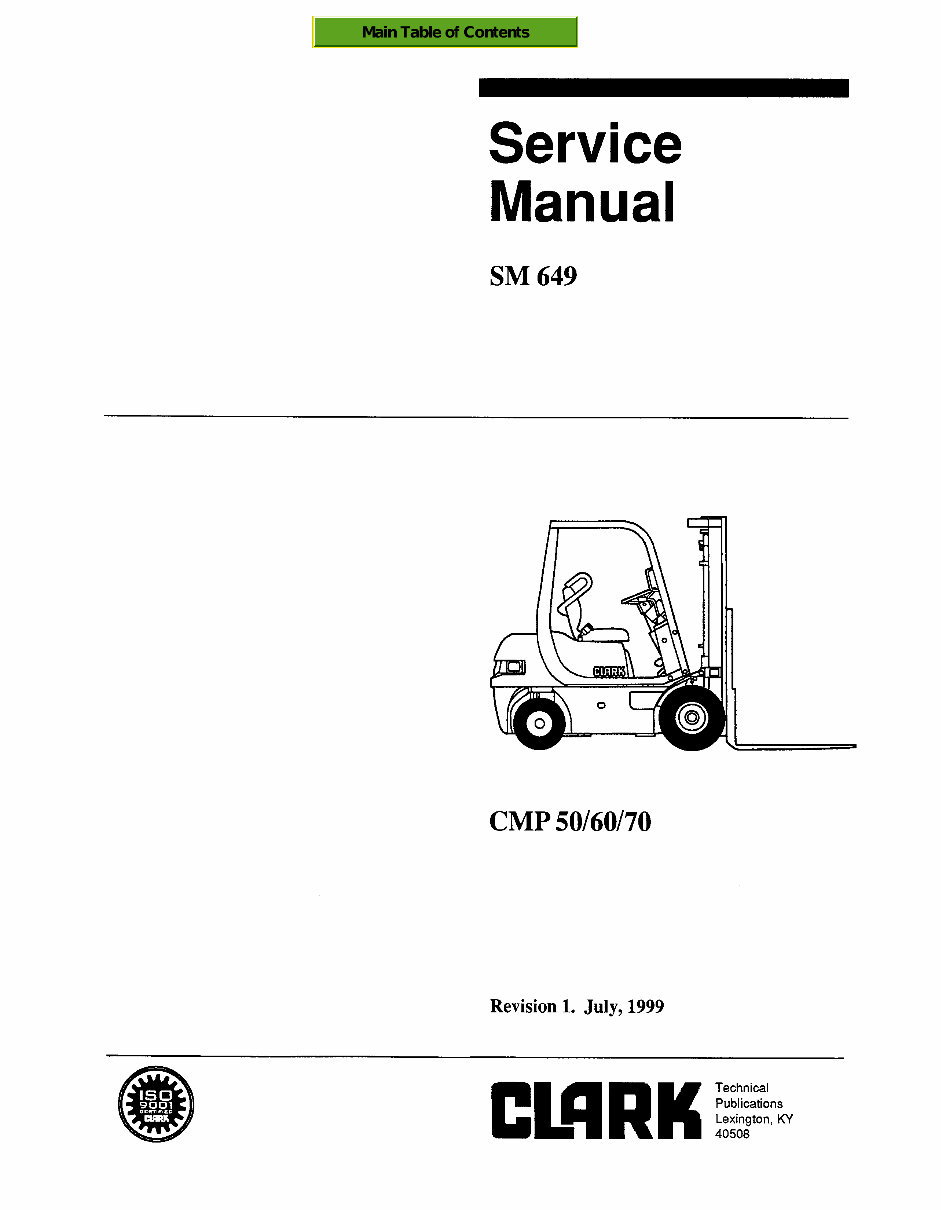
Service Manual SM.649 CMP50/60/70 Revision 1. July, 1999
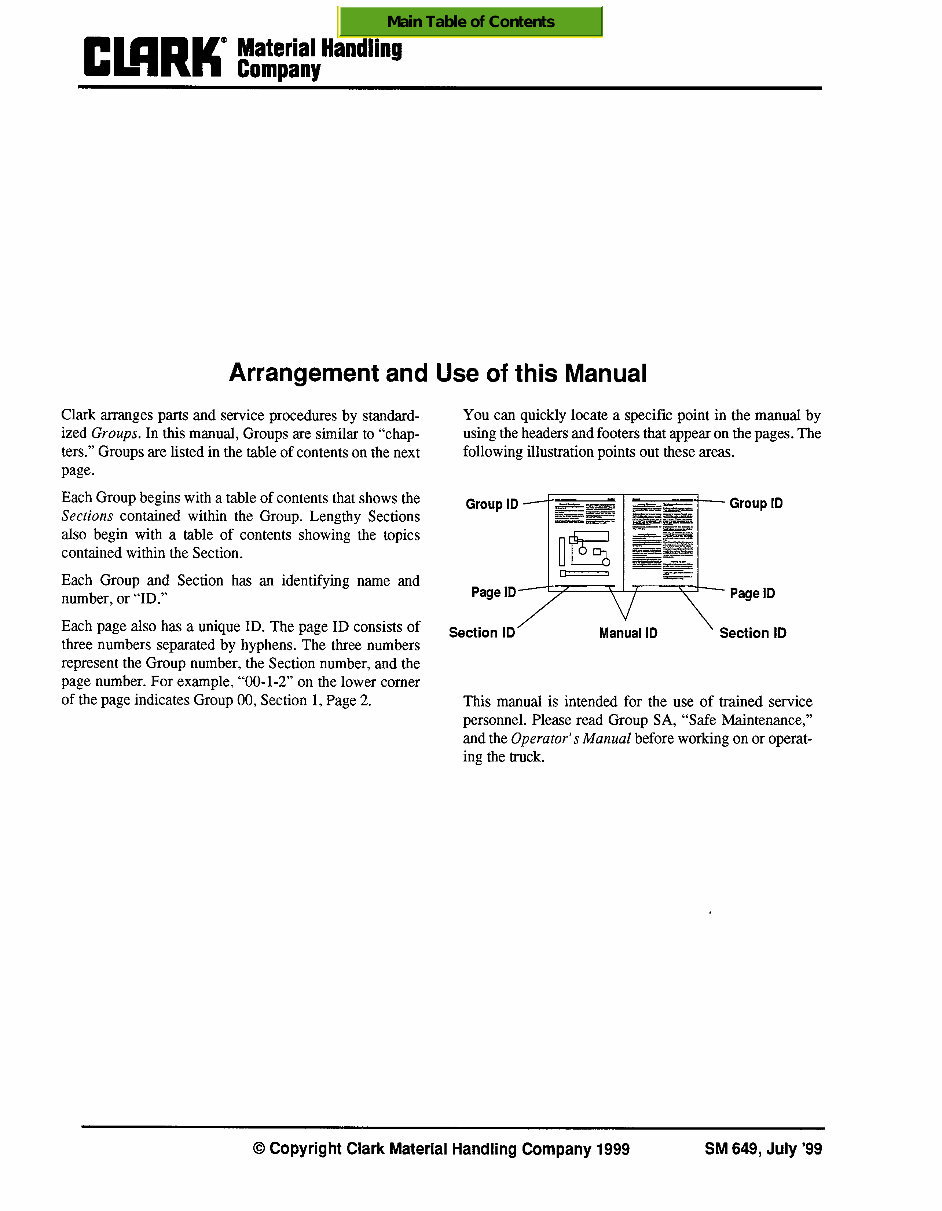
Arrangement and Use of this Manual Clark arranges parts and service procedures by standard- ized Groups. In this manual, Groups are similar to “chap- ters.” Groups are listed in the table of contents on the next page. You can quickly locate a specific point in the manual by using the headers and footers that appear on the pages. The following illustration points out these areas. Each Group begins with a table of contents that shows the Sections contained within the Group. Lengthy Sections also begin with a table of contents showing the topics contained within the Section. Each Group and Section has an identifying name and number, or “ID.” Each page also has a unique ID. The page ID consists of three numbers separated by hyphens. The three numbers represent the Group number, the Section number, and the page number. For example, “00-1-2” on the lower comer of the page indicates Group 00, Section 1. Page 2. This manual is intended for the use of trained service personnel. Please read Group SA, “Safe Maintenance,” and the Operator’s Manual before working on or operat- ing the truck. 0 Copyright Clark Material Handling Company 1999 SM 649, July ‘99
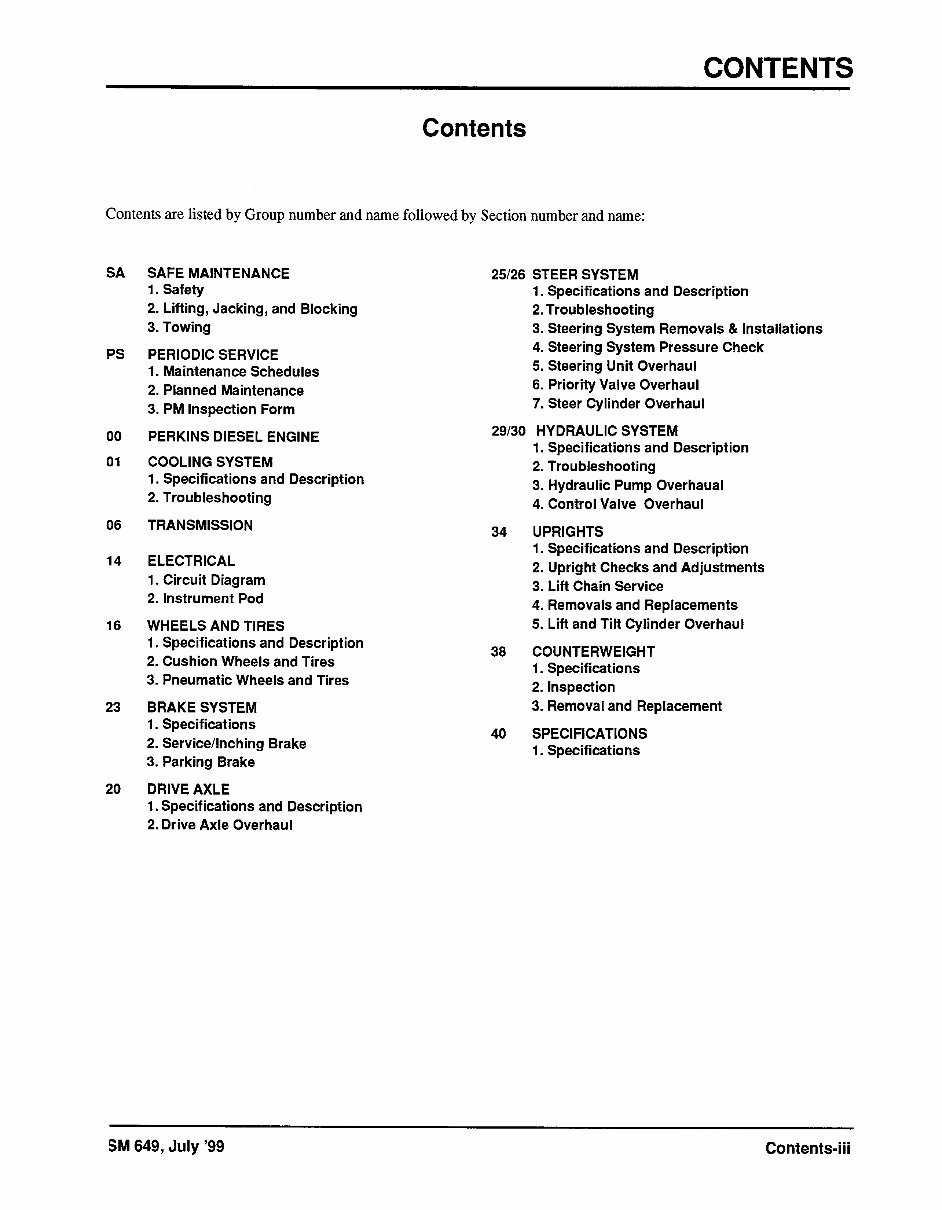
CONTENTS Contents Contents are listed by Group number and name followed by Section number and name: SA PS 00 01 06 14 16 23 20 SAFE MAINTENANCE 1. Safety 2. Lifting, Jacking, and Blocking 3. Towing PERIODIC SERVICE 1. Maintenance Schedules 2. Planned Maintenance 3. PM Inspection Form PERKINS DIESEL ENGINE COOLING SYSTEM 1. Specifications and Description 2. Troubleshooting TRANSMISSION 34 ELECTRICAL 1. Circuit Diagram 2. Instrument Pod WHEELS AND TIRES 1. Specifications and Description 2. Cushion Wheels and Tires 3. Pneumatic Wheels and Tires 38 BRAKE SYSTEM 1. Specifications 2. Service/Inching Brake 3. Parking Brake DRIVE AXLE 1. Specifications and Description 2. Drive Axle Overhaul 40 25126 STEER SYSTEM 1. Specifications and Description 2. Troubleshooting 3. Steering System Removals & Installations 4. Steering System Pressure Check 5. Steering Unit Overhaul 6. Priority Valve Overhaul 7. Steer Cylinder Overhaul 29130 HYDRAULIC SYSTEM 1. Specifications and Description 2. Troubleshooting 3. Hydraulic Pump Overhaual 4. Control Valve Overhaul UPRIGHTS 1. Specifications and Description 2. Upright Checks and Adjustments 3. Lift Chain Service 4. Removals and Replacements 5. Lift and Tilt Cylinder Overhaul COUNTERWEIGHT 1. Specifications 2. Inspection 3. Removal and Replacement SPECIFICATIONS 1. Specifications SM 649, July ‘99 Contents-iii
GROUP SA GROUP SA SAFE MAINTENANCE Safety ............................................................................... Section 1 Lifting, Jacking, and Blocking the Truck ..................... Section 2 Towing .............................................................................. Section 2 SM 649, July ‘99 Safe Maintenance
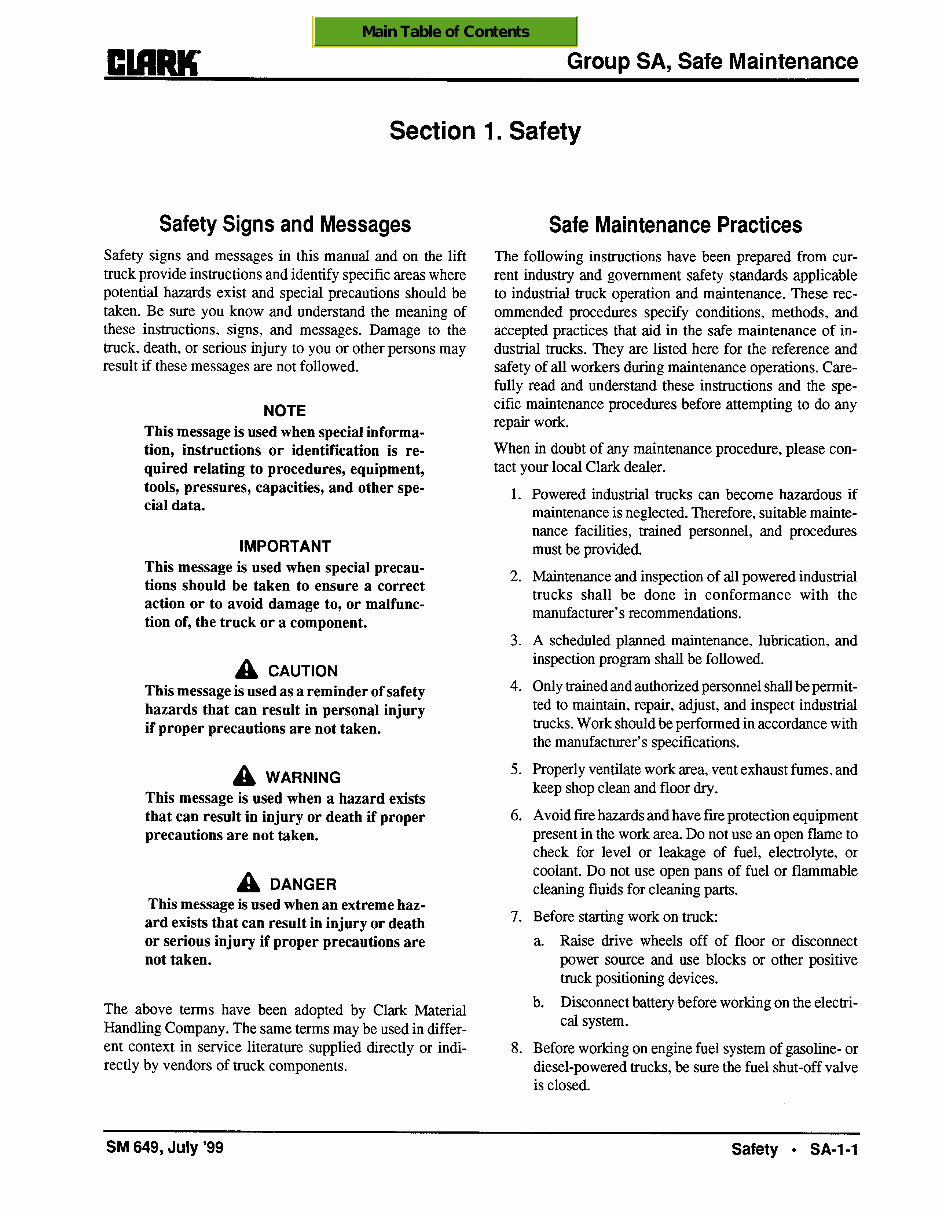
ElmK Group SA, Safe Maintenance Section 1. Safety Safety Signs and Messages Safe Maintenance Practices Safety signs and messages in this manual and on the lift truck provide instructions and identify specific areas where potential hazards exist and special precautions should be taken. Be sure you know and understand the meaning of these instructions, signs, and messages. Damage to the truck. death, or serious injury to you or other persons may result if these messages are not followed. NOTE This message is used when special informa- tion, instructions or identification is re- quired relating to procedures, equipment, tools, pressures, capacities, and other spe- cial data. The following instructions have been prepared from cur- rent industry and government safety standards applicable to industrial truck operation and maintenance. These rec- ommended procedures specify conditions, methods, and accepted practices that aid in the safe maintenance of in- dustrial trucks. They are listed here for the reference and safety of all workers during maintenance operations. Care- fully read and understand these instructions and the spe- cific maintenance procedures before attempting to do any repair work. When in doubt of any maintenance procedure, please con- tact your local Clark dealer. 1. IMPORTANT Powered industrial trucks can become hazardous if maintenance is neglected. Therefore, suitable mainte- nance facilities, trained personnel, and procedures must be provided. This message is used when special precau- tions should be taken to ensure a correct action or to avoid damage to, or malfunc- tion of, the truck or a component. 2. Maintenance and inspection of all powered industrial trucks shall be done in conformance with the manufacturer’s recommendations. 3. A CAUTION This message is used as a reminder of safety hazards that can result in personal injury if proper precautions are not taken. A scheduled planned maintenance, lubrication, and inspection program shall be followed. 4. Only trained and authorized personnel shall be permit- ted to maintain, repair, adjust, and inspect industrial trucks. Work should be performed in accordance with the manufacturer’s specifications. A WARNING This message is used when a hazard exists that can result in injury or death if proper precautions are not taken. 5. Properly ventilate work area, vent exhaust fumes, and keep shop clean and floor dry. 6. A DANGER This message is used when an extreme haz- ard exists that can result in injury or death or serious injury if proper precautions are not taken. Avoid fire hazards and have fire protection equipment present in the work area. Do not use an open flame to check for level or leakage of fuel, electrolyte, or coolant. Do not use open pans of fuel or flammable cleaning fluids for cleaning parts. 7. Before starting work on truck: The above terms have been adopted by Clark Material Handling Company. The same terms may be used in differ- ent context in service literature supplied directly or indi- rectly by vendors of truck components. a. Raise drive wheels off of floor or disconnect power source and use blocks or other positive truck positioning devices. b. Disconnect battery before working on the electri- cal system. 8. Before working on engine fuel system of gasoline- or diesel-powered trucks, be sure the fuel shut-off valve is closed. SM 649, July ‘99 Safety l SA-l-l
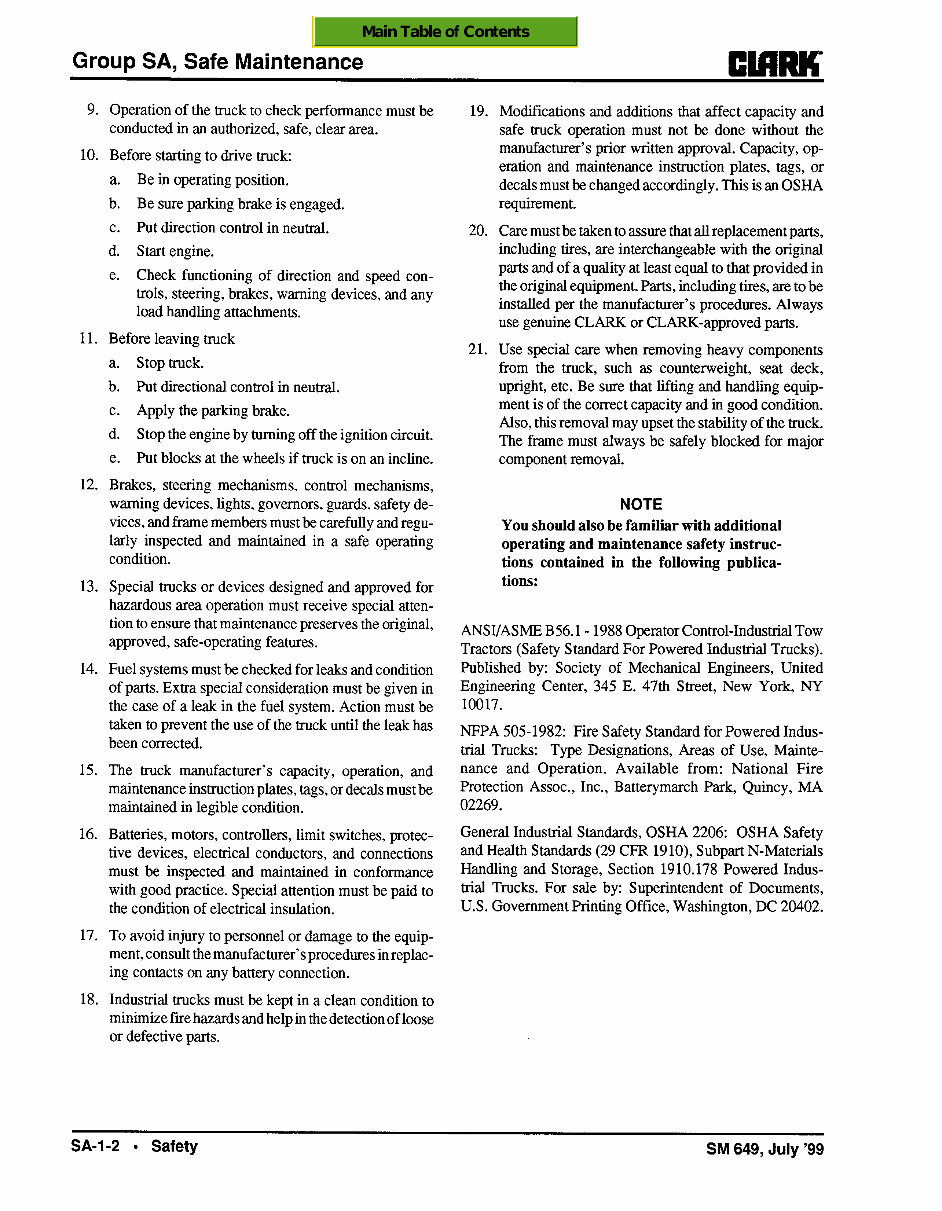
Group SA, Safe Maintenance ClRRK 9. Operation of the truck to check performance must be conducted in an authorized, safe, clear area. 10. Before starting to drive truck: a. Be in operating position. b. Be sure parking brake is engaged. c. Put direction control in neutral. d. Start engine. e. Check functioning of direction and speed con- trols, steering, brakes, warning devices, and any load handling attachments. 11. 12. Before leaving truck a. Stop truck. b. Put directional control in neutral. c. Apply the parking brake. d. Stop the engine by turning off the ignition circuit. e. Put blocks at the wheels if truck is on an incline. Brakes. steering mechanisms, control mechanisms, warning devices, lights, governors, guards, safety de- vices, and frame members must be carefully and regu- larly inspected and maintained in a safe operating condition. 13. Special trucks or devices designed and approved for hazardous area operation must receive special atten- tion to ensure that maintenance preserves the original, approved, safe-operating features. 14. Fuel systems must be checked for leaks and condition of parts. Extra special consideration must be given in the case of a leak in the fuel system. Action must be taken to prevent the use of the truck until the leak has been corrected. 15. The truck manufacturer’s capacity, operation, and maintenance instruction plates, tags, or decals must be maintained in legible condition. 16. Batteries, motors, controllers, limit switches, protec- General Industrial Standards, OSHA 2206: OSHA Safety tive devices, electrical conductors, and connections and Health Standards (29 CFR 1910), Subpart N-Materials must be inspected and maintained in conformance Handling and Storage, Section 1910.178 Powered Indus- with good practice. Special attention must be paid to trial Trucks. For sale by: Superintendent of Documents, the condition of electrical insulation. U.S. Government Printing Office, Washington, DC 20402. 17. 18. To avoid injury to personnel or damage to the equip- ment. consult the manufacturer’s procedures in replac- ing contacts on any battery connection. Industrial trucks must be kept in a clean condition to minimize fue hazards and help in the detection of loose or defective parts. 19. 20. 21. Modifications and additions that affect capacity and safe truck operation must not be done without the manufacturer’s prior written approval. Capacity, op- eration and maintenance instruction plates, tags, or decals must be changed accordingly. This is an OSHA requirement. Care must be taken to assure that all replacement parts, including tires, are interchangeable with the original parts and of a quality at least equal to that provided in the original equipment. Parts, including tires, are to be installed per the manufacturer’s procedures. Always use genuine CLARK or CLARK-approved parts. Use special care when removing heavy components from the truck, such as counterweight, seat deck, upright, etc. Be sure that lifting and handling equip- ment is of the correct capacity and in good condition. Also, this removal may upset the stability of the truck. The frame must always be safely blocked for major component removal. NOTE You should also be familiar with additional operating and maintenance safety instruc- tions contained in the following publica- tions: ANSI/ASME B56.1- 1988 Operator Control-Industrial Tow Tractors (Safety Standard For Powered Industrial Trucks). Published by: Society of Mechanical Engineers, United Engineering Center, 345 E. 47th Street, New York, NY 10017. NFPA 505-1982: Fire Safety Standard for Powered Indus- trial Trucks: Type Designations, Areas of Use, Mainte- nance and Operation. Available from: National Fire Protection Assoc., Inc., Batterymarch Park, Quincy, MA 02269. SA-1-2 l Safety SM 649, July ‘99
CUIRK Group SA, Safe Maintenance Section 2. Lifting, Jacking, and Blocking Safe Parking ................................................................................................................................... 2 Lifting, Jacking, and Blocking Points .......................................................................................... 2 Raising Drive Wheels Off Floor ................................................................................................... 2 Raising Truck with A Hoist .......................................................................................................... 3 Blocking the Upright in Raised Position ...................................................................................... 4 Raising Rear of Truck ................................................................................................................... 4 Raising Entire Truck ................................................................ ...................~................................ 5 Shipping Tie-Down Instructions ................................. ........................................... ................. ...... 6 A WARNING Lifting or jacking any large piece of equipment such as your fork truck presents obvious hazards. It must be done with great care and forethought. Consult the truck weight tabulations in Group 40, “Specifications” to ensure that your lifting equipment is of adequate capacity. SM 649, July ‘99 Lifting, Jacking, and Blocking . SA-2-l
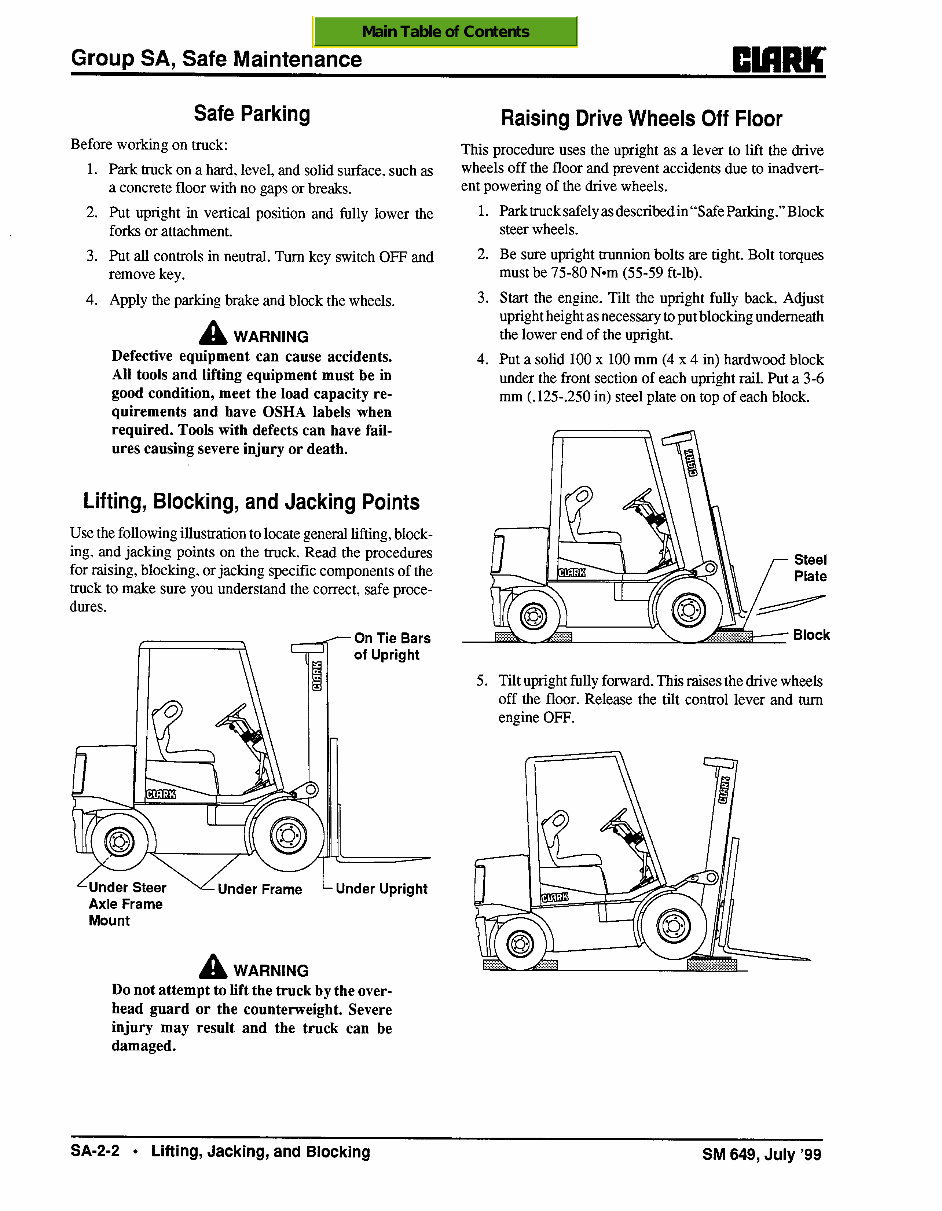
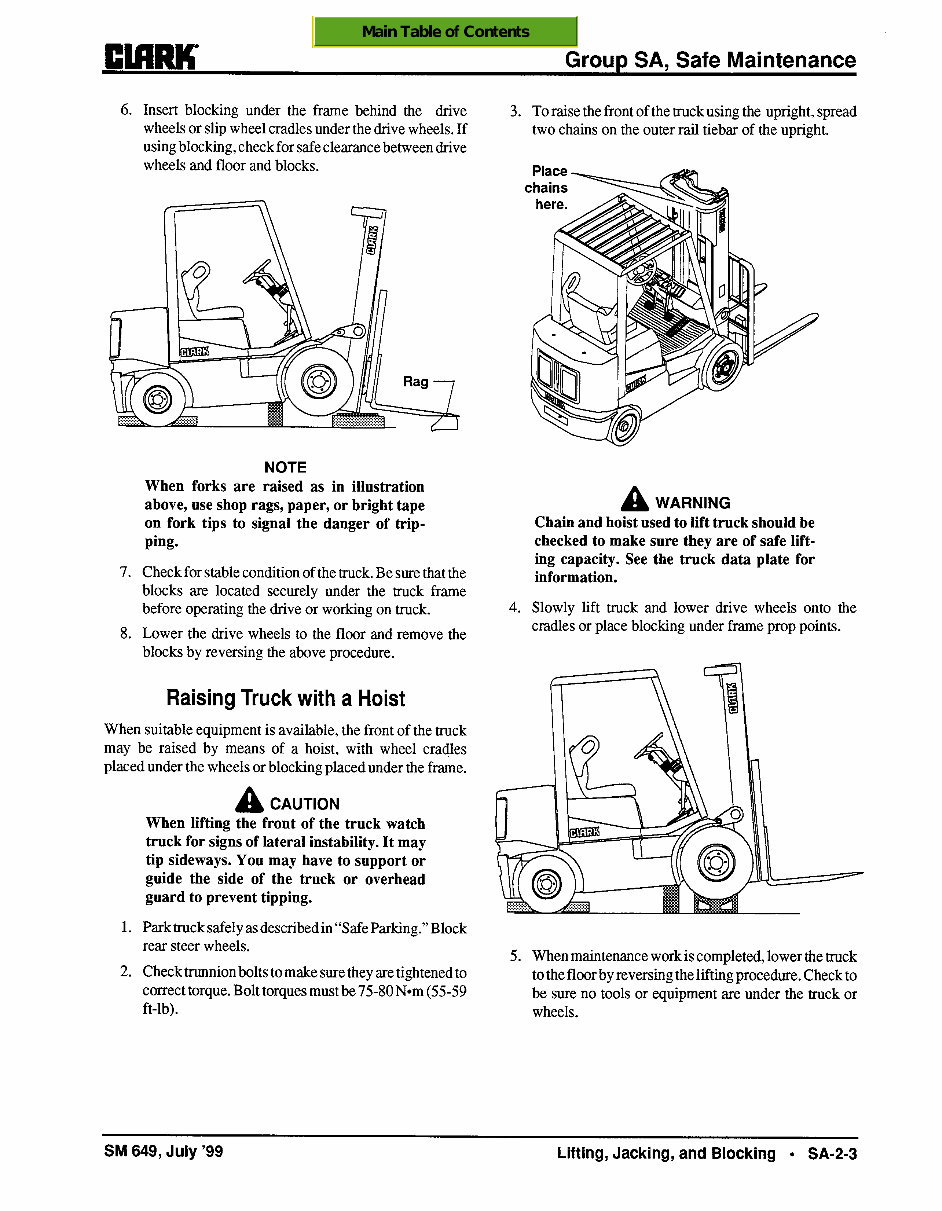
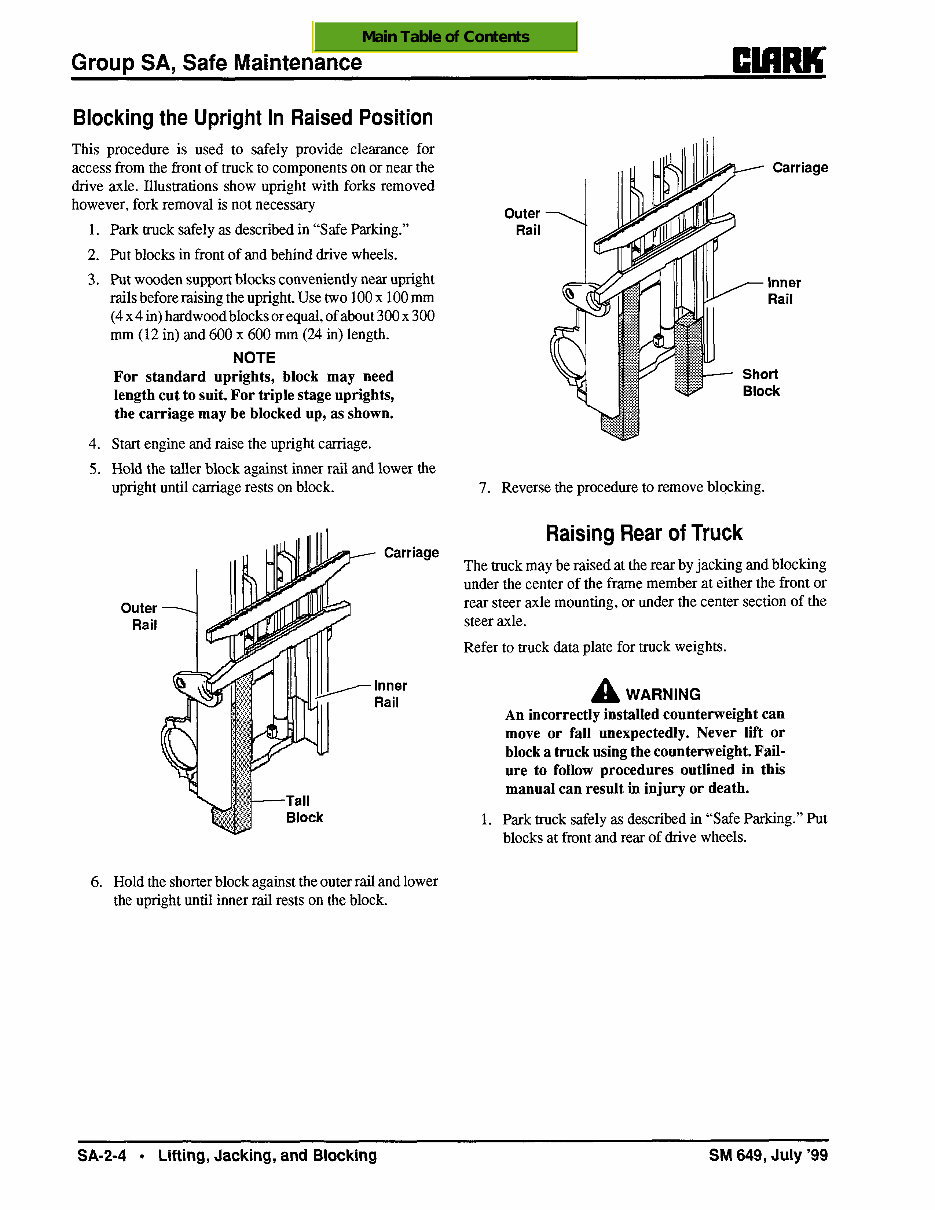
Group SA, Safe Maintenance CWRK Safe Parking Raising Drive Wheels Off Floor Before working on truck: 1. 2. 3. 4. Park truck on a hard, level, and solid surface, such as a concrete floor with no gaps or breaks. Put upright in vertical position and fully lower the forks or attachment. This procedure uses the upright as a lever to lift the drive wheels off the floor and prevent accidents due to inadvert- ent powering of the drive wheels. Park truck safely as described in “Safe Parking.” Block steer wheels. Put all controls in neutral. Turn key switch OFF and remove key. Apply the parking brake and block the wheels. 1. 2. 3. 4. Be sure upright tnmnion bolts are tight. Bolt torques must be 75-80 Nom (55-59 ft-lb). Start the engine. Tilt the upright fully back. Adjust upright height as necessary to put blocking underneath the lower end of the upright. Put a solid 100 x 100 mm (4 x 4 in) hardwood block under the front section of each upright rail. Put a 3-6 mm (.125-.250 in) steel plate on top of each block. A WARNING Defective equipment can cause accidents. All tools and lifting equipment must be in good condition, meet the load capacity re- quirements and have OSHA labels when required. Tools with defects can have fail- ures causing severe injury or death. Lifting, Blocking, and Jacking Points Use the following illustration to locate general lifting, block- ing, and jacking points on the truck. Read the procedures for raising, blocking. or jacking specific components of the truck to make sure you understand the correct, safe proce- dures. LUnder Steer \L Under Frame Axle Frame Mount -On Tie Bars of Upright Under Upright A WARNING Do not attempt to lift the truck by the over- head guard or the counterweight. Severe injury may result and the truck can be damaged. 5. Tilt upright fully forward. This raises the drive wheels off the floor. Release the tilt control lever and turn engine OFF. SA-2-2 l Lifting, Jacking, and Blocking SM 649, July ‘99
CIRRK Group SA, Safe Maintenance 6. Insert blocking under the frame behind the drive wheels or slip wheel cradles under the drive wheels. If using blocking, check for safe clearance between drive wheels and floor and blocks. 7. 8. NOTE When forks are raised as in illustration above, use shop rags, paper, or bright tape on fork tips to signal the danger of trip- ping. Check for stable condition of the truck. Be sure that the blocks are located securely under the truck frame before operating the drive or working on truck. Lower the drive wheels to the floor and remove the blocks by reversing the above procedure. Raising Truck with a Hoist When suitable equipment is available. the front of the truck may be raised by means of a hoist. with wheel cradles placed under the wheels or blocking placed under the frame. 1. 2. A CAUTION When lifting the front of the truck watch truck for signs of lateral instability. It may tip sideways. You may have to support or guide the side of the truck or overhead guard to prevent tipping. Park truck safely as described in “Safe Parking.” Block rear steer wheels. Check trunnion bolts to make sure they are tightened to correct torque. Bolt torques must be 7580N*m (55-59 ft-lb). 3. To raise the front of the truck using the upright, spread two chains on the outer rail tiebar of the upright. 4. A WARNING Chain and hoist used to lift truck should be checked to make sure they are of safe lift- ing capacity. See the truck data plate for information. Slowly lift truck and lower drive wheels onto the cradles or place blocking under frame prop points. 5. When maintenance work is completed, lower the truck to the floor by reversing the lifting procedure. Check to be sure no tools or equipment are under the truck or wheels. SM 649, July ‘99 Lifting, Jacking, and Blocking l SA-2-3
Group SA, Safe Maintenance CWRK Blocking the Upright In Raised Position This procedure is used to safely provide clearance for access from the front of truck to components on or near the drive axle. Illustrations show upright with forks removed however. fork removal is not necessary 1. 2. 3. 4. 5. 6. Park truck safely as described in “Safe Parking.” Put blocks in front of and behind drive wheels. Put wooden support blocks conveniently near upright rails before raising the upright. Use two 100 x 100 mm (4 x4 in) hardwood blocks or equal, of about 300 x 300 mm (12 in) and 600 x 600 mm (24 in) length. NOTE For standard uprights, block may need length cut to suit. For triple stage uprights, the carriage may be blocked up, as shown. Start engine and raise the upright carriage. Hold the taller block against inner rail and lower the upright until carriage rests on block. Outer Rail Hold the shorter block against the outer rail and lower the upright until inner rail rests on the block. Outer Rail Short Block 7. Reverse the procedure to remove blocking. Raising Rear of Truck The truck may be raised at the rear by jacking and blocking under the center of the frame member at either the front or rear steer axle mounting, or under the center section of the steer axle. Refer to truck data plate for truck weights. 1. A WARNING An incorrectly installed counterweight can move or fall unexpectedly. Never lift or block a truck using the counterweight. Fail- ure to follow procedures outlined in this manual can result in injury or death. Park truck safely as described in “Safe Parking.” Put blocks at front and rear of drive wheels. SA-2-4 l Lifting, Jacking, and Blocking SM 649, July ‘99
You're Reading a Preview
What's Included?
Lifetime Access
Fast Download Speeds
Online & Offline Access
Access PDF Contents & Bookmarks
Full Search Facility
Print one or all pages of your manual
$41.99
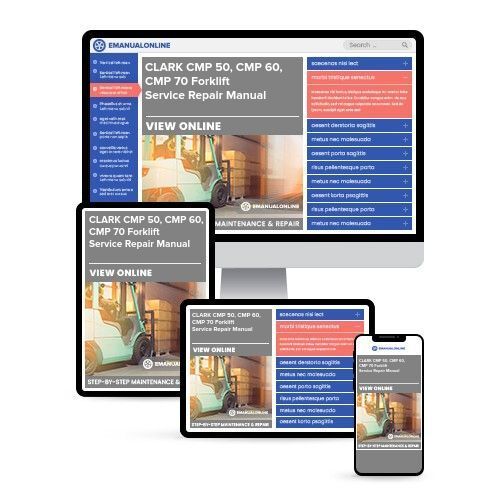
CLARK CMP 50, CMP 60, CMP 70 Forklift Service Repair Manual
This is the complete official service repair manual for the Clark CMP 50, CMP 60, CMP 70 Forklift. It contains deep information about maintaining, assembly, disassembly, and servicing your Clark CMP 50, CMP 60, CMP 70 Forklift.
This manual offers full information you need for repairing your machine. It contains specs, diagrams, actual real photo illustrations, and schemes, which provide complete step-by-step operations on repair, servicing, technical maintenance, and troubleshooting procedures for your machine. All pages are printable, so you can run off what you need and take it with you into the garage or workshop.
Models Covered:
Clark CMP 50 Forklift
Clark CMP 60 Forklift
Clark CMP 70 Forklift
Table of Contents:
SA SAFE MAINTENANCE
Safety
Lifting, Jacking, and Blocking
Towing
PS PERIODIC SERVICE
Maintenance Schedules
Planned Maintenance
PM Inspection Form
00 PERKINS DIESEL ENGINE
01 COOLING SYSTEM
Specifications and Description
Troubleshooting
06 TRANSMISSION
14 ELECTRICAL
Circuit Diagram
Instrument Pod
16 WHEELS AND TIRES
Specifications and Description
Cushion Wheels and Tires
Pneumatic Wheels and Tires
23 BRAKE SYSTEM
Specifications
Service/Inching Brake
Parking Brake
20 DRIVE AXLE
Specifications and Description
Drive Axle Overhaul
25/26 STEER SYSTEM
Specifications and Description
Troubleshooting
Steering System Removals & Installations
Steering System Pressure Check
Steering Unit Overhaul
Priority Valve Overhaul
Steer Cylinder Overhaul
29/30 HYDRAULIC SYSTEM
Specifications and Description
Troubleshooting
Hydraulic Pump Overhaul
Control Valve Overhaul
34 UPRIGHTS
Specifications and Description
Upright Checks and Adjustments
Lift Chain Service
Removals and Replacements
Lift and Tilt Cylinder Overhaul
38 COUNTERWEIGHT
Specifications
Inspection
Removal and Replacement
40 SPECIFICATIONS
Specifications
Model Specification: Clark CMP 50, CMP 60, CMP 70 Forklift
Language: English
Total Pages: 411
File Format: .PDF
Requirements: Adobe Reader
Zoom In/Out: Yes
Instant Delivery: Yes
Specifications: Fully Printable & Bookmarked
Compatible: All Versions of Windows & Mac, APP ISO, iPhone, iPod, Android, etc.
This quality manual is 100% complete and intact, with no missing/corrupt pages/sections.
This file is bookmarked and searchable to make what you need easy to find.
Detailed illustrations, exploded diagrams, drawings, and photos guide you through every service repair procedure.
This manual can be viewed on any computer, as well as zoomed and printed. It comes in .PDF format, which can work under all PC-based Windows operating systems and Mac as well. It can be saved to your hard drive and burned to CD-ROM.
Instant delivery means there will be no shipping costs or waiting for a paper or CD manual to arrive in the mail. You will receive this manual today via instant delivery on completion of payment via our secure payment processor.
We accept all major credit/debit cards and PayPal. You can do the repairs yourself and save money.
Reviews
Q&A
Recently Viewed
5,521,897Happy Clients
2,594,462eManuals
1,120,453Trusted Sellers
15Years in Business
Price:
Actual Price:
CLARK CMP 50, CMP 60, CMP 70 Forklift Service Repair Manual



 Lifetime Access




