

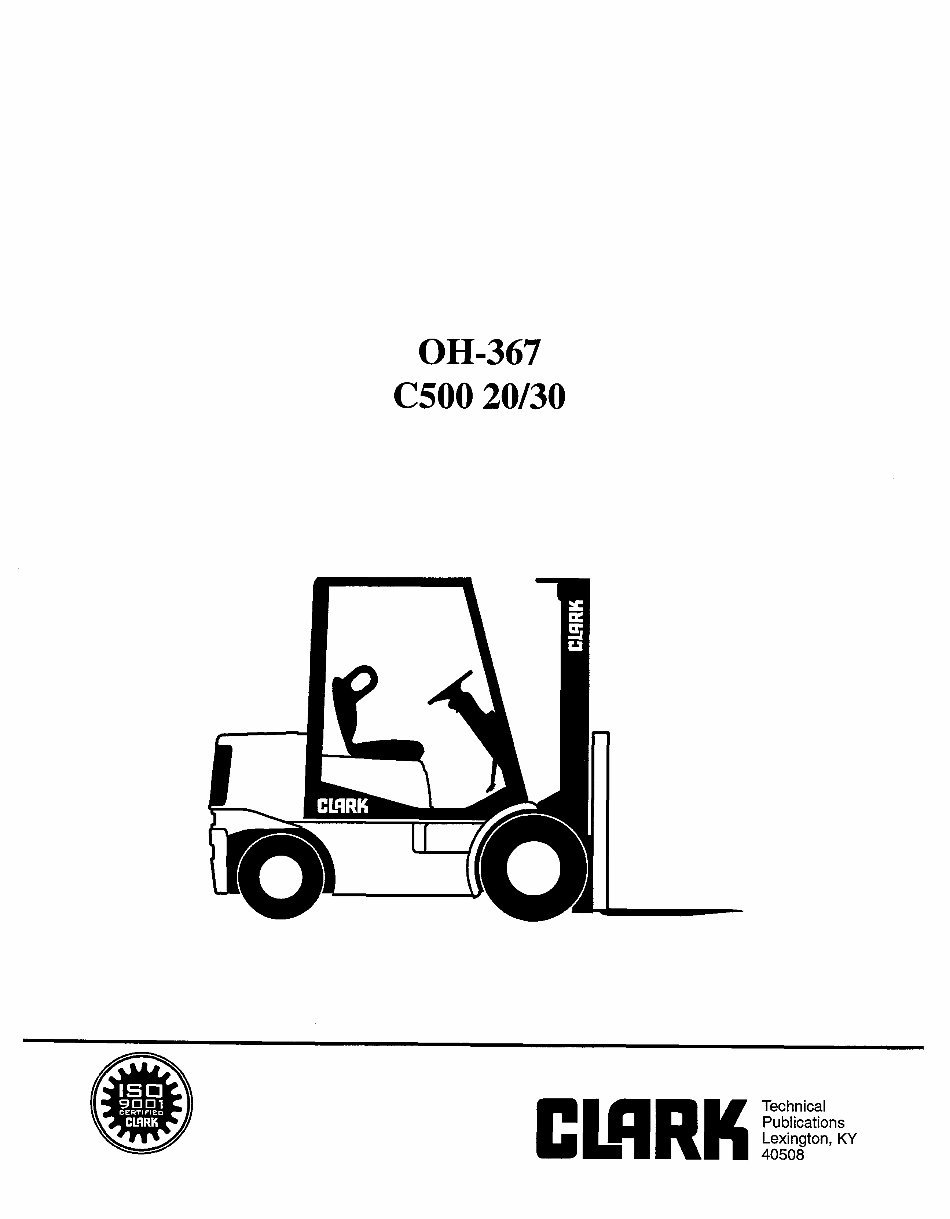
OH-367
C50020/30
Copyrighted Material
Intended for CLARK dealers only
Do not sell or distribute
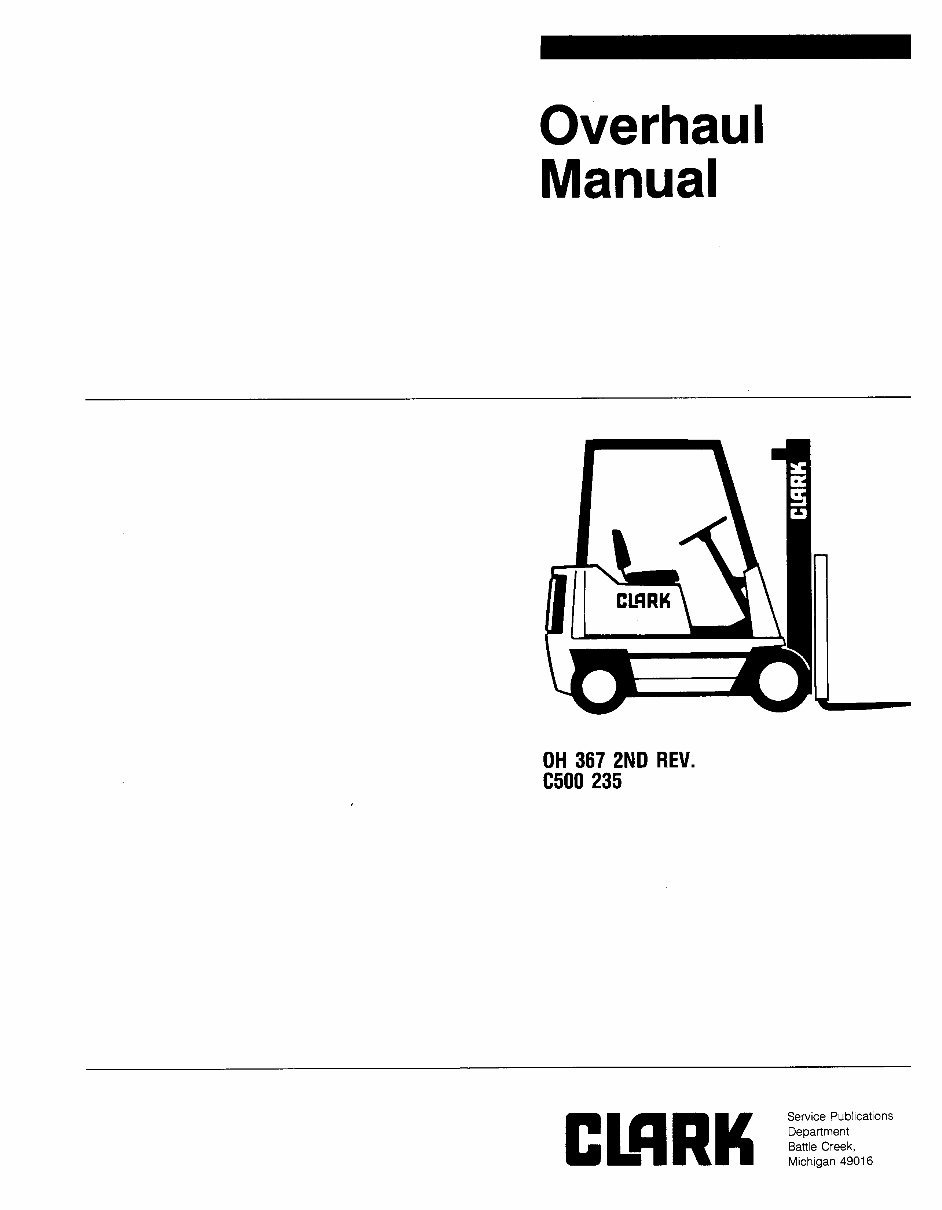
Overhaul
Manual
Copyrighted Material
Intended for CLARK dealers only
Do not sell or distribute
INDUSTRIAL TRUCK DIVISION
MARKETING TRAINING DEPT.
CL!mK
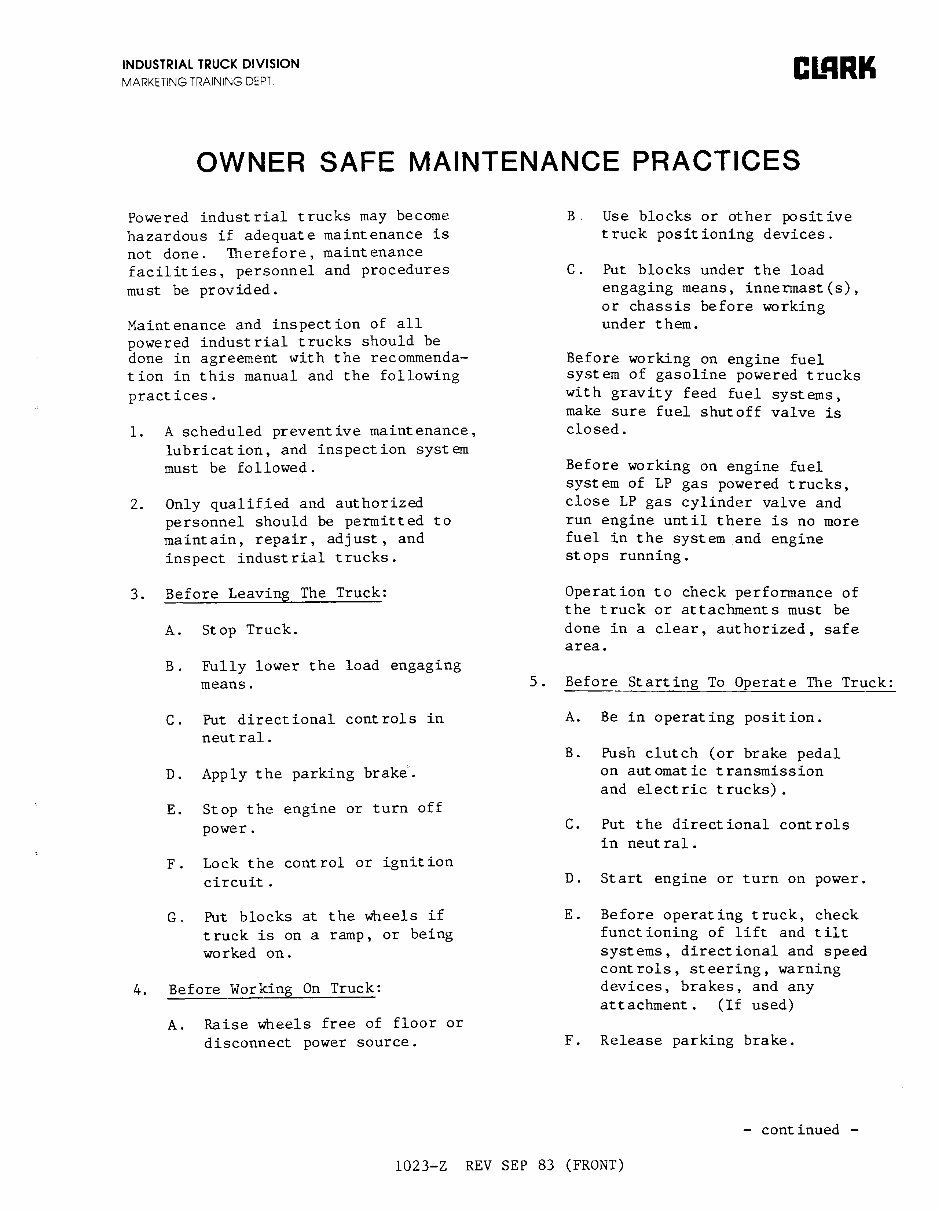
OWNER SAFE MAINTENANCE PRACTICES
Powered industrial trucks may become
hazardous if adequate maintenance is
not done. Therefore, maintenance
facilities, personnel and procedures
must be provided.
Maintenance and inspection of all
powered industrial trucks should be
done in agreement with the recommenda-
tion in this manual and the following
practices.
1.
2.
3.
A scheduled preventive maintenance,
lubrication, and inspection system
must be followed.
Only qualified and authorized
personnel should be permitted to
maintain, repair, adjust, and
inspect industrial trucks.
Before Leaving The Truck:
A. Stop Truck.
B. Fully lower the load engaging
means.
C. Put directional controls in
neutral.
D. Apply the parking brake.
E. Stop the engine or turn off
power.
F. Lock the control or ignition
circuit.
G. Put blocks at the wheels if
truck is on a ramp, or being
worked on.
4. Before Working On Truck:
A. Raise wheels free of floor or
disconnect power source.
B. Use blocks or other positive
truck positioning devices.
C. Put blocks under the load
engaging means, innermast(
or chassis before working
under them.
Before working on engine fuel
system of gasoline powered trucks
with gravity feed fuel systems,
make sure fuel shutoff valve is
closed.
Before working on engine fuel
system of LP gas powered trucks,
close LP gas cylinder valve and
run engine until there is no more
fuel in the system and engine
stops running.
Operation to check performance of
the truck or attachments must be
done in a clear, authorized, safe
area.
5. Before Starting To Operate The Truck:
A. Be in operating position.
B. Push clutch (or brake pedal
on automatic transmission
and electric trucks).
C. Put the directional controls
in neutral.
D. Start engine or turn on power.
E. Before operating truck, check
functioning of lift and tilt
systems, directional and speed
controls, steering, warning
devices, brakes, and any
attachment. (If used)
F. Release parking brake.
- continued -
1023-Z REV SEP 83 (FRONT)
Copyrighted Material
Intended for CLARK dealers only
Do not sell or distribute
INDUSTRIAL TRUCK DIVISION
MARKETING TRAINING DEPT.
Cl!!Rl4
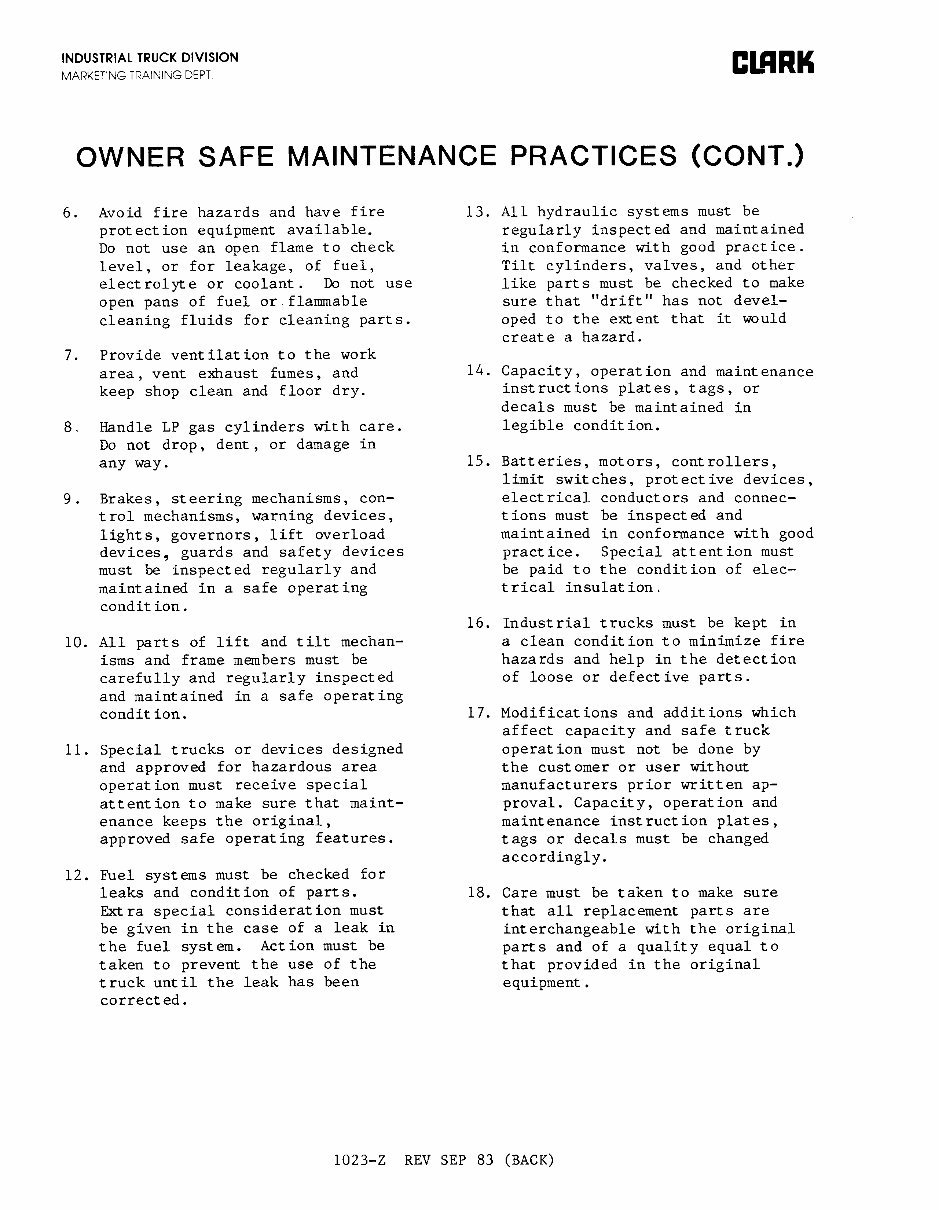
OWNER SAFE MAINTENANCE PRACTICES (CONT.)
6.
7.
8.
9.
10.
11.
12.
Avoid fire hazards and have fire
protection equipment available.
Do not use an open flame to check
level, or for leakage, of fuel,
electrolyte or coolant. Do not use
open pans of fuel or flammable
cleaning fluids for cleaning parts.
Provide ventilation to the work
area, vent exhaust fumes, and
keep shop clean and floor dry.
Handle LP gas cylinders with care.
Do not drop, dent, or damage in
any way.
Brakes, steering mechanisms, con-
trol mechanisms, warning devices,
lights, governors, lift overload
devices , guards and safety devices
must be inspected regularly and
maintained in a safe operating
condition.
All parts of lift and tilt mechan-
isms and frame members must be
carefully and regularly inspected
and maintained in a safe operating
condition.
Special trucks or devices designed
and approved for hazardous area
operation must receive special
attention to make sure that maint-
enance keeps the original,
approved safe operating features.
Fuel systems must be checked for
leaks and condition of parts.
Extra special consideration must
be given in the case of a leak in
the fuel system. Action must be
taken to prevent the use of the
truck until the leak has been
corrected.
13.
14.
15.
16.
17.
18.
All hydraulic systems must be
regularly inspected and maintained
in conformance with good practice.
Tilt cylinders, valves, and other
like parts must be checked to make
sure that "drift" has not devel-
oped to the extent that it would
create a hazard.
Capacity, operation and maintenance
instructions plates, tags, or
decals must be maintained in
legible condition.
Batteries, motors, controllers,
limit switches, protective devices,
electrical conductors and connec-
tions must be inspected and
maintained in conformance with good
practice. Special attention must
be paid to the condition of elec-
trical insulation.
Industrial trucks must be kept in
a clean condition to minimize fire
hazards and help in the detection
of loose or defective parts.
Modifications and additions which
affect capacity and safe truck
operation must not be done by
the customer or user without
manufacturers prior written ap-
proval. Capacity, operation and
maintenance instruction plates,
tags or decals must be changed
accordingly.
Care must be taken to make sure
that all replacement parts are
interchangeable with the original
parts and of a quality equal to
that provided in the original
equipment.
1023-z REV SEP 83 (BACK) Copyrighted Material
Intended for CLARK dealers only
Do not sell or distribute
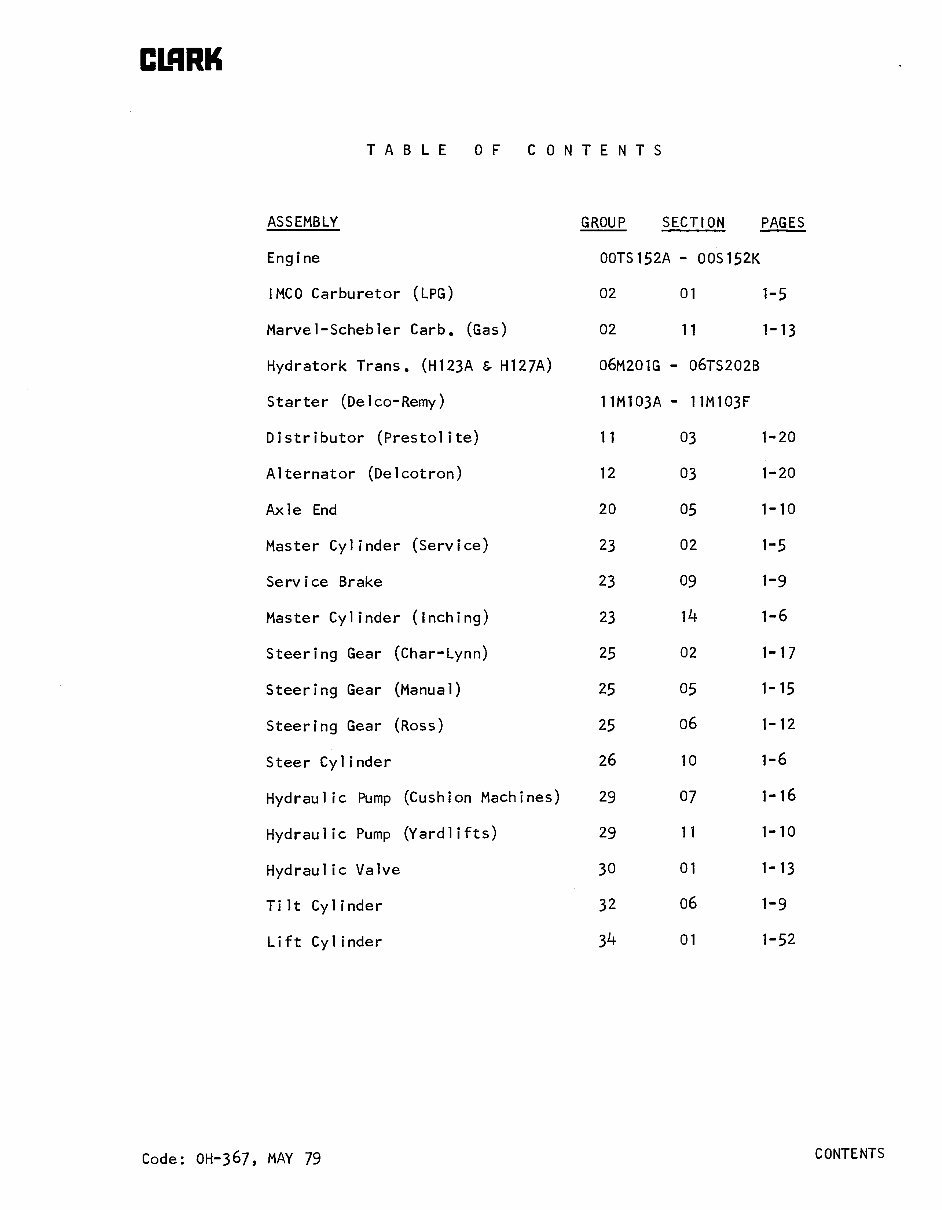
TABLE OF CONTENTS
ASSEMBLY
Engine
IMCO Carburetor (LPG)
Marvel-Schebler Carb. (Gas)
Hydratork Trans. (H123A E H127A)
Starter (Delco-Remy)
Distributor (Prestolite)
Alternator (Delcotron)
GROUP SECTION PAGES
OOTS152A - OOS152K
02 01
l-5
02 11 1-13
06M20lG - 06TS202B
llM103A - llM103F
11
03
12
03
20
05
23
02
23 09
23 14
Axle End
Master Cylinder
Service Brake
Master Cylinder
(s
erv
ce>
(inch
ing)
Steeri ng Gear (Char-Lynn) 25 02
Steeri ng Gear (Manual) 25 05
Steeri ng Gear (Ross) 25 06
Steer Cylinder 26 10
Hydraulic Pump (Cushion Machines) 29 07
Hydraulic Pump (Yardlifts) 29 11
Hydraulic Valve 30 01
Tilt Cylinder 32
06
Lift Cylinder 34
01
l-20
l-20
l-10
l-5
l-9
1-6
1-17
l-15
1-12
1-6
1-16
l-10
1-13
l-9
l-52
Code: OH-367, MAY 79
CONTENTS
Copyrighted Material
Intended for CLARK dealers only
Do not sell or distribute
CMRK
GR&UP
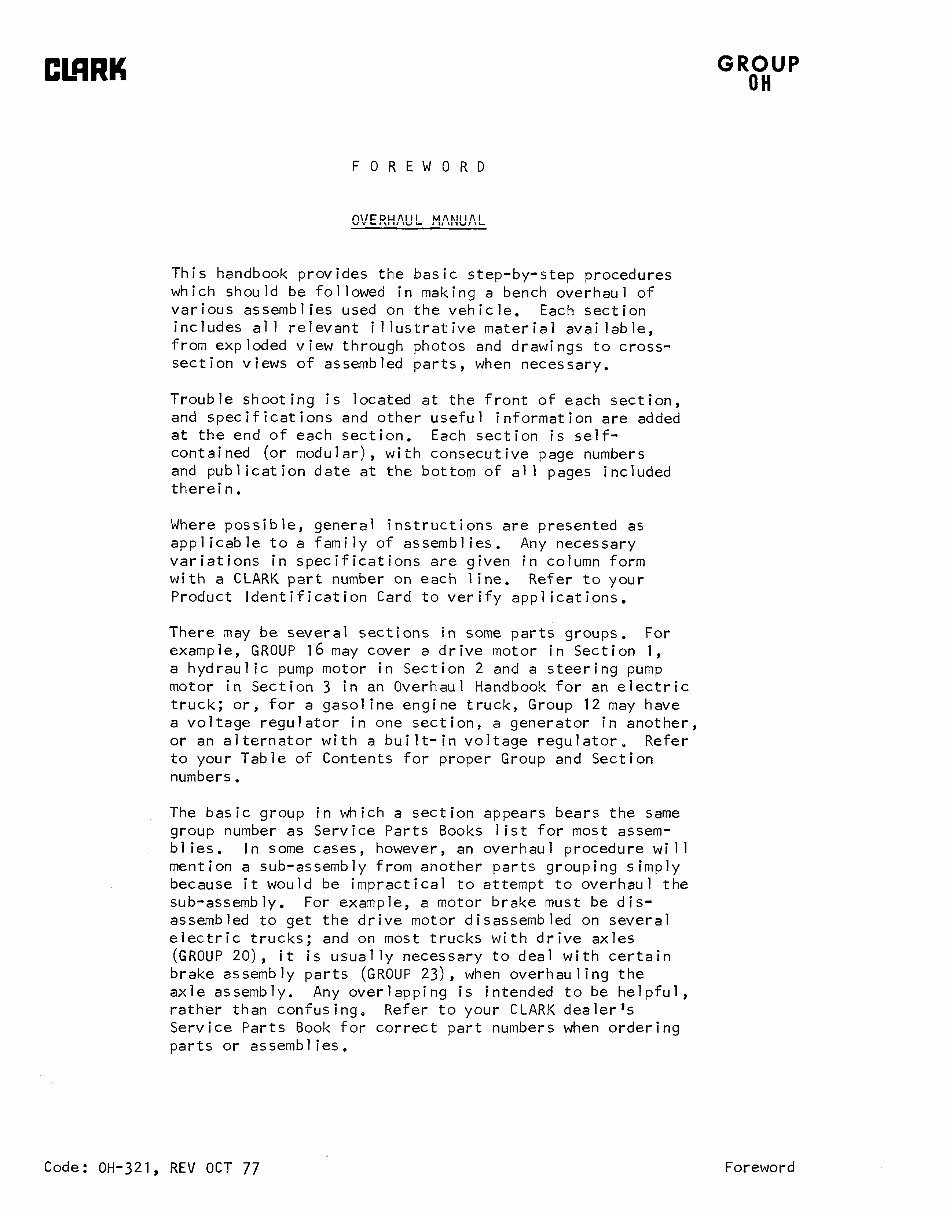
FOREWORD
OVERHAUL MANUAL
This handbook provides the basic step-by-step procedures
which should be followed in making a bench overhaul of
various assemblies used on the vehicle. Each sect ion
includes al 1 relevant i 1 lustrat ive material avai lable,
from exploded view through photos and drawings to cross-
section views of assembled parts, when necessary.
Trouble shooting is located at the front of each section,
and specifications and other useful information are added
at the end of each sect ion. Each section is self-
contained (or modular), with consecutive page numbers
and pub1 ication date at the bottom of al 1 pages included
therein.
Where possible, general instructions are presented as
appl icable to a family of assembl ies. Any necessary
variations in specifications are given in column form
with a CLARK part number on each line. Refer to your
Product Identification Card to verify applications.
There may be several sections in some parts groups. For
example, GROUP 16 may cover a drive motor in Section 1,
a hydraulic pump motor in Section 2 and a steering pump
motor in Section 3 in an Overhaul Handbook for an electric
truck; or, for a gasoline engine truck, Group 12 may have
a voltage regulator in one section, a generator in another,
or an alternator with a built-in voltage regulator, Refer
to your Table of Contents for proper Group and Section
numbers.
The basic group in which a section appears bears the same
group number as Service Parts Books list for most assem-
bl ies. In some cases, however, an overhau 1 procedure wi 11
mention a sub-assembly from another parts grouping simply
because it would be impractical to attempt to overhau 1 the
sub-assemb ly . For example, a motor brake must be d is-
assembled to get the drive motor disassembled on several
electric trucks; and on most trucks with drive axles
(GROUP 20)) it is usually necessary to deal with certain
brake assembly parts (GROUP 23)) when overhau 1 ing the
axle assembly. Any overlapping is intended to be helpful,
rather than confusing. Refer to your CLARK dealer’s
Service Parts Book for correct part numbers when ordering
parts or assemblies.
Code: OH-321, REV OCT 77 Foreword Copyrighted Material
Intended for CLARK dealers only
Do not sell or distribute
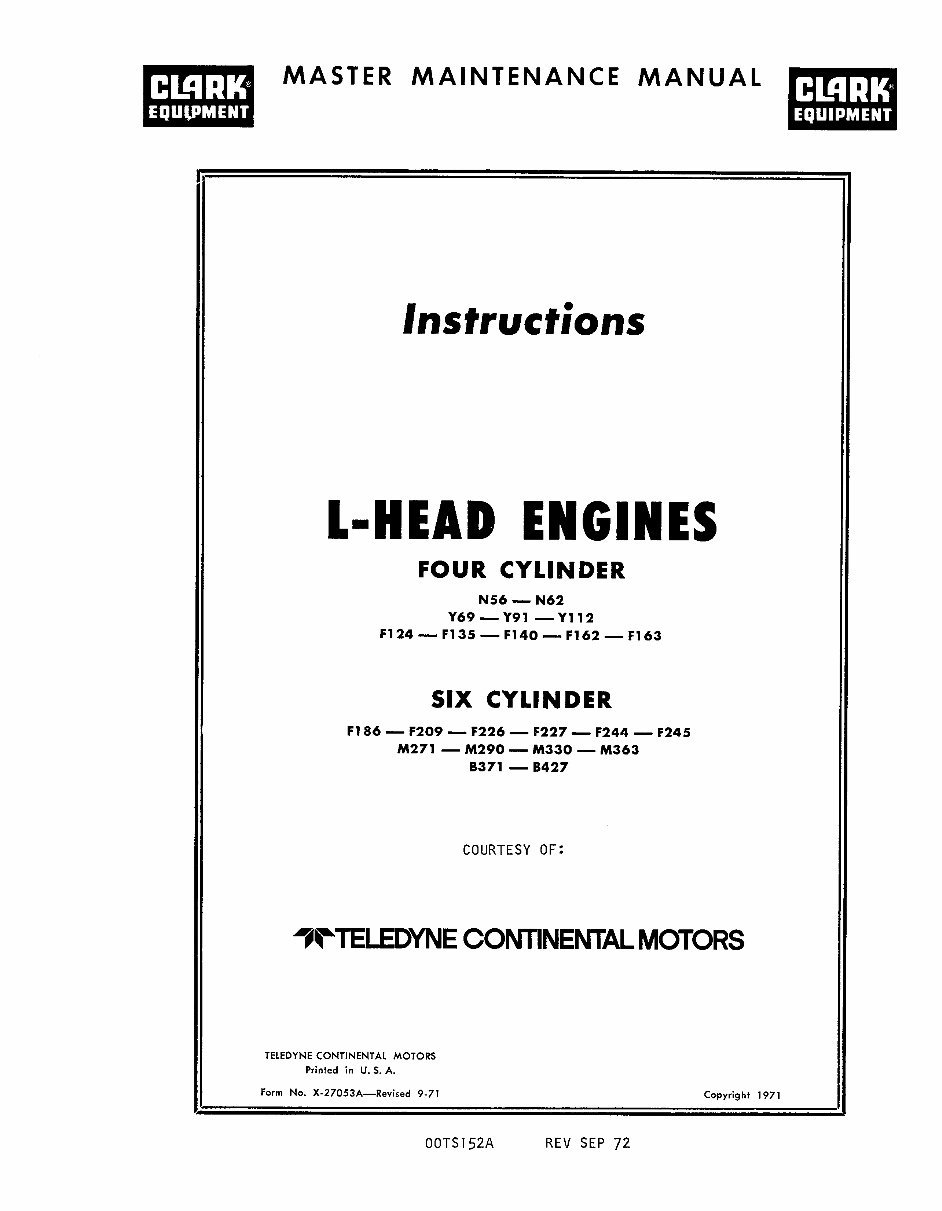
MASTER MAINTENANCE MANUAL
Instructions
MEAD ENGINES
FOUR CYLINDER
N56 - N62
Y69 -Y91 -Y112
F124 - F135 -Fl40-Fl62--163
SIX CYLINDER
F186 - F209 - F226 - F227 - F244 - F245
M271 - M290 - M330 - M363
B371 - B427
COURTESY OF:
7WELEDYNE CONTINENTAL MOTORS
TELEDYNE CONTINENTAL MOTORS
Printed in U.S. A.
Form No. X-27053A-Revised 9-71 Copyright 1971
oo~si52~ REV SEP 72
Copyrighted Material
Intended for CLARK dealers only
Do not sell or distribute
MASTER MAINTENANCE MANUAL
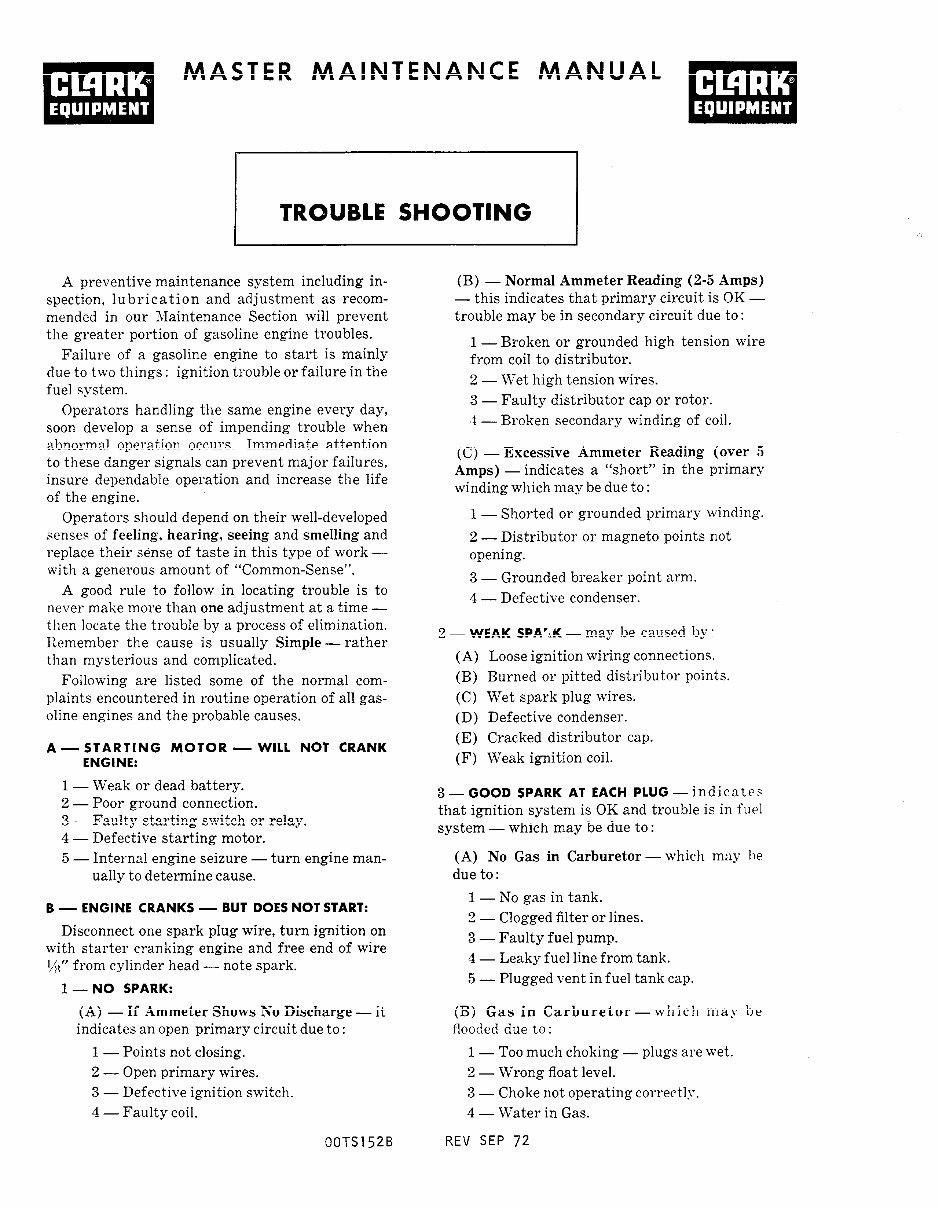
TROUBLE SHOOTING
A preventive maintenance system including in-
spection, lubrication and adjustment as recom-
mended in our Maintenance Section will prevent
the greater portion of gasoline engine troubles.
Failure of a gasoline engine to start is mainly
due to two things : ignition trouble or failure in the
fuel system.
Operators handling the same engine every day,
soon develop a sense of impending trouble when
abnormal operation occurs. Immediate attention
to these danger signals can prevent major failures,
insure dependable operation and increase the life
of the engine.
Operators should depend on their well-developed
senses of feeling, hearing, seeing and smelling and
replace their sense of taste in this type of work -
with a generous amount of “Common-Sense”.
A good rule to follow in locating trouble is to
never make more than one adjustment at a time -
then locate the trouble by a process of elimination.
Remember the cause is usually Simple-rather
than mysterious and complicated.
Following are listed some of the normal com-
plaints encountered in routine operation of all gas-
oline engines and the probable causes.
A- STARTING MOTOR - WILL NOT CRANK
ENGINE:
1 - Weak or dead battery.
2 - Poor ground connection.
3 - Faulty starting switch or relay.
4 - Defective starting motor.
5 - Interna! engine seizure - turn engine man-
ually to determine cause.
B- ENGINE CRANKS - BUT DOES NOT START:
Disconnect one spark plug wire, turn ignition on
with starter cranking engine and free end of wire
i/j{” from cylinder head - note spark.
1 - NO SPARK:
(A) - If Ammeter Shows No Discharge - it
indicates an open primary circuit due to :
1 - Points not closing.
2 - Open primary wires.
3 - Defective ignition switch.
4 - Faulty coil.
OOTSl52B
(B) - Normal Ammeter Reading (2-5 Amps)
-
this indicates that primary circuit is OK -
trouble may be in secondary circuit due to :
1 - Broken or grounded high tension wire
from coil to distributor.
2 - Wet high tension wires.
3 - Faulty distributor cap or rotor.
.4 - Broken secondary winding of coil.
(C) - Excessive Ammeter Reading (over 5
Amps) -indicates a “short” in the primary
winding which may be due to :
1 - Shorted or grounded primary winding.
2 - Distributor or magneto points not
opening.
3 - Grounded breaker point arm.
4 - Defective condenser.
2 - WEAK SPA’,.K - may be caused by:
(A)
Loose ignition wiring connections.
03)
Burned or pitted distributor points.
(C)
Wet spark plug wires.
(D)
Defective condenser.
(El
Cracked distributor cap.
(F)
Weak ignition coil.
3 -GOOD SPARK AT EACH PLUG-indicates
that ignition system is OK and trouble is in fuel
system - which may be due to :
(A) No Gas in Carburetor - which may he
due to :
1 - No gas in tank.
2 - Clogged filter or lines.
3 - Faulty fuel pump.
4 - Leaky fuel line from tank.
5 - Plugged vent in fuel tank cap.
(B) Gas in Carburetor-which may be
flooded due to:
1 - Too much choking - plugs are wet.
2 - Wrong float level.
3 - Choke not operating correctly.
4 - Water in Gas.
REV SEP 72
Copyrighted Material
Intended for CLARK dealers only
Do not sell or distribute
MASTER MAINTENANCE MANUAL
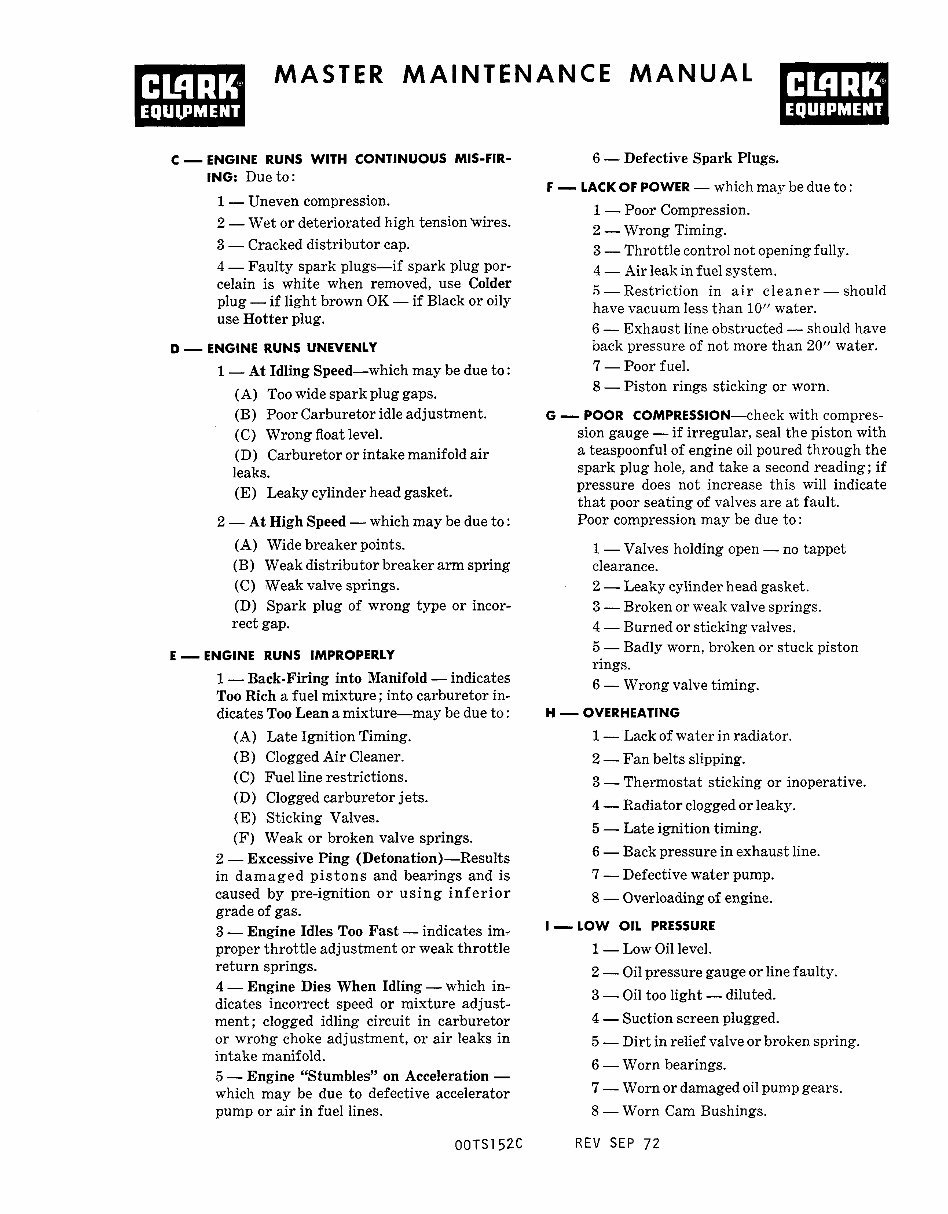
c- ENGINE RUNS WITH CONTINUOUS MIS-FIR-
ING: Due to:
1 - Uneven compression.
2 - Wet or deteriorated high tension wires.
3 - Cracked distributor cap.
4 - Faulty spark plugs-if spark plug por-
celain is white when removed, use Colder
plug -
if light brown OK - if Black or oily
use Hotter plug.
D- ENGINE RUNS UNEVENLY
1 - At Idling Speed-which may be due to :
(A) Too wide spark plug gaps.
(B) Poor Carburetor idle adjustment.
(C) Wrong float level.
(D) Carburetor or intake manifold air
leaks.
(E) Leaky cylinder head gasket.
2 - At High Speed - which may be due to :
(A) Wide breaker points.
(B) Weak distributor breaker arm spring
(C) Weak valve springs.
(D) Spark plug of wrong type or incor-
rect gap.
E- ENGINE RUNS IMPROPERLY
I- Back-Firing into Manifold - indicates
Too Rich a fuel mixture ; into carburetor in-
dicates Too Lean a mixture-may be due to :
(A)
Late Ignition Timing.
03)
Clogged Air Cleaner.
(0
Fuel line restrictions.
0)
Clogged carburetor jets.
(El
Sticking Valves.
(F)
Weak or broken valve springs.
2 - Excessive Ping (Detonation)-Results
in damaged pistons and bearings and is
caused by pre-ignition or using inferior
grade of gas.
3 - Engine Idles Too Fast - indicates im-
proper throttle adjustment or weak throttle
return springs.
4 - Engine Dies When Idling-which in-
dicates incorrect speed or mixture adjust-
ment; clogged idling circuit in carburetor
or wrong choke adjustment, or air leaks in
intake manif old.
5 - Engine “Stumbles” on Acceleration -
which may be due to defective accelerator
pump or air in fuel lines.
OOTSl526
6 - Defective Spark Plugs.
F - LACK OF POWER - which may be due to :
1 - Poor Compression.
2 - Wrong Timing.
3 - Throttle control not opening fully.
4 - Air leak in fuel system.
5 -Restriction in air cleaner-should
have vacuum less than 10” water.
6 - Exhaust line obstructed - should have
back pressure of not more than 20” water.
7 - Poor fuel.
8 - Piston rings sticking or worn.
G - POOR COMPRESSION--check with compres-
sion gauge - if irregular, seal the piston with
a teaspoonful of engine oil poured through the
spark plug hole, and take a second reading ; if
pressure does not increase this will indicate
that poor seating of valves are at fault.
Poor compression may be due to:
1 - Valves holding open - no tappet
clearance.
2 - Leaky cylinder head gasket.
3 - Broken or weak valve springs.
4 - Burned or sticking valves.
5 - Badly worn, broken or stuck piston
rings.
6 - Wrong valve timing.
H- OVERHEATING
1 - Lack of water in radiator.
2 - Fan belts slipping.
3 - Thermostat sticking or inoperative.
4 - Radiator clogged or leaky.
5 - Late ignition timing.
6 - Back pressure in exhaust line.
7 - Defective water pump.
8 - Overloading of engine.
I- LOW OIL PRESSURE
1 - Low Oil level.
2 - Oil pressure gauge or line faulty.
3 - Oil too light - diluted.
4 - Suction screen plugged.
5 - Dirt in relief valve or broken spring.
6 -Worn bearings.
7 - Worn or damaged oil pump gears.
8 -Worn Cam Bushings.
REV SEP 72
Copyrighted Material
Intended for CLARK dealers only
Do not sell or distribute
MASTER MAINTENANCE MANUAL
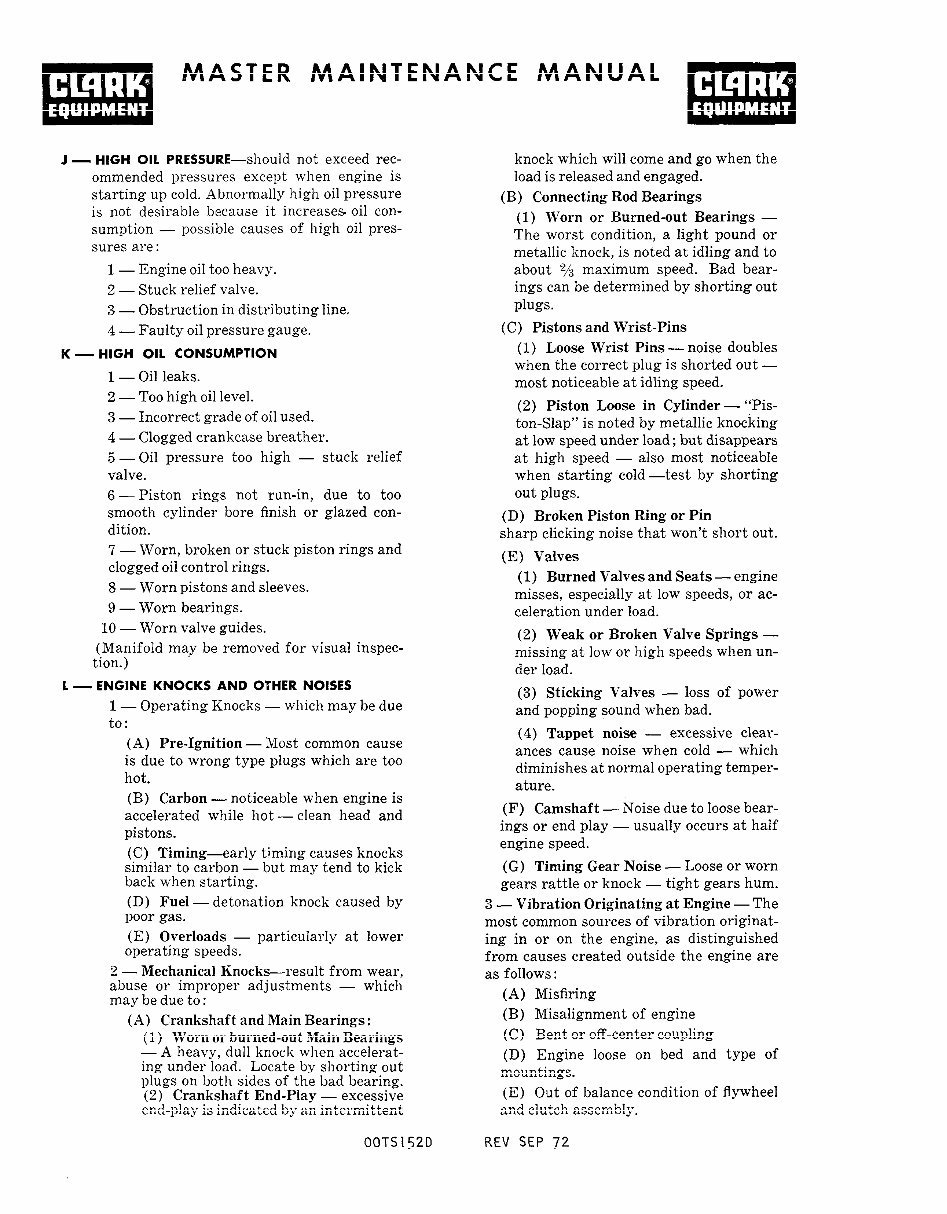
J- HIGH OIL PRESSURE-should not exceed rec-
ommended pressures except when engine is
starting up cold. Abnormally high oil pressure
is not desirable because it increases. oil con-
sumption - possible causes of high oil pres-
sures are :
1 - Engine oil too heavy.
2 - Stuck relief valve.
3 - Obstruction in distributing line.
4 - Faulty oil pressure gauge.
K- HIGH OIL CONSUMPTION
1 - Oil leaks.
2 - Too high oil level.
3 - Incorrect grade of oil used.
4 - Clogged crankcase breather.
5 -Oil pressure too high - stuck relief
valve.
6 -Piston rings not run-in, due to too
smooth cylinder bore finish or glazed con-
dition.
7 -Worn, broken or stuck piston rings and
clogged oil control rings.
8 - Worn pistons and sleeves.
9 -Worn bearings.
10 - Worn valve guides.
(Manifold ma,y be removed for visual inspec-
tion.)
L- ENGINE KNOCKS AND OTHER NOISES
1 - Operating Knocks - which may be due
to:
(A) Pre-Ignition - Most common cause
is due to wrong type plugs which are too
hot.
(B) Carbon - noticeable when engine is
accelerated while hot-clean head and
pistons.
(C) Timing-early timing causes knocks
similar to carbon -but may tend to kick
back when starting.
(D) Fuel-detonation knock caused by
poor gas.
(E) Overloads - particularly at lower
operating speeds.
2 - Mechanical Knocks--result from wear,
abuse or improper adjustments - which
may be due to :
(A) Crankshaft and Main Bearings :
(1) Worn or burned-out Main Bearings
- A heavy, dull knock when accelerat-
ing under load. Locate by shorting out
plugs on both sides of the bad bearing.
(2) Crankshaft End-Play - excessive
end-play is indicated by an intermittent
00~~152~
knock which will come and go when the
load is released and engaged.
(B) Connecting Rod Bearings
(1) Worn or Burned-out Bearings -
The worst condition, a light pound or
metallic knock, is noted at idling and to
about ~~~ maximum speed. Bad bear-
ings can be determined by shorting out
plugs.
(C) Pistons and Wrist-Pins
(1) Loose Wrist Pins - noise doubles
when the correct plug is shorted out -
most noticeable at idling speed.
(2) Piston Loose in Cylinder - “Pis-
ton-slap” is noted by metallic knocking
at low speed under load ; but disappears
at high speed - also most noticeable
when starting cold -test by shorting
out plugs.
(D) Broken Piston Ring or Pin
sharp clicking noise that won’t short out.
(E) Valves
(1) Burned Valves and Seats - engine
misses, especially at low speeds, or ac-
celeration under load.
(2) Weak or Broken Valve Springs -
missing at low or high speeds when un-
der load.
(3) Sticking Valves - loss of power
and popping sound when bad.
(4) Tappet noise - excessive clear-
ances cause noise when cold - which
diminishes at normal operating temper-
ature.
(F) Camshaft - Noise due to loose bear-
ings or end play - usually occurs at half
engine speed.
(G) Timing Gear Noise - Loose or worn
gears rattle or knock - tight gears hum.
3 - Vibration Originating at Engine -The
most common sources of vibration originat-
ing in or on the engine, as distinguished
from causes created outside the engine are
as follows :
(A) Misfiring
(B) Misalignment of engine
(C) Bent or off-center coupling
(D) Engine loose on bed and type of
mountings.
(E) Out of balance condition of flywheel
and clutch assembly.
REV SEP 72
Copyrighted Material
Intended for CLARK dealers only
Do not sell or distribute
You're Reading a Preview
What's Included?
 Lifetime Access
Fast Download Speeds
Online & Offline Access
Access PDF Contents & Bookmarks
Full Search Facility
Print one or all pages of your manual
$52.99
CLARK Forklift C500 20/30 Workshop Service Shop Repair Manual
Viewed 15 Times Today

What's Included?
Lifetime Access
Fast Download Speeds
Online & Offline Access
Access PDF Contents & Bookmarks
Full Search Facility
Print one or all pages of your manual
$52.99

Secure transaction
What's Included?
Lifetime Access
Fast Download Speeds
Online & Offline Access
Access PDF Contents & Bookmarks
Full Search Facility
Print one or all pages of your manual
Description
If you own or work on the CLARK FORKLIFT C500 20/30, this manual is essential for you. It contains over 350 pages of detailed information.


