


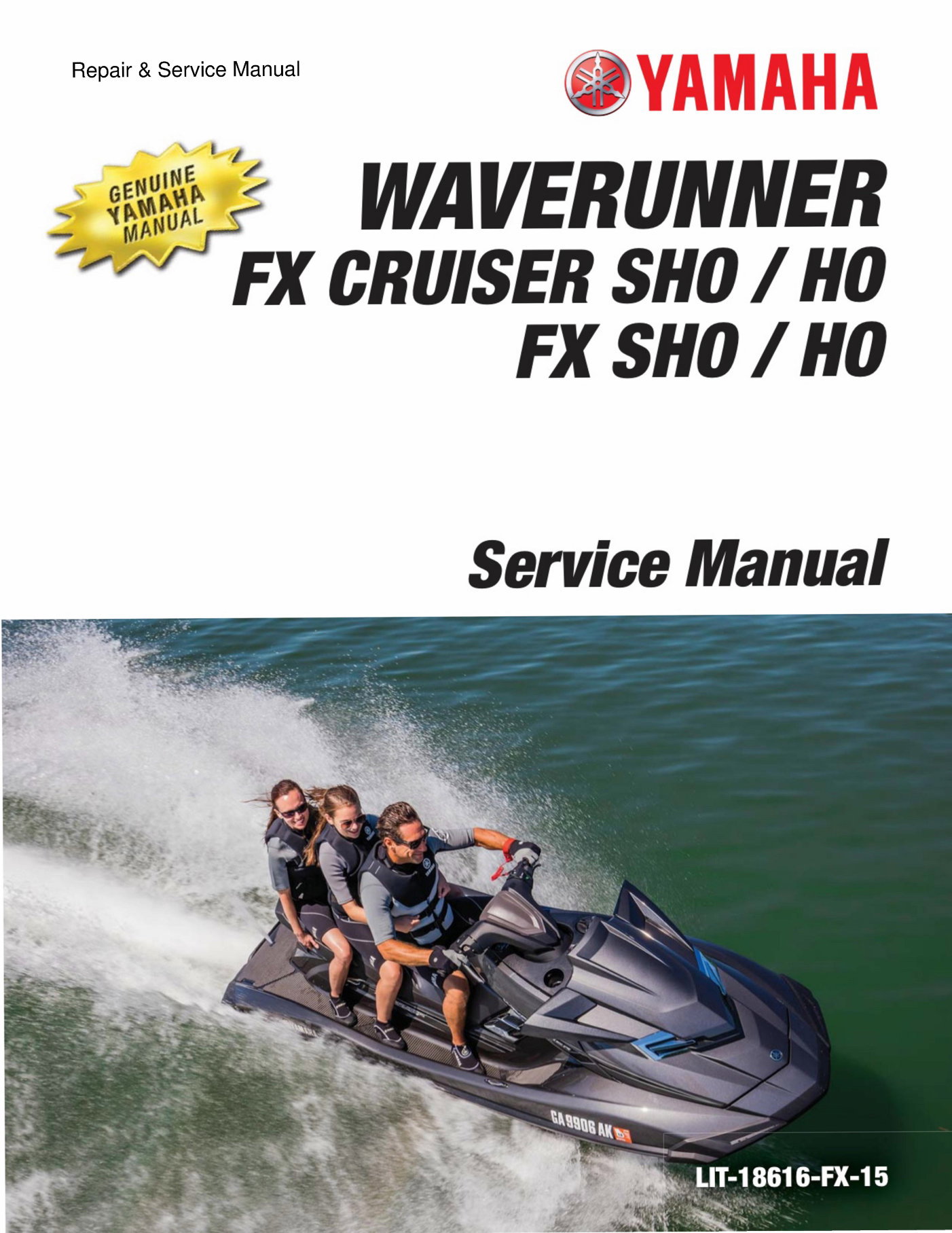
WAVERUNNER
XCRUISERSHO/HO
FXSHO/HO
Manual ce
rv
Se
€YAMAHA=
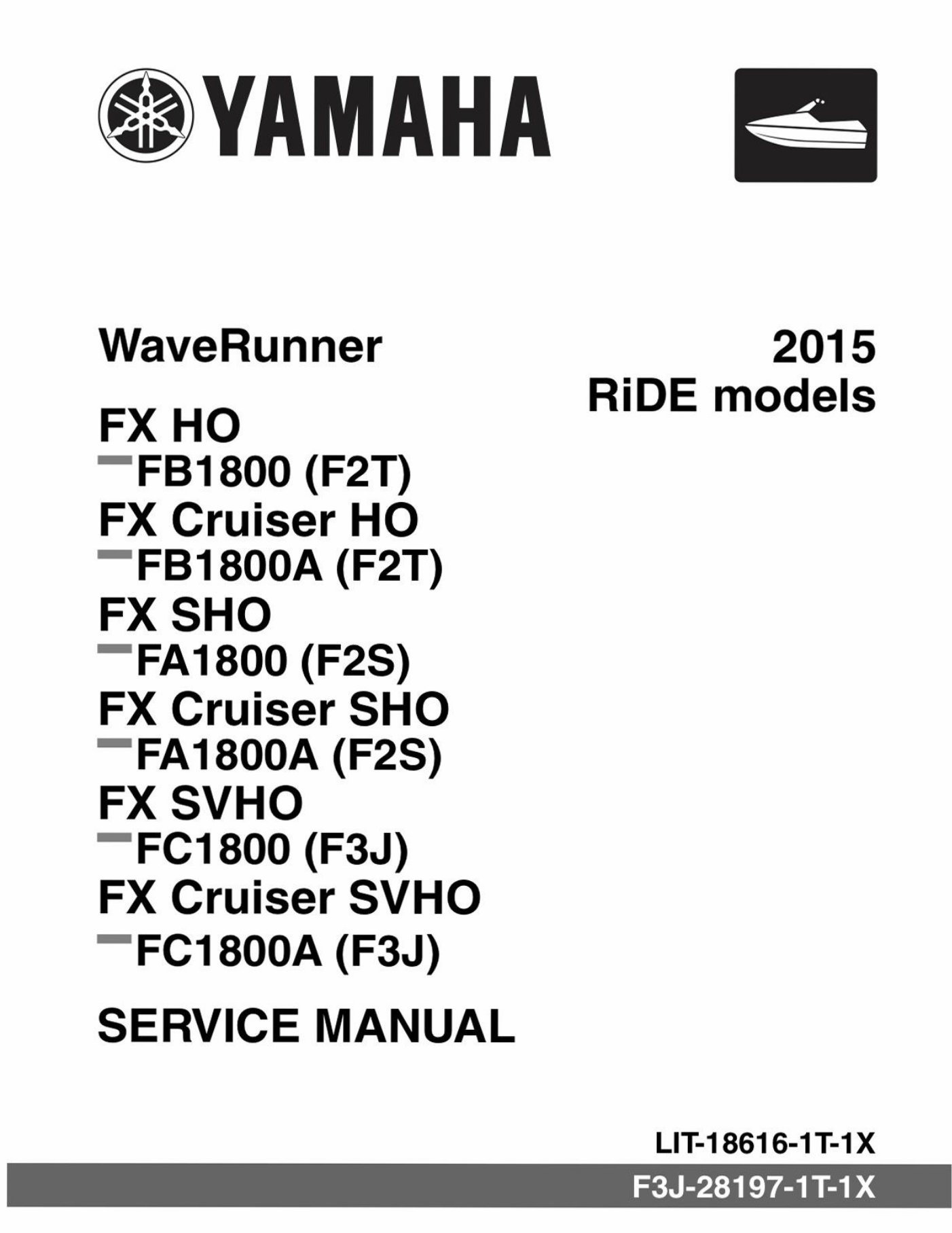
WaveRunner2015
EXHORiDEmodels
TMFB1800(F2T)
FXCruiserHO
TMFB1800A(F2T)
FXSHO
=FA1800(F2S)
FXCruiserSHO
TMFA1800A(F2S)
FXSVHO
TMFC1800(F3J)
FXCruiserSVHO
TMFC1800A(F3J)
SERVICEMANUAL
LIT-18616-1T-1X
F3J-28197-1T-1X
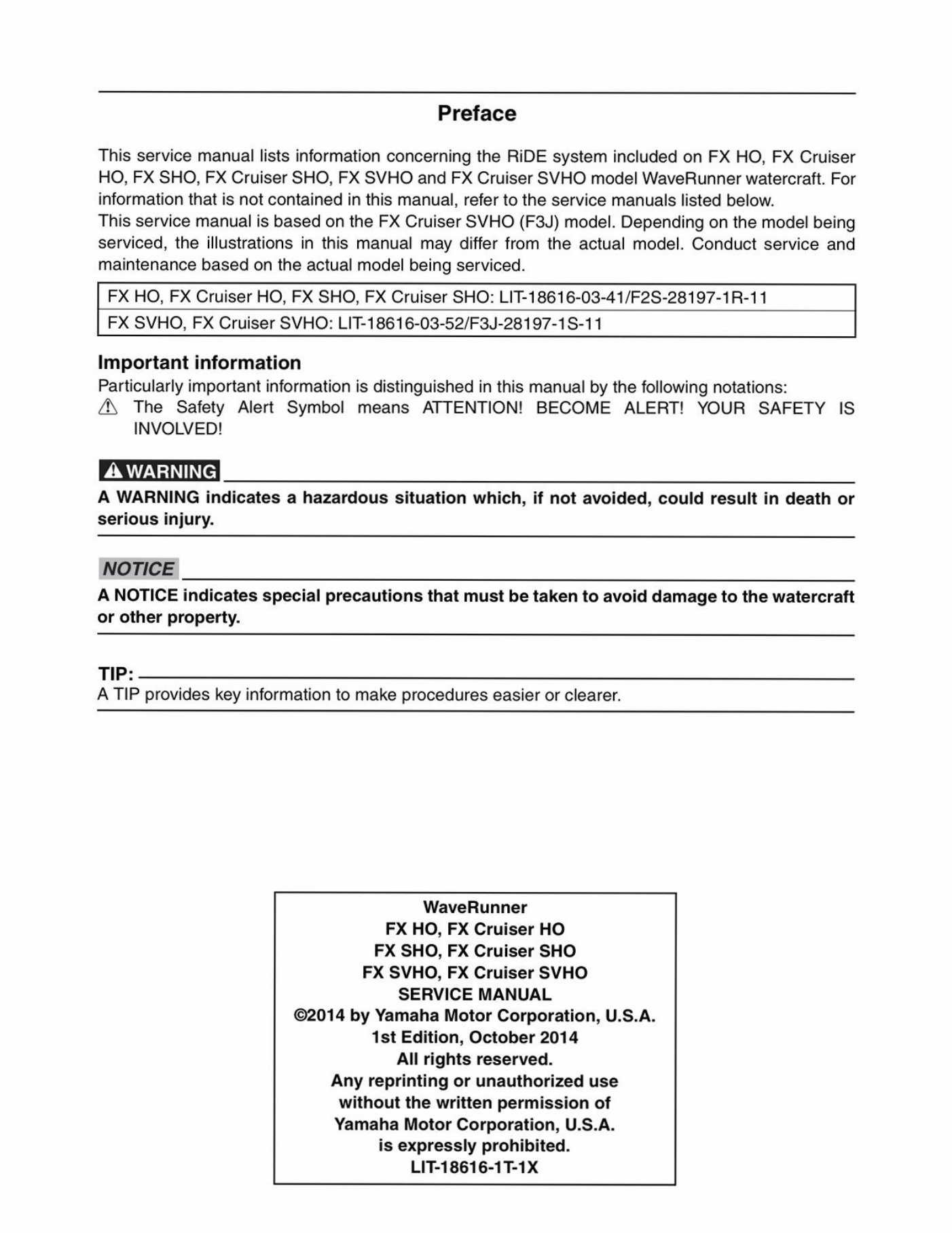
Preface
ThisservicemanuallistsinformationconcerningtheRIDEsystemincludedonFXHO,FXCruiser
HO,FXSHO,FXCruiserSHO,FXSVHOandFXCruiserSVHOmodelWaveRunnerwatercraft.For
informationthatisnotcontainedinthismanual,refertotheservicemanualslistedbelow.
ThisservicemanualisbasedontheFXCruiserSVHO(F3J)model.Dependingonthemodelbeing
serviced,theillustrationsinthismanualmaydifferfromtheactualmodel.Conductserviceand
maintenancebasedontheactualmodelbeingserviced.
FXHO,FXCruiserHO,FXSHO,FXCruiserSHO:LIT-18616-03-41/F2S-28197-1R-11
FXSVHO,FXCruiserSVHO:LIT-18616-03-52/F3J-28197-1S-11
Importantinformation
Particularlyimportantinformationisdistinguishedinthismanualbythefollowingnotations:
Z\TheSafetyAlertSymbolmeansATTENTION!BECOMEALERT!YOURSAFETYIS
INVOLVED!
AWARNING
AWARNINGindicatesahazardoussituationwhich,ifnotavoided,couldresultindeathor
seriousinjury.
NOTICE
ANOTICEindicatesspecialprecautionsthatmustbetakentoavoiddamagetothewatercraft
orotherproperty.
TIP:
ATIPprovideskeyinformationtomakeprocedureseasierorclearer.
WaveRunner
FXHO,FXCruiserHO
FXSHO,FXCruiserSHO
FXSVHO,FXCruiserSVHO
SERVICEMANUAL
©2014byYamahaMotorCorporation,U.S.A.
1stEdition,October2014
Allrightsreserved.
Anyreprintingorunauthorizeduse
withoutthewrittenpermissionof
YamahaMotorCorporation,U.S.A.
isexpresslyprohibited.
LIT-18616-1T-1X
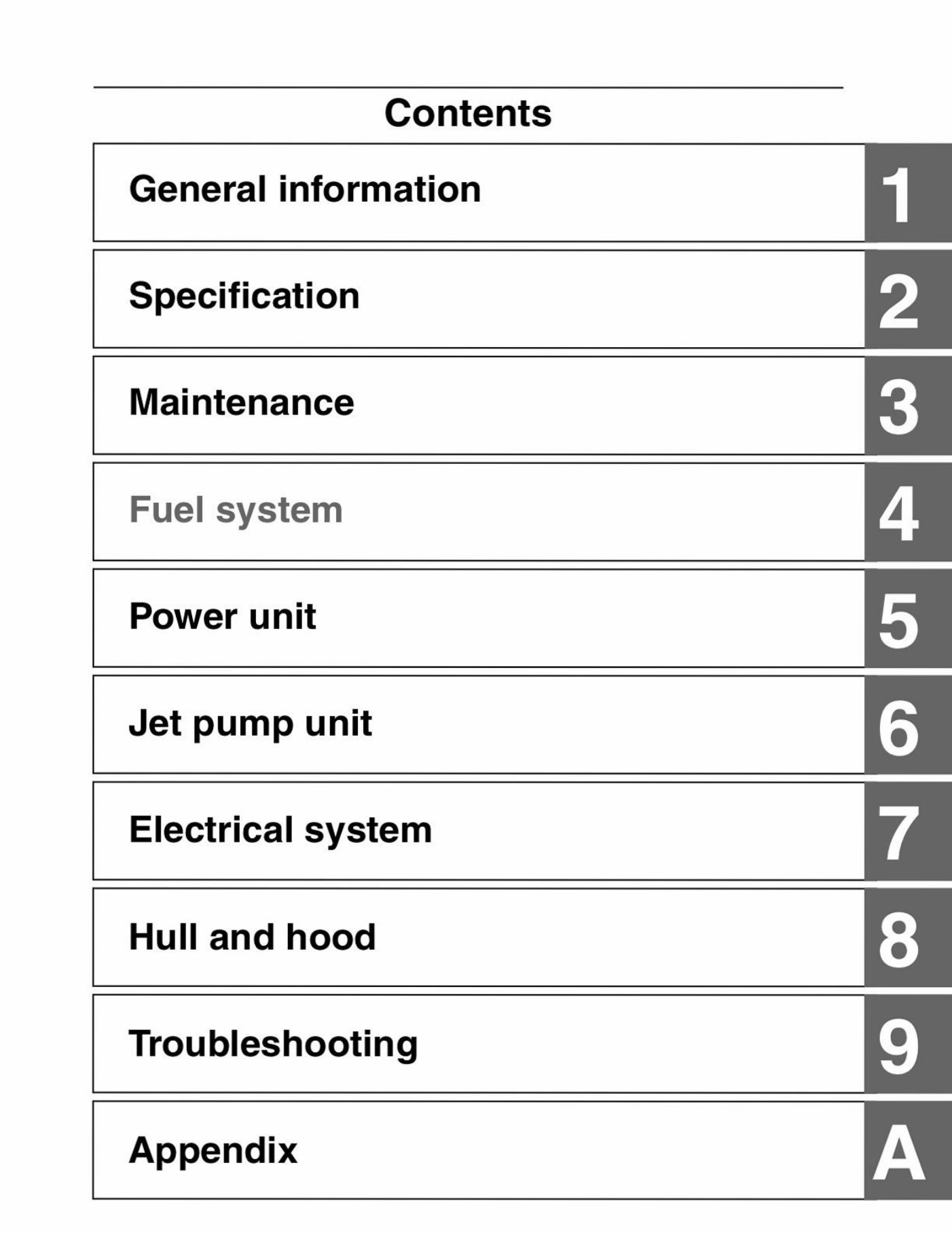
Contents
Generalinformation
Specification
Maintenance
Fuelsystem
Powerunit
Jetpumpunit
Electricalsystem
Hullandhood
Troubleshooting
Appendix
D/O) )N/O)or}] o/h | =|
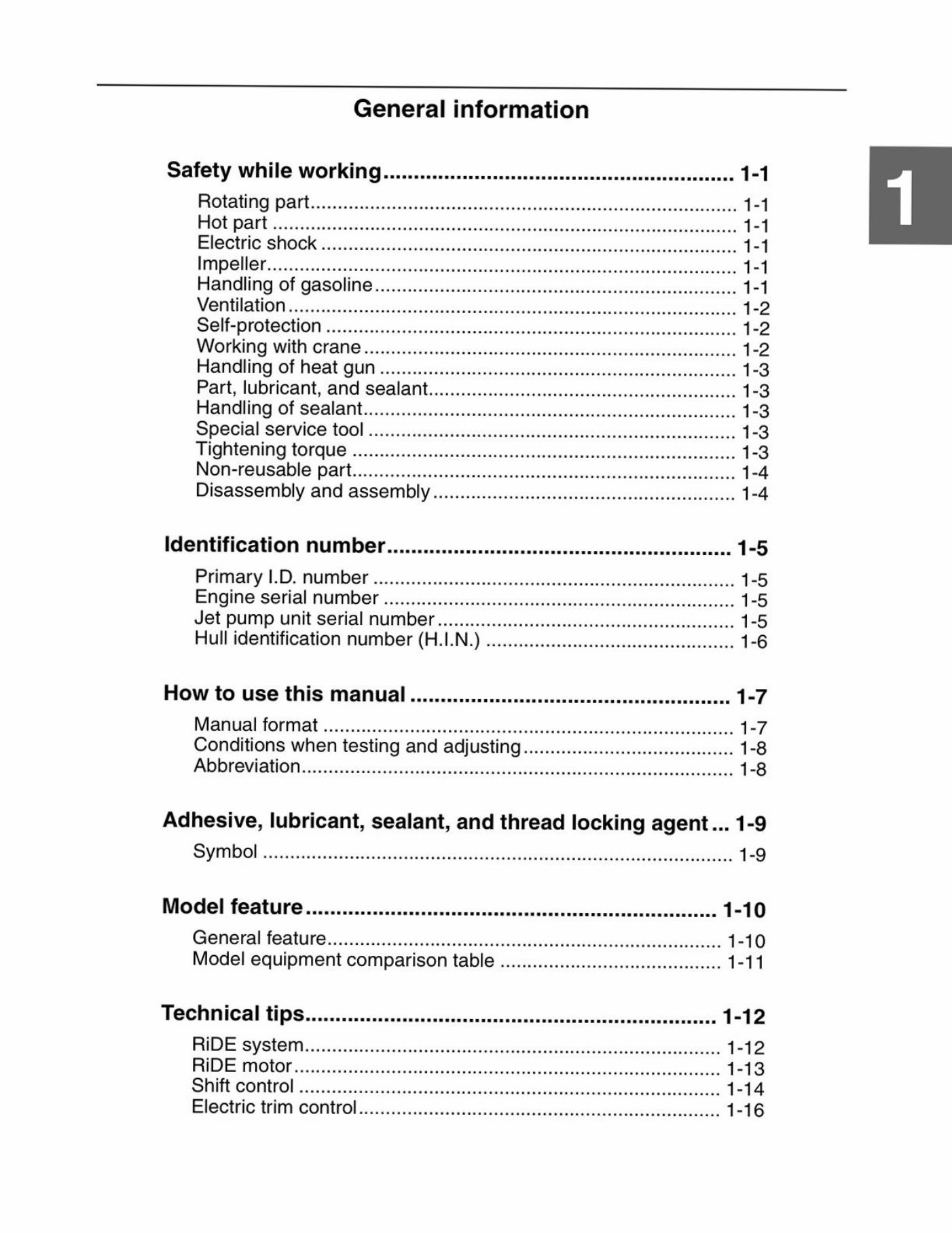
Generalinformation
1
=
Safetywhileworking..
Rotatingpart..
Hotpart......
Electricshock
Impeller..........
Handlingofgasoline
Ventilation...
Self-protection
Workingwithcrane..
Handlingofheatgun
Part,lubricant,andseala
Handlingofsealant..
Specialservicetool.
Tighteningtorque.
Non-reusablepart.
Disassemblyandassembly
feiiaix Wie Tetx 1 Ee a
asad
aerate tn ireie wt areavekres sarees coro of KA dbdOHHONNYNA4+
1
a
Identificationnumbev........
Primary|.D.number....
Engineserialnumber..
Jetpumpunitserialnumber..
Hullidentificationnumber(H.1.N.
iriure ot aagank
Howtousethismanual
Manualformat.............
Conditionswhentestingai
Abbreviation
Adhesive,lubricant,sealant,andthreadlockingagent...1-9
Symbol.
Modelfeature...
Generalfeature.1-10
Modelequipmentcomparisontable21-11
Technicaltips.«1-12
RiDEsystemwee1-12
RiDEmotor..wee1-13
Shiftcontrol.21-14
Electrictrimcontrol+1-16
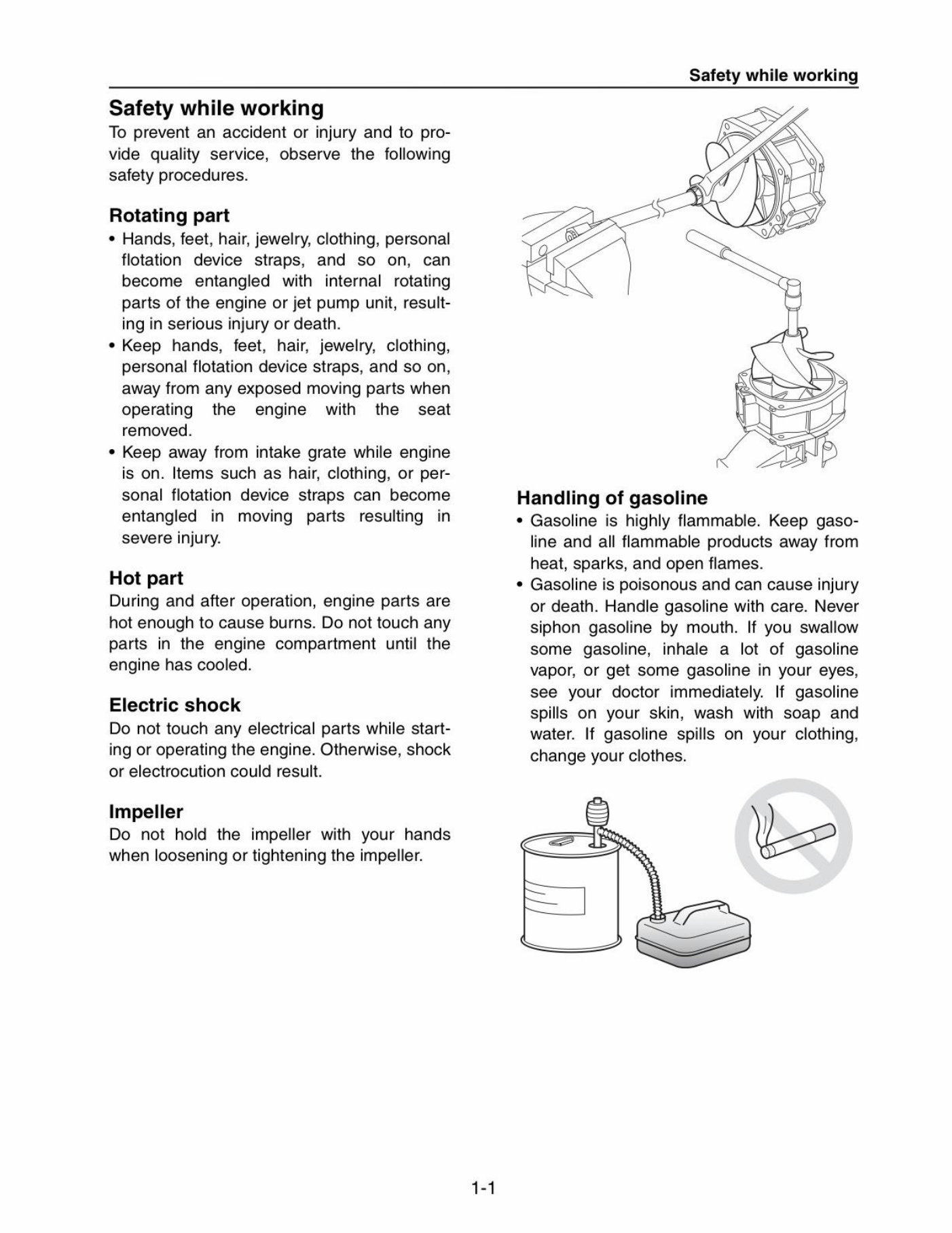
Safetywhileworking
Safetywhileworking
Topreventanaccidentorinjuryandtopro-
videqualityservice,observethefollowing
safetyprocedures.
Rotatingpart
*Hands,feet,hair,jewelry,clothing,personal
flotationdevicestraps,andsoon,can
becomeentangledwithinternalrotating
partsoftheengineorjetpumpunit,result-
inginseriousinjuryordeath.
*Keephands,feet,hair,jewelry,clothing,
personalflotationdevicestraps,andsoon,
awayfromanyexposedmovingpartswhen
operatingtheenginewiththeseat
removed.
*Keepawayfromintakegratewhileengine
ison.Itemssuchashair,clothing,orper-
sonalflotationdevicestrapscanbecome
entangledinmovingpartsresultingin
severeinjury.
Hotpart
Duringandafteroperation,enginepartsare
hotenoughtocauseburns.Donottouchany
partsintheenginecompartmentuntilthe
enginehascooled.
Electricshock
Donottouchanyelectricalpartswhilestart-
ingoroperatingtheengine.Otherwise,shock
orelectrocutioncouldresult.
Impeller
Donotholdtheimpellerwithyourhands
whenlooseningortighteningtheimpeller.
14
Handlingofgasoline
*Gasolineishighlyflammable.Keepgaso-
lineandallflammableproductsawayfrom
heat,sparks,andopenflames.
*Gasolineispoisonousandcancauseinjury
ordeath.Handlegasolinewithcare.Never
siphongasolinebymouth.Ifyouswallow
somegasoline,inhalealotofgasoline
vapor,orgetsomegasolineinyoureyes,
seeyourdoctorimmediately.Ifgasoline
spillsonyourskin,washwithsoapand
water.Ifgasolinespillsonyourclothing,
changeyourclothes.
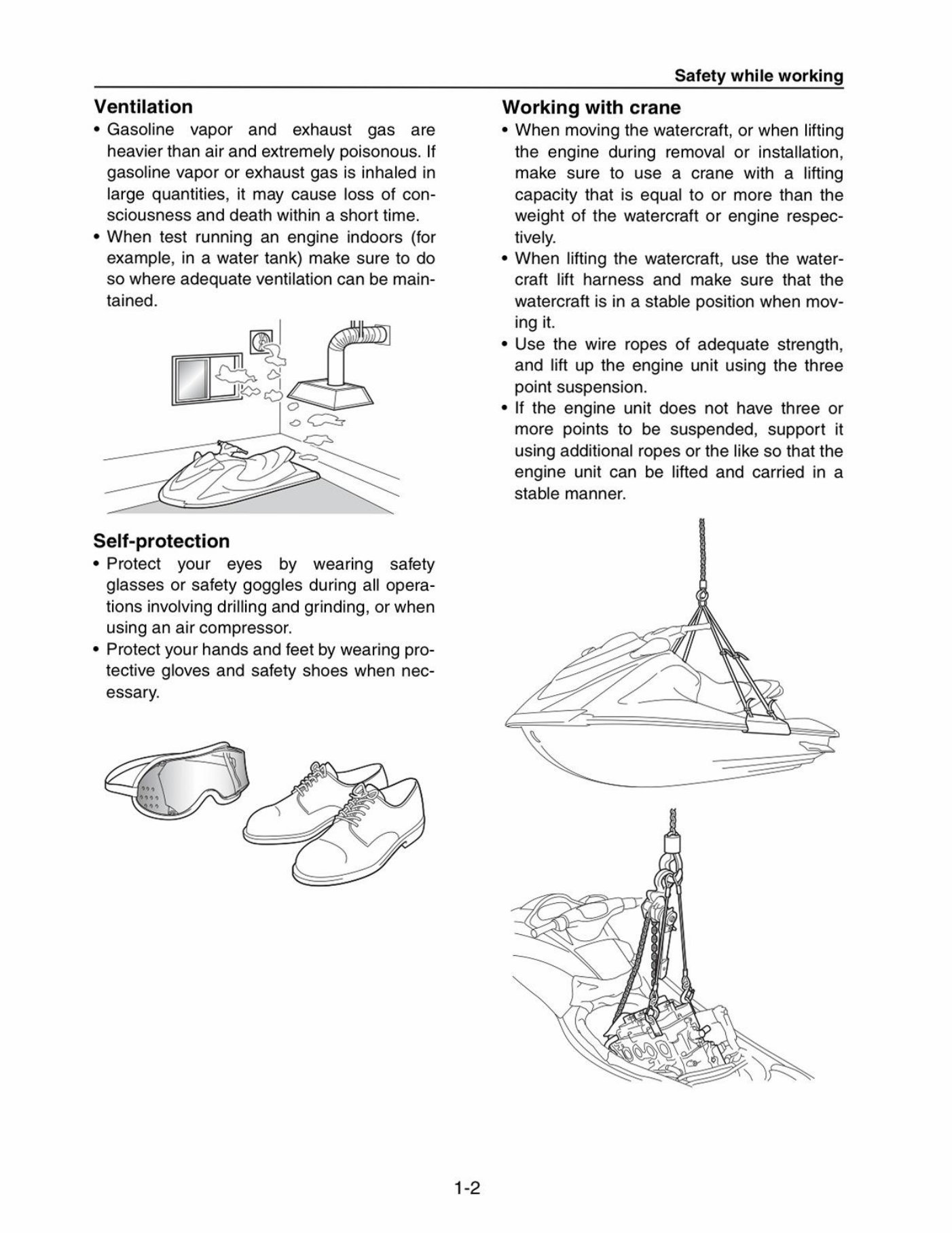
Safetywhileworking
Ventilation
¢Gasolinevaporandexhaustgasare
heavierthanairandextremelypoisonous.If
gasolinevapororexhaustgasisinhaledin
largequantities,itmaycauselossofcon-
sciousnessanddeathwithinashorttime.
¢Whentestrunninganengineindoors(for
example,inawatertank)makesuretodo
sowhereadequateventilationcanbemain-
tained.
ell
ss—
Z—
Self-protection
¢Protectyoureyesbywearingsafety
1-2
Workingwithcrane
*Whenmovingthewatercraft,orwhenlifting
theengineduringremovalorinstallation,
makesuretouseacranewithalifting
capacitythatisequaltoormorethanthe
weightofthewatercraftorenginerespec-
tively.
*Whenliftingthewatercraft,usethewater-
craftliftharnessandmakesurethatthe
watercraftisinastablepositionwhenmov-
ingit.
¢Usethewireropesofadequatestrength,
andliftuptheengineunitusingthethree
pointsuspension.
*Iftheengineunitdoesnothavethreeor
morepointstobesuspended,supportit
usingadditionalropesorthelikesothatthe
engineunitcanbeliftedandcarriedina
stablemanner.
Safetywhileworking
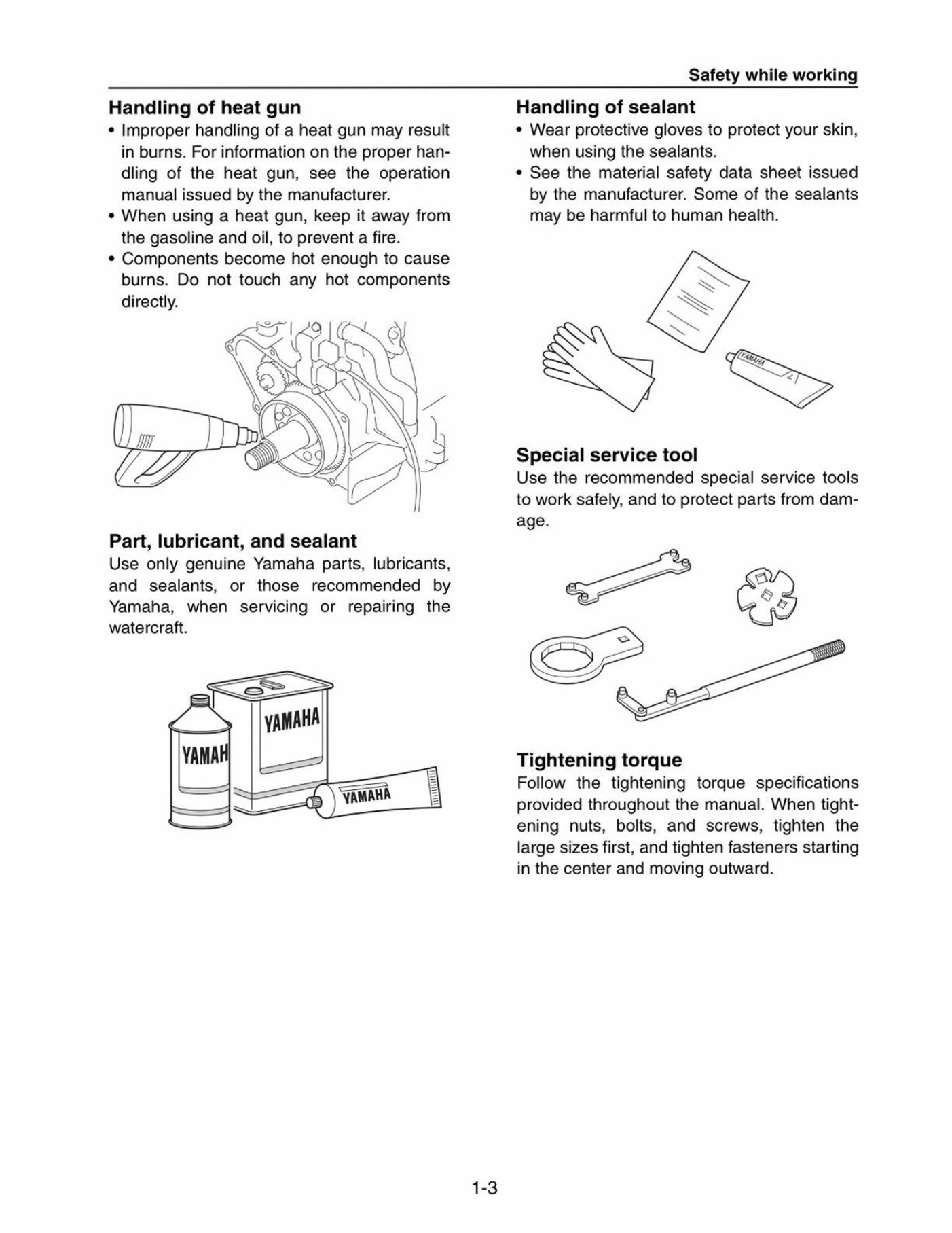
Handlingofheatgun
*Improperhandlingofaheatgunmayresult
inburns.Forinformationontheproperhan-
dlingoftheheatgun,seetheoperation
manualissuedbythemanufacturer.
*Whenusingaheatgun,keepitawayfrom
thegasolineandoil,topreventafire.
*Componentsbecomehotenoughtocause
burns.Donottouchanyhotcomponents
directly.
Part,lubricant,andsealant
UseonlygenuineYamahaparts,lubricants,
andsealants,orthoserecommendedby
Yamaha,whenservicingorrepairingthe
watercraft.
1-3
Handlingofsealant
¢Wearprotectiveglovestoprotectyourskin,
whenusingthesealants.
*Seethematerialsafetydatasheetissued
bythemanufacturer.Someofthesealants
maybeharmfultohumanhealth.
Specialservicetool
Usetherecommendedspecialservicetools
toworksafely,andtoprotectpartsfromdam-
age.
Tighteningtorque
Followthetighteningtorquespecifications
providedthroughoutthemanual.Whentight-
eningnuts,bolts,andscrews,tightenthe
largesizesfirst,andtightenfastenersstarting
inthecenterandmovingoutward.
Safetywhileworking
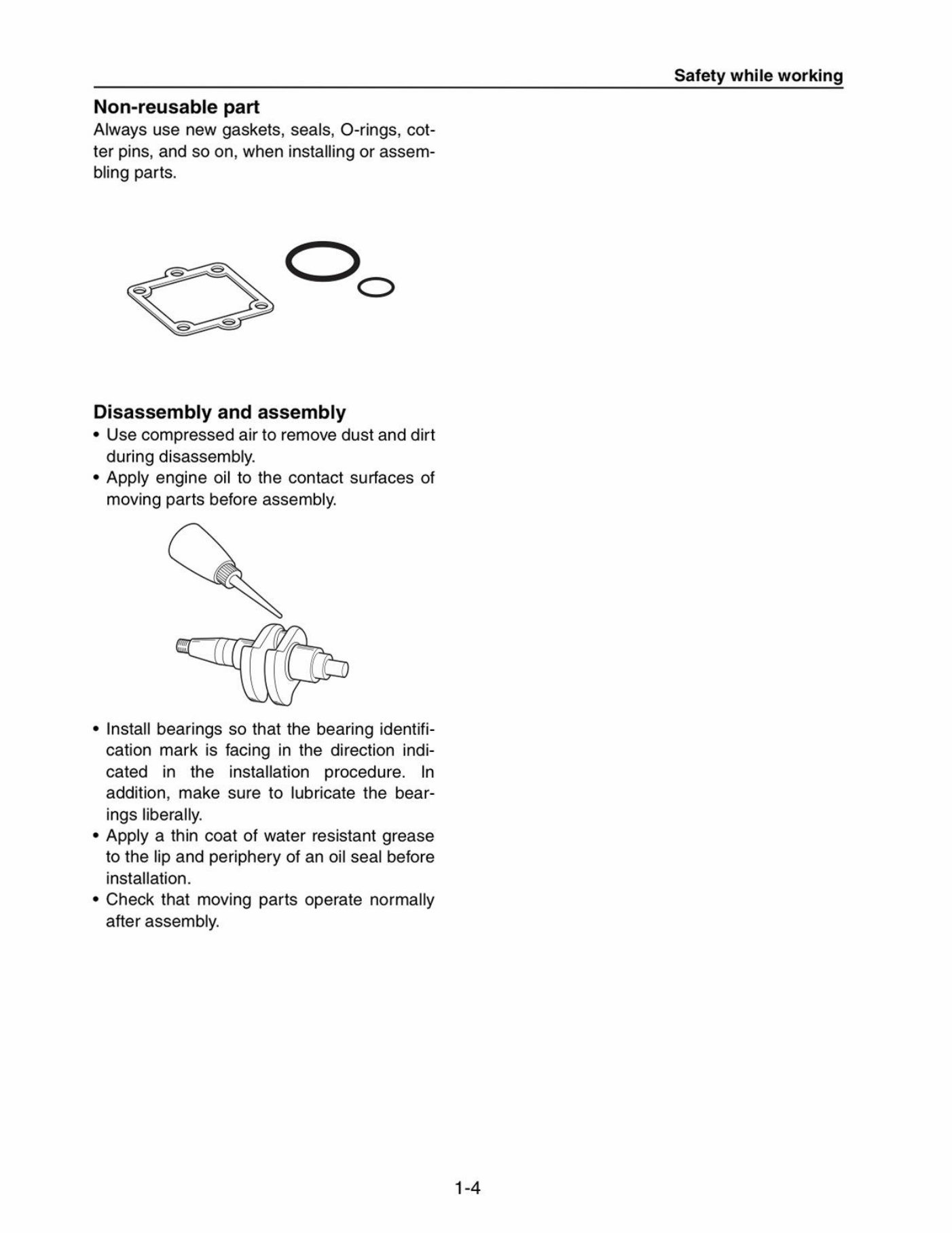
Non-reusablepart
Alwaysusenewgaskets,seals,O-rings,cot-
terpins,andsoon,wheninstallingorassem-
blingparts.
Disassemblyandassembly
«Usecompressedairtoremovedustanddirt
duringdisassembly.
¢Applyengineoiltothecontactsurfacesof
movingpartsbeforeassembly.
se((ars
¢Installbearingssothatthebearingidentifi-
cationmarkisfacinginthedirectionindi-
catedintheinstallationprocedure.In
addition,makesuretolubricatethebear-
ingsliberally.
¢Applyathincoatofwaterresistantgrease
tothelipandperipheryofanoilsealbefore
installation.
*Checkthatmovingpartsoperatenormally
afterassembly.
Identificationnumber
Identificationnumber
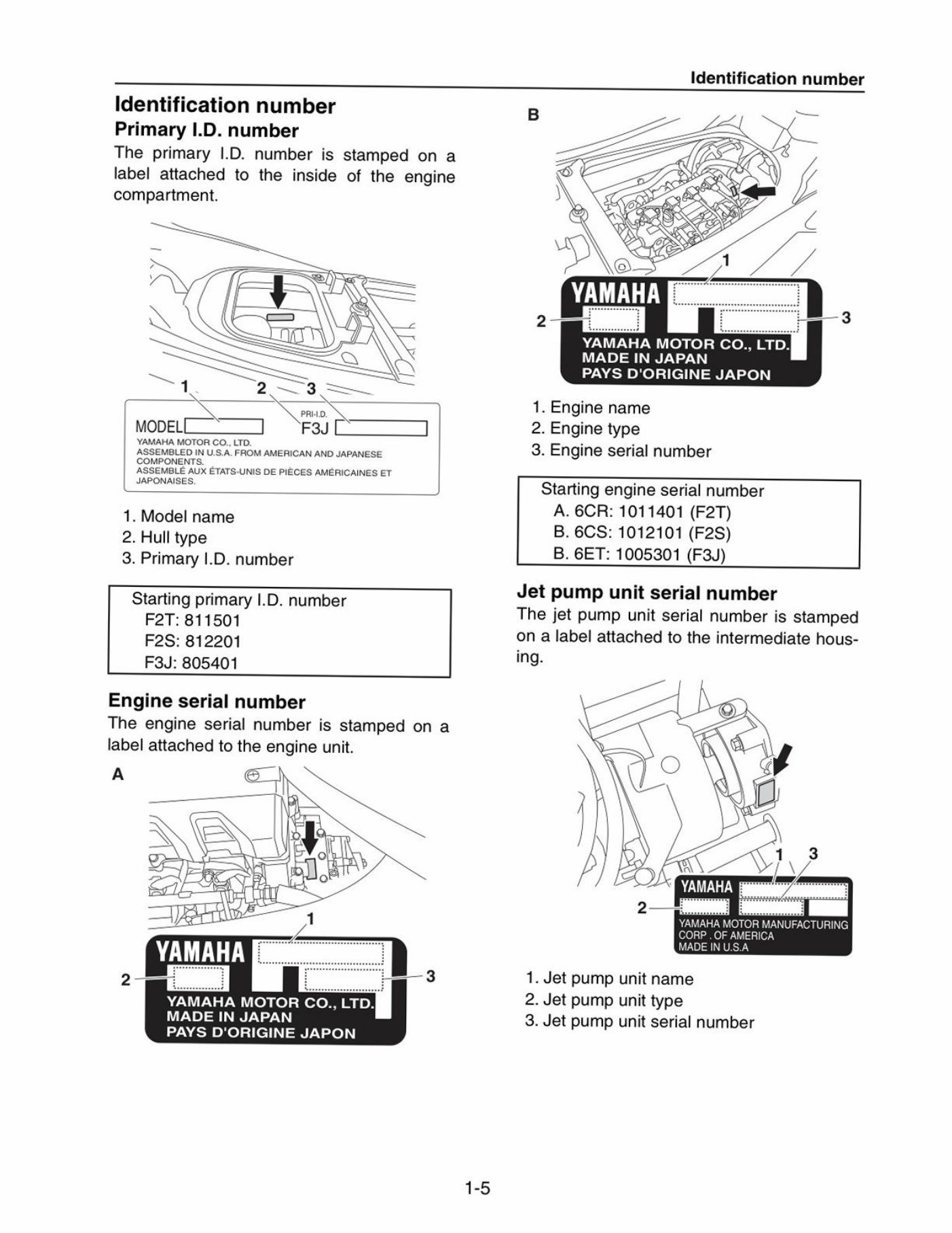
PrimaryI.D.number
Theprimary|.D.numberisstampedona
labelattachedtotheinsideoftheengine
compartment.
ASSEMBLEAUXETATS-UNISDEPIECESAMERICAINESET
JAPONAISES,
1.Modelname
2.Hulltype
3.Primary|.D.number
Startingprimary|.D.number
FT:811501
F2S:812201
F3J:805401
Engineserialnumber
Theengineserialnumberisstampedona
labelattachedtotheengineunit.
MADEINJAPAN
PAYSD'ORIGINEJAPON
MADEINJAPAN
PAYSD'ORIGINEJAPON
1.Enginename
2.Enginetype
3.Engineserialnumber
Startingengineserialnumber
A.6CR:1011401(F2T)
B.6CS:1012101(F2S)
B.6ET:1005301(F3J)
Jetpumpunitserialnumber
Thejetpumpunitserialnumberisstamped
onalabelattachedtotheintermediatehous-
ing.
P.OFAMERICA
1.Jetpumpunitname
2.Jetpumpunittype
3.Jetpumpunitserialnumber
You're Reading a Preview
What's Included?
 Lifetime Access
Fast Download Speeds
Online & Offline Access
Access PDF Contents & Bookmarks
Full Search Facility
Print one or all pages of your manual
$37.99
2016 Yamaha FX CRUISER SVHO Service & Repair Manual
Viewed 19 Times Today

What's Included?
Lifetime Access
Fast Download Speeds
Online & Offline Access
Access PDF Contents & Bookmarks
Full Search Facility
Print one or all pages of your manual
$37.99

Secure transaction
What's Included?
Lifetime Access
Fast Download Speeds
Online & Offline Access
Access PDF Contents & Bookmarks
Full Search Facility
Print one or all pages of your manual
Description
A comprehensive guide for Yamaha FX CRUISER SVHO maintenance and repair, this manual is suitable for both professional mechanics and DIY enthusiasts. It provides detailed information on troubleshooting, repair, and comprehensive maintenance procedures.
- In-depth technical guidance for conducting complex tasks
- Step-by-step procedures for troubleshooting and repair
- Comprehensive maintenance schedules and procedures
- Detailed diagrams and specifications for reference
This manual is an essential resource for anyone looking to understand and maintain their Yamaha FX CRUISER SVHO. Whether you're a seasoned mechanic or a DIY enthusiast, this guide will help you keep your vehicle running smoothly and ensure it remains in top condition.


