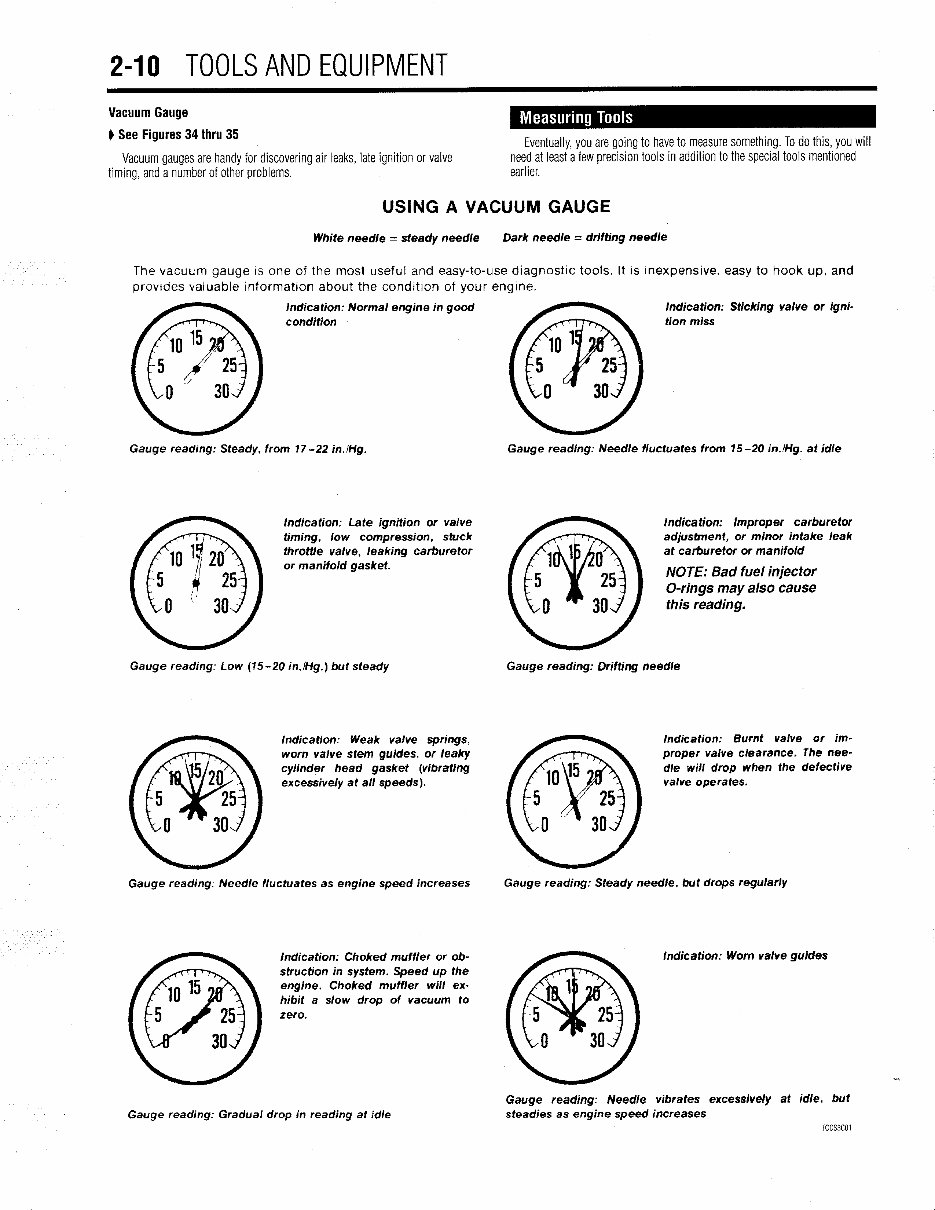
TOOLS AND EQUIPMENT 2-2 SAFETY TOOLS 2-2 WORK GLOVES 2-2 EYE AND EAR PROTECTION 2-2 WORK CLOTHES 2-3 CHEMICALS 2-3 LUBRICANTS & PENETRANTS 2-3 SEALANTS 2-3 CLEANERS 2-4 TOOLS 2-4 HAND TOOLS 2-4 SOCKET SETS 2-4 WRENCHES 2-6 PLIERS 2-7 SCREWDRIVERS 2-8 HAMMERS 2-8 OTHER COMMON TOOLS 2-8 SPECIAL TOOLS 2-8 ELECTRONIC TOOLS 2-9 GAUGES 2-9 MEASURING TOOLS 2-10 MICROMETERS & CALIPERS 2-11 DIAL INDICATORS 2-1 1 TELESCOPING GAUGES 2-12 DEPTH GAUGES 2-12 FASTENERS, MEASUREMENTS AND CONVERSIONS 2-12 BOLTS, NUTS AND OTHER THREADED RETAINERS 2-12 TORQUE 2-13 STANDARD AND METRIC MEASUREMENTS 2-13 SPECIFICATIONS CHARTS USING A VACUUM GAUGE 2-10 CONVERSION FACTORS 2-14 METRIC BOLTS 2-15 SAE BOLTS 2-16
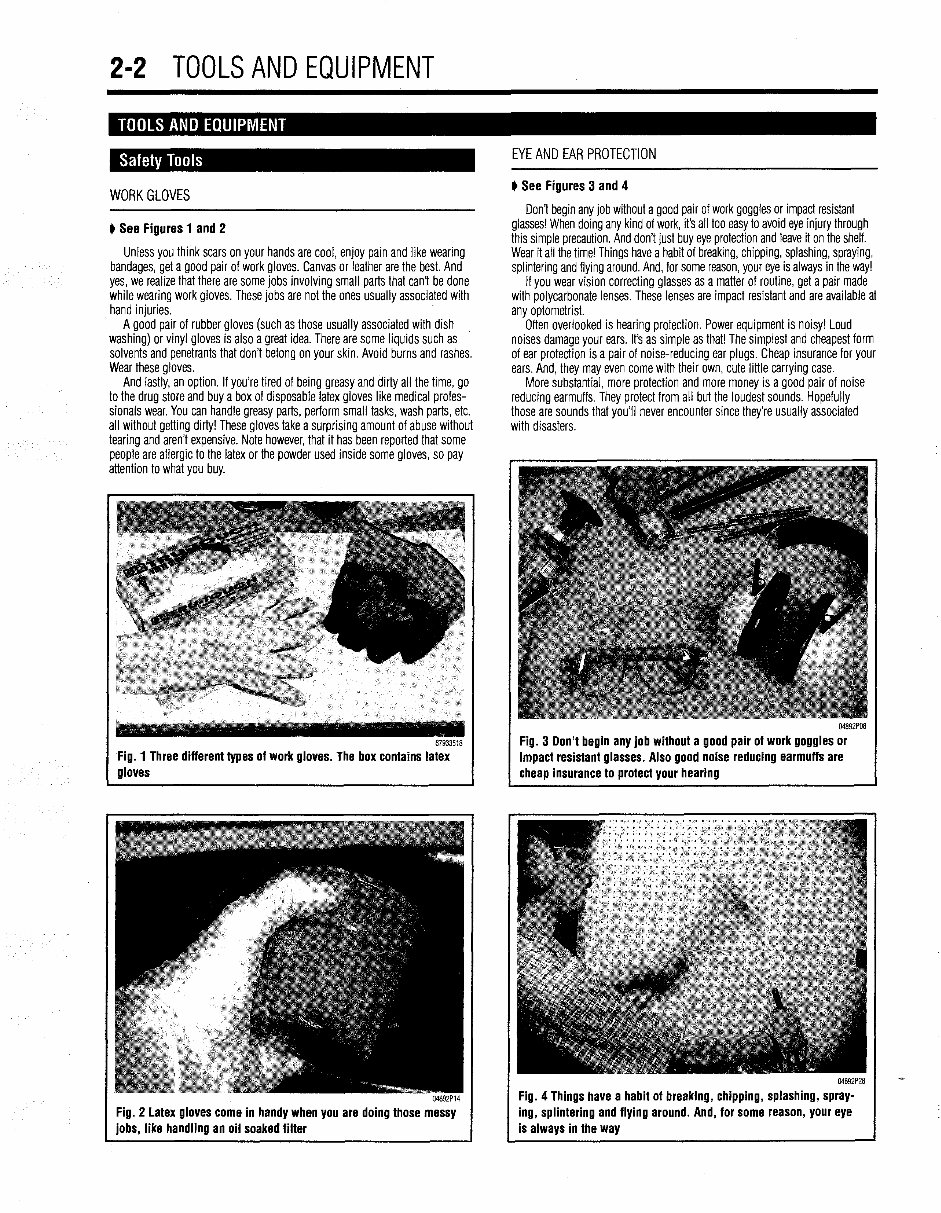
2-2 TOOLS AND EQUIPMENT EYE AND EAR PROTECTION I See Figures 3 and 4 WORK GLOVES > See Figures 1 and 2 Unless you think scars on your hands are cool, enjoy pain and like wearing bandages, get a good pair of work gloves. Canvas or leather are the best. And yes, we realize that there are some jobs involving small parts that can't be done while wearing work gloves. These jobs are not the ones usually associated with hand injuries. A good pair of rubber gloves (such as those usually associated with dish washing) or vinyl gloves is also a great idea. There are some liquids such as solvents and penetrants that don't belong on your skin Avoid burns and rashes. Wear these gloves. And lastly, an option. If you're tired of being greasy and dirty all the time, go to the drug store and buy a box of disposable latex gloves like medical profes- sionals wear. You can handle greasy parts, perform small tasks, wash parts, etc. all without getting dirty! These gloves take a surprising amount of abuse without tearing and aren't expensive. Note however, that it has been reported that some people are allergic to the latex or the powder used inside some gloves, so pay attention to what you buy. 87933518 Fig. 1 Three different types of work gloves. The box contains latex gloves 04892P14 Fig. 2 Latex gloves come in handy when you are doing those messy jobs, like handling an oil soaked filter Don't begin any job without a good pair of work goggles or impact resistant glasses! When doing any kind of work, it's all too easy to avoid eye injury through this simple precaution. And don't just buy eye protection and leave it on the shelf. Wear it all the time! Things have a habit of breaking, chipping, splashing, spraying, splintering and flying around. And, for some reason, your eye is always in the way! If you wear vision correcting glasses as a matter of routine, get a pair made with polycarbonate lenses. These lenses are impact resistant and are available at any optometrist. Often overlooked is hearing protection. Power equipment is noisy! Loud noises damage your ears. It's as simple as that! The simplest and cheapest form of ear protection is a pair of noise-reducing ear plugs. Cheap insurance for your ears. And, they may even come with their own, cute little carrying case. More substantial, more protection and more money is a good pair of noise reducing earmuffs. They protect from all but the loudest sounds. Hopefully those are sounds that you'll never encounter since they're usually associated with disasters. 04892P08 Fig. 3 Don't begin any job without a good pair of work goggles or impact resistant glasses. Also good noise reducing earmuffs are cheap insurance to protect your hearing M892P28 Fig. 4 Things have a habit of breaking, chipping, splashing, spray- ing, splintering and flying around. And, for some reason, your eye is always in the way
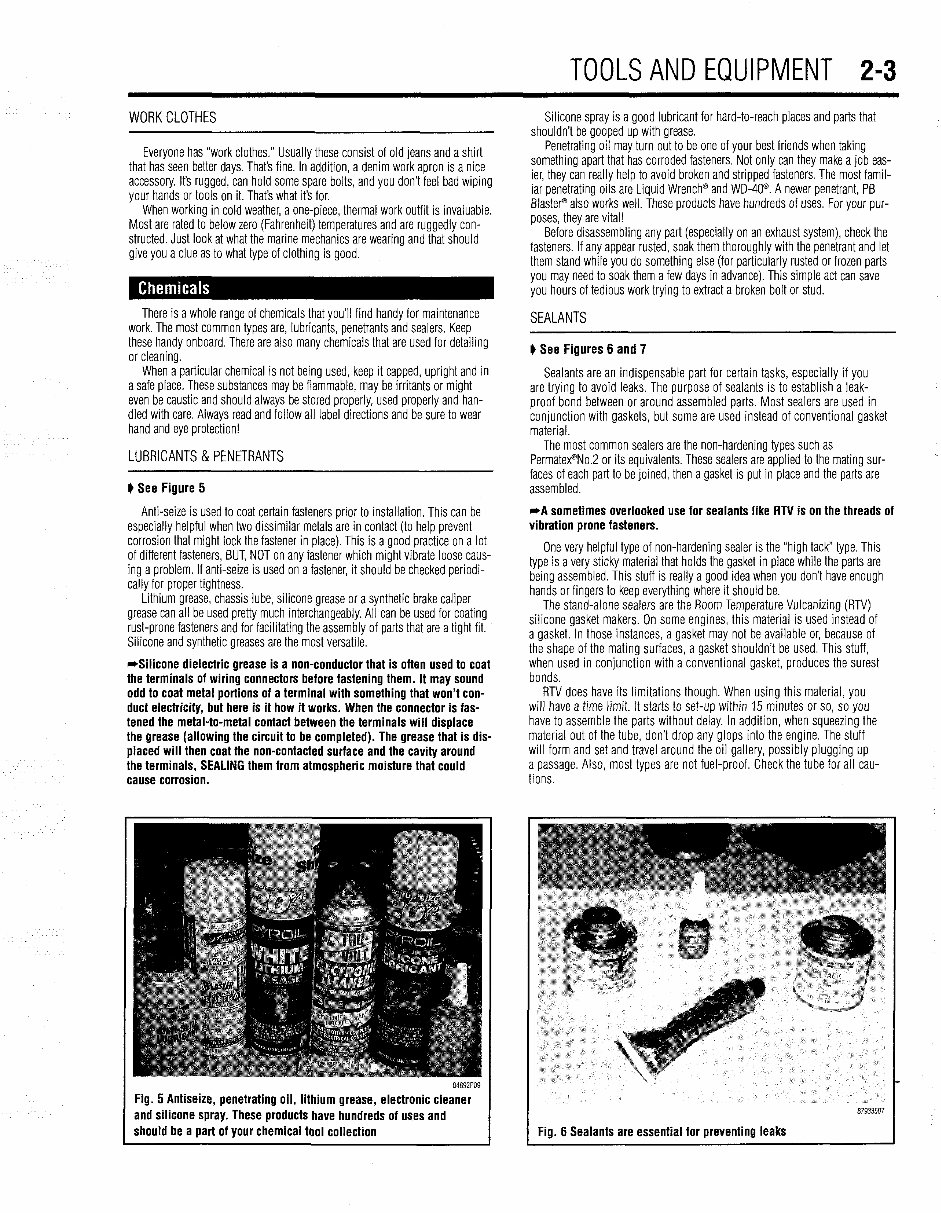
TOOLS AND EQUIPMENT 2-3 WORK CLOTHES Everyone has "work clothes." Usually these consist of old jeans and a shirt that has seen better days. That's fine. In addition, a denim work apron is a nice accessory. It's rugged, can hold some spare bolts, and you don't feel bad wiping your hands or tools on it. That's what it's for. When working in cold weather, a one-piece, thermal work outfit is invaluable. Most are rated to below zero (Fahrenheit) temperatures and are ruggedly con- structed. Just look at what the marine mechanics are wearing and that should give you a clue as to what type of clothing is good. There is a whole range of chemicals that you'll find handy for maintenance work. The most common types are, lubricants, penetrants and sealers. Keep these handy onboard. There are also many chemicals that are used for detailing or cleaning. When a particular chemical is not being used, keep it capped, upright and in a safe place. These substances may be flammable, may be irritants or might even be caustic and should always be stored properly, used properly and han- dled with care. Always read and follow all label directions and be sure to wear hand and eye protection! LUBRICANTS & PENETRANTS I See Figure 5 Anti-seize is used to coat certain fasteners prior to installation. This can be especially helpful when two dissimilar metals are in contact (to help prevent corrosion that might lock the fastener in place). This is a good practice on a lot of different fasteners, BUT, NOT on any fastener which might vibrate loose caus- ing a problem. If anti-seize is used on a fastener, it should be checked periodi- cally for proper tightness. Lithium grease, chassis lube, silicone grease or a synthetic brake caliper grease can all be used pretty much interchangeably. All can be used for coating rust-prone fasteners and for facilitating the assembly of parts that are a tight fit. Silicone and synthetic greases are the most versatile. *Silicone dielectric grease is a non-conductor that is often used to coat the terminals of wiring connectors before fastening them. It may sound odd to coat metal portions of a terminal with something that won't con- duct electricity, but here is it how it works. When the connector is fas- tened the metal-to-metal contact between the terminals will displace the grease (allowing the circuit to be completed). The grease that is dis- placed will then coat the non-contacted surface and the cavity around the terminals, SEALING them from atmospheric moisture that could cause corrosion. 04892P09 Fig. 5 Antiseize, penetrating oil, lithium grease, electronic cleaner and silicone spray. These products have hundreds of uses and should be a part of your chemical tool collection Silicone spray is a good lubricant for hard-to-reach places and parts that shouldn't be gooped up with grease. Penetrating oil may turn out to be one of your best friends when taking something apart that has corroded fasteners. Not only can they make a job eas- ier, they can really help to avoid broken and stripped fasteners. The most famil- iar penetrating oils are Liquid Wrenche and WD-40@ A newer penetrant, PB BlasteP also works well. These products have hundreds of uses. For your pur- poses, they are vital! Before disassembling any part (especially on an exhaust system), check the fasteners. If any appear rusted, soak them thoroughly with the penetrant and let them stand while you do something else (for particularly rusted or frozen parts you may need to soak them a few days in advance). This simple act can save you hours of tedious work trying to extract a broken bolt or stud. SEALANTS I See Figures 6 and 7 Sealants are an indispensable part for certain tasks, especially if you are trying to avoid leaks. The purpose of sealants is to establish a leak- proof bond between or around assembled parts. Most sealers are used in conjunction with gaskets, but some are used instead of conventional gasket material. The most common sealers are the non-hardening types such as PermatexmNo.2 or its equivalents. These sealers are applied to the mating sur- faces of each part to be joined, then a gasket is put in place and the parts are assembled. *A sometimes overlooked use for sealants like RTV is on the threads of vibration prone fasteners. One very helpful type of non-hardening sealer is the "high tack type. This type is a very sticky material that holds the gasket in place while the parts are being assembled. This stuff is really a good idea when you don't have enough hands or fingers to keep everything where it should be. The stand-alone sealers are the Room Temperature Vulcanizing (RTV) silicone gasket makers. On some engines, this material is used instead of a gasket. In those instances, a gasket may not be available or, because of the shape of the mating surfaces, a gasket shouldn't be used. This stuff, when used in conjunction with a conventional gasket, produces the surest bonds. RTV does have its limitations though. When using this material, you will have a time limit. It starts to set-up within 15 minutes or so, so you have to assemble the parts without delay. In addition, when squeezing the material out of the tube, don't drop any glops into the engine. The stuff will form and set and travel around the oil gallery, possibly plugging up a passage. Also, most types are not fuel-proof. Check the tube for all cau- tions. Fig. 6 Sealants are essential for preventing leaks
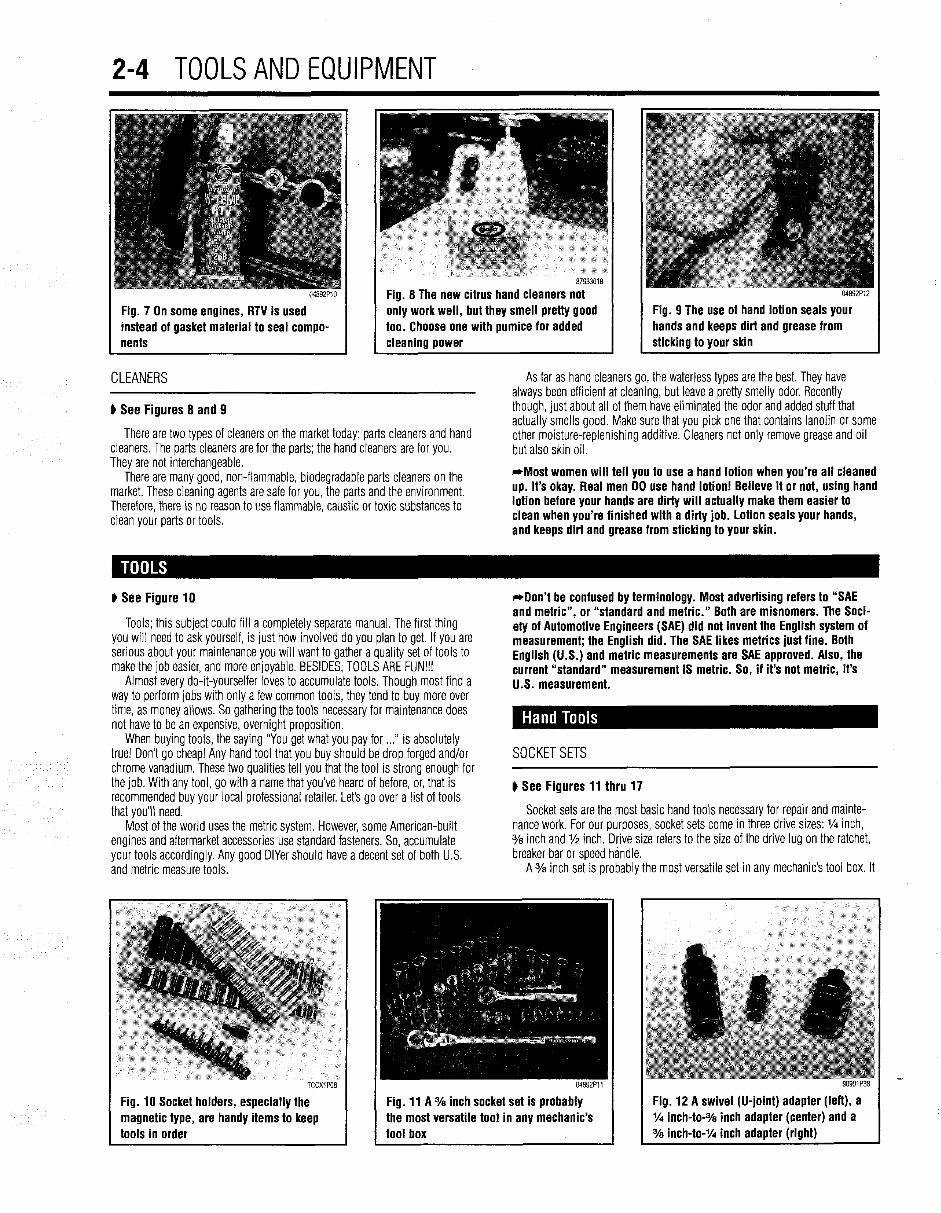
2-4 TOOLS AND EQUIPMENT Fig. 7 On some engines, RTV is used only work well, but they smell pretty good Fig. 9 The use of hand lotion seals your instead of gasket material to seal compo- too. Choose one with pumice for added hands and keeps dirt and grease from nents cleaning power sticking to your skin CLEANERS As far as hand cleaners go, the waterless types are the best. They have always been efficient at cleaning, but leave a pretty smelly odor. Recently I See Figures 8 and 9 though, just about all of them have eliminated the odor and added stuff that actually smells good. Make sure that you pick one that contains lanolin or some There are two types of cleaners on the market today: parts cleaners and hand other moisture-replenishing additive. Cleaners not only remove grease and oil cleaners. The parts cleaners are for the parts; the hand cleaners are for you. but also skin oil. They are not interchangeable. There are many good, non-flammable, biodegradable parts cleaners on the *Most women will tell you to use a hand lotion when you're all cleaned market. These cleaning agents are safe for you, the parts and the environment. up. It's okay. Real men DO use hand lotion! Believe it or not, using hand Therefore, there is no reason to use flammable, caustic or toxic substances to lotion before your hands are dirty will actually make them easier to clean your parts or tools. clean when you're finished with a dirty job. Lotion seals your hands, and keeps dirt and grease from sticking to your skin. Ã See Figure 10 Tools; this subject could fill a completely separate manual. The first thing you will need to ask yourself, is just how involved do you plan to get. If you are serious about your maintenance you will want to gather a quality set of tools to make the job easier, and more enjoyable. BESIDES, TOOLS ARE FUN!!! Almost every do-it-yourselfer loves to accumulate tools. Though most find a way to perform jobs with only a few common tools, they tend to buy more over time, as money allows. So gathering the tools necessary for maintenance does not have to be an expensive, overnight proposition. When buying tools, the saying "You get what you pay for ..." is absolutely true! Don't go cheap! Any hand tool that you buy should be drop forged andlor chrome vanadium. These two qualities tell you that the tool is strong enough for the job. With any tool, go with a name that you've heard of before, or, that is recommended buy your local professional retailer. Let's go over a list of tools that you'll need. Most of the world uses the metric system. However, some American-built engines and aftermarket accessories use standard fasteners. So, accumulate your tools accordingly. Any good DIYer should have a decent set of both U.S. and metric measure tools. Fig. 10 Socket holders, especially the magnetic type, are handy items to keep tools in order *Don't be confused by terminology. Most advertising refers to "SAE and metric", or "standard and metric." Both are misnomers. The Soci- ety of Automotive Engineers (SAE) did not invent the English system of measurement; the English did. The SAE likes metrics just fine. Both English (U.S.) and metric measurements are SAE approved. Also, the current "standard" measurement IS metric. So, if it's not metric, it's U.S. measurement. SOCKET SETS I See Figures 11 thru 17 Socket sets are the most basic hand tools necessary for repair and mainte- nance work. For our purposes, socket sets come in three drive sizes: 1/4 inch, % inch and 1/2 inch. Drive size refers to the size of the drive lug on the ratchet, breaker bar or speed handle. A % inch set is probably the most versatile set in any mechanic's tool box. It Fig. 11 A % inch socket set is probably Fig. 12 A swivel (U-joint) adapter (left), a the most versatile tool in any mechanic's V4 inch-to-% inch adapter (center) and a % inch-to-% inch adapter (right) 1 tool box . 1 1 1
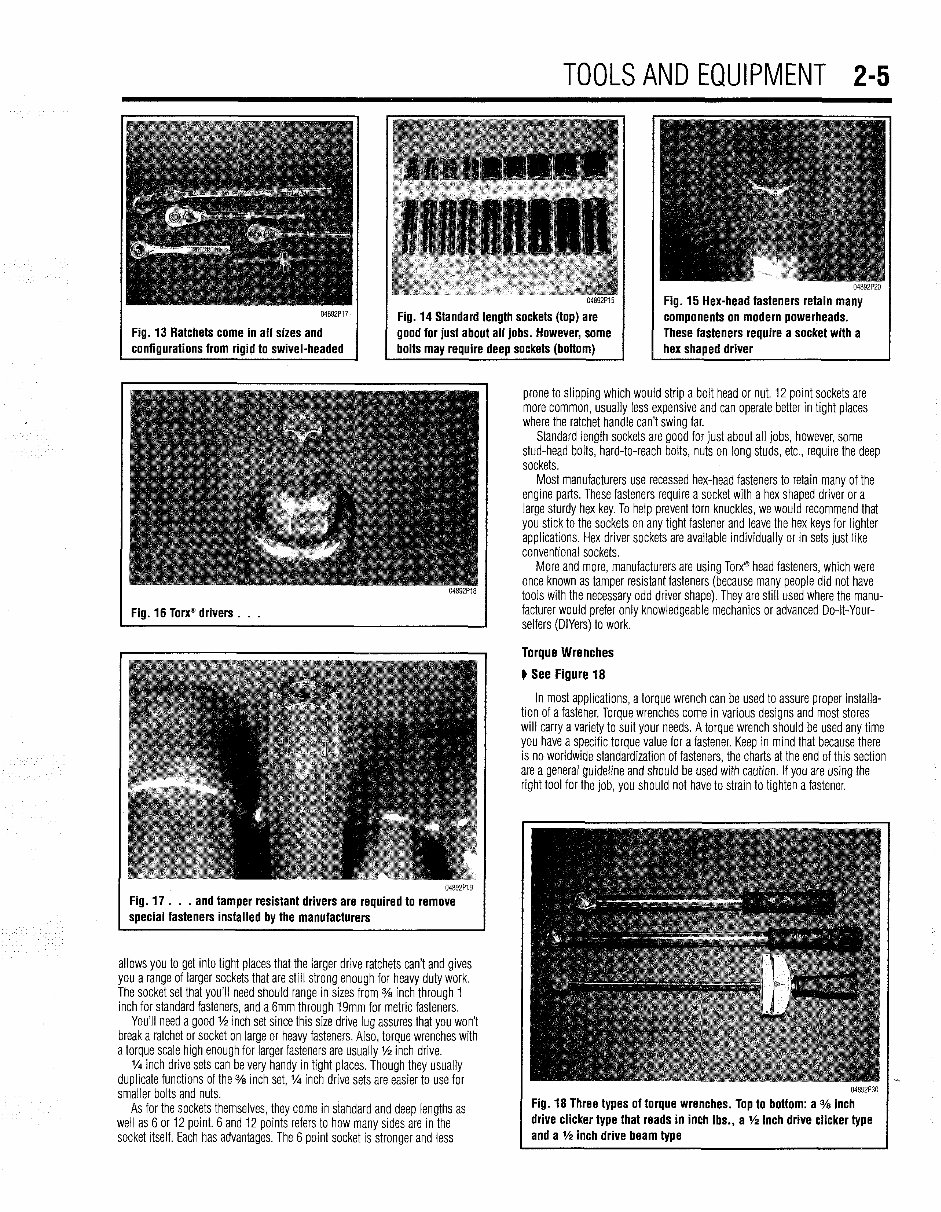
TOOLS AND EQUIPMENT 2-5 Fig. 16 Torxe drivers . . . Fig. 14 Standard length sockets (top) are Fio. 13 Ratchets come in a d sizes and good for iusf about all jobs. However, some configurations from rigid to swivel-headed 1 bolts may require deep sockets (bottom) 04892P19 Fig. 17 . . . and tamper resistant drivers are required to remove special fasteners installed by the manufacturers I allows you to get into tight places that the larger drive ratchets can't and gives you a range of larger sockets that are still strong enough for heavy duty work The socket set that you'll need should range in sizes from % inch through 1 inch for standard fasteners, and a 6mm through 19mm for metric fasteners You'll need a good Vi inch set since this size drive lug assures that you won't break a ratchet or socket on large or heavy fasteners Also, torque wrenches with a torque scale high enough for larger fasteners are usually Vi inch drive Y4 inch drive sets can be very handy in tight places Though they usually duplicate functions of the % inch set, inch drive sets are easier to use for smaller bolts and nuts As for the sockets themselves, they come in standard and deep lengths as well as 6 or 12 point 6 and 12 points refers to how many sides are in the socket itself Each has advantages The 6 point socket is stronger and less Fig. 15 Hex-head fasteners retain many components on modern powerheads. These fasteners require a socket with a hex shaped driver prone to slipping which would strip a bolt head or nut. 12 point sockets are more common, usually less expensive and can operate better in tight places where the ratchet handle can't swing far. Standard length sockets are good for just about all jobs, however, some stud-head bolts, hard-to-reach bolts, nuts on long studs, etc., require the deep sockets. Most manufacturers use recessed hex-head fasteners to retain many of the engine parts. These fasteners require a socket with a hex shaped driver or a large sturdy hex key. To help prevent torn knuckles, we would recommend that you stick to the sockets on any tight fastener and leave the hex keys for lighter applications. Hex driver sockets are available individually or in sets just like conventional sockets. More and more, manufacturers are using TorxB head fasteners, which were once known as tamper resistant fasteners (because many people did not have tools with the necessary odd driver shape). They are still used where the manu- facturer would prefer only knowledgeable mechanics or advanced Do-It-Your- sellers (DIYers) to work. Torque Wrenches à See Figure 18 In most applications, a torque wrench can be used to assure proper installa- tion of a fastener. Torque wrenches come in various designs and most stores will carry a variety to suit your needs. A torque wrench should be used any time you have a specific torque value for a fastener. Keep in mind that because there is no worldwide standardization of fasteners, the charts at the end of this section are a general guideline and should be used with caution. If you are using the right tool for the job, you should not have to strain to tighten a fastener. 04892P30 Fig. 18 Three types of torque wrenches. Top to bottom: a % inch drive clicker type that reads in inch Ibs., a Vs. inch drive clicker type and a Vz inch drive beam type
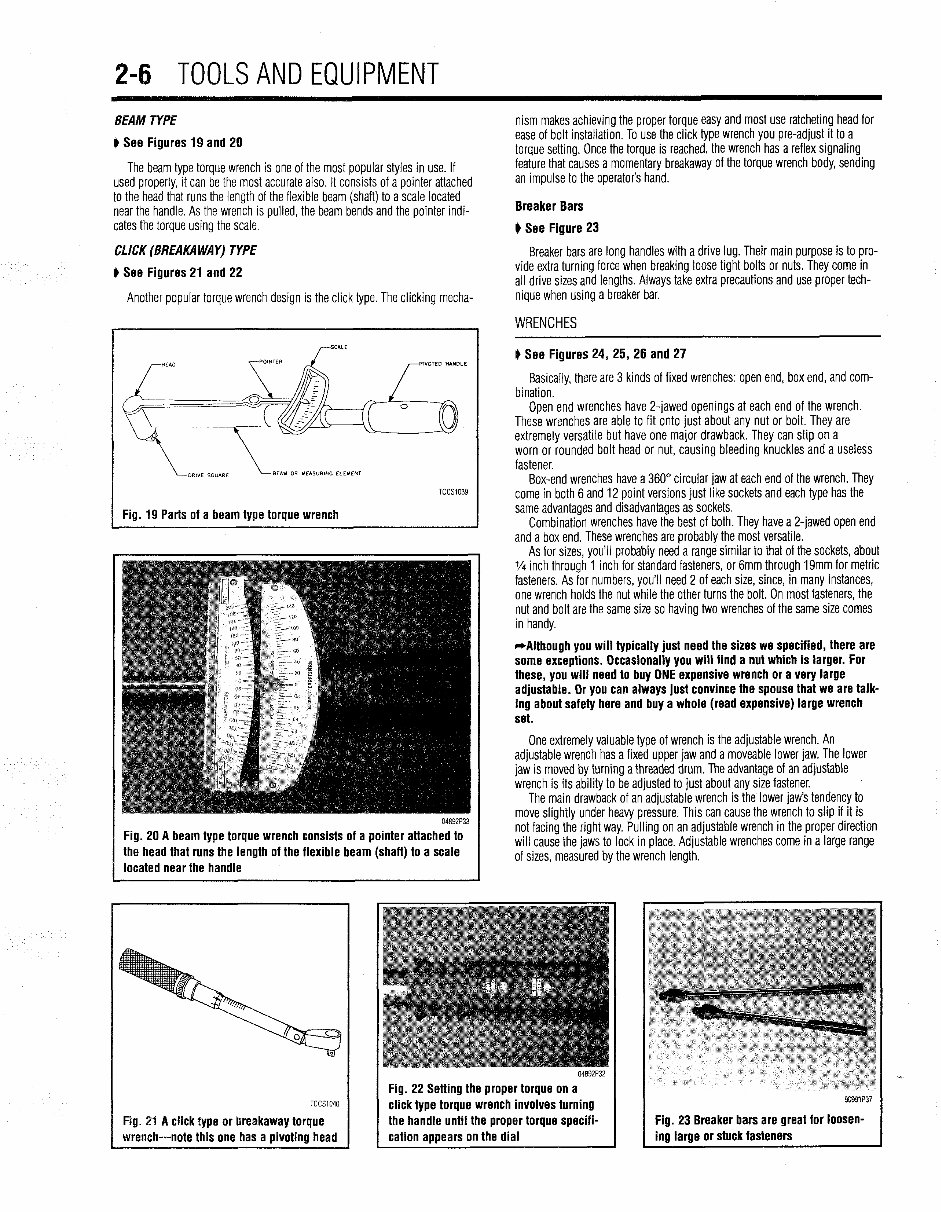
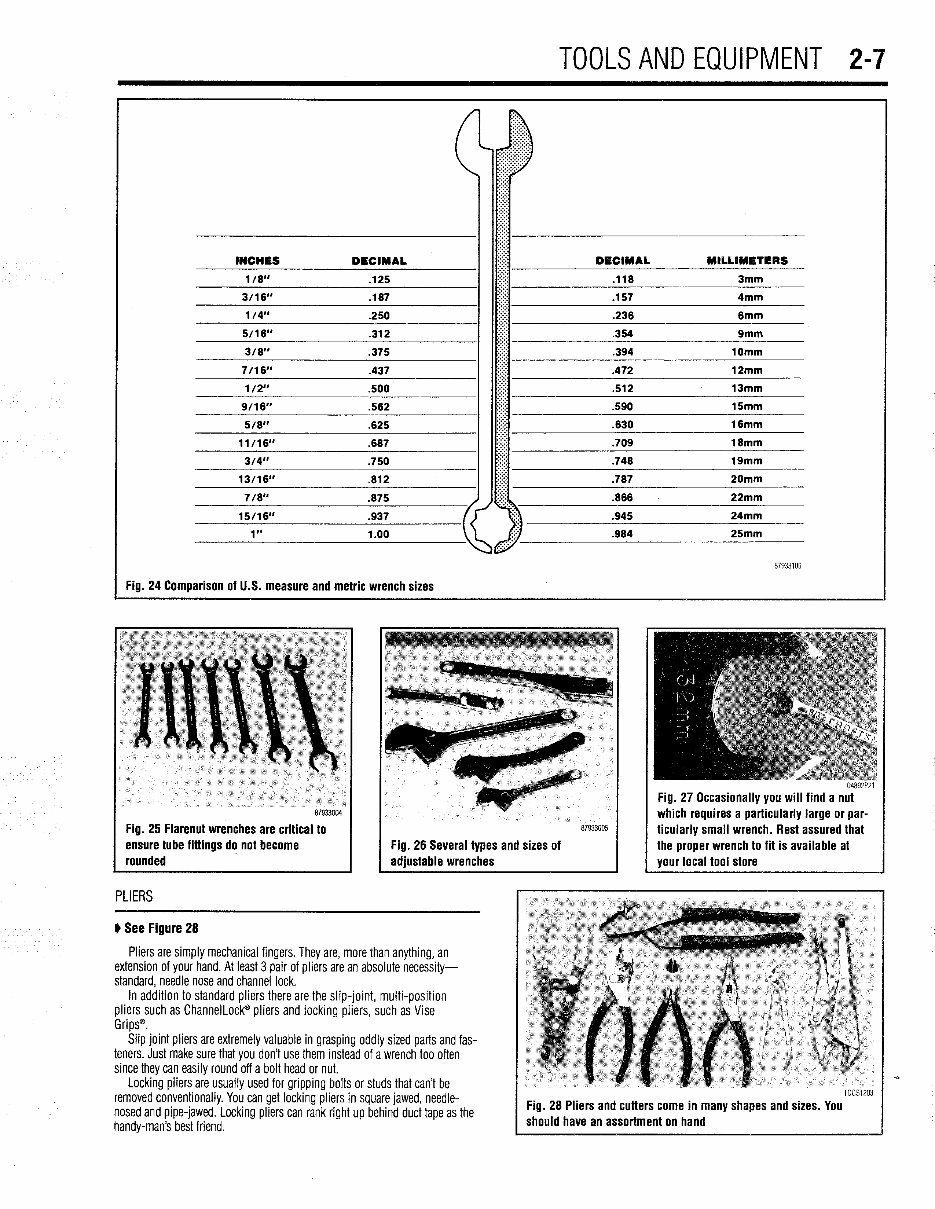
TOOLS AND EQUIPMENT BEAM TYPE à See Figures 19 and 20 The beam type torque wrench is one of the most popular styles in use. If used properly, it can be the most accurate also. It consists of a pointer attached to the head that runs the length of the flexible beam (shaft) to a scale located near the handle. As the wrench is pulled, the beam bends and the pointer indi- cates the torque using the scale. CLICK (BREAKAWAY) TYPE Si See Figures 21 and 22 Another popular torque wrench design is the click type. The clicking mecha- Fig. 19 Parts of a beam type torque wrench 1 04892P33 Fig. 20 A beam type torque wrench consists of a pointer attached to the head that runs the length of the flexible beam (shaft) to a scale located near the handle Fig. 21 A click type or breakaway torque wrench-note this one has a pivoting head nism makes achieving the proper torque easy and most use ratcheting head for ease of bolt installation. To use the click type wrench you pre-adjust it to a torque setting. Once the torque is reached, the wrench has a reflex signaling feature that causes a momentary breakaway of the torque wrench body, sending an impulse to the operator's hand. Breaker Bars à See Figure 23 Breaker bars are long handles with a drive lug. Their main purpose is to pro- vide extra turning force when breaking loose tight bolts or nuts. They come in all drive sizes and lengths. Always take extra precautions and use proper tech- nique when using a breaker bar. WRENCHES > See Figures 24, 25,26 and 27 Basically, there are 3 kinds of fixed wrenches: open end, box end, and com- bination. Open end wrenches have 2-jawed openings at each end of the wrench. These wrenches are able to fit onto just about any nut or bolt. They are extremely versatile but have one major drawback. They can slip on a worn or rounded bolt head or nut, causing bleeding knuckles and a useless fastener. Box-end wrenches have a 360 circular jaw at each end of the wrench. They come in both 6 and 12 point versions just like sockets and each type has the same advantages and disadvantages as sockets. Combination wrenches have the best of both. They have a 2-jawed open end and a box end. These wrenches are probably the most versatile. As for sizes, you'll probably need a range similar to that of the sockets, about i/n inch through 1 inch for standard fasteners, or 6mm through 19mm for metric fasteners. As for numbers, you'll need 2 of each size, since, in many instances, one wrench holds the nut while the other turns the bolt. On most fasteners, the nut and bolt are the same size so having two wrenches of the same size comes in handy. *Although you will typically just need the sizes we specified, there are some exceptions. Occasionally you will find a nut which is larger. For these, you will need to buy ONE expensive wrench or a very large adjustable. Or you can always just convince the spouse that we are talk- ing about safety here and buy a whole (read expensive) large wrench set. One extremely valuable type of wrench is the adjustable wrench. An adjustable wrench has a fixed upper jaw and a moveable lower jaw. The lower jaw is moved by turning a threaded drum. The advantage of an adjustable wrench is its ability to be adjusted to just about any size fastener. The main drawback of an adjustable wrench is the lower jaw's tendency to move slightly under heavy pressure. This can cause the wrench to slip if it is not facing the right way. Pulling on an adjustable wrench in the proper direction will cause the jaws to lock in place. Adjustable wrenches come in a large range of sizes, measured by the wrench length. Fig. 22 Setting the proper torque on a click type torque wrench involves turning the handle until the proper torque specifi- 90991P37 Fig. 23 Breaker bars are great for loosen- ing laroe or stuck fasteners
TOOLS AND EQUIPMENT 2-7 INCHES DECIMAL DECIMAL MILLIMETERS Fig. 24 Comparison of U.S. measure and metric wrench sizes Fig. 25 Flarenut wrenches are critical to ensure tube fittings do not become PLIERS Fig. 26 Several types and sizes of adjustable wrenches à See Figure 28 Pliers are simply mechanical fingers. They are, more than anything, an extension of your hand. At least 3 pair of pliers are an absolute necessity- standard, needle nose and channel lock. In addition to standard pliers there are the slip-joint, multi-position pliers such as ChannelLocP pliers and locking pliers, such as Vise Grips? Slip joint pliers are extremely valuable in grasping oddly sized parts and fas- teners. Just make sure that you don't use them instead of a wrench too often since they can easily round off a bolt head or nut. Locking pliers are usually used for gripping bolts or studs that can't be removed conventionally. You can get locking pliers in square jawed, needle- nosed and pipe-jawed. Locking pliers can rank right up behind duct tape as the handy-man's best friend. Fig. 27 Occasionally you will find a nut-. which requires a particularly large or par- ticularly small wrench. Rest assured that the proper wrench to fit is available at your local tool store Fig. 28 Pliers and cutters come in many shapes and sizes. You should have an assortment on hand
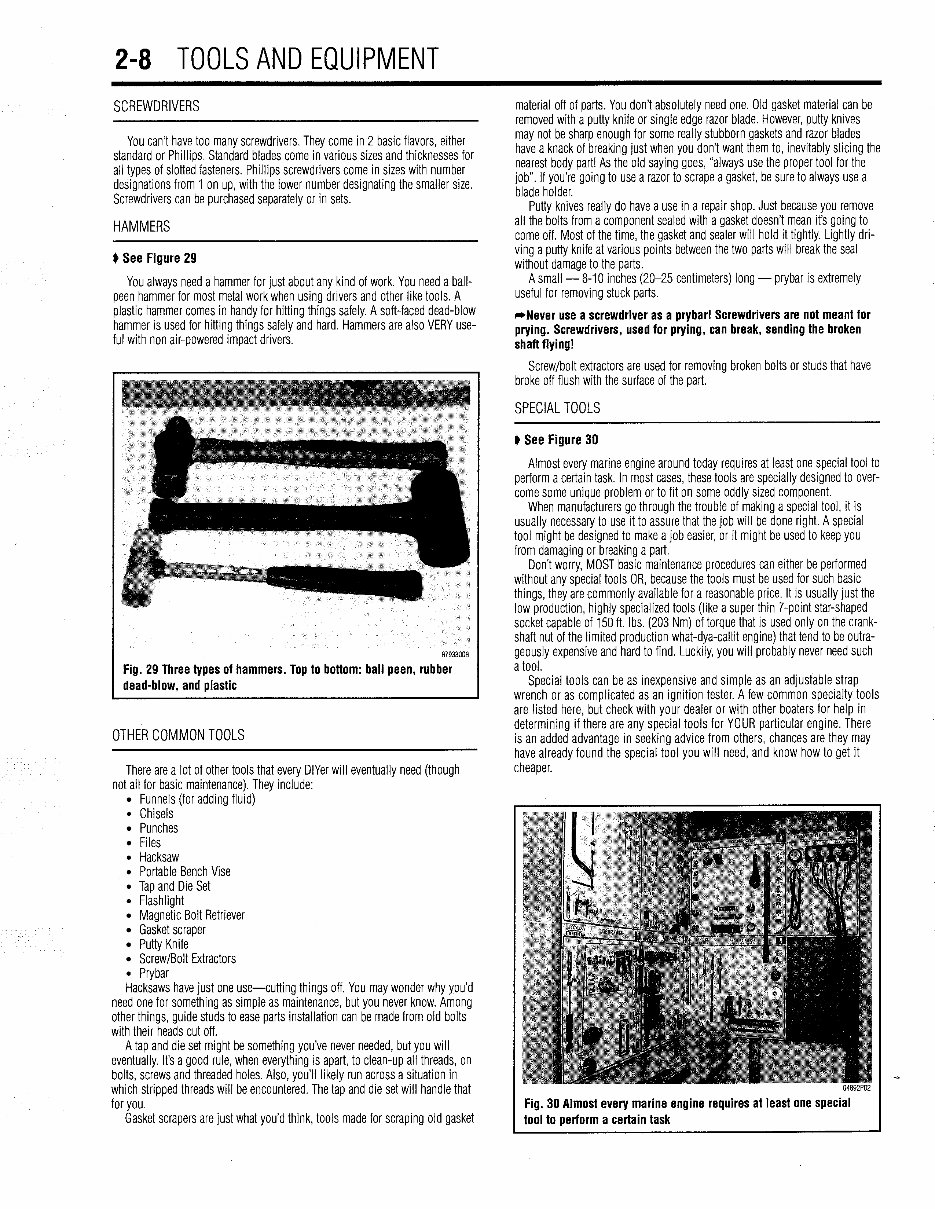
2-8 TOOLS AND EQUIPMENT SCREWDRIVERS You can't have too many screwdrivers. They come in 2 basic flavors, either standard or Phillips. Standard blades come in various sizes and thicknesses for all types of slotted fasteners. Phillips screwdrivers come in sizes with number designations from 1 on up, with the lower number designating the smaller size. Screwdrivers can be purchased separately or in sets. HAMMERS > See Figure 29 You always need a hammer for just about any kind of work. You need a ball- peen hammer for most metal work when using drivers and other like tools. A plastic hammer comes in handy for hitting things safely. A soft-faced dead-blow hammer is used for hitting things safely and hard. Hammers are also VERY use- ful with non air-powered impact drivers. Fig. 29 Three types of hammers. Top to bottom: ball peen, rubber dead-blow, and plastic OTHER COMMON TOOLS There are a lot of other tools that every DIYer will eventually need (though not all for basic maintenance). They include: Funnels (for adding fluid) Chisels Punches Files Hacksaw Portable Bench Vise Tap and Die Set Flashlight Magnetic Bolt Retriever Gasket scraper Putty Knife ScrewIBolt Extractors Prybar Hacksaws have just one use-cutting things off. You may wonder why you'd need one for something as simple as maintenance, but you never know. Among other things, guide studs to ease parts installation can be made from old bolts with their heads cut off. A tap and die set might be something you've never needed, but you will eventually. It's a good rule, when everything is apart, to clean-up all threads, on bolts, screws and threaded holes. Also, you'll likely run across a situation in which stripped threads will be encountered. The tap and die set will handle that for you. Gasket scrapers are just what you'd think, tools made for scraping old gasket material off of parts. You don't absolutely need one. Old gasket material can be removed with a putty knife or single edge razor blade. However, putty knives may not be sharp enough for some really stubborn gaskets and razor blades have a knack of breaking just when you don't want them to, inevitably slicing the nearest body part! As the old saying goes, "always use the proper tool for the job". If you're going to use a razor to scrape a gasket, be sure to always use a blade holder. Putty knives really do have a use in a repair shop. Just because you remove all the bolts from a component sealed with a gasket doesn't mean it's going to come off. Most of the time, the gasket and sealer will hold it tightly. Lightly dri- ving a putty knife at various points between the two parts will break the seal without damage to the parts. A small - 8-10 inches (20-25 centimeters) long - prybar is extremely useful for removing stuck parts. *Never use a screwdriver as a prybar! Screwdrivers are not meant for prying. Screwdrivers, used for prying, can break, sending the broken shaft flying! Screw/bolt extractors are used for removing broken bolts or studs that have broke off flush with the surface of the part. SPECIAL TOOLS # See Figure 30 Almost every marine engine around today requires at least one special tool to perform a certain task. In most cases, these tools are specially designed to over- come some unique problem or to fit on some oddly sized component. When manufacturers go through the trouble of making a special tool, it is usually necessary to use it to assure that the job will be done right. A special tool might be designed to make a job easier, or it might be used to keep you from damaging or breaking a part. Don't worry, MOST basic maintenance procedures can either be performed without any special tools OR, because the tools must be used for such basic things, they are commonly available for a reasonable price. It is usually just the low production, highly specialized tools (like a super thin 7-point star-shaped socket capable of 150 ft. Ibs. (203 Nm) of torque that is used only on the crank- shaft nut of the limited production what-dya-callit engine) that tend to be outra- geously expensive and hard to find. Luckily, you will probably never need such a tool. Special tools can be as inexpensive and simple as an adjustable strap wrench or as complicated as an ignition tester. A few common specialty tools are listed here. but check with vour dealer or with other boaters for helo in determining if there are any special tools for YOUR particular engine. There is an added advantage in seeking advice from others, chances are they may have already found the special tool you will need, and know how to get it cheaper. Fig. 30 Almost every marine engine requires at least one special tool to perform a certain task
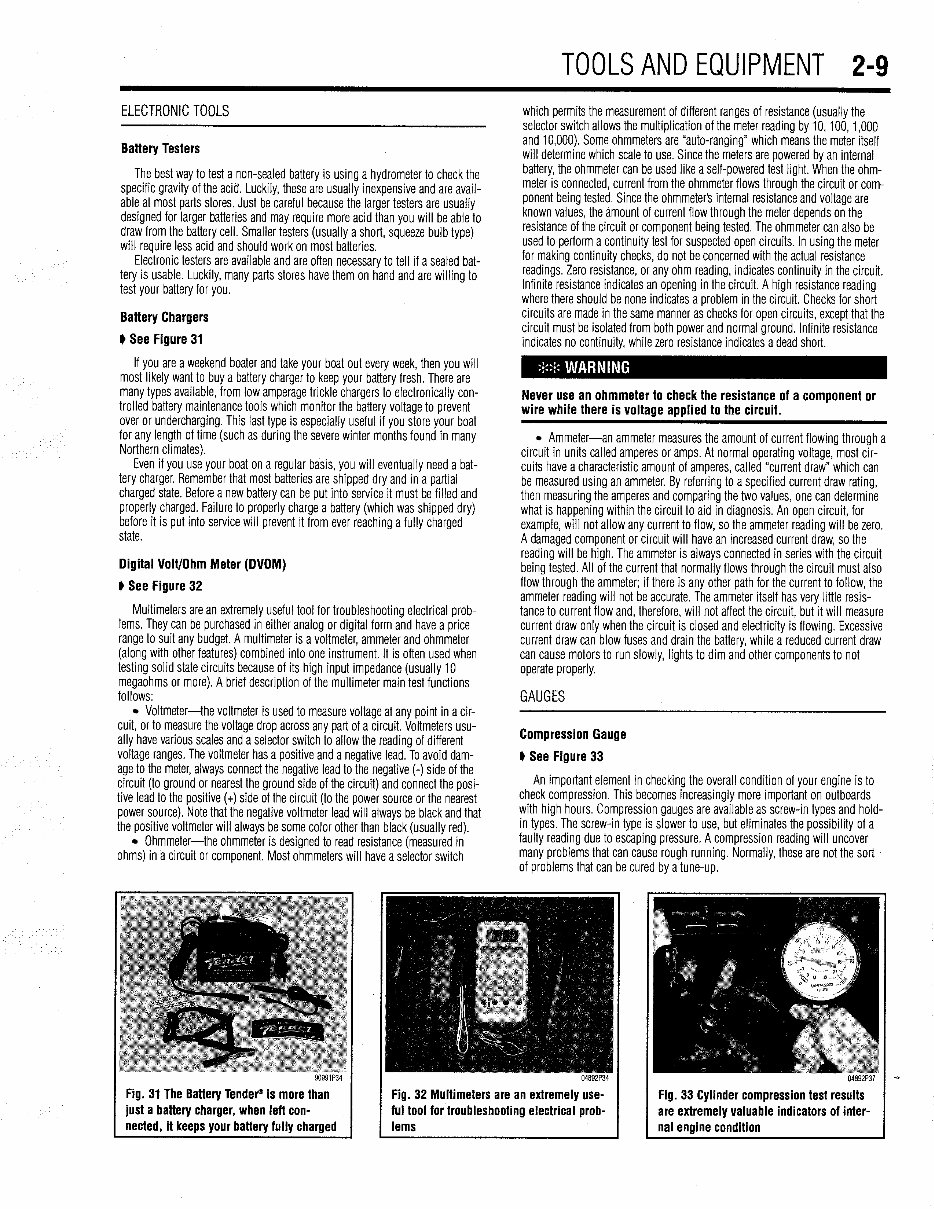
TOOLS AND EQUIPMENT 2-9 ELECTRONIC TOOLS Battery Testers The best way to test a non-sealed battery is using a hydrometer to check the specific gravity of the acid. Luckily, these are usually inexpensive and are avail- able at most parts stores. Just be careful because the larger testers are usually designed for larger batteries and may require more acid than you will be able to draw from the battery cell. Smaller testers (usually a short, squeeze bulb type) I require less acid and should work on most batteries. Electronic testers are available and are often necessary to tell if a sealed bat- tery is usable. Luckily, many parts stores have them on hand and are willing to test your battery for you. Battery Chargers > See Figure 31 If you are a weekend boater and take your boat out every week, then you will most likely want to buy a battery charger to keep your battery fresh. There are many types available, from low amperage trickle chargers to electronically con- trolled battery maintenance tools which monitor the battery voltage to prevent over or undercharging. This last type is especially useful if you store your boat for any length of time (such as during the severe winter months found in many Northern climates). Even if you use your boat on a regular basis, you will eventually need a bat- tery charger. Remember that most batteries are shipped dry and in a partial charged state. Before a new battery can be put into service it must be filled and properly charged. Failure to properly charge a battery (which was shipped dry) before it is put into service will prevent it from ever reaching a fully charged state. Digital VoltIOhm Meter (DVOM) > See Figure 32 Multimeters are an extremely useful tool for troubleshooting electrical prob- lems. They can be purchased in either analog or digital form and have a price range to suit any budget. A multimeter is a voltmeter, ammeter and ohmmeter (along with other features) combined into one instrument. It is often used when testing solid state circuits because of its high input impedance (usually 10 megaohms or more). A brief description of the multimeter main test functions follows: Voltmeter-the voltmeter is used to measure voltage at any point in a cir- cuit, or to measure the voltage drop across any part of a circuit. Voltmeters usu- ally have various scales and a selector switch to allow the reading of different voltage ranges. The voltmeter has a positive and a negative lead. To avoid dam- age to the meter, always connect the negative lead to the negative (-) side of the circuit (to ground or nearest the ground side of the circuit) and connect the posi- tive lead to the positive (t) side of the circuit (to the power source or the nearest power source). Note that the negative voltmeter lead will always be black and that the positive voltmeter will always be some color other than black (usually red). Ohmmeter-the ohmmeter is designed to read resistance (measured in ohms) in a circuit or component. Most ohmmeters will have a selector switch Fig. 31 The Battery Tender" is more than just a battery charger, when left con- nected, it keeps your battery fully charged which permits the measurement of different ranges of resistance (usually the selector switch allows the multiplication of the meter reading by 10,100,1,000 and 10,000). Some ohmmeters are "auto-ranging" which means the meter itself I determine which scale to use. Since the meters are powered by an internal battery, the ohmmeter can be used like a self-powered test light. When the ohm- meter is connected, current from the ohmmeter flows through the circuit or com- ponent being tested. Since the ohmmeter's internal resistance and voltage are known values, the amount of current flow through the meter depends on the resistance of the circuit or component being tested. The ohmmeter can also be used to perform a continuity test for suspected open circuits. In using the meter for making continuity checks, do not be concerned with the actual resistance readings. Zero resistance, or any ohm reading, indicates continuity in the circuit. Infinite resistance indicates an opening in the circuit. A high resistance reading where there should be none indicates a problem in the circuit. Checks for short circuits are made in the same manner as checks for open circuits, except that the circuit must be isolated from both power and normal ground. Infinite resistance indicates no continuity, while zero resistance indicates a dead short. Never use an ohmmeter to check the resistance of a component or wire while there is voltaoe aoolied to the circuit. Ammeter-an ammeter measures the amount of current flowing through a circuit in units called amperes or amps. At normal operating voltage, most cir- cuits have a characteristic amount of amperes, called "current draw" which can be measured using an ammeter. By referring to a specified current draw rating, then measuring the amperes and comparing the two values, one can determine what is happening within the circuit to aid in diagnosis. An open circuit, for example, will not allow any current to flow, so the ammeter reading will be zero. A damaged component or circuit will have an increased current draw, so the reading will be high. The ammeter is always connected in series with the circuit being tested. All of the current that normally flows through the circuit must also flow through the ammeter; if there is any other path for the current to follow, the ammeter reading will not be accurate. The ammeter itself has very little resis- tance to current flow and, therefore, will not affect the circuit, but it will measure current draw only when the circuit is closed and electricity is flowing. Excessive current draw can blow fuses and drain the battery, while a reduced current draw can cause motors to run slowly, lights to dim and other components to not operate properly. GAUGES Compression Gauge I See Figure 33 An important element in checking the overall condition of your engine is to check compression. This becomes increasingly more important on outboards with high hours. Compression gauges are available as screw-in types and hold- in types. The screw-in type is slower to use, but eliminates the possibility of a faulty reading due to escaping pressure. A compression reading will uncover many problems that can cause rough running. Normally, these are not the sort of problems that can be cured by a tune-up. Fig. 32 Multimeters are an extremely use- ful tool for troubleshooting electrical prob- Fig. 33 Cylinder compression test results are extremely valuable indicators of inter- nal engine condition
Our repair manual, owner's manuals, and parts catalogs provide all the information you need for repairs, parts lookup, and routine maintenance on your machine. You will have access to information regarding the following topics:
General information
Routine maintenance
Engine removal and installation
Fuel system
Lubrication and cooling system
Engine specifications
Transmission, drive chain & sprockets
Steering system
Shocks
Body work
Intake & exhaust
Electrical system
Advanced troubleshooting
And more!
With our downloadable repair manual, find the page pertaining to your job, print it off, and start working on your machine without ruining your expensive paper shop manual with grease and dirt.
Broken down on the trail or site and have a smartphone? Our downloadable repair manual provides instant access to the material needed to get you running again, with no downtime on the job site.
All our repair manuals come with a lifetime protection policy. If lost or damaged, simply contact us, and we'll replace it free of charge for life.
We provide various repair service manuals, workshop manuals, repair manuals, owner's manuals, parts catalogs, and other various manuals in an electronic downloadable format for UTVs, motorcycles, ATVs, quads, snowmobiles, Seadoos, equipment, small engines, inboards, outboards, and more.




 Lifetime Access