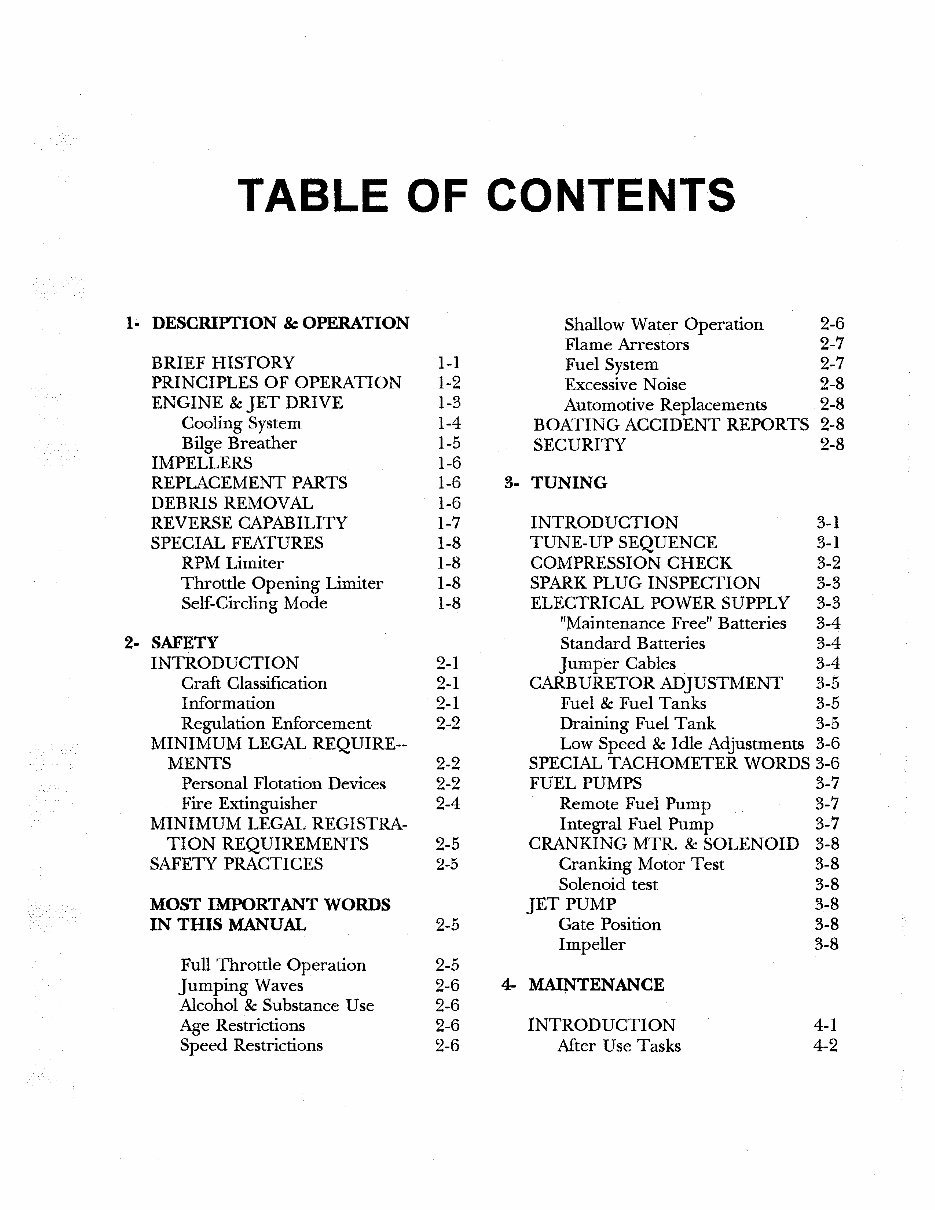
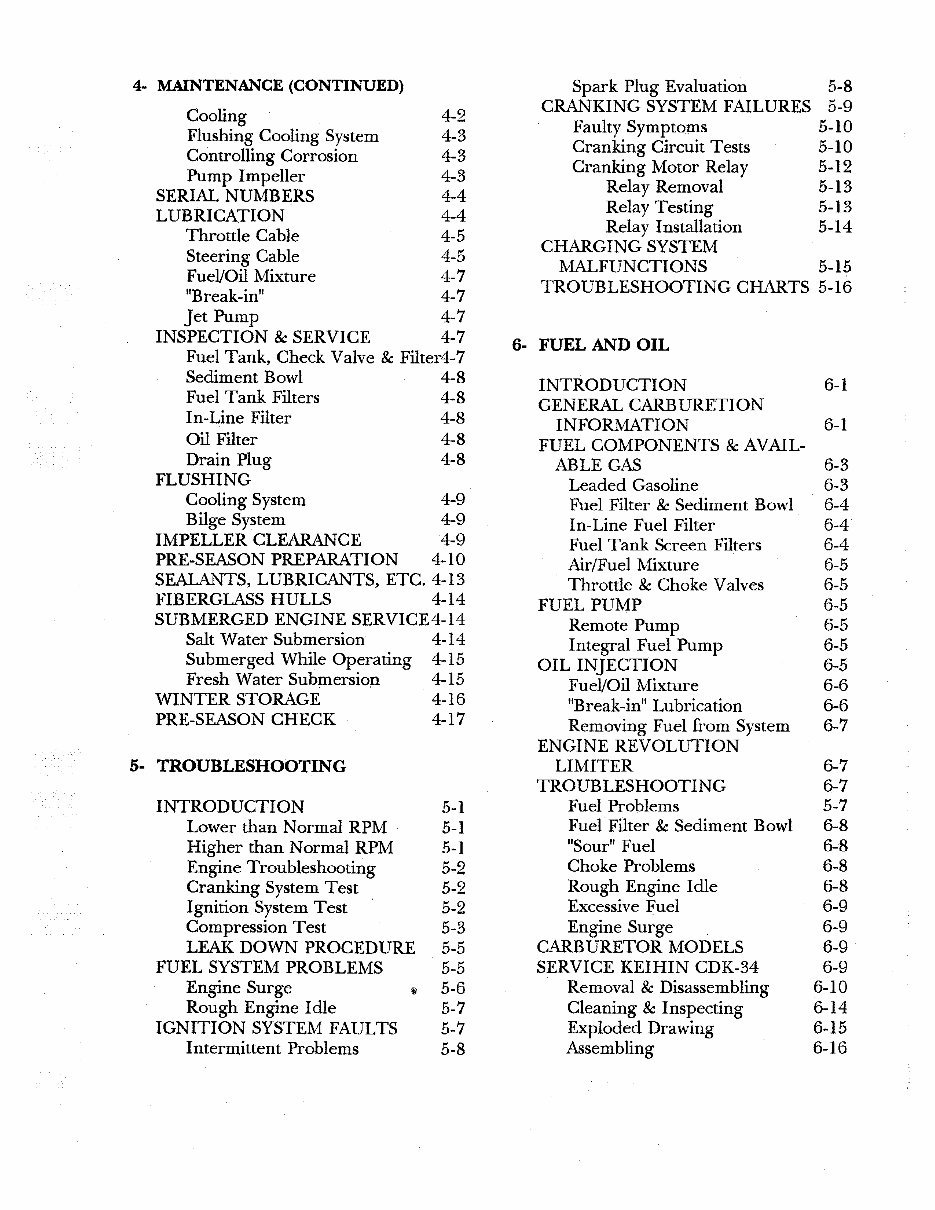
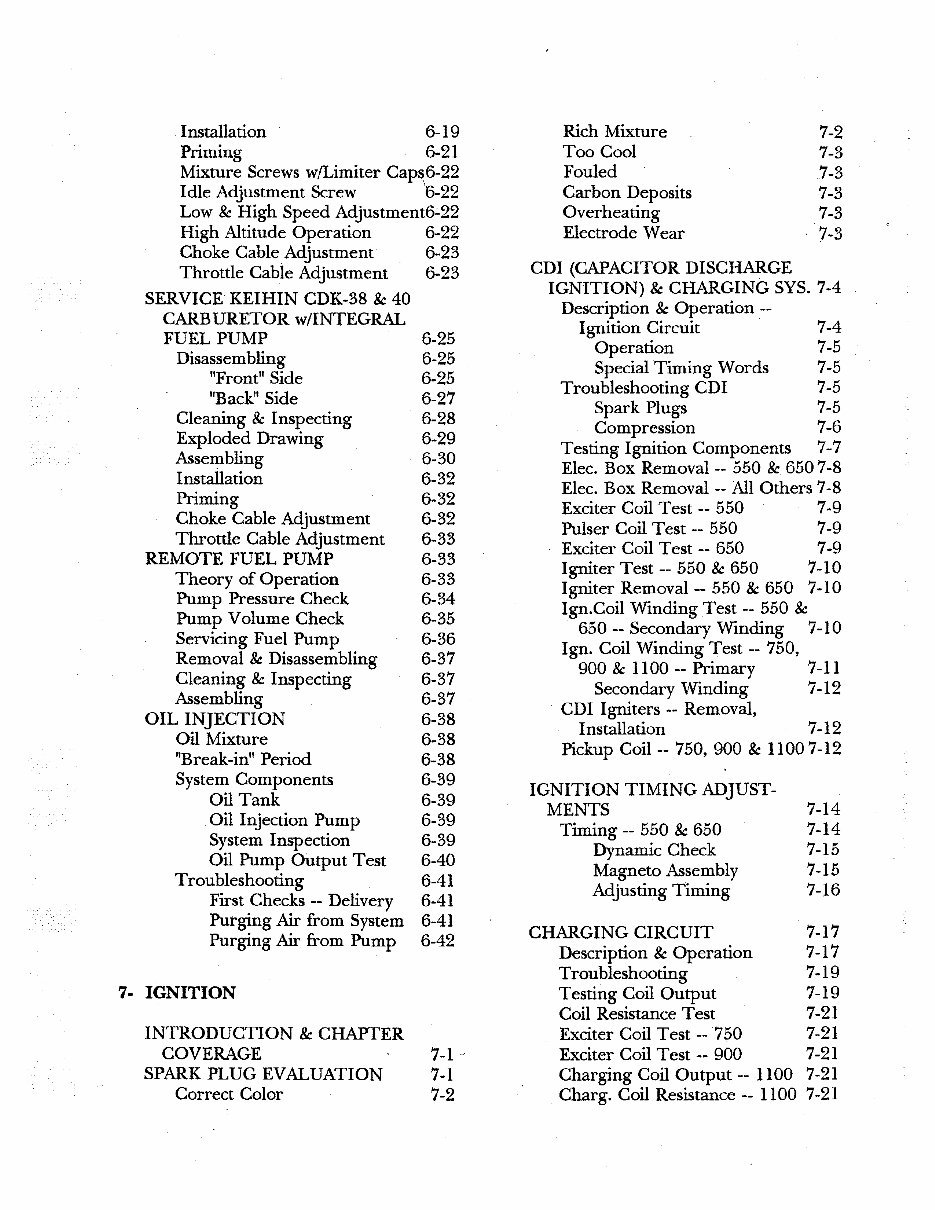
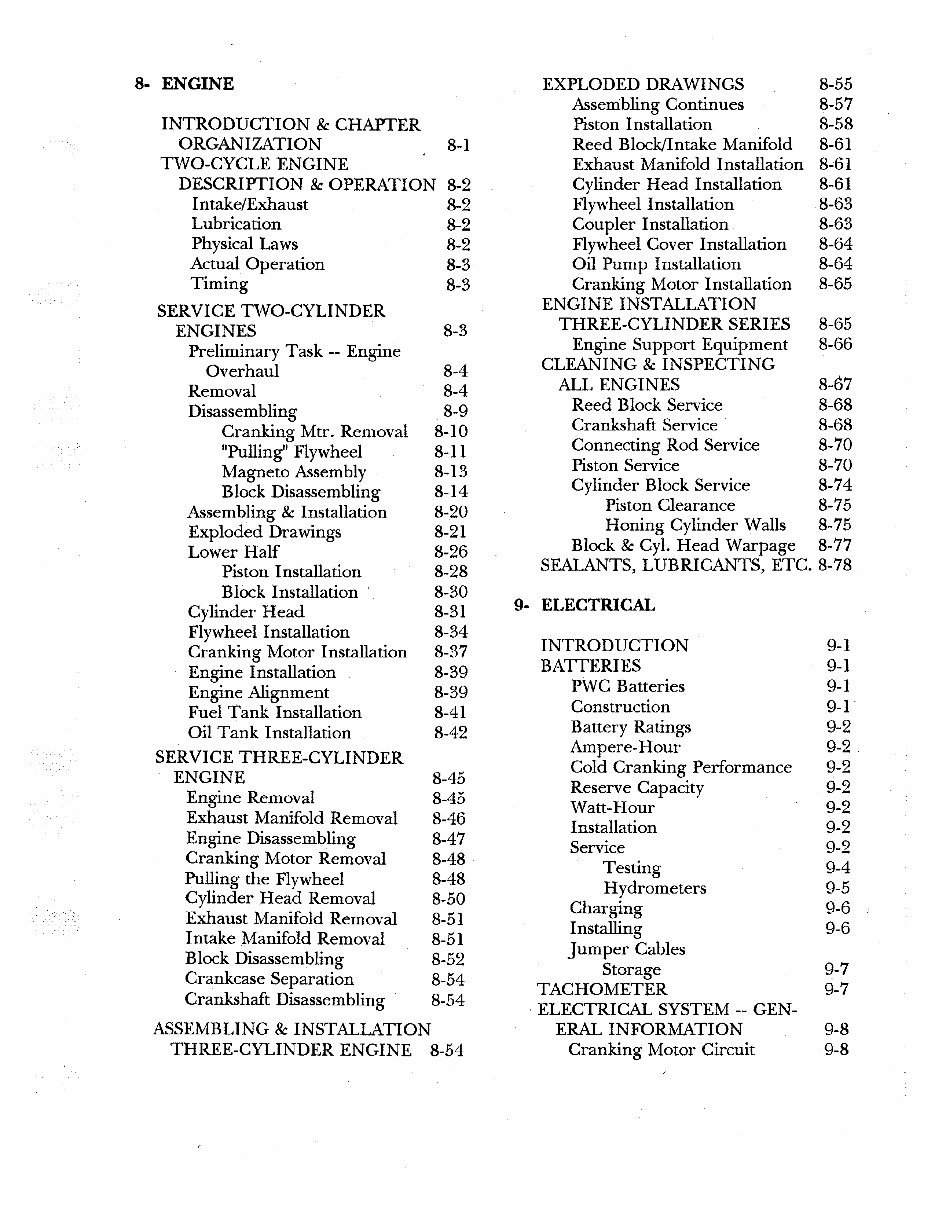
Ignition CRANKING MOTOR CIRCUIT Theory of Operation Cranking Motor Noises Faulty Symptoms CRANKING MOTOR TROUBLE- SHOOTING Circuit Tests Motor Relay Removal for Testing Relay Testing Relay Installation CRANKING MOTOR SERVICE Description Diagrams Inside Elec. Box Motor Removal Disassembling Cleaning & Inspecting Testing Motor Parts Assembling Installation TESTING OTHER ELECTRICAL COMPONENTS Start Button Test Safety Switch Stop Switch Stop Switch Relay Electric Bilge Pump Electric Fan Temperature Warning Sys. Overheat Buzzer ELECTRIC TRIM SYSTEM 10 JET PUMP INTRODUCTION Model Identification and 9-9 9-9 9-9 9-10 9-11 9-11 9-11 9-12 9-14 9-14 9-15 9-15 9-16 9-18 9-18 9-21 9-24 9-26 9-27 9-30 9-31 9-31 9-31 9-31 9-32 9-32 9-32 9-33 9-33 10-1 Chapter Coverage 10-1 Jet Pump Description 10-2 Axial Flow 10-2 Mixed Flow 10-2 IMPELLERS 10-3 Cavitation Burns 10-3 Cooling Water and Bilge Hoses1O-4 I IMPELLER-TO-PUMP CASE CLEARANCE 10-5 Axial Flow Pump 10-5 Mixed Flow Pump 10-6 JET PUMP SERVICE 10-6 Removal 10-7 Impeller Alignment 10-9 Disassembling 10-10 Impeller Removal 10-12 Impeller Shaft Removal 10-13 Cleaning & Inspecting 10-15 Exploded Drawings 10-16 Assembling 10-20 Shimming Procedures -- 550 10-'21 Impeller Installation --550 10-23 Impeller Installation -- All Others 10-25 Pump Installation 10-27 BEARING HOUSING SERVICE 10-30 Removal 10-30 . Disassembling 10-31 Cleaning & Inspecting 10-32 11 CONTROL ADJUSTMENTS INTRODUCTION 11-1 STEERING CABLE 11-1 REVERSE CABLE 11-2 TRIM CABLE 11-3 APPENDIX METRIC CONVERSION CHART A-I RECOMMENDED TORQUE VALUES A-2 ENGINE SPECIFICATIONS AND TUNE- UP ADJUSTMENTS A-4 WIRING DIAGRAMS & COLOR CODE IDENTIFICATION Model 550 Series Model 650 Series Model 750 Series Model 750 Hi-Performance Model 900 Hi-Performance Model 1100 Hi-Performance A-6 A-6 A-7 A-8 A-9 A-I0 A-ll
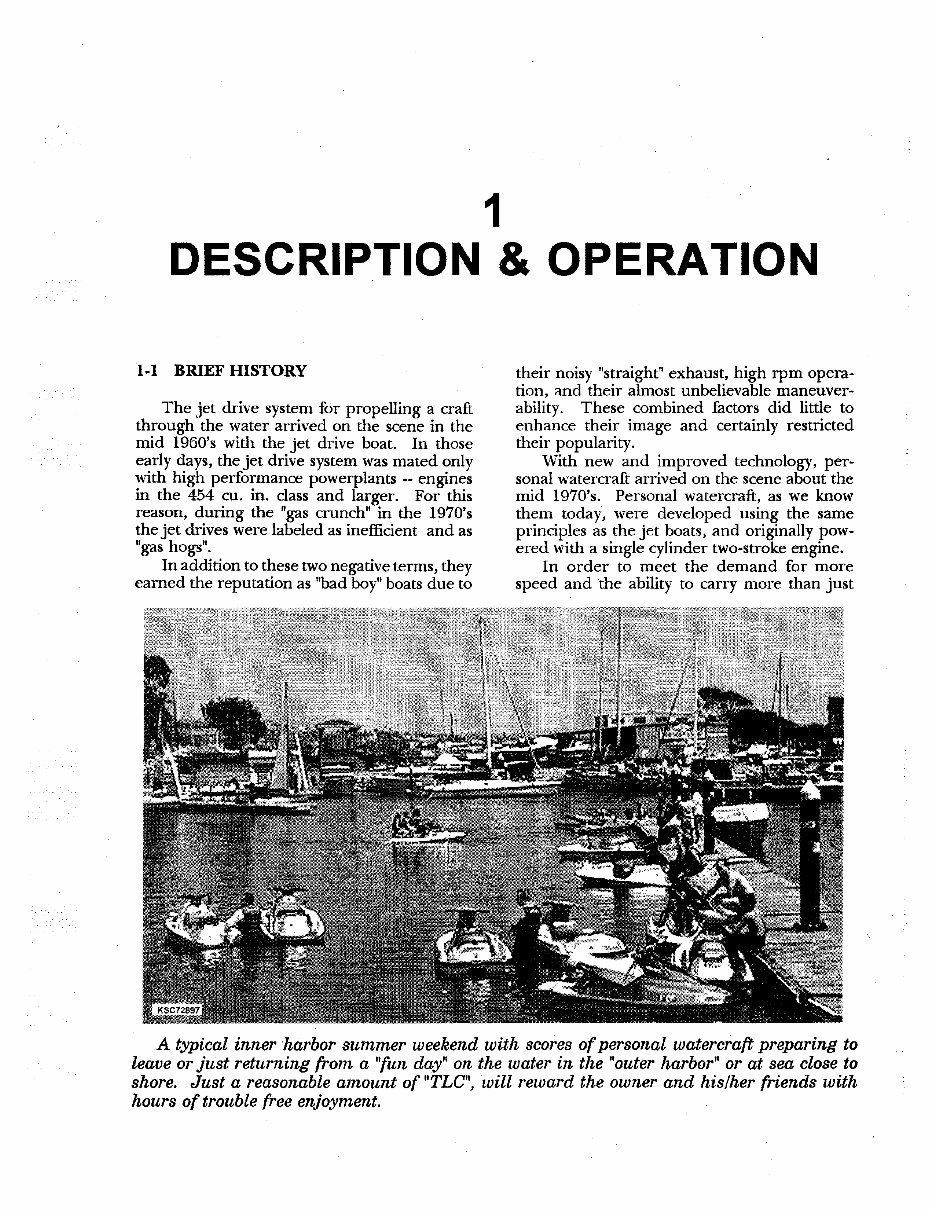
1 DESCRIPTION & OPERATION 1·1 BRIEF HISTORY The jet drive system for propelling a craft through the water arrived on the scene in the mid 1960's with the jet drive boat. In those early days, the jet drive system was mated only with high performance powerplants -- engines in the 454 cu. in. class and larger. For this reason, during the "gas crunch" in the 1970's the jet drives were labeled as inefficient and as "gas hogs". In addition to these two negative terms, they earned the reputation as "bad boy" boats due to their noisy "straight" exhaust, high rpm opera- tion, and their almost unbelievable maneuver- ability. These combined factors did little to enhance their image and certainly restricted their popularity. With new. and improved technology, per- sonal watercraft arrived on the scene about the mid 1970's. Personal watercraft, as we know them today, were developed using the same principles as the jet boats, and originally pow- ered with a single cylinder two-stroke engine. In order to meet the demand for more speed and the ability to carry more than just A typical inner harbor summer weekend with scores of personal watercraft preparing to leave or just returning from a "fun day" on the water in the "outer harbor" or at sea close to shore. Just a reasonable amount of "TLC", will reward the owner and his/her friends with hours of trouble free enjoyment.
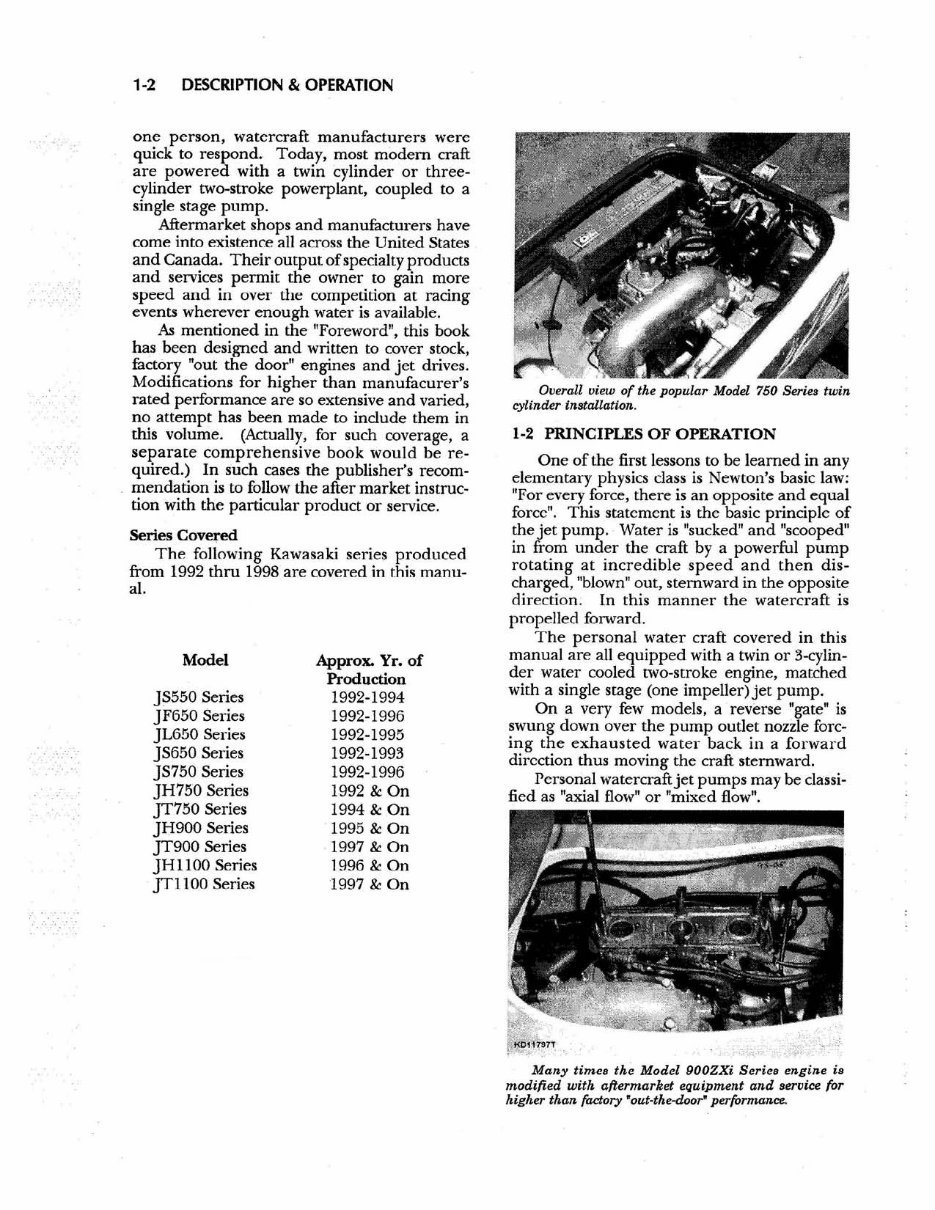
'-2 DESCRIPTION & OPERATION onc person, watercraft manufacturers were quick to respond. Today, most modem craft are powered with a twin cylinder or three- cylinder two-stroke powerplant, coupled to a single stage pump. Aftermarket shops and manufacturers have come into existence 311 acroros the United States and Canada. Their cmput of specialty products and services pennit the owner [Q gain more speed and in over the competition at racing evcnlll wherever enough water is available. As mentioned in the ~Forewordft. this book has been designed and written to cover stock, factory "out the door" engines and jet drives. Modifications for higher than manufa curer's rated performance are so extensive and varied, no attempt has been made to include them in this volume. (Actually, for such coverage, a separate comprehensive book would be re~ quired.) In such cases the publisher's recom~ mendation is La follow the after market iustruc· tion with the partirular product or service. Series Covered. The following KHwHsHki seri es produced from 1992 thru 1998 are covered in r.his manu~ aI. Model J5550 Series J F650 Series JL650 Series JS650 Series JS750 Series ]H750 Series JT7!S0 Series JH900 Series JT900 Series ]H 1100 Series JTl100 $eries ApproL Yr. of Production 1992-1994 1992-1996 1992-1995 1992-1993 1992-1996 1992 & On 1994 & On 1995 & On 1997 & On 1996 & On 1997 & On Overall view of the popular Model 750 Seiu twin cylinder installation. 1-2 PRINCIPLES OF OPERATION One of the first lessons to be lea rned in any elementary physics class is Newton's basic law: HFor every force, there is an opposite and equal force ". This statement is the basic principle of the jet pump. Water is "sucked" and "scooped" in from under the craft by a powerful pump rotating at incr e dible speed and then dis~ charged, Itblown~ out, stemward in the opposite direction . In this manner the watercraft is propelled fOlWard. The personal water craft covered in this manual are all equipped with a twin or 3-cylin- der water cooled £wo-stroke engine, matched with a single uage (one impeUer)je[ pump. On a very few models. a reverse "gate is swung down over the pump oullet nozzle forc- ing the e xhaust ed wa ter back in a forward direction thus moving the craft ste mward. Personal watercraft jet pumps may be classi- fi ed as "axial flow" or "mixed flow". Many time. the Model 900ZXi Serie. engine i. modified with a{rermarket equipment and service for higher than factory 'out-the-door" performance.
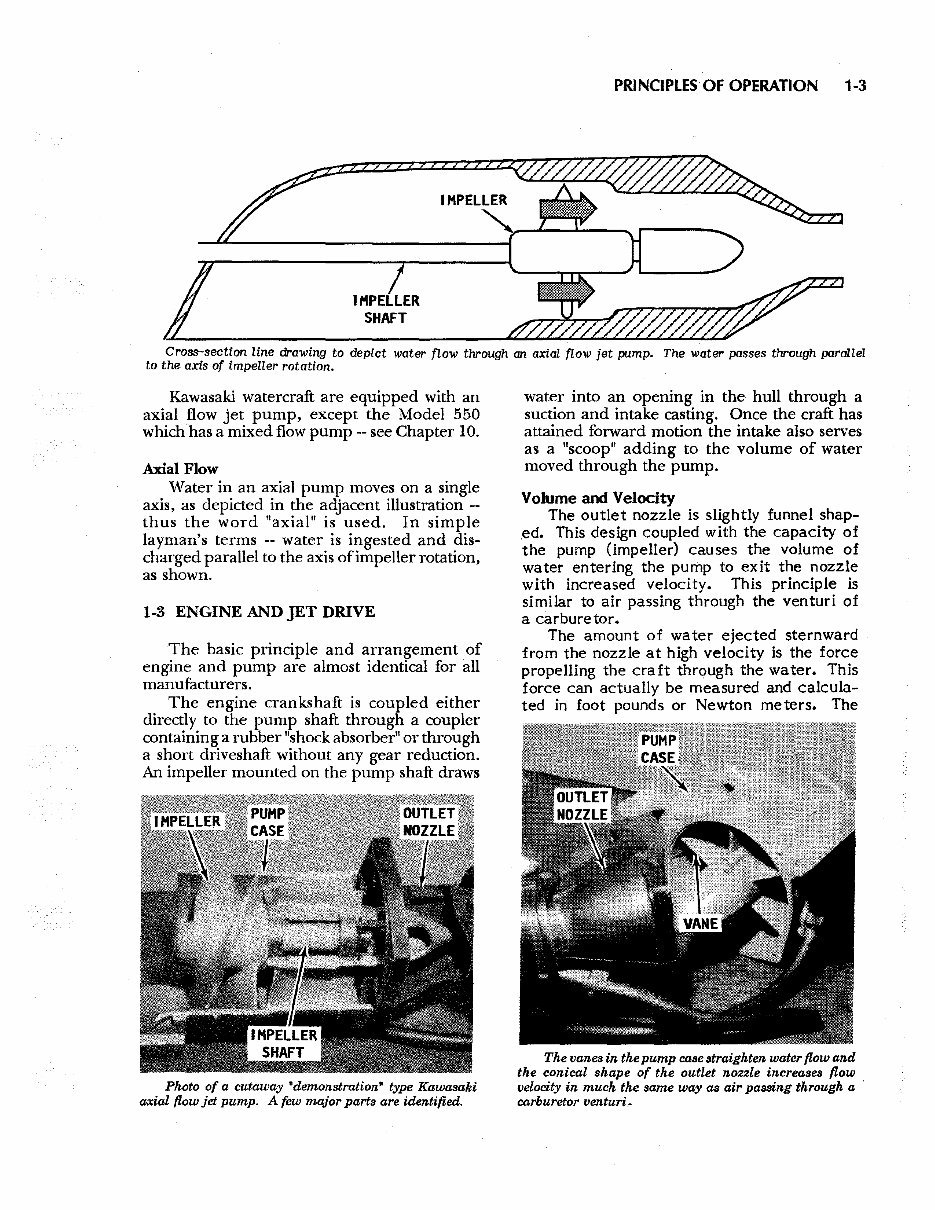
IMP SHAFT PRINCIPLES OF OPERATION 1-3 Cross-section line drawing to depict water flow through an axial flow jet pump. The water passes through parallel to the axis of impeller rotation. Kawasaki watercraft are equipped with an axial flow jet pump, except the Model 550 which has a mixed flow pump -- see Chapter 10. Axial Flow Water in an axial pump moves on a single axis, as depicted in the adjacent illustration -- thus the word "axial" is used. In simple layman's terms -- water is ingested and dis- charged parallel to the axis ofimpeller rotation, as shown. 1-3 ENGINE AND JET DRIVE The basic principle and arrangement of engine and pump are almost identical for all manufacturers. The engine crankshaft is coupled either directly to the pump shaft through a coupler containing a rubber "shock absorber" or through a short driveshaft without any gear reduction. An impeller mounted on the pump shaft draws Photo of a cutaway "demonstration" type Kawasaki axial flow jet pump. A few major parls are identified. water into an opening in the hull through a suction and intake casting. Once the craft has attained forward motion the intake also serves as a "scoop" adding to the volume of water moved through the pump. Volume and Velocity The outlet nozzle is slightly funnel shap- ed. This design coupled with the capacity of the pump (impeller) causes the volume of water entering the pump to exit the nozzle with increased velocity. This principle is similar to air passing through the venturi of a carburetor. The amount of water ejected sternward from the nozzle at high velocity is the force propelling the craft through the water. This force can actually be measured and calcula- ted in foot pounds or Newton meters. The The vanes in the pump case straighten water flow and the conical shape of the outlet nozzle increases flow velocity in much the same way as air paBBing through a ' carburetor venturi.
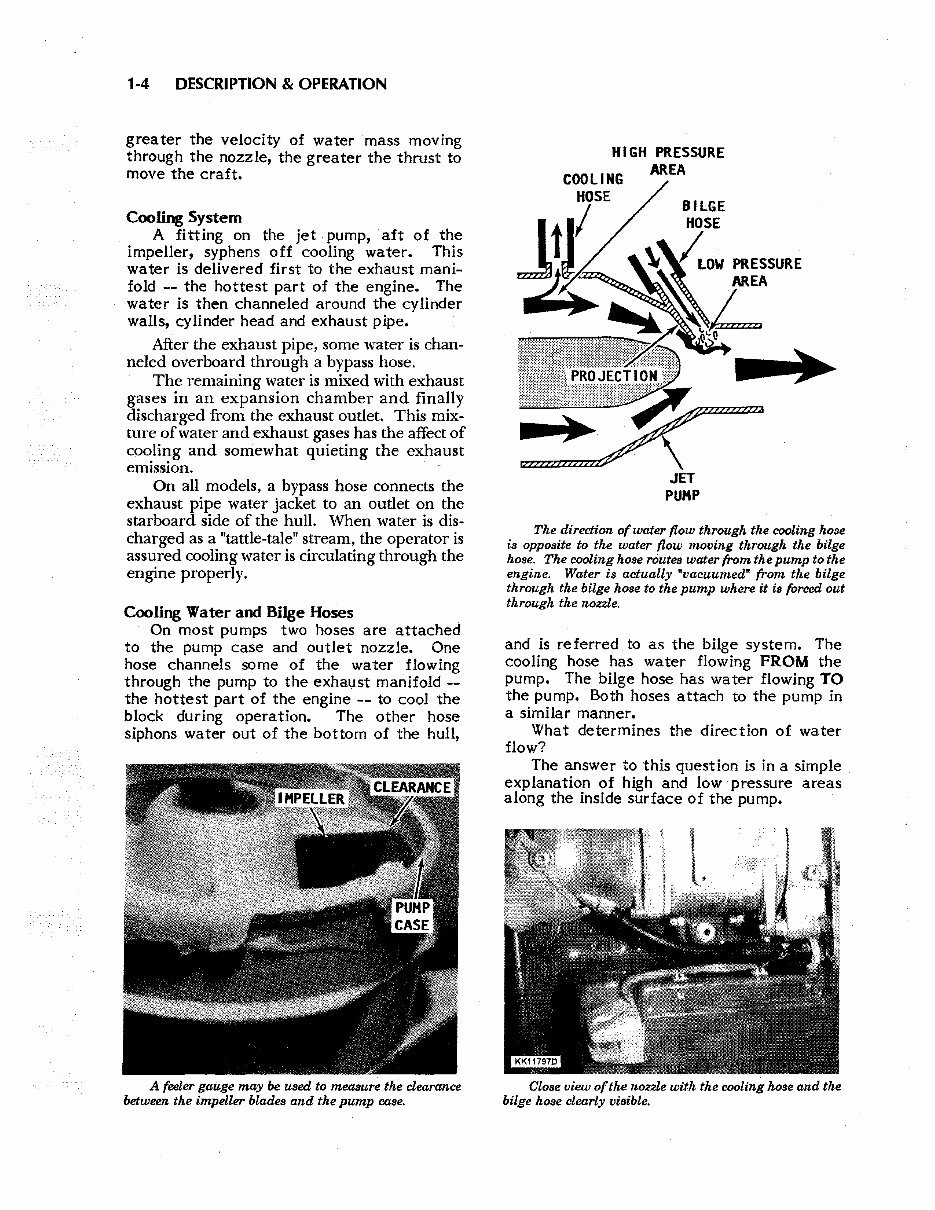
1-4 DESCRIPTION & OPERATION greater the velocity of water mass moving through the nozzle, the greater the thrust to move the craft. Cooling System A fitting on the jet. pump, aft of the impeller, syphens off cooling water. This water is delivered first to the exhaust mani- fold -- the hottest part of the engine. The water is then channeled around the cylinder walls, cylinder head and exhaust pipe. After the exhaust pipe, some water is chan- neled overboard through a bypass hose. The remaining water is mixed with exhaust gases in an expansion chamber and finally discharged from the exhaust outlet. This mix- ture of water and exhaust gases has the affect of cooling and somewhat quieting the exhaust emission. On all models, a bypass hose connects the exhaust pipe water jacket to an outlet on the starboard side of the hull. When water is dis- charged as a "tattle-tale" stream, the operator is assured cooling water is circulating through the engine properly. Cooling Water and Bilge Hoses On most pumps two hoses are attached to the pump case and outlet nozzle. One hose channels some of the water flowing through the pump to the exhaust manifold -- the hottest part of the engine -- to cool the block during operation. The other hose siphons water out of the bottom of the hull, A feeler gauge may be used to measure the clearance between the impeller blades and the pump case. HIGH PRESSURE COOLING AREA JET PUMP The direction of water flow through the cooling hose is opposite to the water flow moving through the bilge hose. The cooling hose routes water from the pump to the engine. Water is actually ·vacuumed" from the bilge through the bilge hose to the pump where it is forced out through the nozzle. and is referred to as the bilge system. The cooling hose has water flowing FROM the pump. The bilge hose has water flowing TO the pump. Both hoses attach to the pump in a similar manner. What determines the direction of water flow? The answer to this question is in a simple explanation of high and low pressure areas along the inside surface of the pump. Close view of the nozzle with the cooling hose and the bilge hose clearly visible.
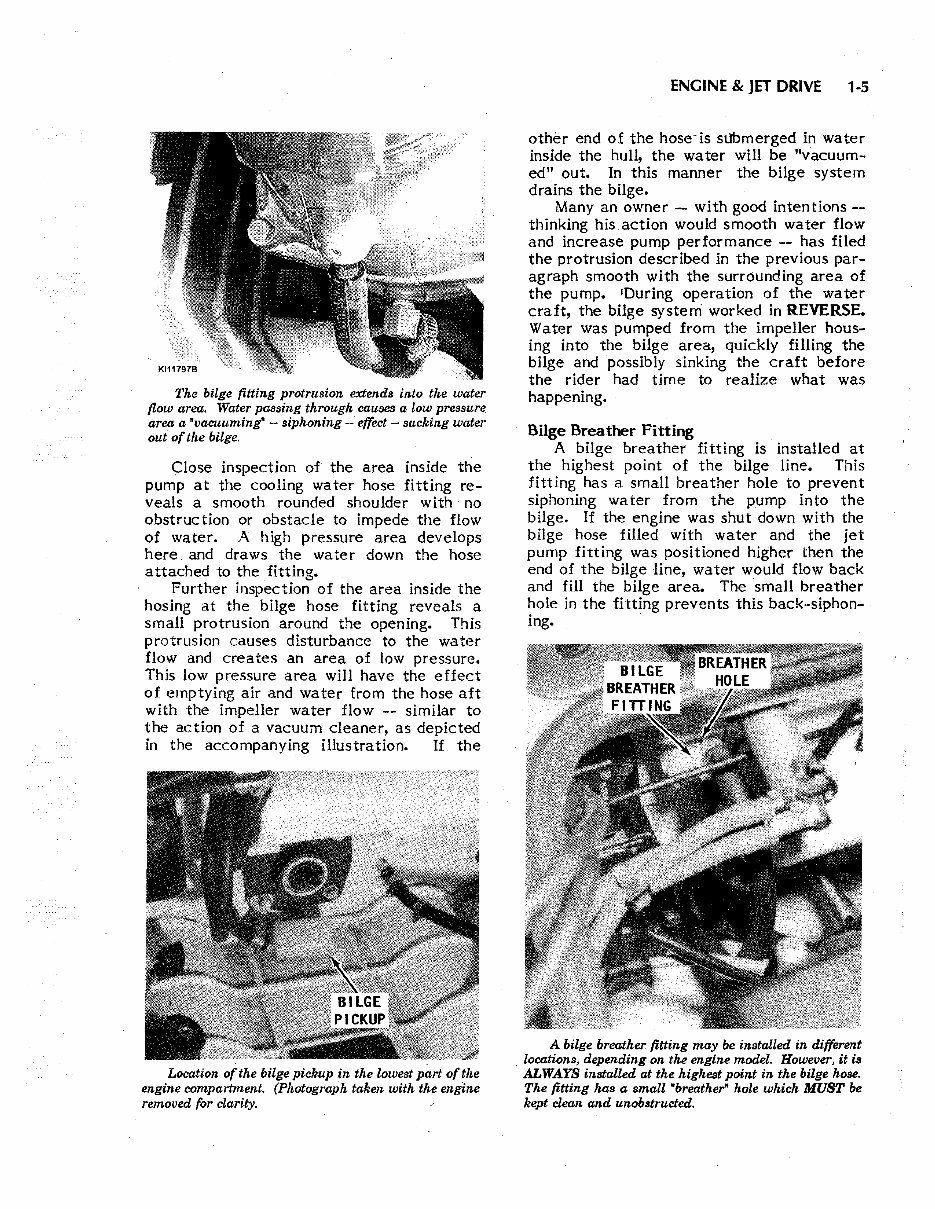
The bilge fitting protrusion extends into the water flow area. Water passing through causes a low pressure area a ·vacuuming· - siphoning -- effect - sucking water out of the bilge. <::lose inspection of the area inside the pump at the cooling water hose fitting re- veals a smooth rounded shoulder with no obstruc tion or obstacle to impede the flow of water. A high pressure area develops here and draws the water down the hose attached to the fitting. Further inspection of the area inside the hosing at the bilge hose fitting reveals a small protrusion around the opening. This protrusion causes disturbance to the water flow and creates an area of low pressure. This low pressure area will have the effect of emptying air and water from the hose aft with the impeller water flow -- similar to the action of a vacuum cleaner, as depicted in the accompanying illustration. If the Location of the bilge pickup in the lowest part of the engine compartment. (Photograph taken with the engine removed for clarity. ENGINE & JET DRIVE 1-5 other end of the hose is sUbmerged in water inside the hull, the water will be "vacuum- ed ll out. In this manner the bilge system drains the bilge. Many an owner -- with good intentions -- thinking his action would smooth water flow and increase pump performance -- has filed the protrusion described in the previous par- agraph smooth with the surrounding area of the pump. 'During operation of the water craft, the bilge system worked in REVERSE. Water was pumped from the impeller hous- ing into the bilge area, quickly filling the bilge and possibly sinking the craft before the rider had time to realize what was happening. Bilge Breather Fitting A bilge breather fitting is installed at the highest point of the bilge line. This fitting has a small breather hole to prevent siphoning water from the pump into the bilge. If the engine was shut down with the bilge hose filled with water and the jet pump fitting was positioned higher then the end of the bilge line, water would flow back and fill the bilge area. The small breather hole in the fitting prevents this back-siphon- ing. . A bilge breather fitting may be installed in different . locations, depending on the engine model. However, it is ALWAYS installed at the highest point in the bilge hose. The fitting has a small "breather" hole which MUST be kept clean and unobstructed.
This is the Kawasaki JS550 JS650 JS750 1992 1993 1994 1995 1996 1997 1998 Service Repair Workshop Manual. It contains comprehensive service and repair instructions used by mechanics worldwide.
It covers all major topics with step-by-step instructions, diagrams, illustrations, wiring schematics, and specifications for repairing and troubleshooting your Kawasaki JS550 JS650 JS750 1992 1993 1994 1995 1996 1997 1998.
Useful for both owners with basic mechanical skills and independent auto service professionals, this manual provides the same specifications and procedures available to authorized dealer service departments. It enables better understanding and more knowledgeable discussions with automotive technicians.
Accurate, clear, and concise text, combined with illustrations, makes it possible for anyone with even basic mechanical knowledge to safely and easily service and repair their vehicle.
Written by the manufacturers, this manual can easily assist with any repairs needed. It includes pictures and easy-to-follow directions on required tools and repair procedures.
It is available in .PDF format, viewable on PC, Mac, and various devices including many phones and e-readers. Individual pages can be printed as needed, avoiding the risk of original copies becoming obscured and unreadable due to oil stains.
Compatible with all versions of Windows and Mac, this manual is printable and requires Adobe Reader. It covers a wide range of topics including lubrication & maintenance, suspension, differential & driveline, brakes, cooling, and more.
All pages are printable, allowing for easy access in the garage or workshop. By following the step-by-step instructions, it enables savings on repair costs for any skill level.
Get the Kawasaki JS550 JS650 JS750 1992 1993 1994 1995 1996 1997 1998 Service Repair Workshop Manual for comprehensive guidance on servicing and repairing your vehicle.
Recently Viewed
5,521,897Happy Clients
2,594,462eManuals
1,120,453Trusted Sellers
15Years in Business
Price:
Actual Price:
1992-1998 Kawasaki JS550 JS650 JS750 Service & Repair Manual




 Lifetime Access