

Keep this manual with the boat at all times.
All operators must read and fully understand the
operational instructions before the boat is used.
• Z-Comanche
®
• Z-500 / Z-100
• Reata
®
• Fisherman
• Angler
• Bay Ranger
®
• Bahia
™
• Intracoastal
• Ranger Trail
®
Trailers
Ranger
®
boats include a wide variety of
advantages in quality, construction and
performance. For even more details,
visit us at www.rangerboats.com
®
®
®
®
®
®
®
®
®
®
®
RPM Performance
Control Post
Dri-Latch
COOL Hub
®
™
®
®
™
®
1
GETTING TO KNOW AND HANDLE YOUR RANGER BOAT . . .
Your Ranger dealer should see that you have selected the proper horsepower engine for the rating range of
the boat model you have chosen. The proper engine mounting height has been selected for optimum performance
and the correct propeller has been chosen.
Since most boats spend more time on the trailer than in the water, a RangerTrail® trailer can extend the useful
life of your new boat. The load MUST be evenly distributed on the properly fitting “bunks” or “pads” of the trailer.
The boat should not rest on the loading rollers, but should properly cradle on the bunks.
Always park your rig so that the trailer tongue is higher than the stern of the boat, so that any water can drain
from the hull when the drain plug is removed. All livewell valves should be placed in the “empty” position to properly
drain your livewell plumbing.
A properly fitted boat cover will protect your investment from the damaging effects of the ultraviolet rays of
sunlight, as well as from road film, rain and dirt abrasion while trailering. The cover also protects your accessory
equipment and fishing tackle from “prying eyes” and helps to guard against pilferage.
Familiarize yourself with the instruments and indicators used with all installed equipment. Factory equipment
manuals are included to assist you to properly operate your trolling motor; depth finders; engine tachometer;
speedometer; and any additional accessories that you have installed. Naturally this Ranger manual is only complete
when you have completely studied your engine operating manual and are familiar with engine operation.
Now you are ready for a ride in your new boat! This will be an exciting, fun experience if you exercise the proper
caution and observe all safety rules and regulations.
Before launching your boat… stop on the ramp short of the water. Stop your vehicle’s engine and set the
parking brake. At the rear of the boat, install your transom drain plug and remove the trailering tie-downs, trailering
arms, motor supports and/or support brackets. Slowly back the boat and trailer into the water and unhook the winch
strap hook. When in the driver’s seat, put on and secure your life vest and attach the engine emergency stop switch
lanyard to your person. Start engine and back your boat off the trailer. You should experience no problem if the
water is adequately deep for proper launching.
While you are easing along within the “No Wake” zone you should trim your engine all the way down to its
lowest position (in). Turn the steering right and left to insure that there is no undue slack and inspect the steering
system. Look for any loose connections at the engine and beneath the driver’s console (see pp. 23-26). Inspection
of this crucial linkage system can be visually made at home or at the lake, but should be done at regular intervals.
Before applying power and “opening it up”, insure that all passengers are properly seated and are wearing an
approved Personal Flotation Device (PFD or Life vest). Check to see that there are no obstructions in your path.
We recommend that the front pedestal seat be removed from the front deck base and positioned in the special base
provided in the front floor of the boat. If your boat has non-adjustable pedestals, remove the extension pipe from the
seat base and install the seat base directly into the front deck receptacle. If your boat has an optional deck extension
and power pedestals, remove the lid in the deck extension and secure the pedestal in the receptacle provided in
the floor. If the optional deck extension does not have a removable lid, store your seat securely in the floor of the
boat. This will provide for an unobstructed view while driving. The power pedestal should be pushed down into the
lowest position. Should there be no base provided in the floor, the seat should be removed and securely placed in
the floor of the boat.
When you have cleared the “No Wake” zone it is time to accelerate and get your new boat “on plane”. Before
applying power, insure that all passengers are properly and securely seated in appropriate locations. Abruptly move
the throttle lever into the full open position (full forward). The bow of the boat will rise into the air for a moment… this
is normal operation when a boat is “coming out of the hole” and is no cause for alarm. The bow will quickly come
back down into a level running position. When the boat begins to accelerate rapidly, the throttle should be pulled
back to obtain a comfortable running speed. Always increase your speed a little at a time until you are running
at a speed at which you feel safe and are in complete control…NEVER FASTER THAN YOUR EXPERIENCE
Getting to Know and Handle Your Ranger® Boat
Failure to store/park your rig with the bow elevated could allow rain water to
accumulate in the storage boxes. NOTICE

2
Getting to Know and Handle Your Ranger® Boat
DICTATES! At this moderate speed you should begin to trim your engine into a higher position (out). Please refer
to your engine owner’s manual for more information on power trim use and operations.
Your speed will increase and the bow will lift. The boat will begin to run with the back rear portion of the hull
in contact with the water and steering will become easier. Over-trimming will result in excessively high RPM (note
your tachometer) and the steering can develop “torque” or a “pull” toward the right. Trim back down slightly for best
operation. A different trim setting (see your trim indicator) will be required for different throttle settings. You will soon
develop an instinctive feel for these settings. Your ear will become attuned to the sound of the proper engine RPM.
Again,over trimming is to be avoided as excessive RPM can cause engine damage and can also cause your prop
to “blow out” (lose its grip on the water because it is too near the surface). If the bow of your boat should begin to
bob up and down (called porpoising) you will probably have over trimmed. Bump the trim button down a little until
the motion stops.
If your boat should continue to “porpoise”, a slight increase in throttle and speed will generally correct the
condition. Proper distribution of the load in your boat will make a great difference in its operation. Moving tackle
boxes or ice chests rearward or toward the front can greatly effect boat performance and handling.
When beginning a turn with the engine trimmed in the higher positions, the trim switch should be pressed to
LOWER the engine further into the water just prior to and during the turning of the steering wheel. Practice and
experience will determine just how far down you will need to trim for safely handling a turn at various speeds
and water conditions. Just remember to MAKE SAFETY YOUR GUIDE when attempting any new or unfamiliar
maneuver. PROCEED ONLY AT SPEEDS AT WHICH YOU FEEL SAFE AND IN CONTROL!
Naturally, it is impossible to describe here all the different situations that you may encounter. Just remember
that COMMON SENSE is your best safety precaution. Your new boat is built to safely carry you in NORMAL
OPERATION, but it is up to you to stay alert and to avoid dangerous situations. Safe boating is in the hands of the
operator.
Even the pleasant experience of the “first ride in your new boat” must sometime come to an end. Hopefully you
have purchased a “drive on” trailer with your boat. The key to simple and effortless loading of your boat is having
the trailer in the proper position. This “right” position is determined by the steepness of the ramp. Here, you will
have to experiment with the proper depth to have your trailer in. The most common mistake is having the trailer
too deep, so a little time spent experimenting with different depth positions can ultimately save you much time and
embarrassment. To load at slow speed, position your boat to head directly between the guide bunks or guide rollers
and use the thrust of your outboard engine to drive the boat forward until the bow contacts the roller on the bow
stand block. Shut down your outboard and fasten the winch strap hook to the bow eye. Tighten the winch strap and
lock winch before pulling the boat from the water. Your engine should be trimmed up into a higher position before
the trailer is pulled up the ramp to prevent damage to the lower unit or propeller. Pull the rig up the ramp and park
well out of the way of other boaters. Stop your vehicle engine and set parking brake. Remove the drain plug, open
and drain the livewell systems, and stow all loose equipment. We recommend that you install a transom saver,
or engine support brace, between the trailer frame and the lower unit of your engine to prevent damage to your
transom while the boat is in transit.
For the most possible boating and fishing enjoyment familiarize yourself completely with your boat and with the
instruction manuals for all additional equipment. If you are a novice, there are publications on good seamanship
recommended to make your boating safe and enjoyable. We also recommend that you enroll and attend any of
the excellent safe boating courses offered and conducted by your area Power Squadron or the U.S. Coast Guard
Auxiliary.
Improper use of power trim may lead to excessive bow steer or
steering torque (pull) and could lead to accidental injury or death. WARNING
The operator (driver) is responsible for the correct and safe operation
of the boat, the equipment aboard and the safety of all occupants
aboard. We strongly recommend that the operator read this manual
and thoroughly understand the operational instructions for the engine and all related accessories before
the boat is used.
WARNING

3
Be Responsible for Safer Boating / Carbon Monoxide Warning
BE RESPONSIBLE FOR SAFER BOATING
• ALCOHOL and DRUGS - The debilitating effects of alcohol and other drugs reduces reaction time and detracts
from judgment. The combined effect of the outdoor environment… sun, heat, rough water, and noise can be more
fatiguing than one would imagine and, combined with drugs or alcohol, can be very dangerous.
• GAME PLAN - Tell a friend, neighbor, or another family member where you will be boating and when you plan
to return. Be certain that this individual has a good description of your boat and any other identifying information
that could be needed to help find you should an emergency arise.
• VISIBILITY - Be sure the operator’s visibility is not obstructed. On models with bases, adjust the seat for best
visibility. (Some saltwater bay models may have limited visibility in the seated position).
• TOOLS and SPARE PARTS - Many people have been stranded by minor breakdowns that they could have
repaired themselves. It is a good idea to carry a few tools and common spare parts and to be familiar with simple
repairs that can be easily accomplished.
• GASOLINE RESERVES - Never push your boating range to the limit of your gas tank capacity… one-third of the
fuel to go, one-third to come back and one-third to reserve.
• GOOD BOAT KEEPING - A clean boat is a safer boat. Take care to see that rods, lures, nets, gaffs and other
potentially harmful gear are properly stowed so that it cannot blow or move around while the boat is underway.
Perform all maintenance and safety checks regularly. Secure all icebox or cooler lids and place any trash or
debris safely under cover until the trip is over.
• BOARDING LADDER - Many models are equipped with a boarding ladder. Rotating propeller may cause serious
injury or death. Do not approach or use the ladder when engine is running. Shut off the engine when near persons
in the water. Make sure to stow the ladder after it is used and before starting the engine. Never use a damaged
ladder.
• SPEED and SKILL - The fast and powerful boat can require the operator to exercise a high level of skill and
attention to driving. Only go as fast as your skill and good judgment dictates is safe. You are in charge of the
wellbeing of your passengers and yourself. Be alert for any hazards in the water and operate your boat in such
a manner as would be appropriate for the water conditions. Be a good boating “neighbor” and do not create a
hazard or annoyance to others. The best safety equipment is your own good judgment.
• SKIERS and SWIMMERS - Do not allow operation of the engine when anyone is in the water near the stern of
the boat. Never back up to a down skier or anyone in the water. Never drive your boat directly behind a skier.
CARBON MONOXIDE
Carbon monoxide is a deadly gas that is odorless, tasteless and colorless. It is present in the exhaust of internal
combustion engines. Inhaling sufficient concentrations of carbon monoxide can be fatal within minutes. Early signs
of carbon monoxide poisoning may include headache, nausea, fatigue, drowsiness, confusion and vomiting. DO
NOT MISTAKE THESE SYMPTOMS FOR SEASICKNESS. If any of these symptoms occur to you or any of your
passengers, ventilate the boat by opening the side curtains or forward hatch to remove the fumes and immediately
seek medical attention.
Carbon monoxide can be drawn into the cockpit area over the stern of the boat. When operating the engine,
ventilate the cockpit area by removing side curtains or opening forward hatches to allow fresh air to flow though. Do
not operate the engine if your boat is moored in a confined area.
Exhaust from a running engine can cause an accumulation of
carbon monoxide gas in the cockpit area when the canvas top and
side curtains are installed. Provide adequate ventilation when these
coverings are installed in their closed positions.
WARNING

4
TABLE OF CONTENTS
Getting to Know and Handle Your Ranger Boat ............................................1-2
Be Responsible for Safer Boating ..................................................................... 3
Carbon Monoxide Warning................................................................................ 3
Special Information............................................................................................ 5
Your Ranger Dealer’s Responsibilities.............................................................. 5
Owner/Operator’s Responsibilities .................................................................5-6
Warnings ........................................................................................................... 6
Hazard Labeling ............................................................................................. 7-9
Hull Identification Plate .................................................................................... 10
U.S. Coast Guard Capacity Information Plate ................................................ 11
Recommended On-Plane Seating Locations .................................................. 12
Gasoline Fuel System ..................................................................................... 13
Your Livewell Aeration System ....................................................................... 18
Steering at Console ......................................................................................... 25
Your Boat’s Finish ........................................................................................... 28
Maintenance and Repair ........................................................................28-29
Your Power Pedestals ..................................................................................... 29
Key Locks, Carpet, and Upholstery................................................................. 31
Cleaning Upholstery .................................................................................. 31-32
Adding Accessories To Your Boat .................................................................. 33
Hook Up of Trolling Motor Leads .................................................................... 33
Wiring Diagrams ......................................................................................... 34-43
Electrical System ............................................................................................. 44
Fuse Panel Information .......................................................................... 44-45
1850, 2050,1880, 2080 .......................................................................... 45-46
620FS and 621FS .................................................................................. 47-50
Saltwater Series - 220, 240, 2310, 2410..................................................... 51
Saltwater Series - 2350, 2510 Bay ........................................................52-54
Z519c, Z520c, Z520ci, Z521c, Z522d ....................................................55-58
Z522 ............................................................................................................ 59
Safety and Maintenance Tips.......................................................................... 61
Boating Safety Checklist ................................................................................. 62
Federal Requirements for Recreational Boats ........................................... 63-64
YOUR RANGER TRAIL® TRAILER
General Information and Maintenance ............................................................ 64
Contained Oil Orbital Lubrication (COOL) Hubs ............................................. 64
Reporting Safety Defects ................................................................................ 64
Trailer Brakes .................................................................................................. 65
RangerTrail Wiring .......................................................................................... 66
Before Towing Your Ranger Trail Trailer ........................................................ 67
Towing Your Ranger Trail Trailer .................................................................... 67
Swing Hitch ..................................................................................................... 68
Hitch Class Rating ........................................................................................... 68
Trailer Tire Safety, Care and Maintenance ................................................68-72
Trailer Exploded View ..................................................................................... 73
Ranger Trail Parts List .................................................................................... 73
Limited Warranty ........................................................................................ 74-75
5
SPECIAL INFORMATION
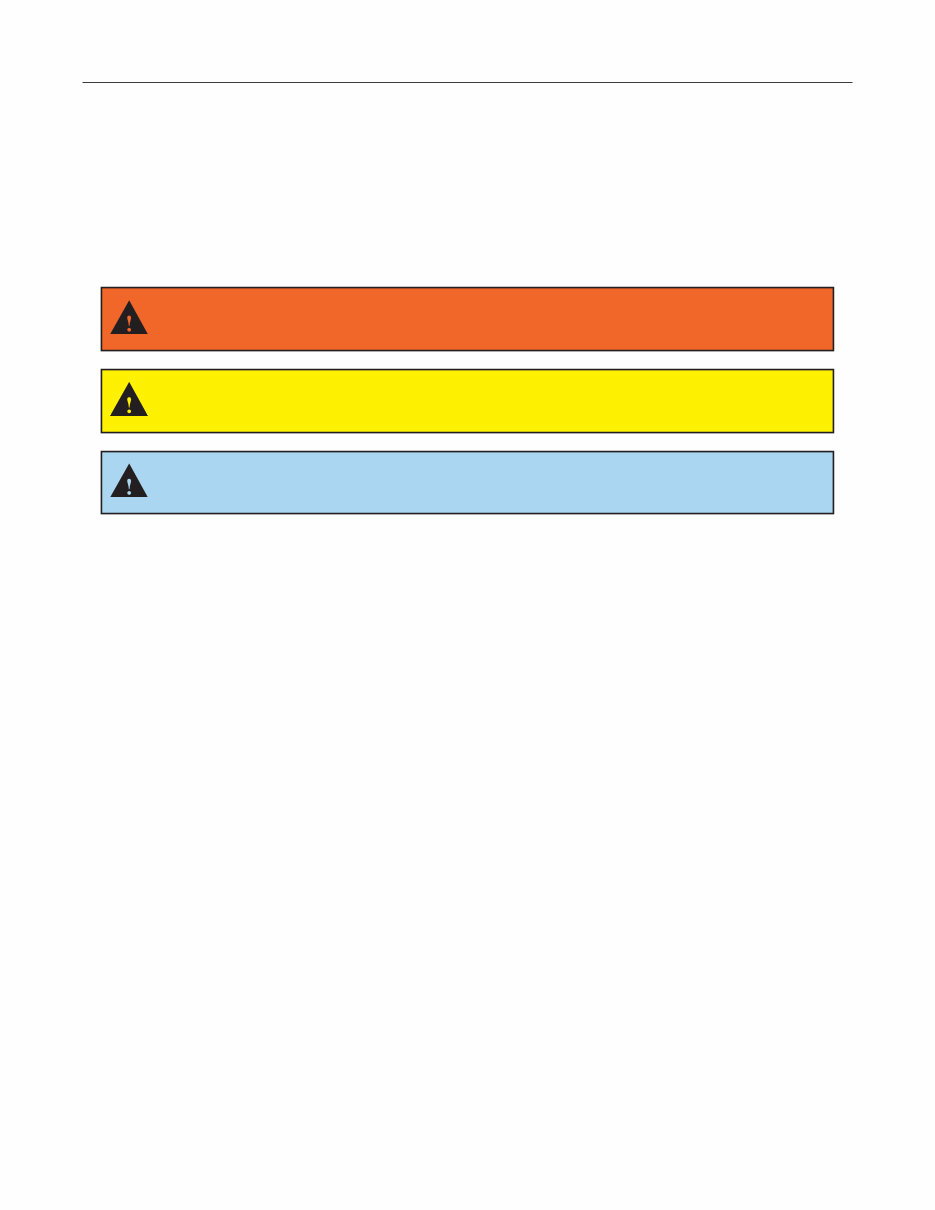
The following special information is intended to alert you to possible dangers and to information important to
the safe operation of your boat and other equipment. Observe them carefully. However, simply being aware of the
“WARNING”, “CAUTION” AND “NOTICE” notations in this manual will not eliminate the dangers that they signal if
you do not implement the information. These warnings, plus common sense operation will insure you a safe and
fun boating or fishing outing.
Please take special note when you see one of the following signs:
ALL information or instructions in this manual could be necessary for proper operation and/or maintenance.
If you do not understand any portion of this manual, please contact your Ranger dealer or our Customer Service
Department for any additional information.
IMPORTANT:
Your Ranger Dealer’s Responsibilities…
Generally, it is the dealer’s responsibility to the customer to make sure that the boat has been equipped as
ordered with a properly installed and functioning engine that is within the horsepower rating specified for that model
boat. The dealer should see that the engine is outfitted with the proper propeller for that boat model and for the load
that the boat is normally expected to carry.
The dealer should help to familiarize the customer with the onboard equipment and explain operation of this
equipment; the engine operation; and the proper functioning and operation of the boat itself.
Prior to delivery, the dealer should make certain that the product and equipment is completely operational; the
proper propeller is installed; and that all oil, fuel system and lubrication systems are understood. The dealer should
explain the operation of all instrumentation equipment, and the boat electrical and livewell systems.
The dealer should check for correct carburetor adjustment, throttle and steering functioning, and instrumentation
accuracy. Engine cooling water should be properly circulating.
The dealer should test for maximum engine RPM as specified in the engine manufacturer’s specification
sheet(s) and/or engine owner’s manual for proper operation of all equipment and for proper adjustment of steering
effort and direction. All necessary adjustments for maximum efficiency should be made.
Owner/Operator’s Responsibilities…
It is the owner/operator’s responsibility to perform all safety checks and to ensure that all lubrication and
maintenance instructions are complied with for maximum safety and proper operation.
Special Information
Failure to follow the advice of a “WARNING” may result in bodily injury
or death.
WARNING
Draws special attention to installation, operation, or other important
maintenance information.
NOTICE
Non-compliance with “CAUTION” instructions could result in failure of,
or damage to, the product and/or equipment.
CAUTION
6
It is also the owner/operator’s responsibility to return the unit to the Ranger dealer for a periodic checkup.
The owner/operator is responsible for the correct operation of the boat and for the safety of its occupants. Be
sure that all operators read this manual before attempting to operate the boat. Your passengers should be shown
the location and use of all emergency equipment and one passenger should be instructed how to handle the boat
in case of emergency. U.S. Coast Guard requirements for PFDs (Personal Flotation Devices, or Life vests) can
vary, depending on the type of boat. Be sure to comply with the U.S. Coast Guard regulations that apply to your
boat. The owner/operator should, however, make certain that all passengers in the boat are in possession of, and
are securely wearing a PFD whenever the boat is in operation. We strongly recommend that an engine emergency
stop switch be securely connected to the boat operator any time that the engine is in operation!
Learn the waterway rules of the locality in which you intend to operate your boat. Navigable waterways are
controlled by Federal regulations while inland lakes and Canadian waters are controlled by local jurisdictions. Obey
all regulations to protect yourself, your passengers, and fellow boating enthusiasts.
Before boating, obtain the weather forecast for your area. Familiarize yourself with the weather bureau warning
system signal(s) and waterway traffic sign/marking information.
Contact your local U.S. Coast Guard Auxiliary and take advantage of their excellent boating and safety classes
and seasonal boat inspections.
Special Information
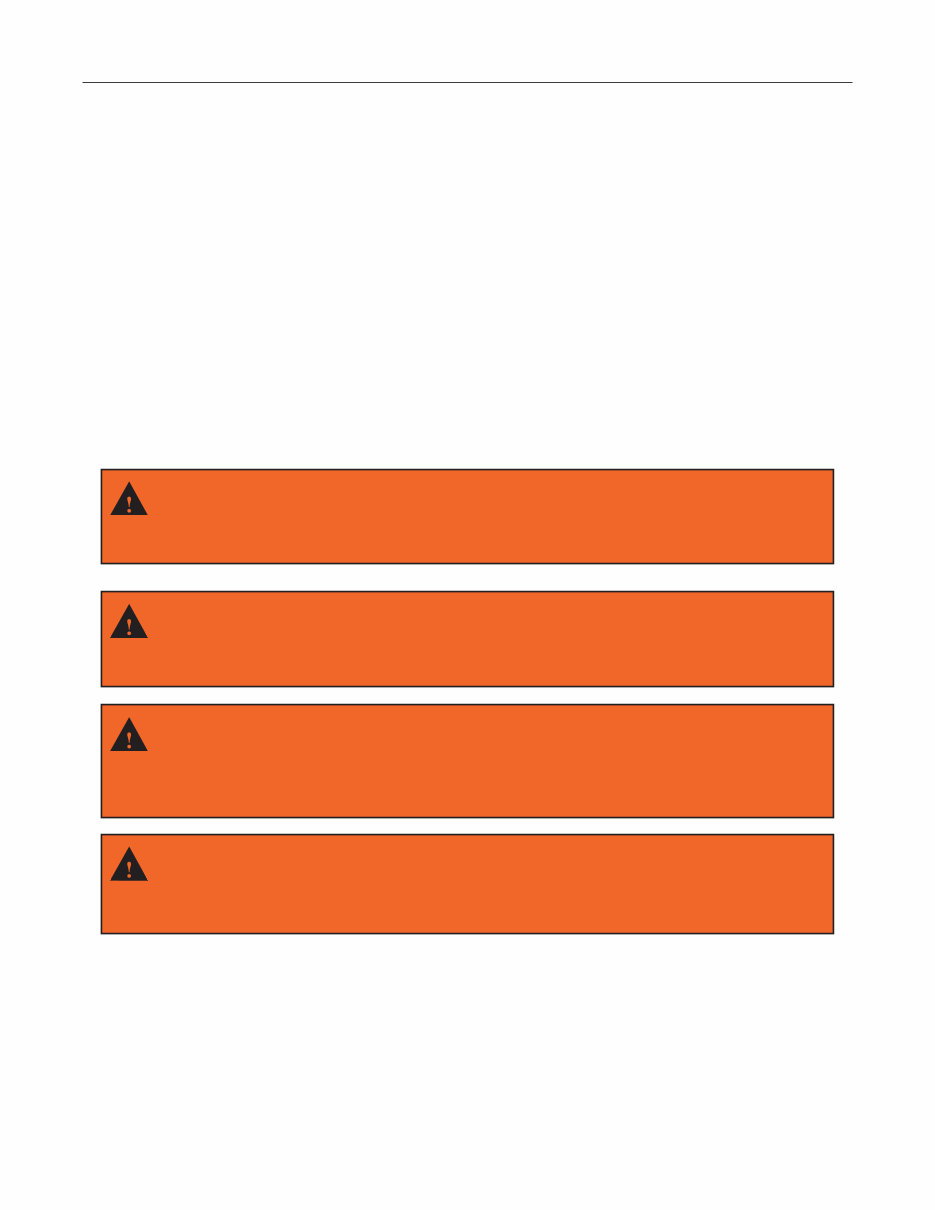
Operating a boat with an engine of horsepower in excess of that
specified on the boat’s capacity plate can result in loss of control over
the boat’s operation and could lead to an accident resulting in injury
or death of the boat’s occupants.
WARNING
Imprudent operation of the boat, with or without the use of PFDs and
an approved engine emergency stop switch, can lead to property
damage, injury or death of the boat operator or passenger(s), or
other(s), whether within the boat or outside the boat.
WARNING
The boat operator should insure that the lanyard connection to the
emergency stop switch is of ample length to insure that the inadvertent
activation of the switch is not likely. Accidental triggering of the
emergency stop switch could result in loss of engine power at inopportune times, such as while docking
or in heavy seas, strong currents or high winds and could lead to an accident resulting in injury or death.
WARNING
Do not exceed the maximum weight and persons capacity found on
the U.S. Coast Guard capacity information plate located on your boat.
Overloading severely affects the stability and handling of your boat
and could lead to an accident causing injury or death.
WARNING
7
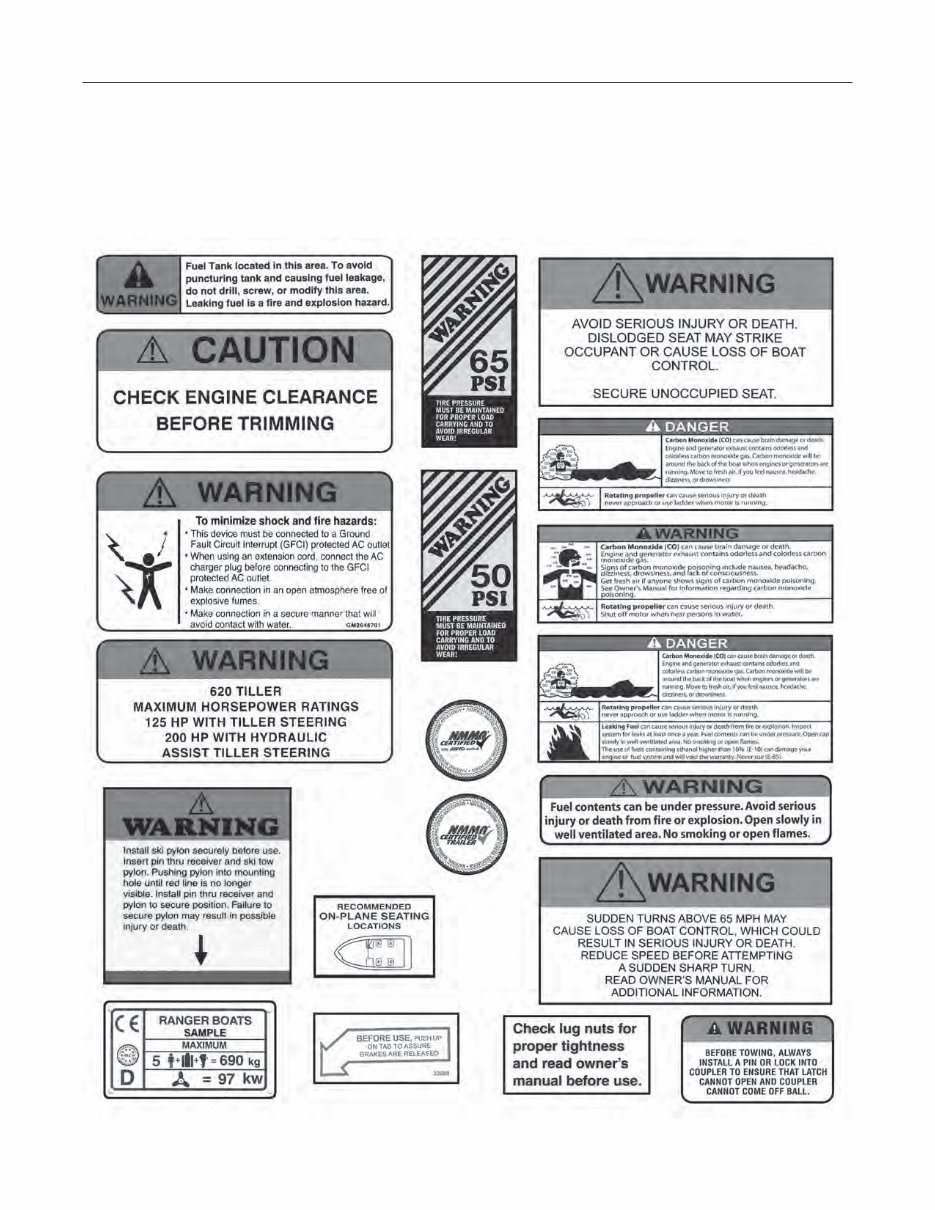
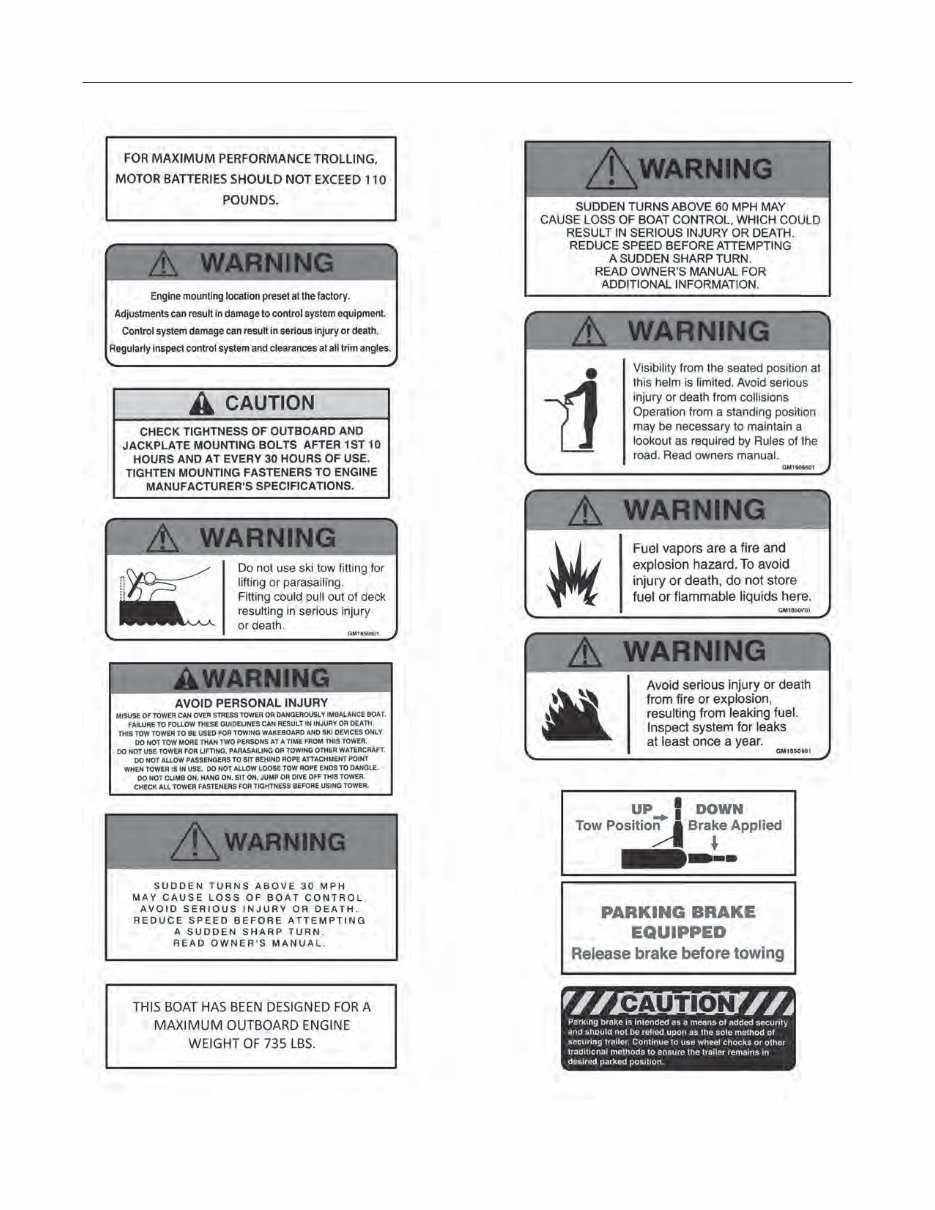
HAZARD LABELING
The following images are a partial list of warning/information decals that may be found in various locations on
your boat and trailer. (Photos are not to scale) Some labels are not appropriate for every boat/trailer model, so your
rig may not have them all. Check with your Ranger dealer to find out what labels your boat and trailer should have
and ask them to order any necessary replacements.
Hazard Labeling
8
Hazard Labeling
You're Reading a Preview
What's Included?
 Lifetime Access
Fast Download Speeds
Online & Offline Access
Access PDF Contents & Bookmarks
Full Search Facility
Print one or all pages of your manual
$26.99
2017 Ranger Fiberglass Owners Manual
Viewed 10 Times Today

What's Included?
Lifetime Access
Fast Download Speeds
Online & Offline Access
Access PDF Contents & Bookmarks
Full Search Facility
Print one or all pages of your manual
$26.99

Secure transaction
What's Included?
Lifetime Access
Fast Download Speeds
Online & Offline Access
Access PDF Contents & Bookmarks
Full Search Facility
Print one or all pages of your manual
Description
This manual is a valuable resource for anyone working on Ranger Fiberglass vehicles manufactured between 2017 and 2019. It contains detailed instructions for installation, maintenance, troubleshooting, and more, presented in easy-to-understand language with helpful diagrams and illustrations.
It covers the following models:
- 2017-2019 Ranger Fiberglass
Whether you're a professional mechanic or a DIY enthusiast, this manual provides comprehensive and current information to help you keep your Ranger Fiberglass vehicle in optimal condition and ensure its longevity.
Get your Ranger Fiberglass Owners Manual 2017-2020 today and enjoy the convenience of instant delivery through a download link.


