



Classic
260/290/310/340/360/380
Classic Deluxe
340/360/380
Owner’s Manual
Before operating your boat, please read this manual carefully
PLEASE KEEP THIS MANUAL IN A SECURE PLACE, AND HAND IT OVER TO THE NEW
OWNER WHEN YOU SELL THE BOAT.

Content
General Introduction ......................................................................................................................................... 3
Safety alerts ....................................................................................................................................................... 4
Safe Boating Recommendations ....................................................................................................................... 4
Pre-operation check list..................................................................................................................................... 5
Specifications: Classic ........................................................................................................................................ 6
General Arrangement ...................................................................................................................................... 6
Specifications: Classic Deluxe ............................................................................................................................ 7
General Arrangement ...................................................................................................................................... 7
Recommended Seating Arrangement (Classic) ................................................................................................. 9
Recommended Seating Arrangement (Classic Deluxe) ................................................................................... 10
Boat Components ............................................................................................................................................ 10
Builder’s Plate: ................................................................................................................................................. 11
Information connected with the risk of flooding and stability........................................................................ 12
Transporting .................................................................................................................................................... 13
Engine Start ..................................................................................................................................................... 13
Operation......................................................................................................................................................... 14
Maintenance.................................................................................................................................................... 17
Warranty.......................................................................................................................................................... 20
Service assistance ............................................................................................................................................ 21
To ensure that you gain maximum satisfaction from your Highfield boat, please
read this Owner’s Manual carefully. It contains all the safety and operation

instructions that you need to get the most out of your new Highfield.
General Introduction
This manual has been compiled to help you to operate your boat with safety and pleasure. It contains
details of the boat; the equipment supplied or fitted; its systems and information on their operation. Please read
it carefully, and familiarize yourself with the boat before using it.
This owner's manual is not a course on boating safety or seamanship. If this is your first boat, or if you are
changing to a type of boat you are not familiar with, for your own comfort and safety, please ensure that you
obtain handling and operating experience before “assuming command” of the boat. Your dealer or national
sailing federation or yacht club will be pleased to advise you of local sea schools, or competent instructors.
Ensure that the anticipated wind and sea conditions will correspond to the design category of your boat,
and that you and your crew are able to handle the boat in these conditions.
Even when your boat is categorized for them, the sea and wind conditions corresponding to the design
categories A, B and C range from severe storm conditions for category A, to strong conditions for the top of
category C, open to the hazards of a freak wave or gust. These are therefore dangerous conditions, where only a
competent, fit and trained crew using a well maintained boat can satisfactorily operate.
This owner's manual is not a detailed maintenance or trouble-shooting guide. In the case of difficulty, refer
to the boat builder or his representative. If a maintenance manual is provided, use it for the boat's maintenance.
Always use trained and competent people for maintenance, fixing or modifications. Modifications that may
affect the safety characteristics of the boat shall be assessed, executed and documented by competent people.
The boat builder cannot be held responsible for modifications that he has not approved.
In some countries, a driving license or authorization is required, or specific regulations are in force.
Always maintain your boat properly and make allowance for the deterioration that will occur in time and as
a result of heavy use or misuse of the boat.
Any boat, no matter how strong it may be, can be severely damaged if not used properly. This is not
compatible with safe boating. Always adjust the speed and direction of the boat to sea conditions.
If your boat is fitted with a life raft, carefully read its operating manual. The boat should have onboard the
appropriate safety equipment (lifejackets, harness, etc.) according to the type of boat, weather conditions, etc.
This equipment is mandatory in some countries. The crew should be familiar with the use of all safety equipment
and emergency maneuvering (man overboard recovery, towing, etc.), sailing schools and clubs regularly organize
drill sessions.
All persons should wear a suitable buoyancy aid (life jacket/personal floatation device) when on deck. Note
that, in some countries, it is a legal requirement to wear a buoyancy aid that complies with their national
regulations at all times.

Safety alerts
This manual uses the following safety alerts to draw your attention to special safety instructions that should be
followed.
Degree of hazard and corresponding safety labels:
Danger
Denotes that an extreme intrinsic hazard exists which would result in high probability of death or irreparable
injury if proper precautions are not taken.
Warning
Denotes that an extreme intrinsic hazard exists which would result in high probability of death or irreparable
injury if proper precautions are not taken.
Caution
Denotes that an extreme intrinsic hazard exists which would result in high probability of death or irreparable
injury if proper precautions are not taken.
Safe Boating Recommendations
1. Always wear a life jacket
Local authorities require that you carry an approved personal flotation device, or life jacket, for each person
aboard your vessel. We recommend wearing a life jacket at all times while boating.
2. Use the kill switch lanyard
The operator of the boat must at all times wear a switch lanyard while driving. In the event of accidental
ejection or loss of balance, the boat will shut off automatically. Wearing a switch lanyard would possibly saving
the driver’s life or that of someone else.
3. Know your boat
Knowing your boat is the foundation of good seamanship, which is simply the skill of managing a boat and
encompasses; navigation, safety, boat handling, line handling, anchoring, troubleshooting of engine problems
and appropriate emergency response.
4. Take a boating safety course and know the navigation rules
A boating course will teach you the basics of seamanship mentioned above. The knowledge you will gain by
taking a boating safety course will never be wasted. Learn to read nautical charts, and keep them on your vessel
to become familiar with the area in which you boat. Taking a boating safety course is the next step, where you
will learn to navigate using charts, GPS, RADAR and a compass.
5. Boat sober
Alcoholic drinks are even more dangerous on the water than on land because the marine environment
accelerates impairment. Besides the safety risks, boating while intoxicated, or BUI, is illegal and heavy penalties
are enforced by both state and federal agencies.
6. Avoid collisions.
Observe the rules of priority as defined in the Navigation Rules and imposed by the international regulations
for preventing collisions at sea. Ensure that you always have sufficient room to stop or manoeuver if necessary in
order to avoid a collision. Avoid abrupt maneuvers at full speed.
7. Protect people
Always slow down and exercise extreme caution any time you are boating in area where there are people in

the water.
8. Respect for environment
Please be aware of local environment laws and international regulations against marine pollution and respect
them as much as possible.
9. Control Speed
Do not drive at top speed in areas of heavy boat traffic or in situations of reduced visibility, strong winds or
heavy seas. Reduce the boat’s speed in big waves and wake out of courtesy and for your own safety and the
safety of others. Observe speed limits and “NO WASH” signs.
10. Others:
Do not sit in the bow cockpit when the boat is moving at high speed.
Danger
When operating, passengers must avoid standing up or hanging appendage outside of the boat. Leaking fuel is a
fire hazard, inspect fuel system regularly. Shut off the engine before boarding from the water.
Warning
Shall the operator or passenger fall out of the boat, the possibility of serious injury or death from being run over
by the boat can be greatly reduced by stopping the engine immediately. Always properly connect both ends of
the stop switch lanyard to the stop switch and the operator.
Caution
Passengers must use suitable PFDs. Special PFDs are designed for children or watersport activities. (Personal
Flotation Device)
Pre-operation check list
a). Make sure you every passenger is wearing a suitable personal flotation device.
b). Make sure there is an extra buoyant device that can be thrown to rescue person in the water.
c.) If boating with passengers, instruct at least on passenger in the basics of boat handling, staring and operation
of the outboard motor.
d). Check that every passenger is securely seated and hold a safe line, grab handle or rope.
e). Make sure that there is a 4m towing rope in the boat.
f). Make sure the load in the boat is distributed evenly.
g). Make sure you respect the maximum load specified for the boat as described on the manufacturer’s plate.
h). Make sure that all safety gears is on board, e.g. whistle, floating ropes, waterproof flashlight, first aid kit, fresh
water, tool kit…
i). Check that the boat is equipped with 2 paddlers or oars.
j). Make sure the outboard motor is securely fastened to the transom.
k). Make sure the drain plug is fully functional.
l). Check the pressure level in each chamber using a pressure gauge. Recommended working pressure is
displayed on manufacturer’s plate.
m). Check fuel tank level and make sure it suits your plan.
n). Start the outboard motor and make sure it stops when the lanyard is disconnected from the switch.
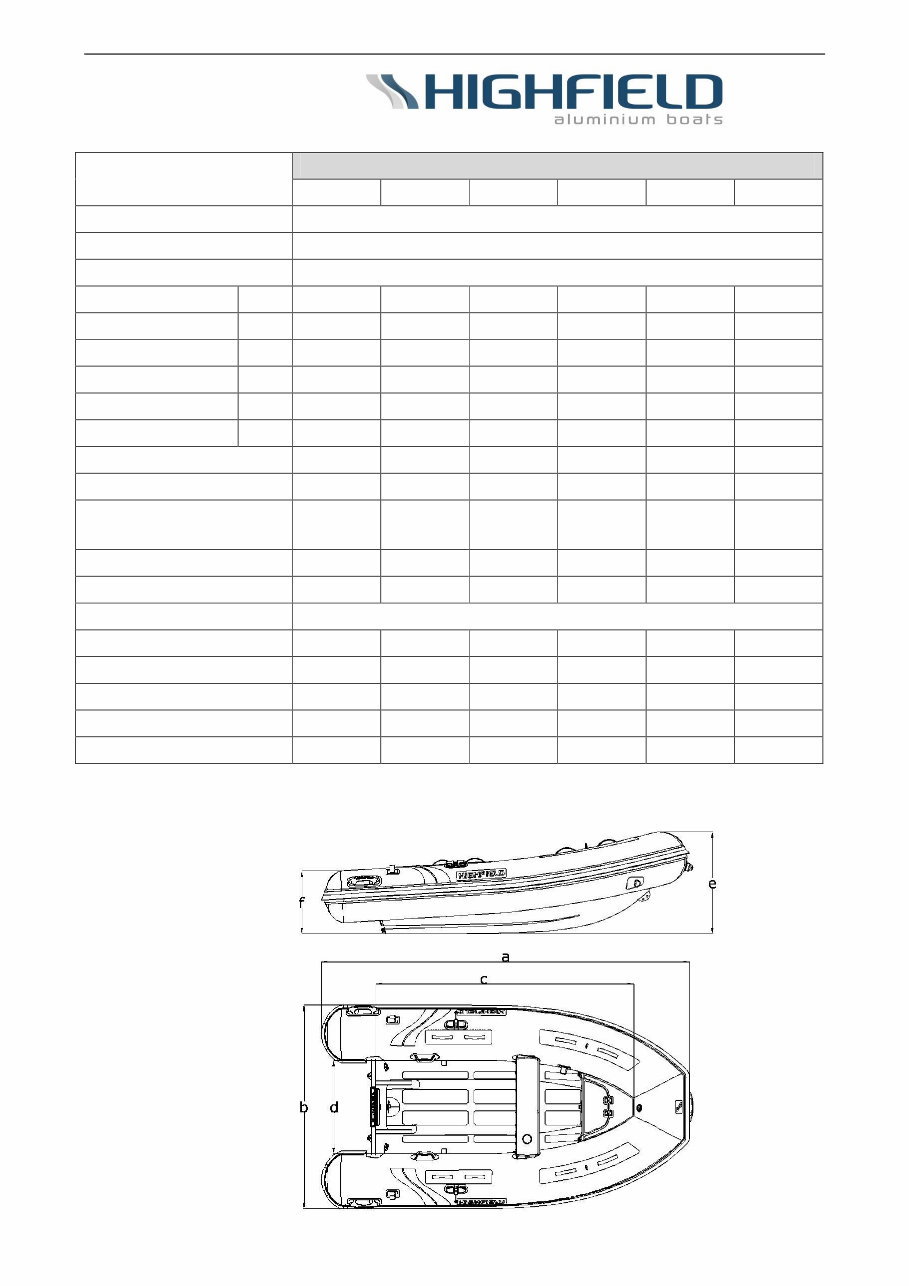
Specifications: Classic
Description
Classic Models
260 290 310 340 360 380
Hull Construction Material 5 series marine grade aluminum alloy
Deck Construction Material 5 series marine grade aluminum alloy
Tube Material PVC or Hypalon coated fabrics
Overall Length a 2.6m 2.9m 3.1m 3.4m 3.6m 3.8m
Inside Length c 1.71m 2.01m 2.18m 2.48 2.70m 2.88m
Beam b 1.73m 1.73m 1.73m 1.73m 1.73m 1.73m
Inside Width d 0.79m 0.79m 0.79m 0.79m 0.79m 0.79m
Bow Height e 835mm 858mm 850mm 816mm 820mm 820mm
Stern Height f 500mm 500mm 500mm 516mm 515mm 524mm
Dead Rise 15
o
15
o
15
o
15
o
15
o
15
o
Airtight Chambers 3 3 3 3 3 3
Light displacement without
engine
52Kg 57Kg 60Kg 70Kg 74Kg 82Kg
Max Passenger 3+1 4 5 6 6 7
Max Load 360Kg 480Kg 550Kg 551Kg 561Kg 637Kg
Main Propulsion Motor
Max Engine Power 10HP 15HP 20HP 25HP 30HP 30HP
Engine Shaft S S S S S S
Design Category C C C C C C
Tube Diameter 440mm 440mm 440mm 440mm 440mm 440mm
Max Engine Weight 42Kg 42Kg 42Kg 70Kg 80Kg 80Kg
General Arrangement
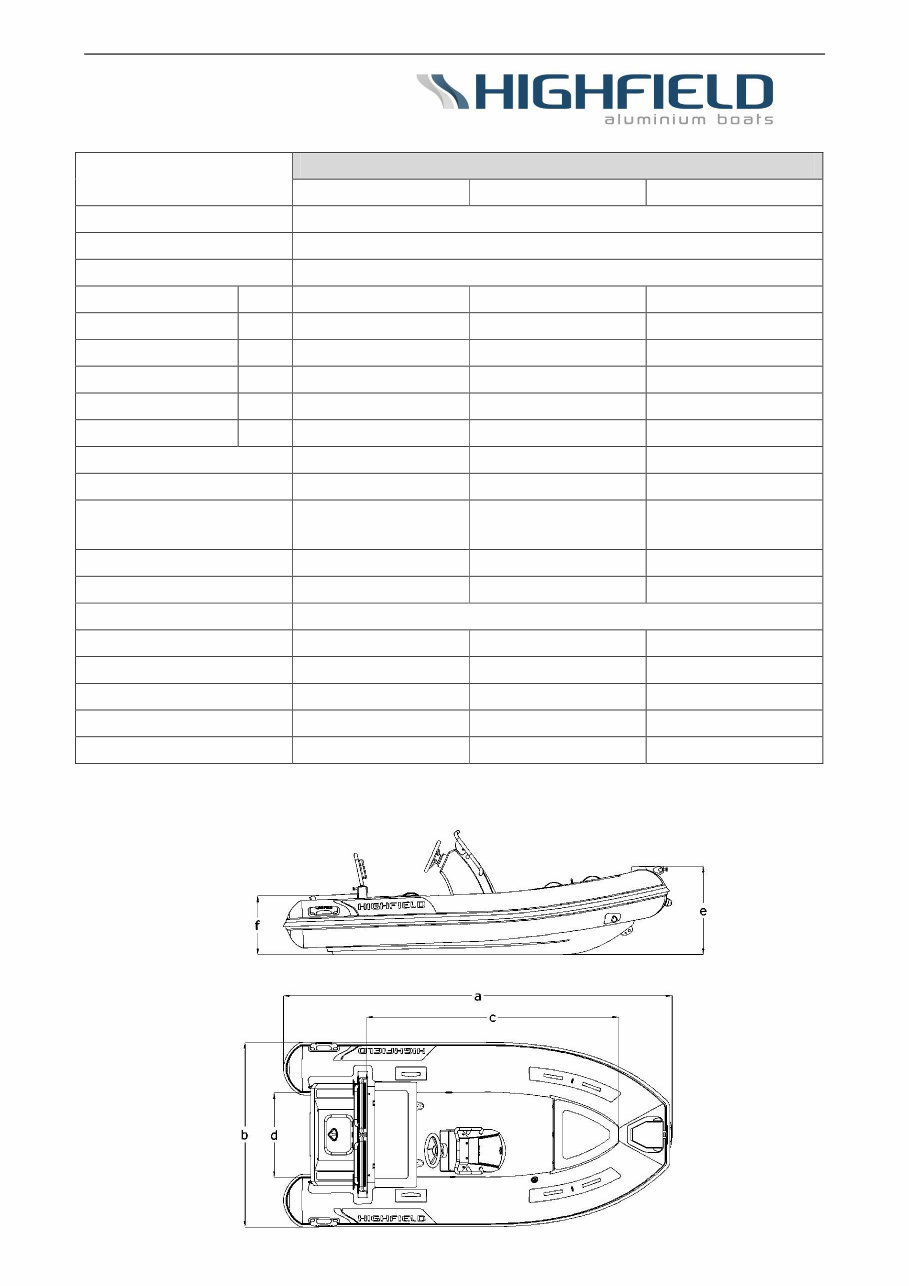
Specifications: Classic Deluxe
Description
Classic Deluxe models
CL340DL CL360DL CL380DL
Hull Construction Material 5 series marine grade aluminum alloy
Deck Construction Material 5 series marine grade aluminum alloy
Tube Material PVC or Hypalon coated fabrics
Overall Length a 3.4m 3.6m 3.8m
Inside Length c 2.12m 2.32m 2.52m
Beam b 1.73m 1.73m 1.73m
Inside Width d 0.79m 0.79m 0.79m
Bow Height e 870mm 870mm 870mm
Stern Height f 560mm 560mm 560mm
Dead Rise 15
o
15
o
15
o
Airtight Chambers 3 3 3
Light displacement without
engine
141Kg 155Kg 170Kg
Max Passenger 6 6 7
Max Load 545Kg 545Kg 640Kg
Main Propulsion Motor
Max Engine Power 30HP 30HP 40HP
Engine Shaft L L L
Design Category C C C
Tube Diameter 440mm 440mm 440mm
Max Engine Weight 85Kg 85Kg 105Kg
General Arrangement

Notes:
a) Overall Length: Including removable parts that can be dismantled, without affecting the structure of the
boat.
b) Inside Length: Excluding removable parts that can be dismantled, without affecting the structure of the boat.
c) Beam: Including removable parts that can be dismantled, without affecting the structure of the boat.
d) Inside width: Excluding removable parts that can be dismantled, without affecting the structure of the boat.
e) Fuel Tank Capacity: It may not be possible to use this capacity fully depending on the trim and load of the
boat. It is recommended to keep a reserve of 20% in the fuel tanks.
f) Category C: Craft designed to operate in winds up to Beaufort force 6 and the associated wave heights
(significant wave height up to 2m). Such conditions may be encountered in exposed inland waters, in
estuaries, and in coastal waters in moderate weather conditions.(according to ISO10240)
g) Load distribution
- Please refer to the maximum numbers of passengers and load capacity of the boat in this manual or on
the builder’s plate. Do not exceed the maximum number.
- Position the passengers and distribute the load evenly in the boat to help counterbalance the weight of
the outboard.
- In rough waters, load can be moved forward to ease the motion of the craft.
h) If some of those onboard are children, the total number of people allowed onboard may be increased,
provided that:
- The total weight of the children does not exceed 37.5Kg; and that
- The total weight of all allowed onboard (based on about 75Kg per adult) is not exceeded.
Warning
Do not exceed the maximum recommended number of persons. Regardless of the number of persons on board,
the total weight of persons and equipment must never exceed the maximum recommended load. Always use the
seats/ seating spaces provided.
When loading the boat, never exceed the recommended maximum load. Always load the boat carefully and
distribute loads appropriately to maintain design trim (approximately level). Avoid placing heavy weights high up.
Do not install an engine in this boat with a higher rated power than that indicated on the Builder’s plate as
below.
Do not operate the boat with an engine of rated power greater than the maximum recommended power.
Overpowering a boat can result in serious injury, death or boat damage.
Use negative trim to go from cruising speed to planning speed and at low speeds (applicable to boats equipped
with a system for directing the propeller thrust).
Do no drive the boat at high speed with a negative trim of the propulsion equipment (bow down).
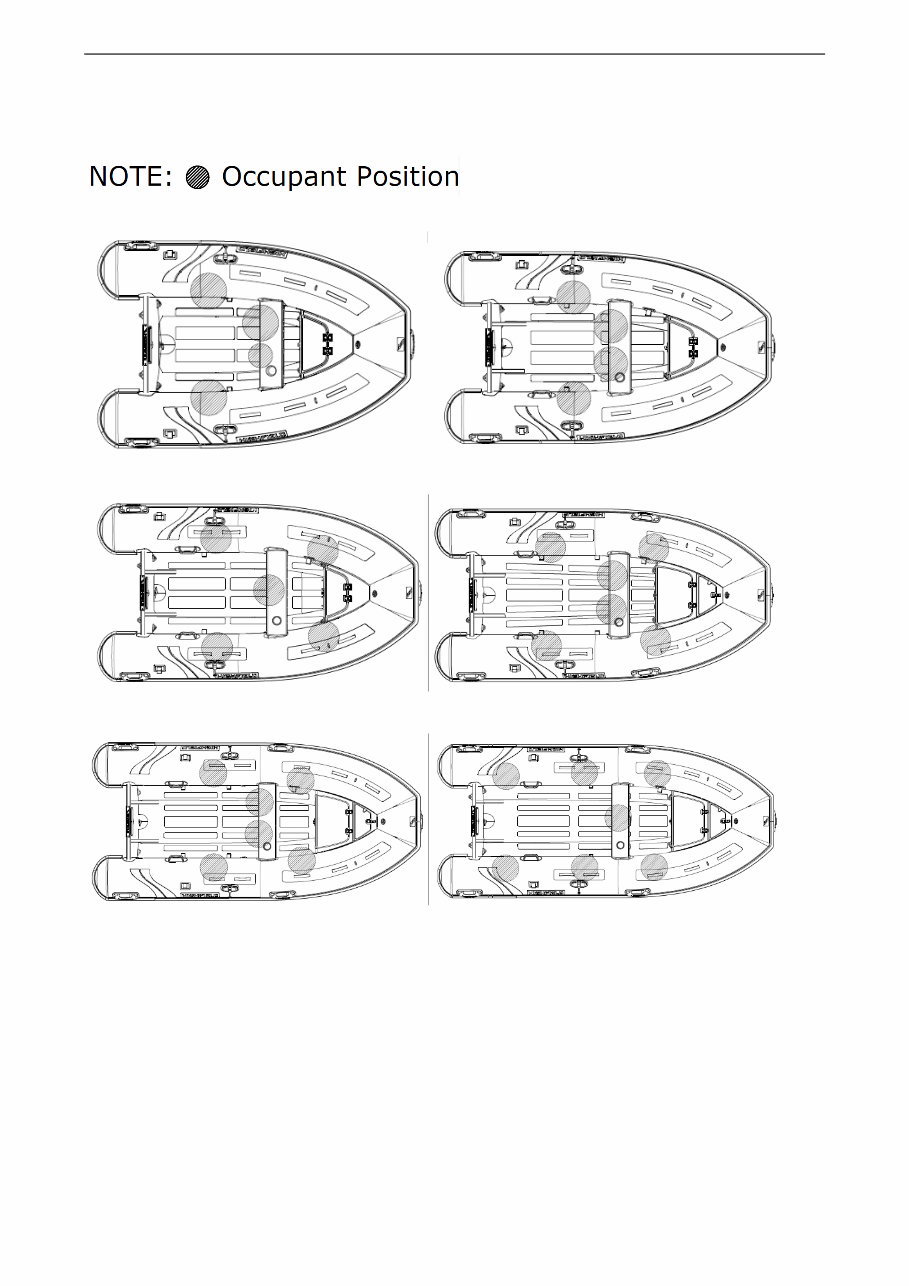
Recommended Seating Arrangement (Classic)
CL260 CL290
CL310 CL340
CL360 CL380
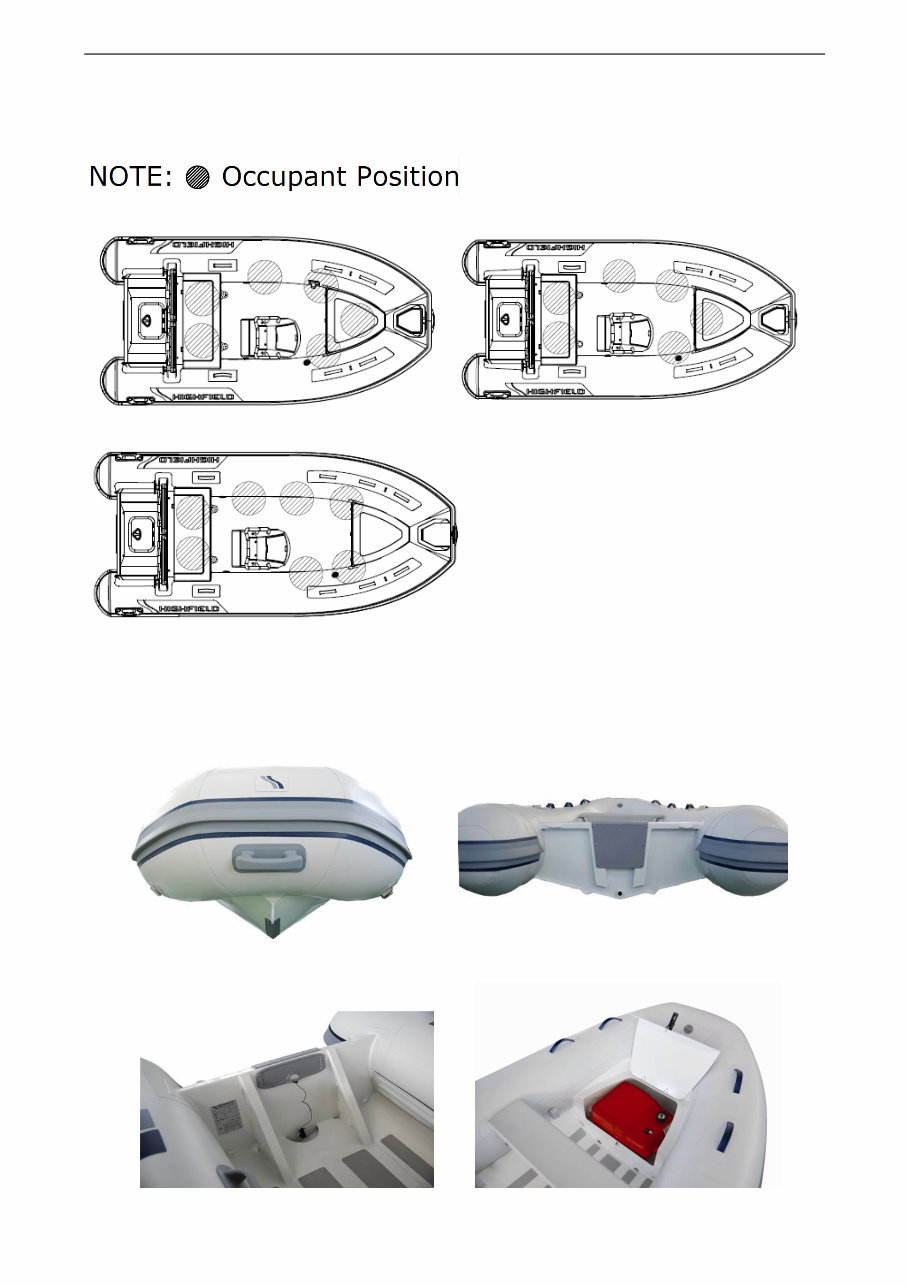
Recommended Seating Arrangement (Classic Deluxe)
CL340DL CL360DL
CL380DL
Boat Components
Front view Stern view
Transom view Bow view
You're Reading a Preview
What's Included?
 Lifetime Access
Fast Download Speeds
Online & Offline Access
Access PDF Contents & Bookmarks
Full Search Facility
Print one or all pages of your manual
$26.99
Highfield Classic 260/290/310/340/360/380 Owners Manual
Viewed 77 Times Today

What's Included?
Lifetime Access
Fast Download Speeds
Online & Offline Access
Access PDF Contents & Bookmarks
Full Search Facility
Print one or all pages of your manual
$26.99

Secure transaction
What's Included?
Lifetime Access
Fast Download Speeds
Online & Offline Access
Access PDF Contents & Bookmarks
Full Search Facility
Print one or all pages of your manual
Description
The Highfield Classic range of boats offers superior stability and a comfortable ride for everyone, with models ranging from 260cm to 380cm. Whether you prefer a traditional open style or a cabin with a well-ventilated forward deck, these roto-molded polyethylene boats are designed to bring you closer to nature. The manual provides essential instructions for usage, maintenance advice, and troubleshooting, making it useful for both professional mechanics and DIY enthusiasts. It comes equipped with all the necessary safety equipment and features for an easy and enjoyable experience, ensuring you're ready for your aquatic adventure with the Highfield Classic Owners Manual.


