TABLE OF CONTENT FOREWORD ............................................. 4 1 GENERAL ............................................. 5 1.1 CE-CERTIFICATION........................................ 5 1.1.1 IDENTIFICATION ............................................ 6 1.1.2 BUILDER’S PLATE ........................................... 6 1.1.3 ID OF NOTIFIED AUTHORITY .......................... 6 1.2 TECHNICAL DATA ......................................... 6 1.2.1 GENERAL FACTS ............................................ 7 1.3 DECLARATION OF CONFORMITY AND ESSEN- TIAL SECURITY REQUIREMENTS .............................. 8 1.4 GENERAL LAYOUT ......................................... 9 2 STABILITY AND BUOYANCY ............. 10 2.1 GENERAL .................................................... 10 2.2 SELF DRAINING SYSTEMS ............................ 10 2.3 DOORS, HATCHES AND SEACOCKS............ 10 2.4 BILGE PUMP SYSTEM ................................... 12 3 BOAT OPERATION ............................. 13 3.1 HANDLING DEVICES OF BOAT ..................... 13 3.1.1 STEERING CONSOLE .................................... 13 3.1.2 WINDSCREEN WIPERS.................................. 14 3.1.3 STEERING SYSTEM ....................................... 14 3.1.4 STARTING THE ENGINE ................................ 15 3.2 REGULAR INSPECTION FOR USER ................. 15 3.2.1 BEFORE LEAVING HARBOUR ........................ 15 3.2.2 AFTER USE ................................................... 15 3.3 NOTES FOR SUNNY CONDITIONS................. 16 3.3.1 PROTECTING ............................................... 16 3.4 BOAT HANDLING ......................................... 16 3.4.1 BEFORE LEAVING HARBOUR ........................ 16 3.4.2 LEAVING THE JETTY ..................................... 17 3.4.3 DRIVING THE BOAT...................................... 17 3.4.4 VISIBILITY FROM HELMING POSITION ........... 18 3.4.5 USING THE TRIM TABS ................................. 19 3.5 PREVENTING FALLING OVERBOARD AND HOW TO GET BACK ON BOARD..................................... 19 3.6 ANCHRORING, DOCKING AND MOORING... 20 3.6.1 FASTENING POINTS ...................................... 20 3.6.2 DOCKING .................................................... 20 3.6.3 BEFORE ANCHORING................................... 20 3.6.4 TOWING AND MOORING ............................ 20 3.6.5 LIFTING AND TRANSPORTING ...................... 21 4 TECHNICAL SYSTEMS ....................... 23 4.1 ELECTRICAL SYSTEM ................................... 23 4.2 12 V SYSTEM............................................... 23 4.2.1 MAIN SWITCHES ......................................... 24 4.2.2 DIRECT SUPPLY SWITCHES ........................... 24 4.2.3 FUSES .......................................................... 24 4.2.4 HEAVY DUTY FUSES .................................... 25 4.2.5 BATTERIES ................................................... 25 4.3 110/230 V SYSTEM...................................... 26 4.4 FUEL SYSTEM .............................................. 26 5 EQUIPMENT ....................................... 28 5.1 FRESH WATER SYSTEM ................................ 28 5.2 SEPTIC SYSTEM ........................................... 29 5.2.1 TOILET SEAT ................................................ 29 5.2.2 SEPTIC TANK ............................................... 29 5.2.3 SEPTIC DIAGRAM ........................................ 29 5.3 HEATING SYSTEM ........................................ 30 5.4 BOW THRUSTER .......................................... 30 5.5 ANCHOR WINDLASS.................................... 30 5.6 LPG SYSTEM ................................................ 31 5.6.1 LIGHTING THE LPG COOKER ................. 31 5.6.2 THE LPG USE ............................................... 31 6 SAFETY .............................................. 33 6.1 GENERAL ..................................................... 33 6.2 FIRE CONTROL ............................................. 33 6.2.1 BOAT OWNER’S/USER’S RESPONSIBILITIES.... 33 6.3 LIFE RAFT STORAGE ..................................... 33 6.3.1 USE OF LIFE RAFT......................................... 34 6.4 CARBON MONOXIDE................................... 34 6.5 GENERAL SAFETY DIAGRAM ....................... 35 7 MAINTENANCE ................................. 36 7.1 MAINTENANCE............................................ 36 7.1.1 MAINTENANCE NOTES ................................ 36 7.2 CORRECTIVE PROCEDURES ......................... 36 7.2.1 WOODEN INTERIORS ................................... 37 7.2.2 CLEANING THE COVER ................................ 37 7.2.3 COVER ........................................................ 37 7.2.4 PREVENTING FROST DAMAGE ..................... 37 7.2.5 ACTIONS BEFORE WINTER LAY-UP ............... 37 7.2.6 ACTION BEFORE LAUNCHING ...................... 37 8 THE ENVIROMENT ............................. 38 8.1 REQUIREMENTS FOR NORTH AMERICAN RE- GION 38 9 APPENDIxES...................................... 39 APPENDIX 1 WARRANTY POLICY .......................... 39 APPENDIX 2 ELECTRIC DIAGRAM.......................... 39 APPENDIX 3 EPA FUEL SYSTEM ............................. 39 3
FOREWORD Congratulations on your new boat! We thank you for choosing this boat and wish you safe and enjoyable moments out on the waters will occur over time and as a result of heavy use or misuse of the boat. Any boat, no matter how strong it may be, can be severely damaged if not used properly. Inappropriate use of this boat i.e. use which is not compatible with safe boating, is not allowed. It is always important to adjust the speed and direction of the boat to the sea conditions and your own boating experience. If your boat is fitted with a life raft, carefully read its operating manual. Onboard, the boat should have the appropriate safety equipment according to the type of boat, weather conditions, etc. This equipment is compulsory in some countries. The crew should be familiar with the use of all safety equipment and the most important actions in different emergency situations (man overboard recovery, towing, etc.). Sailing schools and clubs regularly organize rescue drills. The equipment in your boat may differ from the equipment used in the pictures and illustrations in this manual. The reason for this might be due to any optional equipment you have chosen or modifications that have been adapted since this manual was made. In such cases we recommend that you contact your local dealer for additional information regarding the equipment in question. Keep this manual in a safe place and pass it on to the new owner if you sell your boat. If the manual is mislaid or destroyed, a copy can be ordered from your dealer. The warranty on the engine, as well as optional equipment such as trim tabs, bow thrusters, navigation equipment and other equipment fitted afterwards, is on the individual supplier’s conditions. The warranties for this equipment and the suppliers’ contact information are enclosed. Concerning all other warranty claims, please contact you Axopar dealer mentioned on the cover page. See the purchase agreement/order for the scope of your purchase. In case something does not work satisfactorily with your boat or its equipment, you can check the service documents for possible service and repair measures. In the event of uncertainty, you should always contact your dealer. Please note that your boat is a recreational boat, thus not suitable for professional use. Specifications, illustrations and examples and related constructional data in this publication are not binding. We reserve the rights for changes. In this owner´s manual you will find important information that will help you handle and maintain your boat in a safe and easy manner. Furthermore, the manual contains detailed information about the boat and the systems installed, and general information about handling and taking care of your boat. We advise you to read the manual carefully and familiarise yourself with your boat before you start to use it. Naturally this owner’s manual is not a substitute for boating safety skills or good seamanship. If this is your first boat or if this boat type is new to you, we ask for your own comfort and safety that you ensure you can handle the boat before you set out for the first time. Your boat dealer, local boat clubs and national motorboat or yacht federations will gladly inform you about local sea schools or recommend approved instructors. You should ensure that the anticipated wind and wave conditions correspond to the design category of your boat, and that you and your crew are able to handle the boat in these conditions. Design category B corresponds to wind and wave conditions that can vary from storm to strong winds. Category C also indicates a risk of exceptional swell and gust. Even though your boat is designed for such conditions, they are still very dangerous. Only a capable, fit and trained crew, using a well maintained boat, can satisfactorily operate in such conditions. This owner’s manual is not a detailed maintenance or troubleshooting guide. If problems occur, you should contact the boat manufacturer or their representative. When you are in need of maintenance or repair and alteration work, you should always turn to competent and trained workshops. Changes that can affect the boat’s security features must be assessed, carried out and documented by competent professionals. The boat manufacturer cannot be held responsible for unauthorised modifications. Every change to the boat’s centre of gravity (from highly mounted heavy equipment or a new engine type etc.) will significantly affect the stability, trim and performance of the boat. The boat owner must take local and international regulations into consideration concerning the boat crew, equipment and handling of the boat. In some countries, a driving licence or a separate authorization is required for driving the boat and in some countries special regulations might also be in force. Always maintain your boat properly and make allowance for the deterioration that 4
1 GENERAL The purpose of the owner’s manual is not to be a complete service guide or repair handbook, but to guide the owner into the characteristics of his/her new boat and to handle it in a proper way. The warnings and precautions in this manual are defined as follows: DANGER! Maximum caution should be observed to prevent fatal injury or permanent harm. WARNING! Denotes that an extreme inherent hazard exists which very likely could result in death or serious injury if proper precautions are not taken. CAUTION! Take precautions to prevent injury and/or damage to the boat and its components. Units in line with the SI system have been used in this manual, but in some cases other units have been added in parentheses. An exception is wind velocity, which in the Recreational Boat Directive is given in the Beaufort Scale. In this manual, the right side of the hull is referred to as STB (starboard) and the left side as Port. 1.1 CE-CERTIFICATION The category is determined according to the maximum number of persons allowed onboard. CE certification means that a boat is designed and built in such a way that it retains its stability and buoyancy in given circumstances and meets other important requirements that are characteristic of the category in question. One of these requirements is that the boats must be easy to manoeuvre. The CE-categories means also that boats in each category must be designed and constructed to withstand the following parameters in respect of stability, buoyancy, and other relevant essential requirements stated. A. Ocean These boats are designed for extended voyages, where conditions experienced may exceed wind force 8 Beaufort Scale and include significant wave heights of at least 4 metres. Under such conditions these boats must be largely self-sufficient. B. Offshore These boats are designed for offshore voyages, where conditions up to and including wind force 8 Beaufort Scale and significant wave heights up to and including 4 metres may be experienced. C. Inshore These boats are designed for voyages in coastal waters, large bays, estuaries, lakes and rivers, where conditions up to and including wind force 6 Beaufort Scale and significant wave heights up to and including 2 m may be experienced. This boat is classified as Category B and C. 5
1.1.1 IDENTIFICATION Each boat is supplied with a unique identification code, containing the data described below. The identification code comprises 14 characters plus a hyphen. The height of the code text is 6 mm and it is applied to the starboard side of the stern. The identification code reads as follows: 1.1.3 ID OF NOTIFIED AUTHORITY VTT Expert Services Oy, Notified authority number 0537 1.2 TECHNICAL DATA WARNING! When loading the boat, never exceed the maximum recommended load of the boat. Always load the boat carefully and always distribute loads appropriately to maintain design trim. Avoid placing heavy equipment or material high up in the boat. Overloading the boat can damage the engine, even when shut off. CAUTION! The specified tank capacity is not necessarily fully available, depending on the trim and load on board. The tank should always be kept at least 20% full. WARNING! You must not exceed the max. number of persons of the boat. Regarding the number of persons you must also always take into consideration that the total weight of the persons on board and their personal luggage must never exceed the max. load of the boat. When out on the water, always use the seats intended for passengers. CAUTION! The liquids in the built-in tanks are not included in the max. load shown on the Builder’s plate. 1.1.2 BUILDER’S PLATE The cooperation with VTT (Technical Research Centre of Finland) means that VTT as an external and independent organisation has inspected that the boat fulfils the Recreational Boat Directive and related standards requirements. The manufacturer’s plate is always fitted close to the steering position in the boat. The manufacturer’s plate gives the following information: BOAT TYPE Boat model DESIGN CATEGORY Boat class. See additional information in the chapter CE-category. MAX. LOAD Buoyancy. Total weight of persons including personal luggage (excluding tank contents). MAX. NO Maximum number of persons on board A comprehensive explanation of the information given on the plate is presented in each chapter respectively in this manual. (Load and max. engine power) FI – BOTS7001E818 FI Country of manufacturer - Hyphen BOT Manufacturer: S7 Boat model 001 Boat number E Month of manufacture: A = January, B = February, etc. 6 Year of manufacture 18 Model year 6
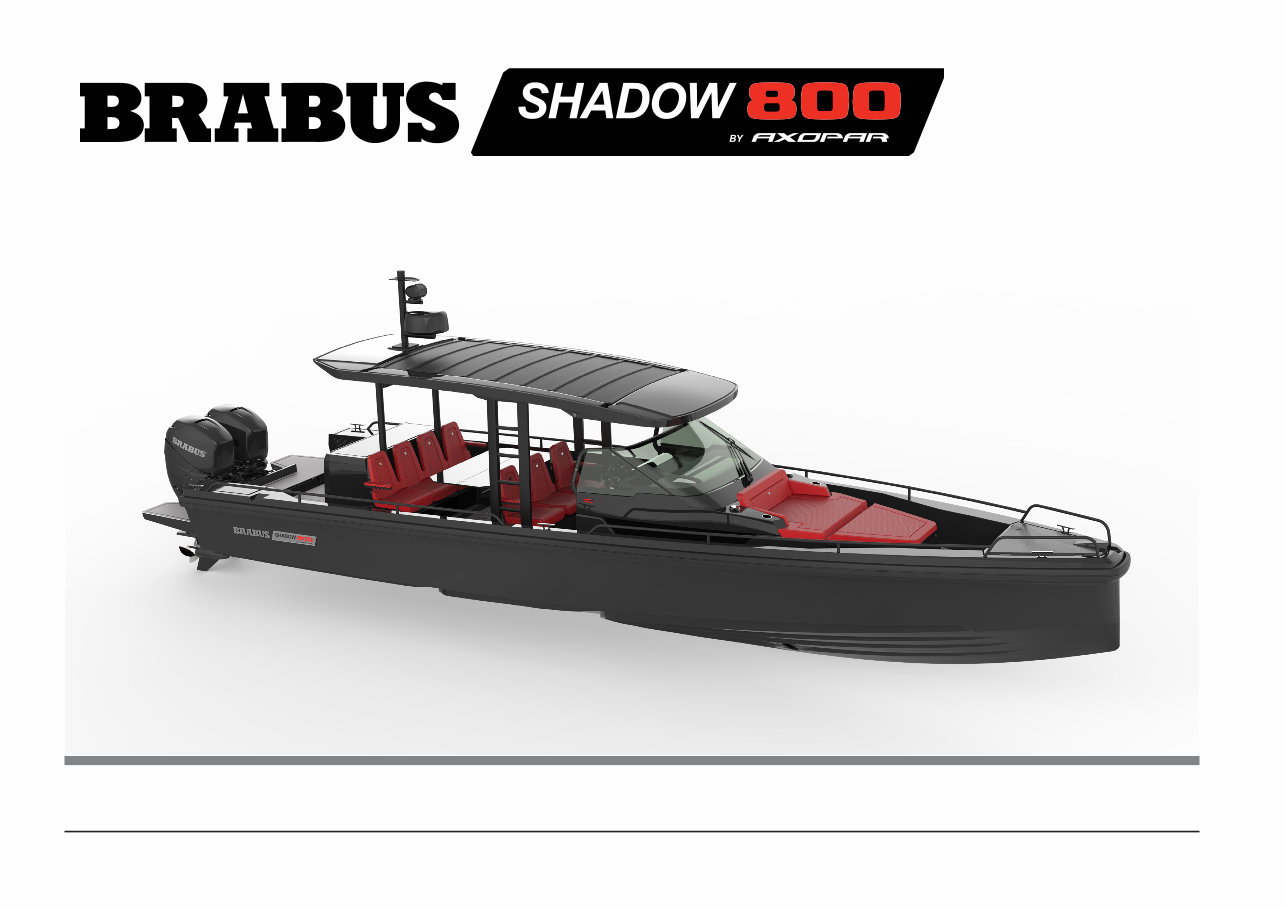
1.2.1 GENERAL FACTS BOAT MODEL BRABUS SHADOW 800 DESING CATEGORY B and C DIMENSIONS SI units US units HULL LENGTH LH 11,2 M 36ft 9in OVERALL LENGTH LMAX (excl. Engine) 11,2 M 36ft 9in HULL BEAM BH 3,3 M 10ft 10in MAXIMUM NUMBER OF PERSONS (CATEGORY B) 10 (DEFAULT WEIGHT OF ONE ADULT 75KG, A CHILD 37,5 KG) MAXIMUM NUMBER OF PERSONS (CATEGORY C) 12 DRAUGHT AT MAX. LOAD (EXCLUDING ENGINE) 0,5 M 1ft 4in HEIGHT MEASURED FROM WATERLINE AT LIGHT LOAD 2,9 M 9ft 10in MAXIMUM RECOMMEDED ENGINE POWER 2x298 Kw 800 hp LOADING CATEGORY B CATEGORY C CREW LIMIT 10 12 SI units US units SI units US units TOTAL WEIGHT OF ALL PERSONS 750 kg 1653 lb 900 kg 1984 lb WEIGHT OF UNLOADED BOAT WITH MAX. WEIGHT OUTB. ENGINES 4631 kg 10210 lb 4631 kg 10210 lb MAXIMUM RECOMMEDED LOAD 1570 kg 3461 lb 1720 kg 3792 lb BOAT WEIGHT AT MAX. LOAD 6201 kg 13671 lb 6351 kg 14002 lb OF WHICH: SI units US units WEIGHT OF BOAT´S HULL (EXCLUDING ENGINE) 3810 kg 8400 lb MAXIMUM RECOMMEDED ENGINE WEIGHT 644 kg 1420 lb PERSONAL LUGGAGE 100 kg 220 lb FRESH WATER 85 kg 187 lb SEPTIC WATER 70 kg 154 lb FUEL 548 kg 1208 lb OTHER LIQUIDS (HEATER FUEL) 17 kg 37 lb TOTAL WEIGHT OF FUEL, WATER AND OTHER LIQUIDS 720 kg 1587 lb MASS AT TRANSPORT 5281 kg 11643 lb 7
1.3 DECLARATION OF CONFORMITY AND ESSENTIAL SECURITY REQUIREMENTS TANK CAPACITY FUEL TANK 730 L 63 gal FRESH WATER TANK 85 L 22 gal SEPTIC TANK 70 L 18 gal SAFETY Basic data EN ISO 8666:2002 Hull identification ISO 10087:2006 Manufacturer’s plate RDC ANNEX I: A 2.2 Owner’s manual EN ISO 10240:2004/A1:2015 Preventing falling overboard EN ISO 15085:2003/A1:2009, DAM 2.3.2 Life raft stowage RSG Guidelines Escape EN ISO 9094:2017 Anchoring and towing EN ISO 15084:2003 Running lights 1972 COLREG Emissions control EN ISO 8099:2000 INSTALLATIONS Engines and engine spaces - Fuel system EN ISO 10088:2017, EN ISO 11105 2017 Electrical system EN ISO 10133:2017, ISO 28846:1993/ A1:2000 EN ISO 13297:2017 Steering system EN ISO 10592:2017 Gas systems EN ISO 10239:2014 Fire protection EN ISO 9094:2017 DIMENSIONING Structure ISO 12215-5:2008+A1:2014, ISO 12215- 6:2008 HYDROSTATICS Stability and freeboard EN ISO 12217-1:2017 Buoyancy and floatation EN ISO 12217-1:2017 Manufacturer’s maximum recommended load EN ISO 14946:2001/AC 2005 Openings in hull, deck and superstructure EN ISO 9093-1:1997, EN ISO 9093- 2:2002, EN ISO 12216:2002 Flooding EN ISO 11812:2001, EN ISO 15083:2003, ISO 8849:2003 HANDLING CHARACTERISTICS Handling characteristics RFU 144, EN ISO 8665:2006 Visibility from the steering position EN ISO 11591:2011 EXHAUST EMISSIONS OF ENGINES - NOISE EMISSIONS - Assessment of the stability of the boat has been done at max. load conditions. The maximum recommended load contains only the weight components mentioned above. LAYOUT AND EQUIPMENT GELCOAT / PAINT HULL .........................................................ALEXSEAL GUN METAL GREY DECK ........................................................ALEXSEAL GUN METAL GREY SWITCH PANEL MODULE ...........................SOFT TOUCH / CARBON FIBER ELECTRICAL SYSTEM 12V (RECOMMENDATION) START BATTERY .........................................2 pcs. 65 Ah AGM BATTERY SERVICE BATTERY ......................................2 pcs. 110 Ah AGM BATTERY ELECTRICAL SYSTEM 230V BATTERY CHARGER ...................................65 AH SHOREPOWER CONNECTOR 8
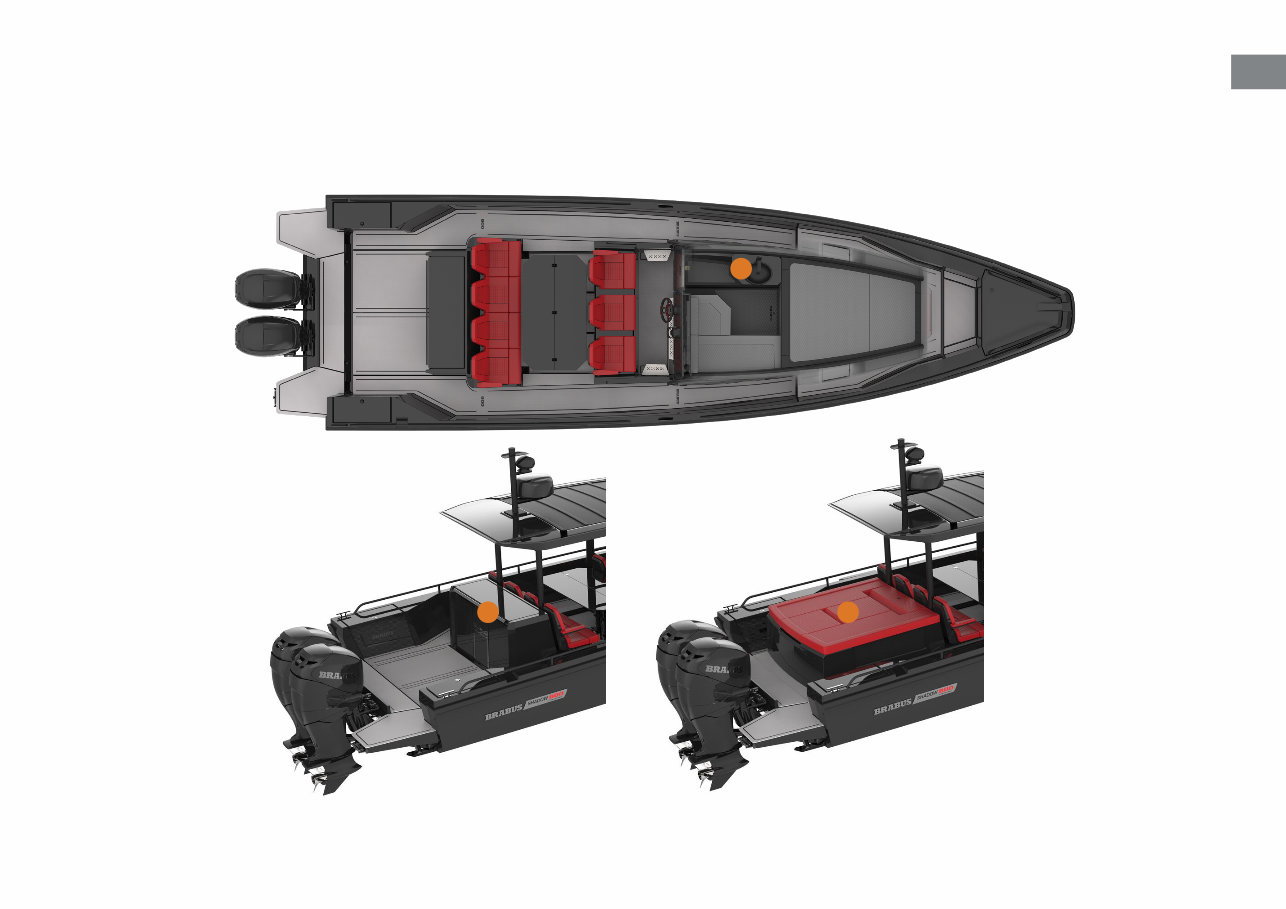
1.4 GENERAL LAYOUT 2 The Brabus Shadow 800 boats have two different deck options. The boat can be equipped with a wetbar (1) or an aft cabin (2). The boat’s fore cabin may equipped with a galley module (3). The layout of equipment and technical components may vary between boats due to different accessory alternatives. 1 3 9
2 STABILITY AND BUOYANCY 2.1 GENERAL All weight dispositions (for example installing a fishing tower, radar or furling mast, engine replacement etc.) can have a significant impact on the stability, trim, and performance of your boat. The bilge water level should be kept at a minimum. The stability of your boat will be compromised if any weight is placed in a high position. In stormy weather all hatches, compartments and doors should be kept closed to minimize the risk of flooding. The stability can be diminished when towing or lifting heavy objects using the davit or jib crane. Breaking waves represent a serious significant danger to stability. CAUTION! To avoid the risk of flooding, always keep sea valves closed when not in use. (For example, the sea valve for the toilet’s flushing water). 2.2 SELF DRAINING SYSTEMS The Axopar boat is equipped with self-draining systems for the forward and aft cockpits, which include drain holes. There are drain holes for water in both aft corners of the deck (see next Figure). The openings are directly connected to the sea. The deck of the boat has been designed to allow the water to drain straight into the sea via the water gullies (see next Figure). In addition to rainwater, the drain holes are intended to drain water ending up on the deck through splashing or from breaking waves. The drain holes must be open at all times and the holes regularly cleaned by removing any accumulated debris to prevent clogging. The system is built so as to drain the water from the deck in normal use. Do not close the taps when using the boat or when the boat is attached to the dock. CAUTION! The self-emptying open space is meant for the removal of such water that ends up on the deck through rain, splashing or from breaking waves. A part of the rain water as well as water condensation in the bilge may end up in the bilge. Do not leave the boat unattended in the water for a long time. Observe the floating position of the boat and empty the bilge when necessary. Leaving the boat unattended in the water for a long time may cause damage. WARNING! Do not close the drain holes when using the boat. 2.3 DOORS, HATCHES AND SEACOCKS There are several inlets through the boat that include taps for opening and closing the inlets. It is recommended to keep these closed if the boat is out of use for a long time, and to open them again when the boat is used again. Check always before and after boat use that every deck- and service hatches are securely closed especially inspection hatch of the engine bracket. We recommended that you keep the windows, doors, deck hatches and vents shut while driving. However, on occasion and depending on the weather they can be kept open. In stormy weather, always keep deck hatches, storage room doors and openings closed to minimize the risk of water getting into the boat. In certain conditions and speeds it is possible that water is sprayed inside through canopies, hatches or other openings, due to negative pressure or other effects. This can be prevented by closing the canopies, hatches or other openings. In the cockpit of boat are two recesses, recess under driver and passenger where in both are separate draining systems. These drain holes are located in both aft corners of the recess. Recess drains via sea-cock whick locates transom of the boat. WARNING! Do not close draining sea-cocks if boat is in the use. WARNING! Doors and hatches to aft and front cabin must be kept shut when under way. On the next page is shown openings that are required to be shut when boat is underway. These openings can be open at nice conditions and must be closed if waves or wind conditions are harsh. 10
This Axopar Brabus Shadow 800 Owners Manual is an essential resource for both professional mechanics and DIY enthusiasts who own an Axopar Shadow 800. It provides detailed information for maintenance and repairs, making it a valuable companion for watercraft owners.
The manual covers various models up to 2021, including the Shadow 800 T-Top, Shadow 800 Walkaround, and Shadow 800 Sun-Top.
Inside, users will find a wealth of content, including numerous full-color images, easy-to-follow steps, and a wide range of maintenance and repair information. Whether you're a weekend warrior or a full-time sailor, this manual is designed to help you maximize the performance of your Axopar boat.
Order the Axopar Shadow 800 Owners Manual to gain immediate access to this valuable resource. The digital file can be viewed or downloaded instantly, providing the necessary information to elevate your sailing experience.



 Lifetime Access