2 Contents These contents provide you with the exact information about the contents of the troubleshooting and repair instructions. If you are looking for a phrase or technical term or need an explanation for an abbreviation, please use the corresponding index at the end of the instructions from page 51. Chapter Chapter title Chapter contents Page 1 Introduction • Special forms of notation, presentation and icons ......................... 4 • Liability / Guarantee ......................................................................... 4 • Accident prevention ........................................................................ 4 • Important information – Range of application of HYDRONIC ............................................ 5 – Purpose of HYDRONIC ................................................................. 5 – Initial commissioning of HYDRONIC respectively function test following repairs ................................. 5 • HYDRONIC documentation – Contents and purpose of these troubleshooting and repair instructions ................................................................. 5 – Other HYDRONIC documentation ............................................... 5 • Statutory regulations ........................................................................ 6 – Regulations for installation and repair ........................................ 6 – Regulations for operation ............................................................. 6 • Safety instructions for installation and repair of HYDRONIC ......... 7 • Safety instructions for operation ...................................................... 7 – Emergency shut-down (EMERGENCY OFF) ................................ 7 2 Function and operation • Sectional drawing HYDRONIC B 4 W SC and B 5 W SC ................ 8 • Function diagram HYDRONIC B 4 W SC and B 5 W SC ................ 9 • Control diagram HYDRONIC B 4 W SC and B 5 W SC ................... 9 • Sectional drawing HYDRONIC D 4 W SC and D 5 W SC ............. 10 • Function diagram HYDRONIC D 4 W SC and D 5 W SC .............. 11 • Control diagram HYDRONIC D 4 W SC and D 5 W SC ................ 11 • Description of functions ................................................................. 12 • Control and safety features ............................................................ 12 3 Technical data • HYDRONIC B 4 W SC and B 5 W SC ............................................. 13 • HYDRONIC D 4 W SC and D 5 W SC ............................................ 14 • Water pump .................................................................................... 15 4 Troubleshooting • When faults occur, first check … ................................................... 16 • Controller lock ................................................................................ 16 • Cancel the controller lock ............................................................. 16 • Testing equipment ......................................................................... 16 • Testing equipment – Diagnosis instrument ................................................................. 17 – Module clock – installed in vehicle ........................................... 17 – Customer service program KD 2000 ......................................... 17 – Radio remote control TP5 ........................................................... 17 • Fault diagnosis with diagnosis instrument .............................. 18, 19 • Fault diagnosis with module clock ................................................ 20 • Fault diagnosis with customer service program KD 2000 ........... 21 • Fault diagnosis with radio remote control TP5 ............................. 22 • Error code table ...................................................................... 23 – 28 Introduction 1
3 Introduction 1 Chapter Chapter title Chapter contents Page 5 Repair instructions • Repair instructions ......................................................................... 29 • Observe following safety instructions before working on the HYDRONIC ................................................ 29 • Instructions for AMP unlocking tool ............................................... 29 • Fitting HYDRONIC back into the vehicle ...................................... 29 • Assembly drawing .................................................................... 30, 31 • Repair step 1 Dismantle the fan covering ............................................................ 32 • Repair step 2 Dismantle cover for heat exchanger with water pump ................ 32 • Repair step 3 Dismantle controller ...................................................................... 33 Check controller ............................................................................ 33 • Repair step 4 Remove glow plug ......................................................................... 33 • Repair step 5 Remove flame sensor .................................................................... 34 Check flame sensor ....................................................................... 34 • Repair step 6a Dismantle combustion air fan ....................................................... 35 • Repair step 6b Measure speed of combustion air fan motor ................................ 36 • Repair step 7a Remove plug filter .......................................................................... 36 • Repair step 7b Remove socket .............................................................................. 36 • Repair step 8 Remove combustion chamber ...................................................... 37 • Repair step 9 Remove overheating and temperature sensor ............................. 38 Check overheating and temperature sensor ................................ 38 • Repair step 10 Remove heat exchanger ............................................................... 39 • Repair step 11 Re-mount heat exchanger ............................................................. 39 • Repair step 12 Remove dosing pump – only HYDRONIC D 4 W SC / D 5 W SC .......................................... 40 • Measuring the fuel quantity ........................................................... 41 6 Wiring diagram • Wiring diagram HYDRONIC B 4 W SC / B 5 W SC HYDRONIC D 4 W SC / D 5 W SC ........................................... 42, 43 • Wiring diagram Controls – part 1 ....................................................................... 44, 45 • Wiring diagram Controls – part 2 ....................................................................... 46, 47 7 Service • Certification .................................................................................... 48 • Disposal ......................................................................................... 48 • Foreign representatives ........................................................... 49, 50 • List of abbreviations ....................................................................... 51 • Keyword index ............................................................................... 52
4 Introduction 1 Special forms of notation, presentations and icons These instructions use special forms of notation and icons to underline various different contents. Please refer to the examples below for the meaning and how to behave. Special forms of notation and presentations • This point (•) indicates a list introduced by a heading. – If a “dot” is followed by an indented hyphen (–), this list is classified under the black dot. Icons Regulation This icon refers you to a statutory regulation. Failure to comply can possibly lead to the ABG (general type certification) for HYDRONIC becoming null and void and to the preclusion of any guarantee or liability on the part of J. Eberspächer GmbH & Co. KG. Danger This icon draws your attention to a threat of danger to life and limb. Failure to comply can possibly lead to severe personal injury. è This arrow refers to the corresponding precautions to be taken to prevent the danger. Caution This icon draws your attention to a dangerous situation for a person and / or product. Failure to comply can result in injury to persons or damage to the machine. è This arrow refers to the corresponding precautions to be taken to prevent the danger. This draws your attention to recommendations and helpful tips for operation, installation and repair of the HYDRONIC. Liability / guarantee Compliance with the official regulations and safety instructions is a prerequisite for any liability claims. Failure to comply with the official regulations and safety instructions precludes any liability on the part of the heater manufacturer. Accident prevention General accident prevention regulations and correspond- ing workshop and operational protection instructions must always be observed. Please note
5 Important information Range of application of HYDRONIC The engine-independent water heater HYDRONIC is intended for installation in the following vehicles, depending on heater output: • motorised vehicles of all kinds • construction machines • boats, ships and yachts (diesel heaters only). Caution • The heater may only be used and operated for the range of application stated by the manufacturer in full compliance with the “operating instructions” enclosed with every heater. • HYDRONIC B 4 W SC, B 5 W SC, D 4 W SC and D 5 W SC – 12 volt must not be installed in vehicles used for the transport of dangerous substances as per GGVS / TRS003 / ADR / ADR99. Purpose of HYDRONIC • Preheating, de-misting windows • Heating the following and keeping them warm: – Driver or working cab – Freight compartments – Ship’s cabins – Passenger and crew compartments – Vehicle engines and additional units. Given its functional purpose, HYDRONIC is not certified for the following uses: • Long-term continuous operation, e.g. pre-heating and heating of: – Living areas – Garages – Working sheds, weekend houses and hunting cottages – Houseboats, etc. Initial commissioning of HYDRONIC respectively function test following repairs • After installation of the heater respectively after repairs to HYDRONIC, the coolant circuit and the whole fuel supply system must be carefully vented. Please comply with the instructions issued by the vehicle manufacturer. • Prior to a trial run, open all heating circuits (set the temperature control to “warm”). • During the trial run of HYDRONIC, check that all water and fuel connections do not leak and are firmly connected. • If HYDRONIC should show a malfunction during opera- tion, eliminate the problem with a diagnosis device. Introduction 1 HYDRONIC Documentation Content and purpose of these troubleshooting and repair instructions These instructions are to be used for eliminating faults and performing repairs on HYDRONIC. The necessary work must only be carried out by a JE service partner or correspondingly trained staff. Other HYDRONIC documentation Operating instructions The operating instructions give the customer all neces- sary information for safe operation of HYDRONIC. Technical description / Installation instructions The technical description/installation instructions give the JE service partner all necessary technical information and describe correct proper installation of HYDRONIC. Spare parts list The spare parts list gives the JE service partner all neces- sary information for ordering spare parts required for repair work.
6 Please note Introduction 1 Statutory regulations For installation in vehicles subject to the German Regula- tions Authorising the Use of Vehicles for Road Traffic (StVZO), the heater has been awarded a “general type certification (ABG)” with official test symbol marked on the heater nameplate. HYDRONIC B 4 W SC S 288 HYDRONIC B 5 W SC S 288 HYDRONIC D 4 W SC S 274 HYDRONIC D 5 W SC S 274 The statutory regulations are compulsory in the scope of the StVZO and must also be observed in countries where there are no special regulations. For installation of the heater in vehicles not subject to the StVZO (e.g. ships), the specially valid regulations and installation instructions must be observed. Regulations for installation and repair • The year of initial commissioning must be entered indelibly on the nameplate. For this purpose, 3 year numbers are printed on the corresponding section of the nameplate. The respective year number is to be indicated by removing (peeling off) the two inapplicable year numbers. • The heaters are to be installed according to the installa- tion instructions. Installation is to be checked a) by type testing of the vehicles as per § 20 StVZO b) by individual testing as per § 21 StVZO or c) by a survey as per § 19 StVZO or by an officially approved surveyor or inspector for motorised vehicles, a motorised vehicle surveyor or employee according to section 7.4a of the appendix to StVZO. In the case of c), this is to be certified stating the vehicle manufacturer, vehicle type and vehicle ident. number on the acceptance confirmation contained in the ABG form. Effectiveness of type certification depends on this. The acceptance confirmation must always be kept in the vehicle. • For installation of the heater in special vehicles (e.g. vehicles for the transport of dangerous goods), the regulations applying to such vehicles must be observed. • The heater may not be installed in the driver or passen- ger compartment of buses and coaches with more than 8 seats apart from the driver’s seat. • The sticker “turn the heater off before refuelling” included in the scope of supply of the heater must be affixed to a suitable point of the vehicle (near to the fuel filler neck). • The outlet opening must be designed so that a ball of 16 mm diameter cannot pass through. • Exhaust pipes must be routed so that any penetration of exhaust inside the vehicle is not to be expected. • The functioning of important operational parts of the vehicle must not be impaired. • Condensation or penetrated water must not be allowed to gather in the exhaust pipe. Drain openings are permitted, consisting of impervious pipes in the interior which drain the liquid to the outside. • The opening of the exhaust pipe should be routed upwards, to the side, or when the exhaust pipe is routed under the bottom of the vehicle, close to the side or rear end of the driver’s cab or vehicle. • The necessary combustion air must be taken in from the outside. • The opening of the combustion air intake must be designed so that a ball of 16 mm diameter cannot pass through. • Electrical cables, switchgear and controllers for the heater must be arranged in the vehicle so that troublefree operation is not impaired under normal operating conditions. All pipes leading out from the heaters must be splashproof at the leadthrough. • The corresponding operating condition (at least switched on or off) must be clearly obvious for the user. • §§ 45 and 46 StVZO are to be observed for the routing of fuel pipes and installation of additional fuel tanks. Excerpt from §§ 45 and 46 StVZO: – In the case of buses and coaches, fuel tanks may not be located in the passenger or driver’s compartment. They must be arranged so that the exits from the bus are not at any risk in the case of a fire. – In the case of buses and coaches, fuel pipes may not be located in the passenger or driver’s compartment. Regulations for operation • The heater must be switched off when refuelling. • Operation of the heater is not allowed in closed rooms, such as: – garages – underground car parks – multi-storey car parks. • The acceptance confirmation is enclosed with the documents for HYDRONIC.
7 Safety instructions for installation and repair of HYDRONIC Danger Risk of injury, burning and fire! • Disconnect the vehicle battery before starting any work on HYDRONIC. • Always switch HYDRONIC off and let all hot parts cool down prior to repairs. Caution Important instructions for installation and repair of HYDRONIC • The heater must only be installed by a JE service partner authorised by the manufacturer, according to the specifications made in this document and possibly any special installation suggestions, or repaired in the case of repairs or guarantee claims. • Repairs by unauthorised third parties and / or with non- original spare parts are dangerous and therefore not allowed. They make the general type certification (ABG) of the heater invalid and thus in the case of motorised vehicles, under certain circumstances also the general operating permit (ABE) of the vehicle. • The following are not allowed: – Modifications to heating-relevant components. – Use of third-party components not approved by Eberspächer. – Failure during installation or operation to comply with statutory and safety regulations or regulations relevant to function, as stipulated in the installation instructions and operation instructions. This applies in particular to the electrical wiring (circuit diagrams), fuel supply, combustion air system and exhaust system. • Only original accessories and original spares may be used for installation or repairs. • Only the controls approved by Eberspächer may be used to operate HYDRONIC. The use of other controls can cause malfunctions of the heater / heating operation. • Before installing a heater in another vehicle, those parts of the heater which convey water must be rinsed with clear water. • Fuel pipes and exhaust pipes must be fastened securely (recommended spacing 50 cm) to avoid damage from vibrations. • Ensure that the insulation of electric cables etc. cannot be damaged by chafing, buckling, clamping or heat development. Introduction 1 • Failure to comply with the statutory and safety regulations and / or specifications relevant to functions makes the ABG of HYDRONIC null and void and releases J. Eberspächer GmbH & Co. KG from any guarantee or liability. Other “safety instructions and important information for the installation and repair of HYDRONIC” are printed directly in the corresponding sections of these troubleshooting and repair instructions. Safety instructions for operation Caution • The heater may not be operated wherever inflammable fumes or dust can be produced, e.g. near to – fuel depots – coal depots – wood storage yards – cereal storage facilities. • HYDRONIC’s after-running feature may not be inter- rupted prematurely for example by pressing the battery disconnecting switch, apart from in an emergency shut-down. Please note Emergency shut-down (EMERGENCY STOP) If during operation an emergency shut-down (EMERGENCY STOP) should be necessary, please proceed as follows: • Switch HYDRONIC off at the controls, or • Pull the fuse, or • Open the battery disconnecting switch, or • Disconnect HYDRONIC from the battery.
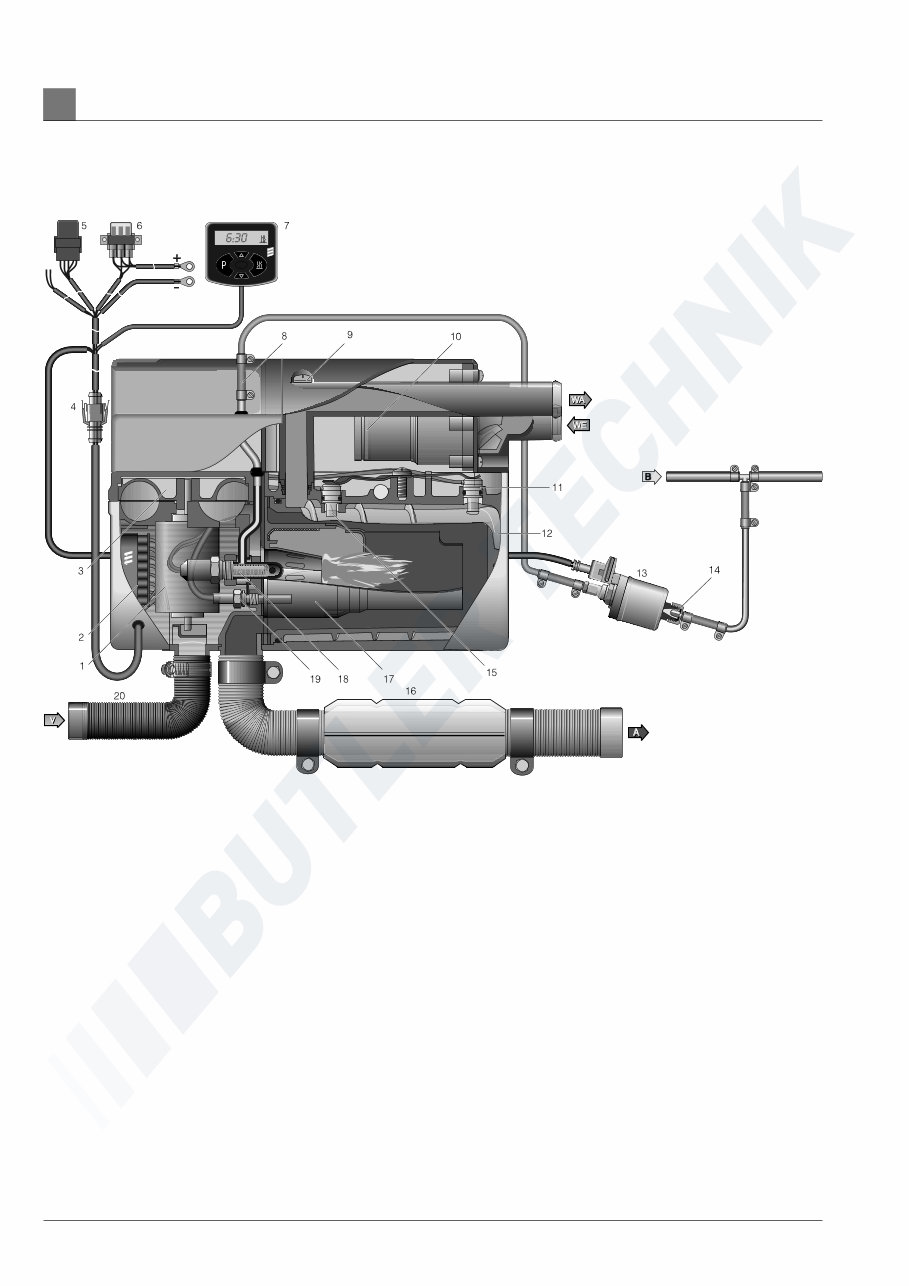
8 Sectional drawing HYDRONIC B 4 W SC and B 5 W SC 1 Electric motor 2 Controller 3 Combustion air fan 4 Interface / 8-pole connector 5 Fan relay 6 Fuse holder 7 Mini timer 8 Fuel connection 9 Vent screw 10 Water pump 11 Overheating sensor 12 Heat exchanger 13 Dosing pump 14 Cup filter, fitted in dosing pump 15 Temperature sensor 16 Exhaust pipe with exhaust silencer 17 Combustion chamber 18 Glow plug 19 Flame sensor 20 Combustion air pipe A = exhaust B = fuel C = combustion air WA = water discharge WE = water intake Function and operation 2
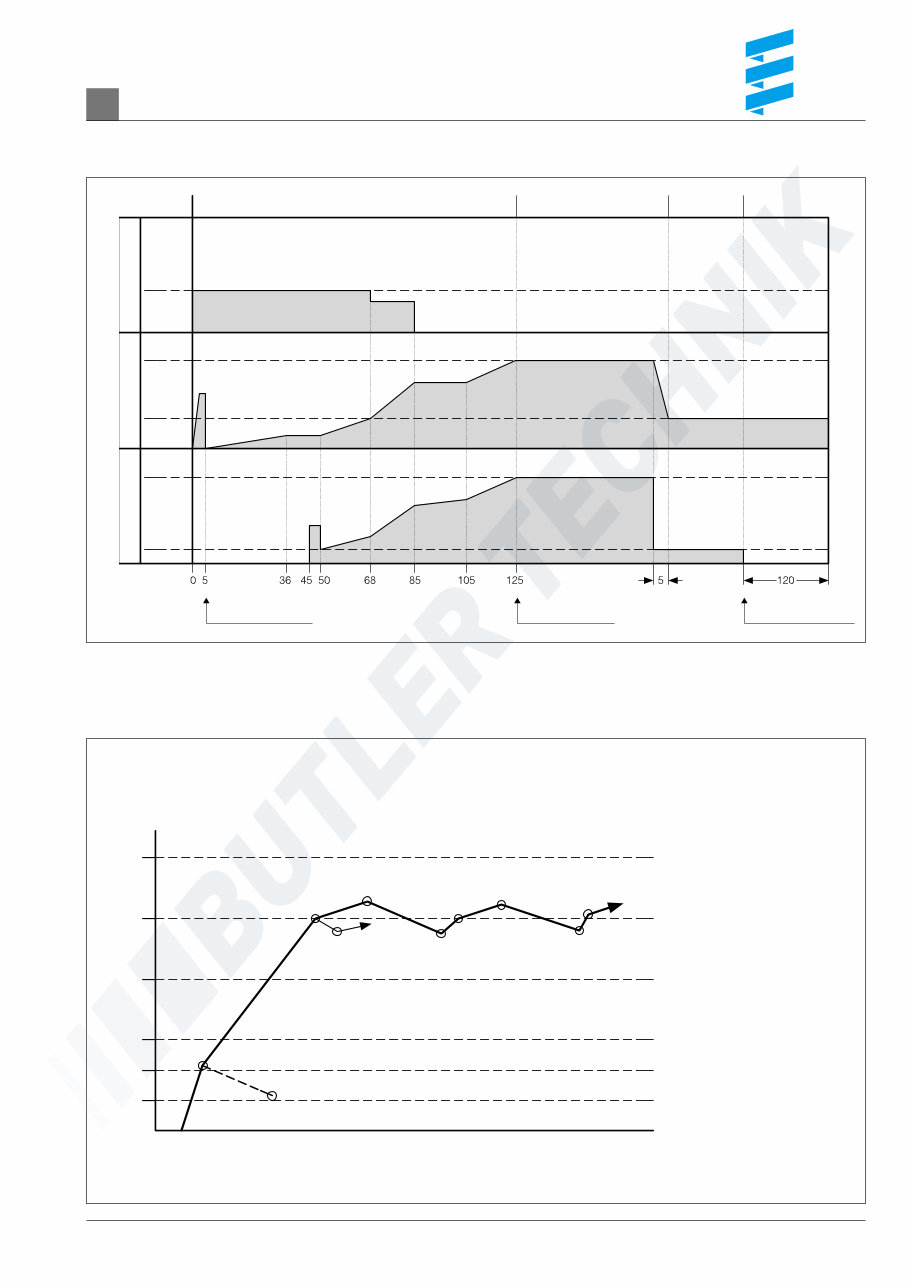
9 Function diagram – HYDRONIC B 4 W SC and B 5 W SC Function and operation 2 Sectional drawing – HYDRONIC B 4 W SC and B 5 W SC HYDRONIC on Control stage large Control stage small HYDRONIC off Afterrunning on Glow plug Fan Dosing pump SMALL LARGE SMALL LARGE 8.0 V 7.8 V time (sec.) Vehicle fan ON Flame detection Vehicle fan OFF large 4.3 KW (B 4 W SC) 5.0 KW (B 5 W SC) small 1.5 KW time 100 80 60 40 30 20 °C large large large large off off Vehicle fan ON on on Vehicle fan OFF small small
Get the service manual for the Eberspacher Hydronic B4WSC, B5WSC, D4WSC, and D5WSC heaters. This manual features bookmarked chapters for easy navigation, allowing you to quickly find exact repair service procedures. Throughout each chapter, you'll find notes, cautions, and warnings pinpointing critical service information. Numbered instructions will guide you through every repair procedure in a step-by-step fashion, while bold figured numbers help you quickly match illustrations with instructions. Detailed illustrations, exploded diagrams, drawings, and photos will guide you through every service repair procedure. The numbered table of contents is easy to use, enabling you to find the information you need fast. The manual is in English and is available in PDF format. It consists of 52 pages. To purchase this repair manual, simply click on the green "Instant" button at the upper left-hand corner of this page. After purchasing, download it to your computer to save and print pages whenever you need them.
Recently Viewed
5,521,897Happy Clients
2,594,462eManuals
1,120,453Trusted Sellers
15Years in Business
Price:
Actual Price:
Eberspacher Hydronic B4WSC, B5WSC, D4WSC and D5WSC heater service manual



 Lifetime Access