


CUMMINS PCC2100 Wiring Diagram Manual
What's Included?
 Lifetime Access
Fast Download Speeds
Online & Offline Access
Access PDF Contents & Bookmarks
Full Search Facility
Print one or all pages of your manual
Service Manual
Generator Set
GGFD (Spec E−K)
GGFE (Spec E−K)
GGHE (Spec E−H)
GGHF (Spec E−H)
GGHG (Spec E−H)
GGHH (Spec E−H)
with PowerCommand
)
Control 2100
English − Original Instructions 2−2011 928−0507 (Issue 7)

i
Table of Contents
SECTION TITLE PAGE
IMPORTANT SAFETY INSTRUCTIONS iii . . . . . . . . . . . . . . . . . . . . . . . . . . . . . . .
1 INTRODUCTION
About this Manual 1-1 . . . . . . . . . . . . . . . . . . . . . . . . . . . . . . . . . . . . . . . . . . . . . .
System Overview 1-1 . . . . . . . . . . . . . . . . . . . . . . . . . . . . . . . . . . . . . . . . . . . . . . .
Test Equipment 1-1 . . . . . . . . . . . . . . . . . . . . . . . . . . . . . . . . . . . . . . . . . . . . . . . . .
How To Obtain Service 1-1 . . . . . . . . . . . . . . . . . . . . . . . . . . . . . . . . . . . . . . . . . .
2 CONTROL OPERATION
General 2-1 . . . . . . . . . . . . . . . . . . . . . . . . . . . . . . . . . . . . . . . . . . . . . . . . . . . . . . .
Control Panel Power On/Off Modes 2-1 . . . . . . . . . . . . . . . . . . . . . . . . . . . . . . .
Front Panel 2-3 . . . . . . . . . . . . . . . . . . . . . . . . . . . . . . . . . . . . . . . . . . . . . . . . . . . .
Menu Display and Buttons 2-5 . . . . . . . . . . . . . . . . . . . . . . . . . . . . . . . . . . . . . . .
Main Menus 2-7 . . . . . . . . . . . . . . . . . . . . . . . . . . . . . . . . . . . . . . . . . . . . . . . . . . . .
Controller Configuration Menu 2-8 . . . . . . . . . . . . . . . . . . . . . . . . . . . . . . . . . . . .
Engine Menu 2-10 . . . . . . . . . . . . . . . . . . . . . . . . . . . . . . . . . . . . . . . . . . . . . . . . . .
Alternator Menu 2-12 . . . . . . . . . . . . . . . . . . . . . . . . . . . . . . . . . . . . . . . . . . . . . . .
Adjust Menu 2-14 . . . . . . . . . . . . . . . . . . . . . . . . . . . . . . . . . . . . . . . . . . . . . . . . . .
Faults Menu 2-16 . . . . . . . . . . . . . . . . . . . . . . . . . . . . . . . . . . . . . . . . . . . . . . . . . .
System Menu 2-18 . . . . . . . . . . . . . . . . . . . . . . . . . . . . . . . . . . . . . . . . . . . . . . . . .
History Menu 2-20 . . . . . . . . . . . . . . . . . . . . . . . . . . . . . . . . . . . . . . . . . . . . . . . . . .
About Menu 2-22 . . . . . . . . . . . . . . . . . . . . . . . . . . . . . . . . . . . . . . . . . . . . . . . . . . .
Power Transfer Menu 2-24 . . . . . . . . . . . . . . . . . . . . . . . . . . . . . . . . . . . . . . . . . .
3 CIRCUIT BOARDS AND MODULES
General 3-1 . . . . . . . . . . . . . . . . . . . . . . . . . . . . . . . . . . . . . . . . . . . . . . . . . . . . . . .
Base Board 3-3 . . . . . . . . . . . . . . . . . . . . . . . . . . . . . . . . . . . . . . . . . . . . . . . . . . . .
4 TROUBLESHOOTING
General 4-1 . . . . . . . . . . . . . . . . . . . . . . . . . . . . . . . . . . . . . . . . . . . . . . . . . . . . . . .
InPower Service Tool 4-1 . . . . . . . . . . . . . . . . . . . . . . . . . . . . . . . . . . . . . . . . . . . .
Network Application and Customer Inputs 4-1 . . . . . . . . . . . . . . . . . . . . . . . . . .
Safety Considerations 4-2 . . . . . . . . . . . . . . . . . . . . . . . . . . . . . . . . . . . . . . . . . . .
Troubleshooting Procedure 4-2 . . . . . . . . . . . . . . . . . . . . . . . . . . . . . . . . . . . . . .

ii
SECTION TITLE PAGE
5 POWER TRANSFER CONTROL (PTC) TROUBLESHOOTING
General 5-1 . . . . . . . . . . . . . . . . . . . . . . . . . . . . . . . . . . . . . . . . . . . . . . . . . . . . . . .
PTC Module 5-1 . . . . . . . . . . . . . . . . . . . . . . . . . . . . . . . . . . . . . . . . . . . . . . . . . . .
Sequence of Events 5-1 . . . . . . . . . . . . . . . . . . . . . . . . . . . . . . . . . . . . . . . . . . . . .
Troubleshooting using Fault Codes 5-3 . . . . . . . . . . . . . . . . . . . . . . . . . . . . . . . .
PTC Fault Code Troubleshooting Procedure 5-3 . . . . . . . . . . . . . . . . . . . . . . . .
Troubleshooting with Symptoms 5-7 . . . . . . . . . . . . . . . . . . . . . . . . . . . . . . . . . .
Source 1 Power Fails, But Genset Does Not Start 5-9 . . . . . . . . . . . . . . . . . . .
Genset Starts, But Does Not Assume Load 5-11 . . . . . . . . . . . . . . . . . . . . . . .
PTC Module Does Not Retransfer When Source 1 Utility Power
Is Restored After A Power Failure Or On Initial Installation 5-13 . . . . . . .
Genset Continues To Run After Retransfer Of Load To S1 Utility 5-15 . . . . .
Genset Starts During Normal Power Service 5-15 . . . . . . . . . . . . . . . . . . . . . .
Generator Test Runs But Genset Does Not Assume Load 5-15 . . . . . . . . . . .
6 CONTROL ADJUSTMENT AND SERVICE
General 6-1 . . . . . . . . . . . . . . . . . . . . . . . . . . . . . . . . . . . . . . . . . . . . . . . . . . . . . . .
Circuit Board Removal/Replacement 6-2 . . . . . . . . . . . . . . . . . . . . . . . . . . . . . .
Modifying Setup Submenus 6-3 . . . . . . . . . . . . . . . . . . . . . . . . . . . . . . . . . . . . . .
Password Submenu 6-4 . . . . . . . . . . . . . . . . . . . . . . . . . . . . . . . . . . . . . . . . . . . . .
Crank/Idle Setup Menu 6-6 . . . . . . . . . . . . . . . . . . . . . . . . . . . . . . . . . . . . . . . . . .
Governor/Regulator Setup Menu 6-8 . . . . . . . . . . . . . . . . . . . . . . . . . . . . . . . . .
Power Transfer Setup Menu 6-12 . . . . . . . . . . . . . . . . . . . . . . . . . . . . . . . . . . . .
PCC Control Panel Box Components (Standard/Optional) 6-14 . . . . . . . . . . .
Engine Sensors 6-18 . . . . . . . . . . . . . . . . . . . . . . . . . . . . . . . . . . . . . . . . . . . . . . .
Ignition Control Module (ICM) 6-20 . . . . . . . . . . . . . . . . . . . . . . . . . . . . . . . . . . .
Magnetic Speed Pickup Unit (MPU) 6-21 . . . . . . . . . . . . . . . . . . . . . . . . . . . . . .
Current Transformer (CT) Installation 6-22 . . . . . . . . . . . . . . . . . . . . . . . . . . . . .
7 SERVICING THE GENERATOR
Testing the Generator 7-1 . . . . . . . . . . . . . . . . . . . . . . . . . . . . . . . . . . . . . . . . . . .
Generator/Base Board Isolation Procedure 7-2 . . . . . . . . . . . . . . . . . . . . . . . . .
Generator Disassembly 7-10 . . . . . . . . . . . . . . . . . . . . . . . . . . . . . . . . . . . . . . . . .
Generator Reassembly 7-12 . . . . . . . . . . . . . . . . . . . . . . . . . . . . . . . . . . . . . . . . .
Servicing the PMG 7-12 . . . . . . . . . . . . . . . . . . . . . . . . . . . . . . . . . . . . . . . . . . . . .
8 FUEL SYSTEM ADJUSTMENTS
General 8-1 . . . . . . . . . . . . . . . . . . . . . . . . . . . . . . . . . . . . . . . . . . . . . . . . . . . . . . .
Fuel System Components 8-1 . . . . . . . . . . . . . . . . . . . . . . . . . . . . . . . . . . . . . . .
Actuator/Fuel System Adjustments 8-2 . . . . . . . . . . . . . . . . . . . . . . . . . . . . . . . .
Fuel Mixture Adjustments 8-4 . . . . . . . . . . . . . . . . . . . . . . . . . . . . . . . . . . . . . . . .
Demand Regulator Adjustment 8-5 . . . . . . . . . . . . . . . . . . . . . . . . . . . . . . . . . . .
Main Fuel Valve/Propane Valve Adjustment 8-6 . . . . . . . . . . . . . . . . . . . . . . . .
Fuel Conversion (NG to LPV or LPV to NG) 8-7 . . . . . . . . . . . . . . . . . . . . . . . .
Demand Regulator/Dual Fuel Shut-off Solenoid 8-8 . . . . . . . . . . . . . . . . . . . . .
Verify Overspeed Fault Detection 8-10 . . . . . . . . . . . . . . . . . . . . . . . . . . . . . . . .
9 WIRING DIAGRAMS
General 9-1 . . . . . . . . . . . . . . . . . . . . . . . . . . . . . . . . . . . . . . . . . . . . . . . . . . . . . . .

MS-5
iii
IMPORTANT SAFETY INSTRUCTIONS
SAVE THESE INSTRUCTIONS − This manual contains
important instructions that should be followed during
installation and maintenance of the generator and batter-
ies.
Before operating the generator set (genset), read the
Operator’s Manual and become familiar with it and the
equipment. Safe and efficient operation can be
achieved only if the equipment is properly operated
and maintained. Many accidents are caused by failure
to follow fundamental rules and precautions.
The following symbols, found throughout this manual,
alert you to potentially dangerous conditions to the op-
erator, service personnel, or the equipment.
This symbol warns of immediate
hazards which will result in severe personal in-
jury or death.
WARNING This symbol refers to a hazard or un-
safe practice which can result in severe per-
sonal injury or death.
CAUTION This symbol refers to a hazard or un-
safe practice which can result in personal injury
or product or property damage.
FUEL AND FUMES ARE FLAMMABLE
Fire, explosion, and personal injury or death can result
from improper practices.
DO NOT permit any flame, cigarette, pilot light,
spark, arcing equipment, or other ignition source
near the generator set or fuel tank.
Fuel lines must be adequately secured and free of
leaks. Fuel connection at the engine should be
made with an approved flexible line. Do not use
copper piping on flexible lines as copper will be-
come brittle if continuously vibrated or repeatedly
bent.
Natural gas is lighter than air, and will tend to gather
under hoods. Propane is heavier than air, and will
tend to gather in sumps or low areas. NFPA code re-
quires all persons handling propane to be trained
and qualified.
Be sure all fuel supplies have a positive shutoff
valve.
Be sure battery area has been well-ventilated prior
to servicing near it. Lead-acid batteries emit a highly
explosive hydrogen gas that can be ignited by arc-
ing, sparking, smoking, etc.
EXHAUST GASES ARE DEADLY
Provide an adequate exhaust system to properly
expel discharged gases away from enclosed or
sheltered areas and areas where individuals are
likely to congregate. Visually and audibly inspect
the exhaust daily for leaks per the maintenance
schedule. Make sure that exhaust manifolds are se-
cured and not warped. Do not use exhaust gases to
heat a compartment.
Be sure the unit is well ventilated.
Engine exhaust and some of its constituents are
known to the state of California to cause cancer,
birth defects, and other reproductive harm.
MOVING PARTS CAN CAUSE SEVERE
PERSONAL INJURY OR DEATH
Keep your hands, clothing, and jewelry away from
moving parts.
Before starting work on the generator set, discon-
nect battery charger from its AC source, then dis-
connect starting batteries, negative (-) cable first.
This will prevent accidental starting.
Make sure that fasteners on the generator set are
secure. Tighten supports and clamps, keep guards
in position over fans, drive belts, etc.
Do not wear loose clothing or jewelry in the vicinity of
moving parts, or while working on electrical equip-
ment. Loose clothing and jewelry can become
caught in moving parts. Jewelry can short out elec-
trical contacts and cause shock or burning.
If adjustment must be made while the unit is run-
ning, use extreme caution around hot manifolds,
moving parts, etc.

iv
ELECTRICAL SHOCK CAN CAUSE
SEVERE PERSONAL INJURY OR DEATH
Remove electric power before removing protective
shields or touching electrical equipment. Use rub-
ber insulative mats placed on dry wood platforms
over floors that are metal or concrete when around
electrical equipment. Do not wear damp clothing
(particularly wet shoes) or allow skin surface to be
damp when handling electrical equipment.
Use extreme caution when working on electrical
components. High voltages can cause injury or
death. DO NOT tamper with interlocks.
Follow all applicable state and local electrical
codes. Have all electrical installations performed by
a qualified licensed electrician. Tag and lock open
switches to avoid accidental closure.
DO NOT CONNECT GENERATOR SET DI-
RECTLY TO ANY BUILDING ELECTRICAL SYS-
TEM. Hazardous voltages can flow from the gen-
erator set into the utility line. This creates a potential
for electrocution or property damage. Connect only
through an approved isolation switch or an ap-
proved paralleling device.
GENERAL SAFETY PRECAUTIONS
Coolants under pressure have a higher boiling point
than water. DO NOT open a radiator or heat ex-
changer pressure cap while the engine is running.
Allow the generator set to cool and bleed the system
pressure first.
Benzene and lead, found in some gasoline, have
been identified by some state and federal agencies
as causing cancer or reproductive toxicity. When
checking, draining or adding gasoline, take care not
to ingest, breathe the fumes, or contact gasoline.
Used engine oils have been identified by some state
or federal agencies as causing cancer or reproduc-
tive toxicity. When checking or changing engine oil,
take care not to ingest, breathe the fumes, or con-
tact used oil.
Keep multi-class ABC fire extinguishers handy.
Class A fires involve ordinary combustible materials
such as wood and cloth; Class B fires, combustible
and flammable liquid fuels and gaseous fuels; Class
C fires, live electrical equipment. (ref. NFPA No. 10).
Make sure that rags are not left on or near the en-
gine.
Make sure generator set is mounted in a manner to
prevent combustible materials from accumulating
under the unit.
Remove all unnecessary grease and oil from the
unit. Accumulated grease and oil can cause over-
heating and engine damage which present a poten-
tial fire hazard.
Keep the generator set and the surrounding area
clean and free from obstructions. Remove any de-
bris from the set and keep the floor clean and dry.
Do not work on this equipment when mentally or
physically fatigued, or after consuming any alcohol
or drug that makes the operation of equipment un-
safe.
Substances in exhaust gases have been identified
by some state or federal agencies as causing can-
cer or reproductive toxicity. Take care not to breath
or ingest or come into contact with exhaust gases.
Do not store any flammable liquids, such as fuel,
cleaners, oil, etc., near the generator set. A fire or
explosion could result.
Wear hearing protection when going near an oper-
ating generator set.
To prevent serious burns, avoid contact with hot
metal parts such as radiator, turbo charger and ex-
haust system.
KEEP THIS MANUAL NEAR THE GENSET FOR EASY REFERENCE

1-1
1. Introduction
ABOUT THIS MANUAL
This manual provides troubleshooting and repair
information regarding the PowerCommand
2100
Control (PCC) and generators for the gensets listed
on the front cover. Engine service instructions are in
the applicable engine service manual. Operating
and maintenance instructions are in the applicable
Operator’s Manual.
This manual does not have instructions for
servicing printed circuit board assemblies. After
determining that a printed circuit board assembly is
faulty, replace it. Do not repair it. Attempts to repair a
printed circuit board can lead to costly damage to
the equipment.
This manual contains basic (generic) wiring
diagrams and schematics that are included to help
in troubleshooting. Service personnel must use the
actual wiring diagram and schematic shipped with
each unit. The wiring diagrams and schematics that
are maintained with the unit should be updated
when modifications are made to the unit.
Read Safety Precautions and carefully observe all
instructions and precautions in this manual.
SYSTEM OVERVIEW
The PCC is a microprocessor-based control for
Cummins Power Generation generator sets. All
generator set control functions are contained on
one circuit board (Base board). The Base board
provides engine speed governing, main alternator
voltage output regulation, and complete generator
set control and monitoring.
The operating software provides control of the gen-
erator set and its performance characteristics, and
displays performance information on a digital dis-
play panel. It accepts menu-driven control and set-
up input from the push button switches on the front
panel.
TEST EQUIPMENT
To perform the test procedures in this manual, the
following test equipment must be available
True RMS meter for accurate measurement of
small AC and DC voltages. Fluke models 87 or
8060A are good choices.
Grounding wrist strap to prevent circuit board
damage due to electrostatic discharge (ESD).
Battery Hydrometer
Jumper Leads
Tachometer or Frequency Meter
Wheatstone Bridge or Digital Ohmmeter
Variac
Load Test Panel
Megger or Insulation Resistance Meter
PCC Service Tool Kit (Harness Tool and Sen-
sor Tool)
InPower Service Tool (PC based genset ser-
vice tool)
Woodward L Series electronic service tool)
HOW TO OBTAIN SERVICE
Always give the complete Model, Specification and
Serial number of the generator set as shown on the
nameplate when seeking additional service
information or replacement parts. The nameplate is
located on the side of the generator output box.
WARNING Incorrect service or replacement of
parts can result in severe personal injury or
death, and/or equipment damage. Service per-
sonnel must be qualified to perform electrical
and mechanical service. Read and follow Safety
Precautions, on pages iii and iv.
Cummins and PowerCommand are registered trademarks of Cummins Inc.

1-2
THIS PAGE LEFT INTENTIONALLY BLANK

2-1
2. Control Operation
GENERAL
The following describes the function and operation
of the PowerCommandR 2100 Control (PCC). All
indicators, control switches/buttons and digital dis-
play are located on the face of the control panel as
illustrated in Figure 2-1.
CONTROL PANEL POWER ON/OFF
MODES
The power on/off modes of the control panel and op-
erating software are Power On, Screen Saver and
Sleep/Awake.
Power On Mode: In this mode, power is continu-
ously supplied to the control panel. The control’s
operating software and control panel LEDs/digital
display will remain active until the Screen Saver
mode is activated.
Screen Saver Mode: Power to the digital display is
removed after 30 minutes (generator set not run-
ning or running). The 30 minute timer resets and be-
gins after each control panel action (any button or
switch selection) or signal received by the operating
software. All LEDs on the control panel operate nor-
mally during Screen Saver mode, indicating that the
operating software is active (Awake mode).
When a “Warning” signal is sensed by the PCC (for
example, low coolant temp), the control displays the
warning message.
Sleep/Awake Mode: In the Sleep mode, the con-
trol’s operating software is inactive and the LEDs
and the digital display on the control panel are all off.
Sleep mode is a feature used to reduce battery
power consumption when the control is not being
used and the O/Manual/Auto switch is in the O posi-
tion.
When all conditions are met (i.e., no unacknowl-
edged faults and O/Manual/Auto switch is in the O
position) the Sleep mode is activated.
The operating software is initialized and the digital
display and control panel LEDs are turned on in re-
sponse to moving/pressing the following control
panel switch/buttons:
Off/Manual/Auto switch
Emergency Stop button
Fault Acknowledge/Reset button
Panel Lamp/Lamp Test button
To activate the control and view the menu display
without starting the generator set, press Fault Ac-
knowledge or Panel Lamp button or move mode
switch from O to Manual.
The InPower service tool is required to enable or
disable the Sleep mode. When shipped from the
factory, the Sleep mode is disabled. When disabled,
the operating software will always remain active
(Awake mode). (If network and/or power transfer
control feature is installed, the sleep mode is not
available and should not be enabled − will cause er-
ror condition.)
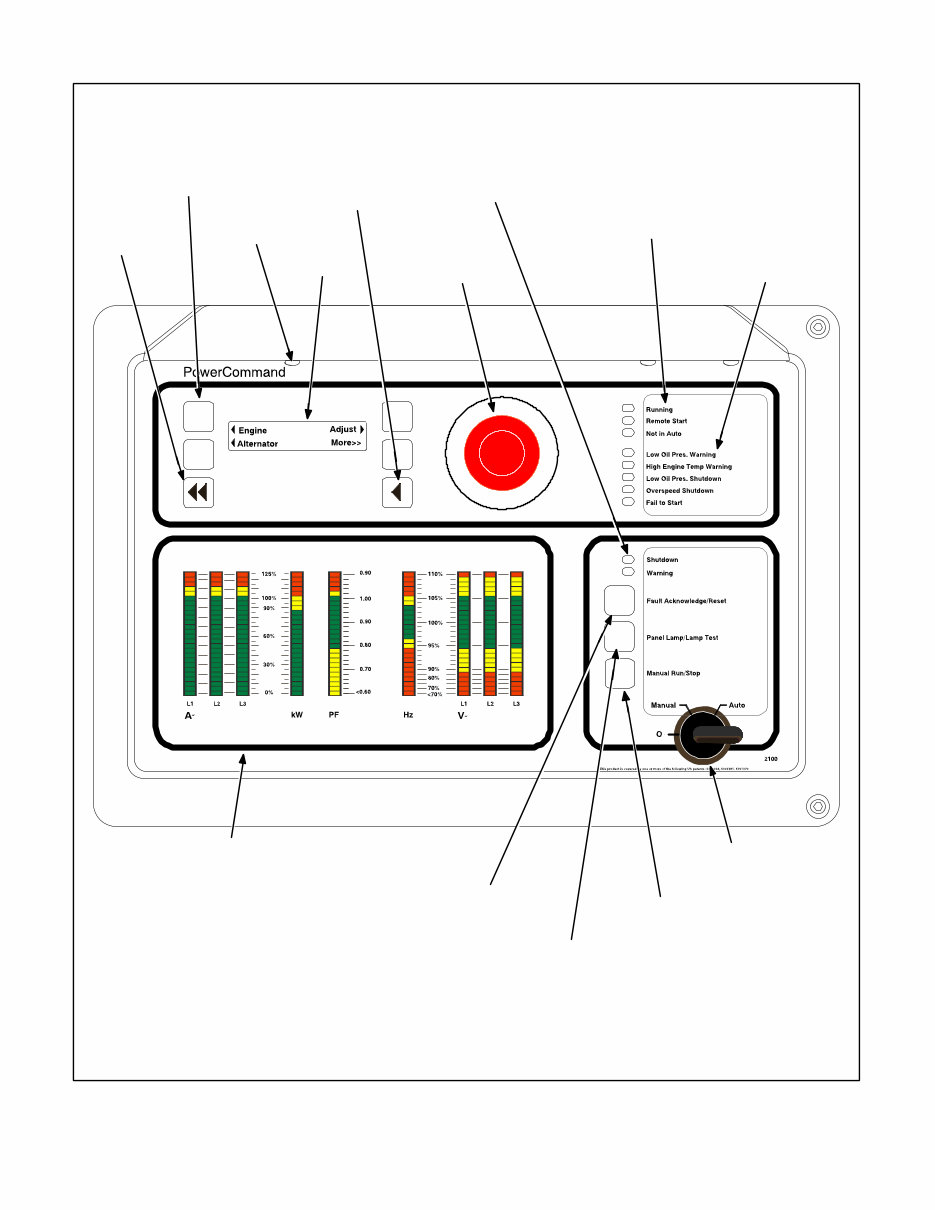
2-2
PANEL
LAMP
(1 of 3)
CONFIGURABLE
INDICATORS
MANUAL
RUN/STOP
BUTTON
OFF/MANUAL/
AUTO SWITCH
SHUTDOWN
AND WARNING
STATUS
INDICATORS
EMERGENCY
STOP PUSH
BUTTON
(Pull to reset)
HOME
BUTTON
ANALOG AC
METERING
PANEL
(OPTIONAL)
DIGITAL
DISPLAY
MENU
SELECTION
BUTTON
(1 of 4)
PREVIOUS
MAIN MENU
BUTTON
FAULT
ACKNOWLEDGEMENT/
RESET BUTTON
RUNNING/REMOTE
START/NOT IN AUTO
INDICATORS
PANEL LAMP
AND LAMP
TEST
BUTTON
FIGURE 2-1. FRONT PANEL

2-3
FRONT PANEL
Figure 2-1 shows the features of the front panel.
Digital Display: This two-line, 20-characters per
line alphanumeric display is used to view menus of
the menu-driven operating system. Refer to the
menu trees later in this section. The display is also
used to show warning and shutdown messages.
Display Menu Selection Buttons: Four momen-
tary buttons—two on each side of the digital display
window—are used to step through the various
menu options and to adjust generator set parame-
ters. A green triangle ( or ), arrow ( , , , or ),
>>, or plus/minus sign (+ or −) in the digital display
adjacent to the button is shown when the button can
be used (button is “active”). Refer to Menu Display
And Buttons later in this section.
Home Button: Press this button ( ) to view the
Home Menu. Refer to the menu trees later in this
section.
Previous Main Menu Button: Press this button ( )
to view the previous Main Menu. All main menus in-
clude both types of green triangles ( and ). Refer
to the menu trees later in this section.
NOTE: The up and down arrows ( and ) are used
to navigate between submenus.
Emergency Stop Button: Push this button in for
emergency shutdown of the generator set. This will
stop the generator set immediately and prevent
starting of the set from any location (local and re-
mote).
To reset:
1. Pull the button and allow it to pop out.
2. Turn the O/Manual/Auto switch to O (Off).
3. Press the front panel Fault Acknowledge/Re-
set button.
4. Select Manual or Auto, as required.
Emergency Stop shutdown can be reset only at the
PCC front panel.
Running Indicator: This green lamp is lit whenever
the generator (local or remote) is running.
Remote Start Indicator: This green lamp is lit
whenever the control is receiving a remote start sig-
nal.
Not in Auto Indicator: This red lamp flashes con-
tinuously when the O/Manual/Auto switch is not in
the Auto position.
Analog AC Metering Panel (Optional): This panel
simultaneously displays (in percent of genset rated
output):
3-phase line-to-line AC current (A~)
Kilowatts (kW)
Generator output frequency in hertz (Hz)
3-phase line-to-line AC volts (V~)
Power Factor (PF) (shown in 0.2 increments)
Shutdown Status Indicator: This red lamp is lit
whenever the control detects a shutdown condition.
The generator set cannot be started when this lamp
is on. After the condition is corrected, shutdown in-
dicators can be reset by turning the O/Manual/Auto
switch to the O position and pressing the Fault Ac-
knowledge/Reset button.
Warning Status Indicator: This yellow lamp is lit
whenever the control detects a warning condition.
After the condition is corrected, warning indicators
can be reset by pressing the Fault Acknowledge/
Reset button. (It is not necessary to stop the gener-
ator set.) In auto mode, warning indicators can also
be reset by cycling the remote reset input after the
condition is corrected.
Some warnings remain active after the condition is
corrected and the control reset button is pressed.
This will require the genset to be shutdown to reset
the warning indicator.
Fault Acknowledge/Reset Button: Press this but-
ton to acknowledge warning and shutdown mes-
sages after the fault has been corrected. Pressing
this button clears the fault from the current fault list.
To acknowledge a Warning message, the O/Manu-
al/Auto switch can be in any position. (It is not nec-
essary to stop the generator set to acknowledge an
inactive Warning condition.) To acknowledge a
shutdown message with this button, the O/Manual/
Auto switch must be in the O position.
You're Reading a Preview
What's Included?
Lifetime Access
Fast Download Speeds
Online & Offline Access
Access PDF Contents & Bookmarks
Full Search Facility
Print one or all pages of your manual
$36.99
$48.99
Viewed 70 Times Today


Secure transaction
What's Included?
Lifetime Access
Fast Download Speeds
Online & Offline Access
Access PDF Contents & Bookmarks
Full Search Facility
Print one or all pages of your manual
$36.99
$48.99
Get access to the Cummins PCC2100 Wiring Diagram Manual for Generator Set Control - Power Command. This manual includes:
- PCC 2100 Control System Schematics Wiring Diagram with CAN/J1939 Interface for Diesel Engine
- 2100 Enhancement Notes
- PCC2100 Presentation
- PCC2100 Spec Sheet
These manuals are valuable resources for both professional mechanics and DIY enthusiasts.


