



POULAN CHAINSAW Repair Service Manual
What's Included?
 Lifetime Access
Fast Download Speeds
Offline Viewing
Access Contents & Bookmarks
Full Search Facility
Print one or all pages of your manual
CARBURETOR SERVICE CHAIN SAW
CARBURETOR SERVICE
GENERAL CARBURETOR SERVICE
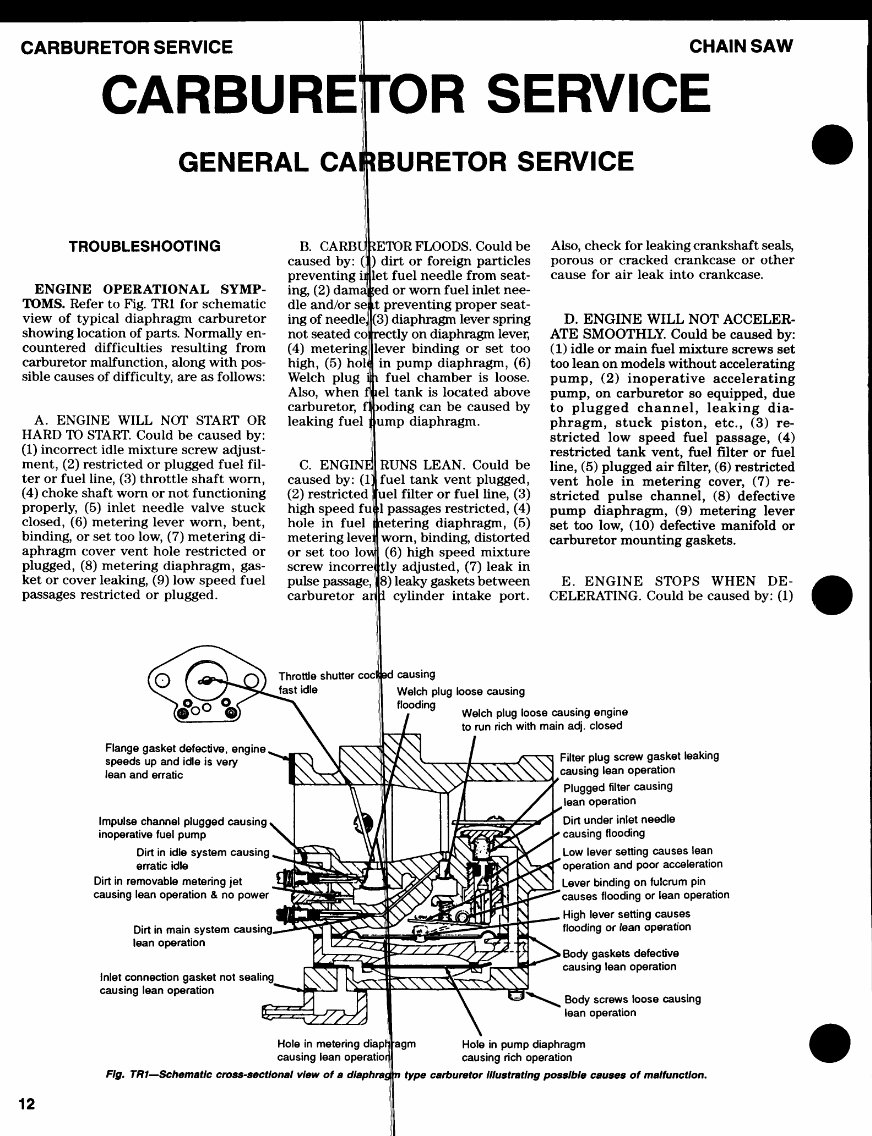
ENGINE OPERATIONAL SYMP-
TOMS. Refer to Fig. TR1 for schematic
view of typical diaphragm carburetor
showing location of parts. Normally en-
countered difficulties resulting from
carburetor malfunction, along with pos-
sible causes of difficulty, are as follows:
A. ENGINE WILL NOT START OR
HARD TO START. Could be caused by:
(1) incorrect idle mixture screw adjust-
ment, (2) restricted or plugged fuel fil-
ter or fuel line, (3) throttle shaft worn,
(4) choke shaft worn or not functioning
properly, (5) inlet needle valve stuck
closed, (6) metering lever worn, bent,
binding, or set too low, (7) metering di-
aphragm cover vent hole restricted or
plugged, (8) metering diaphragm, gas-
ket or cover leaking, (9) low speed fuel
passages restricted or plugged.
B. GARB
caused by: (
preventing i
ing, (2) dam
die and/or s
ing of needle,
not seated c
(4) metering
high, (5) hoi
Welch plug
Also, when
carburetor,
leaking fuel
:ETOR FLOODS. Could be
I) dirt or foreign particles
|let fuel needle from seat-
led or worn fuel inlet nee-
it preventing proper seat-
'3) diaphragm lever spring
;ly on diaphragm lever,
|lever binding or set too
in pump diaphragm, (6)
fuel chamber is loose,
icl tank is located above
•ding can be caused by
lump diaphragm.
C. ENGIN1
caused by: (1]
(2) restricted
high speed fuj
hole in fuel
metering level
or set too loi
screw incorrei
pulse passage,
carburetor ai
RUNS LEAN. Could be
fuel tank vent plugged,
[uel filter or fuel line, (3)
1 passages restricted, (4)
.etering diaphragm, (5)
worn, binding, distorted
(6) high speed mixture
ttly adjusted, (7) leak in
|8) leaky gaskets between
cylinder intake port.
Also, check for leaking crankshaft seals,
porous or cracked crankcase or other
cause for air leak into crankcase.
D. ENGINE WILL NOT ACCELER-
ATE SMOOTHLY. Could be caused by:
(1) idle or main fuel mixture screws set
too lean on models without accelerating
pump, (2) inoperative accelerating
pump, on carburetor so equipped, due
to plugged channel, leaking dia-
phragm, stuck piston, etc., (3) re-
stricted low speed fuel passage, (4)
restricted tank vent, fuel filter or fuel
line, (5) plugged air filter, (6) restricted
vent hole in metering cover, (7) re-
stricted pulse channel, (8) defective
pump diaphragm, (9) metering lever
set too low, (10) defective manifold or
carburetor mounting gaskets.
E. ENGINE STOPS WHEN DE-
CELERATING. Could be caused by: (1)
;o
Flange gasket defective, engine,
speeds up and idle is very
lean and erratic
Throttle shutter coclj
fast idle
! causing
Welch plug loose causing
flooding
Welch plug loose causing engine
to run rich with main adj. closed
Impulse channel plugged causing v
inoperative fuel pump >^
Dirt in idle system causing
erratic idle
Dirt in removable metering jet
causing lean operation & no power
Dirt in main system causing,
lean operation
Inlet connection gasket not sealing
causing lean operation
Filter plug screw gasket leaking
causing lean operation
Plugged filter causing
,lean operation
Dirt under inlet needle
causing flooding
Low lever setting causes lean
operation and poor acceleration
Lever binding on fulcrum pin
causes flooding or lean operation
High lever setting causes
flooding or (ean operation
> Body gaskets defective
causing lean operation
Body screws loose causing
lean operation
Hole in metering diaprj
causing lean operatior
Fig. TR1—Schematic cross-sectional view of a dlaphras
agm Hole in pump diaphragm
causing rich operation
type carburetor Illustrating possible causes of malfunction.
12
SERVICE MANUAL SAW CHAIN
tion in pitch which will contribute
to rapid wear of sprocket teeth.
6. A badly worn bar will contribute
to rapid wear of the chain which
will cause the sprocket to wear.
Rapid deterioration and wear on
chain drive lugs, side links and
cutters will result from installing a
new chain. Never install a new
chain on a worn sprocket or bar.
CLUTCH
CLUTCH BEARING. The clutch
drum and sprocket can rotate freely (or
stop) when the clutch is disengaged. A
caged needle roller bearing is located
between the clutch drum hub and the
shaft. The bearing on most models uses
the shaft as the inner race and the
clutch drum hub as the outer race and
can be removed by hand without any
special tools.
Clutch needle bearing failure is often
caused by storing the saw after oper-
ating under extremely wet conditions.
The water will penetrate the needle
bearing, form rust and cause the
needles to become locked. It is recom-
mended that the clutch drum be re-
moved periodically (depending on local
conditions) and the bearing repacked
with a good grade of water-resistant
grease (not water pump grease).
CLUTCH DRUM AND SHOES.
Rapid clutch drum wear, shoe glazing
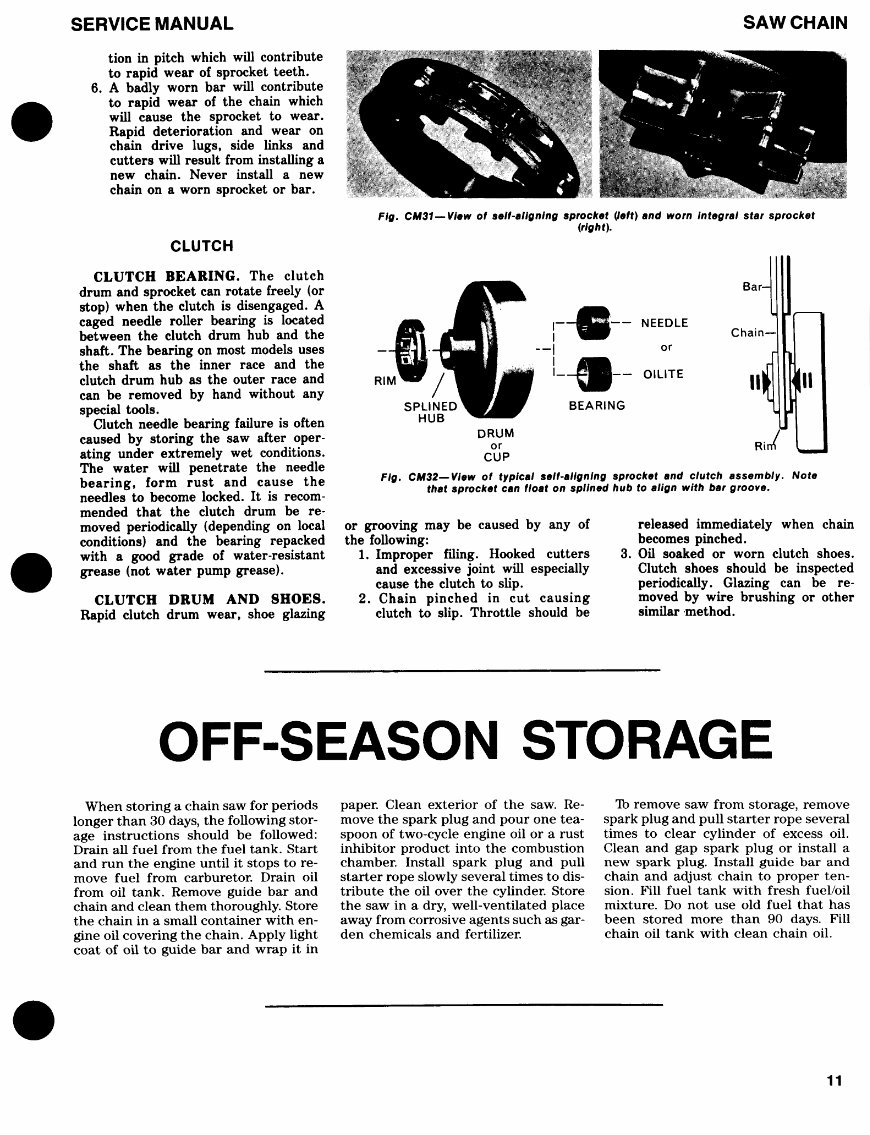
Fig. CM31—View of self-aligning sprocket (left) and worn integral star sprocket
(right).
Bar-
RIM
Chain—
II
lirrt
Fig. CM32—View of typical self-aligning sprocket and clutch assembly. Note
that sprocket can float on spllned hub to align with bar groove.
or grooving may be caused by any of
the following:
1. Improper filing. Hooked cutters
and excessive joint will especially
cause the clutch to slip.
2. Chain pinched in cut causing
clutch to slip. Throttle should be
released immediately when chain
becomes pinched.
3. Oil soaked or worn clutch shoes.
Clutch shoes should be inspected
periodically. Glazing can be re-
moved by wire brushing or other
similar method.
OFF-SEASON STORAGE
When storing a chain saw for periods
longer than 30 days, the following stor-
age instructions should be followed:
Drain all fuel from the fuel tank. Start
and run the engine until it stops to re-
move fuel from carburetor. Drain oil
from oil tank. Remove guide bar and
chain and clean them thoroughly. Store
the chain in a small container with en-
gine oil covering the chain. Apply light
coat of oil to guide bar and wrap it in
paper. Clean exterior of the saw. Re-
move the spark plug and pour one tea-
spoon of two-cycle engine oil or a rust
inhibitor product into the combustion
chamber. Install spark plug and pull
starter rope slowly several times to dis-
tribute the oil over the cylinder. Store
the saw in a dry, well-ventilated place
away from corrosive agents such as gar-
den chemicals and fertilizer.
Tb remove saw from storage, remove
spark plug and pull starter rope several
times to clear cylinder of excess oil.
Clean and gap spark plug or install a
new spark plug. Install guide bar and
chain and adjust chain to proper ten-
sion. Fill fuel tank with fresh fuel/oil
mixture. Do not use old fuel that has
been stored more than 90 days. Fill
chain oil tank with clean chain oil.
11
CARBURETOR SERVICE CHAIN SAW
CARBURETOR SERVICE
TROUBLESHOOTING
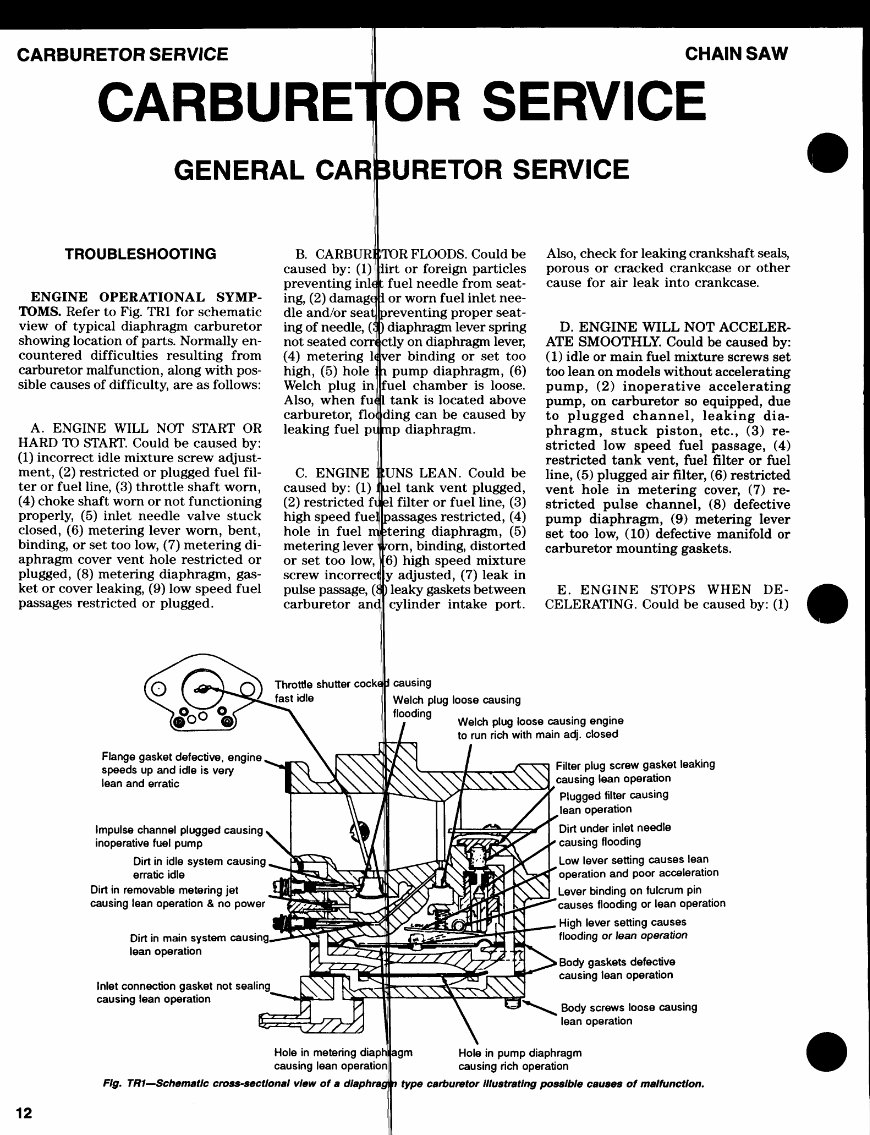
ENGINE OPERATIONAL SYMP-
TOMS. Refer to Fig. TR1 for schematic
view of typical diaphragm carburetor
showing location of parts. Normally en-
countered difficulties resulting from
carburetor malfunction, along with pos-
sible causes of difficulty, are as follows:
A. ENGINE WILL NOT START OR
HARD TO START. Could be caused by:
(1) incorrect idle mixture screw adjust-
ment, (2) restricted or plugged fuel fil-
ter or fuel line, (3) throttle shaft worn,
(4) choke shaft worn or not functioning
properly, (5) inlet needle valve stuck
closed, (6) metering lever worn, bent,
binding, or set too low, (7) metering di-
aphragm cover vent hole restricted or
plugged, (8) metering diaphragm, gas-
ket or cover leaking, (9) low speed fuel
passages restricted or plugged.
B. CARBUR]
caused by: (1)
preventing inl<
ing, (2) damag<
die and/or seal
ing of needle, (J
not seated coi
(4) metering H
high, (5) hole
Welch plug in
Also, when fu<
carburetor, floi
leaking fuel pi
!TOR FLOODS. Could be
irt or foreign particles
fuel needle from seat-
or worn fuel inlet nee-
ireventing proper seat-
diaphragm lever spring
Jctly on diaphragm lever,
jver binding or set too
pump diaphragm, (6)
Ifuel chamber is loose,
tank is located above
ding can be caused by
p diaphragm.
C. ENGINE
caused by: (1)
(2) restricted fit
high speed f
hole in fuel
metering lever
or set too low,
screw incorrect
pulse passage, (8
carburetor anc
:UNS LEAN. Could be
iel tank vent plugged,
il filter or fuel line, (3)
•assages restricted, (4)
stering diaphragm, (5)
n, binding, distorted
high speed mixture
[y adjusted, (7) leak in
leaky gaskets between
cylinder intake port.
Also, check for leaking crankshaft seals,
porous or cracked crankcase or other
cause for air leak into crankcase.
D. ENGINE WILL NOT ACCELER-
ATE SMOOTHLY. Could be caused by:
(1) idle or main fuel mixture screws set
too lean on models without accelerating
pump, (2) inoperative accelerating
pump, on carburetor so equipped, due
to plugged channel, leaking dia-
phragm, stuck piston, etc., (3) re-
stricted low speed fuel passage, (4)
restricted tank vent, fuel filter or fuel
line, (5) plugged air filter, (6) restricted
vent hole in metering cover, (7) re-
stricted pulse channel, (8) defective
pump diaphragm, (9) metering lever
set too low, (10) defective manifold or
carburetor mounting gaskets.
E. ENGINE STOPS WHEN DE-
CELERATING. Could be caused by: (1)
;o
Throttle shutter cocke
fast idle
! causing
Welch plug loose causing
flooding
Welch plug loose causing engine
to run rich with main adj. closed
Flange gasket defective, engine,
speeds up and idle is very
lean and erratic
Impulse channel plugged causing.
inoperative fuel pump
Dirt in idle system causing.
erratic idle
Dirt in removable metering jet
causing lean operation & no power
Dirt in main system causinc
lean operation
Inlet connection gasket not sealing
causing lean operation
Hole in metering diapti
causing lean operation|
Fig. TR1—Schematic cross-sectional view of a dlaphr
Filter plug screw gasket leaking
causing lean operation
Plugged filter causing
lean operation
Dirt under inlet needle
causing flooding
Low lever setting causes lean
operation and poor acceleration
Lever binding on fulcrum pin
causes flooding or lean operation
High lever setting causes
flooding or lean operation
Body gaskets defective
causing lean operation
Body screws loose causing
lean operation
igm Hole in pump diaphragm
causing rich operation
type carburetor Illustrating possible causes of malfunction.
12
SERVICE MANUAL CARBURETOR SERVICE
idle speed, idle mixture or high speed
mixture screws incorrectly adjusted, (2)
defective pump diaphragm, (3) pulse
passage leaking or restricted, (4) air
leaks between carburetor and crank-
case, (5) throttle shaft worn, (6) meter-
ing lever set too high, (7) fuel inlet nee-
dle binding.
F. ENGINE WILL NOT IDLE. Could
be caused by: (1) incorrect adjustment
of idle fuel and/or idle speed screws, (2)
idle discharge or air mixture ports
plugged, (3) fuel channel plugged, (4)
fuel tank vent, filter or fuel line re-
stricted, (5) leaky gaskets between car-
buretor and cylinder intake ports.
G. ENGINE IDLES WITH LOW
SPEED NEEDLE CLOSED. Could be
caused by: (1) metering lever set too
high or stuck, (2) fuel inlet needle not
seating due to wear or damage, (3)
Welch plug covering idle ports not seal-
ing properly.
H. ENGINE RUNS RICH. Could be
caused by: (1) plugged air filter, (2) low
speed or high speed mixture screws in-
correctly adjusted or damaged, (3)
metering lever worn, binding, distorted
or set too high, (4) fuel pump diaphragm
defective, (5) fuel inlet needle valve
leaking, (6) Welch plug leaking, (7)
faulty governor valve (if so equipped).
I. ENGINE HAS LOW POWER UN-
DER LOAD. Could be caused by: (1)
main mixture screw incorrectly ad-
justed, (2) plugged fuel tank vent, fil-
ter or fuel line, (3) pulse channel leak-
ing or restricted, (4) defective pump
diaphragm, (5) plugged air filter, (6) air
leaks between carburetor and crank-
case, (7) metering lever distorted or set
too low, (8) hole in metering diaphragm
or gasket leaking, (9) faulty nozzle check
valve.
PRESSURE TESTING
A hand pump and pressure gauge may
be used to test fuel system for leakage
when diagnosing problems with di-
aphragm carburetors. With engine
stopped and cooled, first adjust carbu-
retor low-speed and high-speed mixture
screws to chain saw manufacturer's rec-
ommended initial settings. Remove fuel
tank cap and withdraw fuel line out fuel
tank opening. Remove strainer on end
of fuel line and connect a suitable pres-
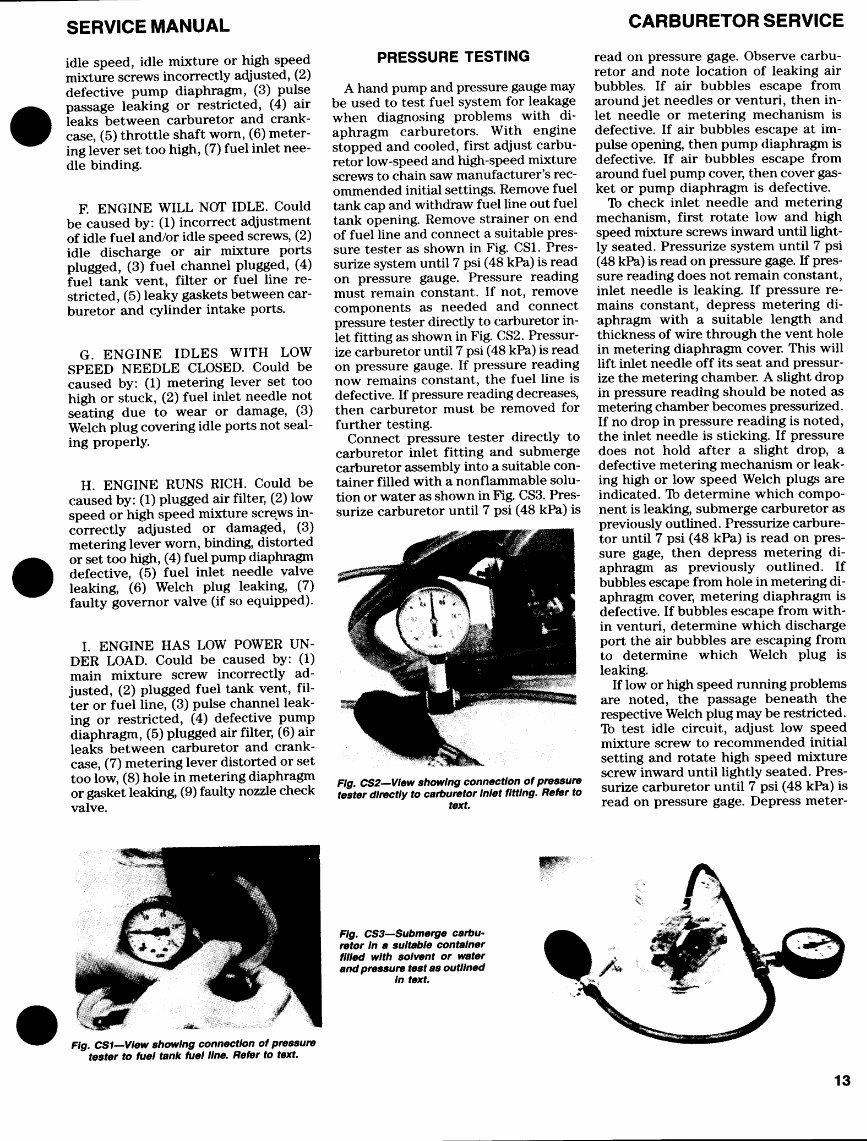
sure tester as shown in Fig. CS1. Pres-
surize system until 7 psi (48 kPa) is read
on pressure gauge. Pressure reading
must remain constant. If not, remove
components as needed and connect
pressure tester directly to carburetor in-
let fitting as shown in Fig. CS2. Pressur-
ize carburetor until 7 psi (48 kPa) is read
on pressure gauge. If pressure reading
now remains constant, the fuel line is
defective. If pressure reading decreases,
then carburetor must be removed for
further testing.
Connect pressure tester directly to
carburetor inlet fitting and submerge
carburetor assembly into a suitable con-
tainer filled with a nonflammable solu-
tion or water as shown in Fig. CS3. Pres-
surize carburetor until 7 psi (48 kPa) is
Fig. CS2—Vlew showing connection of pressure
tester directly to carburetor Inlet fitting. Refer to
text.
read on pressure gage. Observe carbu-
retor and note location of leaking air
bubbles. If air bubbles escape from
around jet needles or venturi, then in-
let needle or metering mechanism is
defective. If air bubbles escape at im-
pulse opening, then pump diaphragm is
defective. If air bubbles escape from
around fuel pump cover, then cover gas-
ket or pump diaphragm is defective.
To check inlet needle and metering
mechanism, first rotate low and high
speed mixture screws inward until light-
ly seated. Pressurize system until 7 psi
(48 kPa) is read on pressure gage. If pres-
sure reading does not remain constant,
inlet needle is leaking. If pressure re-
mains constant, depress metering di-
aphragm with a suitable length and
thickness of wire through the vent hole
in metering diaphragm cover. This will
lift inlet needle off its seat and pressur-
ize the metering chamber. A slight drop
in pressure reading should be noted as
metering chamber becomes pressurized.
If no drop in pressure reading is noted,
the inlet needle is sticking. If pressure
does not hold after a slight drop, a
defective metering mechanism or leak-
ing high or low speed Welch plugs are
indicated. To determine which compo-
nent is leaking, submerge carburetor as
previously outlined. Pressurize carbure-
tor until 7 psi (48 kPa) is read on pres-
sure gage, then depress metering di-
aphragm as previously outlined. If
bubbles escape from hole in metering di-
aphragm cover, metering diaphragm is
defective. If bubbles escape from with-
in venturi, determine which discharge
port the air bubbles are escaping from
to determine which Welch plug is
leaking.
If low or high speed running problems
are noted, the passage beneath the
respective Welch plug may be restricted.
To test idle circuit, adjust low speed
mixture screw to recommended initial
setting and rotate high speed mixture
screw inward until lightly seated. Pres-
surize carburetor until 7 psi (48 kPa) is
read on pressure gage. Depress meter-
Flg. CS3—Submerge carbu-
retor In a suitable container
filled with solvent or water
and pressure test as outlined
In text.
Fig. CS1—Vlew showing connection of pressure
tester to fuel tank fuel line. Refer to text.
13
CARBURETOR SERVICE
|^\^
r^^*^
^^X""
^^
4 -$^
^x?^.
6—^*b,"^^
f t v^Y/
s 6 ^ >fr
v u s. Jslx1^
^^-^&g)
1 £ ^r*^^i*~^^~2^
u^jfrlr1
^^^*\* s
15^>^
16 ^^=\5
x^"^
S^J_^
,
^^f^
I
>^
^3
/ /
^M /
\n
*n -j^ g
4^^&/
^^^w
18
'^19
K'!
r»
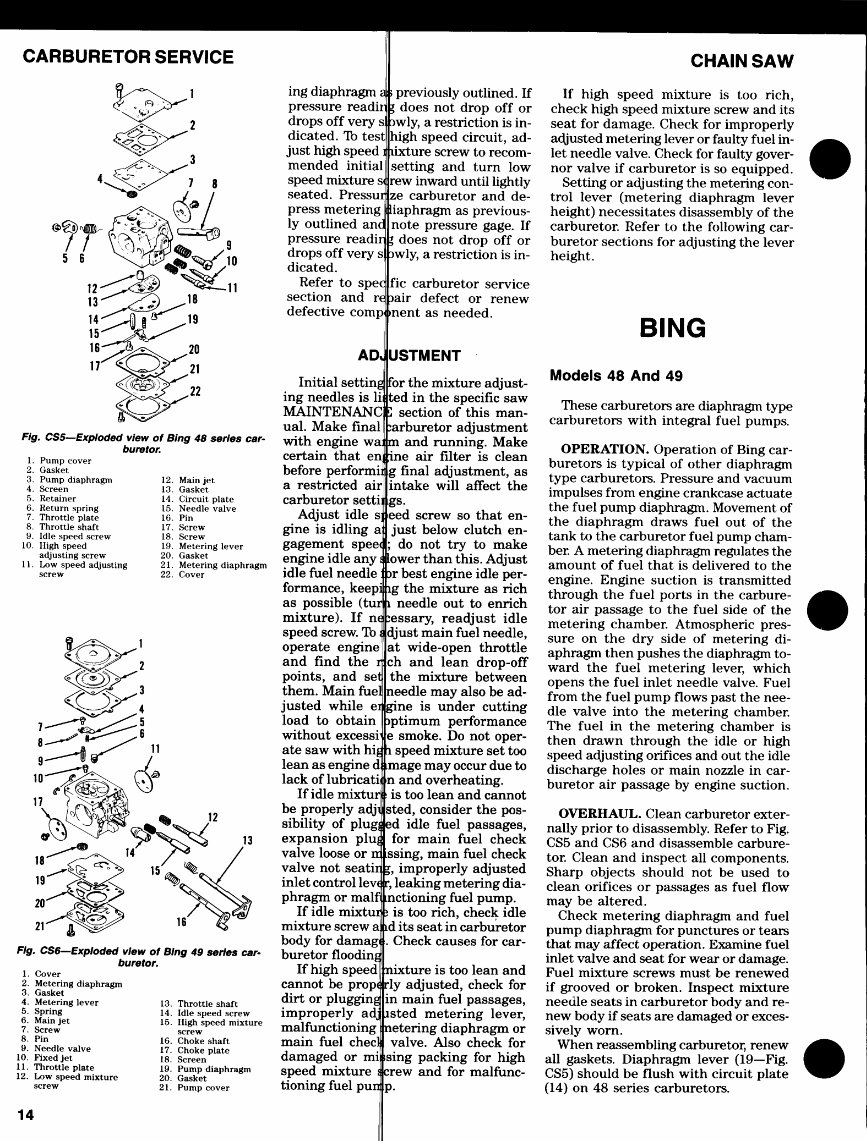
F/g. CSS— Exploded view of Bing 48 series car-
buretor.
1. Pump cover
2. Gasket
3. Pump diaphragm
4. Screen
5. Retainer
6. Return spring
7. Throttle plate
8. Throttle shaft
9. Idle speed screw
10. High speed
adjusting screw
11. Low speed adjusting
screw
fx^-^N^.1
< ^§=^^ < ^ 2
<C^'®^TV'^
XT^'TN^
7^-—^SS'^^5
^-X'^'^'^x' 6
8 ^-"Hfl c*^^ ^
9-^^J^» /
10 ^~^§S^\f
^ v^S^St-^v ^^
17 \i
Vv^j^^^t
«Tv3 ^^Jr^ ^^
•^^^'' 3 \4
18 ^^T' 3 ^^ 15
19 x^^C^
^^^o^
<£*r§^?Sv
21 ""jir^ll^^
*
12. Main jet
13. Gasket
14. Circuit plate
15. Needle valve
16. Pin
17. Screw
18. Screw
19. Metering lever
20. Gasket
21. Metering diaphragm
22. Cover
^<*!&^ / 2
Vo4 13
/« /
*% /
^w ^^C
^^v^^
/\X_^Sr
16 ^
F/g. CS6—Exploded view of Bing 49 series car-
buretor.
1 . Cover
2. Metering diaphragm
3. Gasket
4. Metering lever
5. Spring
6. Main jet
7. Screw
8. Pin
9. Needle valve
10. Fixed jet
11. Throttle plate
12. Low speed mixture
screw
14
13. Throttle shaft
14. Idle speed screw
15. High speed mixture
screw
16. Choke shaft
17. Choke plate
18. Screen
19. Pump diaphragm
20. Gasket
21. Pump cover
ing diaphragm a
pressure readir
drops off very s
dicated. To test
just high speed
mended initial
speed mixture s
seated. Pressur
press metering
ly outlined anc
pressure readir
drops off very s
dicated.
Refer to spec
section and re
defective comp
AD,
Initial setting
ing needles is li
MAINTENANC
ual. Make final
with engine wa:
certain that en
before perform!
a restricted air
carburetor setti
Adjust idle s
gine is idling a
gagement speet
engine idle any i
idle fuel needle
formance, keepi
as possible (tur
mixture). If ne
speed screw. To <
operate engine
and find the r
points, and set
them. Main fuel
justed while ei
load to obtain
without excessr
ate saw with hij
lean as engine d
lack of lubricatii
If idle mixtur
be properly adji
sibility of plugj
expansion plug
valve loose or rr
valve not seatir
inlet control lev<
phragm or malf
If idle mixtui
mixture screw a
body for damag
buretor flooding
If high speed
cannot be prop*
dirt or plugging
improperly ad:
malfunctioning
main fuel checl
damaged or mi
speed mixture i
tioning fuel pun
i previously outlined. If
I does not drop off or
awly, a restriction is in-
high speed circuit, ad-
lixture screw to recom-
setting and turn low
rew inward until lightly
ze carburetor and de-
liaphragm as previous-
note pressure gage. If
I does not drop off or
3wly, a restriction is in-
fic carburetor service
rair defect or renew
ment as needed.
USTMENT
for the mixture adjust-
ted in the specific saw
Z section of this man-
:arburetor adjustment
m and running. Make
ine air filter is clean
g final adjustment, as
intake will affect the
gs.
eed screw so that en-
just below clutch en-
; do not try to make
lower than this. Adjust
ar best engine idle per-
ig the mixture as rich
i needle out to enrich
:essary, readjust idle
djust main fuel needle,
at wide-open throttle
ch and lean drop-off
the mixture between
needle may also be ad-
gine is under cutting
>ptimum performance
e smoke. Do not oper-
i speed mixture set too
mage may occur due to
n and overheating.
is too lean and cannot
sted, consider the pos-
ed idle fuel passages,
for main fuel check
ssing, main fuel check
I, improperly adjusted
r, leaking metering dia-
nctioning fuel pump.
; is too rich, check idle
id its seat in carburetor
. Check causes for car-
nixture is too lean and
rly adjusted, check for
in main fuel passages,
isted metering lever,
netering diaphragm or
valve. Also check for
ising packing for high
crew and for malfunc-
P-
CHAIN SAW
If high speed mixture is too rich,
check high speed mixture screw and its
seat for damage. Check for improperly
adjusted metering lever or faulty fuel in-
let needle valve. Check for faulty gover-
nor valve if carburetor is so equipped.
Setting or adjusting the metering con-
trol lever (metering diaphragm lever
height) necessitates disassembly of the
carburetor. Refer to the following car-
buretor sections for adjusting the lever
height.
BING
Models 48 And 49
These carburetors are diaphragm type
carburetors with integral fuel pumps.
OPERATION. Operation of Bing car-
buretors is typical of other diaphragm
type carburetors. Pressure and vacuum
impulses from engine crankcase actuate
the fuel pump diaphragm. Movement of
the diaphragm draws fuel out of the
tank to the carburetor fuel pump cham-
ber. A metering diaphragm regulates the
amount of fuel that is delivered to the
engine. Engine suction is transmitted
through the fuel ports in the carbure-
tor air passage to the fuel side of the
metering chamber. Atmospheric pres-
sure on the dry side of metering di-
aphragm then pushes the diaphragm to-
ward the fuel metering lever, which
opens the fuel inlet needle valve. Fuel
from the fuel pump flows past the nee-
dle valve into the metering chamber.
The fuel in the metering chamber is
then drawn through the idle or high
speed adjusting orifices and out the idle
discharge holes or main nozzle in car-
buretor air passage by engine suction.
OVERHAUL. Clean carburetor exter-
nally prior to disassembly. Refer to Fig.
CSS and CS6 and disassemble carbure-
tor. Clean and inspect all components.
Sharp objects should not be used to
clean orifices or passages as fuel flow
may be altered.
Check metering diaphragm and fuel
pump diaphragm for punctures or tears
that may affect operation. Examine fuel
inlet valve and seat for wear or damage.
Fuel mixture screws must be renewed
if grooved or broken. Inspect mixture
needle seats in carburetor body and re-
new body if seats are damaged or exces-
sively worn.
When reassembling carburetor, renew
all gaskets. Diaphragm lever (19—Fig.
CSS) should be flush with circuit plate
(14) on 48 series carburetors.
You're Reading a Preview
What's Included?
Lifetime Access
Fast Download Speeds
Offline Viewing
Access Contents & Bookmarks
Full Search Facility
Print one or all pages of your manual
$31.99
$41.99
Viewed 15 Times Today


Secure transaction
What's Included?
Lifetime Access
Fast Download Speeds
Offline Viewing
Access Contents & Bookmarks
Full Search Facility
Print one or all pages of your manual
$31.99
$41.99
The Poulan Chainsaw Repair Service Manual covers a wide range of models including Poulan/Poulan Pro 180, 20, 200, 2000, 205, 20D, 2100, 225, 2300, 2300AV, 2300CVA, 235, 2350CVA, 236, 2400, 245A, 252A, 306, 306A, 306SA, 361, 4200, 4400, 4900, 5200, 5400, 55, 6900, 7700, 8500, and more.
This manual is a valuable resource for both professional mechanics and DIY enthusiasts, covering all aspects of chainsaw maintenance and repair, including engine repair, carburetor repair, blade changing, blade sharpening, and more.
Securely purchase the manual using your credit card or PayPal through our secure server.


