



McCulloch Chainsaws Service & Repair Manual
What's Included?
 Lifetime Access
Fast Download Speeds
Offline Viewing
Access Contents & Bookmarks
Full Search Facility
Print one or all pages of your manual

Two-Stroke
Engine Repair
& Maintenance

This page intentionally left blank

1
Fundamentals
There comes a time when work stops and the mechanic becomes abstracted, dis-
tant from the task at hand. Something about the machine does not conform to the
picture in the mechanic’s mind. Images flash by until he or she finds one that most
closely conforms to actual conditions. Once that is done, repairs can begin.
Constructing visual images is what mechanics do; the other stuff is mere
wrench-twisting.
This chapter provides grist for these mental images. Because the material
must be conveyed in words, it tends to be abstract. But once you can picture
how these engines work, you will have made the first step in the journey to
becoming a real mechanic.
Spark-ignition engines operate in a cycle consisting of four events: intake,
compression, expansion (or power), and exhaust. A fresh charge of air and
fuel is inducted into the cylinder, which then is compressed by the piston
and ignited by the spark plug. The pressure created by combustion reacts
against the piston to generate torque on the crankshaft. The spent gases
then exhaust into the atmosphere.
Four-stroke-cycle engines require four up and down strokes of the piston, or two
full crankshaft revolutions, to complete the cycle. Two-stroke-cycle engines tele-
scope events into two strokes or one crankshaft revolution. For convenience we
abbreviate the terms to four-cycle or four-stroke, and two-cycle or two-stroke.
Two-cycle operation
Focus on the piston. The double-acting piston works in both directions to
compress the air-fuel mixture in the cylinder above it and in the crankcase
below it. The piston and connecting rod convert a portion of the heat and
1

energy released by combustion into mechanical motion that turns the crank-
shaft. Were that not enough, the piston also acts as a slide valve to open and
close exhaust, transfer and (in some applications) intake ports. Because it
works so hard, the piston is the first mechanical part to fail on two-cycle
engines.
Third-port engines
Third- or piston-ported engines have three ports cast or milled into their
cylinder liners. The inlet port admits fuel to the crankcase, the transfer port
conveys fuel from the crankcase into the combustion chamber, and the
exhaust port opens to the atmosphere.
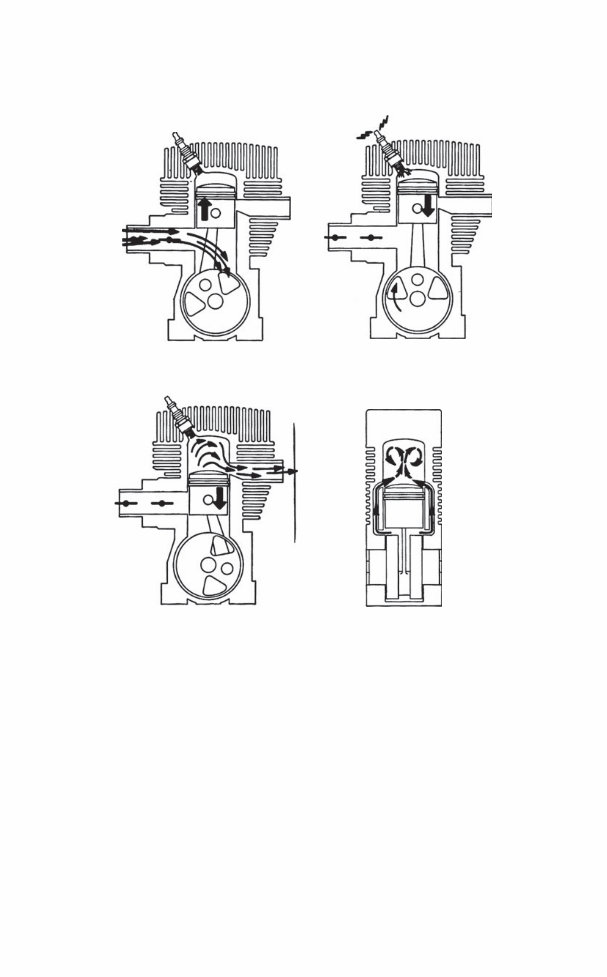
First, let’s look at events above the piston during a full turn of the crank-
shaft. In Fig. 1-1A the piston approaches the upper limit of travel, or top
dead center (TDC), and has compressed the air-fuel mixture above it. The
piston has also uncovered the inlet port to admit fuel and air from the car-
buretor to the crankcase. Figure 1-1B illustrates the beginning of the power
stroke under the impetus of expanding combustion gases. As the piston
falls, it first uncovers the exhaust port (Fig. 1-1C) and, a few degrees of
crankshaft rotation later, the transfer port (Fig.1-1D). Fuel and air pass
through the transfer port and into the cylinder bore.
Meanwhile, much is happening in the crankcase. As the piston falls on
the power stroke, it partially fills the crankcase, reducing its volume, as
shown in Fig. 1-1C. Since the piston now covers the inlet port, the pressure
of the air-fuel mixture trapped in the case rises.
Near bottom dead center (BDC) the piston uncovers the transfer port and
the pressurized fuel mixture passes through this port to the upper cylinder
(Fig. 1-1D). The piston then rounds BDC and begins to climb, an action that
simultaneously compresses the mixture above the piston and creates a par-
tial vacuum under it. Once the inlet port opens, atmospheric pressure forces
fuel and air from the carburetor into the crankcase.
A problem with third-port engines is fuel reversion. At low speeds the
crankcase fills to overflowing. When the piston reverses at the top of the
stroke, some of the charge can flow back through the inlet port to the car-
buretor. A fog of oily fuel hovers around the air cleaner, dirtying the engine
and playing havoc with carburetor metering.
Reed-valve engines
Although third-port engines are still encountered, many manufacturers prefer to
control crankcase filling with a reed valve installed between the carburetor and
crankcase. The valve, similar to the reed on musical instruments, opens and
closes in response to crankcase pressure (Fig. 1-2). Utility engines make do with
a single reed, or pedal, athwart the intake port (Fig. 1-3). High-performance
2 Fundamentals
Two-cycle operation 3
Transfer
D
Intake
A
Power stroke
B
C
Exhaust
FIG. 1-1. Operating sequence of a third-port, loop-scavenged engine. Walbro
engines employ a tent-like valve block with multiple reeds. This arrangement
provides a large valve area for better crankcase filling (Fig. 1-4).
For mini-two-strokes, the position of the carburetor indicates the type of
inlet valve: when a reed is present, the carburetor mounts on the crankcase
(Fig. 1-5). Third-port engines mount their carburetors on the cylinder barrel
in line with the inlet port, as shown in Fig. 1-6. Being able to recognize the
presence of a reed valve without disassembling the engine is useful, since the
reed can malfunction. Should the pedal split or fail to seal, the engine will
not start.
You're Reading a Preview
What's Included?
Lifetime Access
Fast Download Speeds
Offline Viewing
Access Contents & Bookmarks
Full Search Facility
Print one or all pages of your manual
$31.99
$41.99
Viewed 55 Times Today


Secure transaction
What's Included?
Lifetime Access
Fast Download Speeds
Offline Viewing
Access Contents & Bookmarks
Full Search Facility
Print one or all pages of your manual
$31.99
$41.99
Get your hands on the McCulloch Chainsaws Service & Repair Manual, covering a wide range of models including 10-10 AUTO, 7-10 AUTO, DOUBLE EAGLE 80, EAGER BEAVER 2.1, and more. This comprehensive .pdf manual is printable and available in English. It is compatible with various electronic devices such as PC & Mac computers, Android and Apple smartphones & tablets, and more. All you need is the free Adobe Reader to access this valuable resource.
- 10-10 AUTO
- 7-10 AUTO
- DOUBLE EAGLE 80
- EAGER BEAVER 2.1
- MINI-MAC 25
- MINI-MAC 30
- MINI-MAC 35
- PM10-10S
- PM310
- PM320
- PM330
- PM340
- PM355
- PM365
- PM375
- PM510
- PM515
- PM55
- PM555
- PM60
- PM700
- PM800
- PM805
- PM850
- POWER MAC 6
- SP40
- SP60
- SP80
- SP81
- W


