Table of Contents 1 Safety 1.1 Important provisions for all products 5 1.2 Personnel and organizational requirements 6 1.3 Transport 7 1.4 Safety regulations for maintenance and repair work 8 1.5 Fire prevention and environmental protection, fluids and lubricants, auxiliary materials 11 1.6 Standards for safety notices in the text 13 2 General Information 2.1 Engine side and cylinder designations 14 2.2 Product description 15 2.3 Engine layout 38 2.4 Sensors, actuators and injectors on 12V engines – Overview 42 2.5 Sensors, actuators and injectors on 16V engines – Overview 52 3 Technical Data 3.1 12V 4000 M53R engine data 72 3.2 16V 4000 M53R engine data 76 3.3 Engine – Main dimensions 80 3.4 Firing order 82 4 Operation 4.1 Controls 83 4.2 Putting the engine into operation after extended out-of-service periods (>3 months) 84 4.3 Putting the engine into operation after scheduled out-of-service-period 85 4.4 Starting the engine 86 4.5 Operational checks 87 4.6 Tasks after extended out-of-service periods (>3 weeks) 88 4.7 Checks prior to start-up 89 4.8 Fuel treatment system – Putting into operation 90 4.9 Fuel treatment system – Switching on 93 4.10 Fuel treatment system – Shutdown 94 4.11 Stopping the engine 95 4.12 Emergency engine stop 96 4.13 After stopping the engine 97 4.14 Plant – Cleaning 98 5 Maintenance 5.1 Maintenance task reference table [QL1] 99 6 Troubleshooting 6.1 Troubleshooting 101 6.2 Fuel treatment system – Troubleshooting 104 6.3 Engine governor ADEC (ECU 7) fault messages for Series 4000 engines, marine application 105 6.4 ADEC engine governor – Fault codes 106 7 Task Description 7.1 Engine 132 7.1.1 Engine – Barring manually 132 7.1.2 Engine – Barring with starting system 134 7.2 Cylinder Liner 135 7.2.1 Cylinder liner – Endoscopic examination 135 7.2.2 Instructions and comments on endoscopic and visual examination of cylinder liners 137 7.3 Valve Drive 139 7.3.1 Valve gear – Lubrication 139 7.3.2 Valve clearance – Check and adjustment 140 7.3.3 Cylinder head cover – Removal and installation 143 7.4 Injection Pump / HP Pump 144 7.4.1 HP pump – Filling with engine oil 144 7.4.2 HP pump – Relief bore check 145 7.5 Injection Valve / Injector 146 7.5.1 Injector – Replacement 146 7.5.2 Injector – Removal and installation 147 7.6 Fuel Filter 152 7.6.1 Supplementary fuel filter – Overview 152 7.6.2 Additional fuel filter – Replacement 153 7.6.3 Fuel filter – Replacement 154 7.6.4 Fuel prefilter – Differential pressure check and adjustment of gauge 156 7.6.5 Fuel prefilter – Draining 157 7.6.6 Fuel prefilter – Flushing 159 7.6.7 Fuel prefilter with water separator – Filter element replacement 161 7.7 Exhaust Turbocharger 163 7.7.1 Compressor wheel – Cleaning 163 7.8 Charge-Air Cooling 171 7.8.1 Charge-air cooler – Checking condensate drain for water discharge and obstruction 171 7.9 Air Filter 172 MS150036/02E 2013-11 | Table of Contents |3 DCL-ID: 0000029503 - 001
7.9.1 Air filter – Replacement 172 7.9.2 Air filter – Removal and installation 173 7.10 Air Intake 174 7.10.1 Service indicator – Signal ring position check (optional) 174 7.11 Starting Equipment 175 7.11.1 Starter – Condition check 175 7.12 Lube Oil System, Lube Oil Circuit 176 7.12.1 Engine oil – Level check 176 7.12.2 Engine oil – Change 177 7.12.3 Engine oil – Sample extraction and analysis 179 7.13 Oil Filtration / Cooling 181 7.13.1 Checking oil indicator filter 181 7.13.2 Engine oil filter – Replacement 183 7.13.3 Centrifugal oil filter – Cleaning and filter sleeve replacement 185 7.14 Coolant Circuit, General, High-Temperature Circuit 188 7.14.1 Drain and vent points 188 7.14.2 Engine coolant level – Check 192 7.14.3 Engine coolant – Change 193 7.14.4 Engine coolant – Draining 194 7.14.5 Engine coolant – Filling 197 7.14.6 HT coolant pump – Relief bore check 199 7.14.7 Engine coolant – Sample extraction and analysis 200 7.14.8 Engine coolant filter – Replacement 201 7.14.9 Preheating unit 202 7.15 Raw Water Pump with Connections 205 7.15.1 Raw water pump – Relief bore check 205 7.16 Battery-Charging Generator 206 7.16.1 Battery-charging generator drive – Coupling condition check 206 7.17 Engine Mounting / Support 207 7.17.1 Engine mounting – Checking securing screws for firm seating 207 7.18 Auxiliary PTO 208 7.18.1 Bilge pump – Relief bore check 208 7.19 Fuel Supply System 209 7.19.1 Water drain valve – Check 209 7.19.2 Differential pressure gauge – Check 210 7.19.3 Water level probe (3-in-1 rod electrode) – Check 211 7.19.4 Pump capacity – Check 212 7.19.5 Coalescer filter element – Replacement 213 7.20 Wiring (General) for Engine/Gearbox/Unit 215 7.20.1 Engine wiring harness ‒ Overview 215 7.20.2 Engine wiring – Check 224 7.21 Accessories for (Electronic) Engine Governor / Control System 225 7.21.1 Limit switch for start interlock ‒ Check 225 7.21.2 Engine Control Unit ECU 7 – Checking plug connections 226 7.21.3 Engine monitoring unit EMU – Plug connection check 227 7.21.4 Interface module EIM plug connections – Check 228 7.21.5 Engine Control Unit ECU 7 – Removal and installation 229 7.21.6 EMU 7 – Removal and installation 230 7.21.7 Engine Interface Module EIM – Removal and installation 231 7.21.8 Diagnostic features of EIM 232 7.21.9 CDC parameters – Reset 235 8 Appendix A 8.1 Abbreviations 236 8.2 MTU contact persons/service partners 238 9 Appendix B 9.1 Special Tools 239 9.2 Index 246 4 | Table of Contents | MS150036/02E 2013-11 DCL-ID: 0000029503 - 001
1 Safety 1.1 Important provisions for all products Nameplate The product is identified by nameplate, model designation or serial number and must match with the information on the title page of this manual. Nameplate, model designation or serial number can be found on the product. General information This product may pose a risk of injury or damage in the following cases: • Incorrect use • Operation, maintenance and repair by unqualified personnel • Modifications or conversions • Noncompliance with the safety instructions and warning notices Correct use The product is intended exclusively for the application specified in the contract or defined at the time of delivery. This means that the equipment must be operated: • Within the permissible operating parameters in accordance with the (→ Technical data) • With fluids and lubricants approved by the manufacturer in accordance with the (→ Fluids and Lubri- cants Specifications of the manufacturer) • With spare parts approved by the manufacturer in accordance with the (→ Spare Parts Catalog/MTU contact/Service partner) • In the original as-delivered configuration or in a configuration approved by the manufacturer in writ- ing (including engine control/parameters) • In compliance with all safety regulations and in adherence with all warning notices in this manual • In accordance with the maintenance requirements over the entire service life of the product (→ Main- tenance Schedule) • In compliance with the maintenance and repair instructions contained in this manual, in particular with regard to the specified tightening torques • With the exclusive use of technical personnel trained in commissioning, operation, maintenance and repair • By contracting only workshops authorized by the manufacturer to carry out repair and overhaul Any other use is considered improper use and increases the risk of personnel injury or material damage in product operation. The manufacturer will accept no liability for such damage. Modifications or conversions Unauthorized modifications to the product compromise safety. The manufacturer will accept no liability or warranty claims for any damage caused by unauthorized modifications or conversions. Spare parts Only genuine spare parts must be used to replace components or assemblies. The manufacturer will accept no liability or warranty claims for any damage caused by the use of other spare parts. MS150036/02E 2013-11 | Safety | 5 TIM-ID: 0000040530 - 003
1.2 Personnel and organizational requirements Organizational measures of the operator This manual must be issued to all personnel involved in operation, maintenance, repair or transporta- tion. Keep this manual handy in the vicinity of the product such that it is accessible to operating, mainte- nance, repair and transport personnel at all times. Use this manual as a basis for instructing personnel on product operation and repair, whereby the safe- ty-relevant instructions, in particular, must be read and understood. This is particularly important in the case of personnel who only occasionally perform work on or around the product. This personnel must be instructed repeatedly. Personnel requirements All work on the product shall be carried out by trained and qualified personnel only. • Training at the Training Center of the manufacturer • Qualified personnel specialized in mechanical and plant engineering The operator must define the responsibilities of the personnel involved in operation, maintenance, re- pair and transport. Working clothes and personal protective equipment Wear proper protective clothing for all work. When working, always wear the necessary personal protective equipment (e.g. ear protectors, protec- tive gloves, goggles, breathing protection). Observe the information on personal protective equipment in the respective activity description. 6 | Safety | MS150036/02E 2013-11 TIM-ID: 0000040531 - 002
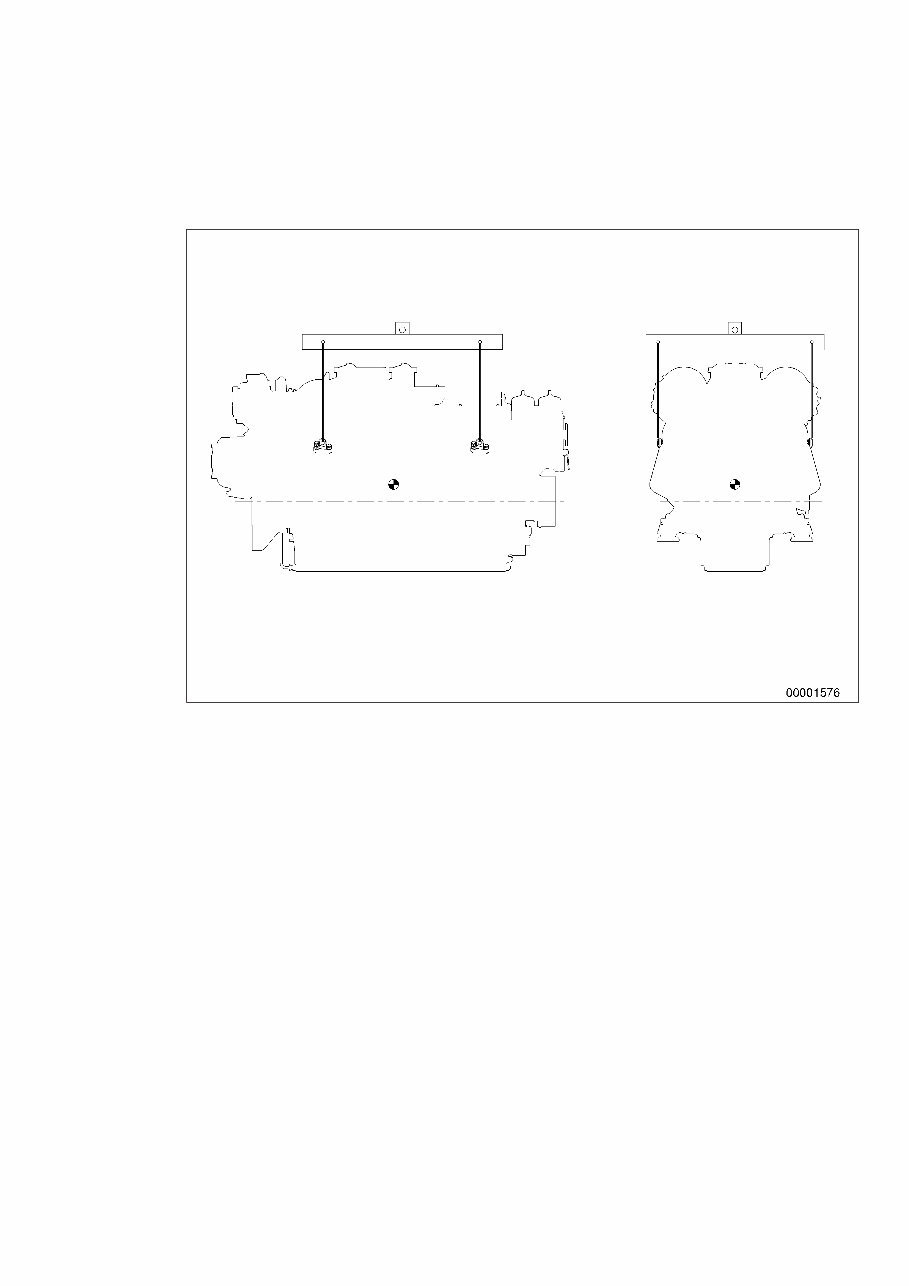
1.3 Transport Transport Only use the lifting eyes provided to lift the engine. The lifting eyes are designed for the transport of engine only, not for the transport of drive units (engine and transmission). Only use transport and lifting devices approved by MTU. The engine must only be transported in installation position, max. permissible diagonal pull 10°. Take the engine's center of gravity into account. In the case of special packaging with aluminum foil, suspend the engine on the lifting eyes of the trans- port pallet or transport with equipment for heavy loads (forklift truck). Install the crankshaft locking device and the locking screws for the engine mounts prior to engine trans- portation. Secure the engine against tilting during transport. The engine must be especially secured against slip- ping or tilting when going up or down inclines and ramps. Setting the engine down after transport Only set down engine on a firm, level surface. Make sure that the consistency and load-bearing capacity of the ground or support surface is adequate. Never place an engine on the oil pan, unless expressively authorized by MTU on a case-to-case basis to do so. MS150036/02E 2013-11 | Safety | 7 TIM-ID: 0000002621 - 003
1.4 Safety regulations for maintenance and repair work Safety regulations prior to maintenance and repair work Have maintenance or repair work carried out by qualified and authorized personnel only. Allow the product to cool down to less than 50°C before starting maintenance work (risk of explosion of oil vapors, fluids and lubricants, risk of burning). Before starting work, relieve pressure in systems and compressed-air lines which are to be opened. Use suitable containers of adequate capacity to catch fluids and lubricants. When changing the oil or working on the fuel system, ensure that the service room is adequately venti- lated. Never carry out maintenance and repair work with the product in operation, unless: • Expressly permitted to do so following a written procedure. • The product is running in the low load range and only for as long as absolutely necessary. Secure the product against unintentional starting, e.g. with start interlock. Attach “Do not operate” sign in the operating area or to control equipment. Disconnect the battery. Lock contactors. Close the main valve on the compressed-air system and vent the compressed-air line when pneumatic starters are fitted. Disconnect the control equipment from the product. The following applies to starters with copper-beryllium alloy pinions: • Wear breathing protection of filter class P3 during maintenance work. Do not blow out the interior of the flywheel housing or the starter with compressed air. Clean the flywheel housing inside with a class H dust extraction device. • Observe the safety data sheet. Safety regulations during maintenance and repair work Take special care when removing ventilation or plug screws from the product. Cover the screw or plug with a rag to prevent fluids escaping under pressure. Take care when draining hot fluids and lubricants (risk of burning). Use only proper and calibrated tools. Observe the specified tightening torques during assembly or dis- assembly. Carry out work only on assemblies or plants which are properly secured. Never use lines for climbing. Keep fuel injection lines and connections clean. Always seal connections with caps or covers if a line is removed or opened. Take care not to damage lines, in particular fuel lines, during maintenance and repair work. Ensure that all retainers and dampers are installed correctly. Ensure that all fuel injection and pressurized oil lines are installed with enough clearance to prevent contact with other components. Do not place fuel or oil lines near hot components. Do not touch elastomeric seals if they have carbonized or resinous appearance unless hands are prop- erly protected. Note cooling time for components which are heated for installation or removal (risk of burning). When working high on the equipment, always use suitable ladders and work platforms. Make sure com- ponents or assemblies are placed on stable surfaces. 8 | Safety | MS150036/02E 2013-11 TIM-ID: 0000040535 - 003
Ensure particular cleanness during maintenance and repair work on the product. After completion of maintenance and repair work, make sure that no unattached parts are in/on the product (e.g. cloths and cable ties). Safety regulations after completion of maintenance and repair work Before barring, make sure that nobody is standing in the danger zone of the product. Check that all guards have been reinstalled and that all tools and loose parts have been removed after working on the product (in particular, the barring tool). Welding work Welding operations on the product or mounted units are not permitted. Cover the product when weld- ing in its vicinity. Before starting welding work: • Switch off the power supply master switch. • Disconnect the battery. • Separate the electrical ground of electronic equipment from the ground of the unit. No other maintenance or repair work must be carried out in the vicinity of the product while welding is going on. Risk of explosion or fire due to oil vapors and highly flammable fluids and lubricants. Do not use product as ground terminal. Never position the welding power supply cable adjacent to, or crossing wiring harnesses of the product. The welding current may otherwise induce an interference voltage in the wiring harnesses which could conceivably damage the electrical system. Remove parts (e.g. exhaust pipes) which are to be welded from the product beforehand. Hydraulic installation and removal Check satisfactory function and safe operating condition of tools, jigs and fixtures to be used. Use only the specified jigs and fixtures for hydraulic removal/installation procedures. Observe the max. permissible force-on pressure specified for the jig/fixture. Do not attempt to bend or apply force to lines. Before starting work, pay attention to the following: • Vent the hydraulic installation/removal jig, the pumps and the lines at the relevant points for the equipment to be used (e.g. open vent plugs, pump until bubble-free air emerges, close vent plugs). • For hydraulic installation, screw on the jig with the piston retracted. • For hydraulic removal, screw on the jig with the piston extended. For a hydraulic installation/removal jig with central expansion pressure supply, screw spindle into shaft end until correct sealing is established. During hydraulic installation and removal, ensure that nobody is standing in the immediate vicinity of the component to be installed/removed. Working with batteries Observe the safety instructions of the battery manufacturer when working with batteries. Gases emanating from the battery are explosive. Avoid sparks and naked flames. Do not allow electrolyte to come in contact with skin or clothing. Wear goggles and protective gloves. Never place tools on the battery. Before connecting the cable to the battery, check the battery polarity. Battery pole reversal may lead to injury through the sudden discharge of acid or bursting of the battery body. MS150036/02E 2013-11 | Safety | 9 TIM-ID: 0000040535 - 003
Working on electrical and electronic assemblies Always obtain the permission of the person in charge before commencing maintenance and repair work or switching off any part of the electronic system required to do so. De-energize the appropriate areas prior to working on assemblies. Do not damage cabling during removal work. When reinstalling ensure that wiring is not damaged dur- ing operation by contact with sharp objects, by rubbing against other components or by a hot surface. Do not secure cables on lines carrying fluids. Do not use cable straps to secure cables. Always use connector pliers to tighten union nuts on connectors. Subject the device as well as the product to a function check on completion of all repair work. In partic- ular, check the function of the engine emergency stop feature. Store spare parts properly prior to replacement, i.e. protect them against moisture in particular. Pack defective electronic components and assemblies in a suitable manner when dispatched for repair, i.e. protected, in particular, against moisture and impact and wrapped in antistatic foil if necessary. Working with laser equipment When working with laser equipment, always wear special laser-protection goggles (hazard due to heavi- ly focused radiation). Laser equipment must be equipped with the protective devices necessary for safe operation according to type and application. For conducting light-beam procedures and measurement work, only the following laser devices must be used: • Laser devices of classes 1, 2 or 3A. • Laser devices of class 3B, which have maximum output in the visible wavelength range (400 to 700 nm), a maximum output of 5 mW, and in which the beam axis and surface are designed to prevent any risk to the eyes. 10 | Safety | MS150036/02E 2013-11 TIM-ID: 0000040535 - 003
This digital manual offers comprehensive operational information for 3- and 4-valve engine models, serving as a valuable resource for understanding the engine's operation, parts, and system components. It is beneficial for both professional mechanics and DIY enthusiasts.
The manual covers the following models:
MTU 12V 4000 M53R
MTU 16V 4000 M53R
By following the instructions provided, users can gain a thorough understanding of the engine's proper operation and maintenance. It facilitates familiarity with the engine's features, components, and operational aspects, ensuring safe and efficient usage.
Furthermore, the manual acquaints users with the regulations governing the engine's use and the necessary safety measures. In essence, it equips users with all essential information to optimize the engine's performance.
Available in digital format, the MTU 12V 4000 M53R / 16V 4000 M53R Diesel Engine Operating Instructions can be conveniently purchased online, with instant delivery through a download link.




 Lifetime Access