


© Panasonic Corporation 2014. All rights reserved.
Unauthorized copying and distribution is a violation of
law.
PSG1403001CE
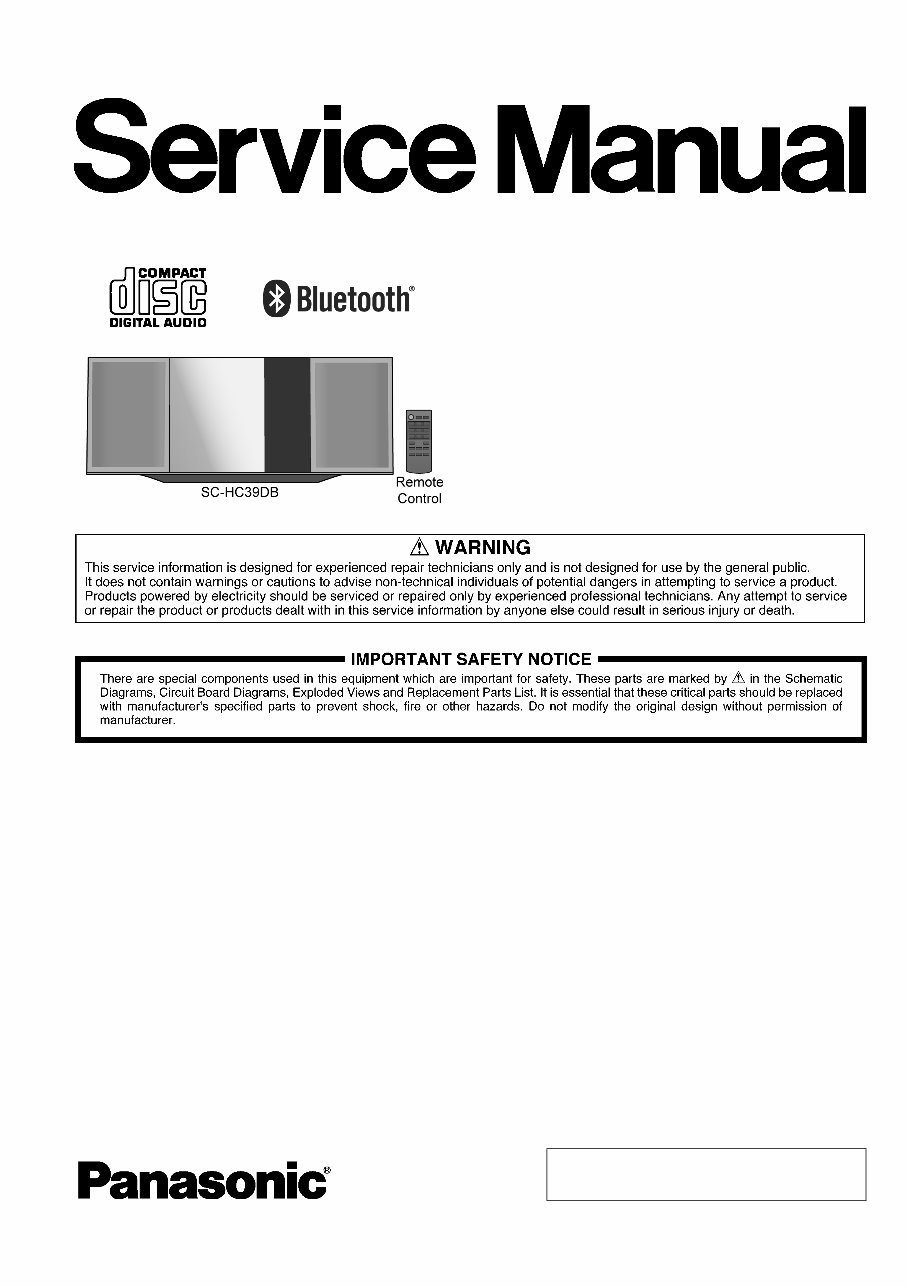
Compact Stereo System
Model No. SC-HC39DBEB
Product Color: (S)...Silver Type
TABLE OF CONTENTS
PAGE PAGE
1 Safety Precautions ----------------------------------------------- 3
1.1. General Guidelines---------------------------------------- 3
1.2. Caution for AC Cord -------------------------------------- 4
1.3. Before Repair and Adjustment ------------------------- 4
1.4. Protection Circuitry ---------------------------------------- 4
1.5. Caution For Fuse Replacement------------------------ 4
1.6. Safety Part Information----------------------------------- 5
2 Warning -------------------------------------------------------------- 6
2.1. Prevention of Electrostatic Discharge (ESD)
to Electrostatically Sensitive (ES) Devices---------- 6
2.2. Precaution of Laser Diode------------------------------- 7
2.3. Service caution based on Legal restrictions -------- 7
2.4. Handling Precaution for Traverse Unit --------------- 8
3 Service Navigation ----------------------------------------------- 9
3.1. Service Information --------------------------------------- 9
4 Specifications ---------------------------------------------------- 10
5 Location of Controls and Components ------------------ 11
5.1. Main Unit & Remote Control Key Button
Operations ------------------------------------------------- 11
6 Service Mode ----------------------------------------------------- 12
6.1. Self Diagnostic Table------------------------------------ 12
6.2. Self Diagnostic Function Error Code ---------------- 13
6.3. Doctor Mode Table 1 ------------------------------------ 14
6.4. Doctor Mode Table 2 ------------------------------------ 15
7 Troubleshooting Guide --------------------------------------- 16
8 Disassembly and Assembly Instructions--------------- 17
8.1. Service Fixture & Tools --------------------------------- 17
8.2. Disassembly flow chart --------------------------------- 18
8.3. Type of Screws ------------------------------------------- 19
8.4. Main Parts Location Diagram ------------------------- 19
8.5. Disassembly of Base Stand Assembly ------------- 20
8.6. Disassembly of Front Ornament Unit (L) & (R) --- 20
8.7. Disassembly of Door Unit ------------------------------ 21
8.8. Disassembly of Door Base ---------------------------- 21

2
8.9. Disassembly of Front Panel Block ------------------- 22
8.10. Disassembly of Bridge P.C.B.------------------------- 23
8.11. Disassembly of Motor P.C.B.--------------------------24
8.12. Disassembly of Gear Block & Arm Spring
(Top) --------------------------------------------------------24
8.13. Disassembly of Arm Spring, Gear Assembly &
Arm Assembly ------------------------------------------- 25
8.14. Replacement of Gear Assembly --------------------- 27
8.15. Replacement of Arm Assembly----------------------- 28
8.16. Disassembly of Cam Rail Top & Door Slider
Top -----------------------------------------------------------30
8.17. Disassembly of Cam Rail Bottom & Door
Slider Bottom ---------------------------------------------- 31
8.18. Disassembly of NFC P.C.B. ---------------------------32
8.19. Disassembly of SMPS Unit ---------------------------- 33
8.20. Disassembly of SMPS P.C.B. -------------------------33
8.21. Disassembly of FL P.C.B. & Button Ornament
Unit----------------------------------------------------------- 35
8.22. Disassembly of Button P.C.B.------------------------- 35
8.23. Disassembly of CD Mechanism ---------------------- 36
8.24. Disassembly of CD Interface P.C.B.----------------- 37
8.25. Disassembly of DAB Module and DAB
Adapter P.C.B. --------------------------------------------38
8.26. Disassembly of Main P.C.B. ---------------------------39
8.27. Disassembly of Front Speaker (SP1) --------------- 40
8.28. Disassembly of Front Speaker (SP2) --------------- 41
8.29. Disassembly of Passive Radiator Unit (SP3) ----- 42
8.30. Disassembly of Passive Radiator Unit (SP4) ----- 43
8.31. Disassembly of Jack Lid-------------------------------- 43
9 Service Position ------------------------------------------------- 45
9.1. Checking of SMPS P.C.B.------------------------------45
9.2. Checking of FL P.C.B.-----------------------------------46
9.3. Checking of CD Interface P.C.B. ---------------------48
9.4. Checking of Main P.C.B.--------------------------------49
10 Block Diagram --------------------------------------------------- 53
10.1. SYSTEM CONTROL (1/2) BLOCK DIAGRAM --- 53
10.2. SYSTEM CONTROL (2/2) BLOCK DIAGRAM --- 54
10.3. AUDIO BLOCK DIAGRAM ---------------------------- 55
10.4. POWER SUPPLY (1/2) BLOCK DIAGRAM ------- 56
10.5. POWER SUPPLY (2/2) BLOCK DIAGRAM ------- 57
11 Wiring Connection Diagram --------------------------------- 58
12 Schematic Diagram--------------------------------------------- 59
12.1. Schematic Diagram Notes ----------------------------- 59
12.2. CD INTERFACE CIRCUIT----------------------------- 61
12.3. MAIN (MICON) CIRCUIT (1/2)------------------------ 62
12.4. MAIN (MICON) CIRCUIT (2/2)------------------------ 63
12.5. MAIN (SUPPLY) CIRCUIT----------------------------- 64
12.6. MAIN (CD) CIRCUIT ------------------------------------ 65
12.7. MAIN (USB) CIRCUIT ---------------------------------- 66
12.8. MAIN (DAMP) CIRCUIT -------------------------------- 67
12.9. MAIN (TUNER) CIRCUIT ------------------------------ 68
12.10. BRIDGE, MOTOR & BUTTON CIRCUIT----------- 69
12.11. FL CIRCUIT ----------------------------------------------- 70
12.12. SMPS CIRCUIT ------------------------------------------ 71
12.13. DAB ADAPTER CIRCUIT------------------------------ 72
13 Printed Circuit Board ------------------------------------------ 73
13.1. CD INTERFACE & BRIDGE P.C.B.------------------73
13.2. MAIN P.C.B. (Side A)------------------------------------74
13.3. MAIN P.C.B. (Side B)------------------------------------75
13.4. MOTOR, FL & BUTTON P.C.B. ----------------------76
13.5. SMPS & DAB ADAPTER P.C.B. ---------------------77
14 Appendix Information of Schematic Diagram -------- 79
14.1. Voltage Measurement & Waveform Chart--------- 79
15 Exploded View and Replacement Parts List ----------- 85
15.1. Cabinet Parts Location - 1----------------------------- 85
15.2. Cabinet Parts Location - 2----------------------------- 86
15.3. Packaging ------------------------------------------------- 87
15.4. Mechanical Replacement Parts List ---------------- 89
15.5. Electrical Replacement Parts List ------------------- 91
3
1 Safety Precautions
1.1. General Guidelines
1. IMPORTANT SAFETY NOTICE
There are special components used in this equipment which are important for safety. These parts are marked by in the
Schematic Diagrams, Circuit Board Layout, Exploded Views and Replacement Parts List. It is essential that these critical parts
should be replaced with manufacturer’s specified parts to prevent X-RADIATION, shock, fire, or other hazards. Do not modify
the original design without permission of manufacturer.
2. An Isolation Transformer should always be used during the servicing of AC Adaptor whose chassis is not isolated from the AC
power line. Use a transformer of adequate power rating as this protects the technician from accidents resulting in personal
injury from electrical shocks. It will also protect AC Adaptor from being damaged by accidental shorting that may occur during
servicing.
3. When servicing, observe the original lead dress. If a short circuit is found, replace all parts which have been overheated or
damaged by the short circuit.
4. After servicing, see to it that all the protective devices such as insulation barriers, insulation papers shields are properly
installed.
5. After servicing, make the following leakage current checks to prevent the customer from being exposed to shock hazards.
1.1.1. Leakage Current Cold Check
1. Unplug the AC cord and connect a jumper between the two prongs on the plug.
2. measure the resistance value, with an ohmmeter between the jumpered AC plug and each exposed metallic cabinet part on
the equipment such as screwheads, connectors, control shafts, etc. When the exposed metallic part has a return path to the
chassis, the reading should be between 1MΩ and 5.2MΩ. When the exposed metal does not have a return path to the chas-
sis, the reading must be
1.1.2. Leakage Current Hot Check
1. Plug the AC cord directly into the AC outlet. Do not use an isolation transformer for this check.
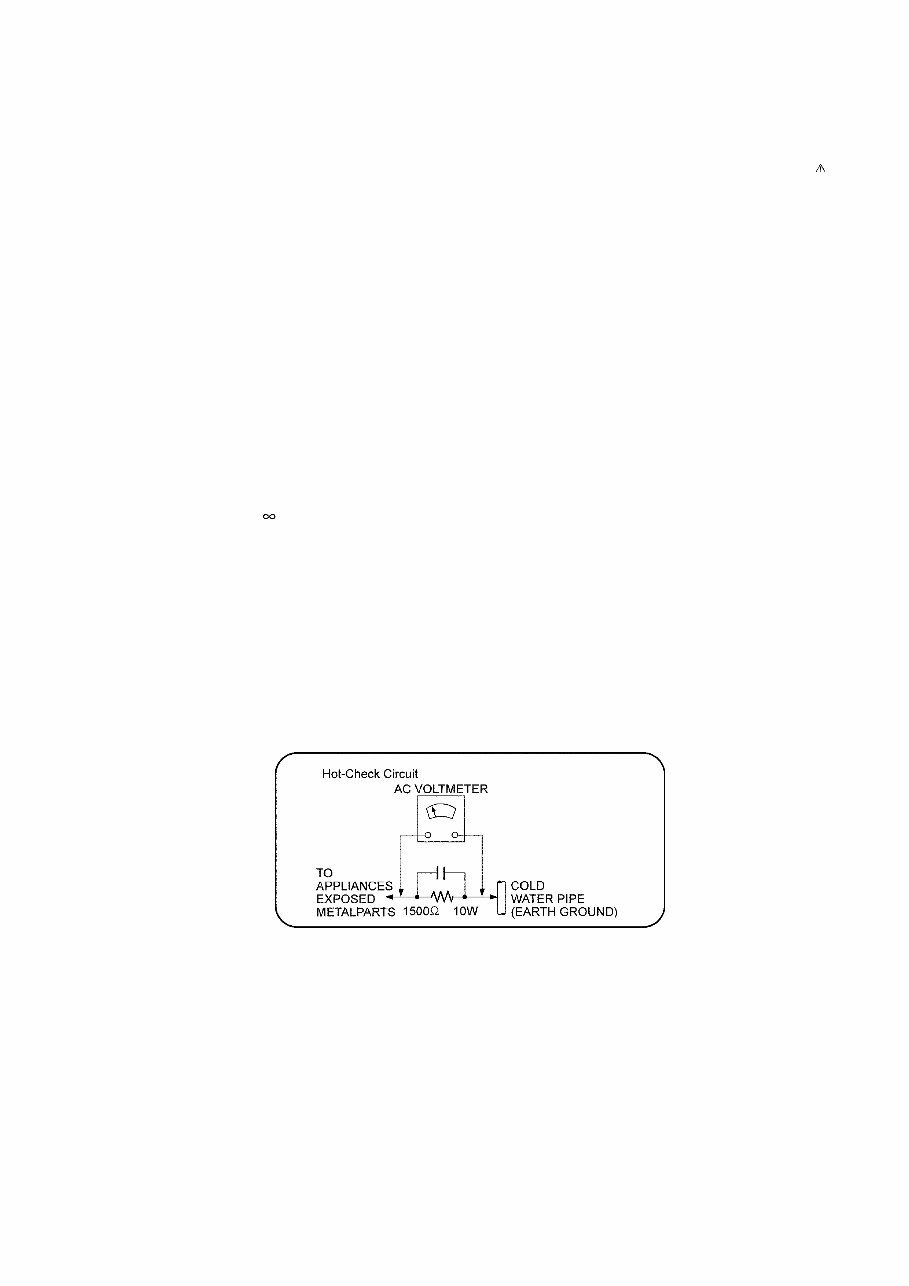
2. Connect a 1.5kΩ, 10 watts resistor, in parallel with a 0.15μF capacitors, between each exposed metallic part on the set and a
good earth ground such as a water pipe, as shown in Figure 1-1.
3. Use an AC voltmeter, with 1000 ohms/volt or more sensitivity, to measure the potential across the resistor.
4. Check each exposed metallic part, and measure the voltage at each point.
5. Reverse the AC plug in the AC outlet and repeat each of the above measurements.
6. The potential at any point should not exceed 0.75 volts RMS. A leakage current tester (Simpson Model 229 or equivalent)
may be used to make the hot checks, leakage current must not exceed 1/2 milliamp. In case a measurement is outside of the
limits specified, there is a possibility of a shock hazard, and the equipment should be repaired and rechecked before it is
returned to the customer.
Figure. 1-1
4
1.2. Caution for AC Cord
1.3. Before Repair and Adjustment
Disconnect AC power, discharge unit AC Capacitors (C1702, C1710, C1725, C1727 and C1728) through a 10W, 1W resistor to
ground.
Caution : DO NOT SHORT-CIRCUIT DIRECTLY (with a screwdriver blade, for instance), as this may destroy solid state devices.
After repairs are completed, restore power gradually using a variac, to avoid overcurrent.
• Current consumption at AC 240V, at 50Hz in NO SIGNAL mode (at volume minimum in FM mode) should be ~200 mA.
1.4. Protection Circuitry
The protection circuitry may have operated if either of the following conditions are noticed:
• No sound is heard when the power is turned on.
• Sound stops during a performance.
The function of this circuitry is to prevent circuitry damage if, for example, the positive and negative speaker connection wires are
"shorted", or if speaker systems with an impedance less than the indicated rated impedance of the amplifier are used.
If this occurs, follow the procedure outlines below:
1. Turn off the power.
2. Determine the cause of the problem and correct it.
3. Turn on the power once again after one minute.
Note:
When the protection circuitry functions, the unit will not operate unless the power is first turned off and then on again.
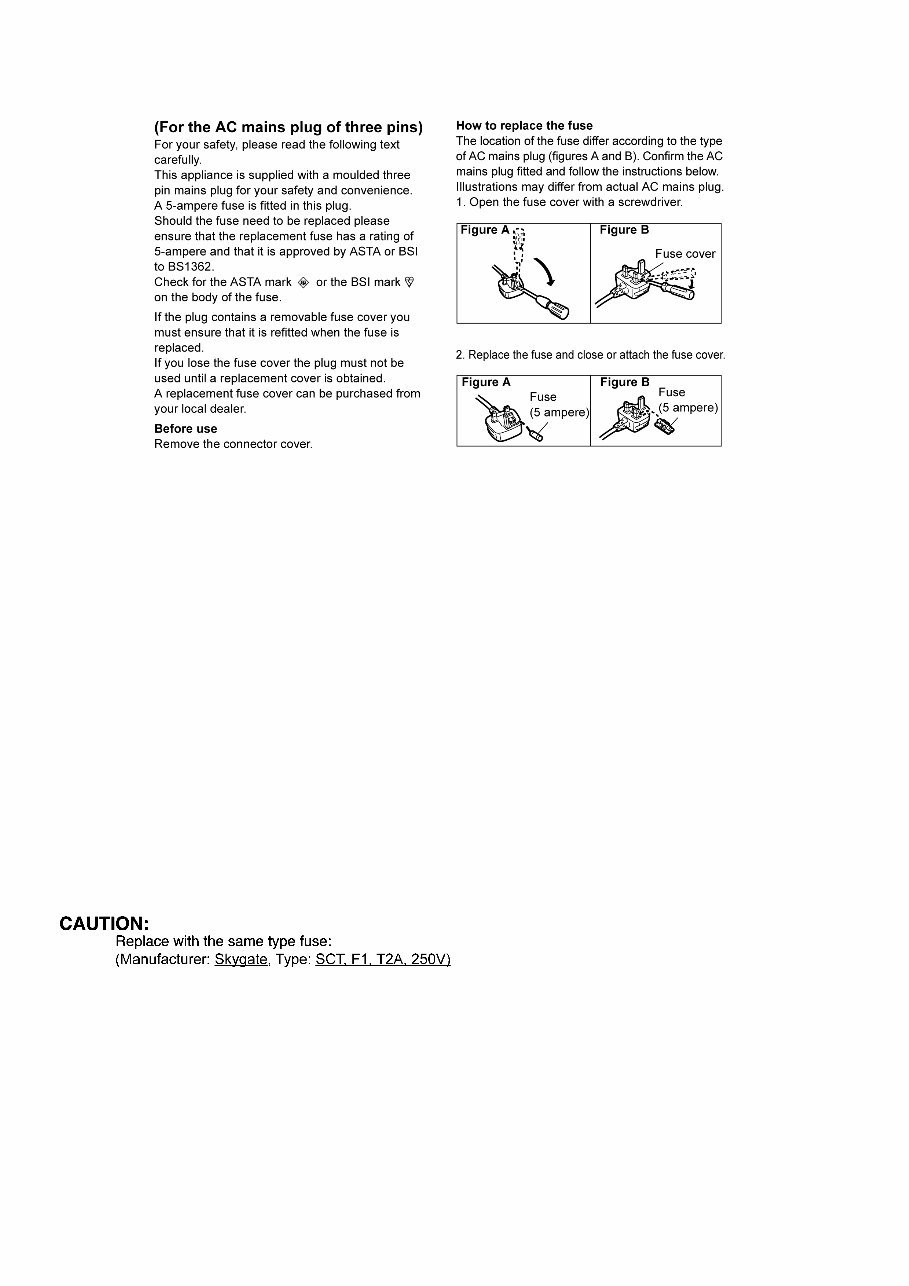
1.5. Caution For Fuse Replacement

5
1.6. Safety Part Information
Safety Parts List:
There are special components used in this equipment which are important for safety.
These parts are marked by in the Schematic Diagrams, Exploded View & Replacement Parts List. It is essential that these
critical parts should be replaced with manufacturer’s specified parts to prevent shock, fire or other hazards. Do not modify the
original design without permission of manufacturer.
Safety Ref. No. Part No. Part Name & Description Remarks
14 RGN3405D-K NAME PLATE
49 RMV0429 SMPS BRACKET INSULATOR A
51 RMV0432 SMPS COVER INSULATION
301 RAE5306Z-V TRAVERSE UNIT
A2 K2CT2YY00097 AC CORD
A3 RQT9941-B O/I BOOK (En)
C1702 F0CAF224A105 0.22uF
C1710 F1BAF471A013 470pF
C1725 F0CAF104A105 0.1uF
C1727 F1BAF1020020 1000pF
C1728 F1BAF1020020 1000pF
F1 K5G202Y00006 FUSE
L1702 G0B922G00002 LINE FILTER
P1751 K2AA2B000011 AC INLET
PC1702 B3PBA0000579 PHOTO COUPLER
PCB7 REP5054CA SMPS P.C.B. (RTL)
R1724 ERJ12YJ105U 1M 1/2W
R1726 ERJ12YJ105U 1M 1/2W
T1700 G4DYZ0000077 TRANSFORMER
Z1752 ERZV10V511CS VARISTOR

6
2 Warning
2.1. Prevention of Electrostatic Discharge (ESD) to Electrostatically Sensi-
tive (ES) Devices
Some semiconductor (solid state) devices can be damaged easily by static electricity. Such components commonly are called Elec-
trostatically Sensitive (ES) Devices.
The following techniques should be used to help reduce the incidence of component damage caused by electrostatic discharge
(ESD).
1. Immediately before handling any semiconductor component or semiconductor-equipped assembly, drain off any ESD on your
body by touching a known earth ground. Alternatively, obtain and wear a commercially available discharging ESD wrist strap,
which should be removed for potential shock reasons prior to applying power to the unit under test.
2. After removing an electrical assembly equipped with ES devices, place the assembly on a conductive surface such as alumi-
num foil, to prevent electrostatic charge buildup or exposure of the assembly.
3. Use only a grounded-tip soldering iron to solder or unsolder ES devices.
4. Use only an anti-static solder removal device. Some solder removal devices not classified as “anti-static (ESD protected)” can
generate electrical charge sufficient to damage ES devices.
5. Do not use freon-propelled chemicals. These can generate electrical charges sufficient to damage ES devices.
6. Do not remove a replacement ES device from its protective package until immediately before you are ready to install it. (Most
replacement ES devices are packaged with leads electrically shorted together by conductive foam, aluminum foil or compara-
ble conductive material).
7. Immediately before removing the protective material from the leads of a replacement ES device, touch the protective material
to the chassis or circuit assembly into which the device will be installed.
CAUTION:
Be sure no power is applied to the chassis or circuit, and observe all other safety precautions.
8. Minimize bodily motions when handling unpackaged replacement ES devices. (Otherwise harmless motion such as the
brushing together of your clothes fabric or the lifting of your foot from a carpeted floor can generate static electricity (ESD) suf-
ficient to damage an ES device).
7
2.2. Precaution of Laser Diode
Caution:
This product utilizes a laser diode with the unit turned "on", invisible laser radiation is emitted from the pickup lens.
Wavelength: 790 nm (CD)
Maximum output radiation power from pickup: 100 μW/VDE
Laser radiation from the pickup unit is safety level, but be sure the followings:
1. Do not disassemble the pickup unit, since radiation from exposed laser diode is dangerous.
2. Do not adjust the variable resistor on the pickup unit. It was already adjusted.
3. Do not look at the focus lens using optical instruments.
4. Recommend not to look at pickup lens for a long time.
2.3. Service caution based on Legal restrictions
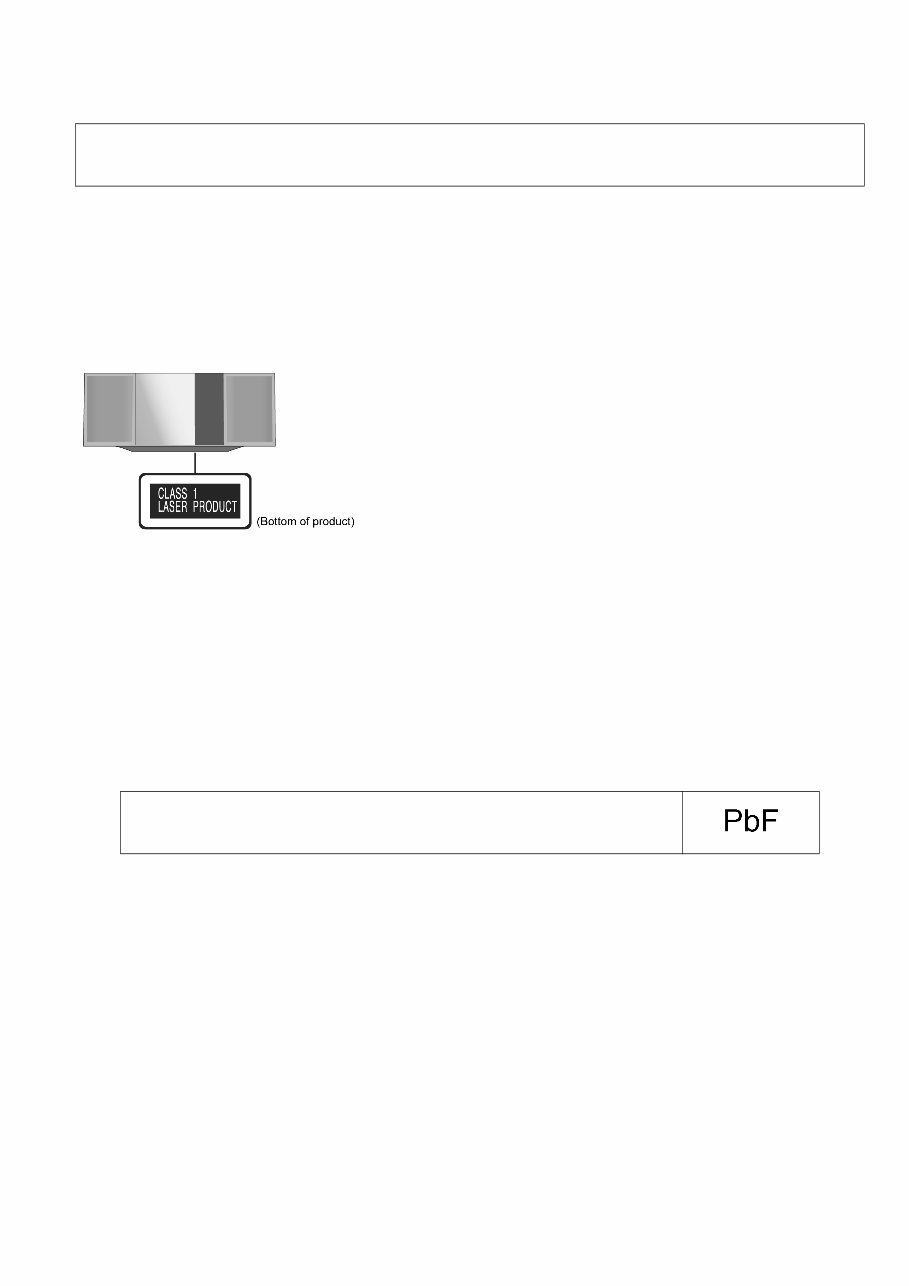
2.3.1. General description about Lead Free Solder (PbF)
The lead free solder has been used in the mounting process of all electrical components on the printed circuit boards used for this
equipment in considering the globally environmental conservation.
The normal solder is the alloy of tin (Sn) and lead (Pb). On the other hand, the lead free solder is the alloy mainly consists of tin
(Sn), silver (Ag) and Copper (Cu), and the melting point of the lead free solder is higher approx.30 degrees C (86°F) more than that
of the normal solder.
Definition of PCB Lead Free Solder being used
Service caution for repair work using Lead Free Solder (PbF)
• The lead free solder has to be used when repairing the equipment for which the lead free solder is used.
(Definition: The letter of “PbF” is printed on the PCB using the lead free solder.)
• To put lead free solder, it should be well molten and mixed with the original lead free solder.
• Remove the remaining lead free solder on the PCB cleanly for soldering of the new IC.
• Since the melting point of the lead free solder is higher than that of the normal lead solder, it takes the longer time to melt the
lead free solder.
• Use the soldering iron (more than 70W) equipped with the temperature control after setting the temperature at 350±30 degrees
C (662±86°F).
Recommended Lead Free Solder (Service Parts Route.)
• The following 3 types of lead free solder are available through the service parts route.
RFKZ03D01K-----------(0.3mm 100g Reel)
RFKZ06D01K-----------(0.6mm 100g Reel)
RFKZ10D01K-----------(1.0mm 100g Reel)
Note
* Ingredient: Tin (Sn), 96.5%, Silver (Ag) 3.0%, Copper (Cu) 0.5%, Cobalt (Co) / Germanium (Ge) 0.1 to 0.3%
CAUTION!
THIS PRODUCT UTILIZES A LASER.
USE OF CONTROLS OR ADJUSTMENTS OR PERFORMANCE OF PROCEDURES OTHER THAN THOSE SPECIFIED HEREIN MAY RESULT
IN HAZARDOUS RADIATION EXPOSURE.
The letter of “PbF” is printed either foil side or components side on the PCB using the lead free solder.
(See right figure)
8
2.4. Handling Precaution for Traverse Unit
The laser diode in the optical pickup unit may break down due to static electricity of clothes or human body. Special care must be
taken avoid caution to electrostatic breakdown when servicing and handling the laser diode in the Traverse Unit.
2.4.1. Cautions to Be Taken in Handling the Optical Pickup Unit
The laser diode in the optical pickup unit may be damaged due to electrostatic discharge generating from clothes or human body.
Special care must be taken avoid caution to electrostatic discharge damage when servicing the laser diode.
1. Do not give a considerable shock to the optical pickup unit as it has an extremely high-precise structure.
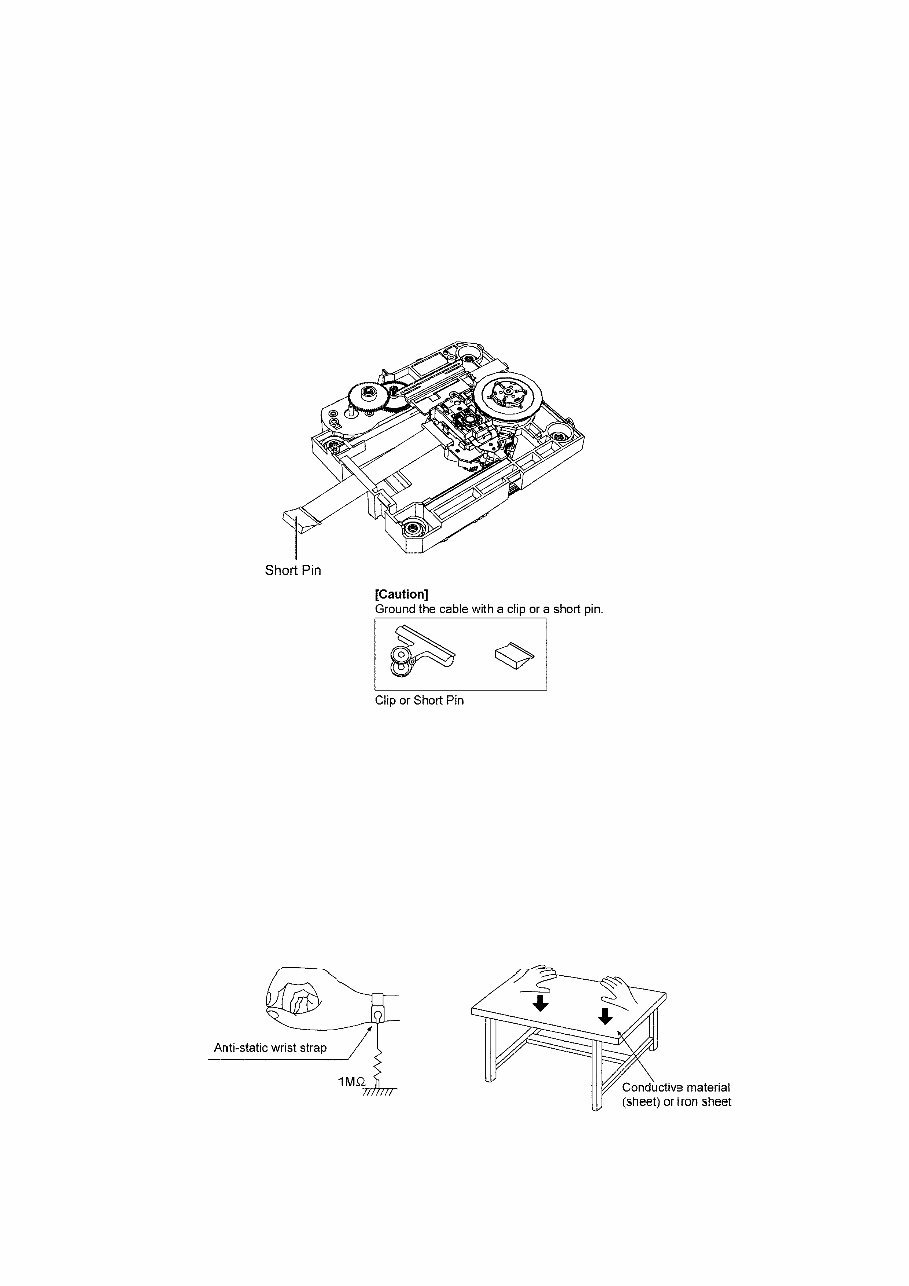
2. To prevent the laser diode from the electrostatic discharge damage, the flexible cable of the optical pickup unit removed
should be short-circuited with a short pin or a clip.
3. The flexible cable may be cut off if an excessive force is applied to it. Use caution when handling the flexible cable.
4. The antistatic FPC is connected to the new optical pickup unit. After replacing the optical pickup unit and connecting the flexi-
ble cable, cut off the antistatic FPC.
2.4.2. Grounding for electrostatic breakdown prevention
Some devices such as the CD player use the optical pickup (laser diode) and the optical pickup will be damaged by static electricity
in the working environment. Proceed servicing works under the working environment where grounding works is completed.
2.4.2.1. Worktable grounding
1. Put a conductive material (sheet) or iron sheet on the area where the optical pickup is placed, and ground the sheet.
2.4.2.2. Human body grounding
1. Use the anti-static wrist strap to discharge the static electricity form your body.

9
3 Service Navigation
3.1. Service Information
This service manual contains technical information which will allow service personnel’s to understand and service this model.
Please place orders using the parts list and not the drawing reference numbers.
If the circuit is changed or modified, this information will be followed by supplement service manual to be filed with original service
manual.
Note : In case either NFC P.C.B. or EEPROM IC (IC8004) on Main P.C.B. should break down, they need to be replaced at the same
time as a pair.
The following optional replacement methods are prepared and provided depending on circumstances.
1. NFC P.C.B. / EEPROM IC (IC8004) kit supply.
Part No. RFKV5053MB
Replace the EEPROM IC (IC8004) and NFC P.C.B. at the same time.
2.NFC P.C.B. / MAIN P.C.B. kit supply.
Part No. RFKV5053MA
Replace the Main P.C.B. and NFC P.C.B. at the same time.

10
4 Specifications
Q General
Power consumption 26 W
Power consumption in standby
mode*
1, 2
Approx. 0.2 W
(when “BLUETOOTH STANDBY” is “ON”)*
2
Approx. 0.3 W
Power supply AC 220 V to 240 V, 50 Hz
Dimensions (W x H x D) 500 mm x 205 mm x 92 mm
Mass Approx. 2.5 kg
Operating temperature range 0 °C to +40 °C
Operating humidity range 35% to 80 % RH
(no condensation)
Q Amplifier Section
Output power:
RMS Output Power Stereo Mode
Front Ch (both ch driven) 20 W per channel (8 Ω),
1 kHz, 10% THD
Total RMS Stereo mode power 40 W
Q Tuner section
Preset Memory FM 30 stations
Frequency modulation (FM)
Frequency range 87.50 MHz to 108.00 MHz
(50 kHz step)
Antenna terminals 75 Ω (unbalanced)
Q DAB section
DAB memories 20 channels
Frequency band (wavelength)
Band III 5A to 13F
(174.928 MHz to 239.200 MHz)
Sensitivity *BER 4x10
-4
Min requirement –98 dBm
DAB External Antenna Terminal F - Connector (75 Ω)
Q Disc Section
Disc played [8 cm or 12 cm]
CD, CD-R/RW (CD-DA, MP3*
3
)
Pick up
Wavelength 790 nm (CD)
Q Speaker System Section
Speaker unit(s)
Full range 6.5 cm Cone type x 1
per channel
Passive Radiator 8 cm x 2 per channel
Impedance 8 Ω
Q Terminal Section
USB Port DC OUT 5 V 1.5 A
USB Standard USB 2.0 full speed
Media file format support MP3 (*.mp3)
USB device file system FAT12, FAT16, FAT32
AUX IN Stereo, 3.5 mm jack
Q Bluetooth Section
Version
Bluetooth
®
Ver2.1+EDR
Class Class 2
Supported profiles A2DP, AVRCP
Operating Frequency 2.4 GHz band FH-SS
Operation distance 10 m Line of sight
• Specifications are subject to change without notice.
• Mass and dimensions are approximate.
• Total harmonic distortion is measured by a digital spectrum ana-
lyzer.
*1: “BLUETOOTH STANDBY” is “OFF”.
*2: No device is connected to the DC OUT terminal before turning to
standby mode.
*3: MPEG-1 Layer 3, MPEG-2 Layer 3.
You're Reading a Preview
What's Included?
 Lifetime Access
Fast Download Speeds
Online & Offline Access
Access PDF Contents & Bookmarks
Full Search Facility
Print one or all pages of your manual
$35.99
Panasonic SC-HC39DB HC39DBEB Service Manual & Repair Guide
Viewed 73 Times Today

What's Included?
Lifetime Access
Fast Download Speeds
Online & Offline Access
Access PDF Contents & Bookmarks
Full Search Facility
Print one or all pages of your manual
$35.99

Secure transaction
What's Included?
Lifetime Access
Fast Download Speeds
Online & Offline Access
Access PDF Contents & Bookmarks
Full Search Facility
Print one or all pages of your manual
Description
This service and repair manual is an invaluable resource for troubleshooting and repairing your stereo system. It contains in-depth information on:
- Safety & Precautions
- Product Specifications
- Self Diagnostics
- Disassembly & Reassembly
- Adjustment Procedures
- Troubleshooting Methods
- Voltage Measurement & Waveform Chart
- Maintenance
- Schematic Diagrams
- Block Diagram
- Circuit Boards
- Wiring Diagrams
- Exploded Views
- Replacement parts list
This service manual is highly detailed and includes illustrated pictures and step-by-step instructions for effective device repair and servicing.
You can easily print this manual from any printer and computer. It is the official service and repair manual in PDF format, ensuring high-resolution quality for all printed pages.
Upon payment, you will have instant access to the manual, eliminating shipping fees and waiting time for postal delivery, allowing you to commence repairs promptly.
Specifications:
- Language: English
- Format: PDF
- Pages: 96


