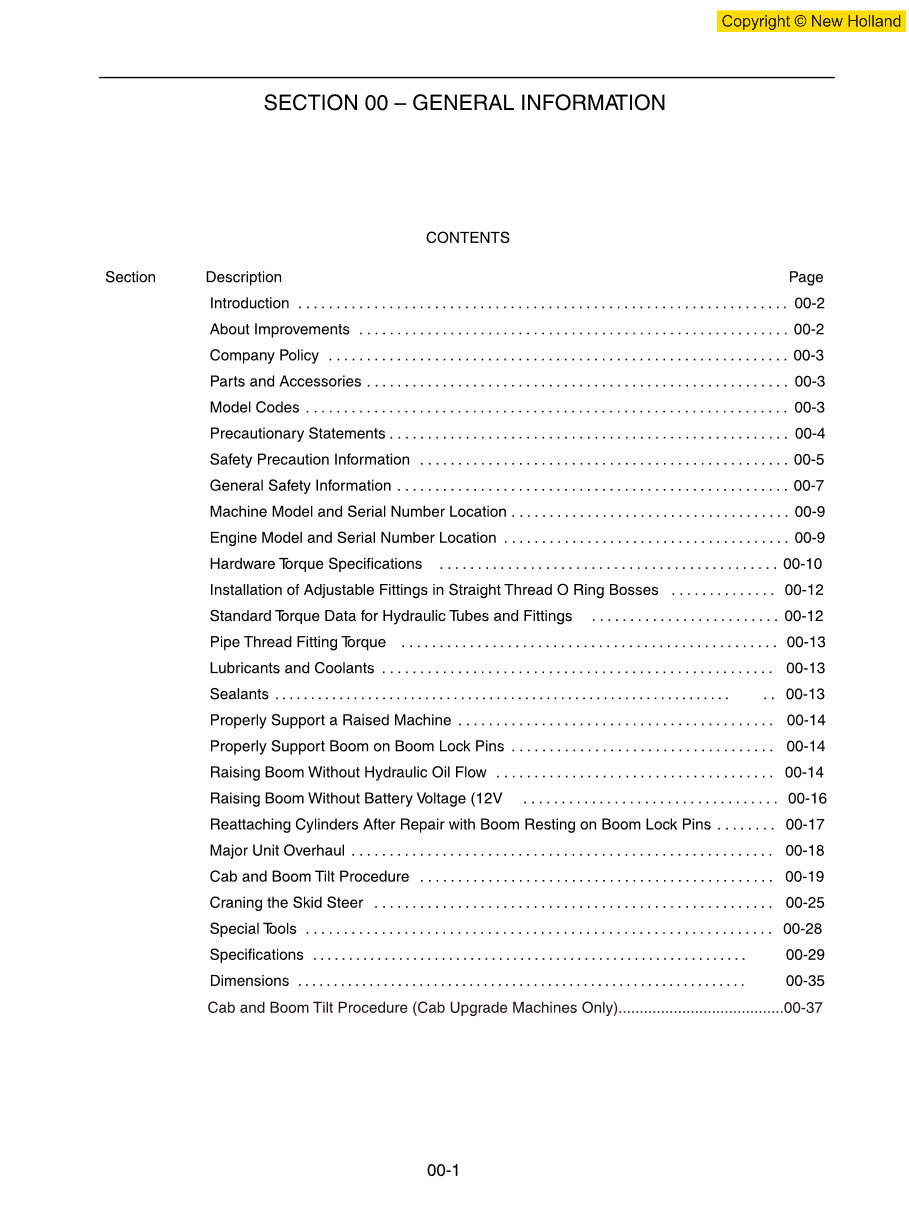
SECTION 00 - GENERAL INFORMATION 00-2 INTRODUCTION This service manual provides the technical information needed to properly service and maintain the Models L175 and C175 skid steers. Use it in conjunction with the operator’s manual which is supplied with the skid steer. Keep both manuals available for ready reference. The L175 and C175 have many similarities with the major differences being the L175 is a wheeled machine and the C185 is a track machine. Whenever working on New Holland equipment, left and right sides of the machine are determined by standing behind the unit, looking in the direction of travel. The easiest and least time-consuming removal, disassembly, and reassembly procedures are detailed in the manual. Modifying these procedures is not recommended. New Holland skid steers are designed with emphasis on safety for operator protection. However, careless and negligent operation can still result in serious injury to persons or damage to property. Be sure to read and follow all safety instructions in this manual. Your New Holland dealer is interested in your obtaining the most from your investment and will be glad to answer any questions you may have about your skid steer. When major service is required, your dealer’s staff of trained service technicians is ready to serve you. When in need of parts, always order genuine New Holland service parts from your New Holland dealer. Be prepared to give your dealer the model and serial number of the engine and skid steer (the location of these numbers is described later in this section). Record the serial numbers here. Skid Steer Model Skid Steer Serial Number Engine Model Engine Serial Number CAUTION This symbol is used throughout this book whenever your own personal safety is involved. Take time to be careful! ABOUT IMPROVEMENTS New Holland is continually striving to improve its products. We must, therefore, reserve the right to make improvements or changes when it becomes practical and possible to do so, without incurring any obligation to make changes or additions to the equipment sold previously. ALL SPECIFICATIONS ARE SUBJECT TO CHANGE WITHOUT NOTICE.
SECTION 00 - GENERAL INFORMATION 00-3 COMPANY POLICY Company policy, which is one of continuous improvement, reserves the right to make changes in design and specifications at any time without notice and without obligation to modify units previously built. All data given in this book is subject to production variations. Dimensions and weights are approximate only and the illustrations do not necessarily show skid steers in standard condition. PARTS AND ACCESSORIES Genuine NEW HOLLAND parts and accessories have been specifically designed for NEW HOLLAND MACHINES. We would like to point out that “NON-GENUINE” parts and accessories have not been examined and released by NEW HOLLAND. The installation and or use of such products could have negative effects upon the design characteristics of your machine and thereby affect its safety. NEW HOLLAND is not liable for any damage caused by the use of “NON-GENUINE” NEW HOLLAND parts and accessories. MODEL CODES The range of Skid Steers described in this manual is identified in the text by the engine horsepower Pferdestarke. (PS). The skid steers listed below may not be available in all countries or markets. ENGINE PS MODEL N844LT 56 L175 N844LT 56 C175
SECTION 00 - GENERAL INFORMATION 00-4 PRECAUTIONARY STATEMENTS PERSONAL SAFETY Throughout this manual and on machine decals, you will find precautionary statements (“CAUTION”, “WARNING”, and “DANGER”) followed by specific instructions. These precautions are intended for the personal safety of you and those working with you. Please take the time to read them. CAUTION The word “CAUTION” is used where a safe behavioral practice according to operating and maintenance instructions and common safety practices will protect the operator and others from accident involvement. WARNING The word “WARNING” denotes a potential or hidden hazard which has a potential for serious injury. It is used to warn operators and others to exercise every appropriate means to avoid a surprise involvement with machinery. DANGER The word “DANGER” denotes a forbidden practice in connection with a serious hazard. Failure to follow the “CAUTION”, “WARNING”, and “DANGER” instructions may result in serious bodily injury or death. MACHINE SAFETY Additional precautionary statement (“IMPORTANT”) is followed by specific instructions. This statement is intended for machine safety. IMPORTANT: The word “IMPORTANT” is used to inform the reader of something he needs to know to prevent minor machine damage if a certain procedure is not followed.
SECTION 00 - GENERAL INFORMATION 00-5 SAFETY PRECAUTIONS CAUTION Unsafe operating practices and improper use of the skid steer and its attachments on the part of the operator can result in injuries. Observe the following safety precautions at all times: 1. For servicing, the skid steer should be on level terrain, engine stopped with the wheels blocked or the entire skid steer solidly supported with the wheels off the ground before servicing any component of the drivetrain. 2. For servicing under the operator’s seat, raise the seat and pan assembly up to the raised latched position and securely latch. 3. Do not operate the skid steer unless the seat is latched in the operate position. 4. Do not service the skid steer with a raised boom unless the boom is resting on the boom lock pins. 5. Do not service the skid steer with the engine running unless the skid steer is properly and securely supported with all four wheels off the ground. 6. Use caution when servicing the unit around moving parts. 7. Do not tilt the boom and cab without proper instruction. 8. Do not tilt the boom and cab without using the proper cab tilting tool. 9. Reinstall all shields removed for service. 10. Never loosen any hydraulic connections before relieving the pressure in the hydraulic system. 11. Wear eye protection such as goggles, etc. 12. Wear ear protection such as ear plugs, etc. When you feel the noise level is uncomfortable. 13. If any servicing or adjustments require the battery to be disconnected, disconnect the (–) negative ground cable. 14. When servicing electrical components, disconnect the (–) negative ground cable. 15. If the electronic instrument cluster (eic) requires removal from the dash area or the skid steer, disconnect the (–) negative ground battery cable. This will shut off power to the eic and prevent damage to the eic board or blowing the 5-amp fuses if the board is accidentally grounded. 16. If welding is required on the skid steer, disconnect the (–) negative ground cable. failure to disconnect the battery may result in damage to the EIC (Electronic Instrument Cluster) monitoring system and other electrical components. 17. If welding is required on an attachment, remove the attachment from the skid steer. 18. Give complete and undivided attention to the job at hand so that complete control of the skid steer is maintained at all times. 19. Drive slowly over rough ground and on slopes; keep alert for holes, ditches and other irregularities that may cause the skid steer to overturn. 20. Avoid steep hillside operation which could cause the skid steer to overturn. 21. Never transport a loaded bucket at full height. Operate the skid steer with the load as low as possible until it becomes necessary to raise the boom to discharge the load into a truck, container, etc. 22. Reduce speed when turning so there is no danger of the skid steer overturning. 23. Never drive up or back up a hill or incline with a raised boom or the skid steer could over turn. 24. Always look behind you before backing the skid steer. 25. Maintain proper transmission oil level to prevent loss of hydrostatic braking. 26. Do not allow passengers to ride on the skid steer at any time. 27. Do not allow children to operate the skid steer or ride on the skid steer at any time. 28. Do not allow anyone to operate the skid steer without proper instruction. OSHA requires that all operators be instructed on the proper operation of the machine before they operate the unit. 29. Do not operate the skid steer in any position other than while in the operator’s seat with the seat belt securely fastened.
SECTION 00 - GENERAL INFORMATION 00-6 30. Before starting the engine, be sure that all operating controls are in neutral and the parking brake is engaged. 31. Never operate the skid steer engine in a closed building without adequate ventilation. 32. Refuel the skid steer outdoors with the engine shut off. Replace the fuel cap securely. Use an approved fuel container. Do not smoke when handling fuel. Avoid spilling fuel. 33. After operating the engine, never touch the muffler, exhaust pipe, engine or radiator until they have had time to cool. 34. Dress appropriately - wear relatively tight-fitting clothing when operating the skid steer. Loose or torn clothing can catch in moving parts or controls. 35. Before servicing the skid steer or any of its attached equipment, be sure that the attachments are lowered to the ground or that the boom arms are supported by the boom lock pins. 36. Do not work under overhangs, electric wires, or where there is danger of a slide. 37. Wear an approved safety hat when operating the machine and while in any work area. 38. When driving the skid steer on a road or highway, use warning lights or warning devices as may be required by local or state government regulations. Headlights, warning lights and smv signs are available through your New Holland dealer. 39. Keep the skid steer clean. Do not allow trash, debris or other articles to accumulate in the cab, floor or foot control pedal area that may hinder safe machine operation. 40. Never operate the skid steer with any of the shielding removed. 41. Never operate the skid steer without windows and/or screens in place. 42. Never extend any part of the body outside of the operator’s area. 43. Always properly tie down the skid steer to a truck or trailer before transport. 44. Make sure all bystanders are at a safe distance away from the skid steer before starting the engine. 45. Do not allow anyone near the skid steer while the engine is running and the skid steer is operational. 46. When using the skid steer to crane objects, do not allow any person to ride on objects being craned. 47. Do not use the skid steer as a work platform for supporting materials. 48. Do not lift personnel or allow personnel to work while standing in the bucket or on other attachments. This is not a man-lift. OSHA requirements now make it the employer’s responsibility to fully instruct each operator in the proper and safe operation of all operative equipment. Both employer and employee should thoroughly familiarize themselves with the following sections. CAUTION Some pictures in this manual show safety shields removed or open to show parts being serviced or for clarity. All shields should be closed or replaced prior to operating the machine. DANGER Fasten seat belt before starting engine! This skid steer is a very stable unit but it can be upset if stopped suddenly when the bucket is raised and loaded. Therefore, do not start the engine before securely fastening the seat belt, and carry the load low.
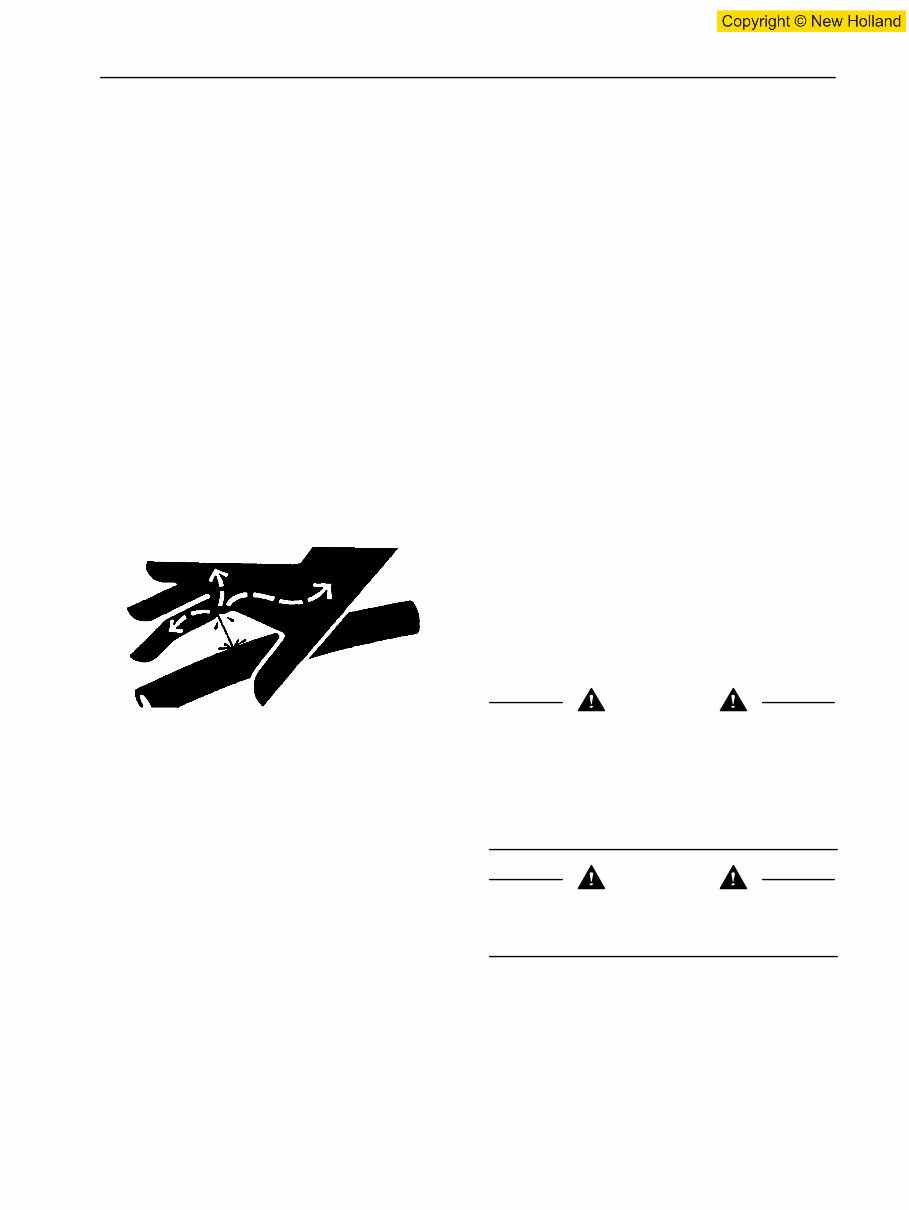
SECTION 00 - GENERAL INFORMATION 00-7 GENERAL SAFETY INFORMATION HANDLE FLUIDS SAFELY When you work around fuel or other flammable material, do not smoke, work near heaters or other fire hazards. Do not store flammable material in open containers. Store flammable fluids away from fire hazards. Do not incinerate or puncture pressurized containers. Make sure machine is clean of trash, grease, oil, and debris. Do not store oily rags; they can ignite and burn spontaneously. Keep a first aid kit and fire extinguisher handy. Keep emergency numbers for doctors, ambulance service, hospital, and fire department near your telephone. USE CARE AROUND HIGH-PRESSURE FLUID LINES Escaping fluid under pressure can penetrate the skin causing serious injury. Avoid the hazard by relieving pressure before disconnecting hydraulic or other lines. Tighten all line connections before applying pressure. Check for leaks with a piece of cardboard. Protect hands and body from high-pressure fluids. If an accident occurs, see a doctor immediately. Any fluid injected into the skin must be surgically removed within a few hours or gangrene may result. Doctors unfamiliar with this type of injury should reference a knowledgeable medical source. AVOID HEATING NEAR PRESSURIZED FLUID LINES Flammable spray can be generated by heating near pressurized fluid lines, resulting in severe burns to yourself and bystanders. Do not heat by welding, soldering, or using a torch near pressurized fluid lines. Pressurized lines can be accidentally cut or damaged when heat goes beyond the immediate flame area. USE CARE IN HANDLING AND SERVICING BATTERIES Prevent Battery Explosions Keep sparks, lighted matches, and open flame away from the top of the battery. Battery gas can explode. Never check battery charge by placing a metal object across the posts. Use a voltmeter or hydrometer. Do not charge a frozen battery; it may explode. Warm the battery to 60° F (16° C). WARNING If any servicing or adjustments require the battery to be disconnected, or welding is required on the skid steer, disconnect the (–) negative ground cable. Failure to disconnect the battery may result in damage to the eic (electronic instrument cluster) monitoring system and other electrical components. WARNING If welding on an attachment is required, first remove the attachment from the skid steer boom attaching plate.
You're Reading a Preview
What's Included?
Lifetime Access
Fast Download Speeds
Online & Offline Access
Access PDF Contents & Bookmarks
Full Search Facility
Print one or all pages of your manual
$71.99
New Holland L175 C175 Workshop Service Repair Manual Skid Steer and Compact Track Loader
This is the Workshop Service Repair Manual for New Holland L175 skid steer loader, and C175 rubber track loaders. This manual contains all the information you need to properly perform complex repairs on the entire machine, including the engines.
Repair Service & Shop Manual: 837-Pages 7-Sections
For do it yourself servicing, teardowns, repairs, overhauls, adjustments, and complete specifications. The pages are very clear and clean, pictures are great with detail, a lot of detailed repair information in a very technical manual. This is just like the original 837 page factory paper manual made for New Holland L175 and C175 model skid steer and track loaders; the only difference is this one is not paper, and doesn't need to be shipped. You get it right away!
Like the paper manual, it has many sections that are neatly organized in Adobe Acrobat, very clean, sharp images that are scalable to several times normal size. There are tons of illustrations, specifications, pictures, step-by-step instructions, special tool info etc. Zoom it, print it, save it, close it. Print a few pages at a time, as you need; no need to lug that bulky binder around anymore! No need to worry about stained, torn or missing pages.
There are 7 complete sections; each section is indexed and bookmarked for fast & easy navigation. Each section covers a different area of the machine.
Section Index:
GENERAL INFORMATION
ENGINE
TRACKS AND MOTORS
HYDROSTATIC TRANSMISSION
BRAKES AND CONTROLS
HYDRAULIC SYSTEM
TOWING HOOKS AND BALLASTING
FRAMES
AXLES AND WHEELS
CAB CLIMATE CONTROL
ELECTRICAL SYSTEM
FRONT LOADER, BOOM AND MOUNTING PLATE
ACCESSORIES
PLATFORMS, CAB, BODYWORK, AND DECALS
ELECTRICAL SCHEMATICS
HYDRAULIC SCHEMATICS
Once you buy the manual, you will get a link in your email, then just go view it, print it, and save it for use later on. This has every page that is in the paper service manual. Viewed in popular Adobe format, which most computers have already. To the free viewer, go to www.adobe.com/reader.
About New Holland
New Holland started with one corn mill in the state of Pennsylvania, first built in 1895. The company then expanded into farm implements and later found success with automatic hay balers. New Holland was acquired by Ford Tractor Operations in 1985, and the Ford New Holland name began to appear on tractors. In 1990 Ford sold a majority interest in its farm machinery operations to a foreign company called FIAT, with the agreement that the Ford name be dropped in ten years.
Tractors began to be released under two names: New Holland in traditional Ford tractor markets, and FIAT in their traditional markets. In 1999, Case IH and FIAT New Holland merged to form CNH Global (Case New Holland) which continues to build tractors under the New Holland brand. New Holland produces both Agricultural farm equipment, and Heavy construction equipment like backhoe, skid steer loader, excavator, mini excavator, and wheel loader. The skid steer loader models and rubber track loaders included in this service work shop repair manual are L175 and C175.
Reviews
Q&A
Recently Viewed
5,521,897Happy Clients
2,594,462eManuals
1,120,453Trusted Sellers
15Years in Business
Price:
Actual Price:
New Holland L175 C175 Workshop Service Repair Manual Skid Steer and Compact Track Loader









 Lifetime Access




