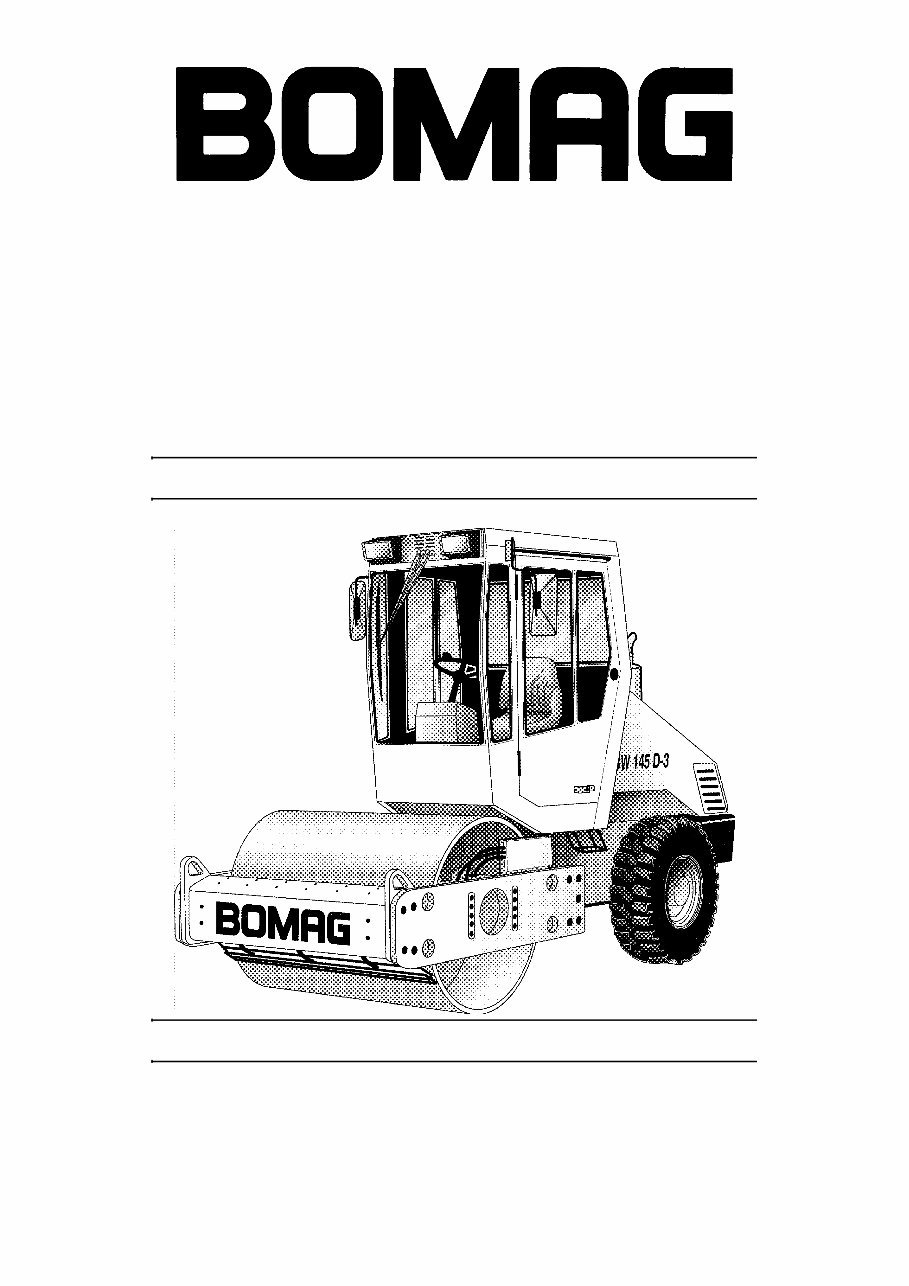
Instructions for repair Catalogue number 008 912 88 05/2003 BW 145 D-3 S/N 101 581 21 .... S/N 101 581 47 ..... Single drum roller
Table of Contents BOMAG 3 008 912 88 General 5 1.1 Foreword 6 1.2 Safety regulations 7 1.3 General repair instructions 9 1.4 Tightening torques 11 1.5 Connection overview 12 Tests and adjustments 15 2.1 Technical data 16 2.2 Special tools 19 2.3 Checking the rotation speeds 21 2.4 Checking / adjusting the neutral positions of the travel pump 23 2.5 Pressure tests in the travel circuit 26 2.6 Check the setting of the high pressure relief valves in the travel circuit 28 2.7 Checking / adjusting the vibrator shaft speeds 31 2.8 Pressure measurements in the vibration circuit 32 2.9 Check the leakage rate of the vibration motor 33 2.10 Pressure test in steering circuit 34 Flushing 37 3.1 Special tool: 38 3.2 Flushing schematic for travel system 40 3.3 Flashing the travel circuit 42 3.4 Flushing schematic for vibration drive 50 3.5 Flushing the vibration circuit 52 Trouble shooting 55 4.1 General 56 4.2 Trouble shooting diagram 57 Drum 83 5.1 Special tools 84 5.2 Repair overview for drum 86 5.3 Removing and installing the drum 88 5.4 Repairing the drum 92 5.5 Dismantling, assembling the change-over weights 107 5.6 Changing the rubber buffers 110 Oscillating articulated joint 111 6.1 Special tools 112 6.2 Repair overview oscillating articulated joint 114 6.3 Removing and installing the oscillating articulated joint 116 6.4 Repairing the oscillating articulated joint 119 Suppliers documentation 129 7.1 A10VG 131 7.2 MS/MSE 02 to 18 185 7.3 A10VM 235 7.4 Vibration motors MMF 025 265 7.5 Axle DANA 172 341
Table of Contents BOMAG 4 008 912 88
BOMAG 5 008 912 88 1 General
1.1 Foreword BOMAG 6 008 912 88 1.1 Foreword Introduction These repair instructions contain all necessary infor- mation for training and repair work. Notes on maintenance, care and trouble shooting can be found in the operating and maintenance instruc- tions. 1 General 2 Tests and adjustments 3 Flushing 4 Perform 5 Drum 6 Articulated joint 7 Components This instruction manual contains only assembly groups needed for this type of machine. The repair instructions describe the removal or dis- mantling and assembly of components and assembly groups. The repair of disassembled assembly groups is de- scribed as far as this makes sense with respect to available tools and spare parts supply and as far as it can be understood by a skilled mechanic. ! Danger Danger of injury Please observe strictly the safety regulations in these operating instructions and the applicable accident prevention regulations. Spare parts needed for repairs can be taken from the spare parts catalogue for the machine. You should only use genuine BOMAG spare parts. These repair instructions are not subject of an updat- ing service; for this reason we would like to draw your attention to our additional technical service bulletins. In case of a new release all necessary changes will be included. In the course of technical development we reserve the right for technical modifications without prior notifica- tion. Information and illustrations in this repair manual must not be reproduced and distributed, nor must they be used for the purpose of competition. All rights accord- ing to the copyright law remain expressly reserved. BOMAG GmbH & Co. OHG Printed in Germany Copyright by BOMAG
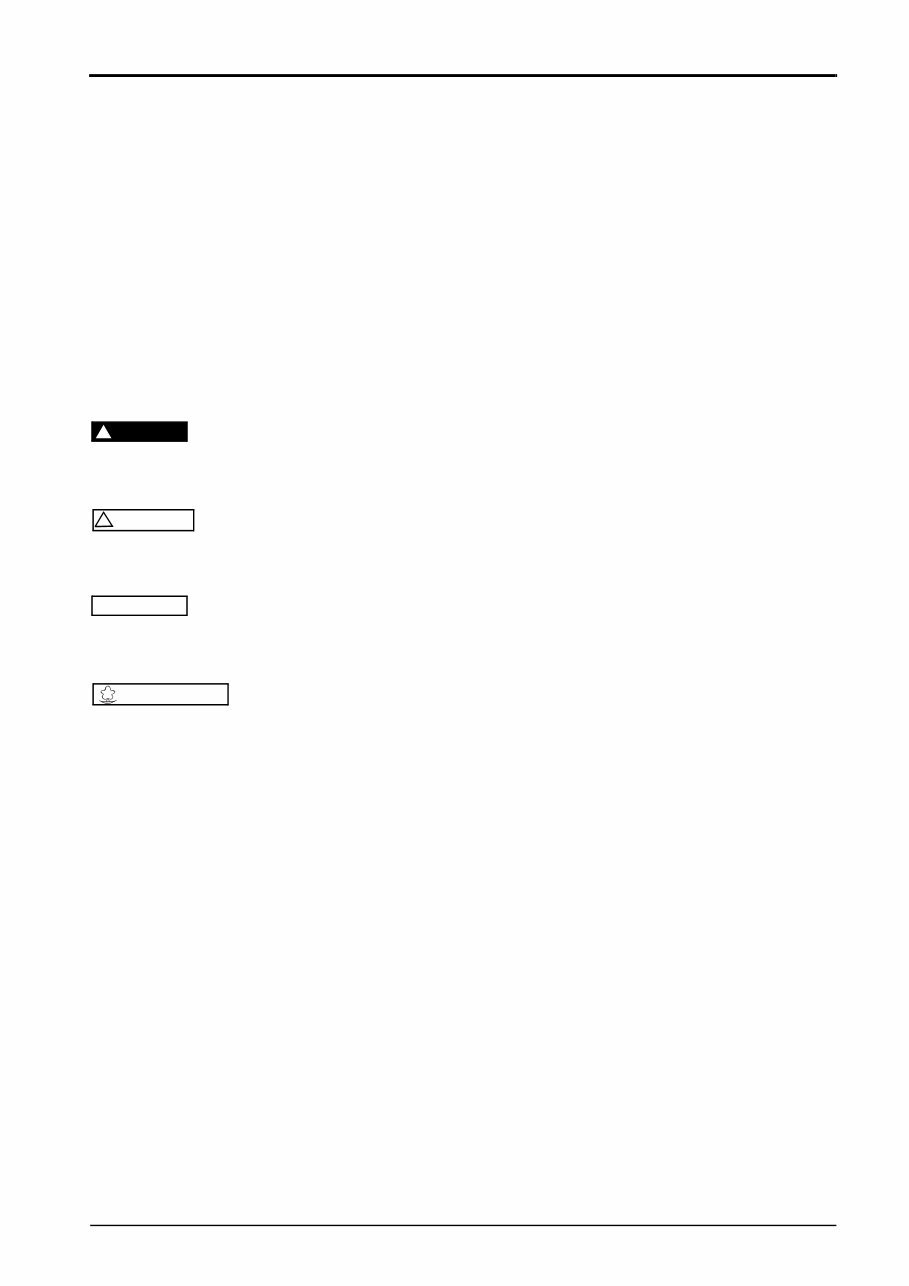
Safety regulations BOMAG 7 008 912 88 1.2 1. 2 Safety regulations Important notes These safety regulations must be read and ap- plied by every person involved in the repair of this machine. The applicable accident prevention in- structions and the safety regulations in the oper- ating and maintenance instructions must be additionally observed. Repair work shall only performed by appropriately trained personnel or by the after sales service of BOMAG. These repair instructions contain headers like „Note“, „Attention“, „Danger“ and „Environment“, which must be strictly complied with in order to avoid dangers for health and for the environment. ! Danger Paragraphs marked like this highlight possible dangers for persons. ! Caution Paragraphs marked like this highlight possible dangers for machines or parts of the machine. i Note Paragraphs marked like this contain technical infor- mation for the optimal economical use of the machine. Environment Paragraphs marked like this point out practices for safe and environmental disposal of fuels and lubricants as well as replacement parts. Observe the regulations for the protection of the environment. General l Before starting repair work stand the machine on level and solid ground. l Always secure the machine against unintended roll- ing. l Secure the engine reliably against unintentional starting. l Mark a machine that is defective or being repaired by attaching a clearly visible warning tag to the steering wheel. l On machines with articulated joint keep the articu- lated joint locked during work. l Use protective clothes like hard hat, safety boots and gloves. l Keep unauthorized persons away from the machine during repair work. l Tools, lifting gear, lifting tackle, supports and other auxiliary equipment must be fully functional and in safe condition. l Use only safe and approved lifting gear of sifficient load bearing capacity to remove and install parts or components from and to the machine. l Be careful with cleansing agents. Do not use easily inflammable or harmful substances, such as gaso- line or paint thinners for cleaning. l Cleaning or repair work on the fuel tank is very dan- gerous. Do not smoke or allow any ignitable sparks or open fire in the vicinity when cleaning or repairing a tank. . l When performing welding work strictly comply with the respective welding instructions. Special safety regulations l Use only genuine BOMAG spare parts for repair purposes. Original parts and accessories have been specially designed for this machine. l We wish to make explicitly clear that we have not tested or approved any parts or accessories not supplied by us. The installation and/or use of such products may therefore have an adverse effect on the specific characteristics of the machine and thereby impair the active and/or passive driving safety. The manufacturer explicitly excludes any li- ability for damage caused by the use of non-original parts or accessories. l Unauthorized changes to the machine are prohibit- ed for safety reasons. l If tests on the articulated joint need to be performed with the engine running, do not stand in the articu- lation area of the machine, danger of injury! l Do not perform cleaning work while the engine is running. l If tests must be performed with the engine running do not touch rotating parts of the engine, danger of injury. l Exhaust gases are highly dangerous. Always en- sure an adequate supply of fresh air when starting the engine in closed rooms. l Refuel only with the engine shut down. Ensure strict cleanliness and do not spill any fuel. l Keep used filters in a separate waste container and dispose of environmentally. l Dispose of oils and fuel environmentally when per- forming repair or maintenance work. l Do not refuel in closed rooms. l Do not heat up oil higher than 160 °C because it may ignite. l Wipe off spilled oil and fuel.
1.2 Safety regulations BOMAG 8 008 912 88 l Do not smoke when refuelling or when checking the acid level in the battery. l Do not check the acid level of the battery with a na- ked flame, danger of explosion! l Old batteries contain lead and must be properly dis- posed of. l There is a danger of scalding when draining off en- gine or hydraulic oil at operating temperature. l on machines with rubber tires a tire may busr if in- correctly assembled. This can cause severe injury. l Do not exceed the specified highest permissible tire pressure. Hydraulics l Hydraulic oil escaping under pressure can pene- trate the skin and cause severe injury. You should therefore relieve the pressure in the system before disconnecting any lines. l Before applying pressure to the system make sure that all line connections and ports have been prop- erly tightened and are in perfect condition. l Hydraulic oil leaking out of a small opening can hardly be noticed, therefore please use a piece of cardboard or wood when checking for leaks. When being injured by hydraulic oil consult a physician im- mediately, as otherwise this may cause severe in- fections. l Do not step in front of or behind the drums/wheels when performing adjustment work in the hydraulic system while the engine is running. Block drums and/or wheels with wedges. Reattach all guards and safety installations after all work has been completed.
General repair instructions BOMAG 9 008 912 88 1.3 1. 3 General repair instructions General l Before removing or disassembling and parts, hoses or components mark these parts for easier assem- bly. l Before assembly oil or grease all parts, as far as this is necessary. Hydraulic system ! Caution Do not open any hydraulic components if you have not been properly trained and without exact knowledge. Please note Cleanliness is of utmost importance. Make sure that no dirt or other contaminating substances can enter into the system. l Clean fittings, filler covers and the area around such parts before disassembly to avoid entering of dirt. l Before disconnecting hoses, pipes or similar relieve the system pressure with the engine shut down. l During repair work keep all openings closed with clean plastic plugs and caps. l Do not run pumps and motors without oil. l When cleaning hydraulic components take care not to damage any fine machine surfaces. l Chemical and rubber soluble cleansing agents may only be used to clean metal parts. Do not use such substances to clean seals and gaskets. l Rinse of cleaned parts thoroughly, dry them with compressed air and apply anti-corrosion oil immedi- ately. Do not install parts that show traces of corro- sion. l Avoid the formation of rust on fine machined caused by hand sweat. l Grease must not used as a sliding agent for assem- bly work. Use hydraulic oil. l Do not start the engine after the hydraulic oil has been drained off. l Use only the specified pressure gauges. Risk of damaging the pressure gauges under too high pres- sure. l Clean ports and fittings before removal so that no dirt can enter into the hydraulic system. l Check the hydraulic oil level before and after the work. l Use only clean oil according to specification. l Check the hydraulic system for leaks, find and rec- tify the cause. l Fill new hydraulic units with hydraulic oil before starting operation. l After changing a component thoroughly flush and bleed the entire hydraulic system. l Perform measurements at operating temperature of the hydraulic oil (approx. 40 °C). l After changing a component perform a high and charge pressure test, if necessary check the speed of the exciter shaft. l The operating pressure of the exciter shaft to a great extent depends on the base under the vibrat- ing drum. If the soil is too hard place the drums on old rubber tires. Do not activate the vibration on a hard, concreted base, danger of bearing damage. l After the completion of all tests perform a test run and then check all connections and fittings for leaks with the engine still stopped and the hydraulic sys- tem depressurized. Before commissioning l After changing a component clean the hydraulic oil tank thoroughly. l Fill the housings of hydraulic pumps and motors with hydraulic oil. l Use only hydraulic oils according to the specifica- tion in the maintenance instructions. l After changing a component clean the hydraulic system as described in the flushing instructions in order to prevent all other components from being damaged by abrasion and metal chips remaining in the system. l Change the hydraulic oil filter. Commissioning l Bleed the hydraulic circuits. l Start up the system without load. l Check the hydraulic oil level in the tank, fill up oil if necessary. After commissioning l Check system pressures and speeds. l Check fittings and flanges for leaks. l After each repair check all adjustment data, rota- tional speeds and nominal values in the hydraulic system, adjust if necessary. l Do not adjust pressure relief valves and control valves to values above their specified values. Electrical system l Always disconnect the battery before starting work in the electrical system. l Ensure correct polarity when connecting the bat- tery.
1.3 General repair instructions BOMAG 10 008 912 88 l Do not check voltage by tapping against ground. l When performing welding work always fasten the earth clamp of the welding unit in the immediate vi- cinity of the welding location. Strictly disconnect the cables from the generator before starting work. Seals and gaskets l Generally use new seals and gaskets when per- forming assembly work. The required seal kits are available as spare parts.
You're Reading a Preview
What's Included?
Lifetime Access
Fast Download Speeds
Online & Offline Access
Access PDF Contents & Bookmarks
Full Search Facility
Print one or all pages of your manual
$33.99
BOMAG Single Drum Rollers BW 145 D-3 / BW 145 DH-3 / BW 145 PDH-3 Service TRAINING Manual
This is a comprehensive service training manual for the BOMAG Single Drum Rollers BW 145 D-3 / BW 145 DH-3 / BW 145 PDH-3. The manual offers detailed service information, step-by-step repair instructions, and maintenance specifications. It has been created to enhance the quality of repairs by providing the operator with an accurate understanding of the product and demonstrating the correct repair procedures and judgments.
Foreword
Documentation
General
Technical data
Maintenance
Maintenance table
DEUTZ Diesel engine
Control side
Exhaust side
Lubrication oil circuit
Fuel circuit
Checking and adjusting the valve clearance
Assembly of the plug-in injection pumps
Replacing the toothed belt for camshaft control
Test and adjustment points on diesel engine
Travel system
BW 145 D-3
BW 145 DH/PDH-3
Travel pump(s) E
Control
Charge pressure relief valves
High pressure relief valves
Pressure override
Drum drive motor (Poclain)
Axle drive motor
Test and adjustment points, travel system
Adjustment/inspection of the double pump actuation kinematics
Troubleshooting
Vibration
Vibration pump
Vibration control valve
Vibration motor
Drum
Test and adjustment points vibration system
Troubleshooting
Steering
Steering pump
Steering valve
Articulated joint
Troubleshooting
Electrical system
Electric circuit diagrams
Power supply
Ignition and starter circuit, monitoring
Brakes
Vibration
Electric circuit diagram
Hydraulic circuit diagrams
Model Specification: BOMAG Single Drum Rollers BW 145 D-3 / BW 145 DH-3 / BW 145 PDH-3
Language: English
File Format: .PDF
Total Pages: 117
Requirements: Adobe Reader
ZOOM IN/OUT: YES
Printable: YES
Compatible: All Versions of Windows & Mac
This manual is bookmarked and searchable for easy access to the required information.
All manuals are compatible with Windows 7, Vista 32 and 64, XP, ME, 98, NT, 2000, and Mac.
Instant access upon receipt of payment.
The manual contains numerous pictures and diagrams for easy reference.
All pages are printable, allowing for easy access in the garage or workshop.
Save money by performing your own repairs with these easy-to-follow, step-by-step instructions suitable for any skill level.
Reviews
Q&A
Recently Viewed
5,521,897Happy Clients
2,594,462eManuals
1,120,453Trusted Sellers
15Years in Business
Price:
Actual Price:
BOMAG Single Drum Rollers BW 145 D-3 / BW 145 DH-3 / BW 145 PDH-3 Service TRAINING Manual











 Lifetime Access