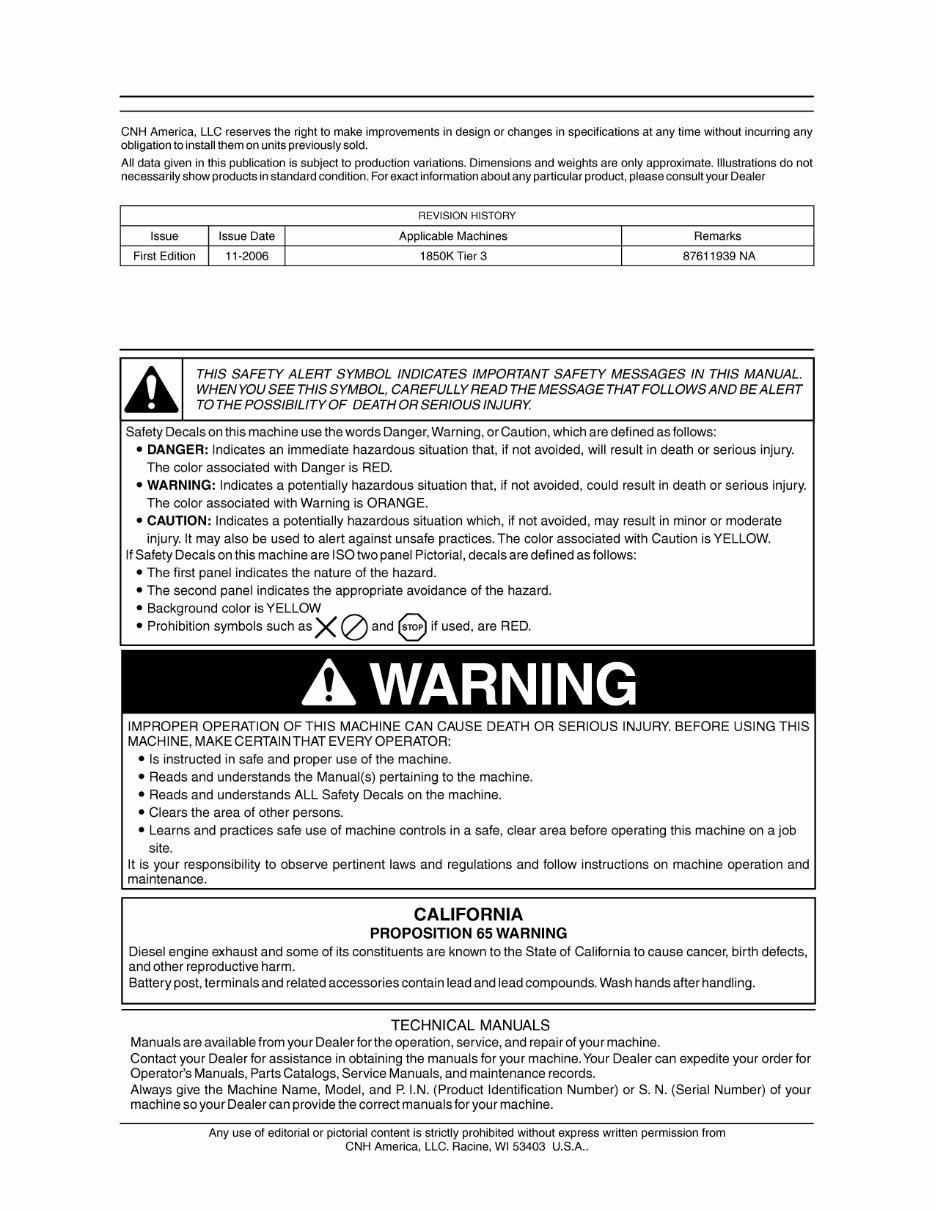
CNH America, LLC reserves the right to make improvements in design or changes in specifications at any time without incurring any obligation to install them on units previously sold. All data given in this publication is subject to production variations. Dimensions and weights are only approximate. Illustrations do not necessarily show products in standard condition. For exact information about any particular product, please consult your Dealer REVISION HISTORY Issue I Issue Date I Applicable Machines I Remarks First Edition I 11-2006 I 1850KTier 3 I 87611939 NA THIS SAFETY ALERT SYMBOL INDICATES IMPORTANT SAFETY MESSAGES IN THIS MANUAL. WHEN YOU SEE THIS SYMBOL, CAREFULLY READ THE MESSAGE THAT FOLLOWS AND BE ALERT TO THE POSSIBILITY OF DEATH OR SERIOUS INJURY. Safety Decals on this machine use the words Danger, Warning, or Caution, which are defined as follows: • DANGER: Indicates an immediate hazardous situation that, if not avoided, will result in death or serious injury. The color associated with Danger is RED. • WARNING: Indicates a potentially hazardous situation that, if not avoided, could result in death or serious injury. The color associated with Warning is ORANGE. • CAUTION: Indicates a potentially hazardous situation which, if not avoided, may result in minor or moderate injury. It may also be used to alert against unsafe practices. The color associated with Caution is YELLOW. If Safety Decals on this machine are ISO two panel Pictorial, decals are defined as follows: • The first panel indicates the nature of the hazard. • The second panel indicates the appropriate avoidance of the hazard. • Background color is YELLOW • Prohibition symbols such as X 0 and 8 if used, are RED. A WARNING IMPROPER OPERATION OF THIS MACHINE CAN CAUSE DEATH OR SERIOUS INJURY. BEFORE USING THIS MACHINE, MAKE CERTAIN THAT EVERY OPERATOR: • Is instructed in safe and proper use of the machine. • Reads and understands the Manual(s) pertaining to the machine. • Reads and understands ALL Safety Decals on the machine. • Clears the area of other persons. • Learns and practices safe use of machine controls in a safe, clear area before operating this machine on a job site. It is your responsibility to observe pertinent laws and regulations and follow instructions on machine operation and maintenance. CALIFORNIA PROPOSITION 65 WARNING Diesel engine exhaust and some of its constituents are known to the State of California to cause cancer, birth defects, and other reproductive harm. Battery post, terminals and related accessories contain lead and lead compounds. Wash hands after handling. TECHNICAL MANUALS Manuals are available from your Dealerforthe operation, service, and repair of your machine. Contact your Dealer for assistance in obtaining the manuals for your machine. Your Dealer can expedite your order for Operator's Manuals, Parts Catalogs, Service Manuals, and maintenance records. Always give the Machine Name, Model, and P. I.N. (Product Identification Number) or S. N. (Serial Number) of your machine so your Dealer can provide the correct manuals for your machine. Any use of editorial or pictorial content is strictly prohibited without express written permission from CNH America, LLC. Racine, WI 53403 U.S.A ..
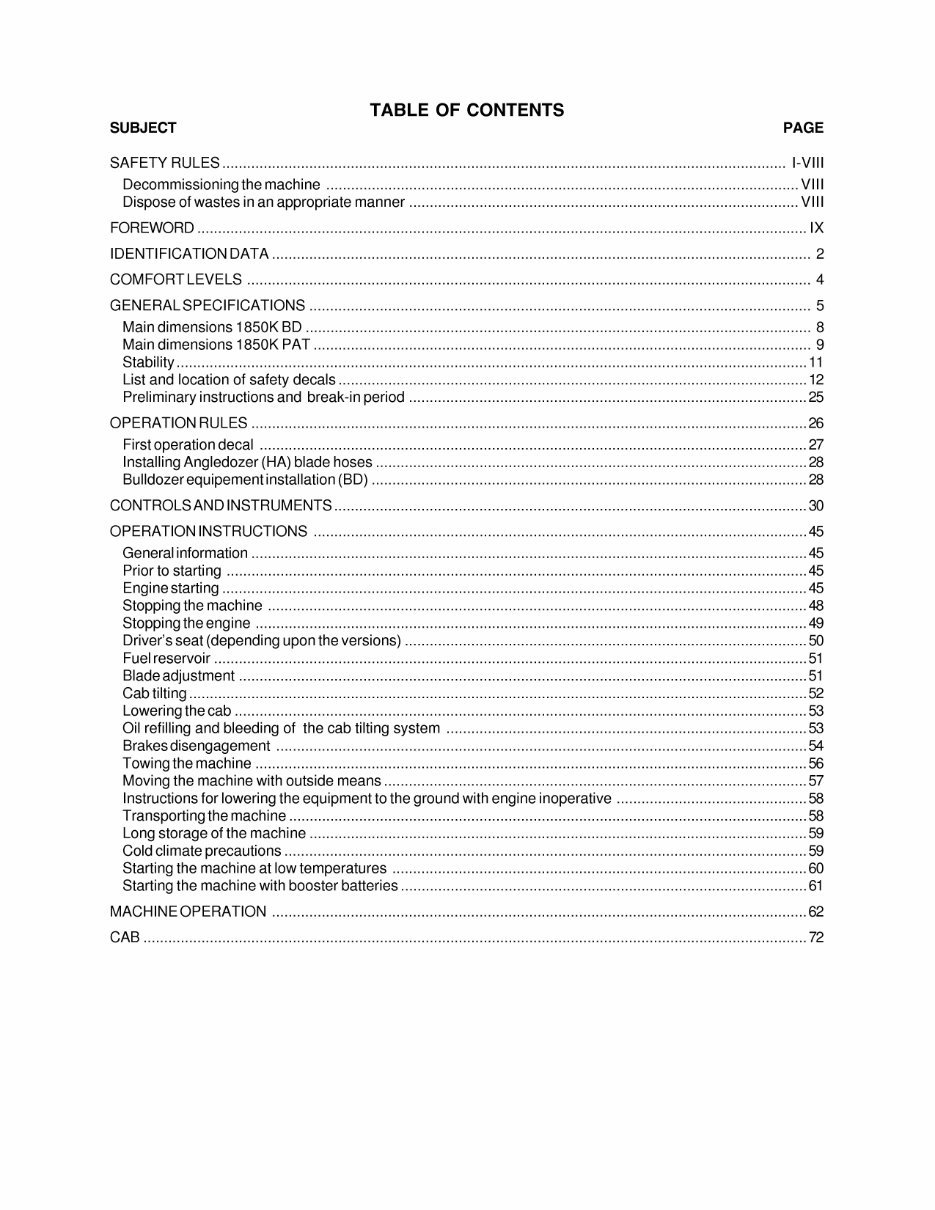
TABLE OF CONTENTS SUBJECT PAGE SAFETY RULES ........................................................................................................................................ I-VIII Decommissioning the machine .................................................................................................................. VIII Dispose of wastes in an appropriate manner .............................................................................................. VIII FOREWORD ................................................................................................................................................... IX IDENTIFICATION DATA .................................................................................................................................. 2 COMFORT LEVELS ........................................................................................................................................ 4 GENERALSPECIFICATIONS ......................................................................................................................... 5 Main dimensions 1850K BD .......................................................................................................................... 8 Main dimensions 1850K PAT ........................................................................................................................ 9 Stability ........................................................................................................................................................ 11 List and location of safety decals ................................................................................................................. 12 Preliminary instructions and break-in period ................................................................................................ 25 OPERATION RULES ...................................................................................................................................... 26 First operation decal .................................................................................................................................... 27 Installing Angledozer (HA) blade hoses ........................................................................................................ 28 Bulldozerequipementinstallation (BD) ......................................................................................................... 28 CONTROLS AND INSTRUMENTS .................................................................................................................. 30 OPERATION INSTRUCTIONS ....................................................................................................................... 45 General information ...................................................................................................................................... 45 Prior to starti ng ............................................................................................................................................ 45 Engine starting ............................................................................................................................................. 45 Stopping the machine .................................................................................................................................. 48 Stopping the engine ..................................................................................................................................... 49 Driver's seat (depending upon the versions) ................................................................................................. 50 Fuel reservoir ............................................................................................................................................... 51 Blade adjustment ......................................................................................................................................... 51 Cab tilti ng ..................................................................................................................................................... 52 Lowering the cab .......................................................................................................................................... 53 Oil refilling and bleeding of the cab tilting system ....................................................................................... 53 Brakes disengagement ................................................................................................................................ 54 Towing the machine ..................................................................................................................................... 56 Moving the machine with outside means ...................................................................................................... 57 Instructions for lowering the equipmentto the ground with engine inoperative .............................................. 58 Transporting the machine ............................................................................................................................. 58 Long storage of the machine ........................................................................................................................ 59 Cold climate precautions .............................................................................................................................. 59 Starting the machine at low temperatures .................................................................................................... 60 Starting the machine with booster batteries .................................................................................................. 61 MACHINEOPERATION ................................................................................................................................. 62 CAB ................................................................................................................................................................ 72
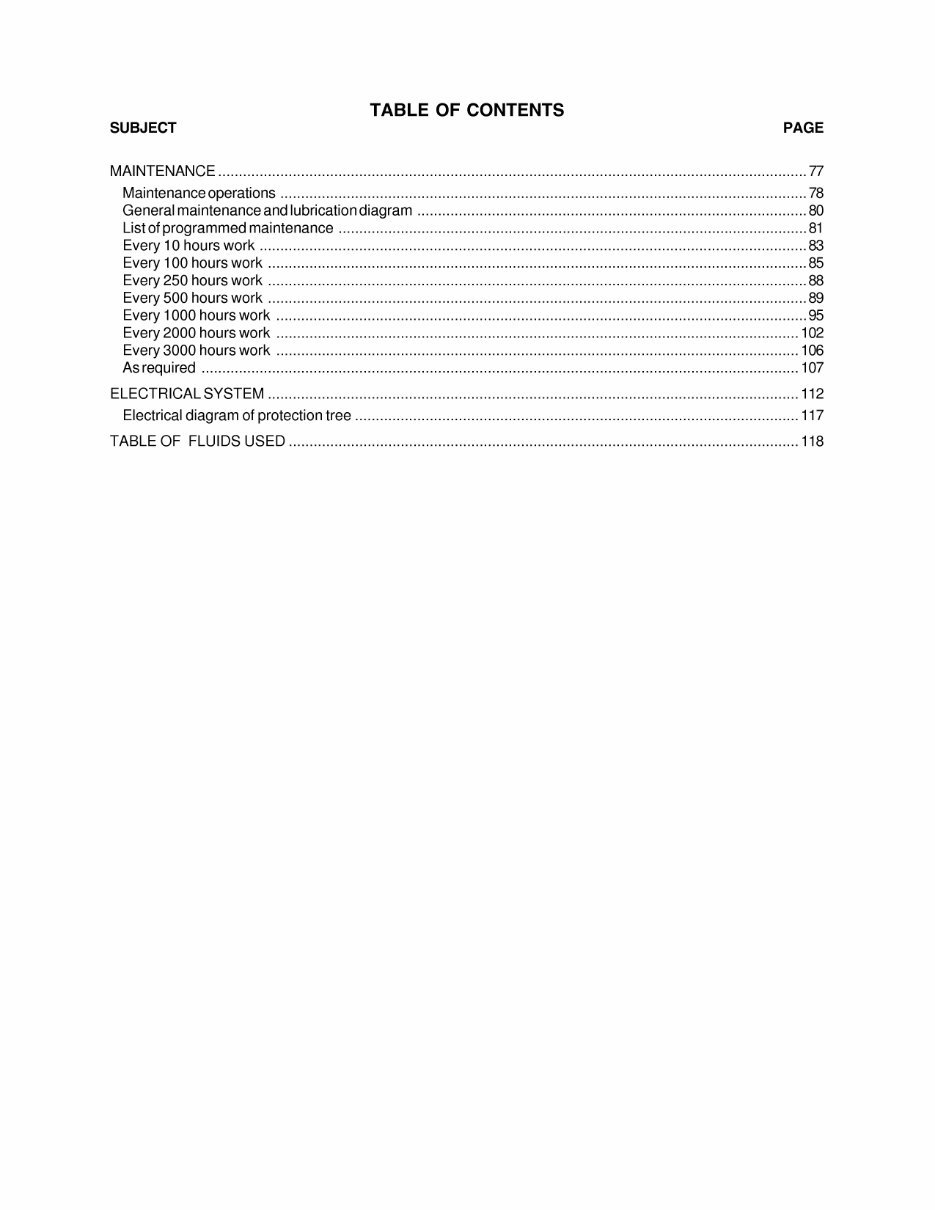
TABLE OF CONTENTS SUBJECT PAGE MAINTENANCE .............................................................................................................................................. 77 Maintenance operations ............................................................................................................................... 78 General maintenance and lubrication diagram .............................................................................................. 80 List of programmed maintenance ................................................................................................................. 81 Every 10 hours work .................................................................................................................................... 83 Every 100 hours work .................................................................................................................................. 85 Every 250 hours work .................................................................................................................................. 88 Every 500 hours work .................................................................................................................................. 89 Every 1000 hours work ................................................................................................................................ 95 Every 2000 hours work .............................................................................................................................. 102 Every 3000 hours work .............................................................................................................................. 106 As required ................................................................................................................................................ 107 ELECTRICAL SYSTEM ................................................................................................................................ 112 Electrical diagram of protection tree ........................................................................................................... 117 TABLE OF FLUIDS USED ........................................................................................................................... 118
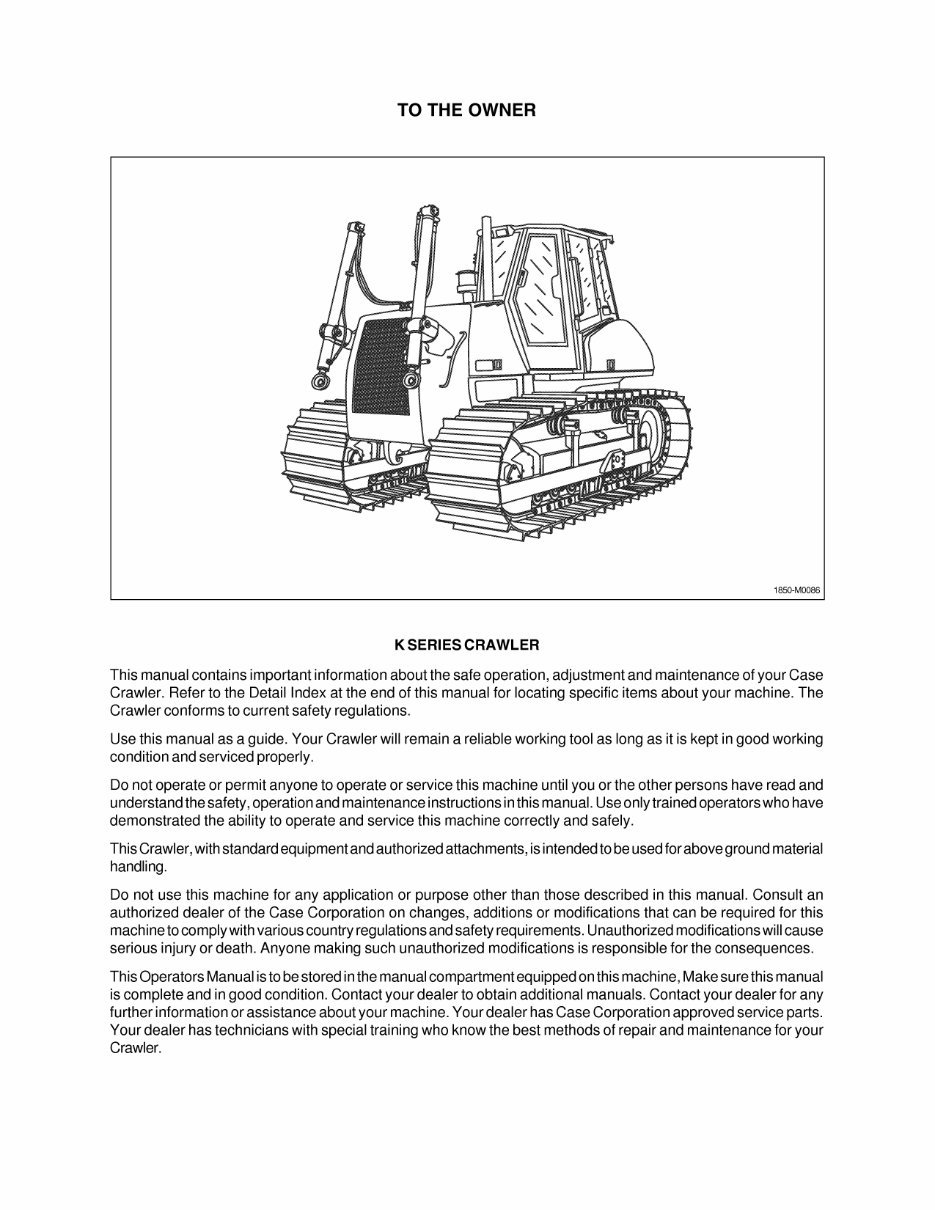
TO THE OWNER 1850-M0086 KSERIESCRAWLER This manual contains important information about the safe operation, adjustment and maintenance of your Case Crawler. Refer to the Detail Index at the end of this manual for locating specific items about your machine. The Crawler conforms to current safety regulations. Use this manual as a guide. Your Crawler will remain a reliable working tool as long as it is kept in good working condition and serviced properly. Do not operate or permit anyone to operate or service this machine until you or the other persons have read and understand the safety, operation and maintenance instructions in this manual. Use only trained operators who have demonstrated the ability to operate and service this machine correctly and safely. This Crawler, with standard equipment and authorized attachments, is intended to be used for above ground material handling. Do not use this machine for any application or purpose other than those described in this manual. Consult an authorized dealer of the Case Corporation on changes, additions or modifications that can be required for this machine to comply with various country regulations and safety requirements. Unauthorized modifications will cause serious injury or death. Anyone making such unauthorized modifications is responsible for the consequences. This Operators Manual is to be stored in the manual compartment equipped on this machine, Make sure this manual is complete and in good condition. Contact your dealer to obtain additional manuals. Contact your dealer for any further information or assistance about your machine. Your dealer has Case Corporation approved service parts. Your dealer has technicians with special training who know the best methods of repair and maintenance for your Crawler.
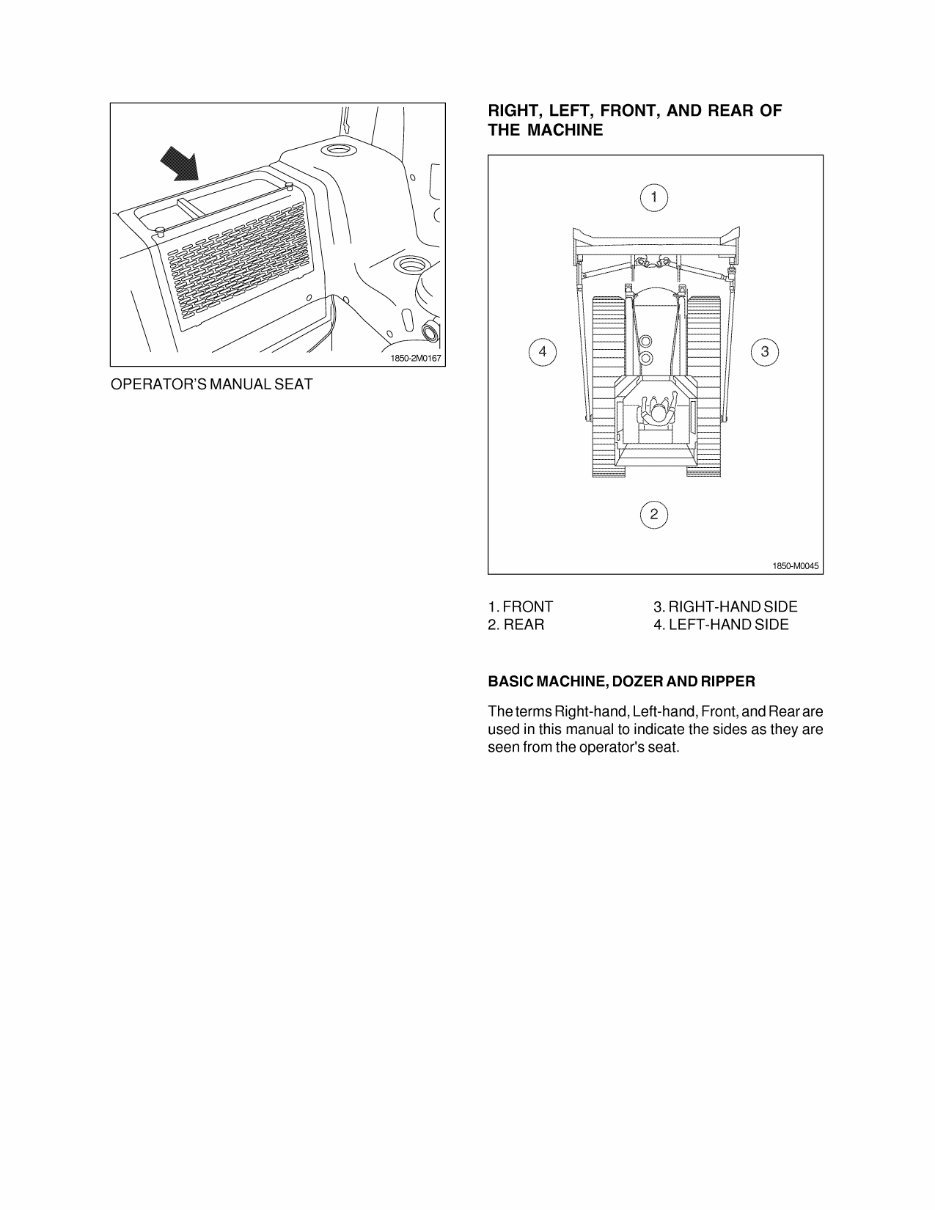
OPERATOR'S MANUAL SEAT RIGHT, LEFT, FRONT, AND REAR OF THE MACHINE CD 1850-M0045 1. FRONT 3. RIGHT-HAND SIDE 2. REAR 4. LEFT-HAND SIDE BASIC MACHINE, DOZER AND RIPPER The terms Right-hand, Left-hand, Front, and Rear are used in this manual to indicate the sides as they are seen from the operator's seat.
SAFETY RULES GENERALITIES Carefully study this manual before starting, operating, maintaining, fuelling or servicing the machine. Read and heed all safety rules before any intervention. Do not allow unauthorized personnel to operate service or maintain this machine. Do not operate the machine if not feeling well or fatiqued. Do not wear rings, wrist watches, jewelry, loose or hanging apparel, such as ties, torn clothing, scarves, unbuttoned or unzipped jackets that can catch on moving parts. Wear proper safety equipment as recommended for the job. Examples: hard hat, heavy gloves, ear protection, safety glasses or goggles, reflector vests, respirator. Consult your employer for specific safety equipment requirements. Keep operator's compartment, stepping points, grab-rails and handles clear of foreign objects, oil, grease, mud or snow accumulation to minimize the danger of slipping or stumbling. Clean mud or grease from shoes before attempting to mount or operate the machine. Do not jump on or offthe machine. Keep two hands and one foot, or two feet and one hand in contact with step, grab rails and handles at all times. Do not use controls or hoses as hand holds when climbing on or off machine. Hoses and controls are movable and do not provide a solid support. Also, controls may be inadvertently moved causing accidental machine or equipment movement. Never attempt to operate the machine or its tools from any position other than seated in the operator's seat. Keep head, body, limbs, hands and feet inside operator's compartment at all times, to reduce exposure to hazards outside the operator's compartment. Be careful of slippery conditions on stepping points, hand rails, and on the ground. Wear safety boots or shoes that have a high slip resistant sole material. Do not leave the machine until it is completely stopped. Check the seat safety belt at least twice a year. If there are signs of wear or fraying or other signs of weakness that could lead to failure, replace it. STARTING NEVER START OR OPERATE AN UNSAFE MACHINE. Before operating a machine, always ensure that any unsafe condition has been repaired. Check brakes, steering and attachment controls before moving. Advise the proper maintenance authority of any malfunctioning part or system. Be sure all protective guards or panels are in place, and all safety devices provided are in place and in good operating conditions. Be sure exposed personnel in the area of operation are clear of the machine before moving it or its attachments. WALK COMPLETELY AROUND the machine before mounting. Sound horn. Before starting machine, check, adjust and lock the operator's seat for maximum comfort and control of the machine. Fasten your seat belt. Obey all flag signals and signs. Due to the presence of flammable fluids, on the machine never check or fill fuel reservoirs or batteries near open flames, smoking materials or sparks. REMEMBER THAT STARTING FLUID IS FLAMMABLE. Follow the recommendations printed on containers and in the Operation and Maintenance Manual. DO NOT PUNCTURE OR BURN CONTAINERS. Containers must be stored in fresh, well ventilated places, out of reach of unauthorized persons. Follow the instructions provided by the manufacturer. Never use these products near open flames, smoking materials or sparks. OPERATION Do not run the engine in closed areas without proper ventilation to remove deadly exhaust gases. Roll Over Protective Structures are required on loaders, dozers, graders, excavators. NEVER OPERATE machines without ROPS. Make sure the operator's compartment is free of foreign objects, especially if not firmly secured. Never use the machine to transport objects, unless proper securing points are provided. Check monitoring instruments at start-up and frequently during operations. If the brake pressure gauge shows a pressure lower than the minimum operating pressure, stop the machine immediately. DO NOT CARRY RIDERS ON MACHINE. Study and familiarize with escape routes alternate to normal exit routes. Seat belts are required by current regulations to be provided with Roll Over Protection Structures or cabs. Keep safety belts fastened around you during operation. For your personal protection, do not climb on or off machine while machine is running. Make sure that exposed persons in the area of operation are clear of the machine before starting the engine and operating the equipment. Sound horn. Obey all indications provided by flags and signals.
SAFETY RULES NEVER COAST the machine down grades and slopes with the transmission in neutral or neutralized. Choose and shift into the most appropriate gear to keep the speed required, thus preventing any loss of control. Do not operate machinery in a condition of extreme fatigue or illness. Be especially careful towards the end of working shift. Do not operate machine with brakes out of adjustment. Operate the machine at speeds slow enough to ensure complete control at all times. Travel slowly over rough terrain, on slopes or near drop- offs, in congested areas or on ice or slippery surfaces. When backing up, always look to where the machine is to be moved. Be alert to the position of exposed personnel. DO NOT OPERATE if exposed personnel enter the immediate work area. STOP THE MACHINE. Maintain a safe distance from other machines. Provide sufficient clearance for ground and visibility conditions. Yield right-of-way to loaded machines. Maintain clear vision of areas of travel or work. Keep cab windows clean and repaired. When pulling or towing through a cable or chain, do not start suddenly at full throttle; take up slack carefully. Inspect carefully for flaws or troubles before using. Avoid kinking chains or cables. Do not pull through a kinked chain or cable to the high stresses and possibility of failure of the kinked area. Always wear heavy gloves when handling chains or cables. Be sure chains and cables are anchored and the anchor points are strong enough to handle the expected load. Keep exposed personnel clear of anchor points and cables or chains. DO NOT PULL UNLESS OPERATOR'S COMPARTMENT OF MACHINES INVOLVED ARE PROPERLY GUARDED AGAINST POTENTIAL CABLE OR CHAIN BACKLASH. Be alert to soft ground conditions close to newly constructed walls. The fill material and weight of the machine may cause the wall to collapse under the machine. In darkness, check area of operation carefully before moving in with machine. Use all lights provided. Do not move into area of restricted visibility. If engine has a tendency to stall for any reason under load or idle, report this for adjustment to proper maintenance authority immediately. Do not continue to operate machine, until condition has been corrected. On machines supplied with suction radiator fans, be sure to periodically check engine exhaust parts for leaks, as exhaust fumes are dangerous to the operator. In case of closed type cabs, always keep an opening with the outside, to ensure a constant air circulation. II Operators must thoroughly know the performances of the machine they are operating. When working on slopes or near sudden level drops of the terrain, avoid areas where ground is loose or soft since rolling-over or loss of control of machine could result. Where noise exposure exceeds 90 dBA for 8 hours, wear approved ear protection. When counterweights are provided, do not work machine if they have been removed. Overtaking maneuver must be performed only when absolutely necessary and unavoidable. Beware of possible uneven terrains, poor visibility conditions, the presence of other machinery or persons out of sight. Operate the machine at a speed adequate to the working conditions in the site and slow enough to ensure complete control at all times. Never use the machine as a work platform or scaffolding, nor other inappropriate operations (i.e. pushing railway cars, trucks or other machines). Be alert of people in the operating area of the machine. When operating a machine, know in advance what clearances will be encountered, overhead doors, cables, pipes, bearing load limitations of ground, bridges, floors or ramps. When roading, find-out what conditions are likely to be encountered, clearances, traffic congestion, type of road surfacing, etc. Beware of fog, smoke or dust elements that obscure visibility. When crossing gullies or ditches, move at an angle with reduced speed after ensuring ground conditions will permit a safe traverse. Explore the working area to identify potential risks such as: slopes, overhangs, pits, demolition rubble, fires, ravines, ditches, soft terrain, heavy traffic, crowded parking areas, closed ambients. In such conditions, proceed with extreme care. Whenever possible, avoid going over obstacles such as rough terrain, rocks, logs, highly irregular ground, steps, ditches, railroad tracks. When obstructions must be crossed, do so with extreme care at an angle, if possible. Reduce speed, shift down. Ease up to the break over point, pass the balance point slowly on the obstruction and ease down on the other side. In steep down-hill operation, do not allow engine to over- speed. Select proper gear before starting down grade. Avoid side hill travel, whenever possible. Drive up and down the slope. Should the machine slip sideways, turn it immediately downhill. The grade of slope you should attempt will be limited by factors such as condition of the ground, load being han- dled, type of machine, speed of machine and visibility. There is no substitute for good judgement when working on slopes.
SAFETY RULES Avoid operating equipment too close to an overhang or high wall, either above or below the machine. Be on the look-out for caving edges, falling objects and slides. Beware of concealment by brush and undergrowth of these dangers. When pushing over trees, the machine must be equipped with proper overhead guarding. Never allow a machine to climb up on the root structure particularly while the tree is being felled. Use extreme care when pushing over any tree with dead branches. When pushing trees with dead limbs, proceed with ex- treme care. Avoid brush piles, logs or rocks. NEVER DRIVE OVER THEM or other surface irregularities that brake traction with the ground, especially when on slopes or near drop-ofts. Be alert to avoid changes in traction conditions that could cause loss of control. DO NOT DRIVE on ice or frozen ground conditions when working the machine on steep slopes or near drop-ofts. Working in virgin and rough terrains is characterized by the presence of all the perils and risks listed above. In these conditions, the danger represented by large tree limbs (possible falling on the machine), large roots (acting as a leverage under the machine when uprooted causing roll- over of the unit, etc. is emphasized. STOPPING When the machine is stopped for whatever reason, follow the instructions of chapters "Stopping the machine" and "Stopping the engine" of the Operation and Maintenance Instruction Manual. Always remember to position the transmission drive control in neutral and engage the control lock to secure the machine. The parking brake is automatically set. NEVER LEAVE THE MACHINE UNATTENDED with the engine running. Always, before leaving the operator's seat and after making sure all people are clear of the machine, slowly lower the attachments or tools flat to the ground in a positive ground support position. Return the controls to rest position. Place the gearshift lever in neutral. Turn the start switch to off and extract the key. See the relevant chapter in this manual. Park in a non- operating and no-traffic area or as instructed. Park on firm level ground if possible. Where not possible, position machine at a right angle to the slope, making sure there is no danger of uncontrolled sliding movements. If parking in traftic lanes cannot be avoided, provide appropriate flags, barriers, flares and signals as required. Also provide advance warning signals in the traffic lane of approaching traffic. III Keep head, body, limbs, feet, fingers or hands away from bucket, blade or ripper when in raised position. Always disconnect the master switch before any intervention (i.e. cleaning, repairing, maintaining, refuelling, etc.). Do the same when parking for prolonged periods of time to avoid accidental or unauthorized starting. Never lower attachments or tools other than seated in operator's seat. Sound horn. Make sure area near the attachment is clear. Lower the attachment slowly. DO NOT USE FLOAT POSITION of hydraulic system. Place master switch in OFF, securely block the machine and lock it every time you leave it unattended. Return keys to authorized security. Heed all shut-down operations of the Operation and Maintenance Instruction Manual are followed. MAINTENANCE GENERALITIES Before operating or performing any intervention on the machine: - read carefully all the rules contained by this manual; - read and obey all safety related plates and instructions located on the machine. Do not allow unauthorized personnel to perform any maintenance operations. Do not perform maintenance operation without prior authorization. Follow all recommended maintenance and service procedures. Keep operator's compartment free of all loose objects. Do not wear rings, wrist watches, jewelry, loose or hanging apparel, such as ties, torn clothing, scarves, unbuttoned or unzipped jackets that can catch on moving parts. Wear proper safety equipment as recommended for the job. Examples: hard hat, heavy gloves, ear protection, safety glasses or goggles, reflector vests, respirator. Consult your employer for specific safety equipment requirements. Do not use controls or hoses as hand holds when climbing on or off machine. Hoses and controls are movable and do not provide a solid support. Also, controls may be inadvertently moved causing accidental machine or equipment movement. Do not jump on or oftthe machine. Keep two hands and one foot, or two feet and one hand in contact with step grab rails and handles at all times. Do not perform any service operation on the machine with a person seated in the operator's compartment, unless he is an authorized operator cooperating in the operation to be performed. Keep operator's compartment, stepping points, grab-rails and handles clear of foreign objects, oil, grease, mud or snow accumulation to minimize the danger of slipping or stumbling. Clean mud or grease from shoes before attempting to mount or operate the machine.
You're Reading a Preview
What's Included?
Lifetime Access
Fast Download Speeds
Online & Offline Access
Access PDF Contents & Bookmarks
Full Search Facility
Print one or all pages of your manual
$81.99
CASE 1850K TIER 3 Crawler DOZER BULLDOZER Service Repair Manual
The CASE 1850K TIER 3 CRAWLER DOZER BULLDOZER SERVICE REPAIR MANUAL contains comprehensive information, diagrams, real photo illustrations, and schemes to guide you through step-by-step repair, servicing, technical maintenance, and troubleshooting procedures for your machine. This manual provides all the necessary information for repairing your machine, enabling you to identify issues and understand how to conduct repairs and maintenance without the need for professional service.
One of the advantages of having this manual in digital format is the ability to utilize the Search feature in Acrobat to quickly locate specific information and print out the exact pages you require. The file format is .PDF, and it consists of 468 pages with a size of 84Mb. The manual is available in English language.
The manual covers the following sections:
GENERAL
ENGINE
TRANSMISSION
FINAL DRIVES
BRAKES AND STEERING
UNDERCARRIAGE
DOZER EQUIPMENT HYDRAULIC SYSTEM
ELECTRICAL SYSTEM
AIR CONDITIONING UNIT
Electrical and Hydraulic schematic
If you require the service manual for engine repairs, please refer to my other publications. Feel free to contact me if you have any questions or if you are searching for a specific manual. Have a great day!
Reviews
Q&A
Recently Viewed
5,521,897Happy Clients
2,594,462eManuals
1,120,453Trusted Sellers
15Years in Business
Price:
Actual Price:
CASE 1850K TIER 3 Crawler DOZER BULLDOZER Service Repair Manual




 Lifetime Access