


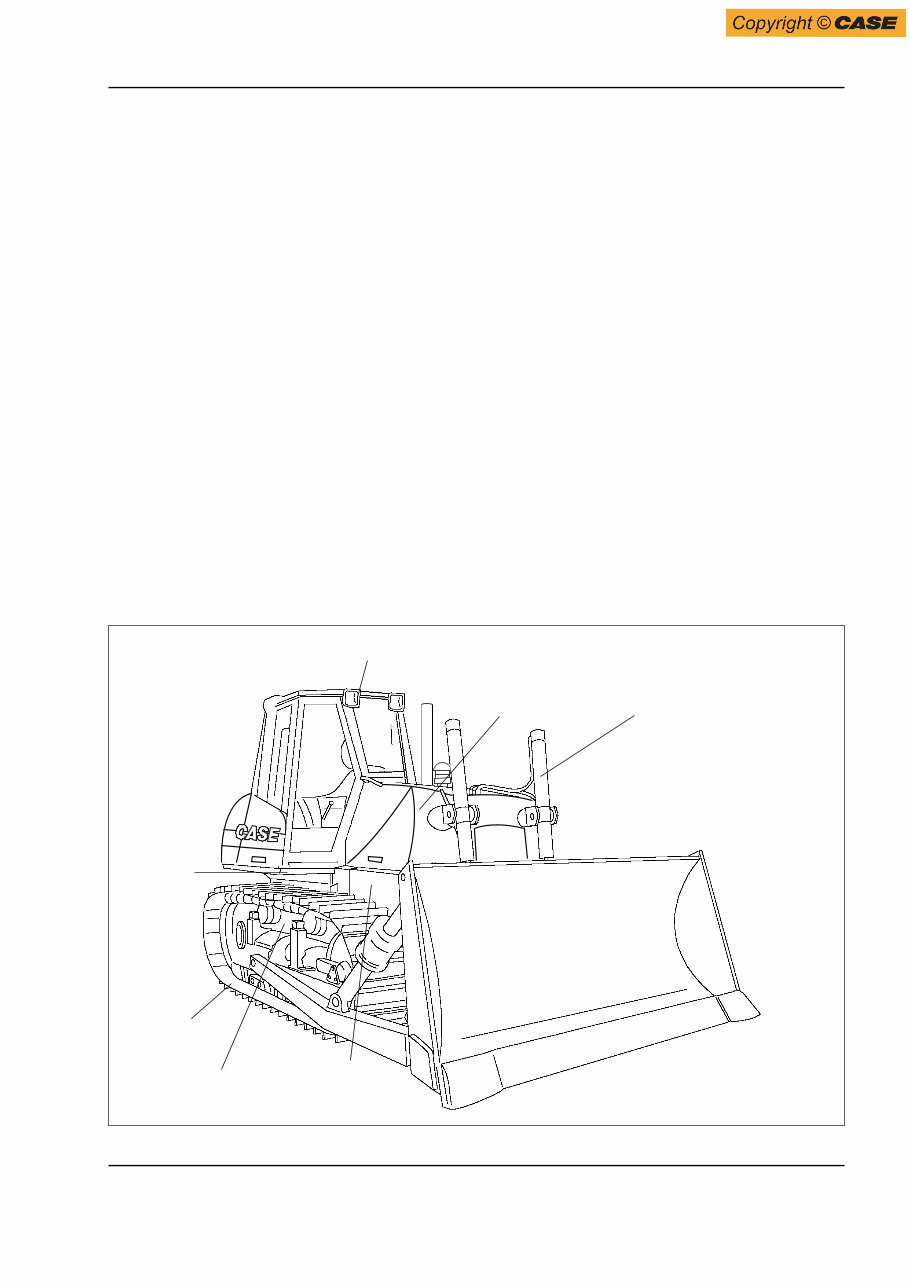
1650K
(Tier 2)
CRAWLER DOZER
Workshop
manual
Print No. 9-54970 English
THIS ALERT SYMBOL SIGNALS IMPORTANT MESSAGES INVOLVING YOUR SAFETY.
Read and heed carefully the safety instructions listed and follow the precautions recommended to avoid
potential risks and to safeguard your health and your safety.
You will find this symbol in the text of this Manual referred to the following key words:
WARNING - Cautions directed to avoid improper repair interventions involving potential consequences for the
safety of the personnel performing the repairs.
DANGER - These warnings qualify specifically potential dangers for the safety of the operator or other persons
directly or indirectly involved.
IMPORTANT NOTICE
All maintenance and repair interventions explained in this Manual must be performed exclusively by the Service
Organisation of the Manufacturer, observing strictly the instructions explained using, whenever necessary, the recom-
mended specific tools.
Whoever performs the operations reported without following exactly the precautions is responsible on his own, for the
damages that may result.
Neither the Factory nor any Organisations in its Distribution Network, including but not limited to national, regional or local
distributors, are responsible for any liability arising from any damage resulting from defects caused by parts and/or
components not approved by the Factory for use in maintaining and/or repairing products manufactured or merchandised
by the Factory.
In any case, no warranty of any kind is made or shall be imposed with respect to products manufactured or merchandised
by the Factory, when failures are caused by the use of parts and/or components not approved by the Factory.

Most accidents, whether they occur in industry, on the
farm, at home or on the road, are caused by the failure
of some individuals to follow simple and fundamental
safety rules and precautions. For this reason MOST
ACCIDENTS CAN BE PREVENTED by recognising
the real cause and doing something aboiut it before the
accident occurs.
Regardless of the care used in the design and
construction of any type of equipment, there are many
conditions that cannot be completely safeguarded
against without interfering in the reasonable
accessibility and efficient operation.
A carefull operator is the best insurance against an
accident. The complete observance of one simple rule
would prevent many serious accidents.
The rule is simple: never attempt to clean, lubricate or
maintain a machine while it is in motion.
AVOID ACCIDENTS
WARNING
Prior to engaging in any maintenance, adjustment
or repair operation on machines having
hydraulically, mechanically, and/or cable
controlled equipment (such as shovels, loaders,
dozers, excavators etc.) be certain the equipment is
lowered to the ground.
If it is necessary to have the equipment partially or
fully raised to gain access to certain items, be sure
the equipment is suitably supported by means
other than the devices used for controlling the
equipment.
SUMMARY
GENERALITIES
ENGINE
TRANSMISSION
FINAL DRIVES
BRAKES AND STEERING
UNDERCARRIAGE
DOZER EQUIPMENT
HYDRAULIC SYSTEM
ELECTRICAL SYSTEM
SECT. 0
SECT. 1
SECT. 2
SECT. 3
SECT. 4
SECT. 5
SECT. 6
SECT. 7
6 1
4
3 2
5
7
1850-2M105


SUBJECT
SAFETY RULES ...................................................................................................................................... I - VIII
IDENTIFICATION DATA ............................................................................................................................ 0-1
TABLE OF FLUIDS USED ....................................................................................................................... 0-2
POSSIBLE ARRANGEMENTS OF THE 1650K ....................................................................................... 0-3
STABILITY ............................................................................................................................................... 0-3
MAIN DIMENSIONS ................................................................................................................................ 0-4
TABLES OF TECHNICAL DATA ................................................................................................................ 0-8
CHECK DATA ON THE MACHINE ............................................................................................................ 0-19
EQUIPMENT MANOEUVRE TIMES ........................................................................................................ 0-20
LEAKAGES ............................................................................................................................................. 0-21
GENERAL INSTRUCTIONS ..................................................................................................................... 0-22
TROUBLE SHOOTING ............................................................................................................................. 0-28
UNITS OF MEASURE ............................................................................................................................. 0-29
TABLE OF TIGHTENING TORQUES ........................................................................................................ 0-31
PAGE
SECTION 0
GENERALITIES
TABLE OF CONTENTS


I
Study carefully this Manual before starting, operating, maintaining, fuelling or servicing the
machine.
Read and heed all safety rules before any intervention.
SAFETY RULES
- Do not allow unauthorised personnel to operate service
or maintain this machine.
- Do not wear rings, wrist watches, jewellery, loose or
hanging apparels, such as ties, torn clothing, scarves,
unbuttoned or unzipped jackets that can catch on mov-
ing parts. Wear proper safety equipment as recommend-
ed for the job. Examples: hard hat, heavy gloves, ear
protection, safety glasses or goggles, reflector vests,
respirator. Consult your employer for specific safety
equipment requirements.
- Keep operator's compartment, stepping points, grab-
rails and handles clear of foreign objects, oil, grease,
mud or snow accumulation to minimise the danger of
slipping or stumbling. Clean mud or grease from shoes
before attempting to mount or operate the machine.
- Do not jump on or off the machine. Keep two hands and
one foot, or two feet and one hand in contact with step
grab rails and handles at all times.
- Do not use controls or hoses as hand holds when
climbing on or off machine. Hoses and controls are
movable and do not provide a solid support. Also,
controls may be inadvertently moved causing acciden-
tal machine or equipment movement.
- Never attempt to operate the machine or its tools from
any position other than seated in the operator's seat.
- Keep head, body, limbs, hands and feet inside opera-
tor's compartment at all times, to reduce exposure to
hazards outside the operator's compartment.
- Be careful of slippery conditions on stepping points,
hand rails, and on the ground. Wear safety boots or
shoes that have a high slip resistant sole material.
- Do not leave the machine until it is completely stopped.
- Check the seat safety belt at least twice a year. If there
are signs of wear or fraying or other signs of weakness
that could lead to failure, replace it.
STARTING
- NEVER START NOR OPERATE AN UNSAFE MA-
CHINE. Before operating a machine, always ensure that
any unsafe condition has been satisfactorily remedied.
- Check brakes, steering and attachment controls before
moving. Advise the proper maintenance authority of any
malfunctioning part or system.
- Be sure all protective guards or panels are in place, and
all safety devices provided are in place and in good
operating conditions.
- Be sure exposed personnel in the area of operation are
clear of the machine before moving it or its attachments.
WALK COMPLETELY AROUND the machine before
mounting. Sound horn.
- Before starting machine, check, adjust and lock the
operator's seat for maximum comfort and control of the
machine.
- Fasten your seat belt (when provided).
- Obey all flag signals and signs.
- Due to the presence on the machine of flammable fluids,
never check or fill fuel reservoirs or batteries near open
flames, smoking materials or sparks.
- REMEMBER THAT STARTING FLUID IS FLAMMA-
BLE. Follow strictly the recommendations printed on
containers and in the Operation and Maintenance
Manual.
- DO NOT PUNCTURE OR BURN CONTAINERS.
- Containers must be stored in fresh, well ventilated plac-
es, out of reach of unauthorised persons. Follow strictly
the instructions provided by the Manufacturer.
- Never use these products near open flames, smoking
materials or sparks.
OPERATION
- Do not run the engine of this machine in closed areas
without proper ventilation to remove deadly exhaust
gases.
- Roll Over Protective Structures are required on loaders,
dozers, graders, excavators. NEVER OPERATE ma-
chines without ROPS.
- Make sure the Operator's compartment is free of foreign
objects, especially if not firmly secured. Never use the
machine to transport objects, unless proper securing
points are provided.
WARNING

SAFETY RULES
II
- Be sure chains and cables are anchored and the anchor
points are strong enough to handle the expected load.
Keep exposed personnel clear of anchor points and
cables or chains.
- DO NOT PULL UNLESS OPERATOR's COMPART-
MENT OF MACHINES INVOLVED ARE PROPERLY
GUARDED AGAINST POTENTIAL CABLE OR CHAIN
BACKLASH.
- Be alert to soft ground conditions close to newly con-
structed walls. The fill material and weight of the machine
may cause the wall collapse under the machine.
- In darkness, check area of operation carefully before
moving in with machine. Use all lights provided. Do not
move into area of restricted visibility.
- If engine has a tendency to stall for any reason under
load or idle, report this for adjustment to proper mainte-
nance authority immediately. Do not continue to operate
machine, until condition has been corrected.
- On machines supplied with suction radiator fans, be sure
to periodically check engine exhaust parts for leaks, as
exhaust fumes are dangerous to the operator.
- In case of closed type cabs, always keep an opening with
the outside, to ensure a constant air circulation.
- Operators must know thoroughly the performances of
the machine they are operating. When working on
slopes or near sudden level drops of the terrain, avoid
areas where ground is loose or soft since rolling-over or
loss of control of machine could result.
- Where noise exposure exceeds 90 dBA for 8 hours, wear
approved ear protection.
- When counterweights are provided, do not work ma-
chine if they have been removed.
- Overtaking manoeuvres must be performed only when
absolutely necessary and unavoidable. Beware of pos-
sible uneven terrains, poor visibility conditions, the pres-
ence of other machinery or persons out of sight.
- Operate the machine at a speed adequate to the working
conditions in the site and slow enough to ensure com-
plete control at all times.
- Never use the machine as a work platform or scaffolding,
nor other inappropriate operations (i.e. pushing railway
cars, trucks or other machines).
- Be alert of people in the operating area of the machine.
- When operating a machine, know in advance what
clearances will be encountered, overhead doors, ca-
bles, pipes, bearing load limitations of ground, bridges,
floors or ramps.
- Check monitoring instruments at start-up and frequently
during operations. in case the brake pressure gauge
shows a pressure lower than the minimum operating
pressure, stop immediately the machine .
- DO NOT CARRY RIDERS ON MACHINE
- Study and familiarise with escape routes alternate to
normal exit routes.
- Seat belts are required by current regulations to be
provided with Roll Over Protection Structures or cabs.
Keep safety belts fastened around you during operation.
- For your personal protection, do not climb on or off
machine while machine is in motion.
- Make sure that exposed persons in the area of operation
are clear of the machine, before starting the engine and
operating the equipment. Sound horn. Obey all indica-
tions provided by flags and signals.
- NEVER COAST the machine down grades and slopes
with the transmission in neutral or neutralised.
Choose and shift into the most appropriate gear to keep
the speed required, thus preventing any loss of control.
- Do not operate machinery in a condition of extreme
fatigue or illness. Be especially careful towards the end
of working shift.
- Do not operate machine with brakes out of adjustment.
- Operate the machine at speeds slow enough to ensure
complete control at all times.
- Travel slowly over rough terrain, on slopes or near drop-
offs, in congested areas or on ice or slippery surfaces.
- When backing, always look to where the machine is to
be moved. Be alert to the position of exposed personnel.
DO NOT OPERATE if exposed personnel enter the
immediate work area. STOP THE MACHINE.
- Maintain a safe distance from other machines. Provide
sufficient clearance for ground and visibility conditions.
Yield right-of-way to loaded machines.
- Maintain clear vision of areas of travel or work. Keep cab
windows clean and repaired.
- When machines are operating in tandem, the pusher
(rear) must be equipped with the appropriate deflectors
to protect the unit in front from the air stream coming from
the radiator.
- When pulling or towing through a cable or chain, do not
start suddenly at full throttle; take-up slack carefully.
Inspect carefully for flaws or troubles before using.
- Avoid kinking chains or cables. Do not pull through a
kinked chain or cable to the high stresses and possibility
of failure of the kinked area. Always wear heavy gloves
when handling chains or cables.

SAFETY RULES
III
- When roading, find-out what conditions are likely to be
encountered, clearances, traffic congestion, type of road
surfacing, etc. Beware of fog, smoke or dust elements
that obscure visibility.
- When crossing gullies or ditches, move at an angle with
reduced speed after ensuring ground conditions will
permit a safe traverse.
- Explore the working area to identify potential risks such
as: slopes, overhangs, pits, demolition rubble, fires,
ravines, ditches, soft terrain, heavy traffic, crowded park-
ing areas, closed ambients. In such conditions, proceed
with extreme care.
- Whenever possible, avoid going over obstacles such as
rough terrain, rocks, logs highly irregular ground, steps,
ditches, railroad tracks. When obstructions must be
crossed, do so with extreme care at an angle, if possible.
Reduce speed, shift-down. Ease up to the break over
point, pass the balance point slowly on the obstruction
and ease down on the other side.
- In steep down-hill operation, do not allow engine to over-
speed. Select proper gear before starting down grade.
- Avoid side hill travel, whenever possible. Drive up and
down the slope. Should the machine slipping sideways,
turn it immediately downhill.
- The grade of slope you should attempt will be limited by
factors such as condition of the ground, load being
handled, type of machine, speed of machine and visibil-
ity.
- There is no substitute for good judgement when working
on slopes.
- Avoid operating equipment too close to an overhang or
high wall, either above or below the machine. Be on the
look-out for caving edges, falling objects and slides.
Beware of concealment by brush and undergrowth of
these danger.
- When pushing-over trees, the machine must be
equipped with proper overhead guarding. Never allow
a machine to climb up on the root structure particularly
while the tree is being felled. Use extreme care when
pushing over any tree with dead branches.
- When pushing trees with dead limbs, proceed with
extreme care. Avoid brush piles, logs or rocks.
- NEVER DRIVE OVER THEM or other surface irregular-
ities that brake traction with the ground, especially when
on slopes or near drop-offs.
- Be alert to avoid changes in traction conditions that could
cause loss of control. DO NOT DRIVE on ice or frozen
ground conditions when working the machine on steep
slopes or near drop-offs.
- Working in virgin and rough terrains is characterised by
the presence of all the perils and risks listed above. In
these conditions, it is emphasised the danger represent-
ed by large tree limbs (possibly falling on the machine),
large roots (acting as a leverage under the machine
when up-rooted causing the roll-over of the unit) etc..
STOPPING
- When the machine is stopped for whatever reason,
follow the instructions of chapters "Stopping the ma-
chine" and "Stopping the engine" of the Operation and
Maintenance Instruction Manual.
- Always remember to position the transmission drive
control in neutral and engage the control lock to secure
the machine.
- The parking brake is automatically set, when the trans-
mission safety lever is lowered.
- NEVER LEAVE THE MACHINE UNATTENDED with the
engine running.
- Always, before leaving the operator's seat and after
making sure all people are clear of the machine, slowly
lower the attachments or tools flat to the ground in a
positive ground support position.
- Return the controls to rest position. Place the gearshift
lever in neutral. Disconnect the master switch and ex-
tract the key.
- Park in a non- operating and no-traffic area or as instruct-
ed. Park on firm level ground if possible. Where not
possible, position machine at a right angle to the slope,
making sure there is no danger of uncontrolled sliding
movements.
- If parking in traffic lanes cannot be avoided, provide
appropriate flags, barriers, flares and signals as re-
quired. Also provide advance warning signals in the
traffic lane of approaching traffic.
- Keep head, body, limbs, feet, fingers or hands away from
bucket, blade or ripper when in raised position.
- Always disconnect the master switch before any inter-
vention (i.e. cleaning, repairing, maintaining, refuelling
etc.). Do the same when parking for prolonged periods
of time to avoid accidental or unauthorised starting.
- Never lower attachments or tools other than seated in
operator's seat. Sound horn. Make sure area near the
attachment is clear. Lower the attachment slowly. DO
NOT USE FLOAT POSITION of hydraulic system.

SAFETY RULES
IV
- Place master switch in OFF, securely block the machine
and lock it every time you leave it unattended. Return
keys to authorised security. Heed all shut-down opera-
tions of the Operation and Maintenance Instruction
Manual are followed.
MAINTENANCE
GENERALITIES
- Before operating or performing any intervention on the
machine:
• read carefully all the rules contained by this Manual;
• read and obey all safety related plates and instruc-
tions located on the machine.
- Do not allow unauthorised personnel to perform any
maintenance operation. Do not perform maintenance
operation without prior authorisation. Follow all recom-
mended maintenance and service procedures.
- Keep operator's compartment free of all loose objects
that are not properly secured.
- Do not wear rings, wrist watches, jewellery, loose or
hanging apparels, such as ties, torn clothing, scarves,
unbuttoned or unzipped jackets that can catch on mov-
ing parts. Wear proper safety equipment as recommend-
ed for the job. Examples: hard hat, heavy gloves, ear
protection, safety glasses or goggles, reflector vests,
respirator. Consult your employer for specific safety
equipment requirements.
- Do not use controls or hoses as hand holds when
climbing on or off machine. Hoses and controls are
movable and do not provide a solid support. Also,
controls may be inadvertently moved causing acciden-
tal machine or equipment movement.
- Do not jump on or off the machine. Keep two hands and
one foot, or two feet and one hand in contact with step
grab rails and handles at all times.
- Do not perform any service operation on the machine
with a person seated in the operator's compartment,
unless he is an authorised operator co-operating in the
operation to be performed.
- Keep operator's compartment, stepping points, grab-
rails and handles clear of foreign objects, oil, grease,
mud or snow accumulation to minimise the danger of
slipping or stumbling. Clean mud or grease from shoes
before attempting to mount or operate the machine.
- Keep shoes free of mud or grease before climbing or
driving the machine.
- Never attempt to operate the machine or its tools from
any position other than seated in the operator's seat.
- When maintenance operations require moving hydrau-
lically operated attachments by means of machine's
hydraulic system remember that all manoeuvres must
be made only when seated in the operator's seat. Before
starting machine or moving attachment or tools, set
brakes , sound horn and call for an all clear. Raise
attachment slowly.
- Always block booms or parts of the machine which must
be raised to perform interventions under them with
external devices. Do not allow persons to move into the
vicinities nor standing under equipment not being
blocked. Unless you are totally sure about your safety,
avoid staying under raised equipment, even in case it is
blocked.
- Do not place the body, limbs or fingers into sharp articu-
lation uncontrolled openings of the machine and without
proper protections, unless they are blocked in a safe
manner.
- Never perform interventions with engine running, ex-
cept as called for in a Manual. Do not wear loose clothing
or jewellery near moving parts.
- When servicing or maintenance require access to areas
that cannot be reached from the ground, use a ladder or
step platform that meet local and national regulations, to
reach the service point. If such ladder or platform are not
available, use the machine hand holds and steps as
provided. Perform all service or maintenance carefully.
- Shop and/or field service platforms or ladders must be
constructed and maintained in accordance with local
and national regulations.
- Disconnect batteries and tag all controls according to
current regulations to warn that work is in progress. Block
machine and all attachments that must be raised accord-
ing to current regulations.
- Due to the presence of flammable fluids, never check or
fill fuel tanks, batteries, nor use starting fluid near lighted
smoking materials or open flames.
- Brakes are inoperative when manually released for
servicing. Provisions must be made to maintain control
of the machine by blocking or other means.
- The fuel filling nose must be kept constantly inside the
filling neck. Keep this contact from the beginning to the
end of the fuelling operation to avoid the possibility that
sparks due to static electricity are generated.
- Use only designated towing or attaching points. Use
care in making attachments. Make sure pins and/or locks
are secure before pulling. Stay clear of drawbars, cables
or chains under load.
You're Reading a Preview
What's Included?
 Lifetime Access
Fast Download Speeds
Online & Offline Access
Access PDF Contents & Bookmarks
Full Search Facility
Print one or all pages of your manual
$86.99
Case 1650K Service Manual
Viewed 33 Times Today

What's Included?
Lifetime Access
Fast Download Speeds
Online & Offline Access
Access PDF Contents & Bookmarks
Full Search Facility
Print one or all pages of your manual
$86.99

Secure transaction
What's Included?
Lifetime Access
Fast Download Speeds
Online & Offline Access
Access PDF Contents & Bookmarks
Full Search Facility
Print one or all pages of your manual
Description
The Case 1650K Dozers Repair Manual is an essential resource for maintaining or repairing your dozer. It contains detailed removal, installation, disassembly, and assembly instructions. The manual also includes an electrical wiring diagram and hydraulic schematic for troubleshooting. The diagnostic section helps identify and fix problems, ensuring top working condition. Additionally, it provides specifications and torque values for proper servicing. Available models include:
- 1650K Series 1 Crawler Dozer
- 1650K Series 2 Crawler Dozer
- 1650K Series 3 Crawler Dozer


