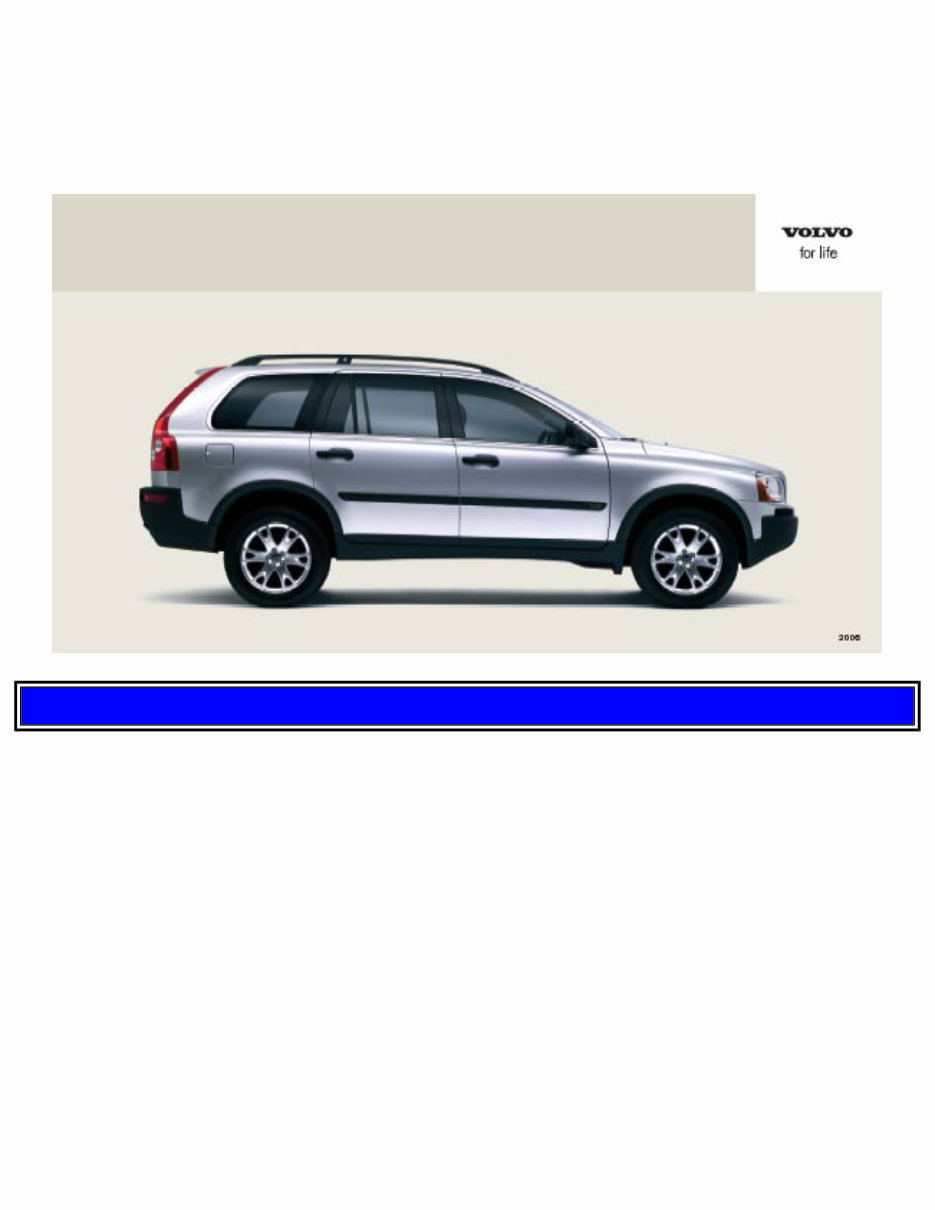
2006 VOLVO XC90 2 0 0 6 VOLVO XC90 Introduction Welcome to the world-wide family of Volvo owners. We trust that you will enjoy many years of safe driving in your Volvo, an automobile designed with your safety and comfort in mind. To help ensure your satisfaction with this vehicle, we encourage you to familiarize yourself with the equipment descriptions, operating instructions and maintenance requirements/recommendations in this manual. We also urge you and your passengers to wear seat belts at all times in this (or any other) automobile. And, of course, please do not operate a vehicle if you may be affected by alcohol, medication or any impairment that could hinder your ability to drive. Your Volvo is designed to meet all applicable safety and emission standards, as evidenced by the certification labels attached to the driver's door opening and on the left wheel housing in the engine compartment. For further information please contact your retailer, or: In the USA: Volvo Cars of North America Customer Care Center P.O. Box 914 Rockleigh, New Jersey 07647-0914 file:///K|/ownersdocs/2006/2006_XC90/06xc90_00.htm (1 of 7)12/30/2006 5:32:34 PM
2006 VOLVO XC90 Information contained in the balance of the manual is extremely useful and should be read after operating the vehicle for the first time. The manual is structured so that it can be used for reference. For this reason, it should be kept in the vehicle for ready access. Do not export your Volvo to another country before investigating that country's applicable safety and exhaust emission requirements. In some cases it may be difficult or impossible to comply with these requirements. Modifications to the emission control system(s) may render your Volvo not certifiable for legal operation in the U.S., Canada and other countries. All information, illustrations and specifications contained in this manual are based on the latest product information available at the time of publication. Please note that some vehicles may be equipped differently, depending on special legal requirements. Optional equipment described in this manual may not be available in all markets. Volvo reserves the right to make model changes at any time, or to change specifications or design without notice and without incurring obligation. WARNING! CALIFORNIA Proposition 65 Warning Engine exhaust, some of its constituents, and certain vehicle components contain or emit chemicals known to the state of California to cause cancer, and birth defects or other reproductive harm. In addition, certain fluids contained in vehicles and certain products of component wear contain or emit chemicals known to the State of California to cause cancer, and birth defects or other reproductive harm. Volvo and the environment Volvo is committed to the well being of its customers. As a natural part of this commitment, we care about the environment in which we all live. Caring for the environment means an everyday involvement in reducing our environmental impact. Volvo's environmental activities are based on a holistic view, which means we consider the overall environmental impact of a product throughout its complete life cycle. In this context, design, production, product use, and recycling are all important considerations. In production, Volvo has partly or completely phased out several chemicals including chlorofluorocarbons (CFCs), lead chromates, naphtanates, asbestos, mercury and cadmium; and reduced the amount of chemicals used in our plants 50% since 1991. Volvo was the first in the world to introduce into production a three-way catalytic converter with Lambda Sond, now called oxygen sensor, in 1976. The current version of this highly efficient system reduces emissions file:///K|/ownersdocs/2006/2006_XC90/06xc90_00.htm (3 of 7)12/30/2006 5:32:34 PM
2006 VOLVO XC90 of harmful substances (CO, HC, NOx) from the exhaust pipe by approximately 95% and the search to eliminate the remaining emissions continues. Volvo is the only automobile manufacturer to offer CFC-free retrofit kits for the air conditioning system of all models as far back as the 1975 Volvo 240. Advanced electronic engine controls, refined purification systems and cleaner fuels are bringing us closer to our goal. After Volvo vehicles and parts have fulfilled their use, recycling is the next critical step in completing the life cycle. The metal content is about 75% of the total weight of a vehicle, which makes the vehicle among the most recycled industrial products. In order to have efficient and well controlled recycling, many Volvo variants have printed dismantling manuals, indicating the weight and material of individual components. For Volvo, all homogeneous plastic parts weighing more than 1.7 oz. (50 grams) are marked with international symbols that indicate how the component is to be sorted for recycling. In addition to continuous environmental refinement of conventional gasoline-powered internal combustion engines, Volvo is actively looking at advanced technology alternative-fuel vehicles. When you drive a Volvo, you become our partner in the work to lessen the vehicle's impact on the environment. To reduce your vehicle's environmental impact, you can: ● Maintain proper air pressure in your tires. Tests have shown decreased fuel economy with improperly inflated tires. ● Follow the recommended maintenance schedule in your Warranty and Service Records Information booklet. ● Drive at a constant speed. ● See an authorized Volvo retailer as soon as possible for inspection if the check engine (malfunction indicator) lamp illuminates, or stays on after the vehicle has started. ● Properly dispose of any vehicle-related waste such as used motor oil, used batteries, brake pads, etc. ● When cleaning your vehicle, use Volvo's own vehicle care products, all of which have systematically been adapted to the environment. For additional information regarding the environmental activities in which Volvo Cars of North America, LLC and Volvo Car Corporation are involved, visit our Internet home page at: http://www.volvocars.us PremAir® On the surface of the radiator in the engine compartment, there is a special coating called PremAir®. PremAir® works as a catalytic converter, converting most of the ground-level ozone passing through the radiator into oxygen, thereby reducing harmful ground-level ozone. PremAir is a registered trademark of Engelhard Corporation. Instruments, switches and controls file:///K|/ownersdocs/2006/2006_XC90/06xc90_00.htm (4 of 7)12/30/2006 5:32:34 PM
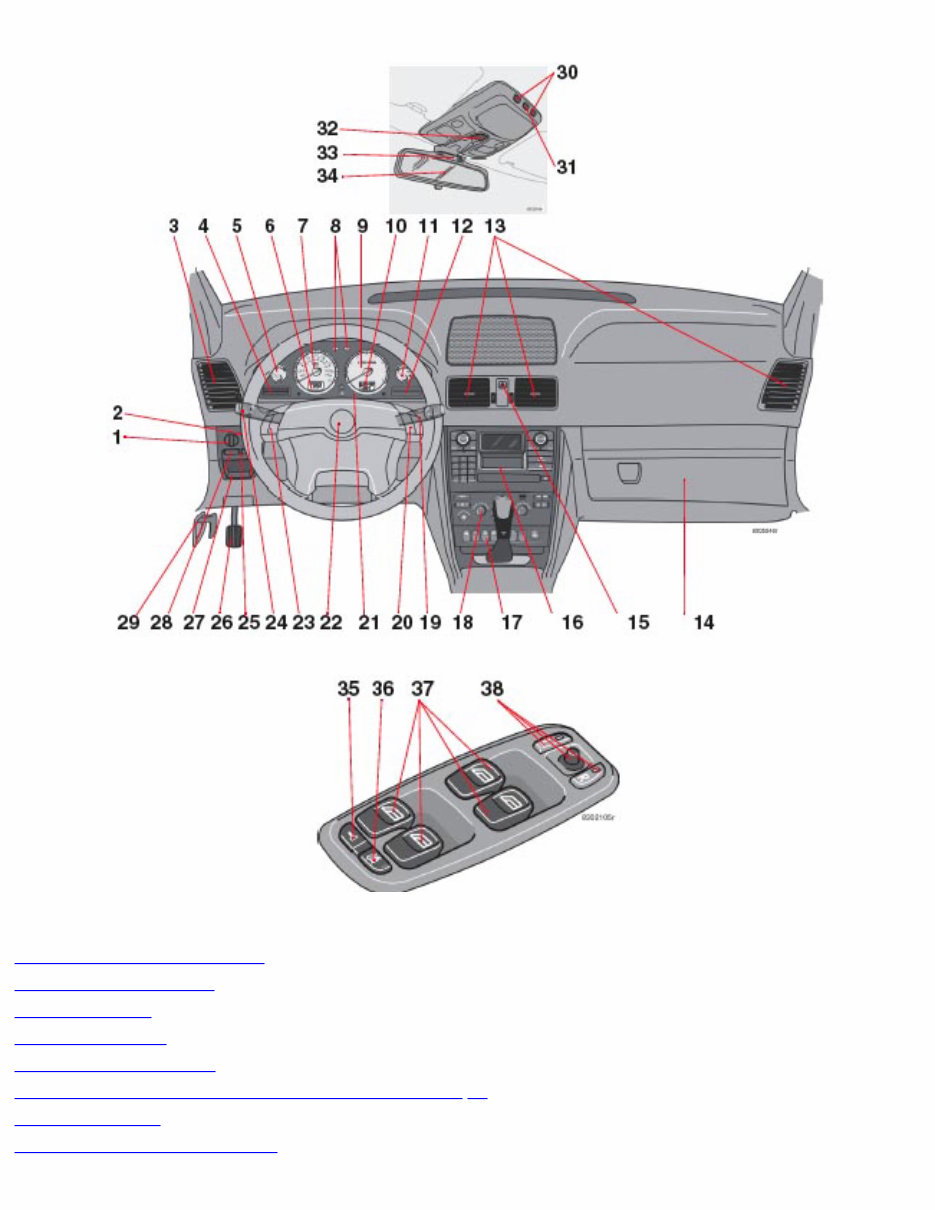
2006 VOLVO XC90 Control panel in driver's door (controls 34-37) 1. Headlights/Parking lights 29 2. Instrument lighting 29 3. Panel vents 52 4. Text window 26 5. Temperature gauge 22 6. Odometer/Trip odometer/Cruise control indicator 22, 38 7. Speedometer iv 8. Turn signal indicator lights 22 file:///K|/ownersdocs/2006/2006_XC90/06xc90_00.htm (5 of 7)12/30/2006 5:32:34 PM
2006 VOLVO XC90 9. Tachometer 22 10. Ambient temperature gauge, clock, gear indicator 22 11. Fuel gauge 22 12. Indicator and warning symbols 23 13. Panel vents 52 14. Glove compartment 69 15. Hazard warning flashers 36 16. Audio system 183 17. Switches in the center console 27 18. Climate system controls 53 19. Windshield wiper/washer lever 33 20. Audio control buttons in steering wheel 185 21. Instrument panel 22 22. Horn iv 23. Cruise control buttons in steering wheel 38 24. Turn signals, High/low beams 32 25. Front fog lights, Rear fog light 29 26. Parking brake pedal 41 27. Parking brake release handle 41 28. Button for unlocking fuel filler door 29 29. Hood open lever 41 30. Reading lights 65 31. Courtesy light 65 32. Moonroof control (option) 46 33. Seat belt reminder 25 34. Rearview mirror 44 35. Central locking button 79 36. Lockout switch for rear seat power windows 43 37. Power window controls 42 38. Sideview mirror controls 44 WARNING! If your vehicle is involved in an accident, unseen damage may affect your vehicle's driveability and safety. Contents Contents file:///K|/ownersdocs/2006/2006_XC90/06xc90_00.htm (6 of 7)12/30/2006 5:32:34 PM
2006 VOLVO XC90 Safety Instruments and controls Climate control Interior Locks and alarm Starting and driving Wheels and tires Vehicle care Maintenance Specifications Audio Index Back Cover Top of Page file:///K|/ownersdocs/2006/2006_XC90/06xc90_00.htm (7 of 7)12/30/2006 5:32:34 PM
2006 VOLVO XC90 2 0 0 6 VOLVO XC90 Safety pg. 1 Safety Occupant safety, Reporting safety defects 2 Seat belts 3 Supplemental Restraint System (SRS) 5 Front airbags 6 Occupant Weight Sensor (OWS) 9 Side impact (SIPS) airbag 12 Volvo Inflatable Curtain (VIC) 13 Inspecting SRS Ssystem components 14 Whiplash Protection System (WHIPS) 15 Child safety 17 pg. 2 Safety Occupant safety, Reporting safety defects Volvo Concern for Safety Safety is the Volvo cornerstone. Our concern dates back to 1927 when the first Volvo rolled off the production line. Three-point seat belts (a Volvo invention), safety cages, and energy-absorbing impact zones were designed into Volvo cars long before it was fashionable or required by government regulation. We will not compromise our commitment to safety. We continue to seek out new safety features and to refine those already in our cars. You can help. We would appreciate hearing your file:///K|/ownersdocs/2006/2006_XC90/06xc90_01a.htm (1 of 17)12/30/2006 5:32:36 PM
2006 VOLVO XC90 suggestions about improving automobile safety. We also want to know if you ever have a safety concern with your car. Call us in the U.S. at: 800-458-1552 or in Canada at: 800-663-8255. Occupant safety How safely you drive doesn't depend on how old you are, but rather on: ● How well you see. ● Your ability to concentrate. ● How quickly you make decisions under stress to avoid an accident. The tips listed below are suggestions to help you cope with the ever changing traffic environment. ● Never drink and drive. ● If you are taking any medication, consult your physician about its potential effects on your driving abilities. ● Take a driver-retraining course. ● Have your eyes checked regularly. ● Keep your windshield and headlights clean. ● Replace wiper blades when they start to leave streaks. ● Take into account the traffic, road, and weather conditions, particularly with regard to stopping distance. Reporting Safety Defects in the U.S. If you believe that your vehicle has a defect which could cause a crash or could cause injury or death, you should immediately inform the National Highway Traffic Safety Administration (NHTSA) in addition to notifying Volvo Cars of North America. If NHTSA receives similar complaints, it may open an investigation, and if it finds that a safety defect exists in a group of vehicles, it may order a recall and remedy campaign. However, NHTSA cannot become involved in individual problems between you, your retailer, or Volvo Cars of North America. To contact NHTSA, you may either call the Auto Safety Hotline toll-free at 1-800-424-9393 (or 202-366-0123 in Washington, D.C. area) or write to: NHTSA, U. S. Department of Transportation, Washington D.C. 20590. You can also obtain other information about motor vehicle safety from the Hotline. Volvo strongly recommends that if your vehicle is covered under a service campaign, safety or emission recall or similar action, it should be completed as soon as possible. Please check with your local retailer or Volvo Cars of North America, LLC if your vehicle is covered under these conditions. NHTSA can be reached at: Internet: http://www.nhtsa.dot.gov Telephone: 1-888-DASH-2-DOT (1-888-327-4236) (toll free) 1-800-424-9393 (toll free) file:///K|/ownersdocs/2006/2006_XC90/06xc90_01a.htm (2 of 17)12/30/2006 5:32:36 PM
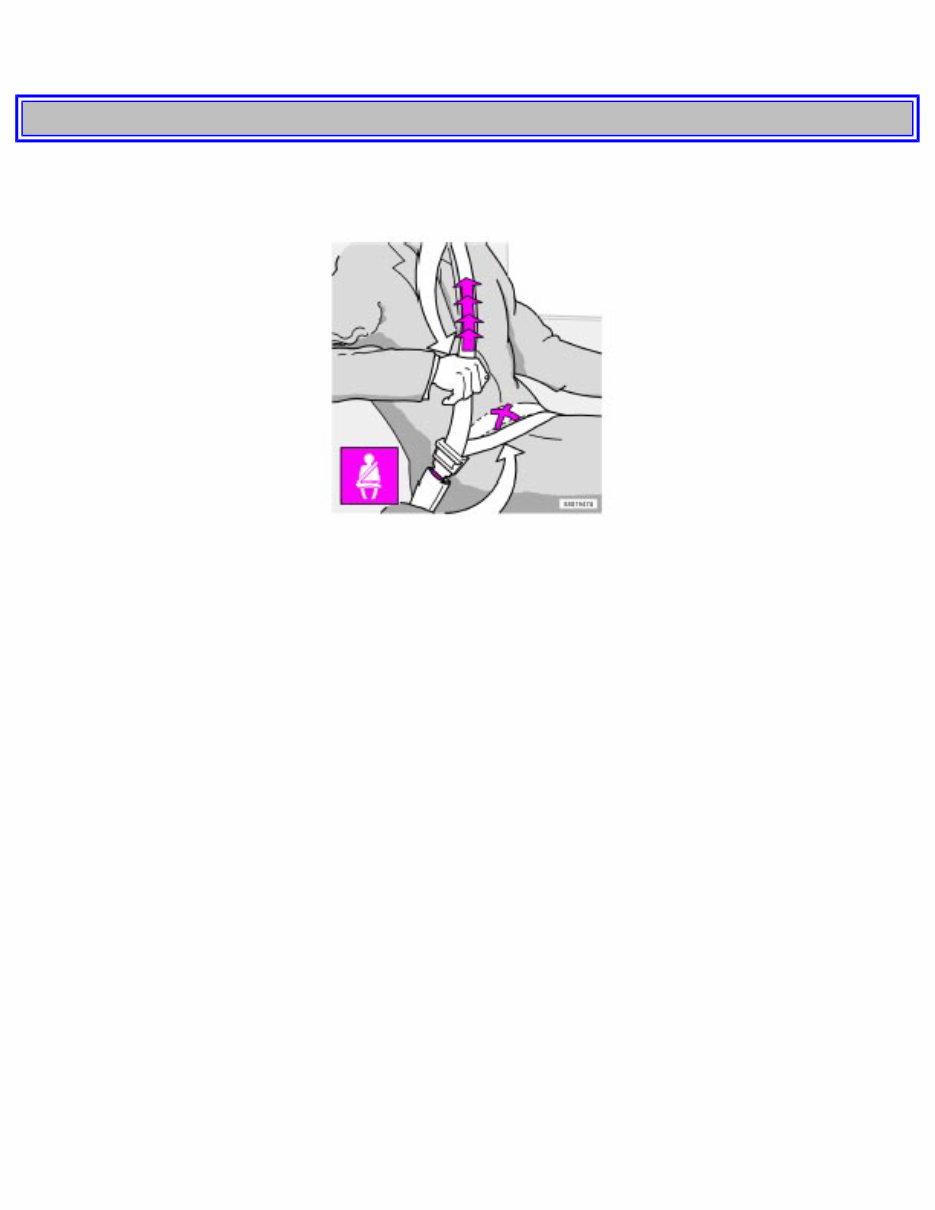
2006 VOLVO XC90 1-202-366-0123 (in Washington DC area) pg. 3 Safety Seat belts Adjusting the seat belt Using seat belts Volvo, the inventor of the three-point seat belt, urges you and all occupants of your vehicle to wear seat belts and ensure that children are properly restrained, using an infant, car, or booster seat determined by age, weight and height. Volvo also believes no child should sit in the front seat of a vehicle. Most states and provinces make it mandatory for occupants of a vehicle to use seat belts. Seat belt tensioners The seat belts are equipped with tensioners that reduce slack in the belts. These tensioners are triggered in situations where the airbags deploy. The front seat belts also include a tension reducing device which, in the event of a collision, limits the peak forces exerted by the seat belt on the occupant. Buckling a seat belt Pull the belt out far enough to insert the latch plate into the receptacle until a distinct click is heard. The seat belt retractor is normally "unlocked" and you can move freely, provided that the shoulder belt is not pulled out too far. The retractor will lock up as follows: ● if the belt is pulled out rapidly ● during braking and acceleration file:///K|/ownersdocs/2006/2006_XC90/06xc90_01a.htm (3 of 17)12/30/2006 5:32:36 PM
The 06 Volvo XC90 2006 Owners Manual is an essential guide for owners of the 2006 Volvo XC90 model. This comprehensive manual provides detailed information on the operation and maintenance of the vehicle.
The 06 Volvo XC90 2006 Owners Manual covers a wide range of topics, including:
Introduction to the vehicle and its features
Important safety information and precautions
Instrument panel and controls
Driving and operating procedures
Maintenance and troubleshooting
Technical specifications
Whether you are a new owner or have been driving your Volvo XC90 for years, this manual is a valuable resource. It provides step-by-step instructions and helpful tips to ensure the proper care and optimal performance of your vehicle.
Invest in the 06 Volvo XC90 2006 Owners Manual to gain a deeper understanding of your vehicle's features and capabilities. With its user-friendly format and comprehensive information, this manual is the perfect companion for every Volvo XC90 owner.









 Lifetime Access


