


2010 Toyota Yaris Service & Repair Manual
What's Included?
 Lifetime Access
Fast Download Speeds
Online & Offline Access
Access PDF Contents & Bookmarks
Full Search Facility
Print one or all pages of your manual
Last Modified: 8-29-2022 6.11:8.1.0 Doc ID: RM000000GE8012X
Model Year Start: 2010 Model: Yaris Prod Date Range: [08/2009 - ]
Title: INTRODUCTION: HOW TO USE THIS MANUAL: GENERAL INFORMATION; 2010 MY Yaris [08/2009 - ]
GENERAL INFORMATION
1. GENERAL DESCRIPTION
(a) This manual is written in accordance with SAE J2008.
(1) Diagnosis
(2) Removing/Installing, Replacing, Disassembling/Reassembling, Checking and Adjusting
(3) Final Inspection
(b) The following procedures are omitted from this manual. However, these procedures must be performed.
(1) Use a jack or lift to perform operations
(2) Clean all removed parts
(3) Perform a visual check
2. INDEX
(a) An alphabetical INDEX section is provided at the end of the manual as a reference to help you find the item to be repaired.
3. PREPARATION
(a) Use of Special Service Tools (SST) and Special Service Materials (SSM) may be required, depending on the repair
procedure. Be sure to use SST and SSM when they are required and follow the working procedure properly. A list of SST
and SSM is in the "Preparation" section of this manual.
4. REPAIR PROCEDURES
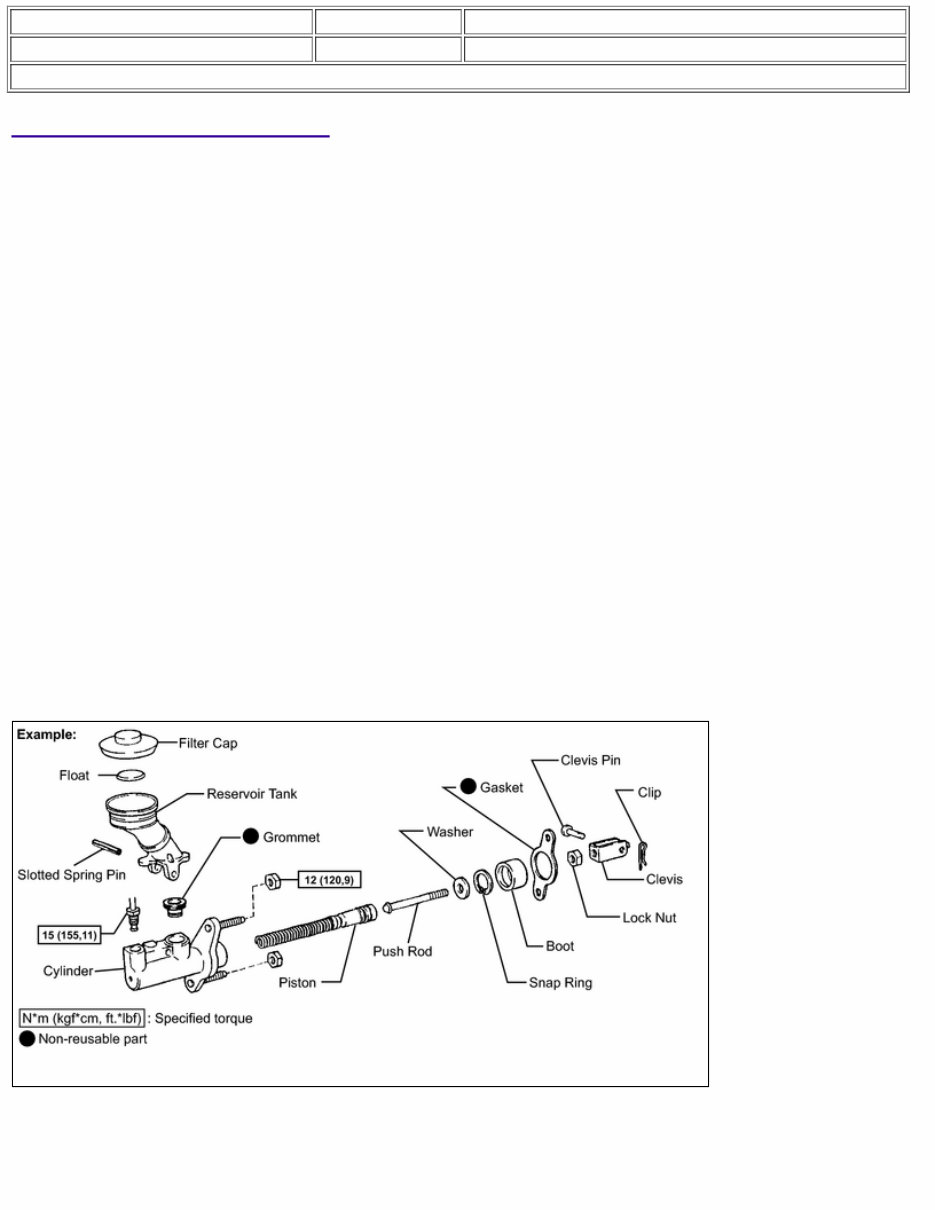
(a) A component illustration is placed under the title where necessary.
(b) Non-reusable parts, grease application areas, precoated parts and torque specifications are noted in the component
illustrations.
Following illustration is example
(c) Torque specifications, grease application areas and non-reusable parts are emphasized in the procedures.
HINT:
There are cases where such information can only be explained by using an illustration. In these cases, torque, oil and other
information are described in the illustration.

(d) Only items with key points are described in the text. What to do and other details are explained using illustrations next to
the text. Both the text and illustrations are accompanied by standard values and notices.
Illustration What to do and where to do
Task heading What work will be performed
Explanation text
How to perform the task
Also has information such as specifications and warnings, which are written in boldface text
(e) Illustrations of similar vehicle models are sometimes used. In these cases, minor details may be different from the actual
vehicle.
(f) Procedures are presented in a step-by-step format.
5. SERVICE SPECIFICATIONS
(a) SPECIFICATIONS are presented in boldface text throughout the manual. The specifications are also found in the "Service
Specifications" section for reference.
6. TERMS DEFINITION
CAUTION Possibility of injury to you or other people.
NOTICE Possibility of damage to components being repaired.
HINT Provides additional information to help you perform repairs.
7. INTERNATIONAL SYSTEM OF UNITS
(a) The units used in this manual comply with the International System of Units (SI UNIT) standard. Units from the metric
system and the English system are also provided.
Example is as follow.
Torque:
30 N·m {310 kgf·cm, 22 ft·lbf}
Last Modified: 8-29-2022 6.11:8.1.0 Doc ID: RM000000GE9014X
Model Year Start: 2010 Model: Yaris Prod Date Range: [08/2009 - ]
Title: INTRODUCTION: IDENTIFICATION INFORMATION: VEHICLE IDENTIFICATION AND SERIAL NUMBERS; 2010 MY Yaris
[08/2009 - ]
VEHICLE IDENTIFICATION AND SERIAL NUMBERS
1. VEHICLE IDENTIFICATION NUMBER
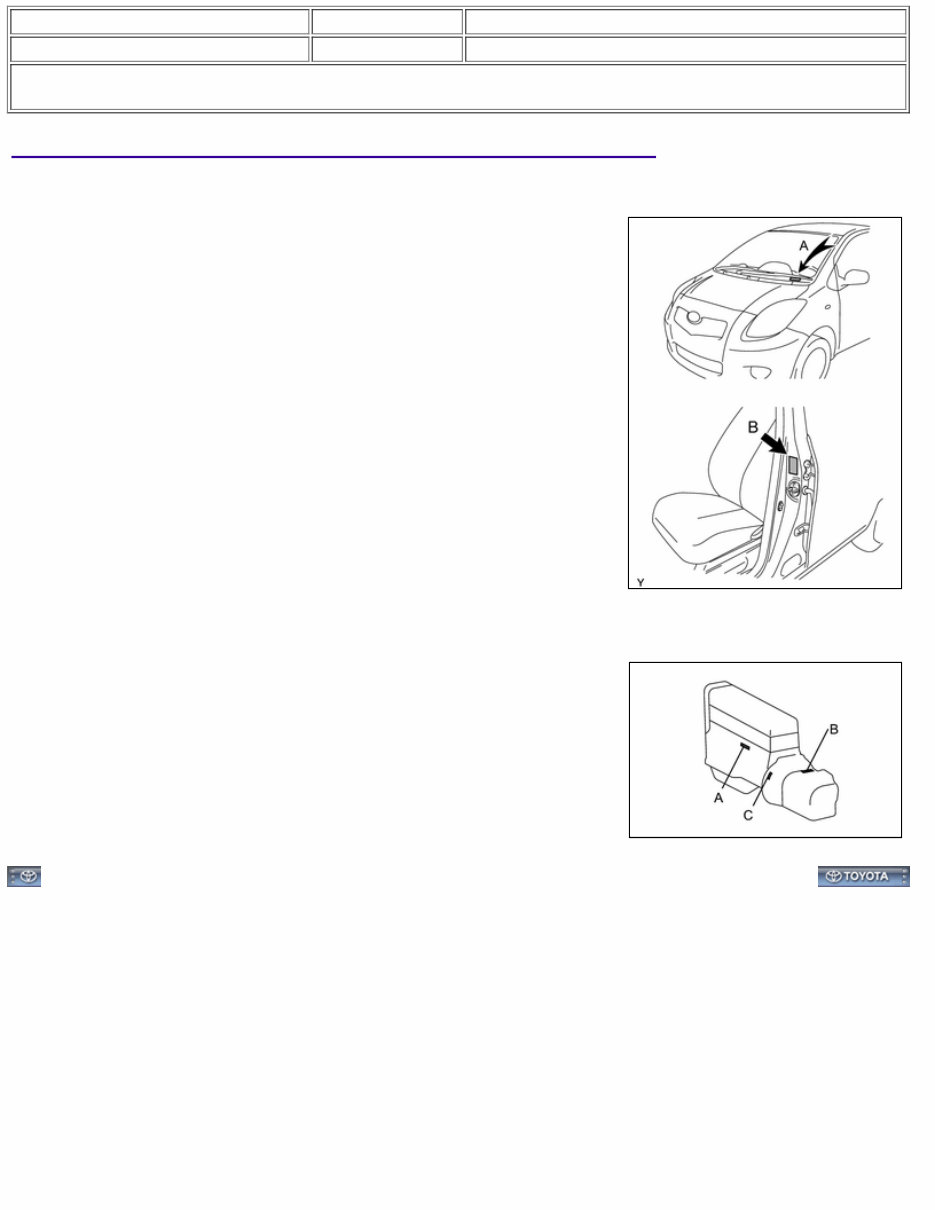
(a) The vehicle identification number is stamped on the vehicle body and on the
certification label, as shown in the illustration.
A:
Vehicle Identification Number
B:
Certification Label
2. ENGINE SERIAL NUMBER AND TRANSAXLE SERIAL NUMBER
(a) The engine serial number is stamped on the cylinder block of the engine and the
transaxle serial number is stamped on the housing as shown in the illustration.
A:
1NZ-FE
B:
U340E
C:
C50
Last Modified: 8-29-2022 6.11:8.1.0 Doc ID: RM000000UYX08HX
Model Year Start: 2010 Model: Yaris Prod Date Range: [08/2009 - ]
Title: INTRODUCTION: REPAIR INSTRUCTION: PRECAUTION; 2010 MY Yaris [08/2009 - ]
PRECAUTION
1. BASIC REPAIR HINT
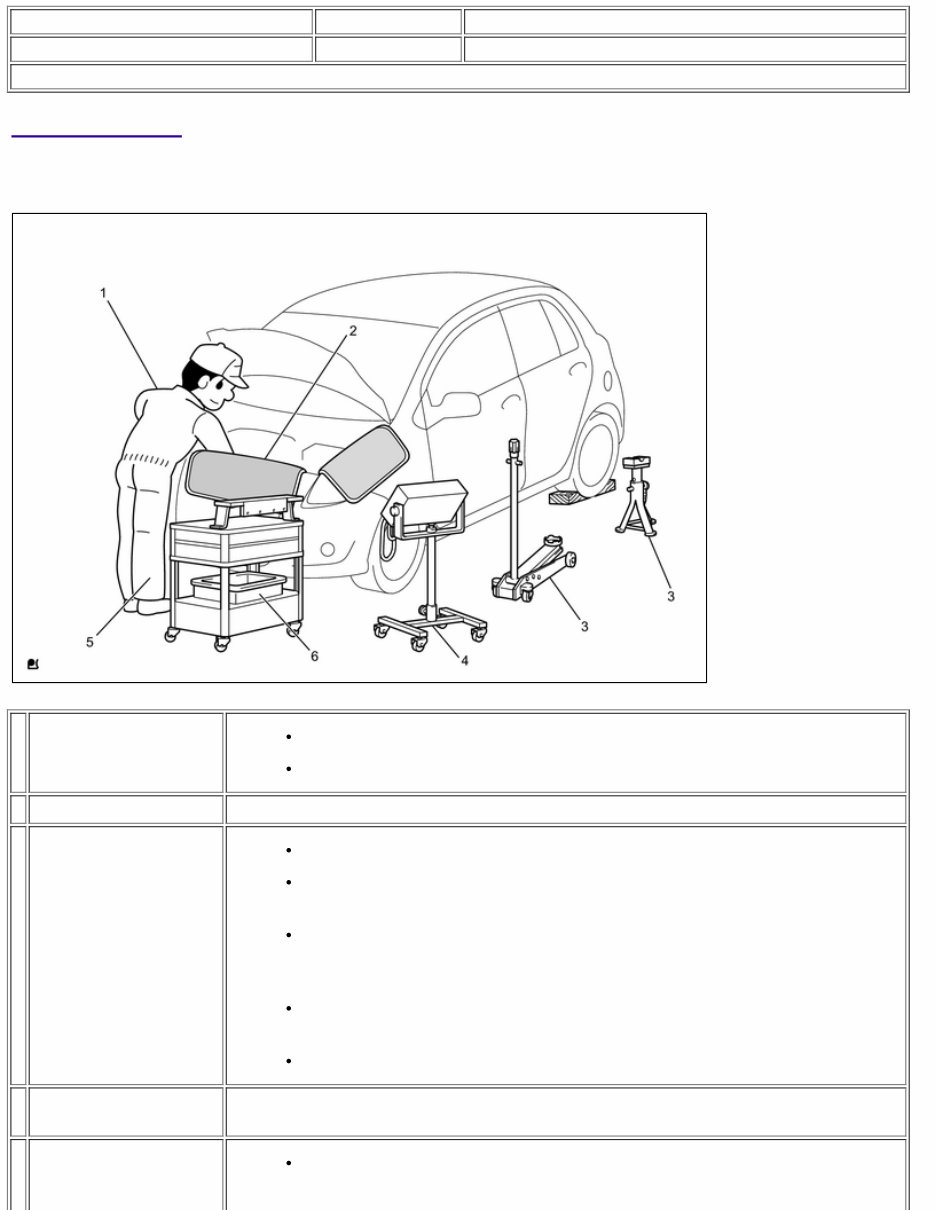
(a) HINTS ON OPERATIONS
1 Attire
Always wear a clean uniform.
Hat and safety shoes must be worn.
2 Vehicle protection Prepare a grille cover, fender cover, seat cover and floor mat before starting the operation.
3 Safe operation
When working with 2 or more persons, be sure to check safety for one another.
When working with the engine running, make sure to provide ventilation for exhaust
fumes in the workshop.
If working on high temperature, high pressure, rotating, moving, or vibrating parts,
wear appropriate safety equipment and take extra care not to injure yourself or
others.
When jacking up the vehicle, be sure to support the specified location with a safety
stand.
When lifting up the vehicle, use appropriate safety equipment.
4
Preparation of tools and
measuring gauge
Before starting operation, prepare a tool stand, SST, gauge, oil and parts for replacement.
5 Removal and installation,
disassembly and assembly
operations
Diagnose with a thorough understanding of proper procedures and of the reported
problem.
Before removing the parts, check the general condition of the assembly and for
deformation and damage.
When the assembly is complicated, take notes. For example, note the total number of
electrical connections, bolts, or hoses removed. Add matchmarks to insure
reassembly of components in the original positions. Temporarily mark hoses and their
fittings if needed.
Clean and wash the removed parts if necessary and assemble them after a thorough
check.
6 Removed parts
Place the removed parts in a separate box to avoid mixing them up with the new parts
or contaminating the new parts.
For non-reusable parts such as gaskets, O-rings, and self-locking nuts, replace them
with new ones as instructed in this manual.
Retain the removed parts for customer inspection, if requested.
(b) JACKING UP AND SUPPORTING VEHICLE
(1) Care must be taken when jacking up and supporting the vehicle. Be sure to lift and support the vehicle at the proper
locations.
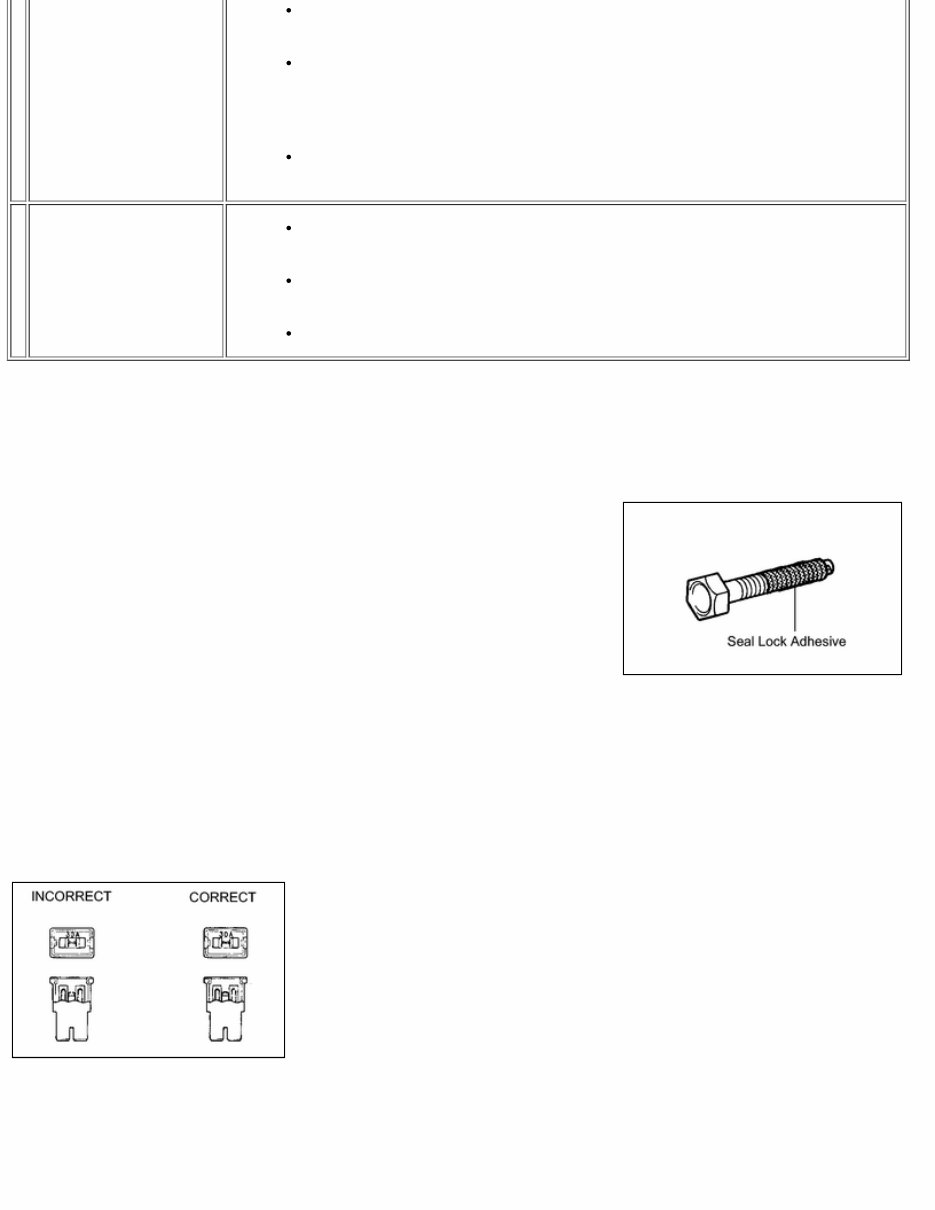
(c) PRECOATED PARTS
(1) Precoated parts are bolts and nuts that are coated with a seal lock adhesive
at the factory.
(2) If a precoated part is retightened, loosened or moved in any way, it must be
recoated with the specified adhesive.
(3) When reusing a precoated part, clean off the old adhesive and dry the part
with compressed air. Then apply new seal lock adhesive appropriate to that
part.
(4) Some seal lock agents harden slowly. You may have to wait for the seal lock
adhesive to harden.
(d) GASKETS
(1) When necessary, use a sealer on gaskets to prevent leaks.
(e) BOLTS, NUTS AND SCREWS
(1) Carefully follow all the specifications for tightening torques. Always use a torque wrench.
(f) FUSES
(1) When inspecting a fuse, check that the wire of the fuse is not broken.
(2) If the wire of a fuse is broken, confirm that there are no shorts in its circuit.
(3) When a fuse is replaced, a fuse with the same amperage rating must be used.
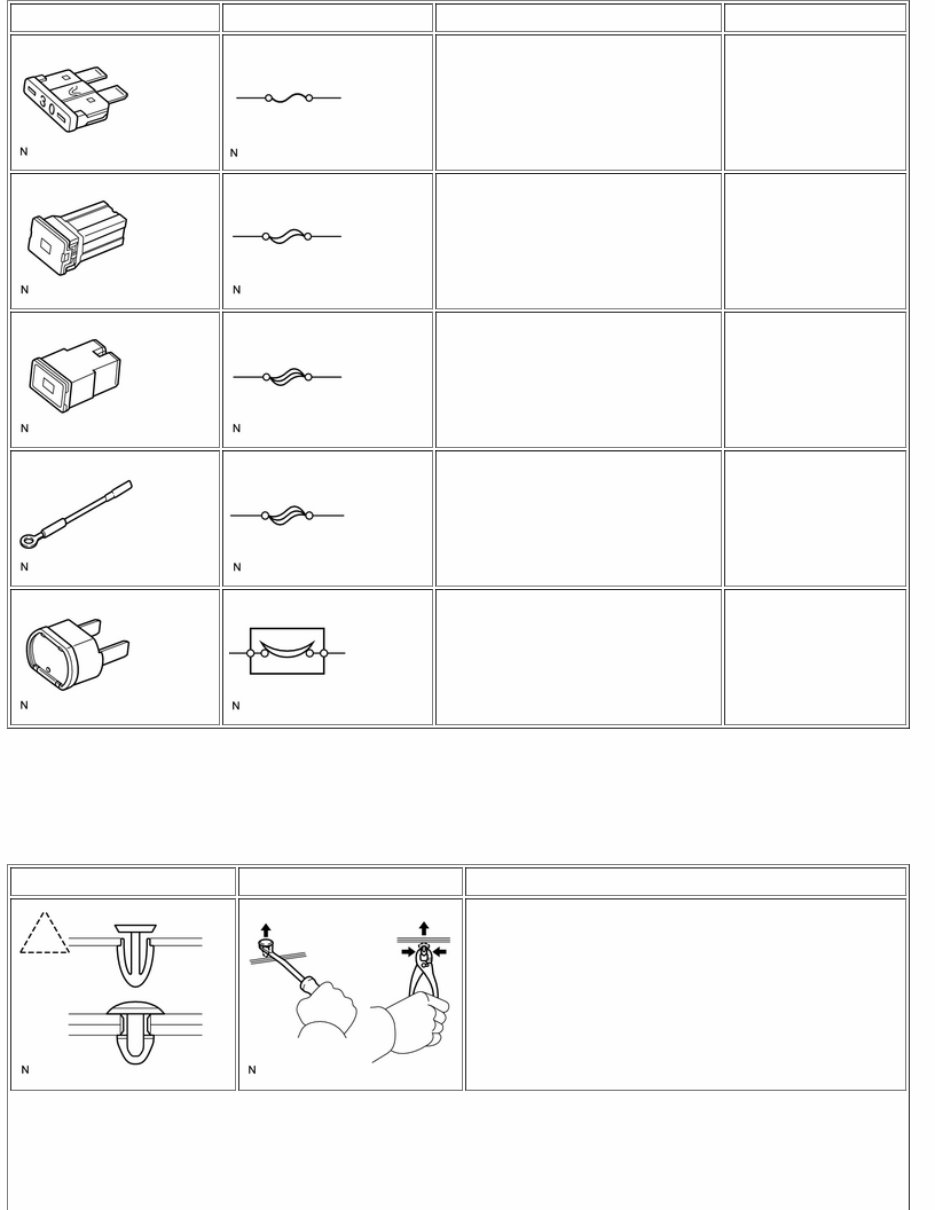
ILLUSTRATION SYMBOL PART NAME ABBREVIATION
FUSE FUSE
MEDIUM CURRENT FUSE M-FUSE
HIGH CURRENT FUSE H-FUSE
FUSIBLE LINK FL
CIRCUIT BREAKER CB
(g) CLIPS
(1) The removal and installation methods of typical clips used for vehicle body parts are shown in the table below.
HINT:
If clips are damaged during a procedure, always replace the damaged clip with a new clip.
SHAPE (EXAMPLE) ILLUSTRATION PROCEDURES
1. Remove clips with clip remover or pliers.
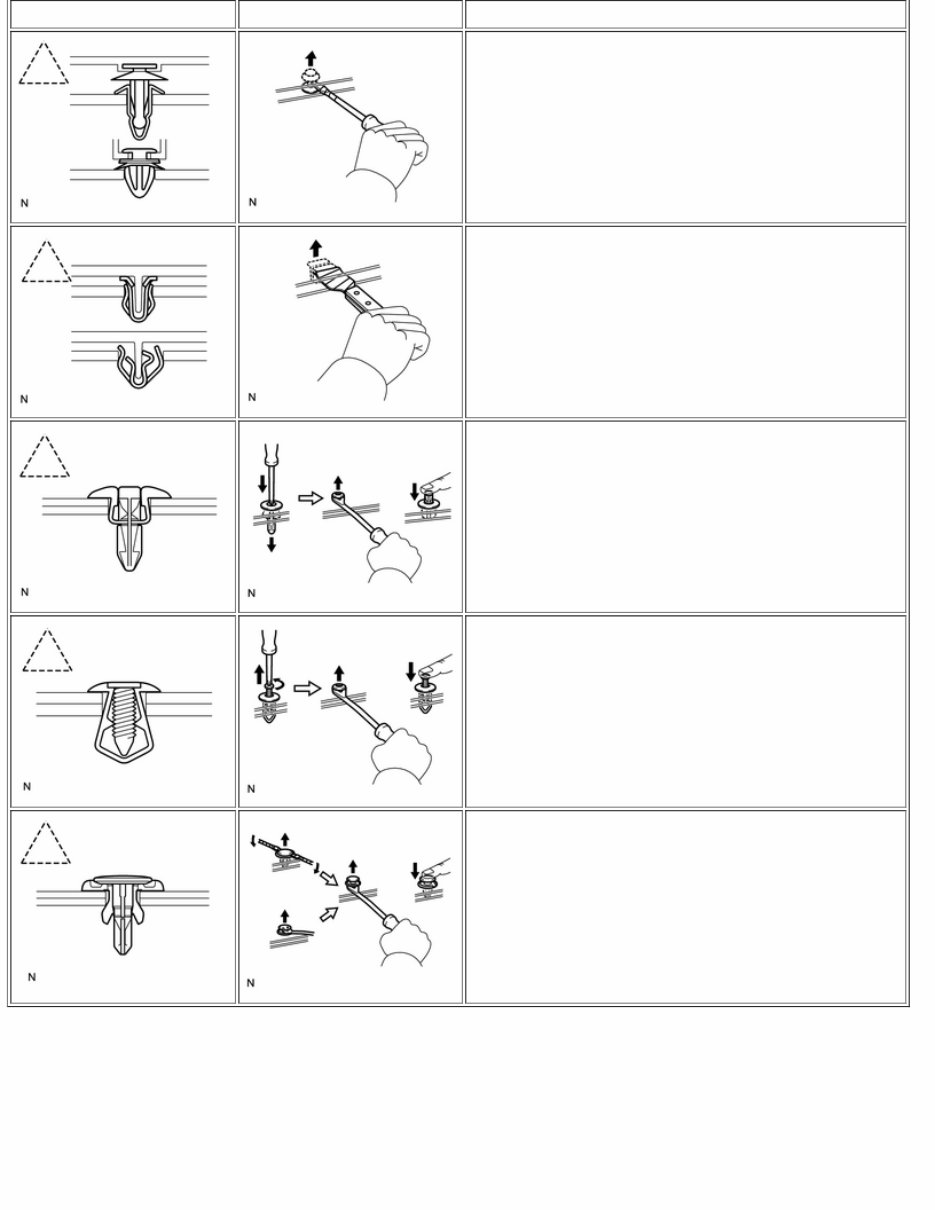
SHAPE (EXAMPLE) ILLUSTRATION PROCEDURES
1. Remove the clips with clip remover or screwdriver.
1. Remove clips with wide scraper to prevent panel
damage.
1. Remove clips by pushing center pin through and
prying out the shell.
1. Remove clips by unscrewing the center pin and
prying out the shell.
1. Remove clips by prying out the pin and then prying
out the shell.
(h) CLAWS
(1) The removal and installation methods of typical claws used for vehicle body parts are shown in the table below.
HINT:
If claws are damaged during a procedure, always replace the damaged claws with new caps or covers.
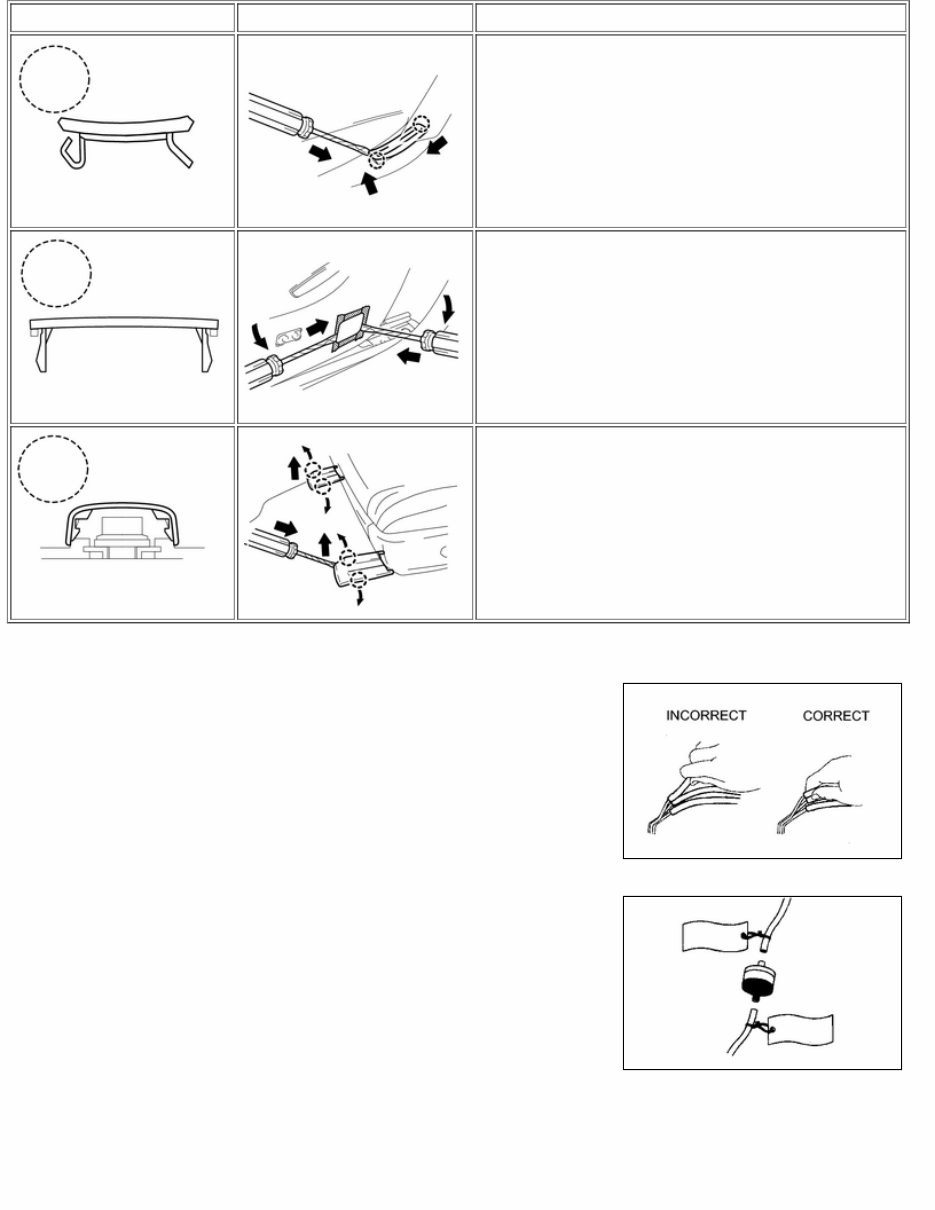
SHAPE (EXAMPLE) ILLUSTRATION PROCEDURES
1. Using a screwdriver, detach the claws and
remove the cap or covers.
1. Using a screwdriver, detach the claws and
remove the cap or covers.
1. Using a screwdriver, detach the claws and
remove the cap or covers.
(i) REMOVAL AND INSTALLATION OF VACUUM HOSES
(1) To disconnect a vacuum hose, pull and twist from the end of the hose. Do
not pull from the middle of the hose as this may cause damage.
(2) When disconnecting vacuum hoses, use tags to identify where they should
be reconnected.
(3) After completing any hose related repairs, double check that the vacuum hoses are properly connected. The label
under the hood shows the proper layout.
(4) When using a vacuum gauge, never force the hose onto a connector that is too large. If a hose has been stretched, it
may leak air. Use a step-down adapter if necessary.
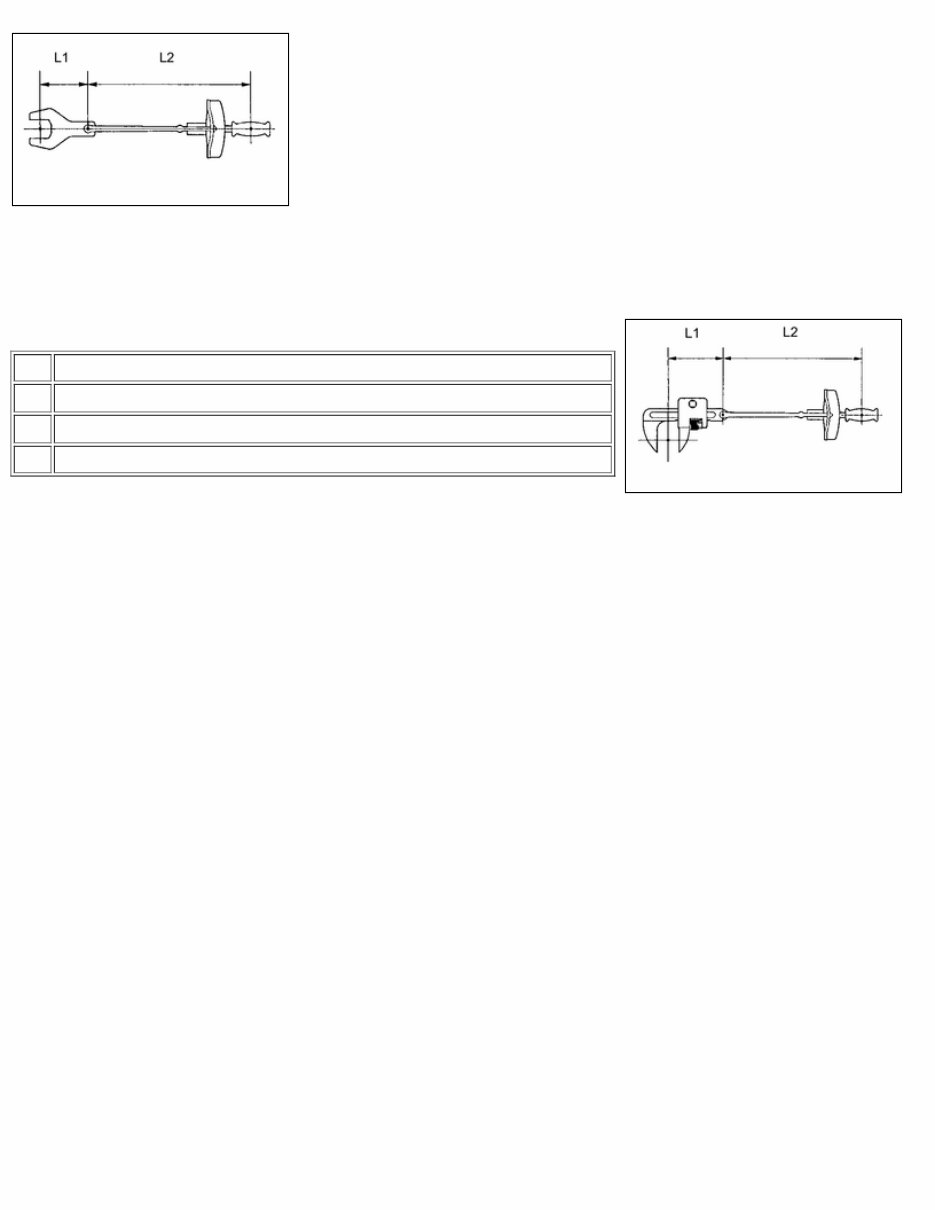
(j) TORQUE WHEN USING TORQUE WRENCH WITH EXTENSION TOOL
(1) Use the formula below to calculate special torque values for situations where
SST or an extension tool is combined with the torque wrench.
Formula:
T' = L2/(L1 + L2) * T
T' Reading of torque wrench {N*m (kgf*cm, ft.*lbf)}
T Torque {N*m (kgf*cm, ft.*lbf)}
L1 Length of SST or extension tool {cm (in.)}
L2 Length of torque wrench {cm (in.)}
NOTICE:
If an extension tool or SST is combined with a torque wrench and the wrench is
used to tighten to a torque specification in this manual, the actual torque will be
excessive and parts will be damaged.
2. FOR VEHICLES EQUIPPED WITH SRS AIRBAG AND SEAT BELT PRETENSIONER
The YARIS is equipped with a Supplemental Restraint System (SRS).
CAUTION:
Failure to carry out the service operations in the correct sequence could cause the SRS to unexpectedly deploy during
servicing and lead to serious injury. Furthermore, if a mistake is made when servicing SRS, it is possible that the SRS may
fail to operate properly. Before servicing (including removal or installation of parts, inspection or replacement), be sure to
read the following section carefully.
(a) GENERAL NOTICE
(1) As malfunctions of the SRS are difficult to confirm, the Diagnostic Trouble Codes (DTCs) become the most important
source of information when troubleshooting. When troubleshooting the SRS, always check the DTCs before
disconnecting the battery.
(2) Work must be started at least 90 seconds after the engine switch is turned off and after the cable is disconnected from
the negative (-) battery terminal.
The SRS is equipped with a back-up power source. If work is started within 90 seconds after turning the engine switch
off and disconnecting the cable from the negative (-) battery terminal, the SRS may deploy.
When the cable is disconnected from the negative (-) battery terminal, clock and audio system memory is erased.
Before starting work, make a note of the settings of each memory system. When work is finished, reset the clock and
audio system as before.
CAUTION:
Never use a back-up power source (battery or other) to avoid erasing system memory. The back-up power source may
inadvertently power the SRS and cause it to deploy.
(3) In minor collisions where the SRS does not deploy, the steering pad, front passenger airbag assembly, curtain shield
airbag assembly, front seat airbag assembly and front seat outer belt assembly should be inspected before further use
of the vehicle.
(4) Never use SRS parts from another vehicle. When replacing parts, use new parts.
(5) Before repairs, remove the airbag sensor assemblies if impacts are likely to be applied to the sensor during repairs.
(6) Never disassemble and attempt to repair all airbag sensor assemblies, all airbag assemblies.
1. Steering pad
2. Front passenger airbag assembly
3. Curtain shield airbag assembly
4. Front seat airbag assembly
5. Front seat outer belt assembly
(7) Replace the airbag sensor assemblies and the airbag assemblies if: 1) damage has occurred from being dropped, or 2)
cracks, dents or other defects in the case, bracket or connector are present.
(8) Do not directly expose the airbag sensor assembly or airbag assembly to hot air or flames.
(9) Use a voltmeter / ohmmeter with high impedance (minimum=10 kΩ) for troubleshooting electrical circuits.
(10) Information labels are attached to the SRS components. Follow the instructions on the labels.
(11) After work on the SRS is completed, check the SRS warning light.
(b) SPIRAL CABLE
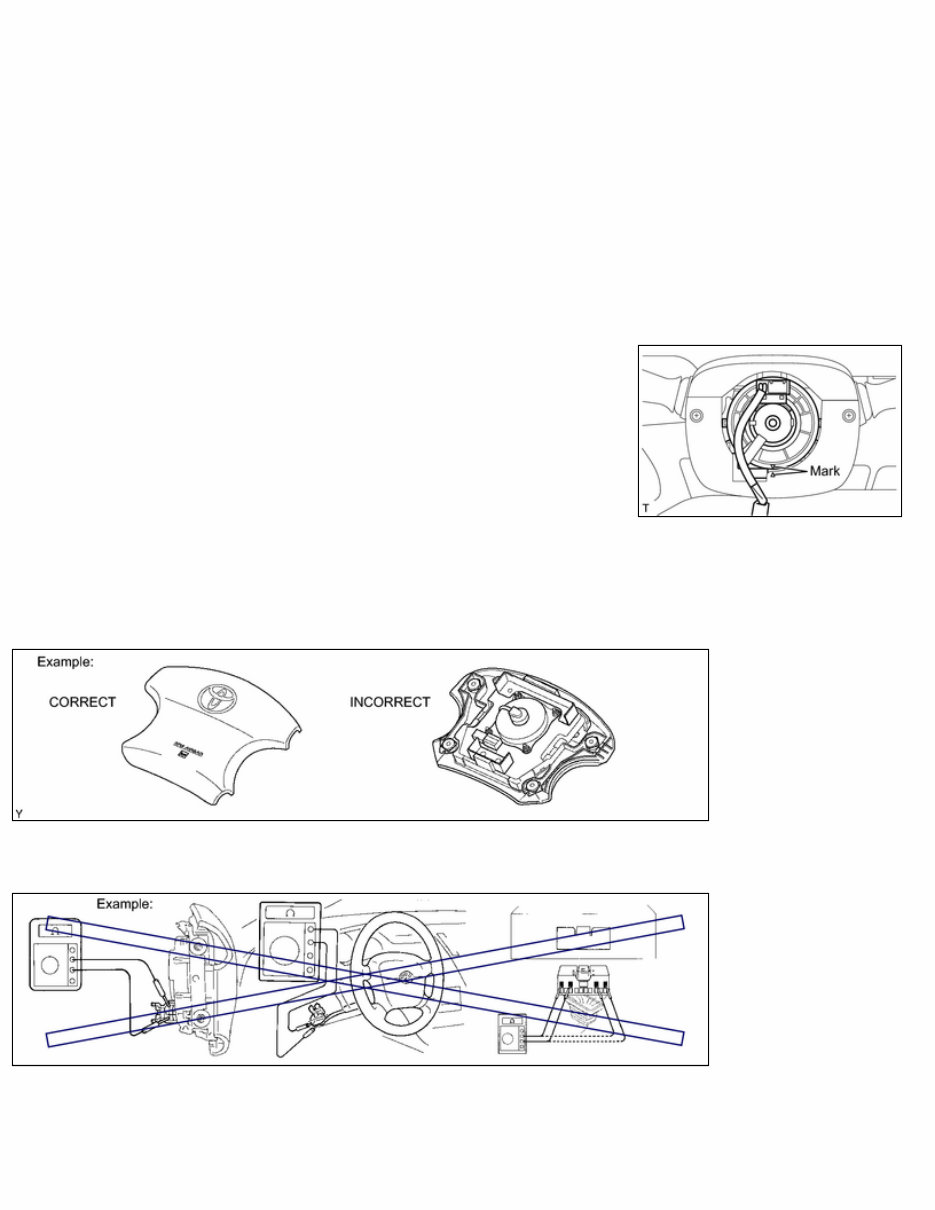
(1) The steering wheel must be fitted correctly to the steering column with the
spiral cable at the neutral position, as cable disconnection and other problems
may occur. Refer to the information about correct installation of the steering
wheel.
(c) STEERING PAD
(1) Always place a removed or new steering pad surface upward as shown in the illustration. Placing the horn button with
the pad surface facing down could cause a serious accident if the airbag inflates. Also, do not place anything on top of
the horn button.
(2) Never measure the resistance of the airbag squib. This may cause the airbag to inflate, which could cause serious
injury.
(3) Grease or detergents of any kind should not be applied to the horn button.
(4) Store the horn button assembly in an area where the ambient temperature is below 93°C (200°F), the humidity is not
high and there is no electrical noise.
(5) When using electric welding anywhere on the vehicle, disconnect the airbag ECU connectors (4 pins). These connectors
contain shorting springs. This feature reduces the possibility of the airbag deploying due to currents entering the squib
You're Reading a Preview
What's Included?
Lifetime Access
Fast Download Speeds
Online & Offline Access
Access PDF Contents & Bookmarks
Full Search Facility
Print one or all pages of your manual
$31.99
$41.99
Viewed 91 Times Today


Secure transaction
What's Included?
Lifetime Access
Fast Download Speeds
Online & Offline Access
Access PDF Contents & Bookmarks
Full Search Facility
Print one or all pages of your manual
$31.99
$41.99
The 2010 Toyota Yaris Service & Repair Manual is a comprehensive technical guide designed for both professional mechanics and DIY enthusiasts. This manual provides detailed instructions on troubleshooting, repair, and maintenance procedures to help you understand and address the inner workings of your vehicle.
- • Covers essential information on the mechanical, electrical, and safety systems of the Toyota Yaris
- • Includes diagnostic procedures, repair methods, and maintenance schedules for all major components
- • Specifies relevant diagrams, illustrations, and charts to aid in comprehension and troubleshooting
- • Catering to both novice and experienced users, this manual is designed to help you effectively address and resolve technical issues
This authoritative resource is an essential tool for anyone seeking to understand and maintain their 2010 Toyota Yaris. Whether you're a professional mechanic, a DIY enthusiast, or simply a vehicle owner looking to improve your knowledge, this service & repair manual is the perfect guide to keep your Toyota running at its best.


