

FOREWORD
This repair manual has been prepared to provide essential in-
formation on body panel repair methods (including cutting and
welding operations, but excluding painting) for the TOYOTA
AVALON.
Applicable models: GSX30 series
This manual consists of body repair methods, exploded dia-
grams and illustrations of the body components and other in-
formation relating to body panel replacement such as handling
precautions, etc. However, it should be noted that the front fend-
ers of the TOYOTA model is bolted on and require no welding.
When repairing, don’t cut and join areas that are not shown in
this manual. Only work on the specified contents to maintain
body strength.
Body construction will sometimes differ depending on specifica-
tions and country of destination. Therefore, please keep in mind
that the information contained herein is based on vehicles for
general destinations.
For the repair procedures and specifications other than collision-
damaged body components of the TOYOTA AVALON refer to
the repair manuals.
If you require the above manuals, please contact your TOYOTA
Dealer.
All information contained in this manual is the most up-to-date at
the time of publication. However, specifications and procedures
are subject to change without prior notice.
VIEWS OF THIS TEXT
Scope of the repair work explanation
D This text explains the welding panel replacement instructions from the vehicle’s white body condi-
tion. We have abbreviated the explanations of the removal and reinstallation of the equipment parts
up to the white body condition and of the installation, inspection, adjustment and final inspection of
equipment parts after replacing the weld panel.
Section categories
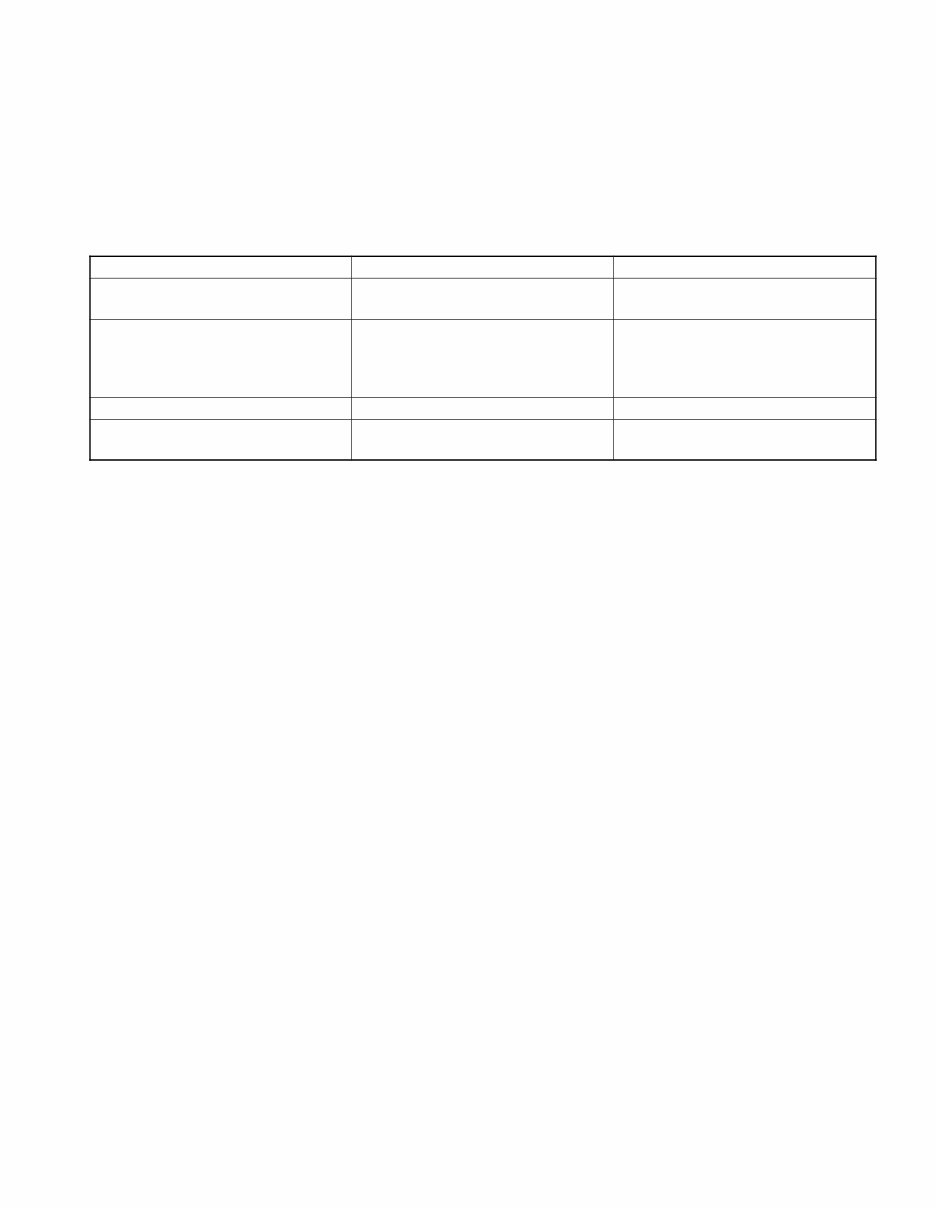
D Each section has been divided as shown below.
Section Title Contents Examples
INTRODUCTION
Explanation of general body repair.
Views of weld panel replacement instructions.
Cautionary items.
Views of weld panel replacement instructions.
BODY PANEL REPLACEMENT
Instructions for replacing the weld panels
from the white body condition, from which
bolted parts have been removed, with
individual supply parts.
Front side member replacement.
Quarter panel replacement.
BODY DIMENSIONS Body aligning measurements. Dimension diagrams.
PAINT D COATING
Scope and type of anti-rust treatment, etc.
together with weld panel replacement.
Under coat.
Body sealer.
Abbreviation of contents in this text.
D The following essential procedures have been abbreviated. When actually working, conduct this
work properly.
(1) Jack and lift operations.
(2) Clean and wash removed parts, if necessary.
(3) Visual inspection.
F10004A
F10001A
F10002A
F10003A
Glass Cover
Seat Cover
WRONG
WRONG
INTRODUCTION IN-1
GENERAL REPAIR INSTRUCTIONS
1. WORK PRECAUTIONS
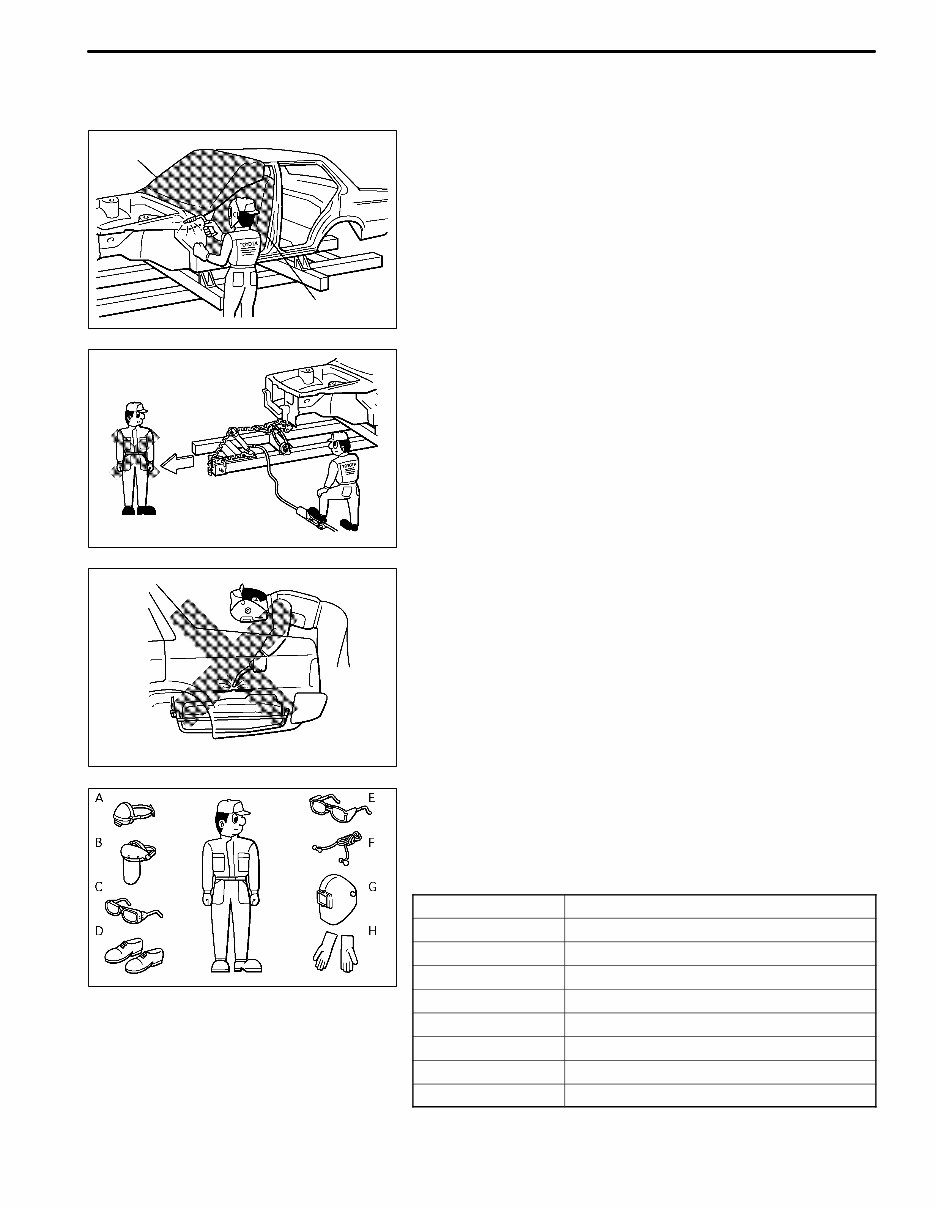
(a) VEHICLE PROTECTION
(1) When welding, protect the painted surfaces, windows,
seats and carpet with heat resistant, fire-proof covers.
(b) SAFETY
(1) Never stand in direct line with the chain when using a
puller on the body or frame, and be sure to attach a
safety cable.
(2) Before performing repair work, check for fuel leaks.
If a leak is found, be sure to close the opening totally.
(3) If it is necessary to use a flame in the area of the fuel
tank, first remove the tank and plug the fuel line.
(c) SAFETY WORK CLOTHES
(1) In addition to the usual mechanic’s wear, cap and
safety shoes, the appropriate gloves, head protector,
glasses, ear plugs, face protector, dust-prevention
mask, etc. should be worn as the situation demands.
Code Name
A Dust-Prevention Mask
B Face Protector
C Eye Protector
D Safety Shoes
E Welder’s Glasses
F Ear Plugs
G Head Protector
H Welder’s Gloves

INTRODUCTION IN-2
2. HANDLING PRECAUTIONS OF PLASTIC BODY PARTS
(1) The repair procedure for plastic body parts must conform with the type of plastic material.
(2) Plastic body parts are identified by the codes in the following table.
(3) When repairing metal body parts adjoining plastic body parts (by brazing, frame cutting, welding, paint-
ing etc.), consideration must be given to the property of the plastic.
Code
Material
name
Heat
*
resistant
temperature
limit _C (_F)
Resistance to
alcohol or gasoline
Notes
AAS
Acrylonitrile
Acrylic Styrene
80
(176)
Alcohol is harmless if applied only for
short time in small amounts (e.g., quick
wiping to remove grease).
Avoid gasoline and organic
or aromatic solvents.
ABS
Acrylonitrile
Butadiene Styrene
80
(176)
Alcohol is harmless if applied only for
short time in small amounts (e.g., quick
wiping to remove grease).
Avoid gasoline and organic
or aromatic solvents.
AES
Acrylonitrile
Ethylene Styrene
80
(176)
Alcohol is harmless if applied only for
short time in small amounts (e.g., quick
wiping to remove grease).
Avoid gasoline and organic
or aromatic solvents.
ASA
Acrylonitrile
Styrene
Acrylate
80
(176)
Alcohol is harmless if applied only for
short time in small amounts (e.g., quick
wiping to remove grease).
Avoid gasoline and organic
or aromatic solvents.
CAB
Cellulose
Acetate
80
(176)
Alcohol is harmless if applied only for
short time in small amounts (e.g., quick
wiping to remove grease).
Avoid gasoline and organic
or aromatic solvents.
EPDM
Ethylene
Propylene
100
(212)
Alcohol is harmless.
Gasoline is harmless if applied only for
short time in small amounts.
Most solvents are harmless
but avoid dipping in gasoline,
solvents, etc.
FRP
Fiber
Reinforced
Plastics
180
(356)
Alcohol and gasoline are harmless. Avoid alkali.
EVA
Ethylene
Acetate
70
(158)
Alcohol is harmless if applid only for short
time in small amounts (e.g., quick wiping
to remove grease).
Avoid gasoline and organic
or aromatic solvents.
E / VAC
Ethylene /
Vinyl
Acetate
Copolymer
Resin
70
(158)
Alcohol is harmless if applid only for short
time in small amounts (e.g., quick wiping
to remove grease).
Avoid gasoline and organic
or aromatic solvents.
PA
Polyamide
(Nylon)
80
(176)
Alcohol and gasoline are harmless. Avoid battery acid.
PBT
Polybutylene
Terephthalate
160
(320)
Alcohol and gasoline are harmless. Most solvents are harmless.
PC Polycarbonate
120
(248)
Alcohol is harmless.
Avoid gasoline brake fluid,
wax, wax removers and
organic solvents. Avoid alkali.
*Temperatures higher than those listed here may result in material deformation during repair.
INTRODUCTION IN-3
Code
Material
name
Heat
*
resistant
temperature
limit _C (_F)
Resistance to
alcohol or gasoline
Notes
PE Polyethylene
80
(176)
Alcohol and gasoline are harmless. Most solvents are harmless.
PET
Polyethylene
Terephthalate
75
(167)
Alcohol and gasoline are harmless. Avoid dipping in water.
PMMA
Polymethyl
Methacrylate
80
(176)
Alcohol is harmless if applied only for
short time in small amounts.
Avoid dipping or immersing
in alcohol, gasoline,
solvents, etc.
POM
Polyoxymethylene
(Polyacetal)
100
(212)
Alcohol and gasoline are harmless. Most solvents are harmless.
PP Polypropylene
80
(176)
Alcohol and gasoline are harmless. Most solvents are harmless.
PPF
Composite
Reinforced
Polypropylene
80
(176)
Alcohol and gasoline are harmless. Most solvents are harmless.
PPO
Modified
Polyphenylene
Oxide
100
(212)
Alcohol is harmless.
Gasoline is harmless if
applied only for quick wiping
to remove grease.
PS Polystyrene
60
(140)
Alcohol and gasoline are harmless if
applied only for short time in small
amounts.
Avoid dipping or immersing
in alcohol, gasoline,
solvents, etc.
PUR Polyurethane
80
(176)
Alcohol is harmless if applied only for very
short time in small amounts (e.g., quick
wiping to remove grease).
Avoid dipping or immersing
in alcohol, gasoline,
solvents, etc.
PVC
Polyvinylchloride
(Vinyl)
80
(176)
Alcohol and gasoline are harmless if
applied only for short time in small
amounts (e.g., quick wiping to remove
grease).
Avoid dipping or immersing
in alcohol, gasoline,
solvents, etc.
SAN
Styrene
Acrylonitrile
80
(176)
Alcohol is harmless if applied only for
short time in small amounts (e.g., quick
wiping to remove grease).
Avoid dipping or immersing
in alcohol, gasoline, solvents
etc.
TPO
Thermoplastic
Olefine
80
(176)
Alcohol is harmless.
Gasoline is harmless if applied only for
short time in small amounts.
Most solvents are harmless
but avoid dipping in gasoline,
solvents, etc.
TPU
Thermoplastic
Polyurethane
80
(176)
Alcohol is harmless if applied only for
short time in small amounts (e.g., quick
wiping to remove grease).
Avoid dipping or immersing
in alcohol, gasoline,
solvents, etc.
TSOP
TOYOTA
Super
Olefine Polymer
80
(176)
Alcohol and gasoline are harmless. Most solvents are harmless.
UP
Unsaturated
Polyester
110
(233)
Alcohol and gasoline are harmless. Avoid alkali.
*Temperatures higher than those listed here may result in material deformation during repair.
You're Reading a Preview
What's Included?
 Lifetime Access
Fast Download Speeds
Offline Viewing
Access Contents & Bookmarks
Full Search Facility
Print one or all pages of your manual
$36.99
2006 Toyota Avalon Service & Repair Manual
Viewed 14 Times Today

What's Included?
Lifetime Access
Fast Download Speeds
Offline Viewing
Access Contents & Bookmarks
Full Search Facility
Print one or all pages of your manual
$36.99

Secure transaction
What's Included?
Lifetime Access
Fast Download Speeds
Offline Viewing
Access Contents & Bookmarks
Full Search Facility
Print one or all pages of your manual
Description
2006 Toyota Avalon Service & Repair Manual
Discover the comprehensive 2006 Toyota Avalon Service & Repair Manual, designed to provide detailed instructions and insights for maintaining and repairing your vehicle.
This manual is tailored for the 2006 Toyota Avalon models, offering valuable guidance for both professional mechanics and DIY enthusiasts.
- Step-by-step procedures: Find easy-to-follow instructions for various maintenance tasks and repairs, from basic oil changes to complex engine overhauls.
- Accurate and reliable information: Access detailed explanations, diagrams, and illustrations based on the manufacturer's specifications.
- Electrical system: Gain detailed information on the electrical system, including wiring diagrams, troubleshooting guides, and component locations.
- Brake and suspension systems: Learn proper inspection, repair, and replacement techniques for these critical systems.
- Engine and transmission: Understand the intricacies of these vital components and get step-by-step instructions for maintenance and repair.
- Heating and cooling systems: Troubleshoot and repair your vehicle's heating and cooling systems with confidence.
Empower yourself with the knowledge and confidence to tackle any maintenance or repair task with the 2006 Toyota Avalon Service & Repair Manual. Keep your Avalon in top condition for years to come.


