Protected by copyright. Copying for private or commercial purposes, in part or in whole, is not permitted unless authorised by ŠKODA AUTO A. S. ŠKODA AUTO A. S. does not guarantee or accept any liability with respect to the correctness of information in this document. Copyright by ŠKODA AUTO A. S. Workshop Manual Octavia III 2013 ➤ , Octavia III 2014 ➤ , Kamiq 2019 ➤ , Scala 2019 ➤ , Octavia IV 2020 ➤ , Octavia IV 2021 ➤ Fuel system - natural gas Engine ID CPW A DHF A DBY A Edition 03.2024 Service Service Department. Technical Information
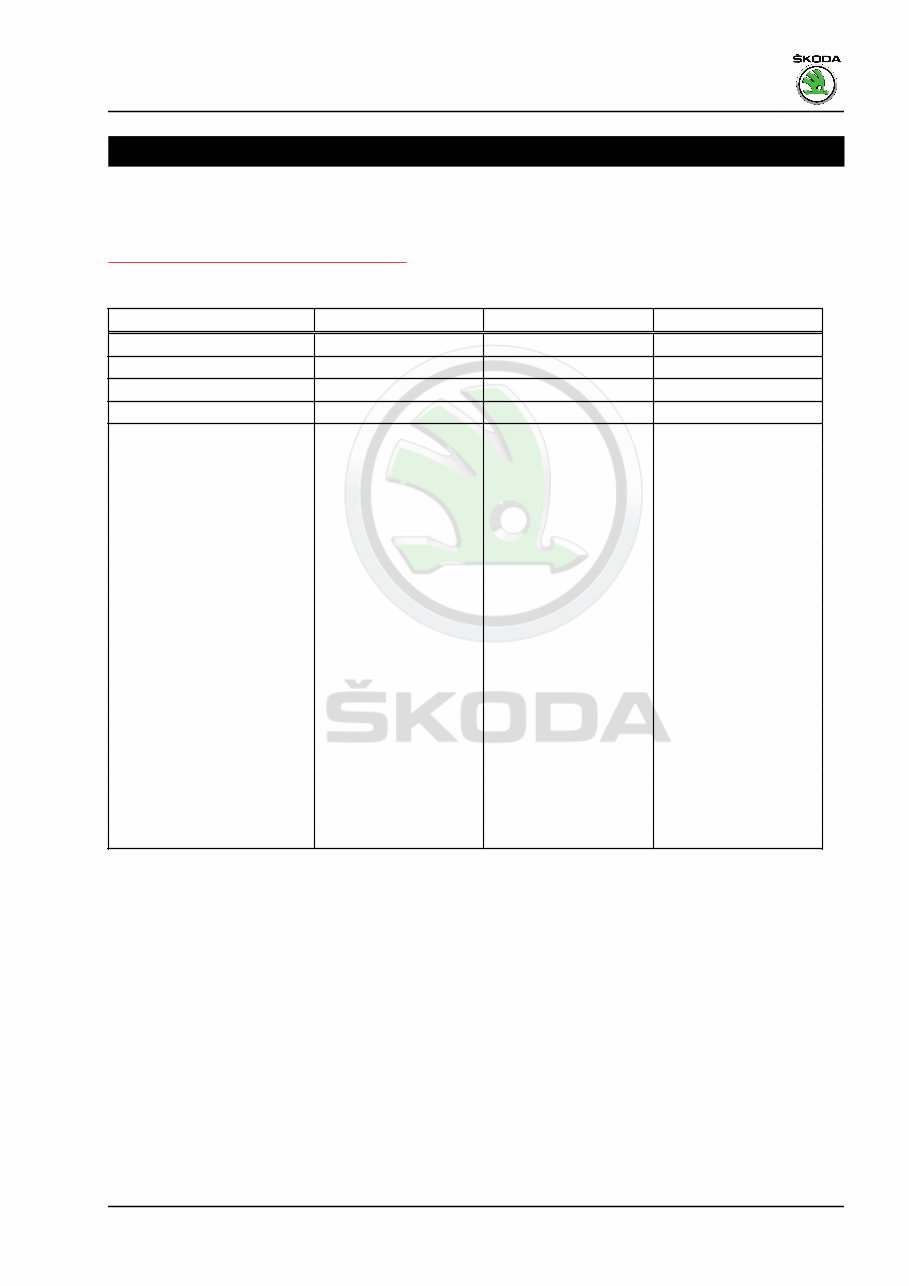
Protected by copyright. Copying for private or commercial purposes, in part or in whole, is not permitted unless authorised by ŠKODA AUTO A. S. ŠKODA AUTO A. S. does not guarantee or accept any liability with respect to the correctness of information in this document. Copyright by ŠKODA AUTO A. S. 00 – Technical data 1 Identification (SRL002161; Edition 03.2024) ⇒ “1.1 Engine number, engine data”, page 1 1.1 Engine number, engine data Engine codes CPWA DHFA DBYA Octavia III 05.2014 ► 12.2018 01.2019 ► 07.2020 Octavia IV 08.2020 ► Scala 11.2019 ► Kamiq 11.2019 ► Emission standards EU6 EU6 AG EU6 DG Displacement cm 3 1395 1498 999 Output kW at rpm 81/4800 - 6000 96- 5000 66/4000–5500 Torque Nm at rpm 200/1500 - 3500 200/1400-4000 160/1800-3800 Borehole ∅ mm 74.5 74.5 74.5 Stroke mm 80.0 85.9 76.4 Compression ratio 10.5 12.5 miller cycle 10.5 Number of cylinders/valves per cylinder 4- 4 4- 4 3- 4 Fuel - RON min. 95 unleaded and CNG up to 140 1) 95 unleaded and CNG up to 140 1) 95 unleaded and CNG up to 140 1) Ignition system/fuel injection Motronic ME 17 Bosch Motronic MG 1 Motronic MED 17 Firing order 1-3-4-2 1-3-4-2 1-2-3 Exhaust gas recirculation no no no Balancing shaft module no no no Intake manifold change-over no no no Camshaft control valve, in‐ let / exhaust yes / no yes / yes yes / yes Exhaust gas turbocharger yes yes yes 1) Engine power and max. torque depend on the quality of the natural gas. Natural gases are separated between the H-gas and L-gas quality groups. H-gas has a higher heating value with a methane content of between 87.1 - 98.0 %. L-gas has a lower heating value with a methane content of between 79.8 - 87.0 %. Octavia III 2013 ➤ , Octavia III 2014 ➤ , Kamiq 2019 ➤ , Scala 2019 ➤ , ... Fuel system - natural gas - Edition 03.2024 1. Identification 1
Protected by copyright. Copying for private or commercial purposes, in part or in whole, is not permitted unless authorised by ŠKODA AUTO A. S. ŠKODA AUTO A. S. does not guarantee or accept any liability with respect to the correctness of information in this document. Copyright by ŠKODA AUTO A. S. 2 Safety instructions ⇒ “2.1 Safety precautions when working on fuel supply system”, page 2 ⇒ “2.2 Safety precautions when working on vehicles with start/ stop system”, page 2 ⇒ “2.3 Safety precautions during road tests in which testing and measuring equipment is used”, page 2 ⇒ “2.4 Safety precautions when working on vehicles with a com‐ pressed natural gas (CNG) system”, page 3 2.1 Safety precautions when working on fuel supply system Fuel under very high pressure creates a risk of injury. – Wear protective gloves. – Wear safety goggles. Lay a clean cloth around the connection point and carefully slacken the connection point in order to relieve the pressure in the fuel system. Leaking fuel creates a fire hazard. Fuel pump is activated by switching on ignition and via driver door contact switch. For reasons of safety, the power supply to the fuel pump must be interrupted ⇒ page 2 . Disconnect the voltage supply to the fuel pump • Only disconnect the battery when the ignition is switched off ⇒ Electrical system ; Rep. gr. 27 ; Battery; Disconnecting and connecting battery . ♦ By disconnecting the battery ⇒ Electrical system; Rep. gr. 27 ; Battery; Disconnecting and connecting battery . ♦ By removing the fuse for the control unit for the fuel pump - J538- ⇒ Current flow diagrams, Electrical fault finding and Fitting locations. ♦ By disconnecting the connector from the flange of the fuel pump. 2.2 Safety precautions when working on vehicles with start/stop system Risk of injury as a result of automatic engine start in vehicles with start/stop system! In vehicles with the start/stop system activated (identifiable by an indication in the dash panel insert) the engine can start automatically if required. – Ensure that the start-stop system is deactivated when carry‐ ing out work on the vehicle (switch ignition off, if required switch ignition on again). 2.3 Safety precautions during road tests in which testing and measuring equip‐ ment is used Distraction can cause accidents. Using testers and measuring instruments during driving opera‐ tion causes distraction. Octavia III 2013 ➤ , Octavia III 2014 ➤ , Kamiq 2019 ➤ , Scala 2019 ➤ , ... Fuel system - natural gas - Edition 03.2024 2 Rep. gr.00 - Technical data
Protected by copyright. Copying for private or commercial purposes, in part or in whole, is not permitted unless authorised by ŠKODA AUTO A. S. ŠKODA AUTO A. S. does not guarantee or accept any liability with respect to the correctness of information in this document. Copyright by ŠKODA AUTO A. S. There is a risk of injury if testers and measuring instruments are not secured adequately. Increased risk of injury from unsecured testers and measuring instruments must be prevented. Measuring instruments can turn into dangerous projectiles on airbag activation. Testers and measuring instruments must always be secured on the rear seat using a seat belt and operated by a 2nd person from there. 2.4 Safety precautions when working on vehicles with a compressed natural gas (CNG) system Work and leak-tightness tests on natural gas systems may only be performed by properly qualified personnel. The country-specific laws and the guidelines of the importer must be observed ⇒ “5.1 Valid instructions, regulations, stand‐ ards and recommendations for the service, assembly and repair work on the natural gas system (LPG)”, page 8 . Risk of death from escaping natural gas. Natural gas is highly flammable and forms ignitable mixtures with air. At least one source of natural ventilation must be assured at all times. As natural gas is lighter than air, it will always rise to the top. No sources of ignition must be located close to the natural gas system (as well as other spark- or flame-producing systems). Inhalation of gas can cause drowsiness and lung damage. In high concentrations, it results in a risk of asphyxia due to lack of oxygen. Natural gas is not “odourless”. For safety reasons it is saturated with odour intensive substances and even small quantities of natural gas can be detected. There is the risk of gas escaping! System is under pressure: The operating pressure reaches the maximum value of around 16-20 MPa (160 - 200 bar) in the high-pressure system, i.e. in the natural gas pressurised containers (CNG), including con‐ nection lines as far as the electromechanical high-pressure con‐ troller. The operating pressure in the low-pressure section reaches a value of around 0.45 - 0.85 MPa (4.5 - 8.5 bar), i.e. at the output of the electromechanical high-pressure controller. Before working on the natural gas system, pressure must be re‐ leased in the high-pressure line ⇒ “2.11 Reduce fuel pressure”, page 119 . Even after emptying the natural gas system, residual pressure is still present in the system. When opening the natural gas system lay cleaning cloths around the connection point. Reduce pressure by carefully re‐ leasing the connection point/bolted connection. You must always wear safety goggles and anti-static protective gear. Octavia III 2013 ➤ , Octavia III 2014 ➤ , Kamiq 2019 ➤ , Scala 2019 ➤ , ... Fuel system - natural gas - Edition 03.2024 2. Safety instructions 3
Protected by copyright. Copying for private or commercial purposes, in part or in whole, is not permitted unless authorised by ŠKODA AUTO A. S. ŠKODA AUTO A. S. does not guarantee or accept any liability with respect to the correctness of information in this document. Copyright by ŠKODA AUTO A. S. Before replacing the natural gas cylinder stop valve or gas cylin‐ der: ♦ If conditions permit, the customer should empty the natural gas container by driving. ♦ This reduces the costs for the customer, as well as the im‐ pact on the environment. Every natural gas fuel tank is fitted with a solenoid valve, which closes automatically after switching off the ignition or in petrol mode. A safety valve is also fitted to every natural gas fuel tank (ex‐ cessive heat and pressure build-up). This safety valve prevents uncontrolled pressure build-up in the natural gas fuel tank in case of fire. A flow limiter prevents a sudden emptying of the natural gas fuel tank in the event of damage to the pressure system. If it is not possible to empty the fuel tank for natural gas, close the shut-off valves and do not attempt to carry out further re‐ pairs. In terms of how to proceed further with a natural gas container which is still full, you need to get in touch with the importer. Risk of natural gas explosion due to electrostatic charge. Before working on the natural gas system, ensure that static charge has been dissipated first. When performing service, installation and repair work on the gas system, wear anti-static gloves with cotton fabric, anti-static workwear made from mixed cotton fabric and antistatic safety boots to prevent static charge. When working on the liquefied petroleum gas system (LPG), the battery earth strap must be disconnected. After the service, installation and repair work on the liquefied petroleum gas system (LPG), a leak tightness test on the gas system inspection must always be carried out ⇒ Rep. gr. 24 ; Fuel processing, injection . Different procedures are described depending on the area of the natural gas system. Note assignment ⇒ Rep. gr. 24 ; Fuel processing, injection . If the leak tightness test for the natural gas has not been per‐ formed, the vehicle must not be operated! For all service, assembly and maintenance work on the gas system, note the following points: When replacing components of the liquefied petroleum gas sys‐ tem (LPG), only system components of the same type and with the same design approval for the manufacture can be replaced. Install the components of the liquefied petroleum gas system (LPG) in such a way that the original cable guide of the natural gas system is re-established. Ensure that there is adequate free access to all moving or hot components, in order to avoid damage to the cables of the liquefied petroleum gas system (LPG). The cables on the liquefied petroleum gas system (LPG) must not be bent. Ensure that the surface of the fuel tank and the natural gas high pressure line is not damaged. Where necessary, protect the surface using suitable means in the workshop. Octavia III 2013 ➤ , Octavia III 2014 ➤ , Kamiq 2019 ➤ , Scala 2019 ➤ , ... Fuel system - natural gas - Edition 03.2024 4 Rep. gr.00 - Technical data
Protected by copyright. Copying for private or commercial purposes, in part or in whole, is not permitted unless authorised by ŠKODA AUTO A. S. ŠKODA AUTO A. S. does not guarantee or accept any liability with respect to the correctness of information in this document. Copyright by ŠKODA AUTO A. S. Always check natural gas fuel tank for damage assessment catalogue before installation ⇒ “5.4 Damage assessment cata‐ logue fuel tank”, page 10 . Risk of natural gas explosion due to escaping natural gas. Natural gas escaping with noise indicates that the system is not leak-tight. Never work on natural gas systems where gas can be heard escaping. Never drive vehicles into the workshop if gas can be heard escaping. In these cases, park the vehicle and ensure the area around it is clear for at least 5m in all directions. Risk of frost due to a gas leak. Natural gas can escape in an uncontrolled manner in the high- pressure natural gas system. This may cause frostbite on your hands and other parts of the body. Before working on the natural gas system, pressure must be re‐ leased in the high-pressure line ⇒ “2.11 Reduce fuel pressure”, page 119 . Octavia III 2013 ➤ , Octavia III 2014 ➤ , Kamiq 2019 ➤ , Scala 2019 ➤ , ... Fuel system - natural gas - Edition 03.2024 2. Safety instructions 5
Protected by copyright. Copying for private or commercial purposes, in part or in whole, is not permitted unless authorised by ŠKODA AUTO A. S. ŠKODA AUTO A. S. does not guarantee or accept any liability with respect to the correctness of information in this document. Copyright by ŠKODA AUTO A. S. 3 General points ⇒ “3.1 Cleanliness rules when working on the parking/auxiliary heater and fuel system”, page 6 3.1 Cleanliness rules when working on the parking/auxiliary heater and fuel sys‐ tem Carefully observe the following “rules” for cleanliness when working on the fuel supply/injection system: ♦ Thoroughly clean the connection points and their surround‐ ings before releasing. ♦ Place removed parts on a clean surface and cover. Use lint-free cloths. ♦ Carefully cover or close opened components if the repair is not completed immediately. ♦ Only install clean parts: remove spare parts from their wrap‐ ping immediately before fitting. Do not use any parts which have been stored unwrapped. ♦ When the system is opened: do no use compressed air. Do not move the vehicle. ♦ Ensure that no fuel runs onto the fuel hoses. If happens, clean the hoses immediately. ♦ Protect electrical plug connections from dirt and moisture and only connect them when dry. Octavia III 2013 ➤ , Octavia III 2014 ➤ , Kamiq 2019 ➤ , Scala 2019 ➤ , ... Fuel system - natural gas - Edition 03.2024 6 Rep. gr.00 - Technical data
You're Reading a Preview
What's Included?
Lifetime Access
Fast Download Speeds
Online & Offline Access
Access PDF Contents & Bookmarks
Full Search Facility
Print one or all pages of your manual
$52.99
2019 SKODA Kamiq (EU) Download Service & Repair Manual
2019 SKODA Kamiq (EU) Download Service & Repair Manual
Models Covered:
SKODA Kamiq (EU) 1.0L G-TEC 6MT (90 HP)
SKODA Kamiq (EU) 1.0L TSI 5MT (95 HP)
SKODA Kamiq (EU) 1.0L TSI 6MT (115 HP)
SKODA Kamiq (EU) 1.5L TSI 6MT (150 HP)
SKODA Kamiq (EU) 1.5L TSI 7AT (150 HP)
SKODA Kamiq (EU) 1.6L TDI 6MT (115 HP)
If you've landed on this page, it's likely that you already understand the importance of routine maintenance for your Škoda vehicle and that repairing it yourself is always the most cost-effective solution in the long term.
And although Škoda vehicles are generally quite reliable, certain parts will inevitably wear out over time and require replacement — and let's not forget that dealership and repair shop prices are skyrocketing these days.
Fortunately, an OEM Škoda repair manual will allow you to maintain and repair your vehicle on your own terms!
Indeed, this 2019 SKODA Kamiq (EU) Download Service & Repair Manual is identical to what Škoda technicians use to service and maintain your vehicle and includes all the manufacturer's recommended troubleshooting and replacement procedures. Thanks to the included step-by-step instructions, troubleshooting charts, exploded-view illustrations, wiring diagrams, and clear images, you'll have everything you need to repair your vehicle and keep the tow truck at bay.
It's also worth noting that digital manuals are far more user-friendly than traditional hardbound books. You won't have to sort through hundreds of pages to find what you're looking for, and you won't have to worry about dirty hands, misplaced pages, or a bunch of manuals collecting dust on your garage shelves. Digital manuals can also be stored on your phone or laptop, ensuring that they're always nearby when you need them.
Of course, if you prefer a physical copy, you can still print out specific pages or the entire manual. Nonetheless, and regardless of how you use it, a good repair manual will always have your back, helping you keep your Škoda in excellent condition at an affordable cost!
Key Features:
Step-by-step instructions
Troubleshooting charts
Comprehensive diagrams
Detailed and clear illustrations
Torque specifications
Special tools required
1000+ images and illustrations
Fully printable content
Compatible with all computers & electronic devices
Topics Covered:
Engine
Transmission
Basic Maintenance
Suspension
Starting & Charging
Steering
Fuel
Supplemental Restraint
Cooling
Braking
HVAC
Electric
Exhaust
Wiring Diagrams
And More!
Format: .PDF
Printable: Yes
Language: English
Compatibility: Pretty much any electronic device, incl. PC & Mac computers, Android and Apple smartphones & tablets, etc.
Requirements: We recommended Adobe Reader (free) but any .PDF reader will do.
Reviews
Q&A
Recently Viewed
5,521,897Happy Clients
2,594,462eManuals
1,120,453Trusted Sellers
15Years in Business
Price:
Actual Price:
2019 SKODA Kamiq (EU) Download Service & Repair Manual











 Lifetime Access




