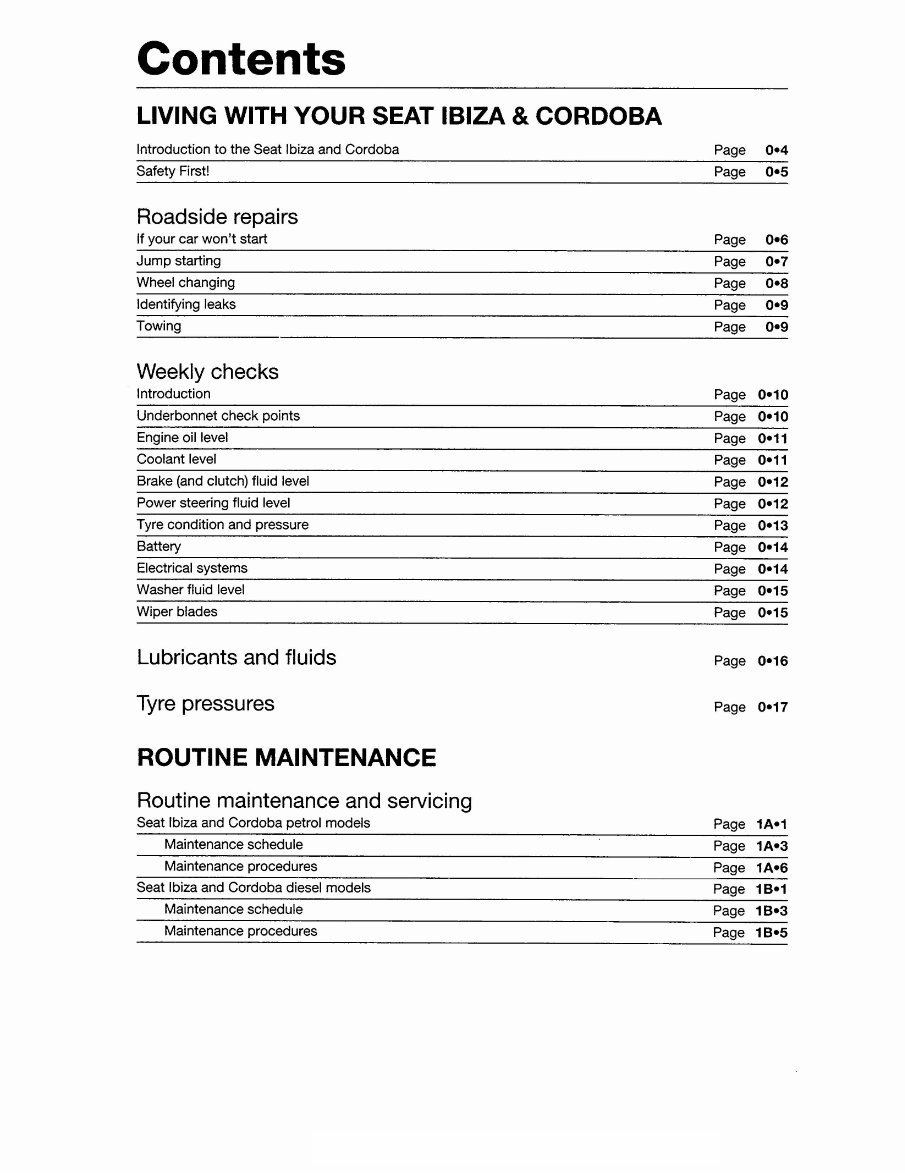
Contents LIVING WITH YOUR SEAT IBIZA & CORDOBA Introduction to the Seat Ibiza and Cordoba Page 0»4 Safety First! Page 0*5 Roadside repairs If your car won’t start Page 0*6 Jump starting Page 0*7 Wheel changing Page 0*8 Identifying leaks Page 0*9 Towing Page 0*9 Weekly checks Introduction Page 0*10 Underbonnet check points Page 0*10 Engine oil level Page 0*11 Coolant level Page 0*11 Brake (and clutch) fluid level Page (M2 Power steering fluid level Page 0*12 Tyre condition and pressure Page 0*13 Battery Page 0*14 Electrical systems Page 0#14 Washer fluid level Page 0*15 Wiper blades Page 0*15 Lubricants and fluids Page 0#16 Tyre pressures Page 017 ROUTINE MAINTENANCE Routine maintenance and servicing Seat Ibiza and Cordoba petrol models Page 1A»1 Maintenance schedule Page 1A»3 Maintenance procedures Page 1A*6 Seat Ibiza and Cordoba diesel models Page 1B*1 Maintenance schedule Page 1B*3 Maintenance procedures Page 1B»5
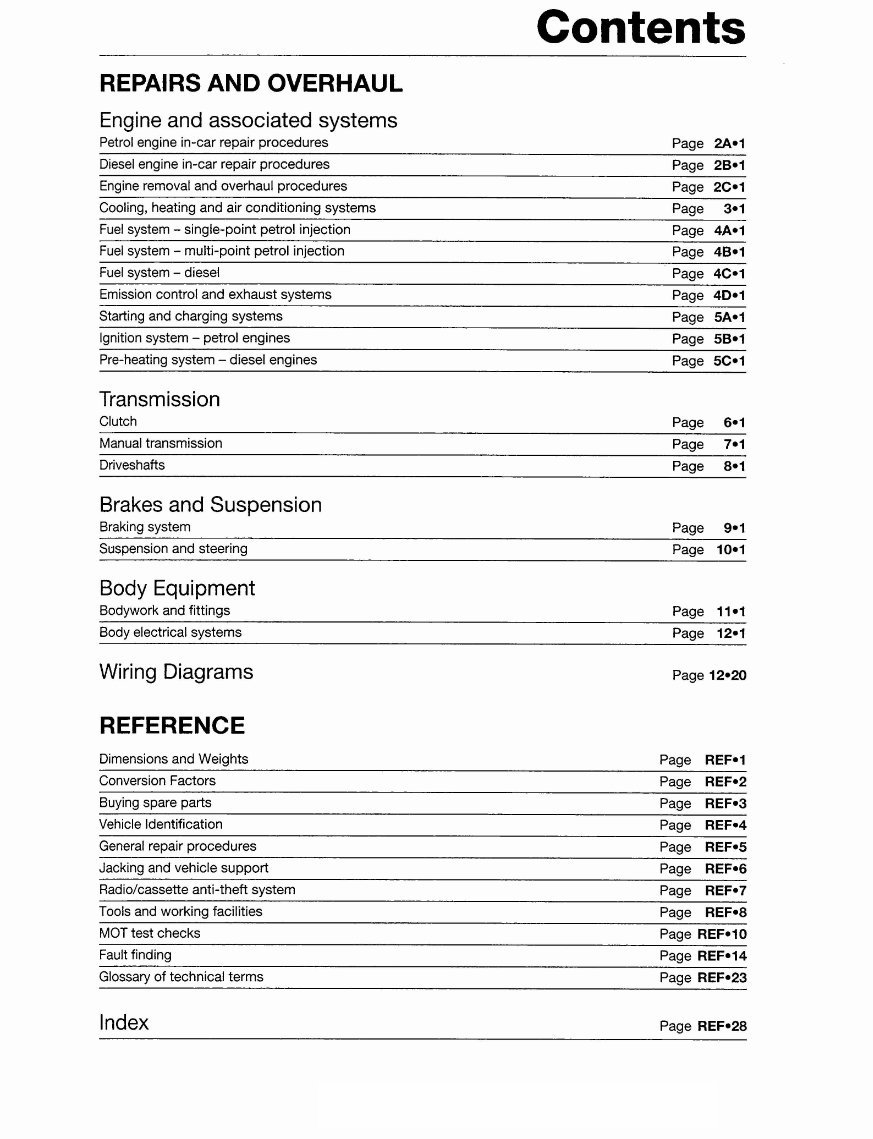
Contents REPAIRS AND OVERHAUL Engine and associated systems Petrol engine in-car repair procedures Page 2A»1 Diesel engine in-car repair procedures Page 2B«1 Engine removal and overhaul procedures Page 2 0 1 Cooling, heating and air conditioning systems Page 3«1 Fuel system - single-point petrol injection Page 4A*1 Fuel system - multi-point petrol injection Page 4B«1 Fuel system - diesel Page 4 0 1 Emission control and exhaust systems Page 4D*1 Starting and charging systems Page 5A*1 Ignition system - petrol engines Page 5B*1 Pre-heating system - diesel engines Page 5 0 1 Transmission Clutch Page 6*1 Manual transmission Page 7*1 Driveshafts Page 8»1 Brakes and Suspension Braking system Page 9*1 Suspension and steering Page 10*1 Body Equipment Bodywork and fittings Page 11*1 Body electrical systems Page 12»1 Wiring Diagrams Page 12*20 REFERENCE Dimensions and Weights Page REF«1 Conversion Factors Page REF*2 Buying spare parts Page REF*3 Vehicle Identification Page REF*4 General repair procedures Page REF»5 Jacking and vehicle support Page REF»6 Radio/cassette anti-theft system Page REF*7 Tools and working facilities Page REF«8 MOT test checks Page REF«10 Fault finding Page REF«14 Glossary of technical terms Page REF*23 Index Page REF*28
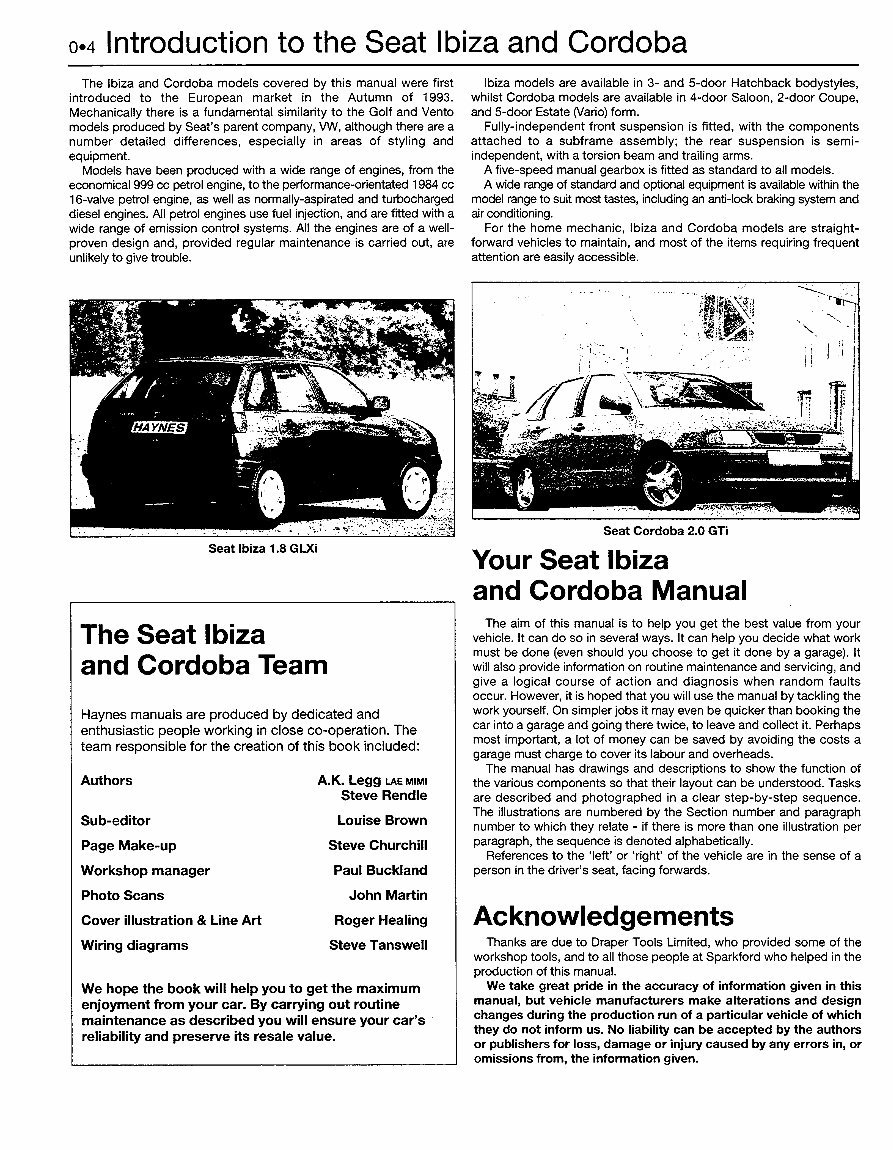
o .4 Introduction to the Seat Ibiza and Cordoba The Ibiza and Cordoba models covered by this manual were first introduced to the European market in the Autumn of 1993. Mechanically there is a fundamental similarity to the Golf and Vento models produced by Seat’s parent company, VW, although there are a number detailed differences, especially in areas of styling and equipment. Models have been produced with a wide range of engines, from the economical 999 cc petrol engine, to the performance-orientated 1984 cc 16-valve petrol engine, as well as normally-aspirated and turbocharged diesel engines. All petrol engines use fuel injection, and are fitted with a wide range of emission control systems. All the engines are of a well- proven design and, provided regular maintenance is carried out, are unlikely to give trouble. Seat Ibiza 1.8 GLXi The Seat Ibiza and Cordoba Team Haynes manuals are produced by dedicated and enthusiastic people working in close co-operation. The team responsible for the creation of this book included: Authors A.K. Legg lae mimi Steve Rendle Sub-editor Louise Brown Page Make-up Steve Churchill Workshop manager Paul Buckland Photo Scans John Martin Cover illustration & Line Art Roger Healing Wiring diagrams Steve Tanswell We hope the book will help you to get the maximum enjoyment from your car. By carrying out routine maintenance as described you will ensure your car’s reliability and preserve its resale value. Ibiza models are available in 3- and 5-door Hatchback bodystyles, whilst Cordoba models are available in 4-door Saloon, 2-door Coupe, and 5-door Estate (Vario) form. Fully-independent front suspension is fitted, with the components attached to a subframe assembly; the rear suspension is semi independent, with a torsion beam and trailing arms. A five-speed manual gearbox is fitted as standard to all models. A wide range of standard and optional equipment is available within the model range to suit most tastes, including an anti-lock braking system and air conditioning. For the home mechanic, Ibiza and Cordoba models are straight forward vehicles to maintain, and most of the items requiring frequent attention are easily accessible. Seat Cordoba 2.0 GTi Your Seat Ibiza and Cordoba Manual The aim of this manual is to help you get the best value from your vehicle. It can do so in several ways. It can help you decide what work must be done (even should you choose to get it done by a garage). It will also provide information on routine maintenance and servicing, and give a logical course of action and diagnosis when random faults occur. However, it is hoped that you will use the manual by tackling the work yourself. On simpler jobs it may even be quicker than booking the car into a garage and going there twice, to leave and collect it. Perhaps most important, a lot of money can be saved by avoiding the costs a garage must charge to cover its labour and overheads. The manual has drawings and descriptions to show the function of the various components so that their layout can be understood. Tasks are described and photographed in a clear step-by-step sequence. The illustrations are numbered by the Section number and paragraph number to which they relate - if there is more than one illustration per paragraph, the sequence is denoted alphabetically. References to the ‘left’ or ‘right’ of the vehicle are in the sense of a person in the driver’s seat, facing forwards. Acknowledgements Thanks are due to Draper Tools Limited, who provided some of the workshop tools, and to all those people at Sparkford who helped in the production of this manual. We take great pride in the accuracy of information given in this manual, but vehicle manufacturers make alterations and design changes during the production run of a particular vehicle of which they do not inform us. No liability can be accepted by the authors or publishers for loss, damage or injury caused by any errors in, or omissions from, the information given.
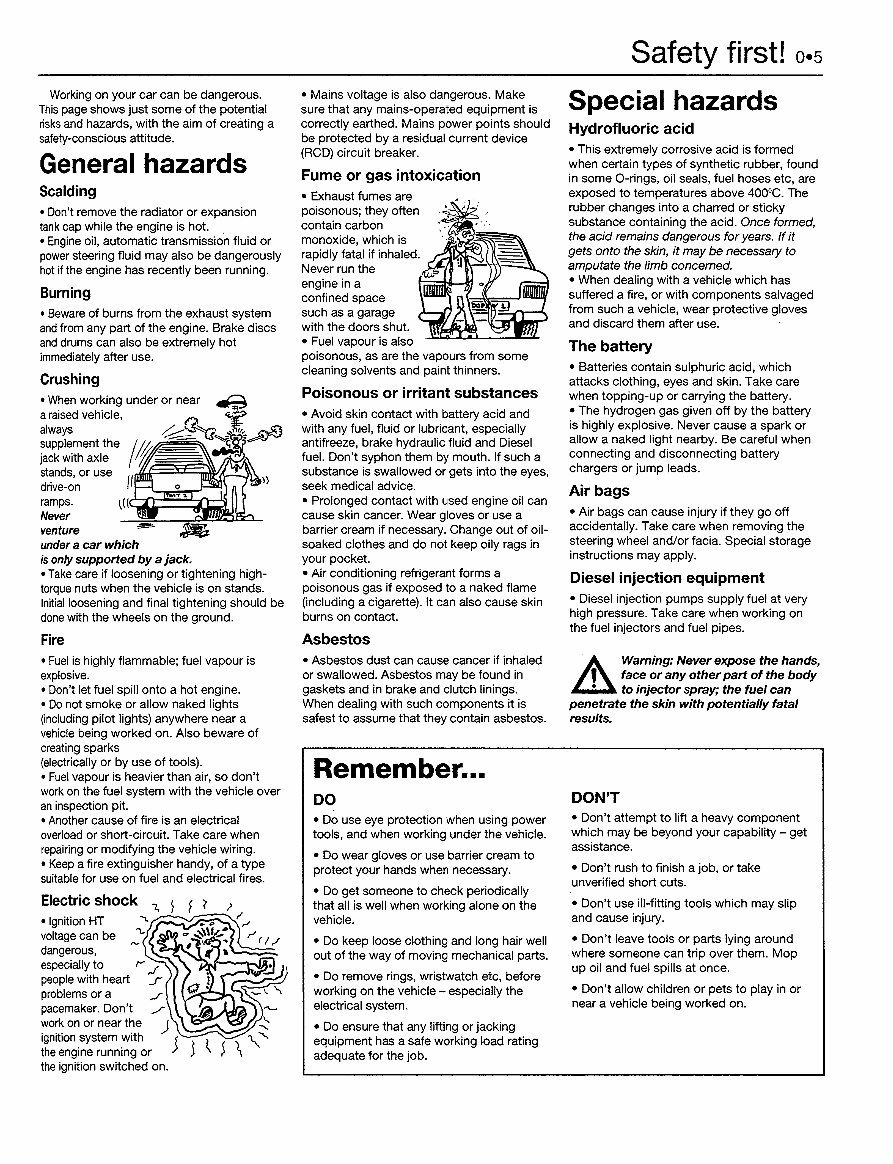
Safety first! 0.5 Working on your car can be dangerous. This page shows just some of the potential risks and hazards, with the aim of creating a safety-conscious attitude. General hazards Scalding • Don’t remove the radiator or expansion tank cap while the engine is hot. • Engine oil, automatic transmission fluid or power steering fluid may also be dangerously hot if the engine has recently been running. Burning • Beware of burns from the exhaust system and from any part of the engine. Brake discs and drums can also be extremely hot immediately after use. Crushing • When working under or near a raised vehicle, always supplement the jack with axle stands, or use drive-on ramps. (_((< Never venture under a car which is only supported by a jack. • Take care if loosening or tightening high- torque nuts when the vehicle is on stands. Initial loosening and final tightening should be done with the wheels on the ground. Fire • Fuel is highly flammable; fuel vapour is explosive. • Don’t let fuel spill onto a hot engine. • Do not smoke or allow naked lights (including pilot lights) anywhere near a vehicle being worked on. Also beware of creating sparks (electrically or by use of tools). • Fuel vapour is heavier than air, so don’t work on the fuel system with the vehicle over an inspection pit. • Another cause of fire is an electrical overload or short-circuit. Take care when repairing or modifying the vehicle wiring. • Keep a fire extinguisher handy, of a type suitable for use on fuel and electrical fires. Electric shock • Ignition HT voltage can be ^ dangerous, especially to people with heart problems or a pacemaker. Don’t work on or near the ignition system with the engine running or the ignition switched on. • Mains voltage is also dangerous. Make sure that any mains-operated equipment is correctly earthed. Mains power points should be protected by a residual current device (RCD) circuit breaker. Fume or gas intoxication • Exhaust fumes are poisonous; they often contain carbon monoxide, which is rapidly fatal if inhaled. Never run the engine in a confined space such as a garage with the doors shut. • Fuel vapour is also poisonous, as are the vapours from some cleaning solvents and paint thinners. Poisonous or irritant substances • Avoid skin contact with battery acid and with any fuel, fluid or lubricant, especially antifreeze, brake hydraulic fluid and Diesel fuel. Don’t syphon them by mouth. If such a substance is swallowed or gets into the eyes, seek medical advice. • Prolonged contact with used engine oil can cause skin cancer. Wear gloves or use a barrier cream if necessary. Change out of oil- soaked clothes and do not keep oily rags in your pocket. • Air conditioning refrigerant forms a poisonous gas if exposed to a naked flame (including a cigarette). It can also cause skin burns on contact. Asbestos • Asbestos dust can cause cancer if inhaled or swallowed. Asbestos may be found in gaskets and in brake and clutch linings. When dealing with such components it is safest to assume that they contain asbestos. Special hazards Hydrofluoric acid • This extremely corrosive acid is formed when certain types of synthetic rubber, found in some O-rings, oil seals, fuel hoses etc, are exposed to temperatures above 400°C. The rubber changes into a charred or sticky substance containing the acid. Once formed, the acid remains dangerous for years. If it gets onto the skin, it may be necessary to amputate the limb concerned. • When dealing with a vehicle which has suffered a fire, or with components salvaged from such a vehicle, wear protective gloves and discard them after use. The battery • Batteries contain sulphuric acid, which attacks clothing, eyes and skin. Take care when topping-up or carrying the battery. • The hydrogen gas given off by the battery is highly explosive. Never cause a spark or allow a naked light nearby. Be careful when connecting and disconnecting battery chargers or jump leads. Air bags • Air bags can cause injury if they go off accidentally. Take care when removing the steering wheel and/or facia. Special storage instructions may apply. Diesel injection equipment • Diesel injection pumps supply fuel at very high pressure. Take care when working on the fuel injectors and fuel pipes. A Warning: Never expose the hands, face or any other part of the body to injector spray; the fuel can penetrate the skin with potentially fatal results. i m Remember... 00 • Do use eye protection when using power tools, and when working under the vehicle. • Do wear gloves or use barrier cream to protect your hands when necessary. • Do get someone to check periodically that all is well when working alone on the vehicle. • Do keep loose clothing and long hair well out of the way of moving mechanical parts. • Do remove rings, wristwatch etc, before working on the vehicle - especially the electrical system. • Do ensure that any lifting or jacking equipment has a safe working load rating adequate for the job. DON’T • Don’t attempt to lift a heavy component which may be beyond your capability - get assistance. • Don’t rush to finish a job, or take unverified short cuts. • Don’t use ill-fitting tools which may slip and cause injury. • Don’t leave tools or parts lying around where someone can trip over them. Mop up oil and fuel spills at once. • Don’t allow children or pets to play in or near a vehicle being worked on.
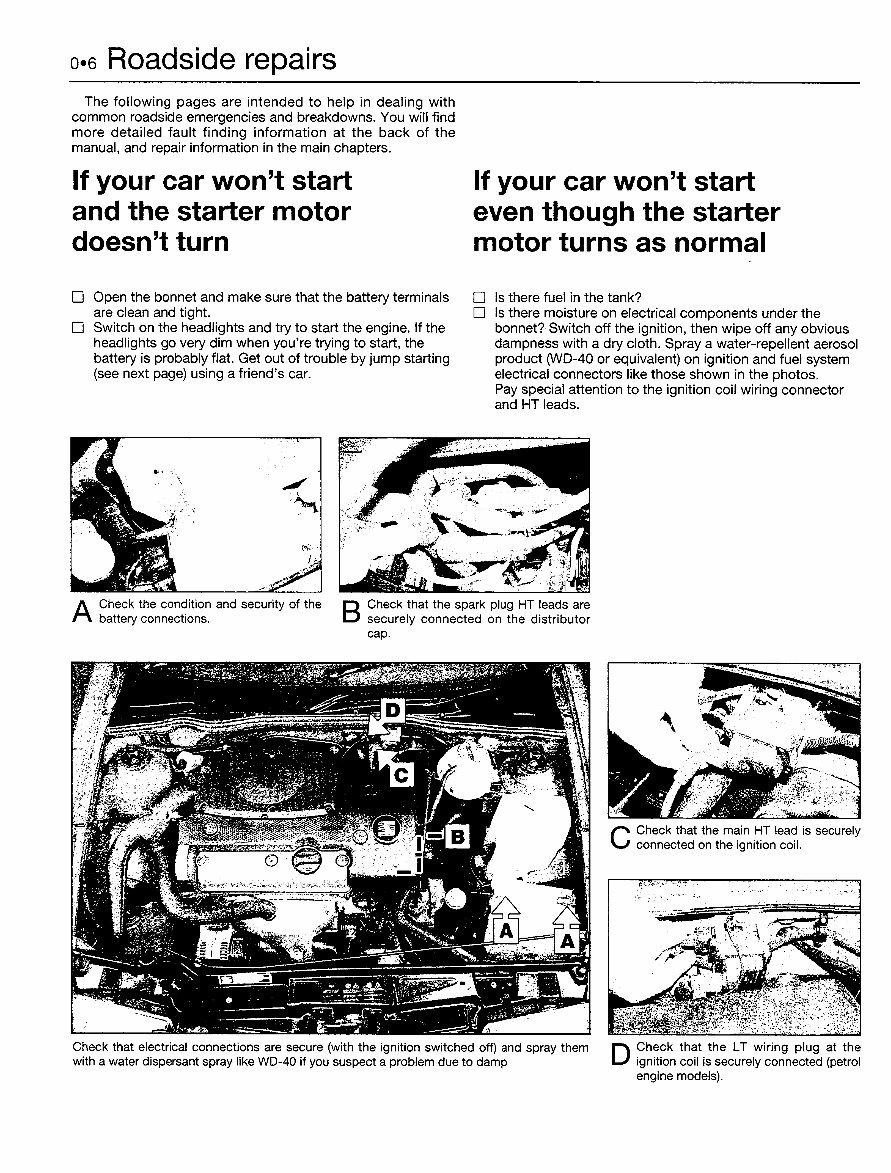
o .6 Roadside repairs The following pages are intended to help in dealing with common roadside emergencies and breakdowns. You will find more detailed fault finding information at the back of the manual, and repair information in the main chapters. If your car won’t start and the starter motor doesn’t turn □ Open the bonnet and make sure that the battery terminals are clean and tight. □ Switch on the headlights and try to start the engine. If the headlights go very dim when you’re trying to start, the battery is probably flat. Get out of trouble by jump starting (see next page) using a friend’s car. If your car won’t start even though the starter motor turns as normal □ Is there fuel in the tank? □ Is there moisture on electrical components under the bonnet? Switch off the ignition, then wipe off any obvious dampness with a dry cloth. Spray a water-repellent aerosol product (WD-40 or equivalent) on ignition and fuel system electrical connectors like those shown in the photos. Pay special attention to the ignition coil wiring connector and HT leads. Check that electrical connections are secure (with the ignition switched off) and spray them r"N Check that the LT wiring plug at the with a water dispersant spray like WD-40 if you suspect a problem due to damp ignition coil is securely connected (petrol engine models).
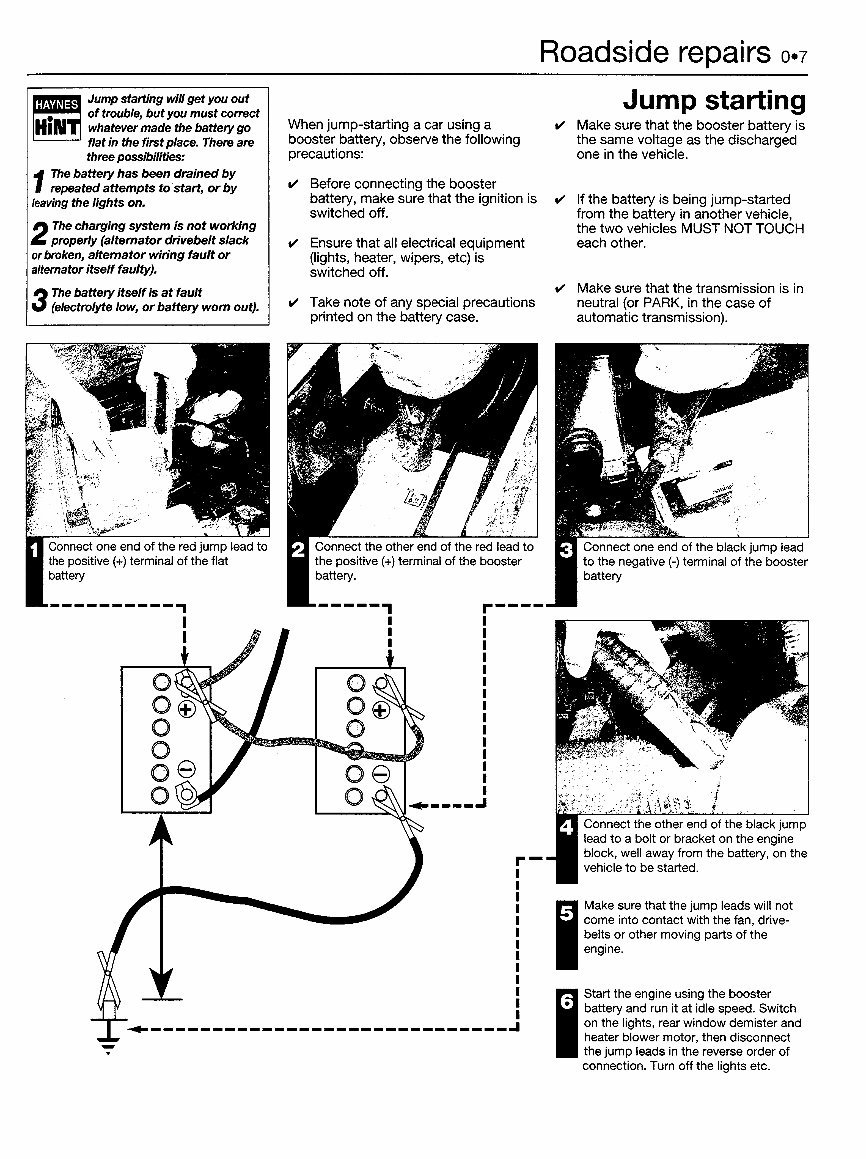
Roadside repairs 0.7 [MI Jump starting w ill get you out of trouble, but you must correct whatever made the battery go flat in the first place. There are three possibilities: t The battery has been drained by repeated attempts to start, or by leaving the lig h ts on. 2 The charging system is not working properly (alternator drivebelt slack or broken, alternator w iring fa u lt or alternator itself faulty). 3 The battery itself is at fault (electrolyte low, or battery worn out). When jump-starting a car using a booster battery, observe the following precautions: ✓ Before connecting the booster battery, make sure that the ignition is switched off. ✓ Ensure that all electrical equipment (lights, heater, wipers, etc) is switched off. ✓ Take note of any special precautions printed on the battery case. Jump starting Make sure that the booster battery is the same voltage as the discharged one in the vehicle. If the battery is being jump-started from the battery in another vehicle, the two vehicles MUST NOT TOUCH each other. Make sure that the transmission is in neutral (or PARK, in the case of automatic transmission). Make sure that the jump leads will not come into contact with the fan, drive- belts or other moving parts of the engine. Start the engine using the booster battery and run it at idle speed. Switch on the lights, rear window demister and heater blower motor, then disconnect the jump leads in the reverse order of connection. Turn off the lights etc.
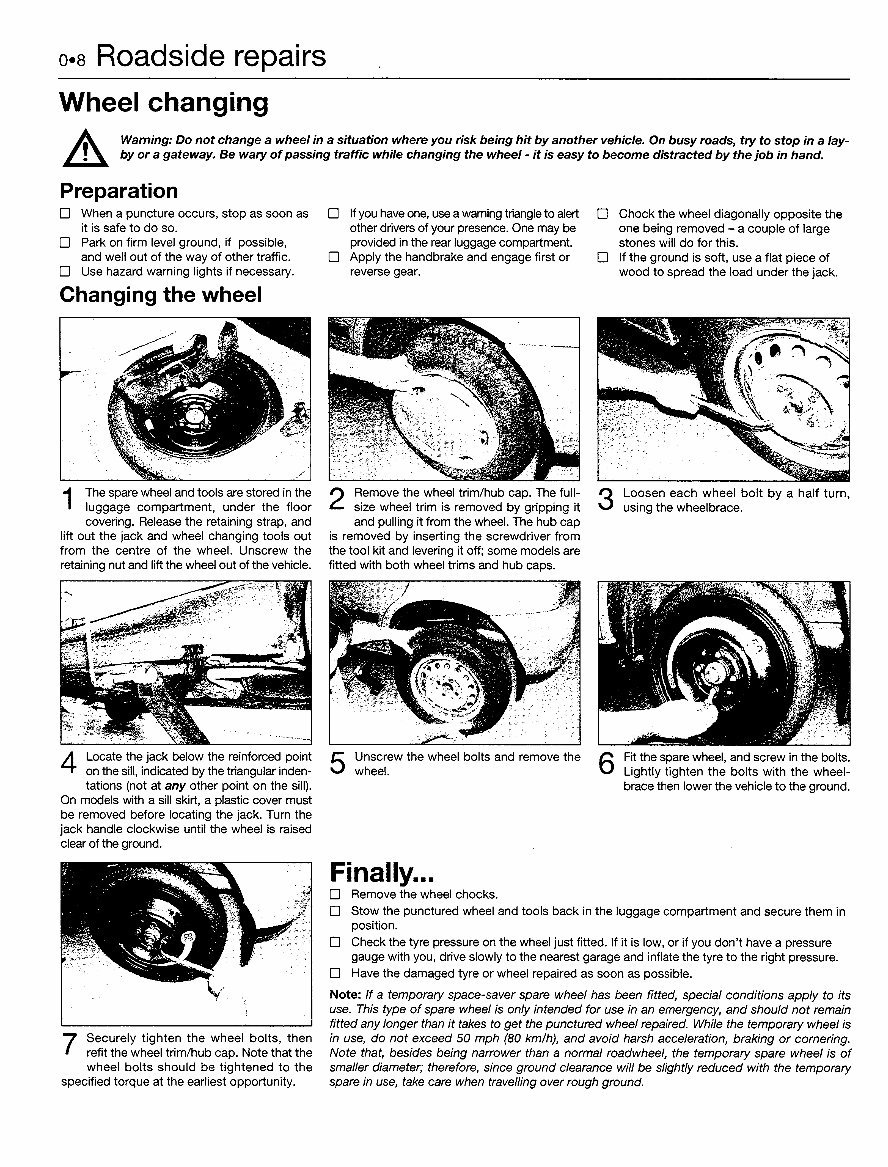
o .8 Roadside repairs Wheel changing A Warning: Do not change a wheel in a situation where you risk being h it by another vehicle. On busy roads, try to stop in a lay by or a gateway. Be wary of passing traffic while changing the wheel - it is easy to become distracted by the job in hand. Preparation □ When a puncture occurs, stop as soon as □ If you have one, use a warning triangle to alert □ Chock the wheel diagonally opposite the it is safe to do so. □ Park on firm level ground, if possible, and well out of the way of other traffic. □ Use hazard warning lights if necessary. Changing the wheel other drivers of your presence. One may be provided in the rear luggage compartment. □ Apply the handbrake and engage first or reverse gear. one being removed - a couple of large stones will do for this. □ If the ground is soft, use a flat piece of wood to spread the load under the jack. -J The spare wheel and tools are stored in the » luggage compartment, under the floor covering. Release the retaining strap, and lift out the jack and wheel changing tools out from the centre of the wheel. Unscrew the retaining nut and lift the wheel out of the vehicle. Remove the wheel trim/hub cap. The full- size wheel trim is removed by gripping it and pulling it from the wheel. The hub cap is removed by inserting the screwdriver from the tool kit and levering it off; some models are fitted with both wheel trims and hub caps. Loosen each wheel bolt by a half turn, using the wheelbrace. 4 Locate the jack below the reinforced point on the sill, indicated by the triangular inden tations (not at any other point on the sill). On models with a sill skirt, a plastic cover must be removed before locating the jack. Turn the jack handle clockwise until the wheel is raised clear of the ground. Fit the spare wheel, and screw in the bolts. Lightly tighten the bolts with the wheel brace then lower the vehicle to the ground. Finally... 7 Securely tighten the wheel bolts, then refit the wheel trim/hub cap. Note that the wheel bolts should be tightened to the specified torque at the earliest opportunity. □ Remove the wheel chocks. □ Stow the punctured wheel and tools back in the luggage compartment and secure them in position. □ Check the tyre pressure on the wheel just fitted. If it is low, or if you don’t have a pressure gauge with you, drive slowly to the nearest garage and inflate the tyre to the right pressure. □ Have the damaged tyre or wheel repaired as soon as possible. Note: If a temporary space-saver spare wheel has been fitted, special conditions apply to its use. This type of spare wheel is only intended for use in an emergency, and should not remain fitted any longer than it takes to get the punctured wheel repaired. While the temporary wheel is in use, do not exceed 50 mph (80 km/h), and avoid harsh acceleration, braking or cornering. Note that, besides being narrower than a normal roadwheel, the temporary spare wheel is of smaller diameter; therefore, since ground clearance will be slightly reduced with the temporary spare in use, take care when travelling over rough ground.
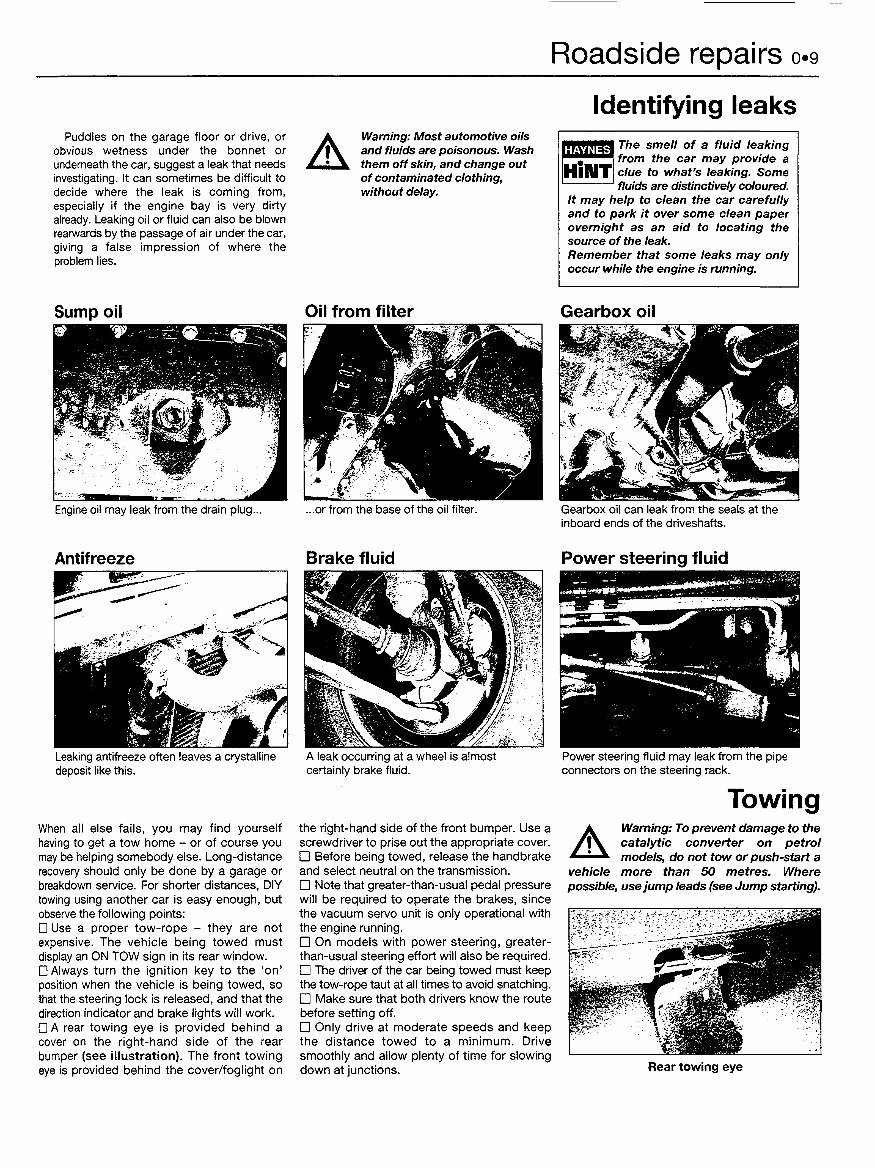
Roadside repairs 0.9 Puddles on the garage floor or drive, or obvious wetness under the bonnet or underneath the car, suggest a leak that needs investigating. It can sometimes be difficult to decide where the leak is coming from, especially if the engine bay is very dirty already. Leaking oil or fluid can also be blown rearwards by the passage of air under the car, giving a false impression of where the problem lies. A Warning: Most automotive oils and fluids are poisonous. Wash them o ff skin, and change out of contaminated clothing, w ithout delay. Identifying leaks HAYNES The smell of a fluid leaking from the car may provide a clue to what’s leaking. Some fluids are distinctively coloured. It may help to clean the car carefully and to park it over some clean paper overnight as an aid to locating the source of the leak. Remember that some leaks may only occur while the engine is running. Sump oil Oil from filter Gearbox oil Engine oil may leak from the drain plug... ...or from the base of the oil filter. Gearbox oil can leak from the seals at the inboard ends of the driveshafts. Antifreeze W- Brake fluid Power steering fluid Leaking antifreeze often leaves a crystalline deposit like this. When all else fails, you may find yourself having to get a tow home - or of course you may be helping somebody else. Long-distance recovery should only be done by a garage or breakdown service. For shorter distances, DIY towing using another car is easy enough, but observe the following points: □ Use a proper tow-rope - they are not expensive. The vehicle being towed must display an ON TOW sign in its rear window. □ Always turn the ignition key to the ‘on’ position when the vehicle is being towed, so that the steering lock is released, and that the direction indicator and brake lights will work. □ A rear towing eye is provided behind a cover on the right-hand side of the rear bumper (see illustration). The front towing eye is provided behind the cover/foglight on A leak occurring at a wheel is almost certainly brake fluid. the right-hand side of the front bumper. Use a screwdriver to prise out the appropriate cover. □ Before being towed, release the handbrake and select neutral on the transmission. □ Note that greater-than-usual pedal pressure will be required to operate the brakes, since the vacuum servo unit is only operational with the engine running. □ On models with power steering, greater- than-usual steering effort will also be required. □ The driver of the car being towed must keep the tow-rope taut at all times to avoid snatching. □ Make sure that both drivers know the route before setting off. □ Only drive at moderate speeds and keep the distance towed to a minimum. Drive smoothly and allow plenty of time for slowing down at junctions. Power steering fluid may leak from the pipe connectors on the steering rack. Towing A Warning: To prevent damage to the catalytic converter on petrol models, do not tow or push-start a vehicle more than 50 metres. Where possible, use jum p leads (see Jump starting). Rear towing eye
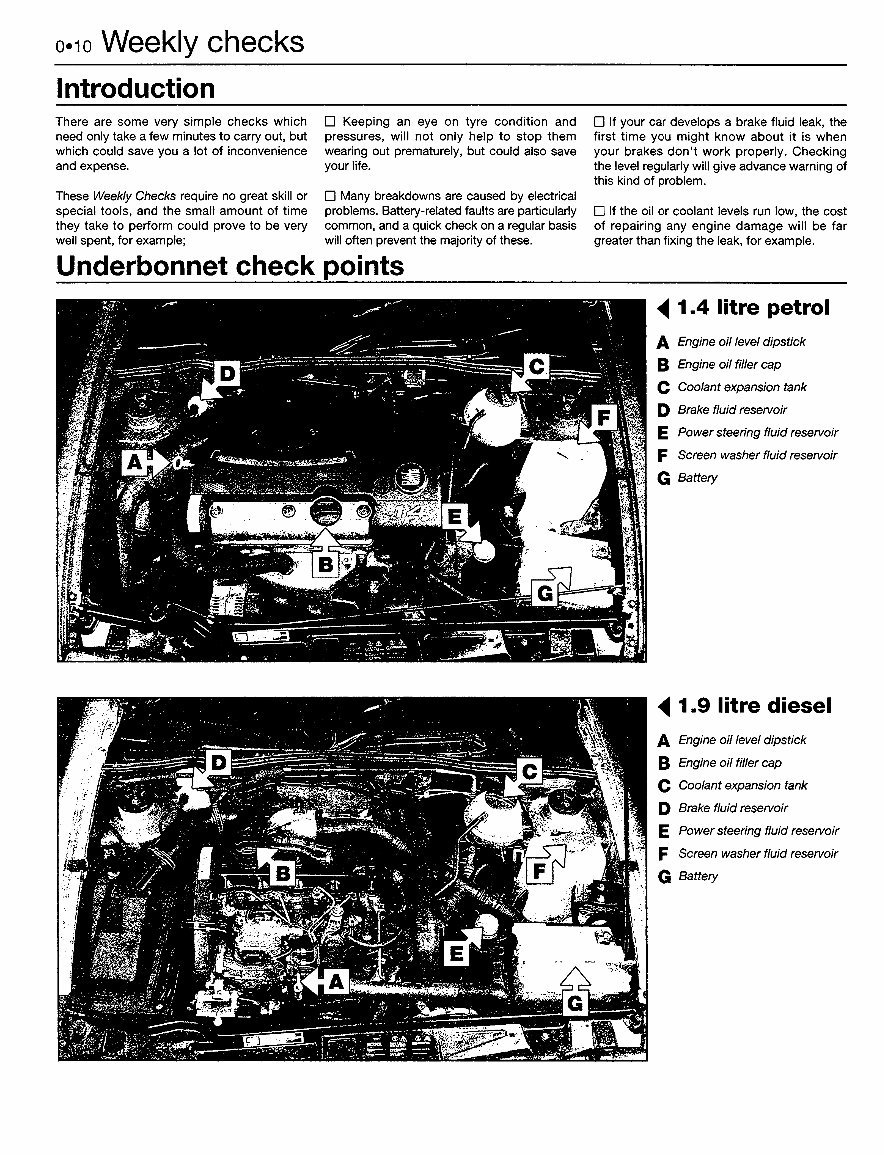
o.io Weekly checks Introduction There are some very simple checks which need only take a few minutes to carry out, but which could save you a lot of inconvenience and expense. These Weekly Checks require no great skill or special tools, and the small amount of time they take to perform could prove to be very well spent, for example; □ Keeping an eye on tyre condition and pressures, will not only help to stop them wearing out prematurely, but could also save your life. □ Many breakdowns are caused by electrical problems. Battery-related faults are particularly common, and a quick check on a regular basis will often prevent the majority of these. □ If your car develops a brake fluid leak, the first time you might know about it is when your brakes don't work properly. Checking the level regularly will give advance warning of this kind of problem. □ If the oil or coolant levels run low, the cost of repairing any engine damage will be far greater than fixing the leak, for example. Underbonnet check points 4 1-4 litre petrol A Engine oil level dipstick B Engine oil filler cap Q Coolant expansion tank Q Brake fluid reservoir E Power steering fluid reservoir F Screen washer fluid reservoir Q Battery 4 1.9 litre diesel A Engine oil level dipstick B Engine o il filler cap O Coolant expansion tank Q Brake fluid reservoir E Power steering fluid reservoir F Screen washer fluid reservoir Q Battery
Introducing the Seat Ibiza Hatchback 1.6L (1595cc & 1598cc) Service Manual!
This comprehensive manual is your ultimate guide to maintaining and servicing your Seat Ibiza Hatchback with 1.6L engines. Whether you are a DIY enthusiast or a professional mechanic, this service manual will provide you with all the information you need to keep your vehicle running smoothly.
The manual covers a range of models with 1.6L engines, including:
Seat Ibiza Hatchback 1.6L (1595cc)
Seat Ibiza Hatchback 1.6L (1598cc)
With step-by-step instructions, diagrams, and illustrations, this manual will assist you in performing various maintenance tasks, such as oil changes, filter replacements, brake inspections, and more. You'll also find detailed information on troubleshooting common issues and conducting repairs.
Ensure the longevity and performance of your Seat Ibiza Hatchback with this indispensable service manual. Order your copy today and become your own trusted mechanic!
Recently Viewed
5,521,897Happy Clients
2,594,462eManuals
1,120,453Trusted Sellers
15Years in Business
Price:
Actual Price:
Seat Ibiza Hatchback 1.6L (1595cc & 1598cc) Service Manual



 Lifetime Access