2017-2018 Porsche Macan OEM Service & Repair Manual
What's Included?
Lifetime Access
Fast Download Speeds
Online & Offline Access
Access PDF Contents & Bookmarks
Full Search Facility
Print one or all pages of your manual
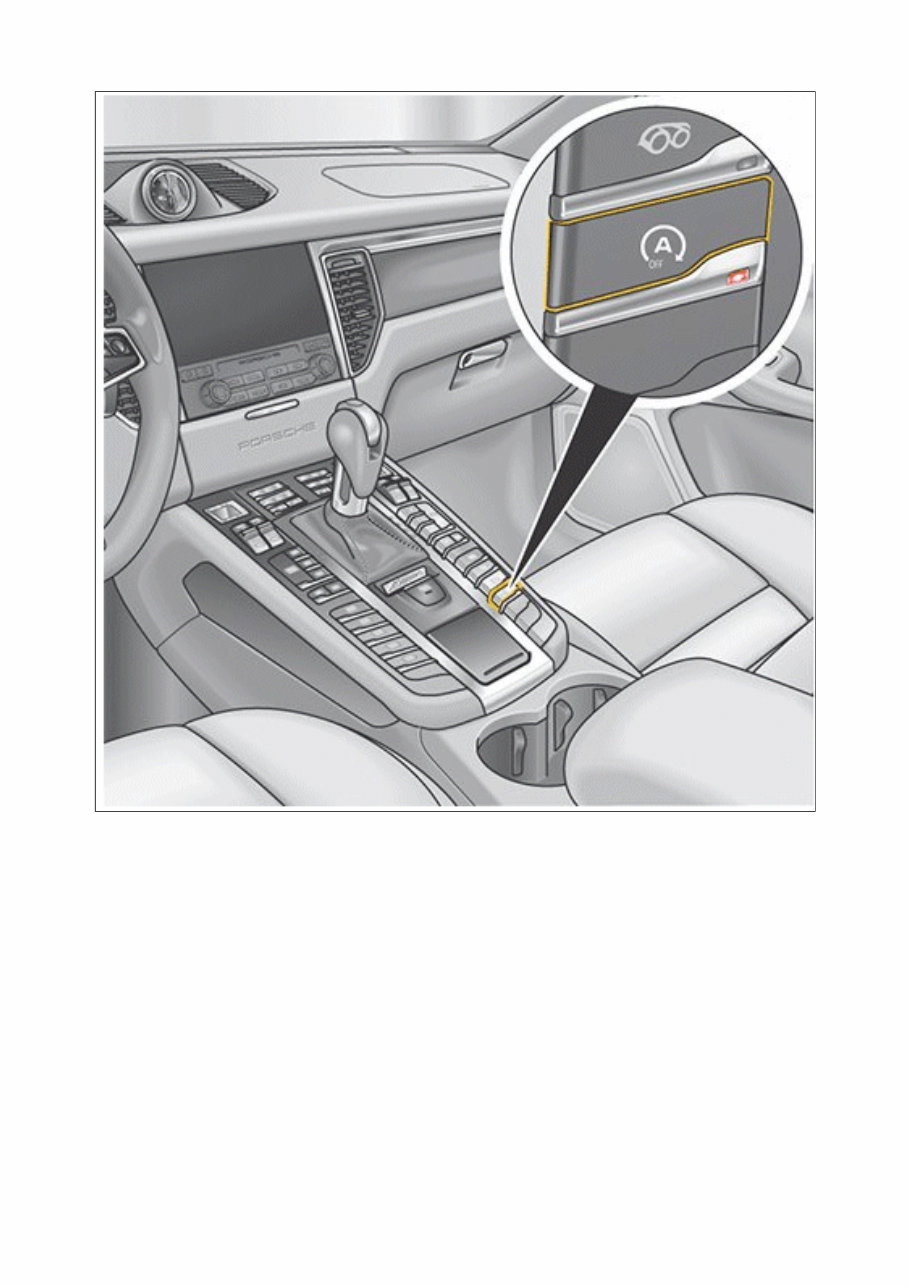
AUTO STOP/START DISABLE AUTO STOP/START DISABLE > DISABLE CONDITIONS On Porsche vehicles equipped with the auto stop/start feature, there may or may not be an auto stop/start off button. For vehicles without the button, any or some of the following conditions may prevent the engine from automatically stopping while parked: Transmission is in P position Engine compartment hood is open Driver's seat belt is unlatched Driver's door is open Windshield defroster is on A/C is set to Manual and is running at Max. AUTO STOP/START DISABLE > DISABLE BUTTON Vehicles with the auto stop/start off button, press the button to switch the system OFF. The button may illuminate to indicate the system is OFF. Deactivation using the button lasts only one key cycle. Press the button again to restore auto stop/start function. See Fig 1. Service Manual: AUTOMATIC STOP/START DISABLE Porsche Macan
Fig 1: Typical Auto Stop/Start Off Button Courtesy of PORSCHE
DOCUMENTING WARRANTY/GOODWILL RELEVANT REPAIRS IN THE EVENT OF VISUAL OR ACOUSTIC COMPLAINTS WITH PICTURES/SOUND FILES (14/16) Model year: as of 1997 Model Line: Valid for all model lines Subject: Documentation of a repair job in the PQIS line Information: Importance of documentation quality. When documenting a repair job, it is absolutely essential that affected or rejected components are documented using pictures and/or sound files. The documentation therefore provides the basis for quality improvement measures and for any claims for recourse against the supplier. To guarantee a well-founded quality analysis, repairs and customer complaints must be verifiably and fully documented for third parties in PQIS. Repairs and customer complaints that are verifiable for third parties help to ensure that warranty and goodwill claims can be processed quickly. Comprehensive documentation for the Porsche partner is essential for any legal proceedings. When documenting complaints/repairs, it is important to differentiate between the coding used for the following process steps: Customer complaint (the actual wording used by the customer is important here) Technical assessment (assessment performed by the Shop Foreman/Technical Expert) Cause (the cause identified by the technician) Corrective measure(s) To ensure verifiability, it is important to specify not only the fault location (FES 5) and damage category (SA 4), but also any further information. Attachments: Specifications for attachments (pictures, videos and sound files): Pictures, videos or sound files of the affected component must be attached in order to document visually or acoustically verifiable complaints so that the complaint is also verifiable for third parties: File attachments must preferably be attached in PQIS. The specifications for file size and accepted file formats must be observed. The file attachment must be labeled with the repair order number and a brief description of the attachment. Visual Defect: Service Manual: COMPLETE VEHICLE - GENERAL -- (95B) MACAN Porsche Macan
Visually verifiable complaint: Definition A visually verifiable complaint can be explained as follows, e.g.: Clearly visible damage or function restrictions of components (e.g. loose or broken/cracked /porous components) Discoloration or flaking All visible leaks in air or fluid-carrying systems/components Required documentation Meaningful pictures of the damage/problem areas. It is not the number of pictures, rather the quality (verifiable damage/problem, sharpness, brightness, contrast) that is important. For extreme close-ups, an overview shot must be taken first. Particularly for pictures of a paint defect, the affected area on the picture must be marked (e.g. with an arrow or border). Special documentation for leaks Leaks on air-carrying components: The leak on the component must be identified using leak-locating spray or a soap solution and after applying pressure as required, must be documented by taking pictures or videos. Leak/condensation: In the event of complaints relating to misting/condensation with and without drops forming, pictures or videos must be taken both before and after drying the affected area in order to document any residues in the components. Leaks on fluid-carrying components. These are differentiated as follows: Leak without drops forming ("sweating") on the components: No documentation required as this is not a defect in the warranty and goodwill context. a. Leak with drops forming: If the problem is immediately verifiable, a picture clearly showing the leak on the affected component with correct details of the problem in PQIS is sufficient. If the problem is not immediately verifiable, it must be made clearly visible using the following procedure and documented accordingly. b. If the affected area is heavily soiled, take pictures before cleaning the area in order to document the additional work involved. 1. After cleaning the relevant area, spray it with talcum powder/Spotcheck. 2. It may be necessary to carry out a test drive or leave the engine running until the operating temperature of the components is reached. (The components must then be allowed to cool down as the leak might only occur after the components have cooled down) 3. Check and identify exactly where the leak starts or which component is responsible. 4. Once the leak is identified, the cause of the leak must be documented by taking more pictures. 5. Acoustic Defect:
Acoustically verifiable complaint: Definition The problem can be perceived acoustically (as a noise). For example, this may involve unusual noises: from the drive train or a. electronic/mechanical components. b. Required documentation A sound file or FFT plot (when required) for acoustic complaints so that the noise can also be assigned to the cause during quality analysis and quality assurance (Porsche AG). Other Documentation: Video documentation: Both for visual and acoustic defects, it may be necessary/helpful to show the problem/defect in a short video. For videos, there are also specifications relating to file size, file format and assignment (see above). The documentation must also contain a detailed description of the damage/damage circumstances (e.g. exact fault location, weather and road conditions, transmission range, driving speed and engine speed). Documentation for paint damage: In the event of paint damage, clear picture documentation and the cost estimate from the paint shop, must also be attached to the quality line in PQIS. Marking affected defects when returning components When returning defective/damaged parts (requested via barcode), the affected damaged area on the component itself must also be marked (e.g. using a wax crayon or chalk, water-resistant felt-tipped pen or adhesive tape) so that it is still clearly identified following transportation. This allows optimal analysis of the cause of damage during quality analysis and quality assurance. Always make sure that damaged parts are packaged adequately (original packaging) during shipping. Information References: Basic information on processing warranty and goodwill claims can be found in the Warranty Policies and Procedures , see => PPN (Porsche Partner Network) RECOMMENDATIONS AND MEASURES FOR VEHICLE STORAGE (26/09)
Model year: as of 2009 Macan models added. i-information for 'hot countries' under "Every week" now includes "maximum tire inflation pressure ". Standard "Warehouse vehicles" form revised to reflect additions mentioned above. Additional vehicle types added. i-information added under "Every week": Information relating to 'hot countries'. Standard "Warehouse vehicles" form revised to reflect additions mentioned above. i-information added: "At end of storage period , check..." (storage time ≥ 150 days...). New : "Pre-Delivery Inspection/1: General measure" section. Standard form "Warehouse vehicles" revised to reflect additions mentioned above. Vehicle Type: All Boxster models (987) All Cayman models (987) All 911 models (997) All Cayenne models (9PA) Vehicle Type: All Boxster models (981) All Cayman models (981) All 911 models (991) Model Year: As of 2012 (C)
Vehicle Type: All Panamera models Model Year: As of 2010 (A) Vehicle Type: All Cayenne models (92A) Model Year: As of 2011 (B) Vehicle Type: All Macan models Model Year: from 2014 (E) Concerns: Recommendations and measures for vehicle storage: Short- and long-term storage of new vehicles. Information: Vehicle storage in the time period between vehicle delivery and handover to the customer. The following recommendations and measures are relevant for new vehicles , which are not immediately displayed for sale following delivery, but will be stored for a short or long period of time. The recommendations and measures are primarily aimed at maintaining vehicle quality during the storage period. This information (and the related standard "Warehouse vehicles" form) is designed to provide you with a basis and guide for planning and implementing the relevant measures. Depending on the storage duration, the measures must be once-off (at start of storage) and must then be carried out every week , every 3 months and every year . The sales check must only be performed on warehouse vehicles if the vehicle is to be displayed for sale.
If the storage time is ≥ 150 days (≥ approx. 5 months) , see → WM 170301 CHECKING OIL PRESSURE (ALL MODEL EXCEPT FOR MACAN & MACAN SPORT EDITION) . Work Procedure: Always use the "Warehouse vehicles" form to implement and document the relevant processes, see => PIWIS Information System => Standard forms. The form contains detailed information about the procedure. Brief Overview: The various measures are listed in the table below (based on storage time). Measures and recommendations - once-off ... upon vehicle delivery Measures - storage time < 3 months Once-off (upon delivery) => every week => Sales check Measures - storage time of 3 months or more Once-off (upon delivery) => every week => every 3 months => Sales check Measures and recommendations - storage time up to 1 year Once-off (upon delivery) => every week => every 3 months => after 1 year => Sales check Essentially, the details and specifications contained in the standard "Warehouse vehicles" form are decisive here. Once-off: Measures during vehicle delivery or start of storage. => Release parking brake, engage 1st gear or move selector lever to position "P", switch off loads; close windows, lids and doors. => Switch off battery disconnect switch (if fitted). => Carry out battery care and maintenance as described in the relevant "Technical Information". Recommendations Leave transport protection film on the vehicle for as long as possible (max. 1 year). Leave battery disconnect switch in the vehicle for as long as possible. Switch off vehicle electrical system upon completion of tasks using the battery disconnect switch. Keep tire inflation pressure at factory-set pressure during storage. Every week: Measures
=> Visual inspection of the body for dirt (bird droppings, etc.) and deposits (leaves, etc.); clean/remove if necessary. Do this more often on showroom vehicles that are ready for sale and parked outside. => Carry out battery care and maintenance as described in the relevant "Technical Information". Keep the vehicle/ tires in the shade if possible => do not expose to direct sunlight. Check tire inflation pressure and correct it if necessary. The maximum permitted tire inflation pressure of 51 psi (3.5 bar) must not be exceeded. Mark the position of the tires and re-position by at least 90°. Every 3 months: Measures => Check tire inflation pressure and correct if necessary. => To prevent flat spots on tires, move the tires to a different position (offset by at least 90°). => Free up brake discs by braking several times. => Check vehicle interior for leaks. => Carry out battery care and maintenance as described in the relevant "Technical Information". After 1 year: Measures => Remove transport protection film from the vehicle. => Remove adhesive residue from film if necessary. => Clean the vehicle after removing the protective film. Recommendations Rim protection film can also be left on the vehicle for more than a year. Top protection cover (Cabriolet) can be washed, dried and fitted on the dry top again after washing the vehicle. Park vehicles with no transport protection film under cover if possible. Pre-Delivery Inspection/1: General measure: Prior to handover to the customer (during the sales check).
If the storage time is ≥ 150 days (≥ approx. 5 months) , see → WM 170301 CHECKING OIL PRESSURE (ALL MODEL EXCEPT FOR MACAN & MACAN SPORT EDITION) Pre-Delivery Inspection/2: Only if necessary: Recommended measures for vehicle inspection prior to handover to customer (as part of sales check). General soiling (e.g. dust, bird droppings, etc.): Wash the vehicle. Remove obvious dirt according to instructions (Owner's Manual, etc.) and wash treated areas again. Then treat with paint protection. Adhesive residue from transport protection film : Remove with isopropanol, then wash the vehicle. Paint finish (reduced glossiness, visible difference between unprotected areas and areas covered with transport protection film): Treat with paint polish and wash the vehicle if necessary. Then apply paint protection. Corroded brake discs : Free up brake discs by braking several times. Exhaust system/rear muffler : Metal polishing paste (e.g. Ambassador, Sidol, etc.) Spots, discoloration on rear scuff plate (Cayenne) : Use Porsche rim cleaner or liquid stainless-steel cleaner, see => Technical Information '6331 Protective strip for rear apron (7/03)'. References: Standard form "Warehouse vehicles" (updated, PCNA version 8/2016) => Technical Information '6331 Protective strip for rear apron (7/03)' => Technical Information '2706 Battery care and maintenance (3/07)' Panamera, as of model year 10 (A): → WM 170301 CHECKING OIL PRESSURE (EXCEPT PANAMERA EXECUTIVE, PANAMERA GTS, PANAMERA 4 EXECUTIVE, PANAMERA 4S SPORT EDITION, PANAMERA PLATINUM ED., PANAMERA 4 PLATINUM ED.) Boxster, Cayman, 911 Carrera, 911 Turbo; as of model year 09: → WM 170301 CHECKING ENGINE OIL PRESSURE (GT3, GT3 RS) Cayenne, model year 09 to 10 (A): → WM 170301 CHECKING OIL PRESSURE (CAYENNE) WM 0X00IN OVERVIEW OF A, B AND C MARKETS (EXCEPT MACAN SPORT
2017-2018 Porsche Macan OEM Service & Repair Manual
Engines covered:
2.0L EA888 Gen 3 (CNCD) I4 turbo
3.0L TFSI V6 twin-turbo
3.6L V6 twin-turbo
Keep your 2017-2018 Porsche Macan in prime condition with this comprehensive Service & Repair Manual. Tailored for Porsche enthusiasts and professional mechanics, this guide provides extensive instructions for the vehicle's maintenance, troubleshooting, and repairs. It includes detailed step-by-step procedures, vivid illustrations, and comprehensive exploded-view diagrams.
The Porsche Macan, a symbol of luxury and dynamic driving, requires regular maintenance and expert repairs to uphold its performance and elegance. This manual is invaluable for servicing the 2017-2018 Macan models, covering various aspects from engine and transmission maintenance to in-depth guidance on electrical systems, suspension, and advanced in-car technology.
Available in a digital format, this manual offers the convenience of accessing critical maintenance information on multiple devices. It's a crucial resource for ensuring the longevity and peak performance of your 2017-2018 Porsche Macan, making it an indispensable asset for both workshop and personal use.
Printable: Yes Language: English Compatibility: Pretty much any electronic device, incl. PC & Mac computers, Android and Apple smartphones & tablet, etc. Requirements: Adobe Reader (free)
Recently Viewed
5,521,897Happy Clients
2,594,462eManuals
1,120,453Trusted Sellers
15Years in Business
Price:
Actual Price:
2017-2018 Porsche Macan OEM Service & Repair Manual



 Lifetime Access