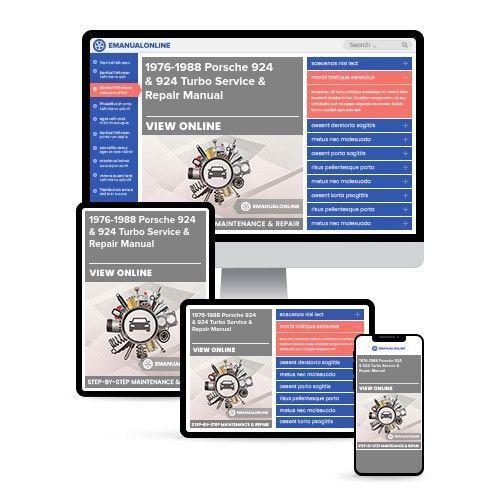
1976-1988 Porsche 924 & 924 Turbo Service & Repair Manual
What's Included?
Lifetime Access
Fast Download Speeds
Offline Viewing
Access Contents & Bookmarks
Full Search Facility
Print one or all pages of your manual
Table of Contents 1. Cover. 2. Index 3. Forward, Purpose, Summary, Disclaimer 4. Introduction to CIS (Continuous Injection System) 5. Getting Started …First place to start your troubleshooting 6. Troubleshooting Chart ….Second place to look 7. Wiring Diagrams …Block diagrams that are easy to read 8. Theory of Operation … Know the sequence of events during engine start-up and run 9. Testing of Components (parts) …Test the suspected part 10. List of Fuel Injection Parts 11. Definitions …Know what the part does 12. Technical Information …Tune-up, idle speed, etc. 13. General lnformation …Horsepower. Compression, Torque, etc. 14. Photos of CIS Fuel Injection …Know what the part looks like 15. Tool List and where to find them FAQ (Frequently asked Questions) 2
CIS TROUBLESHOOTING HANDBOOK FOR THE 73-83 PORSCHE 911 Compiled and Written by Jim Pennington FORWARD Have you ever taken a close look at the troubleshooting manuals today? The information you receive is incomplete. At best,you get only general information. Have you ever gotten to a point that you are frustrated with the time spent researching material to just get your Porsche 911 running? I have the solution to your frustrations. I have written the best troubleshooting handbook for the CIS FUEL INJECTION system for the non Turbo Porsche 911. I have been in the fuel injection repair business for over twenty years. Each time I went to work on a 911, I had to refer to a component list then refer to another book for the specifications. I have made it easier for you to work on your car by having just one book to refer to for information. This troubleshooting manual has troubleshooting charts geared to your car. You will find photos, wiring diagrams, component location, component photos and simple procedures to test the fuel injection in your Porsche 911. PURPOSE The purpose of this handbook is to provide .information in one easy to follow book. This book will answer your questions on CIS fuel injection. It will allow you to follow simple instructions, without having to refer to a number of other manuals. You will find that each year of the CIS system is covered. This handbook will not go into the complete theory of operation of the system. There are many books written on the subject. This handbook will help you with a brief description of each component, photo, specifications and the procedures to test the component. SUMMARY The hand book covers the CIS fuel injection on the non turbo Porsche 911 from 1973 through 1983. Tech Tips, troubleshooting charts, and" how to test" sections are clearly written. The handbook is a reference book that all mid year Porsche 911 owners will want for their library. DISCLAIMER By using this hand book, the user assumes all responsibility of safety, possibility of damage to the vehicle, and his/her ability to perform the tasks required. The user of this handbook will be working around high gasoline pressures, hot temperatures and electrical current, all of which are dangerous to the health of the user. By using this handbook the user will hold the writer harmless of any damage or injury that may occur. This book is put together with information available at the time of printing. This handbook is not meant to be the definitive answer to all CIS fuel injection problems. The person using this handbook is assumed to have the mechanical ability and have the knowledge of the mechanical, electrical and safety aspects of working with fuel on an automobile. This handbook is for informational purposes only and if the user has any doubts of their abilities, consult a specialist. 3
Introduction to CIS (Continuous Injection System) There were two types of CIS used on the Porsche 911 from 1973 through 1983. They are the K-jetronic and K-jetronic with Lambda. K-jetronic- K is for continuous, the system is mechanical with parts that control cold start and idle that are electrical or electrical with vacuum assistance. The amount of fuel is controlled in proportion to air flow to give the correct air- fuel ratio. Air flow is measured by a metal plate in a cone shaped cylinder. A plunger is connected to this plate. The plunger controls the pressure in the fuel metering unit. The pressure is produced by the fuel pump operating at a specified pressure particular to each vehicle. There is a differential pressure controlled by the plunger. This differential pressure operates the injectors. The greater the air the greater the differential pressure, the more fuel that is injected. The fuel is continuously injected rather than with each intake opening. K-jetronic with lambda- operation is the same as above with the addition of a lambda (oxygen sensing). The lambda was added to further help the emissions of the vehicle. By sensing the oxygen in the exhaust, the lambda will adjust the co content. NOTE: I have included a Theory of Operation to help in the understanding, operation and troubleshooting of the CIS system. 4
Getting Started: There are a few things that you should do before trouble shooting the fuel system. You will need to ask a few questions to your self. By doing this you may be able to find the problem and not have to test the system. Ask the following questions ... What is the problem? Cold start ...Hot start...Driveability... When did the problem start? Overnight ..After driving ...Damp day...After fueling ...On startup How was the car running before the problem started? Good ...Fair ...Poor... What was done to the car at the last service? Oil change ...Tune up ...Engine overhaul… Were there any other problems before the new problem started? Low battery ...Bad fuel pump Correct starting procedure: 1973-1975 required the hand throttle to assist in starting. 76-83 did not. By answering the above questions you may be able to narrow the possible problems to just a few. 1. Make sure the Battery is in good condition. 2. Check the Connections to the battery. Clean the connections just in case. 3. Make sure the Ignition System is in good condition.1nspect plugs, check condition of distributor, check the wiring, check the coil and check the timing. You need to be sure all of these are in good condition before starting. You can check each of the above with out the engine running. Do a static test on the timing if the engine is not running. Pull each plug, clean if necessary, replace if needed. 4. Make sure the condition of the Engine is good. 5. Check the Starter. 6. Check the outside of the engine Rubber boots, Hoses, Electrical connections and Vacuum Hoses. 7. Do a sniff test if the car has been sitting for a long period of time. Carefully sniff the fuel. If the fuel smells like varnish, drain the fuel tank and fill with clean fuel. 8. Keep in mind that if the fuel is bad you may have some components that are covered with this bad fuel. Examples would be the mixture control unit, fuel filter, cold start valve, fuel accumulator, fuel pump, fuel check valve and fuel injectors. If you have bad fuel and there is evidence of varnish, a brownish, sticky material, is indication that the car has been sitting for a long period of time, it would be a good idea to inspect and clean all of the above. I would suggest not disassembling the mixture control unit, buy a reconditioned unit from a good parts supplier, you will save a lot of time and frustration. 9. Check the condition of the wiring. There should be no cuts, burns or stiffness in any of the wires. Check the ground wires and the ground to the battery. 10. Check to see if the flow sensor plate moves freely. You will have to remove the air cleaner to do this check. While you are there check to see if there is evidence of "backfire". See if an anti backfire device has been installed. If it has not been installed, it is recommended that you install one, see the photo in the photo section. 11. If all the above has been checked and the condition of the engine is found to be safe, apply power and start a process of elimination. 12. Apply power to the car and try to start the engine. If the engine does not start go to the Trouble Shooting Chart. 5
Trouble Shooting Chart: Engine does not start/starts hard cold: 1. Sensor plate or plunger not moving freely: Remove air filter and gently apply pressure to the sensor plate. If the plate does not move, there may be an internal problem. Look for any possible cause for the binding externally. If this fails, remove the fuel distributor and have it repaired or replaced by a qualified repair shop. 2. Auxiliary air valve does not open: Remove the hoses from the valve and verify that the valve is open. If not check that the electrical connection is good and that there is voltage present with the ignition on. 3. Electric fuel pump not operating: Check the fuel pump fuse and the pump relay, if both are good check voltage at the fuel pump, if good replace fuel pump. 4. Thermo time switch defective: Disconnect the connection to the cold start valve. Put a test light across the terminals. Run the starter, the light should stay on for a few seconds, depending on the temperature of the engine. If the light does not work, check for voltage on the yellow wire between the starter and the Thermo switch. If there is voltage to the switch and the light does not work, replace the Thermo time switch. 5. Cold control pressure out of tolerance: Check the control pressure Regulator. Check the voltage at the connector to the regulator - at least 11.5 volts. With power off and the connector off, check for continuity, if none replace the regulator. 6. Injector leaking, opening pressure low: With the engine not running pull the suspected injector and look for any leaks. If leaking replace with it new injector. 7. Injected fuel quantities not equal: Suspect that there is an injector problem. Pull each injector and test for quantity of fuel injected into a measuring container. Run the engine for a short time for each injector. Compare the amounts of fuel. Replace the injector that is not operating correctly. 8. Basic idle setting incorrect: Check the speed and adjust as necessary. 9. Fuel Accumulator and/ or Fuel Pump Check Valve: These keep pressure on the system. 6.1
1980 Porsche 924 (All Models) Service & Repair Manual
Fixing problems on your vehicle is a Do-It-Yourself approach with this repair manual as it contains every troubleshooting and replacement procedure provided by the manufacturer, including step-by-step instructions, clear images, and exploded-view illustrations.
The durability of your vehicle is unquestionable, but you also know that no matter how tough it is, regular maintenance is definitely required. And even when properly maintained, with time, some parts will eventually wear out and will need to be replaced.
Luckily, that's where a good repair manual will come in handy, providing you with the manufacturer's recommended troubleshooting charts and replacement procedures; basically, everything you need to fix your vehicle. As a result, you’ll be able to save on repairs, increase your vehicle’s reliability, and keep the repair shop at bay — what’s not to like, right?
The manual contains every troubleshooting and replacement procedure provided by the manufacturer, including step-by-step instructions, exploded-view illustrations, and clear images.
No need to flip through hundreds of pages to find specific information; no more greasy, torn, or lost pages anymore! Carry them around, search them, screenshot them, bookmark them — much better than a traditional bound manual if you ask me.
Of course, if you prefer to have a physical copy, nothing prevents you from printing it out too.
Printable: Yes Language: English Compatibility: Pretty much any electronic device, incl. PC & Mac computers, Android and Apple smartphones & tablet, etc. Requirements: Adobe Reader (free)
Recently Viewed
5,521,897Happy Clients
2,594,462eManuals
1,120,453Trusted Sellers
15Years in Business
Price:
Actual Price:
1976-1988 Porsche 924 & 924 Turbo Service & Repair Manual



 Lifetime Access