Whatever your area of interest, Haynes have got it covered ... • t , I •• , , • ! , " Haynes Pu blishing, Sparkford, Nr reovil, Somerset BA22 7 JJ England From Car Service and Repair Manuals covering 9 5% of cars on t he road st oda y, to TechBooks and Restoration Manuals ... ... Servi ce an d Repa ir Manua ls for motorcycles rangi ng from Superbikes to Scooters and Motorcycle Tech Books ... ...books for cy cl is ts feature The Bike Book and the Racing Bike Book ... ... books for the home c ov ering Washing Machine and appliance repai rs and home • decorating ... • ... books for t rave lling, including The Caravan Manual and the hi ghl y regarded Alan Rogers' Good Camps Guide se ri es and, last but not least, boo ks for read in g and en joy i ng ... ...Motorsport biographies, Formula 1, Rallying, Motorcycling, Classic Cars, and mu c h, mu ch more... All t he books featur ed on this page are avail ab le vario usly through motorcycle dealers , car acce sso ry shops , cycle shops, mail o rde r ou tlets an d book s tores. Our policy of con t inuous updating and development means that titles a re being constantly add ed to the ra n ge . For up-to-date information on our complete list of titles, ple ase te lephone: UK ( 019631 442030 France (1) 47 78 50 50 Sweden (4) 618-124016 USA (80 51 498·6703 Australia (613) 9763 8100 E -mai l: sales@haynes-ma nua ls.co.uk Web site. www .haynes.co.uk .. u •• lUD~'~,n - .. -- ~ A LBERTO AS CARI Hanlla eJ ..... --_ ..... .-- _.
Vauxhall/Opel Calibra Servi ce and Repair Manual Michael Gascoigne SSe, MS, CEng, MIChemE, MISTC , Models covered (3502-288-5AC1 ) Vauxhall/Opel Calibra fro nt-wheel-drive models with four-cylinder petrol engines , including speciaVlimited editions; 1998 cc SOHCand DOHC Does not cover V6 engine, four-whee/-drive models or air conditioning systems o Haynes Publishing 1999 Abook in the Haynes Service and Repair Manual Series ~~ Printed in the USA ~"OO so Al rights reserved. No part of this book may be reproduced or transmitted in any form or by any means, electronic or mechanical, including' photocopying, recording or by any information st orage or retrieval system, without permission in writing from the copyri ght holder. ISBN1 85960502 B British Library Ca ta loguing in Publication Data A catalogLle record fOl' this book is available fro m the British U brary. Hayne s Pub lishing Sparkford, Nr Yeovi l, Somerset 002 7JJ, E ngland Haynes North America, Inc 861 Lawrence Drive, Newbury Park, California 91320,USA Editions Haynes $.A. Toor Aurore - IBC, 18 Place des Reftets, 929 75 Paris La Defense 2, Ceoex , f rance Haynes Publishin g Nordi ska AB Box 1504, 751 45 Uppsala. Sverige
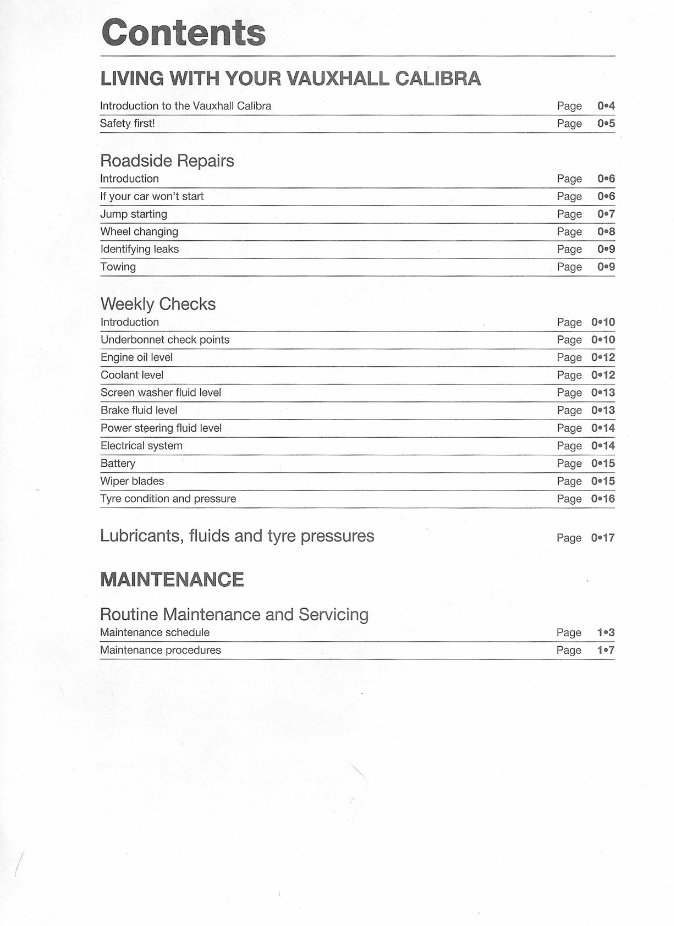
/ Contents LIVING WITH YOUR VAUXHALL CALI BRA Introduct ion to the Vauxhall Caubra Safety first! Roadside Repairs Introduction If your car won't start Jump starting Wheel changing Identifying leaks Towing Weekly Checks Introduction Und erbonnet check poi nts Engine oil level Coo lant level Screen washer fluid level Brake fluid level Power steering fluid level Electrical system Battery Wiper blades Tyre condition and pressure Lubricants, fluids and tyre pressures MAINTENANCE Routine Maintenance and Servicing Maintenance sc hedule Maintenance procedures Page 0· 4 Page 0·5 Page 0·6 Page 0·6 Page 0·7 Page 0·8 Page 0·9 Page 0·9 Page 0-10 Page 0-10 Page 0-12 Page 0-12 Page 0-13 Page 0-13 Page 0 -14 Page 0-14 Page 0-15 Page 0-15 Page 0-16 Page 0-17 Page 1-3
REPAIRS AND OVERHAUL Engine and Associated Systems SOHCengine procedures DOHCengine procedures Cool ing, heating and ventilation systems Fuel and exhaust systems> fuel injection Fuel and exhaust svstems . exhaust and emissions Engine electrical syste ms Transmission Clutc h Manual transmission Autom atic transmiss ion Driveshafts Brakes and Suspension Brak ing system Suspension and steering Body equipment Bodywork and fitti ngs Body electrical systems Wiring Diagrams REFERENCE Dimensions and weights Co nversi on fac to rs Buying spare parts and vehicle identification Gene ral rep air procedures Jacking and vehicle support Radi o/cassette unit anti-theft system Tool s and working facil ities MOT test checks Fault finding Glossary of technical term s Index Contents Page 2A" Page 28-1 Page 3" Page 4A-1 Page 48-1 Page 5" Page 6" Page 7A-1 Page 78-1 Page 8" Page 9" Page 10-1 Page 1 1-1 Page 12-1 Page 12-22 Page REF-, Page REF· 2 Page REF- 3 Page REF-4 Page REF- S Page REF-S Page REF-6 Page REF-S Page REF-12 Page REF-20 Page REF-26
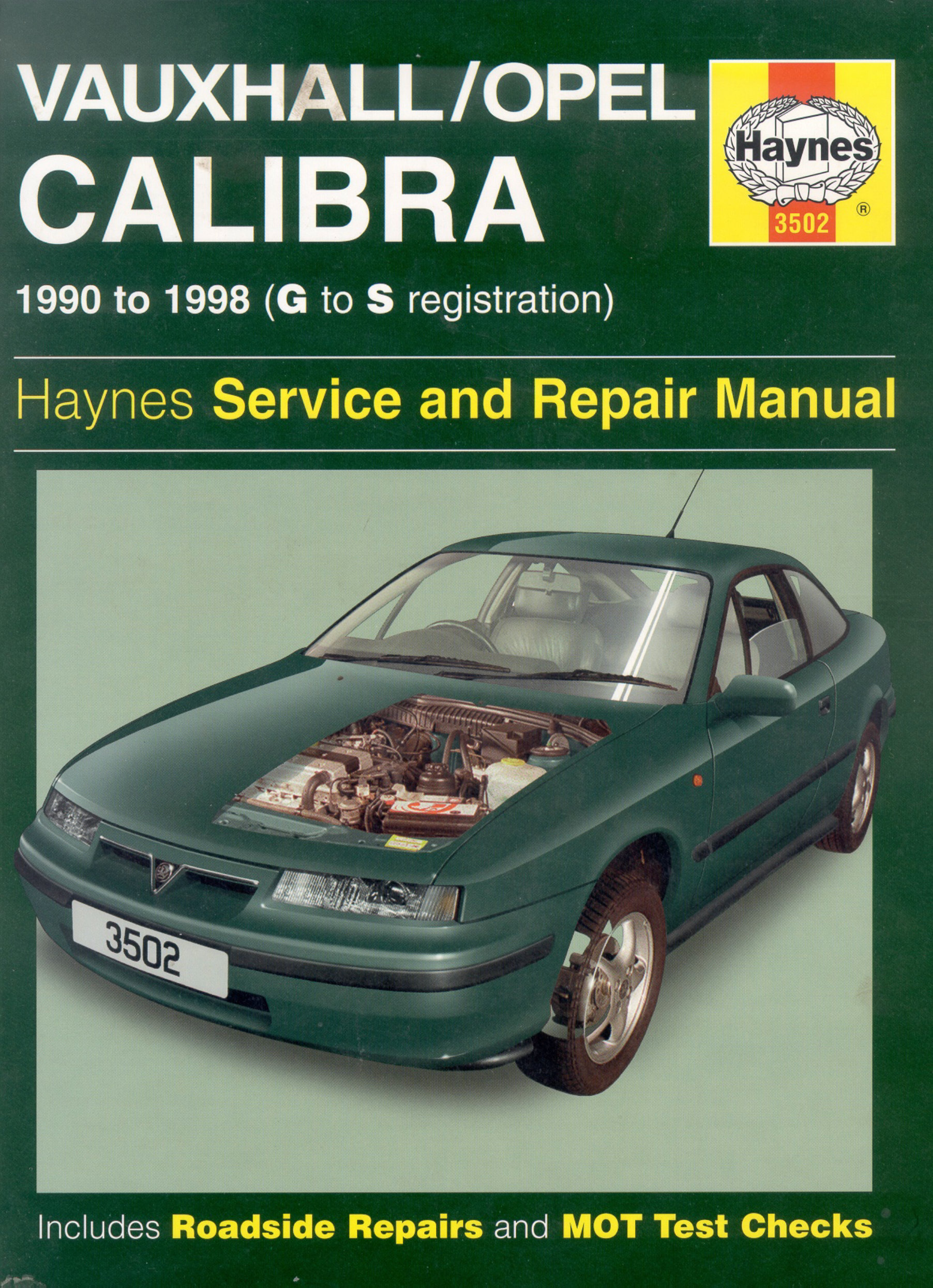
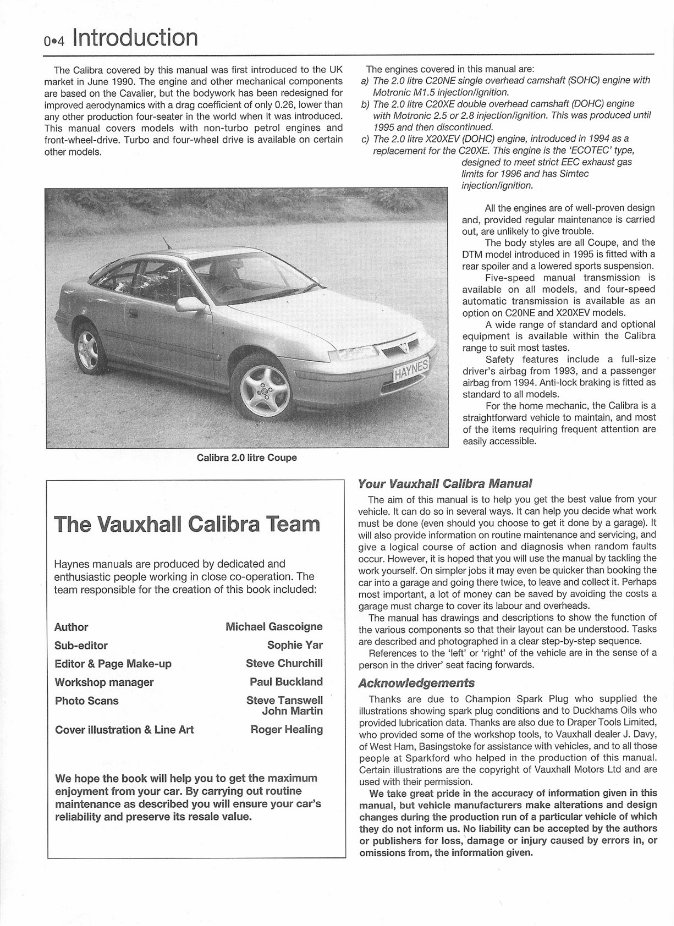
0-4 Introduction The Calibra cov ered by this manua l was first introduced to the UK market in June 1990. The engine and other mechanical components are based on the Cavalier. but the bodywork has been redesigned for improved aerodynamics with a drag ccemcent of only 0.26 , lower than any other production four-seater in the work! when it was introduced. This manual covers mod els with non-turbo petrol engines and front ·wheel-drive. Turbo and four-wheel drive is available on certain othel' models. cenera 2.0 litre Coupe The engines covered in this manual are: a) The 2.0 litre C20NE single 0VfNheadcamshaft (SOHe) engine with Motronic Ml.5 injection/ignition. b) The 2.0 litre C20XEdouble overhead camshaft (OOHC) engine with Motronic 2.5 or 2.8 injection/ignition. This was produced until 1995 and then discont inued. c) The 2.0 litre X20XEV(OOHC)engine, introduced in 1994 asa replacement for the C20XE. Thisengine is the 'ECO TEC' type, designed to meet strictf Ee exhaust gas limits for 1996 and has Sirntec ifliectionlignition. All the enginesare of well-proven design and, provided reqular maintenance is carried out, are unlikely to give trouble. The body styles are all Coupe, and the DTM model introduced in 1995 is fitted with a rear spoiler and a lowered sports suspension . Five-speed ma nual transmission is availabl e on all models, and four-speed aut omati c transmission is available as an opt ion on C20NE and X20XEV moclels. A wide range of standard and optional equipment is available within the Cahbra range to suit most tastes. Safety feat ures incl ude a tun-size driver's airbag from 1993, and a passenger airbag from 1994. Anti-lock brnking is fitted as standard to all models. For the home mechanic, the Calibrn is a straightforward vehicle to maintain, and most of the items requiring frequent attention are easily accessible. The Vauxhall Calibra Team Haynes manuals are produced by dedicated and enthusiastic peop le working in close co-operation. The team responsible for the creation of this book included: We hope the book will help you to get the maximum enjoyment from your car. By canyi ng out routine mai ntena nce as des cr ibed you will ensure your car's reliability and preserve its resale value. Autho r Sub-editor Editor & Page Make-up Workshop manager Photo Scans Cover illustration & Une Art Michael Gascoigne Sophie Var Steve Churchill Paul Buckland Steve Tanswell John Marti n Roger Healing Your Vauxha ll Calibra Manual The aim of this manual is to help you get the best value from your vehic le. It can do so in several ways. It canhelp you dec ide what work must be done (even shoul d you choose to get it done by a garage). II will also provide information on routine maintenance and servicing, and give a logical course of action and diagnosis when random faults occ ur. However, it is hoped that you will use the man ual by tackl ing the work yourself. On simpler job s it may even be quicker than booking the car into a garage and going there twice, to leave and collect it. Perhaps most important, a lot of money can be saved by avoiding the costs a garage must charge to cover rts labour and overheads. The manual has drawings and descriptions to show the function of the various components so that their layou t can be unders tood. Tasks are described and photographed in a clear step-by-step sequence. References to the 'left' or 'right' of the vehicle are in the sense of a person in the driver' seat faCing forwards. Acknowledgements Thanks are du e to Champion Spark Plug who supplied the illustrations showing spark plug conditions and to Duckhams Oils who provided kJbrication data. Thanks are also due to Draper TOOl s Limited , who provided some of the workshop tools, to Vauxhall dealer J. Davy, of West Ham. Basingstoke for assistance with vehicles, and to anthose people at Sp arkford who helped in the production of this manual. Certain illustrations are the copyright 01 Vauxhall Motors lid and are used wit h their permission. We take g reat pride in the accuracy of infonnation given in this m anua l, but vehicle man ufac turers make alterations and design changes during the production run of a parti cular vehicle of which they do not inf orm us. No liability can be accepted by the authors or pub lishers for loss, damage or i njury ca used by errors in, or omiss ions from, the information given.
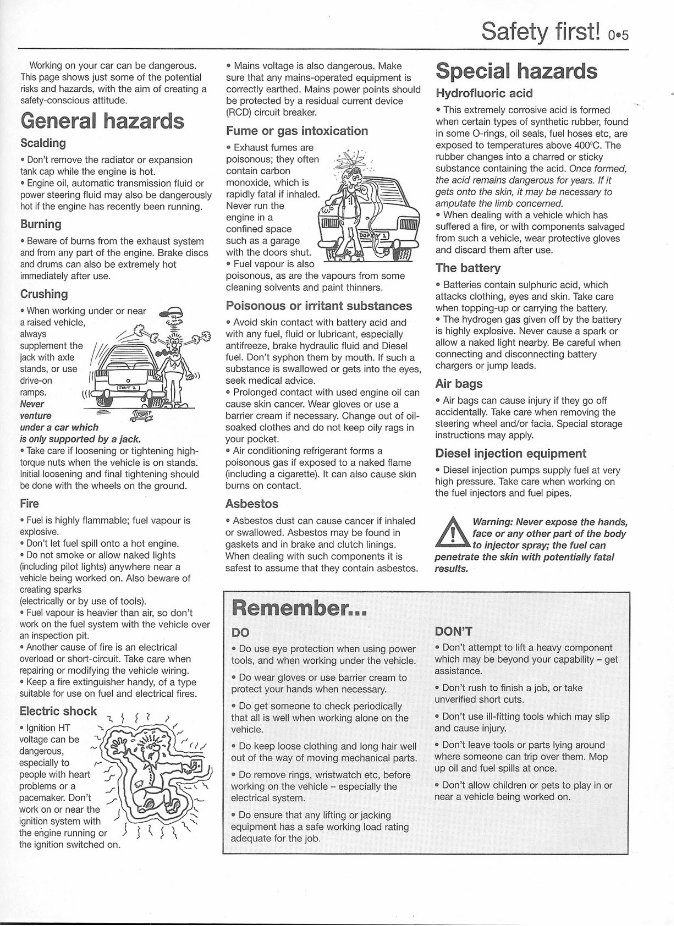
Safety first! 0·5 Working on your car can be dangerous. This page shows just some of the potential risks and hazards, with the aim of creating a safety-conscious attitude. General hazards Scalding • Don'l remove the radiator or expansion tank cap while the engine is hot. • Engine oil, automatic transmission fluid or power steer ing fluid may also be dangerous ly hot if the engine has recently been running. Burning • Beware of burns from the exhaust system and from any part of the engine, Brake discs and drums can also be extremely hot immediately after use. Crushing always supplement the jackwith axle stands, or use drive-on ramps. Never v enture under a car which is only supported by a jack. • Take care if loosening or tightening high- torque nuts when the vehicle is on stands. Initial loosening and final tightening should be done with the wheels on the ground. Fire • Mains voltage is also dangerous. Make sure that any mains-operated equipment is correctly earthed. Mains power points should be protected by a residual current device (RCD) circuit breaker. Fume or gas intoxication • Exhaust fumes are • poisonous: they often ~ contain carbon ~ monoxide, which IS ~ ~ rapidl y fata l If Inhaled I Never run the . engine In a confined space @. irXl such as a garage With the doors shut • Fuel vapour ISalso poisonous, as are the vapours from some cleaning solvents and paint thinners. Poisonous or irritant substances • Avoid skin contact with battery acid and with any fuel, fluid or lubricant, especially antifreeze, brake hydraulic fluid and Diesel fuel. Don 't syphon them by mouth. If such a sub stanc e is swallowed or gets into the eyes, seek medical advice. • Prol onged co ntact with used engine oil can cause skin cancer. Wear gloves or use a barrie r crea m if nece ssary. Chan ge o ut of oil- soaked clothes and do not keep oily rags in your pocket. • Air conditioning refrigerant forms a poisonous gas if exposed to a naked flame (including a cig arette). It can also cause skin burns on contact. Asbestos Special hazards Hydrofluoric acid • This extremely corrosive acid is formed when certain types of synth etic rubber , found in some O-rings, oil seals. fuel hoses etc, are exposed to temperatures above 400'C. The rub ber chan ges into a charred or sticky substance containing the acid . Once formed, the acid remains dangerous for years. If it gets onto the skin, it may be necessary to amputate the limb concemed. • When dealing with a vehicle which has suffer ed a fire, or with components salvaged from such a vehicle, wear protective gloves and discard them after use. The battery • Batteries contain sulphuric acid, which attacks clothing, eyes and skin. Take care when topping-up or carrying the battery. • The hydrogen gas given off by the battery is highly explosive. Never cause a spark or allow a naked light nearby. Be careful when connecting and disconnecting battery charg ers or jump lead s. Air bags • Air bags can cause injury if they go off acc identally. Take care when removing the steering wheel and/or facia. Special st orage instructions may apply. Diese l injection equipment • Diesel injection pumps supply fuel at very high pressure. Take care when working on the fuel injectors and fuel pipes. DON'T • Don' t att empt to lift a heavy component which may be beyond your cap ability - get assistance. • Don't rush to finish a job, or take unve rified short cuts . • Don't use ill-fitting tools which may slip and cause injury. • Don't leave to ols or part s lying around where someone can trip over them. Mop up oil and fuel spills at once. • Don't allow children or pets to play in or near a vehicle being wor ked on. A wam ;ng: Never expose the hands, , face or any other part of the body 4 to injector spray; the fuel can penetrate the skin with potentially fatal results. • Do use eye protection when using power tools, and when wo rking und er the vehicle. • Do wear gloves or use barrier crea m to protect your hands when necessary. • Do get someone to check periodically that all is well wh en working alo ne on the veh icle . • Do keep loose cloth ing and long hair well out of the way of moving mechanical parts. • Do remove rings, wristwatch etc, before working on the vehicle - especially the electrical system . • Do ensure that any lift ing or jacking equipment has a safe working load rating adequate for the job • Asbestos dust can cause cancer if inhaled or swa llowed. Asbestos may be found in gaskets and in bra ke and clutch linings. When dealing with such components it is safest to assume that they contain asbestos. Remember ... DO Ii' Electric shock • Fuel is highly flammab le; fuel vapour is explosive. • Don't let fuel spill onto a hot engine. • Do not smoke or allow naked lights (including pilot lights) anyw here near a vehicle being worked on. Also beware of creating sparks (electrically or by use of tools). • Fuel vapour is heavier than air, so don't work on the fuel system with the vehicle over an inspection pit. • Another cause of fire is an elect rical overload or short -c ircuit. Take care whe n repairing or modifying the vehicle wiring. • Keep a fire extinguisher handy, of a type suitable for use on fuel and electrical fires . • Ignition HT voltage can be dangerous , especially to ~·~1»'l:i~::::l;~~! people with heart -:;- problems or a ./ pacemaker. Don't ./ work on or near the ignition system with the engine running or the ignition switched on .
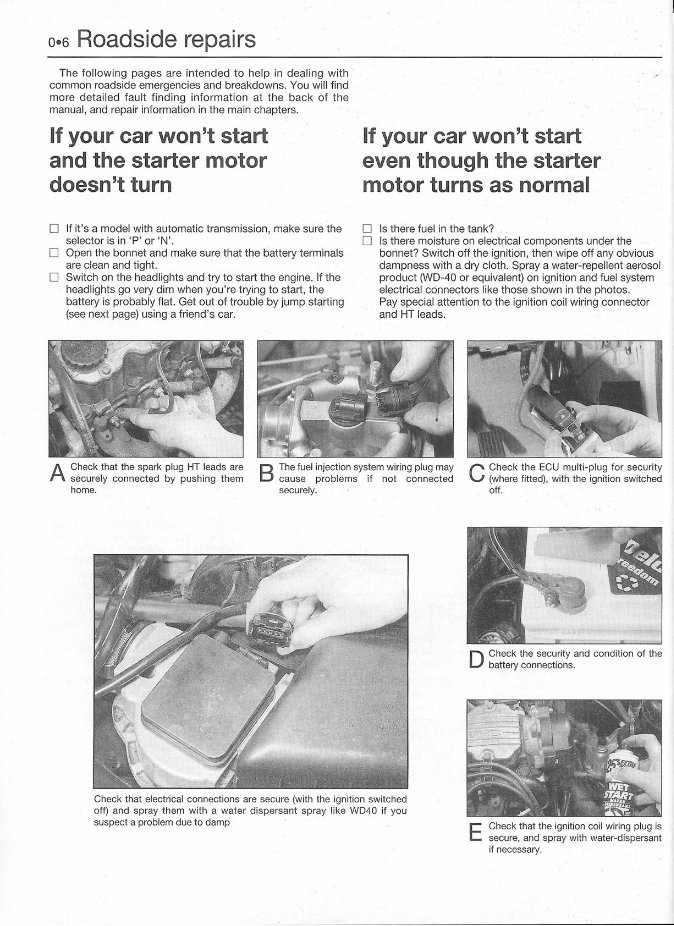
0-6 Roadside repairs The following pages are intended to help in dealing with common roadside emergencies and breakdowns . You will find more detailed fault finding information at the back of the manual, and repair information in the main chapters. If your car won't st art and the starter motor doesn't turn o If it's a model with automatic transmission, make sure the selector is in 'P ' or 'N', D Open the bonnet and make sure that the battery terminals are clean and tight. o Switch on the headlights and try to start the engine. If the headlights go very dim whe n you're trying to start , the battery is probably flat. Get out of trouble by jump starting (see next page) using a friend's car. If your car won 't sta rt even though the sta rter motor turns as normal o Is there fuel in the tank? o Is there moisture on electrical components under the bonnet? Switch off the ignition, then wipe off any obvious dampness with a dry cloth. Spray a water-repellent aerosol p roduct (WD-40 or equivalent) on ignition and fuel system electrical connectors like those shown in the photos. Pay special attention to the ignition coil wiring connector and HT leads. A Check that the spark plug HT leads are securely connected by pushing them home. B The fuel injectio n system wiring plug may cause problems if not connected securely. C Check the ECU multi-plug for security (where fitted), with the ignition switched off. Check that electrica l connections are secure (with the ignition switched off) and spray them with a wate r dispersant spray like WD40 if you suspect a problem due to damp D Check the security and condition of the battery connections . E Check that the ignition coil wiring plug is secure, and spray with water-dispersant if necessary.
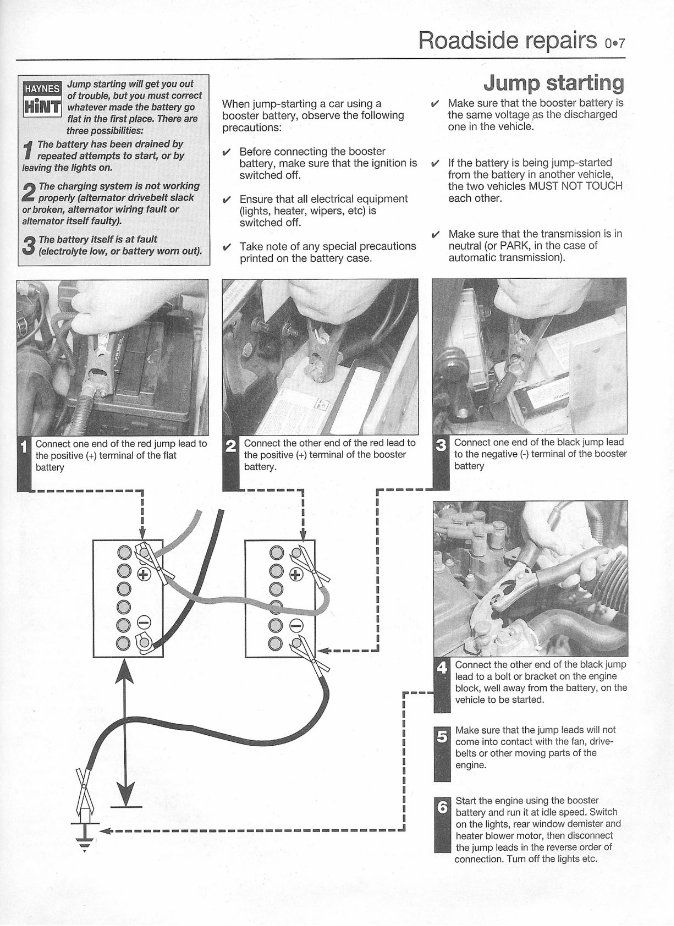
Roadside repairs 0.7 ~ Jump startingwill get you out • of trouble, but you must correct HI whatevermade the battery go flat in the first place. There are three possibilities: 1 The battery has been drained by repeated attempts to start, or by leaving the lights on. 2 The charging system is not working properly (altemator drivebett slack or broken, alternator wiring fault or altemator its e" faulty). 3 The battery itse" is at fault (electrolyte low, or battery worn out). When jump- starting a car using a booster battery, observe th e follow ing precautions: ." Before connecting the booster battery, make sure that the ign ition is switched off. "" Ensu re that all elec tri cal equipment Qights. heater, wipers. etc) is switched off. '" Take note of any special precautions printed on the battery case. Jump starting to" Make sure that the booster ba tte ry is the same volt age as the disch arged one in the vehic le. t/ If the battery is being jump-started from the battery in another vehicle, the two vehicles MUST NOT TOUCH each other. tI Make sure that the transmission is in neutral (or PARK, in the case of automatic transmission). ~------------------------------ ~ Connect the other end of the black jump lead to a bolt or bracket on the engine block, well away from the battery. on the vehicle to be started. i Start the engine using the booster • battery and run it at idle speed. Switch on the lights, rear window dem ister and healer blower motor, then disconnect the jump leads in the reverse order of connection. Tum off the lights etc. I Make sure that the.jump leads wi ll not come into contact WIth the fan, drive- bells or other ITIOVlng part s of the eng ine . -----, I I I Connect the other end of the red lead to the positive (+) terminal of the booster battery. Connect one end of the red jump lead to the positive (+1tenn inal of the flat batt"'Y ----------., I I I
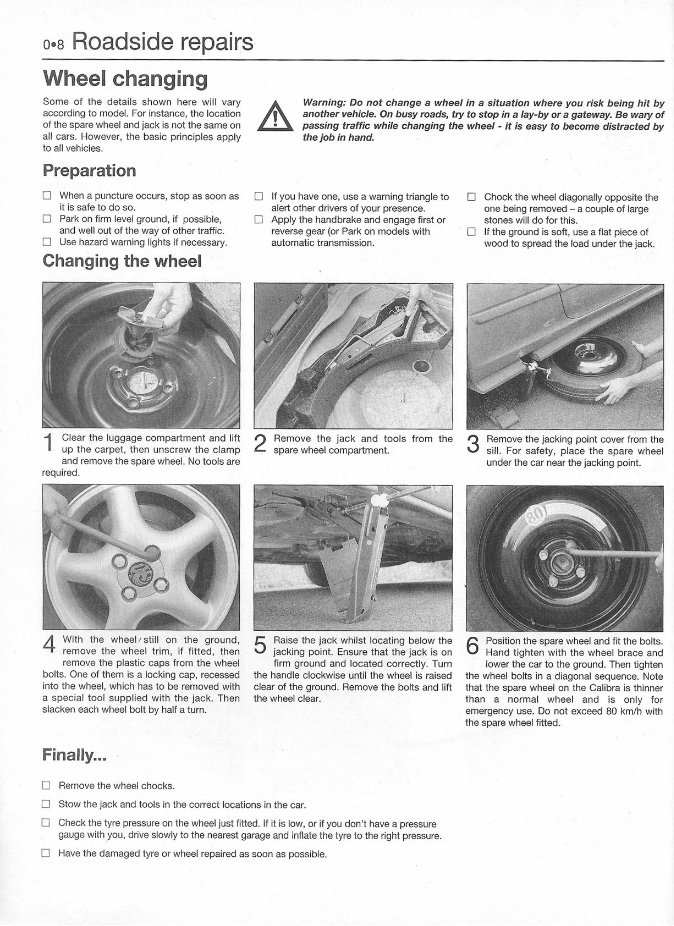
0'8 Roadside repairs Wheel changing Some of the details shown here will vary according 10 model. For instance. the loca tion of the spa re wheel and jack is not the same on all cars. However, the basic principles appty to all vehicles. Warning: Do not change a wheel in a situation where you ri sk being hit by another vehicle. On busy roads, try to stop in a lay-by or a gateway. Be wary of passing tra ffic wh ile changing the wheel · it is easy to become di stracted by the job in hand. Preparation o When a punct ure occurs. slop as soo n as it is sa le to do so. D Park on finn level ground , if possible, and well out of the way of other traffi c. D Use hazard warning lights if nec essary . Changing the wheel o If you have one, use a waming triang le to alert other dnvEll'S of your presence. o Apply the hand brak e and engage first Of reverse gear (or Park on models with automatic transmission. o Chock the wheel diagonally opposite the one being remo ved - a cou ple of large stones will do for this. o If the ground is soft , use a flat piece of wood to spread the load under the jack. 6 Position the spare wheel and fit the bolts. Hand tighten with the wheel brace and lower the car to the ground. Then tighten the wheel bolts in a diagonal sequence . Note that the spar e wheel on the Calibra is th inner than a normal wheel and is only for emergency use. Do not exceed 80 knVh with the spar e wheel fitt ed. 3 Remo ve the jaCking poi nt cover from the sill. For safety. place the spare wheel under the car near the jacki ng poi nt. 2 Remove the j ack and tools from the spare wheel compartment. 5 Raise the jack whilst locat ing below the jacking point. Ensure that the jack is on firm ground and located co rrectly. Tum the handle clockwise unt il the wheel is raised clear of the ground . Remove the bolts and lift the wheel clear . 4 Wit h the wheel - sun on the ground, remove the wheel tnm. if fitt ed. then remove the plastic caps from the wheel bolts. One of them is a locking cap. recessed into the wheel. wtlidl has to be removed with a spec ial tool supplied with the jack . The n slaCken each wheel bolt by half a tum. 1 Clear the luggage co mpartment and lilt up the carpet , then unscrew the clamp and remove the spare wheel . No tools are requ ired . ~~~~ Finally... D Remove the wheel chocks. o Stow the jack and tool s in the correct loca tions in the car. D Check the tyre pressure on the wheel just fitted . If it is low, or if you don 't have a pressure gauge with you, drive slowly to the nearest garage and inflate the tyre to the right pressure. D Have the damaged tyre or wheel repaired as soon as poss ible.
This workshop repair service manual is designed to cover the repair and overhaul of Opel Calibra cars from 1990 to 1998. It assumes that the technician is fully conversant with general automobile practices and emphasizes the special aspects of the product to enable the building and maintenance of a reputation of quality service.
The manual includes instructions on components manufactured for Opel Calibra cars from 1990 to 1998. It also incorporates instructions from respective component manufacturers to enable technicians to understand their functions properly and judge the performance of the car as a whole.
This complete service manual contains all necessary instructions needed for any repair your Opel Calibra from 1990 to 1998 may require. It covers tune-ups, maintenance, removal & install procedures, assemblies & disassemblies, fuel system, ignition, lubrication system, exhaust, electrical system, body, and more extensive repairs involving engine and transmission disassembly.
It provides the most reliable information and aims to help you get the best value from your Opel Calibra from 1990 to 1998. The manual includes many of the specifications and procedures available in an authorized Opel dealer service department, offering information and procedures for routine maintenance and servicing, as well as diagnostic and repair procedures to follow when trouble occurs.
For those intending to do maintenance and repair on their Opel Calibra from 1990 to 1998, it is essential to use safety equipment and observe safety precautions when working on the vehicle. The manual also refers to special tools that are recommended or required to accomplish adjustments or repairs, often identified by their Opel Calibra special tool number and illustrated.
The owner will find that owning and referring to this manual will make it possible to be better informed and to more knowledgeably repair the vehicle like a professional automotive technician.
Specification:
This is a FORM NOT A HARD COPY!!!
FAST and FREE ELECTRONIC DELIVERY via Email!!!
Language: English
Printable: Yes
File Format: .PDF
General Maintenance Tags for WSMBEST Workshop Service Manuals:
Air cleaner element renewal
Air cleaner temperature control check
Auxiliary drivebelt check
Battery electrolyte level check
Battery terminal check
Brake hydraulic fluid renewal
Brake hydraulic system seal and hose renewal
Brake pipe and hose check
Choke adjustment check
Contact breaker point renewal and distributor lubrication



 Lifetime Access