HOW TO USE THIS MANUAL : Repair Manual RDE-000554438 DESCRIPTION This volume explains “Removal, Disassembly, Installation, Inspection and Adjustment” and “Trouble Diagnoses”. TERMS The captions WARNING and CAUTION warn you of steps that must be followed to prevent personal injury and/or damage to some part of the vehicle. WARNING indicates the possibility of personal injury if instructions are not followed. CAUTION indicates the possibility of component damage if instructions are not followed. BOLD TYPED STATEMENTS except WARNING and CAUTION give you helpful information. Standard value: Tolerance at inspection and adjustment. Limit value: The maximum or minimum limit value that should not be exceeded at inspection and adjustment. UNITS The UNITS given in this manual are primarily expressed as the SI UNIT (International System of Unit), and alternatively expressed in the metric system and in the yard/pound system. Also with regard to tightening torque of bolts and nuts, there are descriptions both about range and about the standard tightening torque. “Example” Range Outer Socket Lock Nut : 59 - 78 N·m (6.0 - 8.0 kg-m, 43 - 58 ft-lb) Standard Drive Shaft Installation Bolt : 44.3 N·m (4.5 kg-m, 33 ft-lb) CONTENTS A QUICK REFERENCE INDEX, a black tab (e.g. ) is provided on the first page. You can quickly find the first page of each section by matching it to the section's black tab. THE CONTENTS are listed on the first page of each section. THE TITLE is indicated on the upper portion of each page and shows the part or system. THE PAGE NUMBER of each section consists of two or three letters which designate the particular section and a number (e.g. “BR-5”). THE SMALL ILLUSTRATIONS show the important steps such as inspection, use of special tools, knacks of work and hidden or tricky steps which are not shown in the previous large illustrations. Assembly, inspection and adjustment procedures for the complicated units such as the automatic transaxle or transmission, etc. are presented in a step-by-step format where necessary.
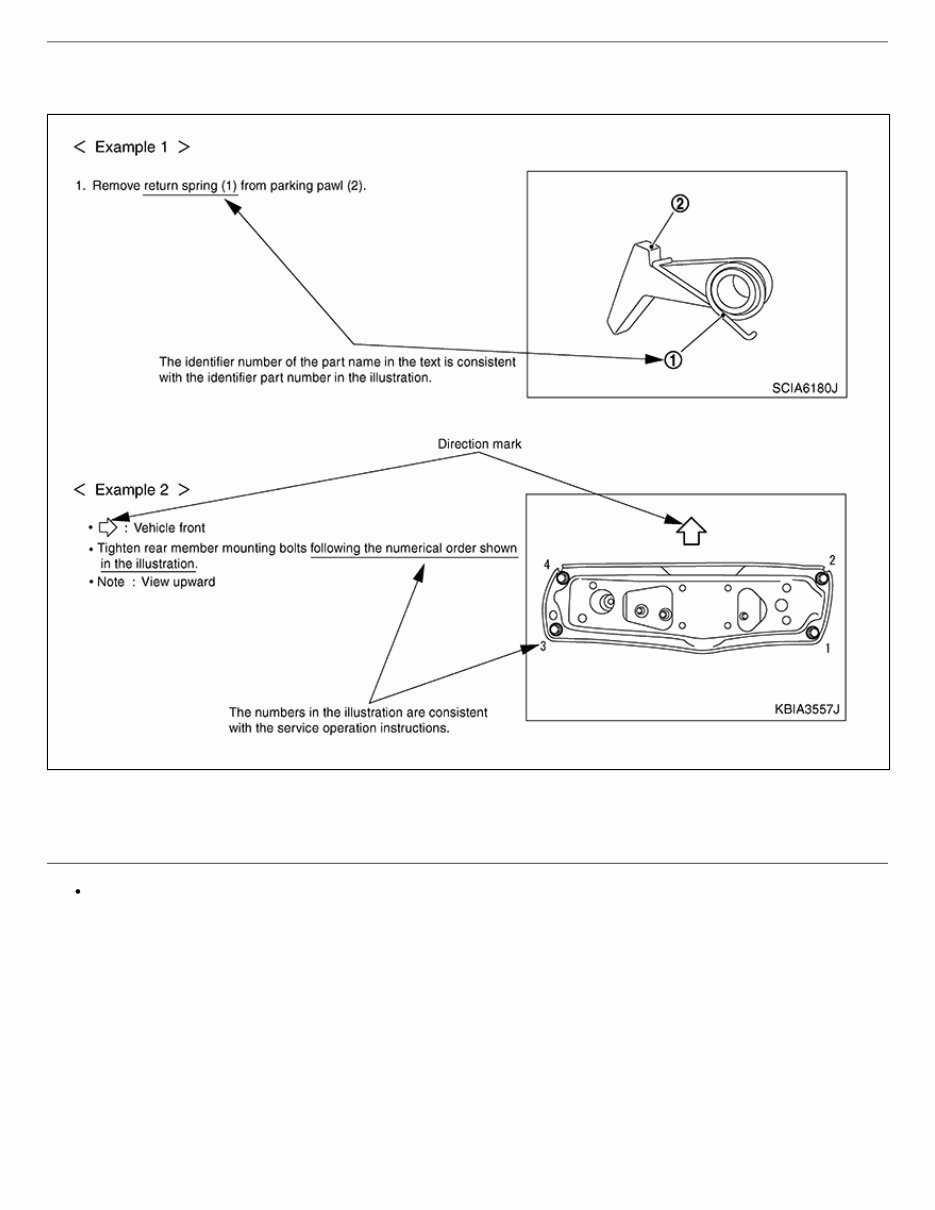
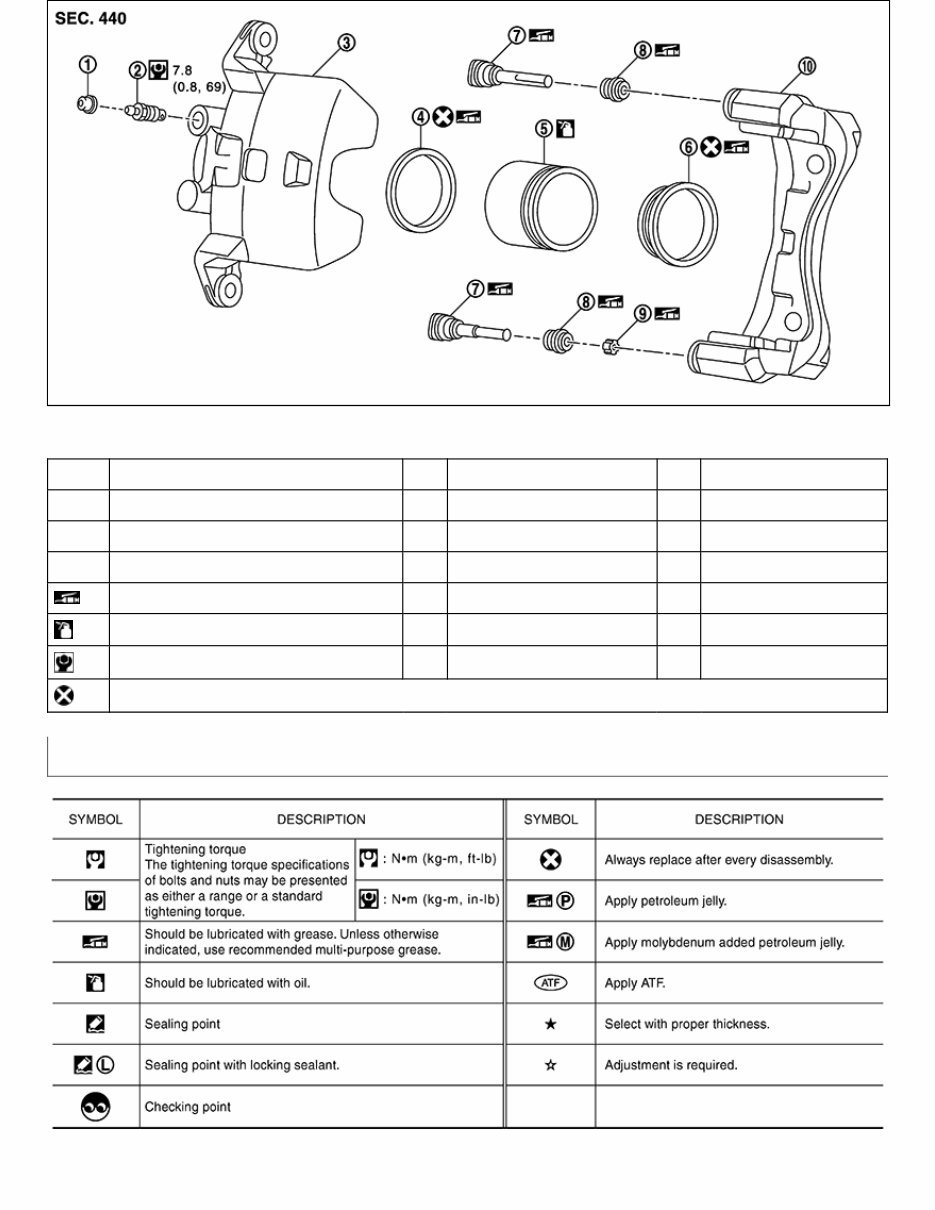
RELATION BETWEEN ILLSUTRATIONS AND DESCRIPTION The following sample explains the relationship between the part description in an illustration, the part name in the text and the service procedures. -01-AIA0519E COMPONENTS THE LARGE ILLUSTRATIONS are exploded views (see the following) and contain tightening torques, lubrication points, section number of the PARTS CATALOG (e.g. SEC. 440) and other information necessary to perform repairs. The illustrations should be used in reference to service matters only. When ordering parts, refer to the appropriate PARTS CATALOG. Components shown in an illustration may be identified by a circled number. When this style of illustration is used, the text description of the components will follow the illustration.
-02-PFIA0511GB 1. Cap 2. Bleeder valve 3. Cylinder body 4. Piston seal 5. Piston 6. Piston boot 7. Sliding pin 8. Sliding pin boot 9. Bushing 10. Torque member : Apply rubber grease. : Apply brake fluid. : N·m (kg-m, in-lb) : Always replace after every disassembly Symbols -03-AIA0749E
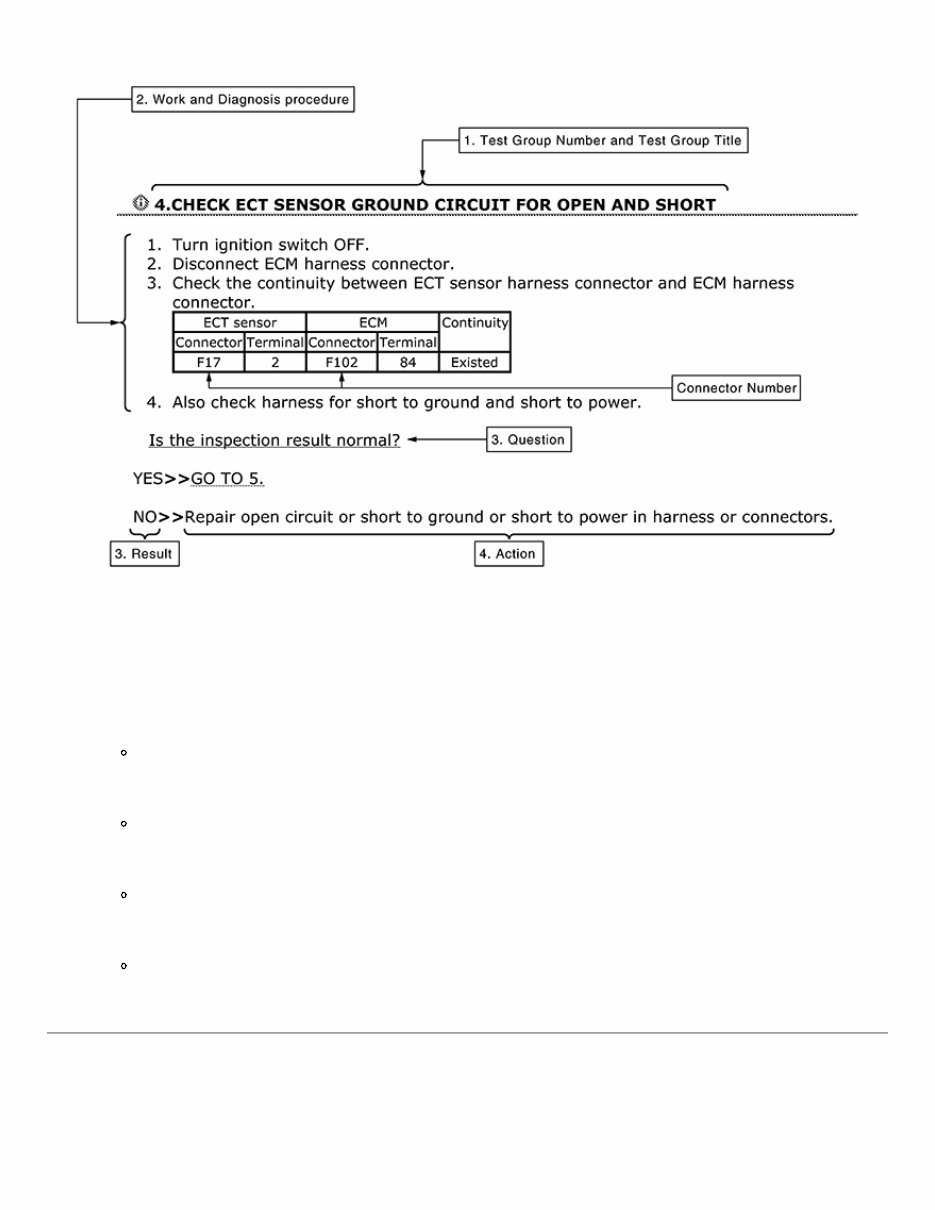
HOW TO USE THIS MANUAL : Diagnosis Manual NISA0000000010242408 Discription NOTE: Trouble diagnoses indicate work procedures required to diagnose problems effectively. Observe the following instructions before diagnosing. Before performing trouble diagnoses, read the “Work Flow” in each section. After repairs, re-check that the problem has been completely eliminated. Refer to Component Parts and Harness Connector Location for the Systems described in each section for identification/location of components and harness connectors. When checking circuit continuity, ignition switch should be OFF. Refer to the Circuit Diagram for quick pinpoint check. If you need to check circuit continuity between harness connectors in more detail, such as when a sub-harness is used, refer to Wiring Diagram in each individual section and Harness Layout in PG section for identification of harness connectors. Before checking voltage at connectors, check battery voltage. After accomplishing the Diagnosis Procedures and Electrical Components Inspection, check that all harness connectors are reconnected as they were. How to Follow Test Groups in Trouble Diagnosis
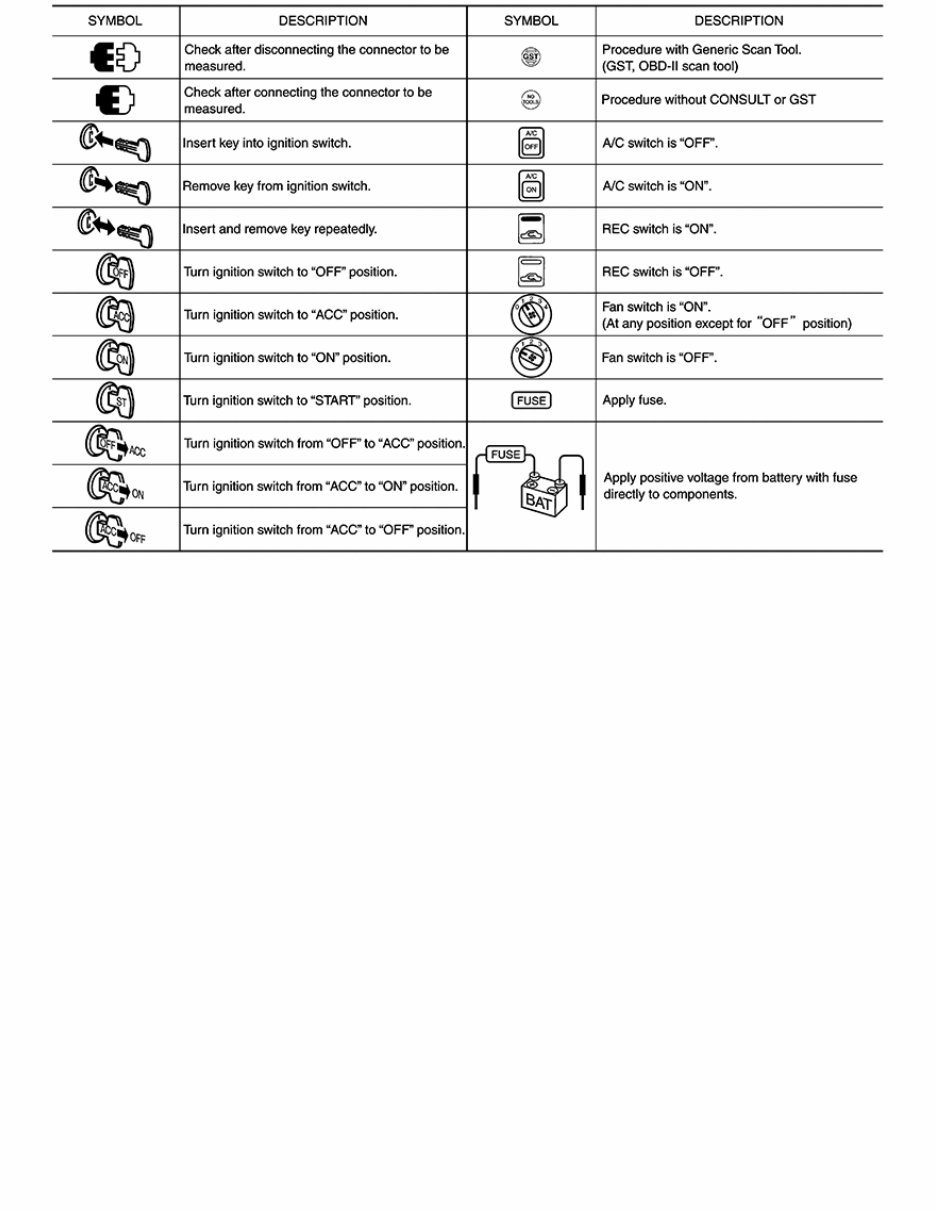
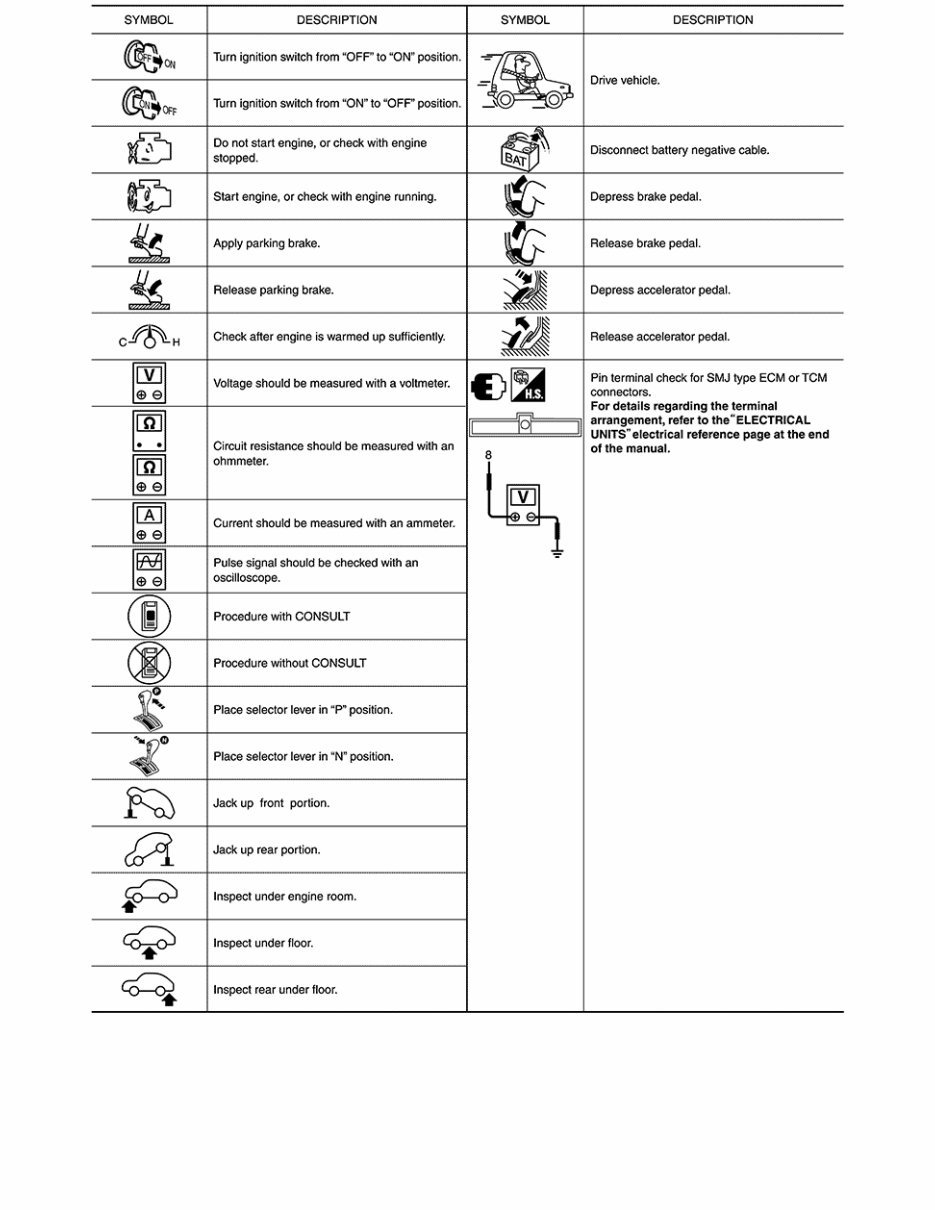
NISA0000000010242408-01-PAIA0021GB 1. Test group number and test group title Test group number and test group title are shown in the upper portion of each test group. 2. Work and diagnosis procedure Start to diagnose a problem using procedures indicated in enclosed test groups. 3. Questions and results Questions and required results are indicated in test group. 4. Action Next action for each test group is indicated based on result of each question. Key to Symbols Signifying Measurements or Procedures
NISA0000000010242408-03-PAIA0982GB
NISA0000000010242408-02-SAIA1461GB
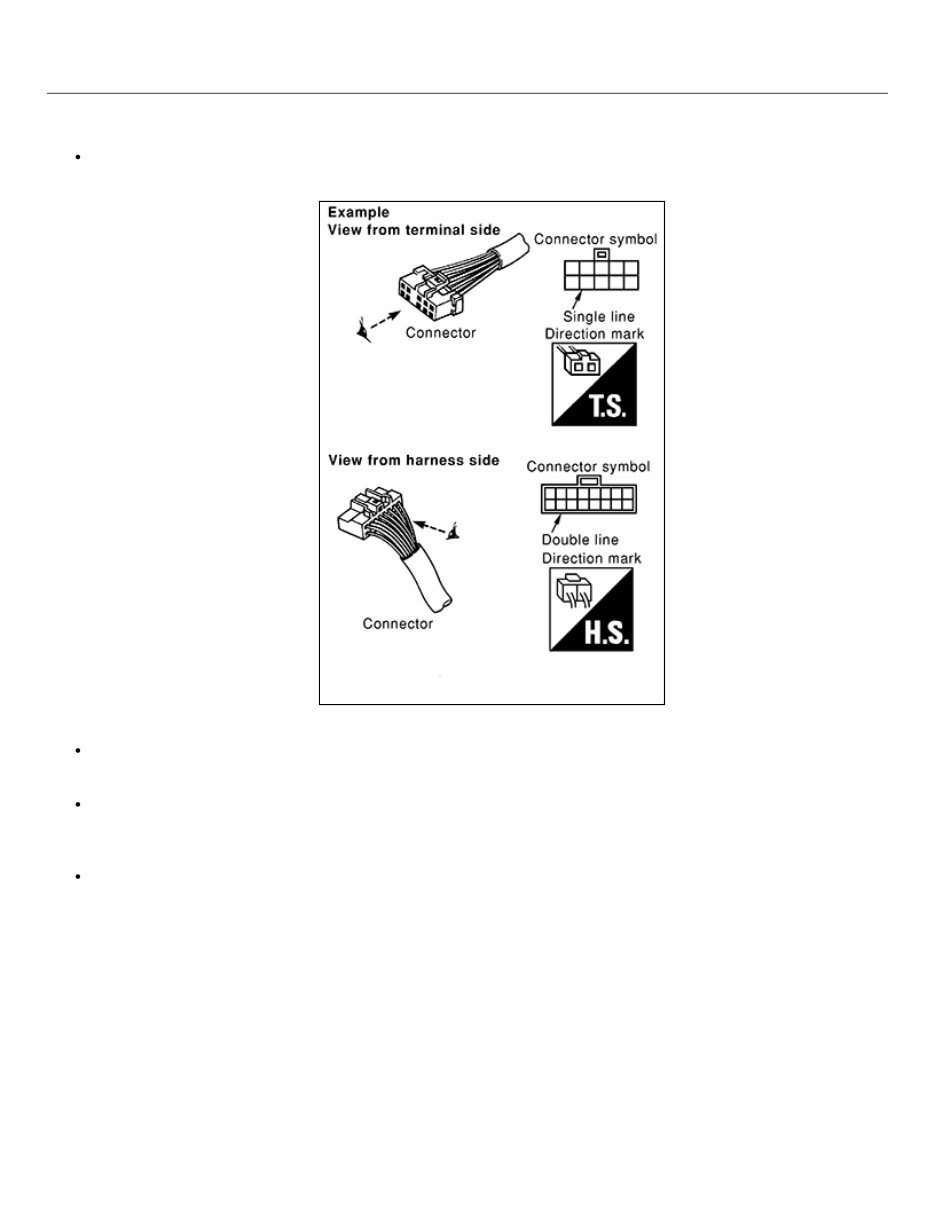
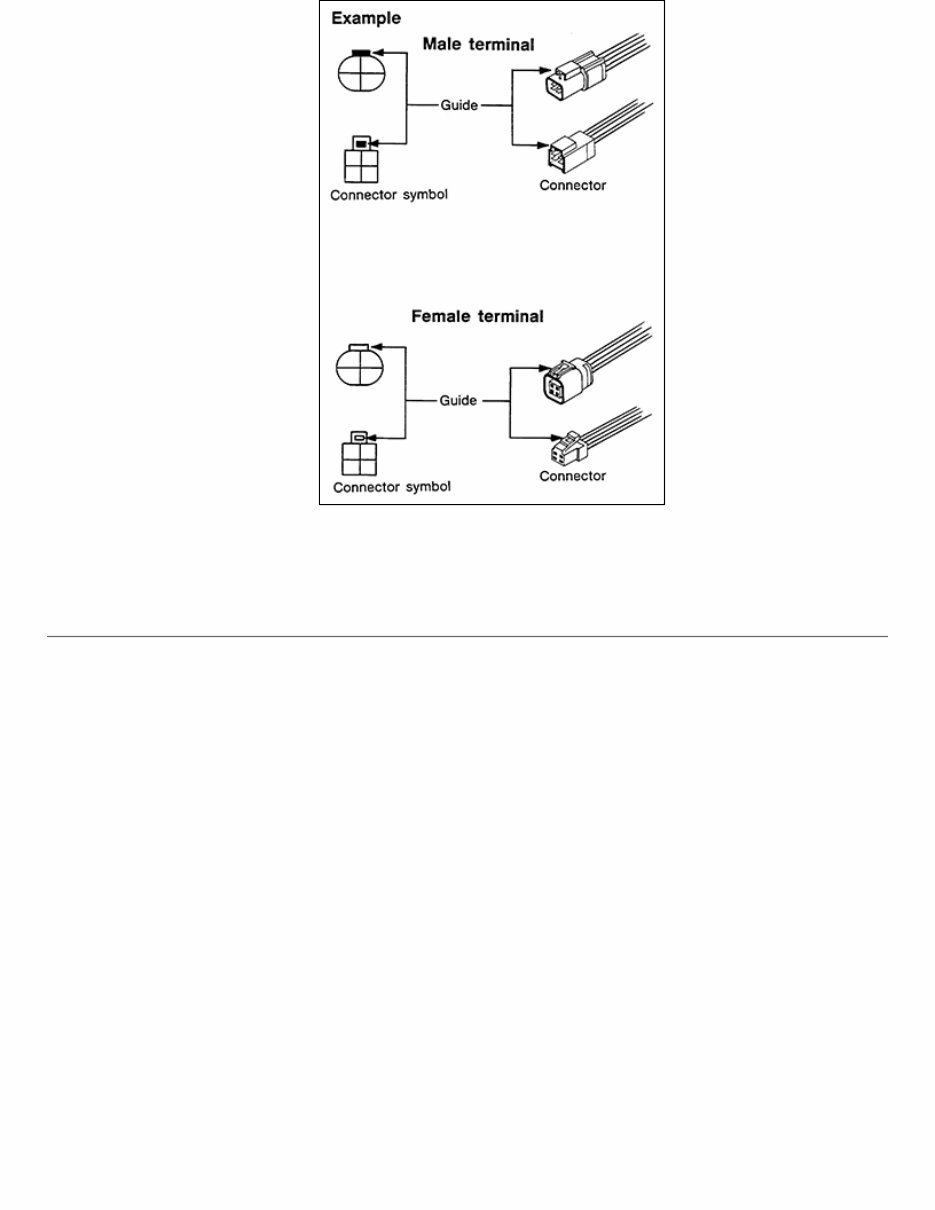
HOW TO USE THIS MANUAL : Wiring Diagram NISA0000000010242411 Connector Symbols Most of connector symbols in wiring diagrams are shown from the terminal side. Connector symbols shown from the terminal side are enclosed by a single line and followed by the direction mark. -01-AIA0257E Connector symbols shown from the harness side are enclosed by a double line and followed by the direction mark. Certain systems and components, especially those related to OBD, may use a new style slide-locking type harness connector. For description and how to disconnect, refer to PG section, “Description”, “HARNESS CONNECTOR”. Male and female terminals
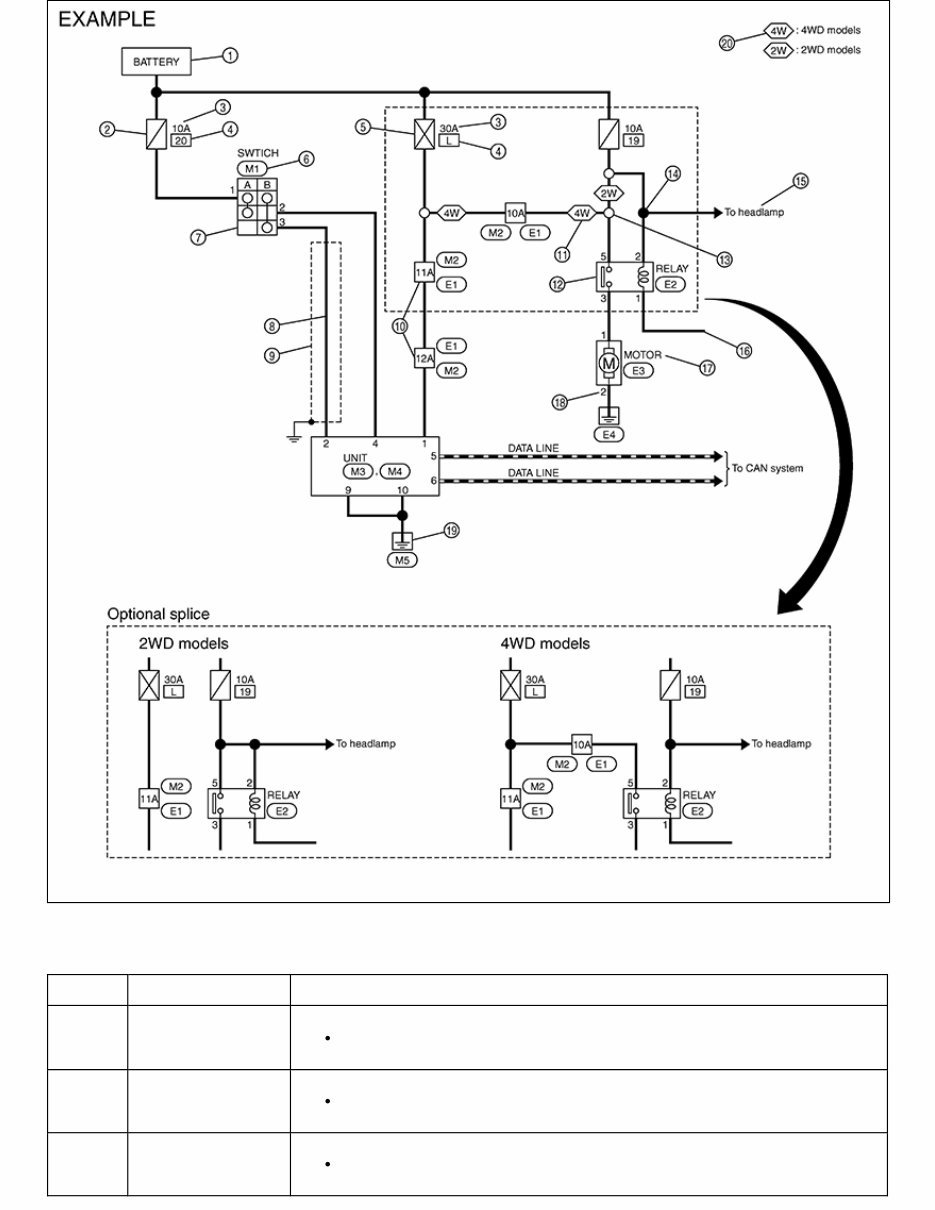
-02-GI363 Connector guides for male terminals are shown in black and female terminals in white in wiring diagrams. Sample/Wiring Diagram -Example- Each section includes wiring diagrams.
-04-RAWC3780GB Description Number Item Description 1 Power supply This means the power supply of fusible link or fuse. 2 Fuse “/” means the fuse. 3 Current rating of fusible link/fuse This means the current rating of the fusible link or fuse.
Maintaining and repairing your 2022 Nissan Armada just got easier with the release of the new service & repair manual. This comprehensive manual contains all the necessary troubleshooting and replacement procedures recommended by the manufacturer, including step-by-step instructions, clear images, and exploded-view illustrations.
Even with the durable build of your Armada, regular maintenance is still essential. With time, certain parts may wear out and need to be replaced. But with this handy manual, you'll have access to all the information you need to keep your vehicle running smoothly and save on expensive repairs in the long run.
Gone are the days of flipping through countless pages or dealing with greasy, torn, or lost pages. This digital manual allows for easy search and navigation, making it the perfect companion for DIY repairs. And if you prefer a physical copy, simply print it out for your convenience.
Compatible with any electronic device, including PC and Mac computers, smartphones, and tablets, this service & repair manual is easily accessible whenever you need it. All you need is Adobe Reader, which is available for free.
Don't wait until a small issue turns into a major problem. Get your 2022 Nissan Armada Service & Repair Manual today and keep your vehicle in top shape for years to come.



 Lifetime Access