

100-01 Identification Codes 2007 Town Car
DESCRIPTION AND OPERATION Procedure revision date: 06/12/2006
Identification Codes
Vehicle Identification Number (VIN) Location
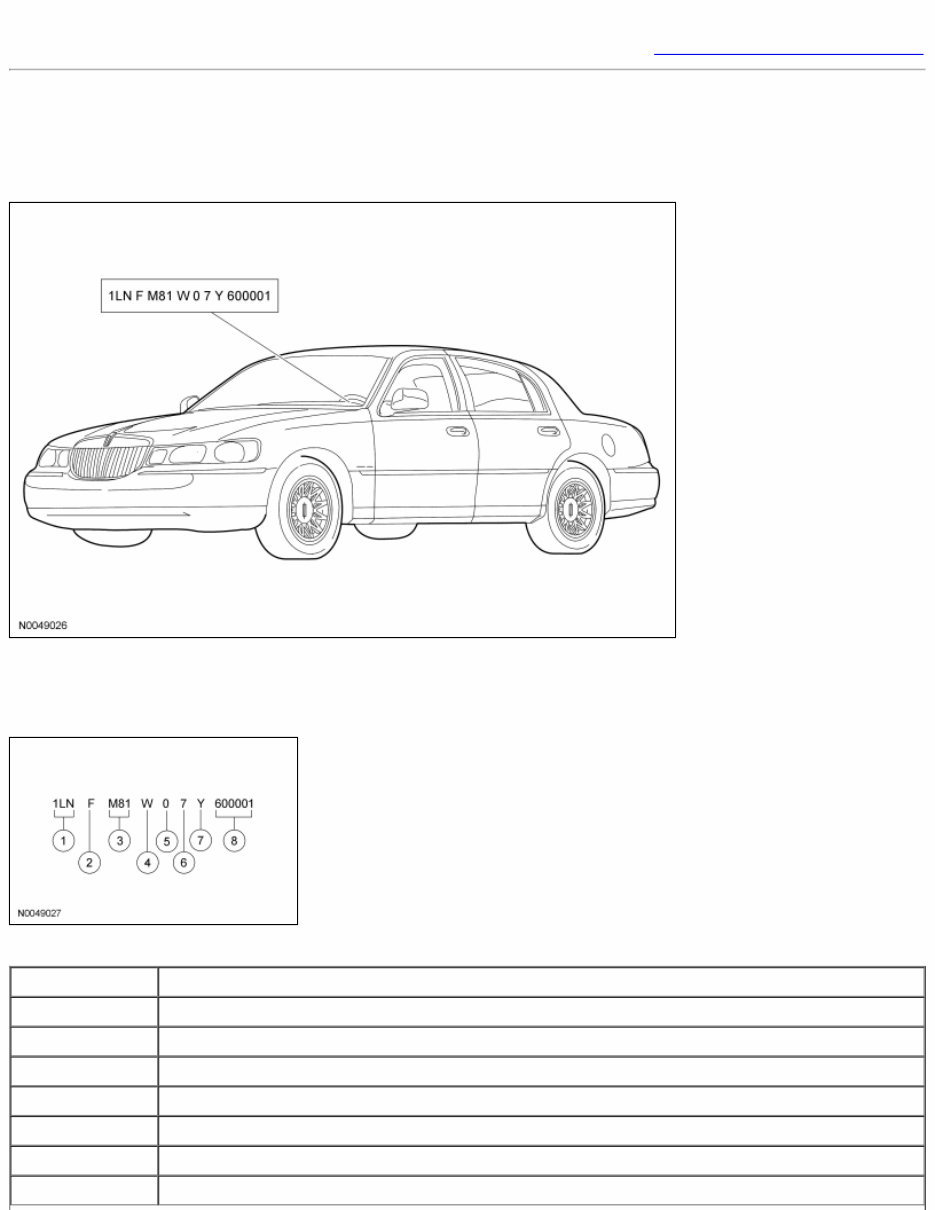
The vehicle identification number (VIN) is a 17-digit combination of letters and numbers. The VIN is stamped on a metal
tab riveted to the instrument panel, top upper left of the dash. The VIN number is also found on the vehicle certification
(VC) label.
Item Description
1 World manufacturer identifier (WMI)
2 Restraint type code
3 Vehicle line and series code
4 Engine code
5 VIN check digit code
6 Model year code
7 Assembly plant code
Item Description
8 Production sequence number
Vehicle Identification Number (VIN)
World Manufacturer Identifier (WMI)
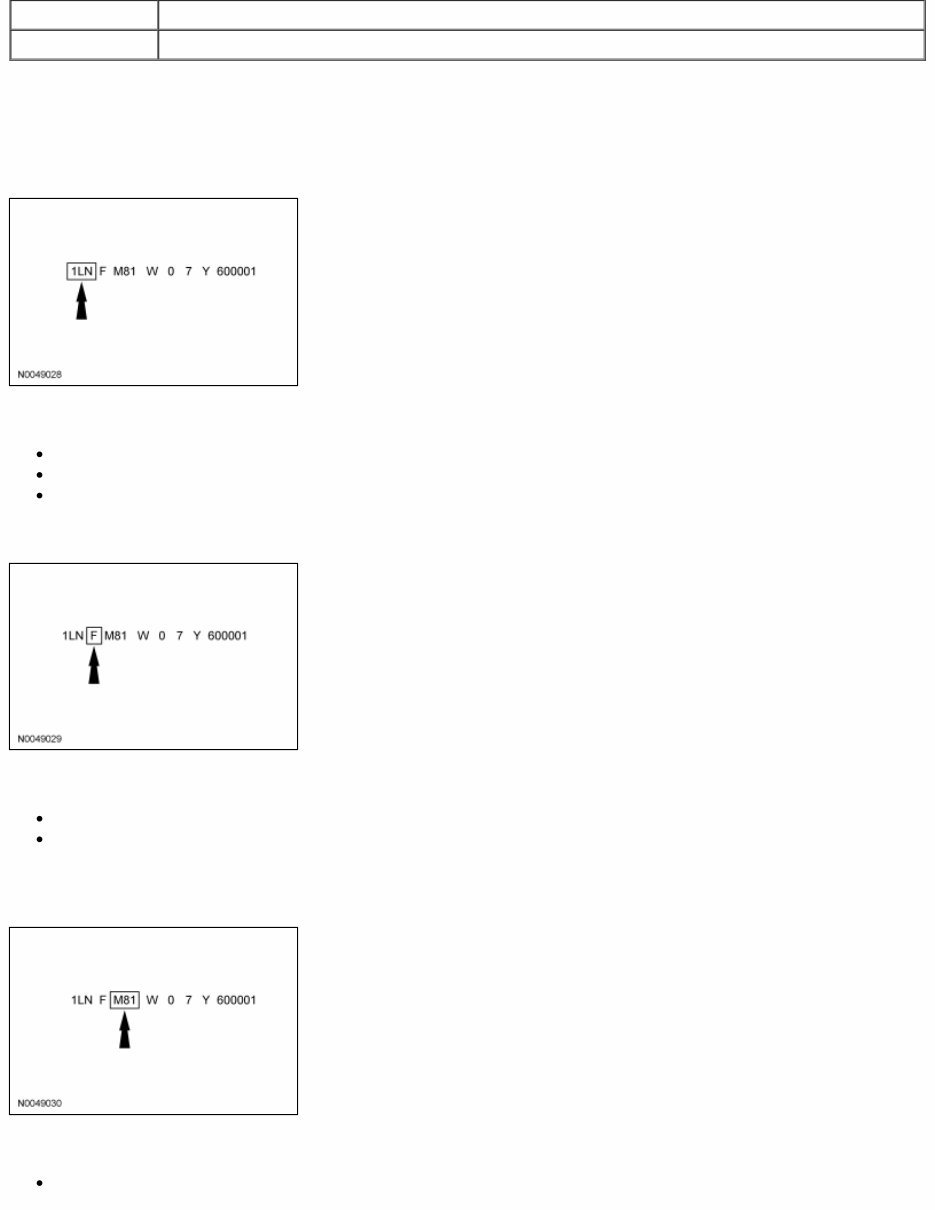
The 3 vehicle identification number (VIN) positions are the world manufacturer identifier (WMI).
1LN — Lincoln, USA, passenger car
1LJ — Lincoln, USA, incomplete vehicle, Hearse
1L1 — Lincoln, USA, Limousine
Restraint Code
The fourth VIN position is the vehicle restraint system type code.
F — Active safety belts — all positions, driver and front passenger air bags (limousine/hearse)
H — Active safety belts — all positions, driver and front passenger air bags with driver and front passenger side
impact air bags
Vehicle Line and Series Code
Positions 5 through 7 indicate vehicle line and series code.
M81 — Signature Series
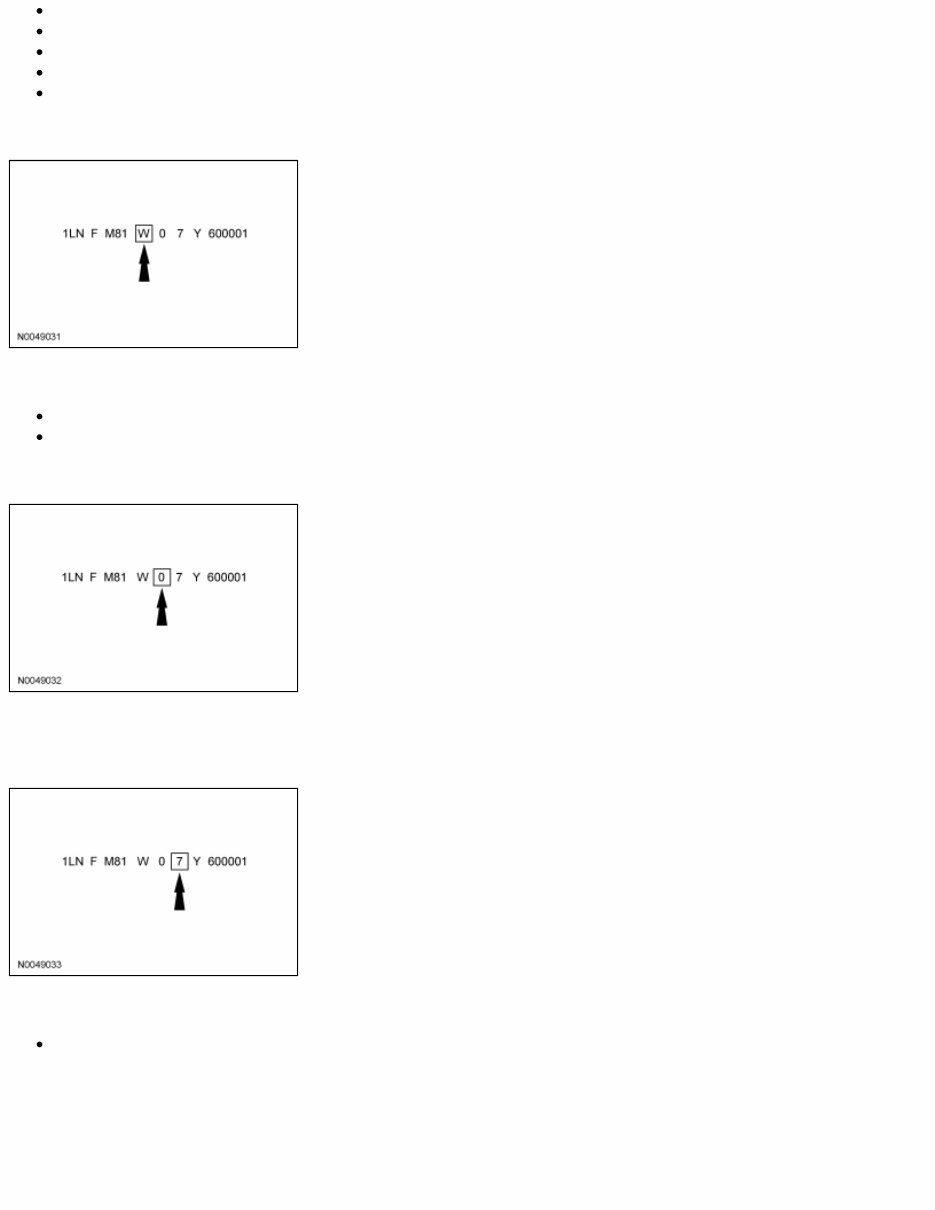
M82 — Signature Limited Series
M83 — Signature Designer Series
M84 — Executive Series (long wheelbase)
M85 — Signature Series (long wheelbase)
M88 — Executive Series (fleet)
Engine Code
The eighth VIN position is the engine displacement and number of cylinders code.
W — 4.6L EFI (SOHC), EFI, 8-cylinder
V — 4.6L EFI (SOHC), EFI, 8-cylinder (flex-fuel)
Check Digit Code
The ninth VIN position is a computer-generated check digit code (0-9).
Model Year Code
The tenth VIN position is the model year code.
7 — 2007
Assembly Plant Code
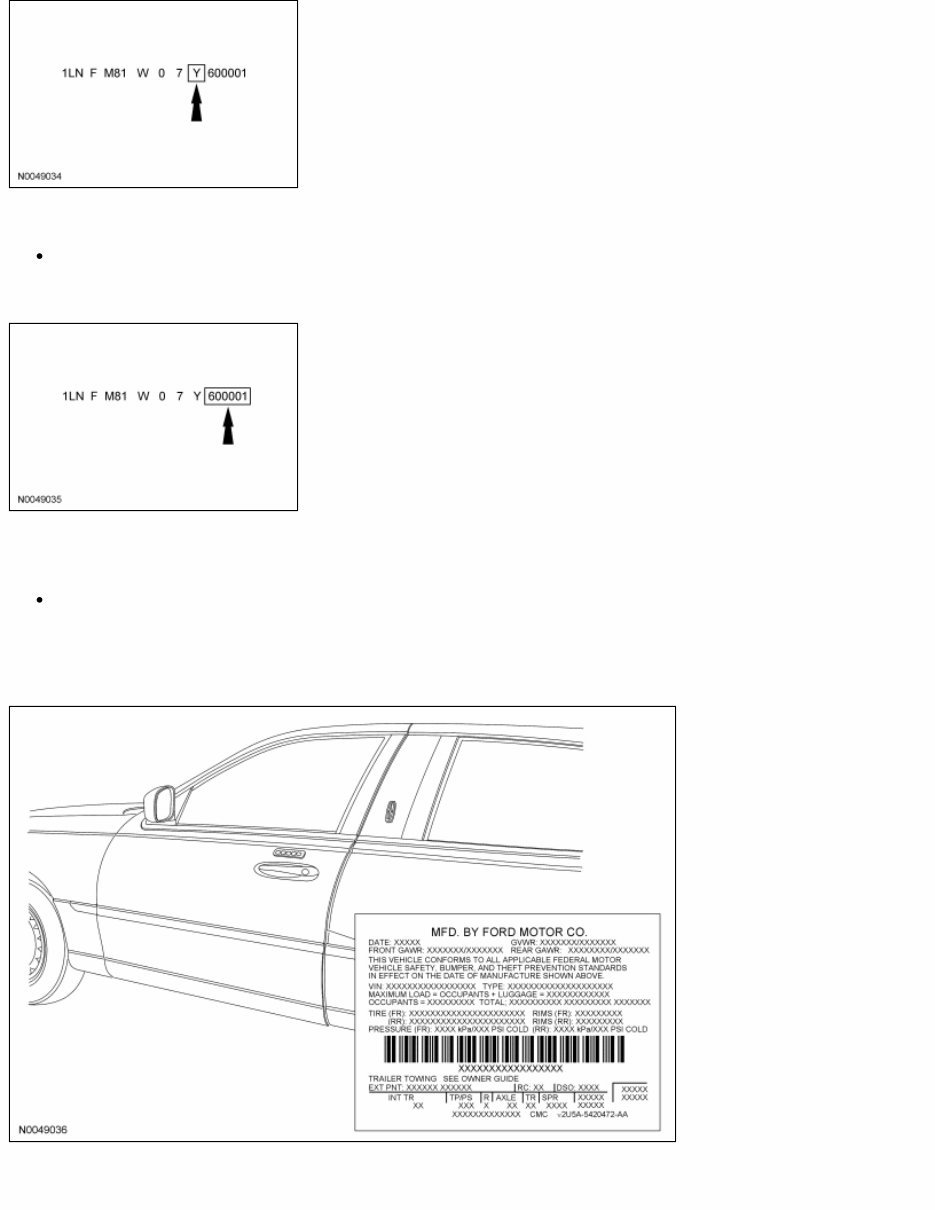
The eleventh VIN position is the assembly plant code.
Y — Wixom, Michigan (USA)
Production Sequence Number
The last 6 VIN positions are the production sequence number. These numbers determine the vehicle build order and provide
warranty information.
600001-999999
Vehicle Certification (VC) Label
Vehicle Certification (VC) Label Location
The upper portion of the vehicle certification (VC) label contains the manufacturer name, the month and year of
manufacture, the certification statement and the VIN. It also includes gross vehicle weight ratings (GVWR). The VC label is
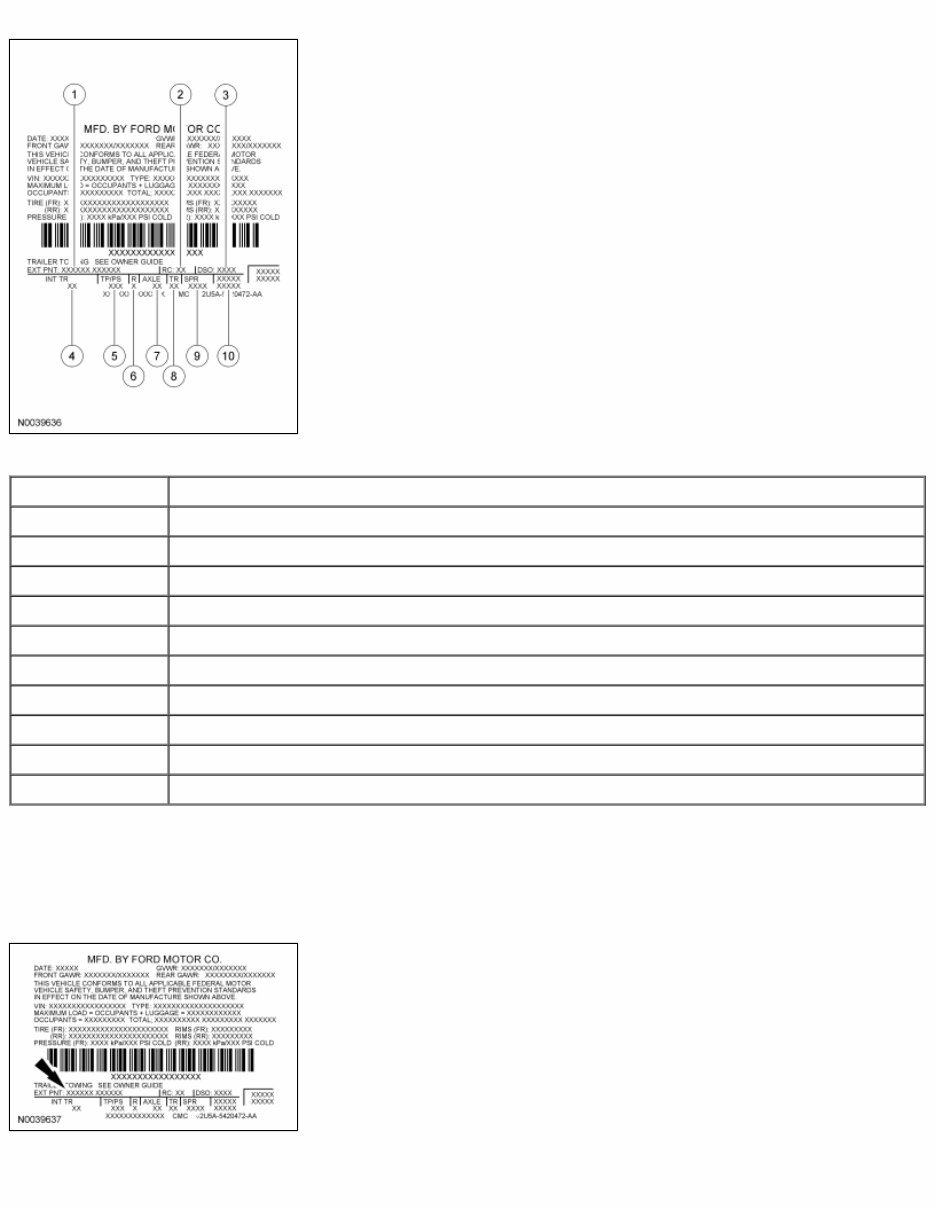
located on the front left-hand door jamb.
Item Description
1 Exterior paint color code
2 Region code
3 Domestic special order code
4 Interior trim code
5 Tape/paint stripe code
6 Radio code
7 Axle code
8 Transmission code
9 Spring code
10 Powertrain calibration information
Vehicle Certification (VC) Label Reference
Exterior Paint Code
Paint codes are listed as a 2-part code. The first set of characters listed indicate the vehicle primary body color. The second
set of characters listed (if applicable) indicate a 2-tone or accent body color. All colors are base coat/clear coat.
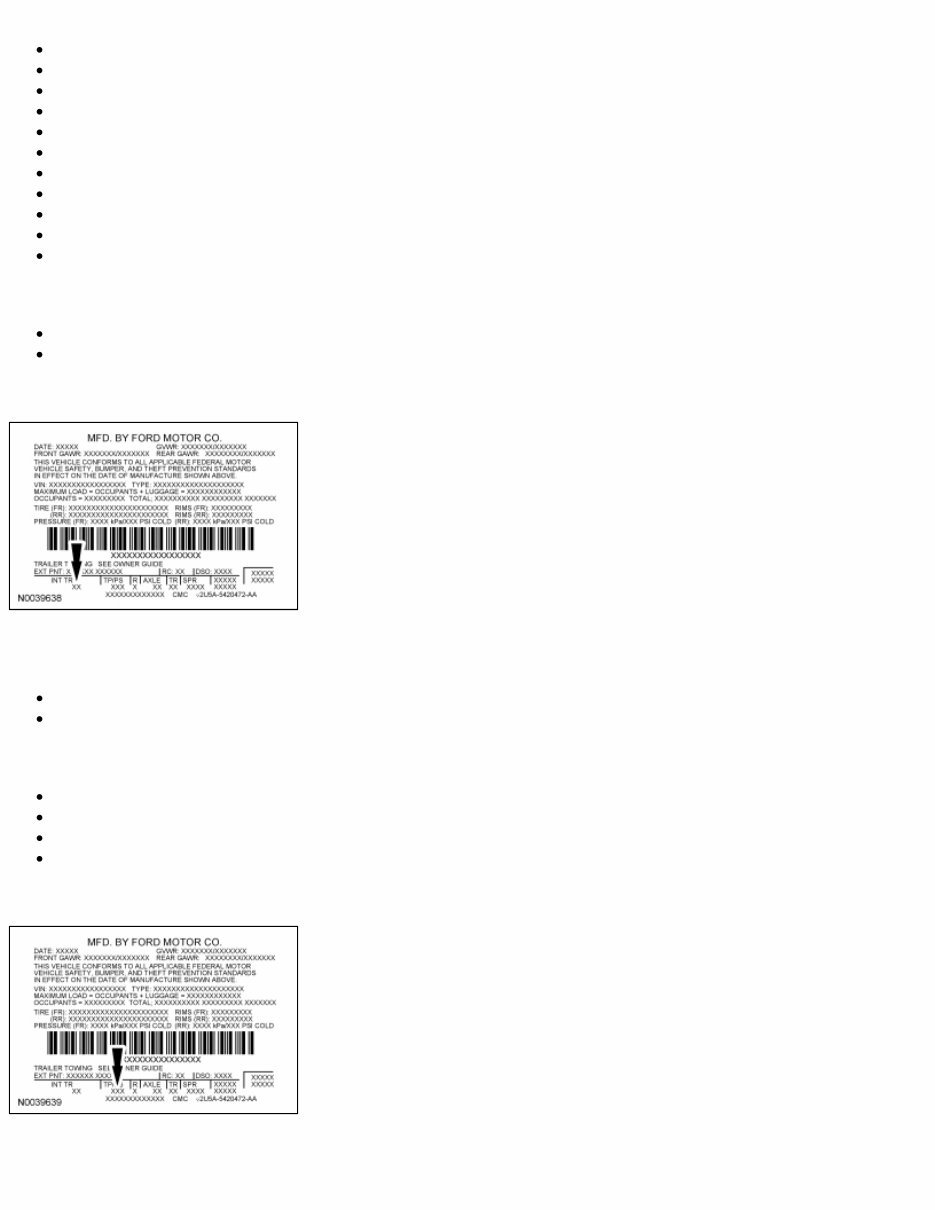
Primary Body Color Codes
DX — Dark Blue Pearl
G3 — Pueblo Gold
G4 — Cashmere (tri-coat)
HH — Dark Cherry
JP — Silver Birch
LS — Light Ice Blue Metallic
PV — White Chocolate (tri-coat)
T3 — Satellite Silver Pearl
T7 — Charcoal Beige Metallic
UA — Ebony
WT — Performance White
2-Tone Color Codes
G3 — Pueblo Gold
JP — Silver Birch Metallic
Interior Trim Code
The interior trim codes are listed below. The first digit indicates the interior fabric. The second digit indicates the interior
color.
D — Provence leather with logo
Q — Nudo leather
The interior trim colors are:
G — Greystone/Medium-Light Stone
K — Medium Camel/Light Camel
N — Charcoal Black
S — Shale/Dove
Tape/Paint Stripe Code
Tape and paint stripe codes do not apply.
Radio Code
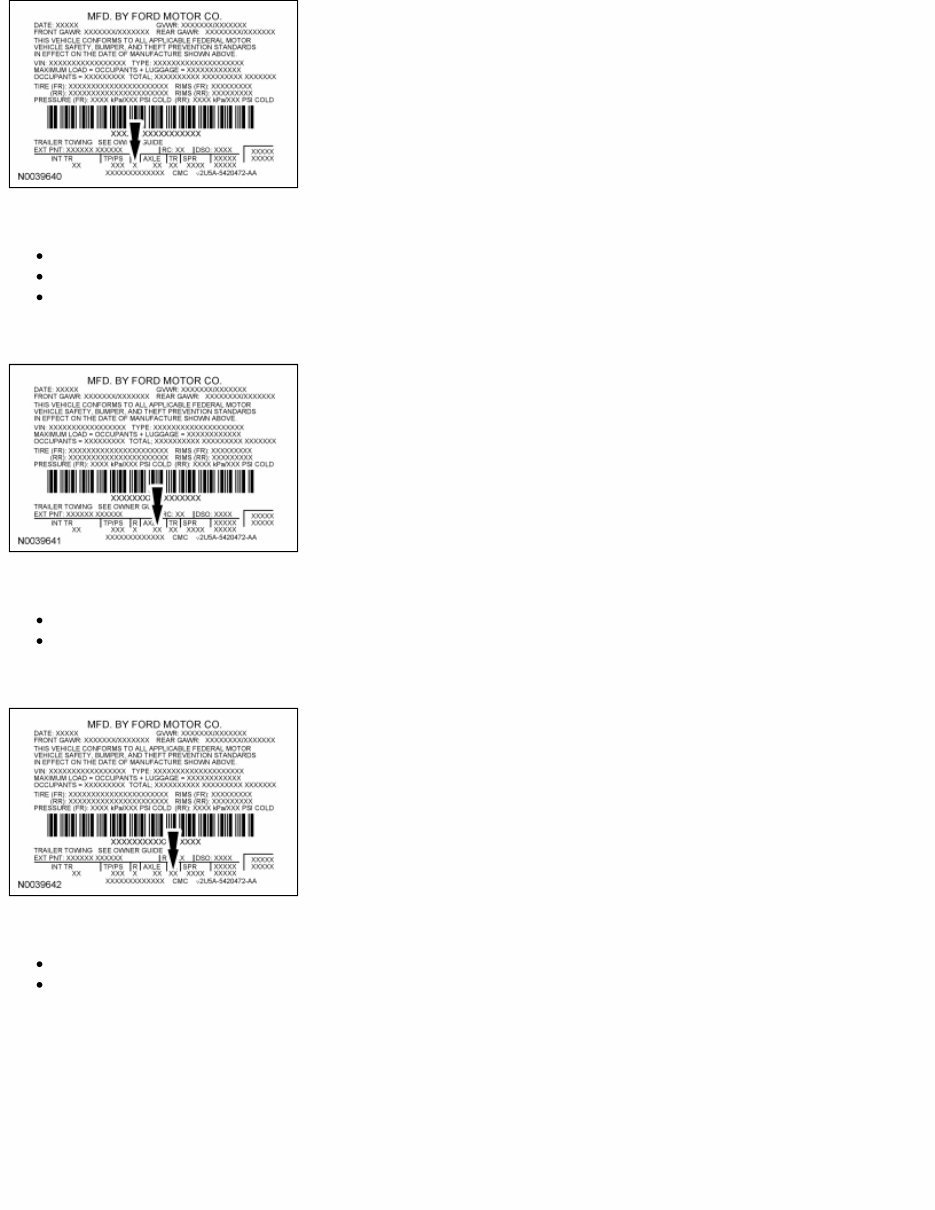
The radio type codes are:
B — AM/FM stereo with in-dash 6-disc compact disc (CD) changer
K — Premium electronic AM/FM stereo with cassette, CD player and clock
Z — Electronic AM/FM stereo with CD player and clock
Axle Code
The axle ratios are:
27 — 3.27 conventional
55 — 3.55 locker
Transmission Code
The transmission code is:
H — 4-speed automatic overdrive, 4R75E (Sharonville)
U — 4-speed automatic overdrive, 4R75E (Livonia)
Spring Code
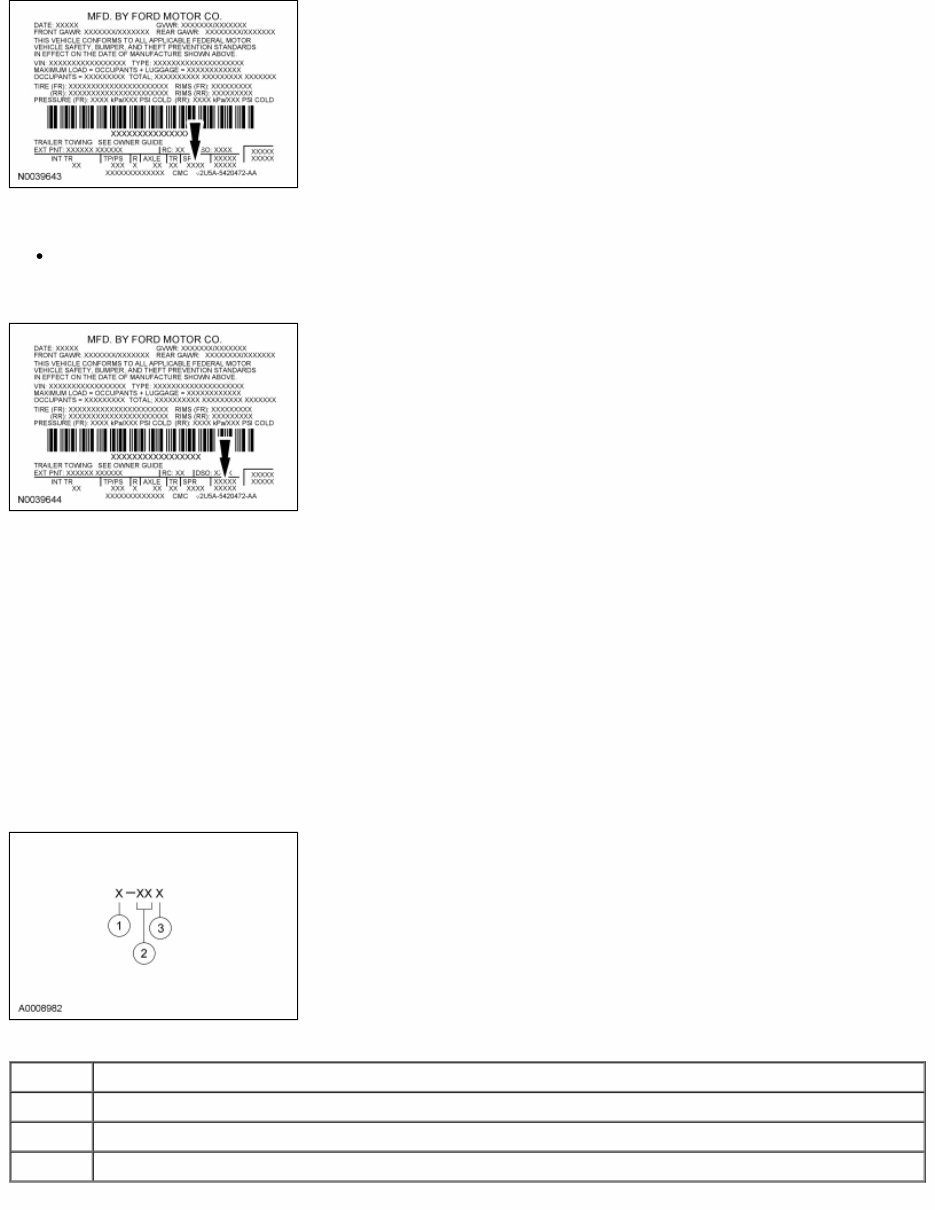
Lincoln Town Car uses a rear air suspension. Only front spring codes are listed.
Base part number — 18B036
Powertrain Calibration Information
NOTE: Powertrain calibration information is limited to a maximum of 5 characters per line on the Vehicle Certification
Label. Because of this, calibration identification consisting of more than 5 characters will wrap to the second line on the VC
label.
Powertrain calibration information is printed in the lower right corner of the Vehicle Certification Label. Only the base
calibration information is printed. Revision levels will not appear, however, they can be found in On Line Automotive
Service Information System (OASIS). For the current model year, Ford Motor Company is using 3 different protocols which
describe powertrain base calibration. These protocols are designed to provide worldwide standardization for vehicle
calibration. If the electronic calibration strategy has been used since 1998 and carried into the current model year, Protocol 1
will be used. Refer to Protocol 1 below. If the electronic calibration strategy has been used since 1999 and is carried into the
current model year, Protocol 2 will be used. Refer to Protocol 2 below. For electronic calibration strategies introduced since
the 2000 model year, use Protocol 3. Refer to Protocol 3 below.
Protocol 1
Item Description
1 Model year (model year in which calibration strategy was first introduced)
2 Engine code
3 Engine revision level
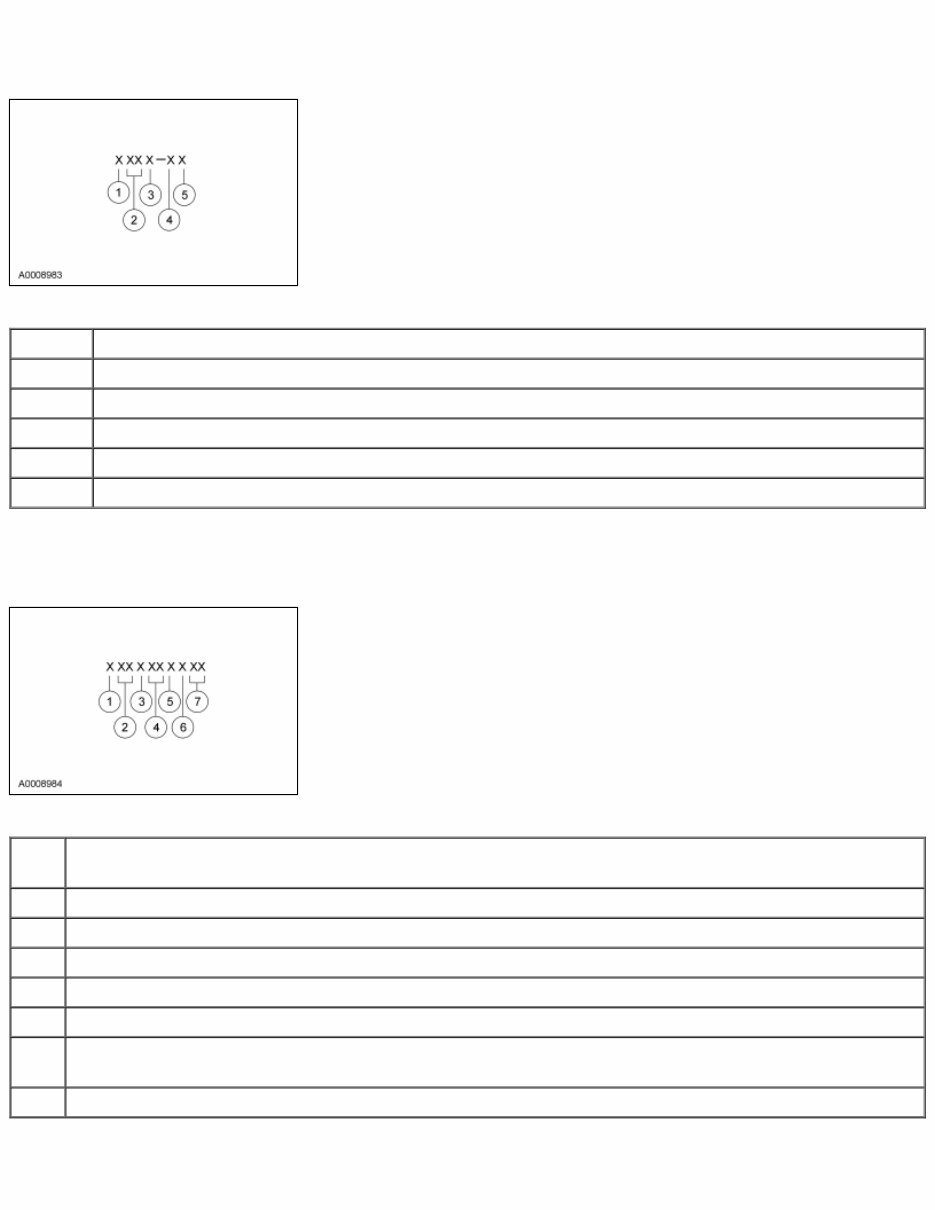
Protocol 2
Item Description
1 Model year (model year in which calibration strategy was first introduced)
2 Engine code
3 Transmission code
4 Emission standard (designates the specific country emission standard)
5 Design level (design level assigned to the engine)
Protocol 3
Item Description
1 Model year (model year in which calibration strategy was first introduced)
2 Vehicle code
3 Transmission code
4 Unique calibration (designates different hardware to similar vehicles). Example: tires, drive ratios, etc.
5 Fleet code (describes fleet to which the vehicle belongs). Example: 6 — evaporative emissions
6 Certification region (lead region where multiple regions are included in one calibration). Example: A — U.S.
federal
7 Revision level (will advance as revisions occur). Not printed on label
The following offers a more detailed explanation of the coding strategy used for Protocol 3.

Model Year
0 — 2000
1 — 2001
2 — 2002
3 — 2003
4 — 2004
5 — 2005
6 — 2006
7 — 2007
Vehicle Line
VC — Lincoln Town Car
Transmission
1 — Automatic transmission
Unique Calibration
The Emission/CAFE/CO2 Compliance Department is responsible for assigning these calibration numbers. Unique
calibration identifications are assigned to cover similar vehicles to differentiate between tires, drive configurations, final
drive ratios and other certification-significant factors.
These 2 characters are chosen by the analyst to provide easily identifiable information unique to each calibration. For
example, using the number 2 to denote a 2-valve engine versus using the number 4 to denote a 4-valve engine provides an
easily identifiable difference.
Fleet Code
0 — Certification (U.S. 4K, final sale in an export market)
1 — HDGE/Dyno
2 — Fast AMA U.S.
3 — ADP U.S.
4 — Not assigned
5 — Not assigned
6 — Evaporative emissions
7 — MACAA
8 — On-board diagnostics
9 — Not assigned
Certification Region
5 — U.S. 50 states
A — U.S. federal, including altitude, may include Canada, may include Mexico
B — U.S. California standard, includes U.S. green states
C — Canada
D — China
G — Gulf Cooperative Council (Bahrain, Kuwait, Oman, Qatar, Saudi Arabia and UAE)
H — Hong Kong
J — Japan
K — Korea
L — Malaysia
M — Mexico
N — New Zealand
P — Australia
Q — South America (Brazil)
S — Singapore
T — Taiwan
You're Reading a Preview
What's Included?
 Lifetime Access
Fast Download Speeds
Online & Offline Access
Access PDF Contents & Bookmarks
Full Search Facility
Print one or all pages of your manual
$31.99
2007 Lincoln Town Car Service & Repair Manual
Viewed 90 Times Today

What's Included?
Lifetime Access
Fast Download Speeds
Online & Offline Access
Access PDF Contents & Bookmarks
Full Search Facility
Print one or all pages of your manual
$31.99

Secure transaction
What's Included?
Lifetime Access
Fast Download Speeds
Online & Offline Access
Access PDF Contents & Bookmarks
Full Search Facility
Print one or all pages of your manual
Description
The 2007 Lincoln Town Car Service & Repair Manual is a comprehensive guide designed to provide detailed information for both professional mechanics and DIY enthusiasts. This technical manual covers aspects of the vehicle's mechanical and electrical systems, allowing users to troubleshoot, repair, and maintain their Lincoln Town Car with confidence.
- Provides technical information on the vehicle's internal components and systems
- Includes step-by-step procedures for diagnosing and fixing common issues
- Presents detailed diagrams and specifications for easier understanding
- Suitable for both professional mechanics and DIY enthusiasts
- Helps users to understand and address complex technical tasks
This manual is an essential resource for anyone looking to perform routine maintenance, repairs, or overhauls on their Lincoln Town Car. It is a valuable tool for anyone who wants to have a thorough understanding of their vehicle's inner workings.


