


Range Rover Classic Workshop Manual (95 Onwards)
What's Included?
 Lifetime Access
Fast Download Speeds
Offline Viewing
Access Contents & Bookmarks
Full Search Facility
Print one or all pages of your manual

;;;f; 1987
CHASSIS AND BODY
‘%
BODY REPAIRS, GENERAL INFORMATION Welding
The Range Rover body consists of a steel frame to
which alloy outer panels are attached. The cowl
panel, front fenders, side door outer panels, body
side outer panels and roof are made from a special
light magnesium-aluminium alloy.
The manufacture of body panels from aluminium
has two distinct advantages, the first of which is a
much better resistance to corrosion, the second
being a decrease in the gross vehicle weight.
Aluminium panels can be effectively repaired using
the ‘Argon Arc ’ process of welding, because the
afore mentioned is a specialist operation it is
necessary that only a skilled operator or specialist
body shop undertake such repairs.
.:
Under certain conditions it may’ not be practical to
repair an exterior damaged panel, if this is the case,
then panels can be easily removed and replaced
with new ones (refer to the appropriate part of the
Body section for panel removal and refit).
Panel beating
.T..
1. Aluminium alloy panels can be beaten out
after accidental damage in the same way as
sheet steel. However, under protracted
hammering the material will harden, and then
it must be annealed to prevent the possibility
of cracking. This is quite easily done by the
application of heat, followed by slow
air-cooling, but as the melting point is low,
heat must be applied slowly and carefully.
CAUTION: Before applying heat to any panel
ensure that the panel is clean and free from
underseal and that the area to be worked on is
well clear of any combustible materials. Ensure
that all necessary precautions are taken against
fire. IF HEAT IS TO BE APPLIED TO THE REAR
RIGHT HAND FENDER, THE FENDER MUST FIRST
BE REMOVED AS A FUEL EXPANSION TANK IS
LOCATED BETWEEN THE FENDER AND INNER
BODY SIDE.
CAUTION: The battery ground lead MUST be
disconnected before commencing welding. IF
WELDING IS TO BE CARRIED OUT ON THE REAR
RIGHT HAND FENDER, THE FENDER MUST BE
REMOVED, AS A FUEL EXPANSION TANK IS
LOCATED BETWEEN THE FENDER AND INNER
BODY SIDE.
1. Clean off all grease and paint, dry thoroughly
and then clean the edges to be welded, and
an area at least half an inch on either side of
the weld, with a stiff wire scratch brush or
wire wool. Cleanliness is essential. Also clean
the welding rod or strip with steel wool.
2. It is strongly recommended that a few welds
are made on scrap metal before the actual
repair is undertaken if the operator is not
already experienced in welding aluminium and
its alloys.
3. Use only 5 per cent magnesium aluminium
welding rod (5 Mg/A).
Welding tears and patching
1. If a tear extends to the edge of a panel, start
the weld from the end away from the edge
and also at this point drill a small hole to
prevent the crack spreading, then work
towards the edge.
2. When welding a long tear, or making a long
welded joint, tack the edges to be welded at
intervals of from 2 in to 4 in (50 to 100mm)
with spots. This is done by melting the metal
at the starting end and fusing into it a small
amount of the filler rod, repeating the process
at the suggested intervals. After this, weld
continuously along the joint from right to left,
increasing the speed of the weld as the
material heats up.
3. When patching, cut the patch to the correct
shape for the hole to be filled, but of such
sizes as to leave a gap of l/32 in (0.80mm)
between it and the panel, and then weld as
described above. Never apply an ‘overlay’
patch.
1 .‘,

76 ‘CHASSIS AND BODY
1987 RANGE
ROVER
c
.
Spot welding
. 1. spot welding is mainly used in the
manufacture of the Range-Rover inner steel
body frame and exterior magnesium-aluminium
alloy panels, and is a process which can be
carried out satisfactorily by the use of the
proper apparatus in a specialist body shop.
Aluminium and its alloys are very good
conductors of heat and electricity, and thus it
is most important to maintain the right
conditions for successful spot welding. The
correct current density must be maintained,
and so must the ‘dwell’ of the electrodes.
Special spot welding machines have been
developed, but they are expensive, and
though the actual work can be carried out by
comparatively unskilled labour, supervision and
machine maintenance must be in the hands of
properly qualified persons.
Riveting
1. Where both sides of the metal are accessible
and it is possible to use an anvil or ‘dolly’
solid aluminium rivets may be used, with a
suitable punch or ‘pop’ to ensure clean
rounded head on the work. For riveting blind
holes, ‘pop-rivets’ must be used. These are
inserted and closed by special ‘Lazy-Tong’
‘pop-rivet’ pliers.
2
PAINTWORK
General Information
Before undertaking any paintwork process on the
exterior body of Range Rover, firstly ascertain which
is the best method of repair either by panel repair
or replacement.
The initial preparation of a panel is very important
to ensure that when finished it is of a standard that
meets and matches existing bodywork. Panels must
be thoroughly degreased with Berger Preclean
802.0516 or a suitable equivalent, any unsound
paint to be stripped using Berger Double strength
Meltic 301.8051. Always refer to the paint
manufacturers instructions.
Paintwork processes should be performed by a
specialist bodyshop where paint spraying can be
undertaken in a controlled environment whereby
temperatures are kept constant and the atmosphere
dust free.
The flow chart on the following page gives a guide
to preparing and painting a panel. Wherever
possible refer to the Berger Vehicle Refinishes
Product Data and Application Sheets for further
information.
j
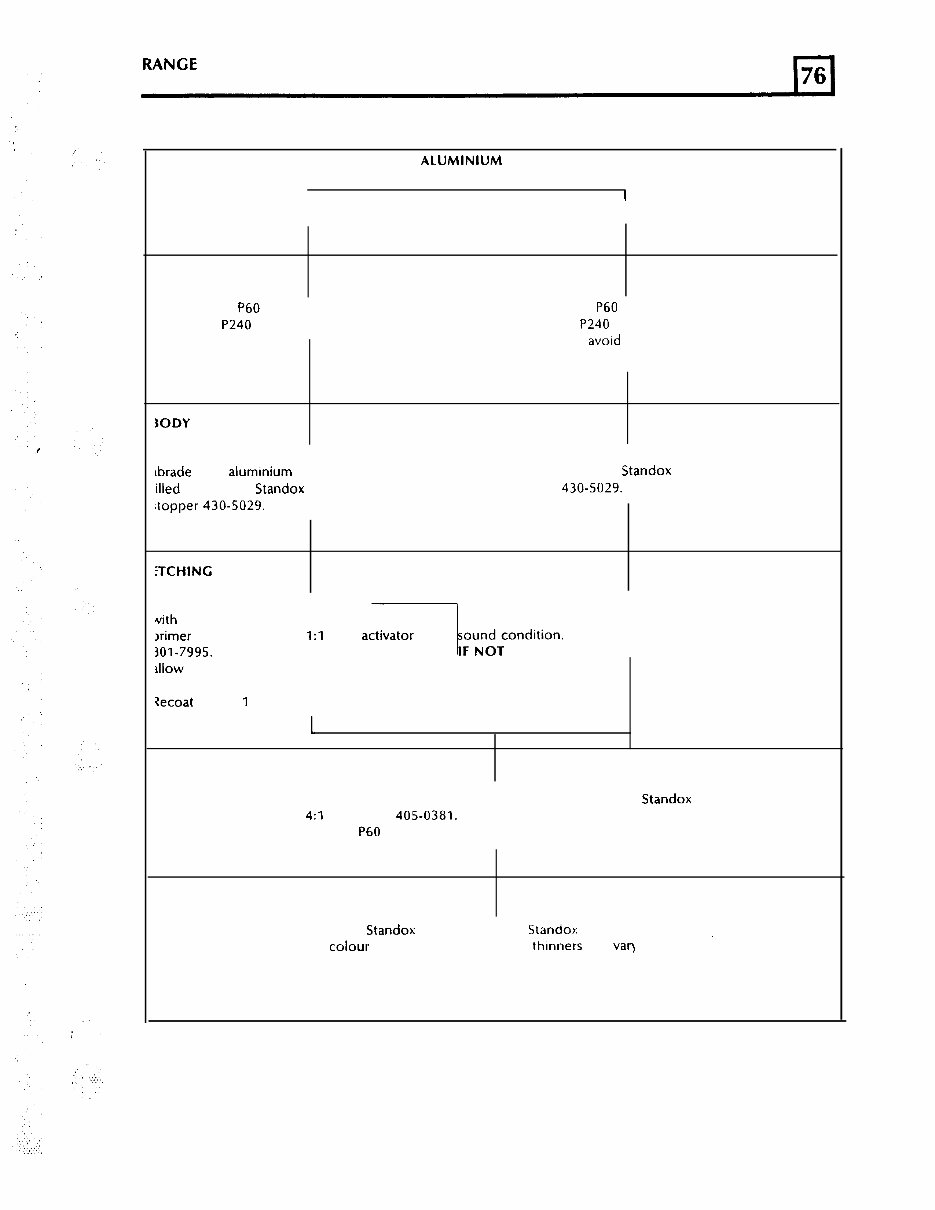
RANGE 1987
ROVER CHASSIS AND BODY
SUBSTRATE
ALUMINIUM PANELS
I
I I
PANEL REPAIR REPLACEMENT PANEL
‘REPARATION
Vet for using P60 Grade paper or dry
and using P240 grit discs.
Wet flat using P60 Grade paper or dry
sand using P240 grit discs. Care must
be taken to avord cutting through to
bare aluminium.
lODY FILLING
f filling is required, thoroughly
lbrade bare alumrnium area to be
illed and apply Standox Polyester
Jopper 430-5029.
If filling is required, fill small
indentations with Standox Polyster
stopper 430-5029.
iTCHlNG
itch the bare aluminium and filler This process is not required if the
with auto-speed self etch original electrocoat primer is in
lrimer 414-1171, mixed 1:l with actrvator
301-7995. Apply one coat and
-1 ;;;zzondition.
allow to dry for approximately 20
ninutes.
Zecoat within 1 hour.
1
‘RIMING
To obtain maximum adhesion and excellent build, apply Standox
2K 4:l full primer 405-0381. Coats of 30-40 microns can be wet
flatted with P60 grade paper after 45 minutes at 20°C.
COLOUR COATING
Apply either Standox 2K Standocryl or Standox Metallic Basislack ,,
to the colour required. Hardeners and thrnners will var)
depending upon system employed, conditions available,
temperature and size of vehicle etc. Refer to paint manufacturers
Technical Information Sheet for correct selection.
REVISED: MARCH 90
: .I.> .I
. .
RANGE
CHASSIS AND BODY
1987-90 ROVER
REVISED: APR. 87
. . . .
‘. :.:.:..
..
;“o”;; 1987-90
CHASSIS AND BODY
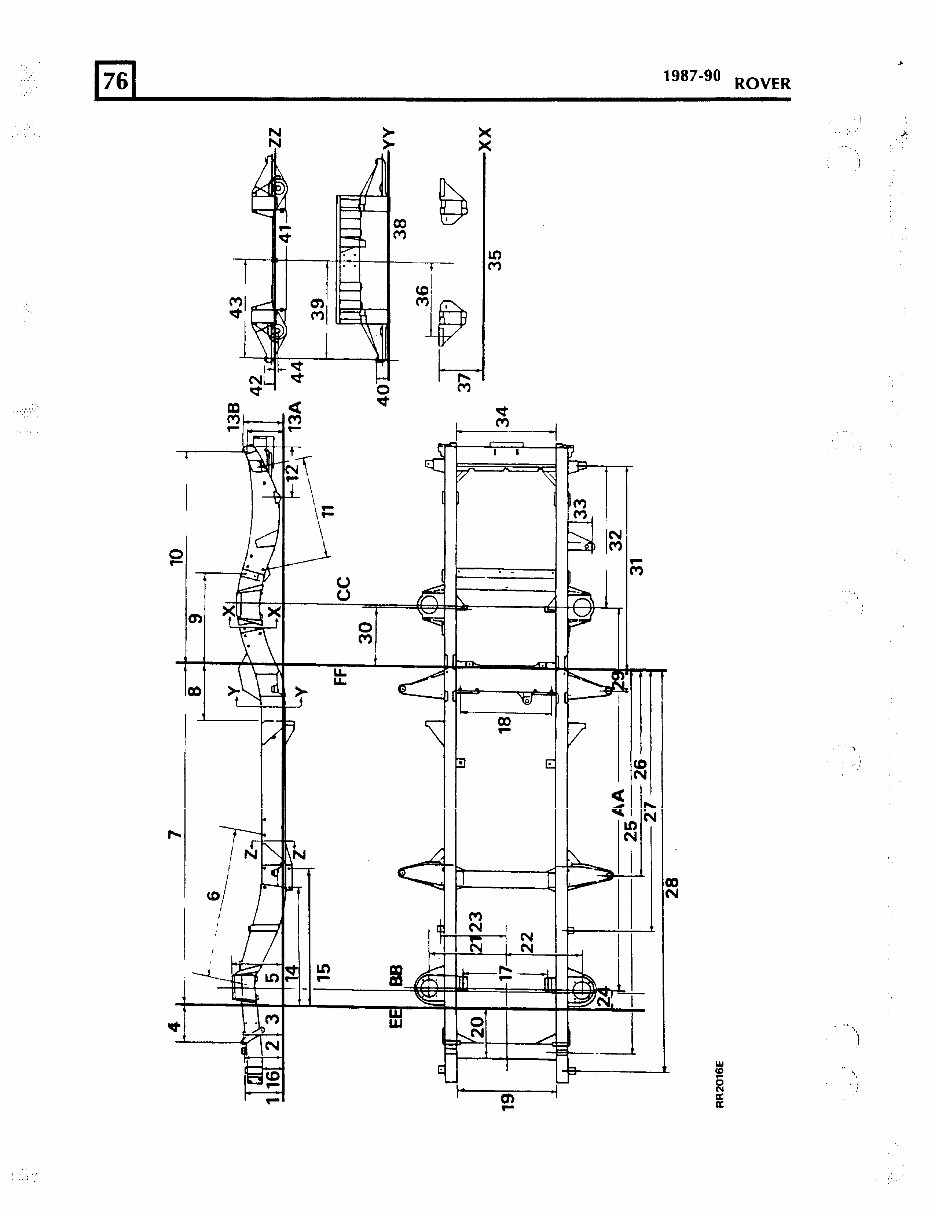
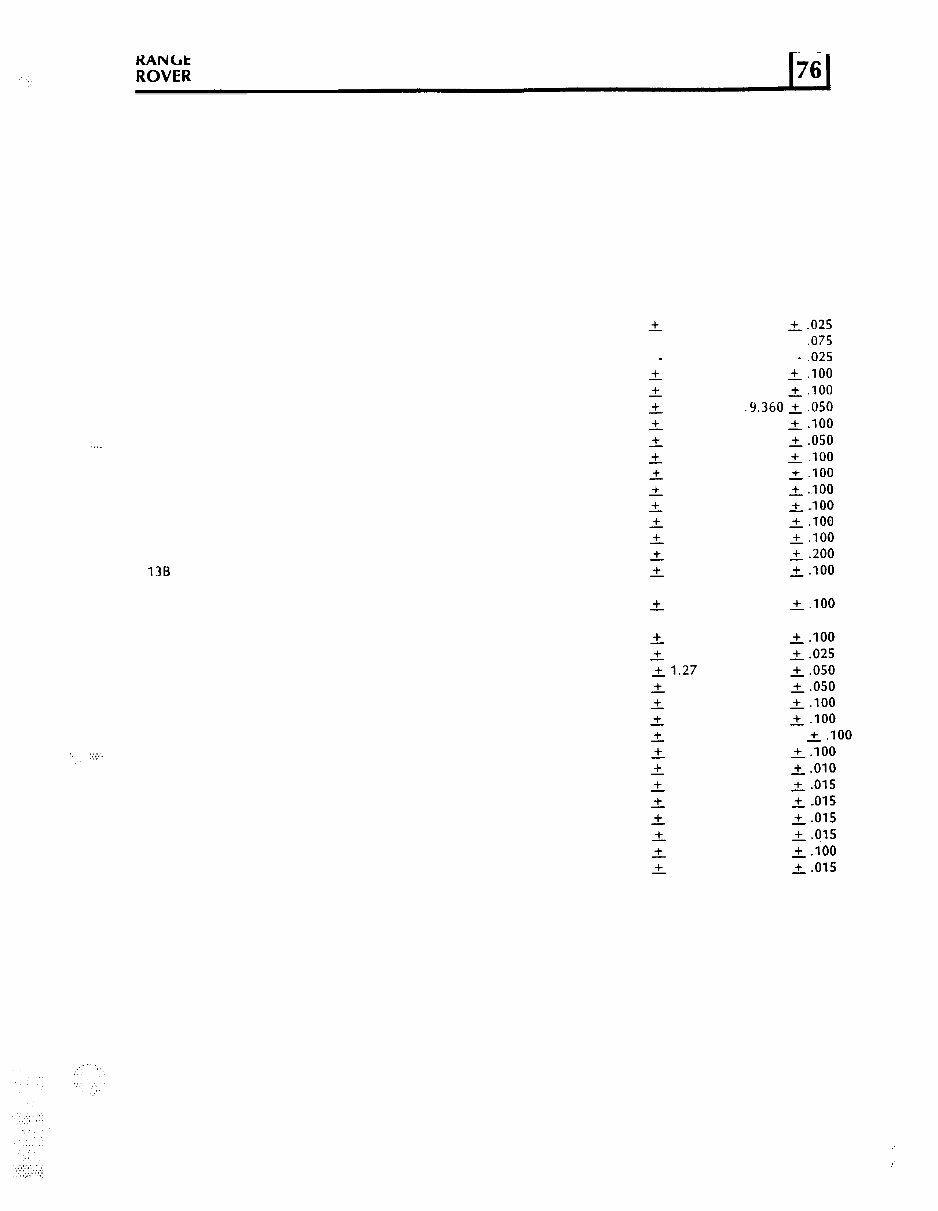
CHASSIS FRAME
Alignment check
AA
BB
cc
DD
EE
FF
1
2
3
4
5
6
7
8
9
10
11
12
13A
138
14
15
16
17
18
19
20
21
22
23
24
25
26
27
28
29
30
31
Diagram reference millimetres inches
Wheelbase-Reference dimension
Centre line of front axle
Centre line of rear axle
Frame datum line
Side member datum line
Datum line
(with mounting washers)
(without washers)
Reference dimension
To face of boss
Frame datum to underside of cross-member
Check figure
2540.00 100.000
254.00 + 0.63 10.000 + ,025
263.525 + 1.91 10.375 + ,075
- 0.63 - ,025
261.11 2 2.54 10.180 + .I00
266.70 + 2.54 10.500 2.100
237.74 4 1.27 .9.360 + ,050
327.81 f- 2.54 12.906 -f .I00
979.93 + 1.27 38.580 2.050
2244.72 + 2.54 88.375 + .I00
356.74 + 2.54 14.045 +.100
605.15 + 2.54 23.825 +.I00
1405.38 + 2.54 55.330 +-loo
694.44 + 2.54 27.340 +.I00
338.83 + 2.54 13.340 +.100
222.25 2 5.08 8.750 2.200
240.54 + 2.54 9.470 L.100
794.91 31.296
935.43 L 2.54 36.828 +.100
150.79 5.937
535.94 + 2.54 21.100 ~.I00
590.55 + 0.64 23.250 2.025
630.93 ~1.27 24.840 2.050
344.17 + 1.27 13.550 +.050
485.77 f 2.54 19.125 + .I00
485.77 + 2.54 19.125 + .I00
414.32 + 2.54 16.312 +.I00 .
129.03 + 2.54 5.080 +.I00
2544.44 + 0.25 100.175 2.010
1355.34 + 0.38 53.360 2.015
1722.04 + 0.38 67.797 2.015
2663.44 + 0.38 104.860 +.015
144.09 2 0.38 5.673 +.QlS
400.48 fL 2.54 15.767 +.lOO
1333.88 + 0.38 52.515 2.015
Continued
5 "
:
You're Reading a Preview
What's Included?
Lifetime Access
Fast Download Speeds
Offline Viewing
Access Contents & Bookmarks
Full Search Facility
Print one or all pages of your manual
$24.99
$32.99
Viewed 21 Times Today


Secure transaction
What's Included?
Lifetime Access
Fast Download Speeds
Offline Viewing
Access Contents & Bookmarks
Full Search Facility
Print one or all pages of your manual
$24.99
$32.99
Range Rover Classic Workshop Manual (95 Onwards)
The workshop manual is a comprehensive guide that includes detailed job instructions, mechanical and electrical fault findings, technical modifications, wiring diagrams, service guides, technical bulletins, and more. It covers a wide range of topics including technical data, engine, gearbox, front/rear axle, brakes, steering, suspension & wheels, repair instructions, auxiliary, bodywork, electrical systems, engine overhaul, and more. It is a valuable resource for both professional mechanics and DIY enthusiasts.
Models/Engines:
- 1995 Onwards
Including engines:
- 3.5 V8
- 3.9 V8
- 4.2 V8
- 300 TDi
- 2.5 TD VM


