SPECTRA(LD) > 2006 > G 2.0 DOHC > General Information General Information > General Information > General Information Fundamental procedures NOTICES, CAUTIONS AND WARNINGS As you read through the various procedures, you will encounter Notices, Cautions and Warnings. Each one is there for a specific purpose. Notices give you added information that will assist you in completing a particular procedure.Cautions prevent you from making an error that could damage the vehicle.Warnings remind you to be especially careful in specific areas where carelessness can cause personal injury. The following items contain general procedures you should always follow when working on a vehicle: PROTECTION OF VEHICLE Always cover fenders, seats, and floor areas before starting work. Operate the engine only in a well-ventilated area to avoid carbon monoxide poisoning. A WORD ABOUT SAFETY The following precautions must be followed when jacking up the vehicle: 1. Block the wheels. 2. Use only the specified jacking positions. 3. Support the vehicle with safety stands. The engine compartment must be clear of tools and people before starting the engine. PREPARATION OF TOOLS AND MEASURING EQUIPMENT All necessary tools and measuring equipment should be available before starting any work. SPECIAL SERVICE TOOLS (SST'S) Use special service tools when they are required. SST's can be found under"preparation"prior to any procedure requiring them. Page 1 of 20
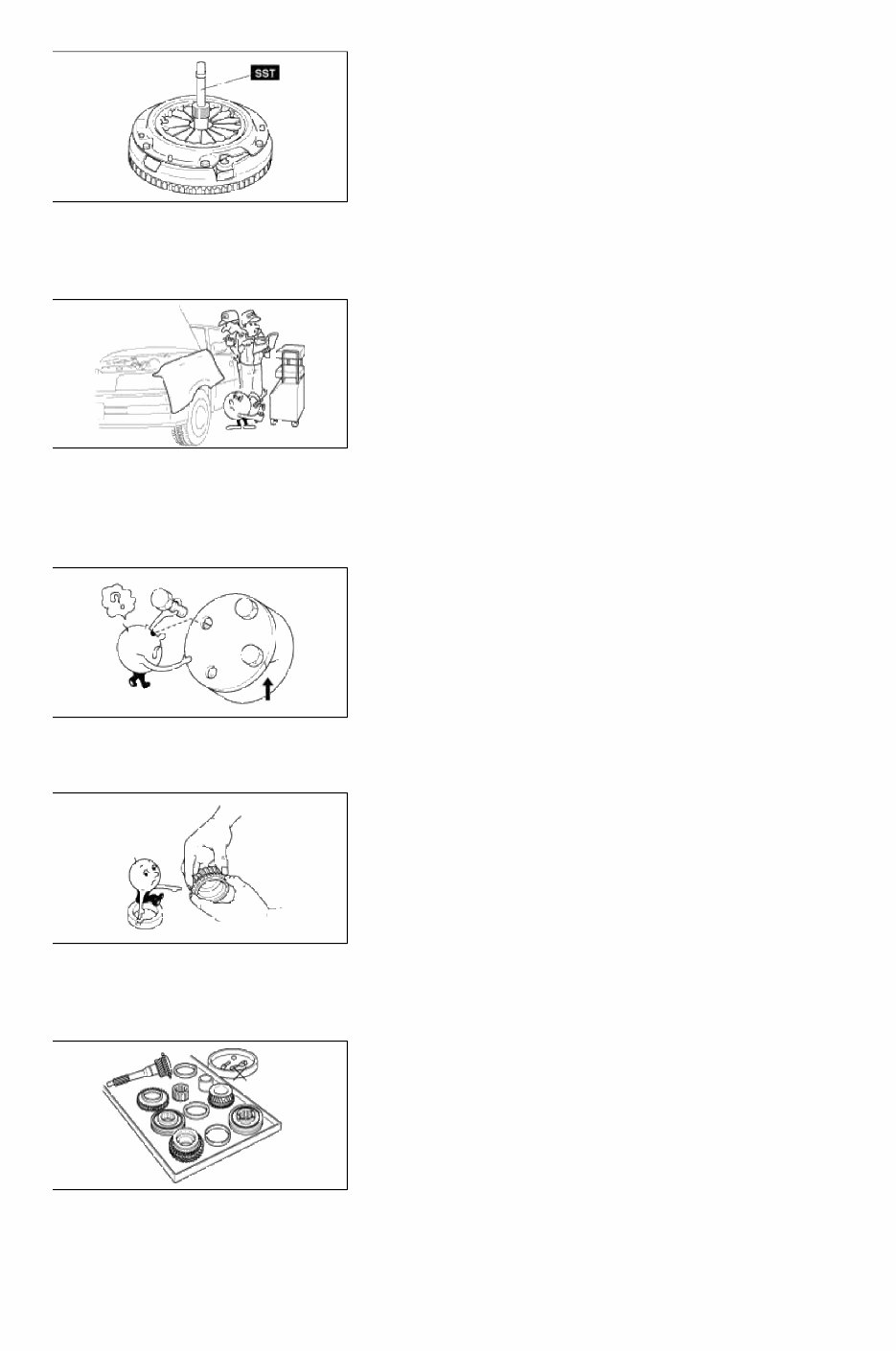
REMOVAL OF PARTS Begin work only after first learning which parts and subassemblies must be removed and disassembled for replacement or repair. DISASSEMBLY If the disassembly procedure is complex, requiring many parts to be disassembled, all parts should be disassembled in a way that will not affect their performance or external appearance. Additionally, these parts should be identified so that reassembly can be done easily and efficiently. INSPECTION OF PARTS When removed, each part should be carefully inspected for malfunction, deformations, damage, or other problems. Arrangement of parts All disassembled parts should be carefully arranged for reassembly. Separate or otherwise identify the parts to be replaced from those that will be reused. CLEANING PARTS FOR REUSE All parts that will be reused should be carefully and thoroughly cleaned using appropriate methods. Page 2 of 20
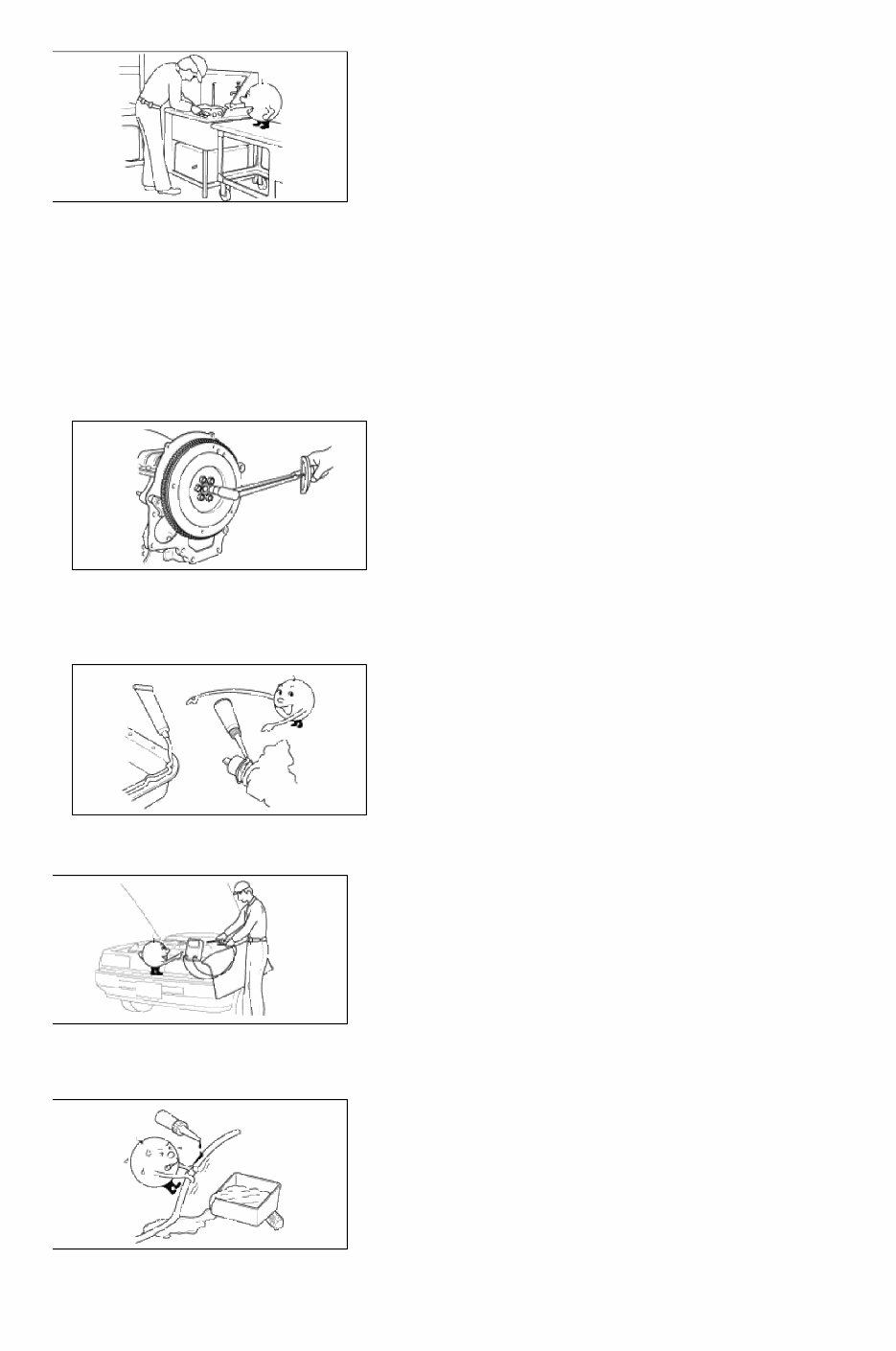
REASSEMBLY Standard values, such as torques and certain adjustments, must be strictly observed in the reassembly of all parts. If removed, the following parts should be replaced with new ones: 1. Oil seals 2. O-rings 3. Cotter pins 4. Gaskets 5. Lock washers 6. Nylon nuts DEPENDING ON LOCATION: 1. Sealant should be applied or new gaskets installed. 2. Oil should be applied to the moving components of parts. 3. Specified oil or grease should be applied at the appropriate locations (such as oil seals) before reassembly. Adjustments Use appropriate gauges and/or testers when making adjustments. Rubber parts and tubing Prevent gasoline or oil from contacting rubber parts or tubing. Electrical troubleshooting tools (Test Light) Page 3 of 20
The test light, as shown in figure, uses a 12V bulb. The two lead wires should be connected to probes. The test light is used for simple voltage checks and in checking for short circuits. When checking the engine control module (ECM), never use a bulb exceeding 3.4W. Electrical troubleshooting tools(Jumper wire) The jumper wire is used for testing by shorting across switch terminals ground connections. Do not connect a jumper wire from the power source line to a body ground. Such a connection may cause damage to harnesses or electronic components. VOLTMETER The DC voltmeter measures circuit voltage. A voltmeter with a range of 15V or more is used by connecting the positive (+) probe (red lead wire) to the point where voltage is be measured, and the negative (-) probe (black lead wire)to a bodyground. OHMMETER The ohmmeter is used to measure the resistance between two points in circuit and also to check for continuity and the diagnosis of short circuits. Do not attempt to connect the ohmmeter to any circuit in which voltage is applied. Such a connection may damage the ohmmeter. Electrical parts Page 4 of 20
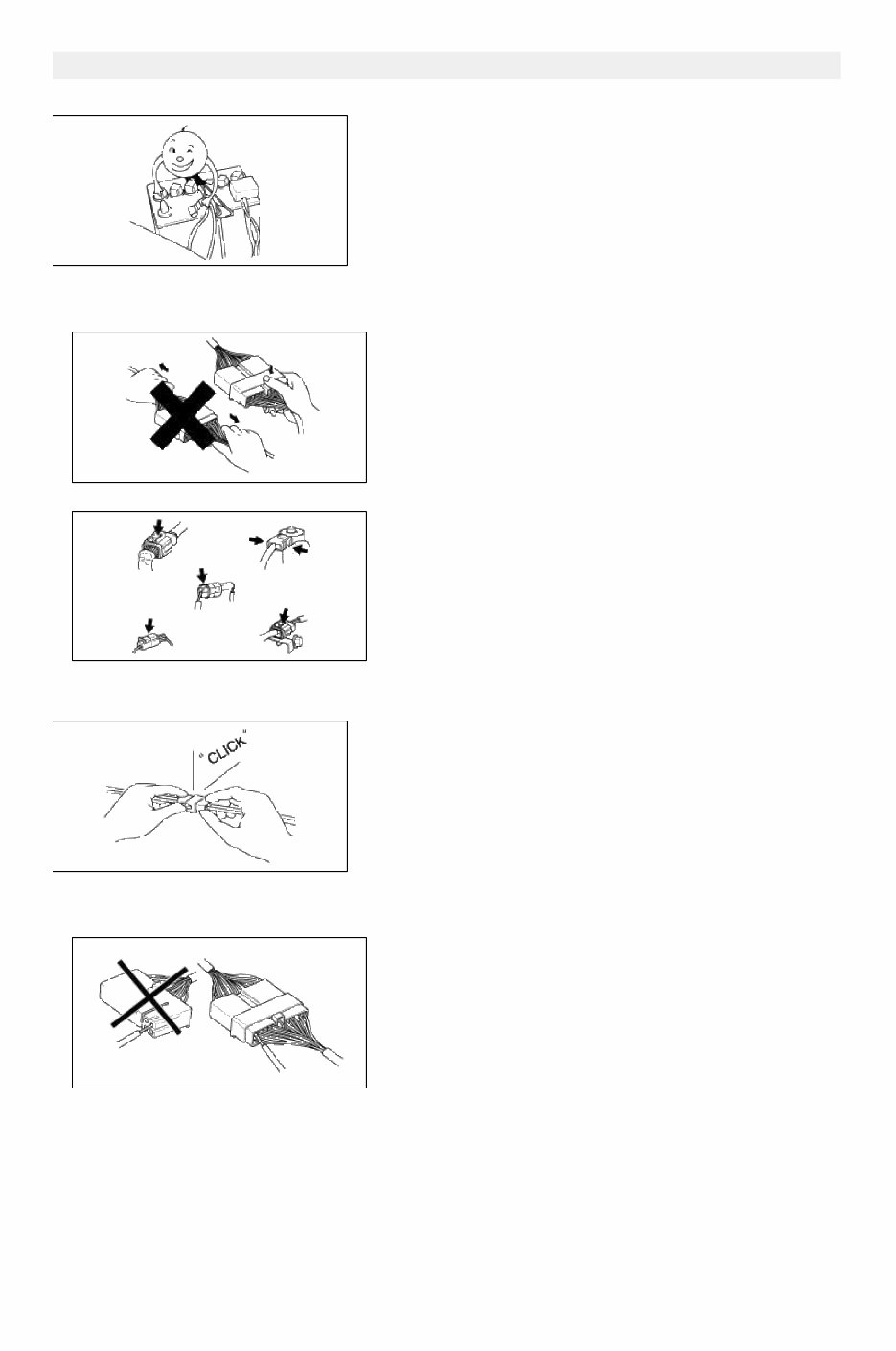
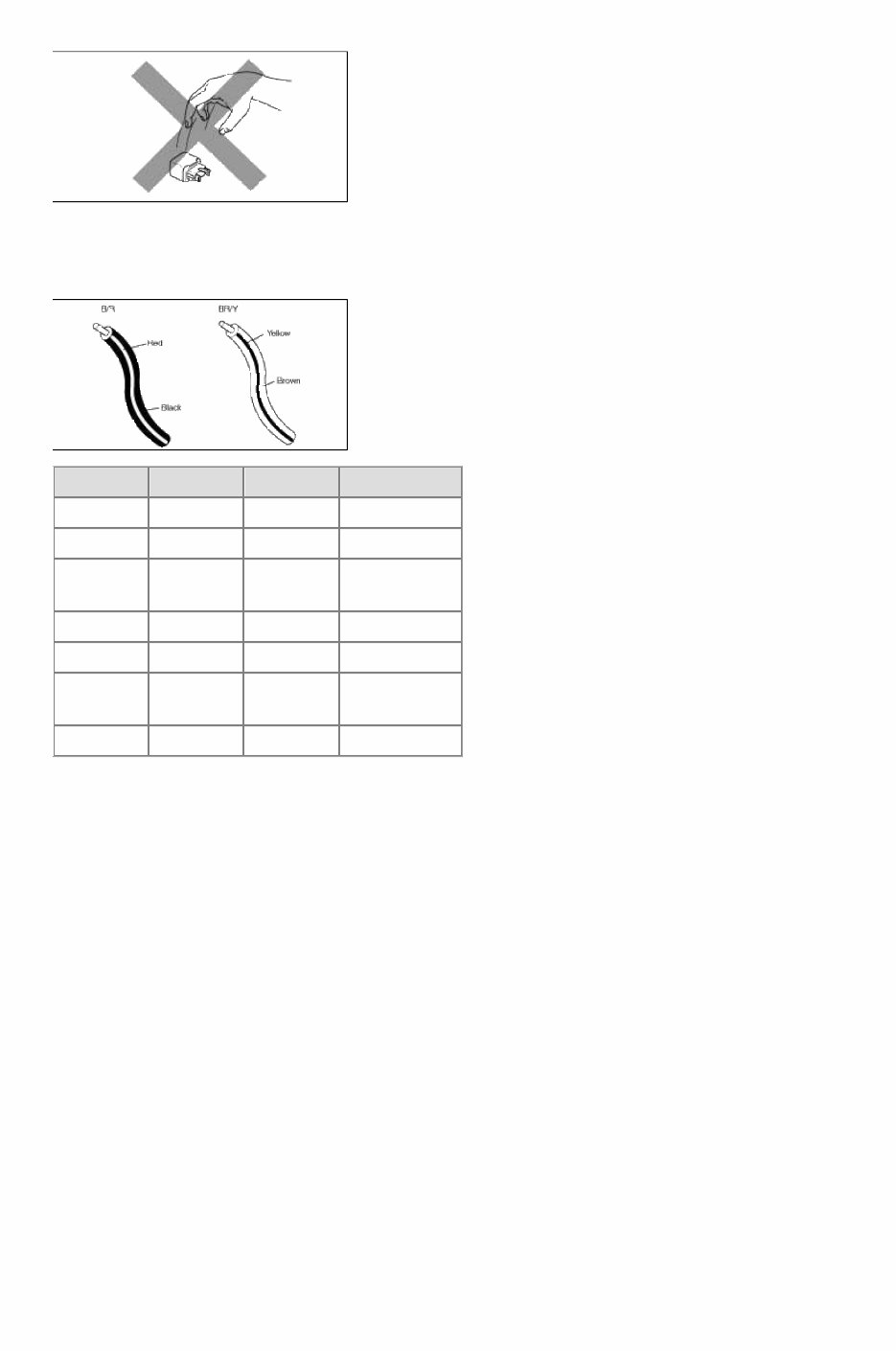
Battery cable Before disconnecting connectors or replacing electrical parts, disconnect the negative battery cable. Connectors(Removal of connector) 1. Never pull on the wiring harness when disconnecting connectors. 2. Connectors can be removed by pressing or pulling lock lever. Connectors(Locking a connector) Listen for a click when locking connectors. This sound indicates that they are securely locked. Connectors(Inspection) 1. When a tester is used to check for continuity or to measure voltage, insert tester probe from wire harness side. Page 5 of 20
2. Check terminals of waterproof connectors from connector side because they cannot be accessed from harness side. • Use a fine wire to prevent damage to the terminal. • Do not damage the terminal when inserting the tester lead. Terminals(Inspection) Pull lightly on individual wires to ensure that they are secured in the terminal. REPLACEMENT OF TERMINALS Use appropriate tools to remove terminal as shown. When installing the terminal, insert it until it locks securely. FEMALE Insert a thin piece of metal from the terminal side of the connector, and then, with the terminal locking tab pressed down, pull the terminal out of the connector. MALE Follow the same procedure as female-type terminal. SENSORS, SWITCHES, AND RELAYS Always handle sensors, switches and relays carefully. Do not drop them or accidentally strike them against other parts. Page 6 of 20
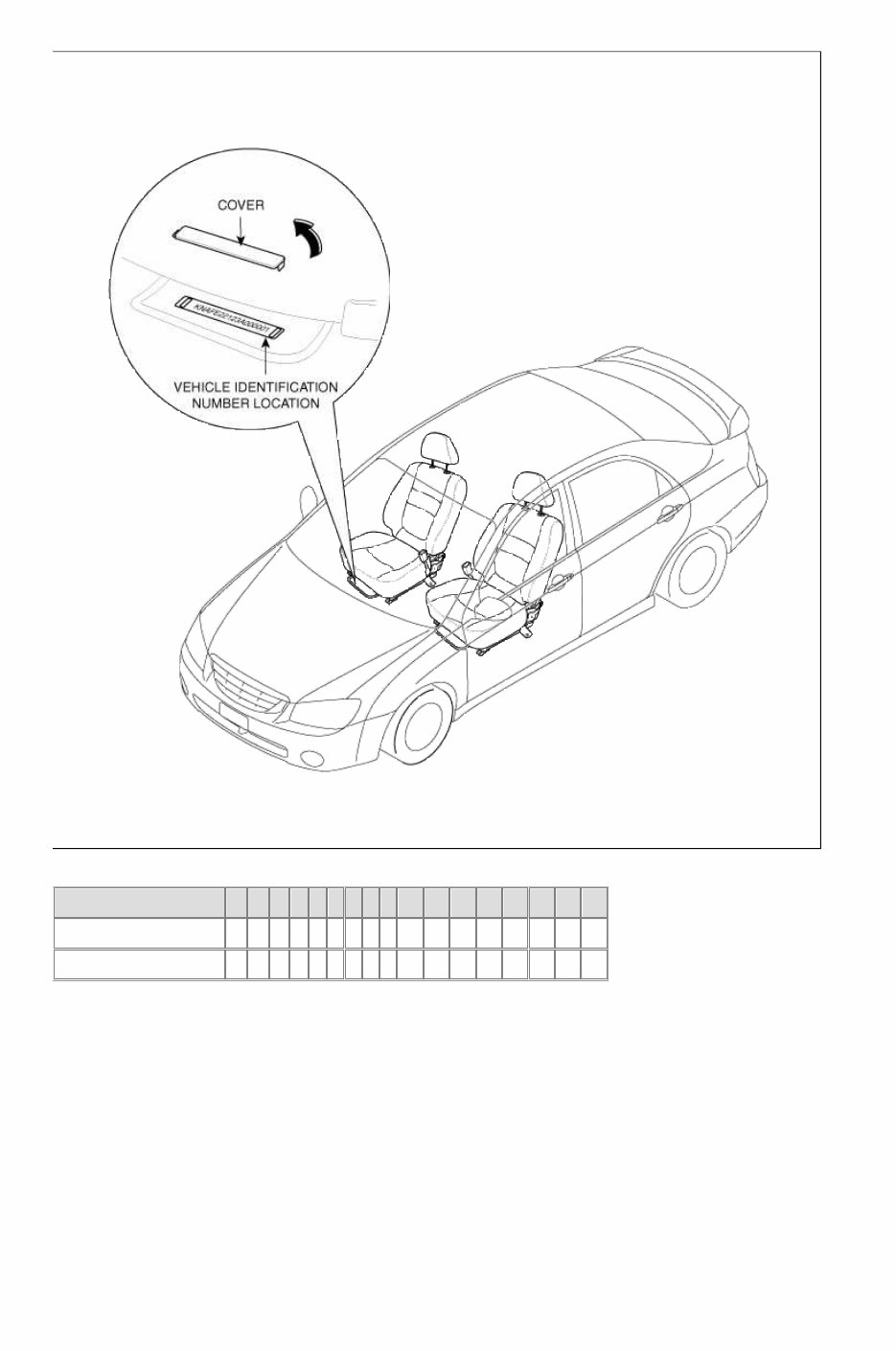
WIRING COLOR CODES Two-color wires are indicated by a two-color code symbol. The firstcolor indicates the base color of the wire; the second color indicates the color of the stripe. CODE COLOR CODE COLOR B BLACK P PINK BR BROWN R RED G GREEN S SILVER(LIGHT BLUE) GY GRAY T TAWNY L BLUE V VIOLET LG LIGHT GREEN W WHITE O ORANGE Y YELLOW VEHICLE IDENTIFICATION NUMBER LOCATION Page 7 of 20
VEHICLE IDENTIFICATION NUMBER DESCRIPTION FOR NORTH AMERICA VEHICLE 1 2 3 4 5 6 7 8 9 10 11 12 13 14 15 16 17 BETA 2.0 4Door Sedan K N A F E 1 2 1 - 4 5 0 0 0 0 0 1 BETA 2.0 5Door Hatch K N A F E 1 6 1 - 4 5 0 0 0 0 0 1 1 - 3 : Make / Vehicle type - KNA = Kia Passenger Car 4 - 5 : Vehicle Line / Series - FE = LD (SPECTRA) 6 - 7 : Body type - 12 = 2WD 4Door Sedan - 16 = 2WD 5Door Hatch 8 : Engine type / Restaint - 1 = BETA 2.0 Gasoline & Air bags (Manual belts) - 2 = BETA 2.0 Gasoline (SULEV) & Air bags (Manual belts) 9 : Check digit - To be calculated 10 : Model year Page 8 of 20
- 4 = 2004, 5 = 2005 11 : Plant location - 5 = Hwasung plant 12 - 17 : Sequential number - 000001 ~ 999999 ENGINE IDENTIFICATION NUMBER LOCATION ENGINE IDENTIFICATION NUMBER DESCRIPTION MODEL 1 2 3 4 5 6 7 8 9 10 11 BETA CVVT ENGINE (2.0) G 4 G C 3 0 0 0 0 0 1 1 : Engine fuel - G = Gasoline 2 : Engine range - 4 = 4 Cycle 4 cylinder 3 : Engine development order - G = BETA Engine 4 : Engine capacity - C = 1,975cc 5 : Production year - 4 = 2004, 5 = 2005 6 - 11 = Engine production sequence number - 000001 ~ 999999 MANUAL TRANSAXLE IDENTIFICATION NUMBER LOCATION Page 9 of 20
Kia Cerato 2006 Factory Service Repair Manual is a comprehensive guide covering all aspects of repair and maintenance for the Kia Cerato 2006 model. This manual is suitable for both professional mechanics and DIY enthusiasts.
The manual includes detailed information on:
Kia Cerato 2006 General Maintenance
Kia Cerato 2006 Troubleshooting
Kia Cerato 2006 Engine Service / Repair
Kia Cerato 2006 Transmission Service / Repair
Kia Cerato 2006 Brake System
Kia Cerato 2006 Wiring Diagram
Kia Cerato 2006 Electrical System
Kia Cerato 2006 Suspension
Kia Cerato 2006 Periodic Lubrication
Kia Cerato 2006 Steering
Kia Cerato 2006 Cooling System
Kia Cerato 2006 Fuel Injection / Fuel System
Kia Cerato 2006 Emission System
Kia Cerato 2006 Heater/ Air Conditional
Kia Cerato 2006 Engine Control System
Kia Cerato 2006 Chassis / Body
Kia Cerato 2006 Restraint System
Kia Cerato 2006 Interior
Kia Cerato 2006 Differential / Drive
Kia Cerato 2006 Axle
And more...
The manual contains illustrations, diagrams, and specifications to guide the mechanic through any repair procedure. It also includes an advanced troubleshooting guide to help diagnose and correct any problem.
This Kia Cerato 2006 Factory Service Repair Manual is available in .PDF format and is printable without any restriction. It is compatible with all PC-based Windows operating systems and Mac. The manual can be saved to the hard drive and burned to CD-ROM. All pages are printable, allowing for easy access to the required information.
With this manual, you can save on shop labor costs and perform all servicing yourself. The detailed substeps, notes, cautions, warnings, and numbered instructions guide you through every repair procedure step by step. The manual also facilitates diagnosing and repairing problems with the vehicle's electrical system, as it combines troubleshooting and electrical service procedures with detailed wiring diagrams for ease of use.
This Kia Cerato 2006 Factory Service Repair Manual is a valuable resource for any owner, providing detailed instructions and photos to guide through service, maintenance, repairs, and tuning.








 Lifetime Access




