

General Information
Body Construction
Body Dimensions
Body Panel Repair Procedure
Body Sealing Locations
Corrosion Protection
Body Modification Tools
Plastic Parts
Body Repair Manual
FOREWORD
This Body Repair Manual provides detailed repair procedures
for repair of commonly damaged structural panels on the
2009 MOHAVE / BORREGO. To aid in the information of the
damaged vehicle, body construction, body dimensions,
Body Panel Repair Procedure, Body Sealing Locations,
Corrosion Protection, Body Modification Tools and Plastic
Parts are contained herein.
The repair procedures specify locations where body mem-
bers may be structurally sectioned.
All of the repair procedures have been performed on MOHAVE
/ BORREGO body shells and that is currently available in
most auto body repair shops.
The repair procedures illustrated in this manual were devel-
oped to simplify body repair in order to reduce insurance
costs, and indirectly, cost of ownership.
The vehicle should not be sectioned in locations other than
those illustrated in this repair manual. Furthermore, these
repair procedures DO NOT apply to any other vehicle. The
individuals performing the work must assume full responsibil-
ity for the quality of their workmanship.
We believe this manual to be helpful for Kia dealers, and
anticipate it to be effectively used for Kia vehicle bodies.
For the services of other than collision-damaged body parts
of the MOHAVE / BORREGO, refer to the MOHAVE /
BORREGO shop manual.
The illustrations and descriptive text in this manual were
corrected at the time of printing.
It is the policy of KIA MOTORS CORPORATION to continu-
ously improve its products.
Specifications and procedures are subject to change at any
time without notice.
April 2008, Printed in Korea
All rights reserved. No part of this publication may be reproduced, stored in any retrieval system or transmitted in any
form or by any means without the prior written permission of KIA MOTORS CORPORATION .
CONTENTS
TITLE GROUP
GI
BC
BD
BP
BS
CP
BT
PP
IN THIS MANUAL
Proper service methods and repair procedures are essential for safe, reliable operation of all
motor vehicles as well as personal safety of the operator. The service procedures and
descriptions in this manual provide general directions for a service and repair.
Procedure, techniques, tools, and parts for service including the skill of the technician vary.
It is impossible to provide advice or caution as to each case in this manual.
Accordingly, anyone who intends to use a replacement part, service procedure, or tool, which is
not recommended by the vehicle manufacturer, must first assure thoroughly that neither their
personal safety nor the safe operation of the vehicle will be first jeopardized by the replacement
part, service procedure, or tool they select.
The following list contains some general WARNINGS that you should follow while working on a
vehicle.
Always wear safety glasses for eye protection.
Use safety stands whenever a procedure requires you to be under the vehicle.
Make sure that the ignition switch is always in the OFF position, unless otherwise required by
the procedure.
Set the parking brake when working on the vehicle. If you have an automatic transaxle, set in
park unless instructed otherwise for a specific operation.
Place supporters against the front and rear surfaces of the tires to help prevent the vehicle
from moving.
Operate the engine only in a well-ventilated area to avoid the danger of carbon monoxide
poisoning.
Keep yourself and your clothing away from moving parts when the engine is running,
especially the drive belts.
To prevent serious burns, avoid contact with hot metal parts such as the radiator, exhaust
manifold, tail pipe, catalytic converter and muffler.
Do not smoke while working on a vehicle.
To avoid injury, always remove rings, watches, loose hanging jewelry, and loose clothing
before beginning to work on a vehicle.
When it is necessary to work under the hood, keep hands and other objects clear of the
radiator fan blades! Your vehicle may be equipped with a cooling fan that may turn on, even
though the ignition switch is in the OFF position. For this reason care should be taken to
ensure that the radiator fan electric motor is completely disconnected when working under the
hood and the engine is not running.
Remind you to be especially careful in those areas where carelessness can
cause personal injury.
To prevent you from making errors that could damage the vehicle as well as
personal injury.
Gives you added information that will help you complete a particular procedure.
WARNING :
CAUTION :
NOTE :
IMPORTANT SAFETY NOTICE

General
Information
GI
GENERAL GUIDE LINES AND
PRECAUTIONS .............................................. GI - 2
FUNDAMENTAL PROCEDURES
VEHICLE PROTECTION .................................. GI - 3
SAFETY FACTORS .......................................... GI - 3
SRS AIR BAG ................................................... GI - 4
WELDING ......................................................... GI - 5
BODY FRAME STRAIGHTENER ..................... GI - 5
ELETRONIC PARTS ........................................ GI - 6
FOR BEST RESULTS
REMOVAL ........................................................ GI - 7
PREPARATION OF INSTALLATION ................. GI - 9
INSTALLATION ................................................. GI - 10
CORROSION PROTECTION AND SEALING
.............................................................. GI - 11
SIDE BODY PALELS ........................................ GI - 12
VEHICLE LIFT (2-SUPPORT TYPE) AND
SAFETY STAND POSITIONS ................... GI -13

GI-2 GENERAL INFORMATION
GENERAL GUIDE LINES AND
PRECAUTIONS
The MOHAVE / BORREGO is a completely new vehicle
design. During its development, close attention has been
given to safety, stability, weight and corrosion protection.
Typical of unit body design, the MOHAVE / BORREGO is
designed so that the front and rear compartments will absorb
much of the collision energy so that the passengers are
better protected. During collisions, these front and rear
energy absorbing systems may be severely damaged.
During repair, these damaged areas must be returned to
their original strength and geometry. If this is not properly
done, the vehicle will not provide the intended level of
protection to its occupants in the event of another collision.
The repairs described in this manual were performed on
MOHAVE / BORREGO body shells. In some instances
special fixtures were welded in place to support the
structure. During the repair of an actual vehicle, the interior
would be fully disassembled and standard jack screws or
portable braces may be used for temporary support.
During the repair of an accident involved vehicle, the vehicle
must first be returned to pre-impact dimensions prior to
beginning the sectioning repair procedures. The extent of
damage that must be repaired should then be evaluated to
determine the appropriate repair procedures. This manual
provides locations and procedures where structural
sectioning may be employed. It is the responsibility of the
repair technician, based upon the extent of damage, to
determine which location and procedure is suitable for the
particular damaged vehicle.
During the repair of a collision damaged automobile, it is
impossible to fully duplicate the methods used in the factory
during the vehicle manufacture. Therefore, auto body repair
techniques have been developed to provide a repair that
has strength properties equivalent to those of the original
design and manufacture.
GENERAL INFORMATION GI-3
FUNDAMENTAL PROCEDURES
VEHICLE PROTECTION
1. Cover the seats before performing any procedure to
keep them from getting dirty.
2. Cover all glasses, seats and mats with a heat resistant
cover when welding.
3. Protect moldings, garnishes and ornaments.
BBHGI6000
SAFETY FACTORS
1. Disconnect the negative(-) battery cable before
performing any work on the vehicle.
2. Protect yourself by wearing goggles, earplugs,
respirators, gloves, safety shoes, caps, etc. when
working on a vehicle.
3. Safely support the vehicle before any work is done.
Block the front or rear wheels if the vehicle is not lifted
off of the ground.
4. When welding or performing other procedures that
require the use of an open flame near the fuel tank,
disconnect and remove the tank and fuel pipe, and
cap the pipe to prevent fuel leakage.
5. Insure proper ventilation of your working area. Some
paint and sealant can generate toxic gases when
heated. Use an air chisel or saw to remove damaged
panels instead of a gas torch.
6. Observe all local and national safety regulations when
performing any work.
7. Cover interior with heat-resistant cover to insure safety
when welding.
8. Take care when using gas or cutting torches so as not
to burn body sealer or interior. Extinguish immediately
if they should catch fire.
GI-4 GENERAL INFORMATION
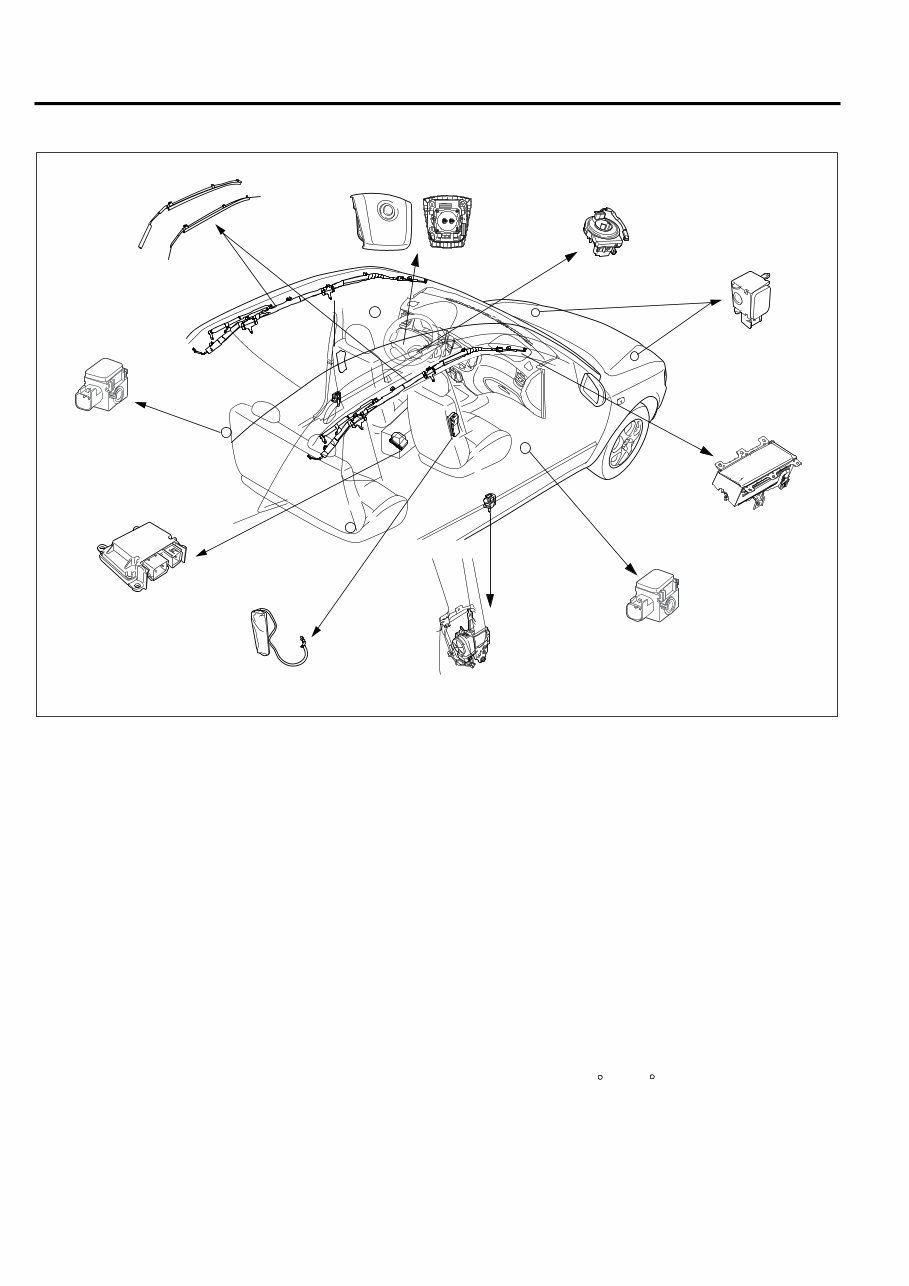
SRS AIR-BAG
The MOHAVE / BORREGO is equipped with a Supplemental Restraint System AIR-BAG to provide the vehicle's driver and/
or the front passenger with additional protection than that offered by the seat-belt system alone, in case of a frontal impact
of sufficient severity.
When handling airbag components (removal, installation or inspection, etc.), always follow the directions given in the repair
manual for the relevant model to prevent the occurrence of accidents and airbag malfunction.
Also take the following precautions when repairing the body:
1. Work must be started after approximately 30 seconds or longer from the time the ignition switch is turned to the LOCK
position and the negative (-) terminal cable is disconnected from the battery. (The airbag system is equipped with a
back-up power source so that if work is started within 30 seconds of disconnecting the negative (-) terminal cable of the
battery, the airbag may be deployed.)
When the negative(-) terminal cable is disconnected from the battery, memory of the clock and audio systems will be
cancelled. So before starting work, make a record of the contents memorized by the audio memory system. Then when
work is finished, reset the audio system as before and adjust the clock.
2. When using electric welding, first disconnect the air-bag connectors under the steering column near the MULTI-FUNCTION
SWITCH and the passenger's side crash pad before starting work.
3. Store the air-bag modules where the ambient temperature remains below 93 C (200 F ), without high humidity and
away from electrical noise.
4. WARNING/CAUTION labels are attached to the periphery of the air-bag components.
Refer to the MOHAVE / BORREGO SHOP MANUAL.
Side airbag
BHMGI6001
Clock spring
Airbag control unit
Front side impact sensor
Curtain airbag
Seat belt pretensioner
Front impact sensor
Passenger airbag
Driver airbag
Rear side
impact sensor
GENERAL INFORMATION GI-5
WELDING
All repairs in this manual require the use of a Metal-Inert Gas (MIG) welder, Gas (oxyacetylene) welding must not be used.
Both high strength steel and mild steel can be welded using the MIG welder. The I-CAR recommendations for welding should
be followed. The shielding gas should be 75% Argon and 25% CO2.
The recommended welding wire size is 0.23" and the wire should satisfy the American Welding Society standard code
AWSER70S-6.
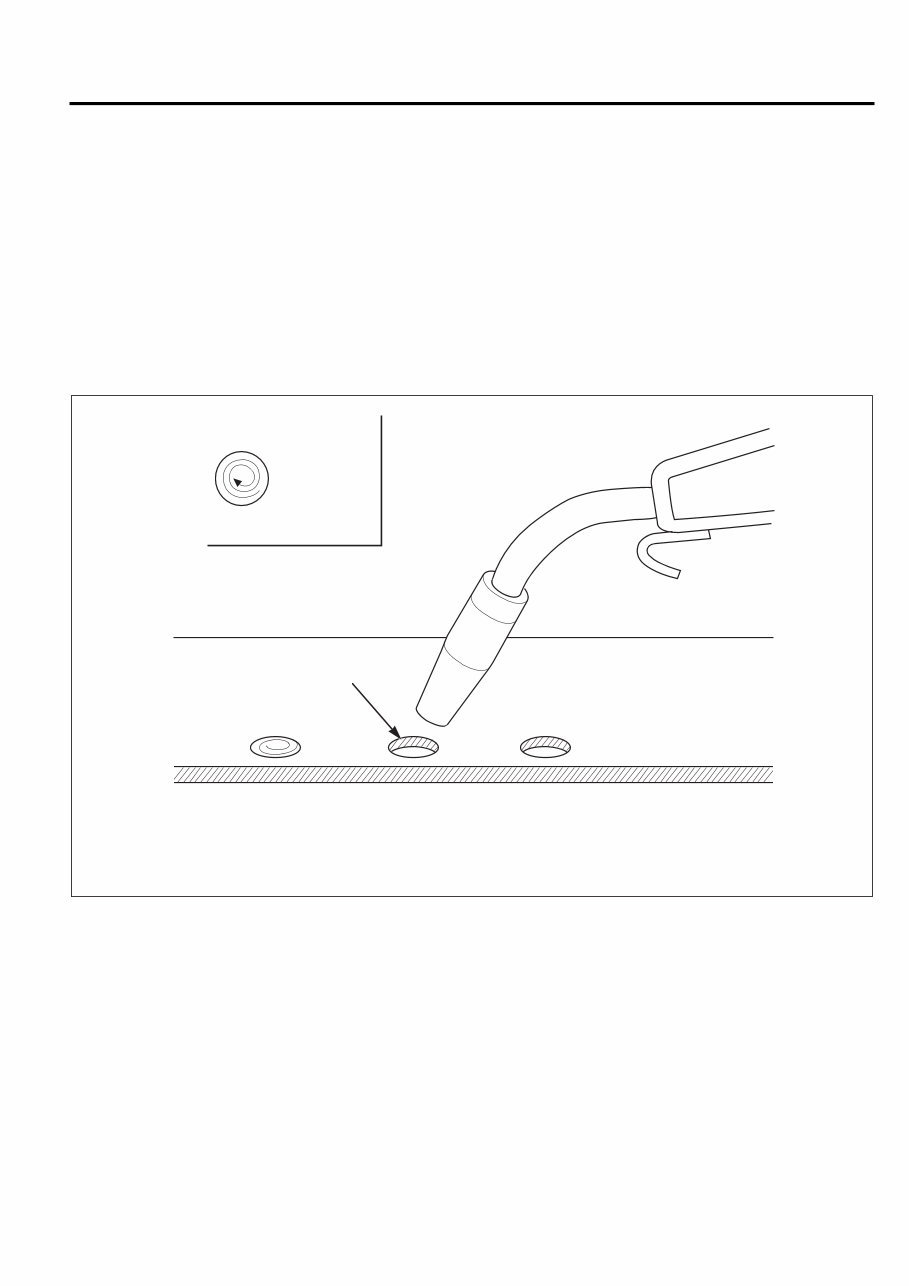
During the repair process, plug welds are used to duplicate original factory spot welds. All plug welds should be done with the
MIG welder. An 8 mm (5/16") hole is placed in the top (welding side) sheetmetal.
You then begin welding along the edges and the spiral towards the center (see illustration). This is important so that weld
penetration between the two metal pieces takes place along the circumference of the circle.
Observe the following tips when welding.
1. Wear appropriate eye protection.
2. Carefully follow the manufacturers operating instructions for the welding machine you are using.
3. Do not weld, smoke or allow open flames around volatile chemicals, cleaners or solvents or in any area where they have
just been used.
BODY FRAME STRAIGHTENER
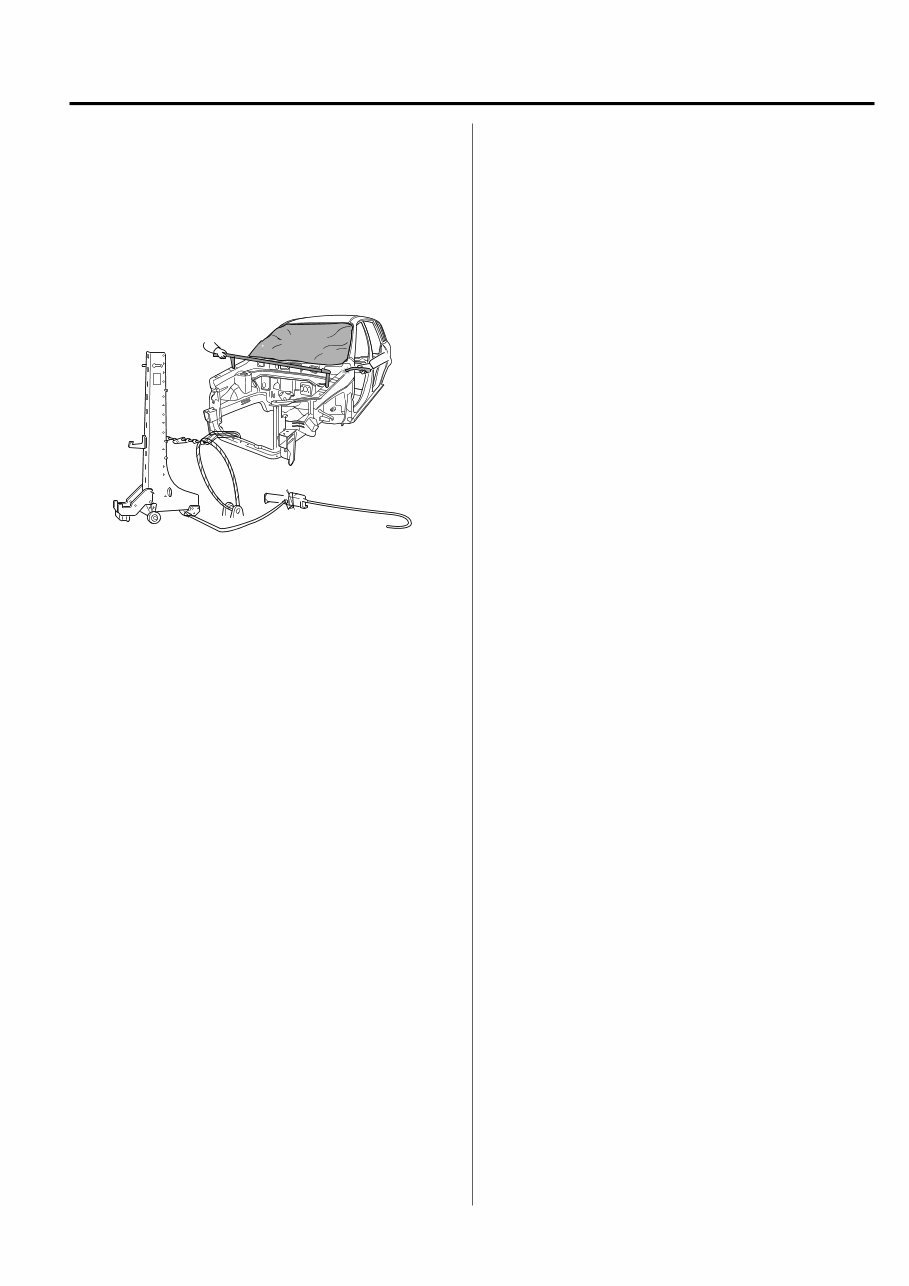
When using a frame straightener, do not enter the area where the body is being straightened by the chain.
CON-0040
Weld around
edges first
working in
towards the
center
(Top view)
PLUG WELDING
8mm or 5/16" dia. hole
Illustration-Welding in collision repair

GI-6 GENERAL INFORMATION
ELECTRONIC PARTS
Vehicles today include a great many electronic parts and
components, and these are in general very susceptible to
adverse effects caused by overcurrent, reverse current,
electromagnetic waves, high temperature, high humidity
impacts, etc.
In particular such electronic components can be damaged
if there is a large current flow during welding from the body
side.
Therefore, take the following precautions during body repair
to prevent damage to the CONTROL MODULES (ECM,
TCM, ABS CM, SRS CM, etc.)
1. Before removing and inspecting the electrical parts or
before starting electric welding operations, disconnect
the negative (-) terminal cable from the battery.
2. Do not expose the CONTROL MODULES to ambient
temperatures above 80 C (176 F ).
If it is possible the ambient temperatures may reach
80 C (176 F) or more, remove the CONTROL
MODULES from the vehicle before starting work.
3. Be careful not to drop the CONTROL MODULES and
not to apply physical shocks to them.
NOTE
GENERAL INFORMATION GI-7
FOR BEST RESULTS
REMOVAL
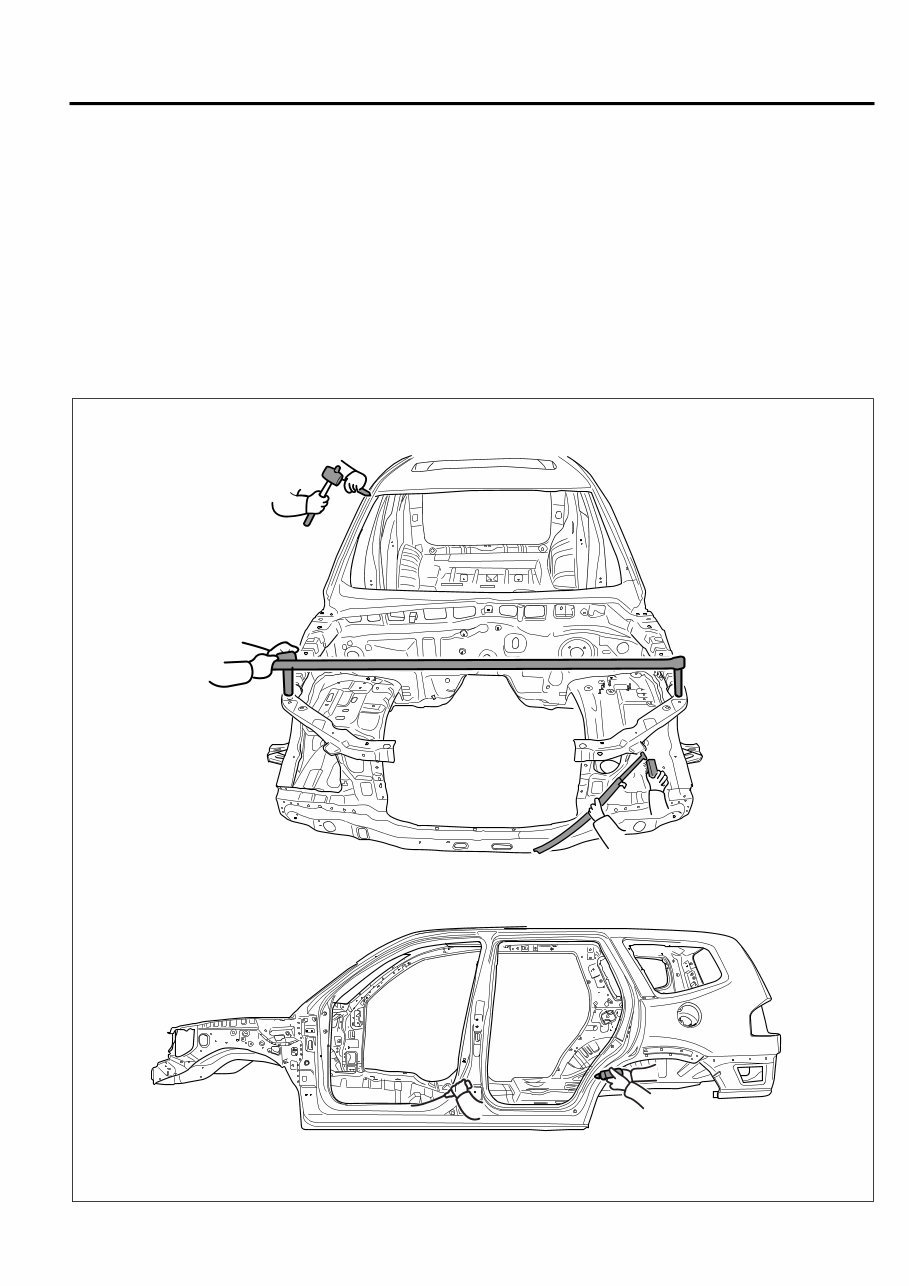
Measuring dimensions before beginning
Measure the dimensions of the damaged area according to the body dimension drawings before removing and repairing.
Adjust dimensions with body frame adjuster if deformed.
Selecting cutting area
Select a cutting area that is easily accessible and that is prone to the least amount of distortion when welding.
Select an area that would allow the new part to overlap repair area by 30~50 mm (1.2~2.0 in) .
Protecting body from damage
Secure the body with clamps and jacks to prevent damage to the body when working on it.
BHMGI6005
GI-8 GENERAL INFORMATION
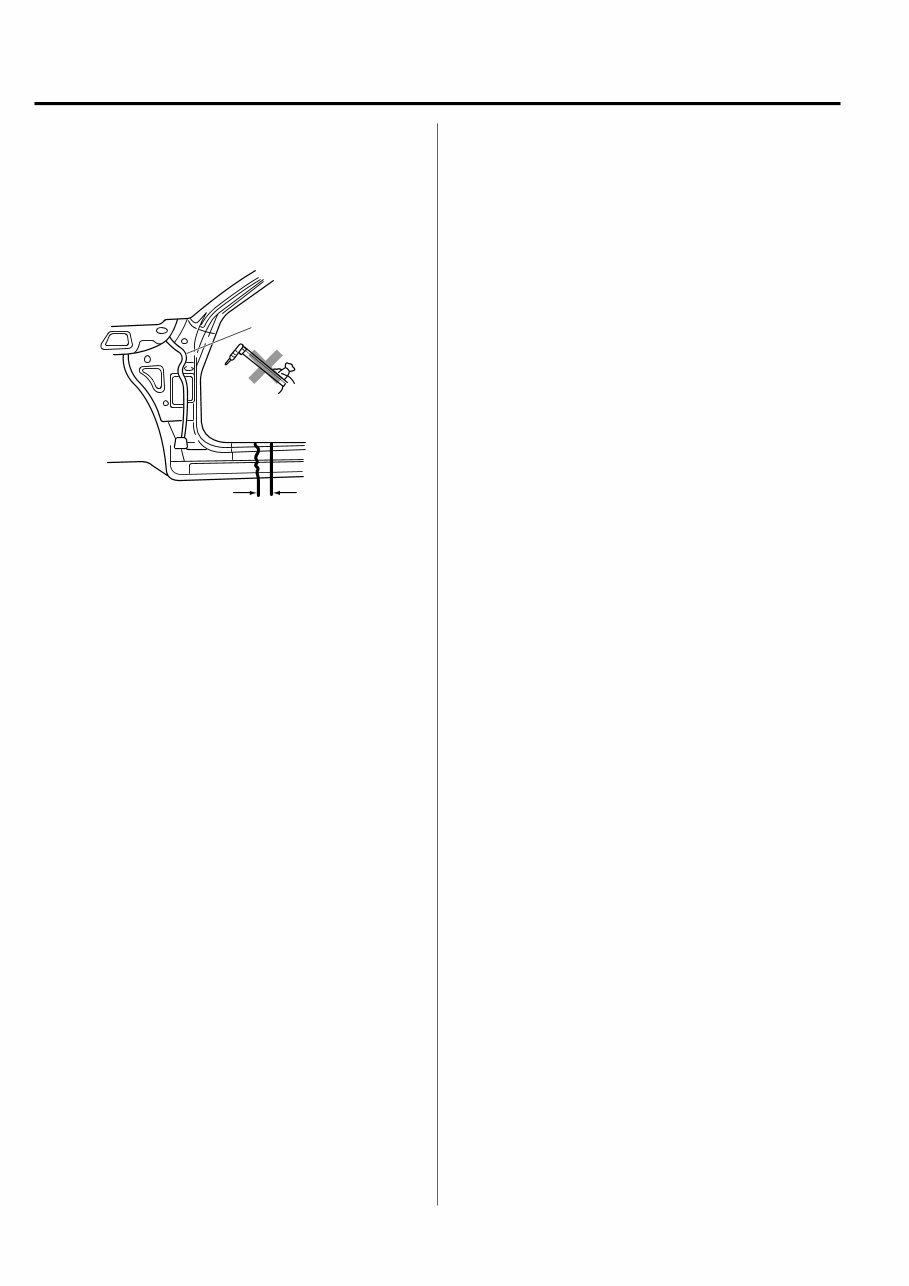
Removing
Use caution when removing body molding and trim from
the area to be worked.
Apply masking tape where needed to prevent damage to
the part being removed or to the vehicle body.
Before starting repairs, check if pipes, hoses or electrical
components are present near damaged area.
BVQGI6006
Wire harness
Repair work area Cutting area
You're Reading a Preview
What's Included?
 Lifetime Access
Fast Download Speeds
Online & Offline Access
Access PDF Contents & Bookmarks
Full Search Facility
Print one or all pages of your manual
$30.99
2009 KIA MOHAVE / BORREGO Body Service / Repair/ Workshop Manual ! 09
Viewed 43 Times Today

What's Included?
Lifetime Access
Fast Download Speeds
Online & Offline Access
Access PDF Contents & Bookmarks
Full Search Facility
Print one or all pages of your manual
$30.99

Secure transaction
What's Included?
Lifetime Access
Fast Download Speeds
Online & Offline Access
Access PDF Contents & Bookmarks
Full Search Facility
Print one or all pages of your manual
Description
This workshop manual provides comprehensive maintenance and repair procedures for the 2009 KIA MOHAVE / BORREGO Body. It is designed to assist both professional mechanics and DIY enthusiasts in servicing, diagnosing, and repairing their vehicles.
- The manual covers a wide range of topics including:
- General Information
- Body Construction
- Body Dimensions
- Body Panel Repair Procedure
- Body Sealing Locations
- Corrosion Protection
- Body Modification Tools
- Plastic Parts
Instant access to this manual eliminates shipping costs and waiting time for a physical copy. It includes step-by-step instructions, detailed exploded pictures, and diagrams to ensure correct and efficient completion of repair procedures. The manual is compatible with all versions of Windows and Mac, and is available in English language. It requires Adobe Reader and Win for viewing and printing.


